Disclosure: topratedkitchenware.com is reader-supported. When you buy through links on our site, we may earn an affiliate commission from Amazon and other retailers, at no extra cost to you.
Where to buy
The six models below are the verified picks for anyone comparing the best programmable pressure cookers. Each name links to its Amazon listing, where you can check the latest price on Amazon, confirm the current configuration, and read the newest owner feedback before you decide.
- RVGMBO 12 Quart Stainless Steel Pressure Cooker and Canner
- Peterboo 3Qt Stainless Steel Pressure Cooker
- Instant Pot Duo 6 Qt 7-in-1 Electric Pressure Cooker
- Cosori Pressure Cooker 6QT 9-in-1
- Instant Pot Duo Mini 3 Quart Electric Pressure Cooker
- Instant Pot Pro 6 Qt 10-in-1 Electric Pressure Cooker
Read the full guide ↓ for how the four genuinely programmable electrics compare in programming depth, and where the two manual stovetop alternatives honestly fit.
The best programmable pressure cookers share one defining ability: you set the pressure and the time, and the machine executes your instructions exactly, then holds the result warm until you return. Around that core, the category layers presets, delay timers, and ever-longer function lists — and the shopper’s job is to separate real programmability from button decoration. This guide does that separation with a verified pool and a clear conscience. Four of its six picks are genuinely programmable electrics, spanning the category’s real range: the benchmark Instant Pot Duo 6 Qt, the feature-rich Cosori 6QT with sous vide, the compact Instant Pot Duo Mini for small households, and the flagship Instant Pot Pro with the broadest program set here. The remaining two picks are manual stovetop cookers, included and labelled as alternatives for the many shoppers who discover, while researching programmable models, that durability and scale matter more to them than automation. Their reviews never pretend they can be programmed, because they cannot.
Why compare programming depth at all, when every electric here can pressure cook a stew? Because the differences live exactly where daily satisfaction does. A cooker whose presets you can freely override becomes an instrument you grow with; one that locks you into fixed programs becomes a vending machine for other people’s recipes. A cooker with a sane keep-warm and a usable delay option reshapes a working household’s evenings; one without them is a timer with a lid. The reviews below therefore grade each electric on the flexibility beneath its presets — manual time and pressure control, the breadth of distinct techniques it truly adds, and the quality of its supporting features — alongside the usual judgements on pot, capacity, and safety. The stovetop pair, meanwhile, are graded as pots: on steel, scale, and safety, with their manual nature stated in every badge and spec box.
You will also find a comparison table marking control types in plain language, a buying guide to reading program lists like an engineer, a technique section that teaches both programmed and manual pressure cooking with troubleshooting, and a mistakes section aimed at the specific ways programmable shoppers get fooled. If your route here began with the common misspelled search, our companion notes on Best Progammable Pressur Cookers approach the same shelf from that angle; if it began with brand prices, Best Prices On Instant Pot Pressure Cookers covers the flagship family’s pricing logic.
Key Takeaways
- Four picks here are genuinely programmable electrics — the Instant Pot Duo, Cosori 6QT, Instant Pot Duo Mini, and Instant Pot Pro — and they are the headline answers to this search.
- Two picks, the RVGMBO 12-quart and the Peterboo 3Qt, are manual stovetop cookers, badged as alternatives. They cannot be programmed; the cook is the program.
- Judge programmability by override freedom: settable time and pressure beneath the presets matters more than the preset count on the box.
- The Pro offers the broadest program set, the Cosori adds sous vide and a ceramic pot, the Duo is the balanced benchmark, and the Mini brings real programming to small kitchens.
- Keep-warm quality and a sensibly usable delay option separate programmable cookers that reshape evenings from those that merely beep.
- Check the latest price on Amazon for each pick, and buy the programming depth your cooking will actually use.
In this guide
Quick Picks
| Pick | Badge | Control type | Capacity | Link |
|---|---|---|---|---|
| Instant Pot Duo 6 Qt | Best Programmable Overall | Programmable electric, 7-in-1 | 6 Qt | Instant Pot Duo 6 Qt |
| Instant Pot Pro 6 Qt | Best for Programming Depth | Programmable electric, 10-in-1 | 6 Qt | Instant Pot Pro 6 Qt |
| Cosori Pressure Cooker 6QT | Best for Sous Vide and Easy Clean | Programmable electric, 9-in-1 | 6 Qt | Cosori Pressure Cooker 6QT |
| Instant Pot Duo Mini | Best Compact Programmable | Programmable electric, 7-in-1 | 3 Qt | Instant Pot Duo Mini |
| RVGMBO 12 Quart | Best Manual Alternative for Scale | Manual stovetop — not programmable | 12 Qt | RVGMBO 12 Quart |
| Peterboo 3Qt | Best Manual Alternative for Small Batches | Manual stovetop — not programmable | 3 Qt | Peterboo 3Qt |
Badges here reward two different virtues honestly: programming excellence among the electrics, and pot excellence among the manual alternatives. No badge crosses the line between them.
How These Picks Were Chosen
This is a research-led guide built on a verified product pool checked against Amazon’s catalogue data. Verification established each pick’s control type from the catalogue record — the step that separates the four programmable electrics from the two stovetop pots — and confirmed capacities, pot materials, and function sets exactly as listed. That discipline matters in this category more than most, because “programmable” is a word listings stretch: multi-cooker language, preset counts, and pressure “settings” on manual pots all borrow its credibility. The picks below use the word only where a machine can genuinely store and execute your time and pressure instructions.
Within the electric camp, selection spanned the meaningful range rather than duplicating it: a benchmark, a flagship, a feature-led rival, and a compact, so that programming depth can be compared across tiers and sizes. Judgement weighed override freedom first, then the distinctness of the added techniques (sous vide counts; a fifth rice-adjacent preset does not), pot material and its maintenance implications, safety systems, and ecosystem depth for spares and accessories. The stovetop alternatives were chosen for the two virtues electrics cannot match — the RVGMBO’s canner-scale capacity and the Peterboo’s safety-dense compactness — so that readers whose research converts them to manual cooking land on genuinely good pots. Long-term owner feedback patterns informed all of it: which panels stay intuitive after a year, which seals and coatings draw the recurring complaints.
No prices are printed, and no manual pot is described as programmable, timed, or automatic anywhere in this guide. Those refusals keep the advice honest in a category built on blurred language. The links lead to live listings where today’s figures wait, ready to be judged against the programming-depth framework the next sections build. Readers weighing build quality across the whole category will find Best Quality Electric Pressure Cookers a natural next read.
The Best Programmable Pressure Cookers, Reviewed
Four electrics first, graded on programming as much as on cooking. Then the two manual alternatives, graded as pots, with their nature stated plainly.

Instant Pot Duo 6 Qt 7-in-1 Electric Pressure Cooker
Badge: Best Programmable Overall
Strengths
- Honest programmability: a solid program set — pressure, slow cook, rice, steam, sauté, yogurt, warm, sterilise — with manual control beneath it for your own times and pressures.
- Stainless steel pot and the category’s deepest accessory and spares ecosystem, keeping a programmable machine serviceable for years.
- The 6-quart mainstream size means the automation serves family batches, not just sides.
Trade-offs
- No sous vide; cooks wanting it should step to the Cosori or the Pro.
- The interface is workmanlike rather than luxurious, and the flagship above it feels noticeably more refined daily.
- Sealing rings absorb strong flavours; budget a spare for varied menus.
Mini spec box
- Capacity: 6 Qt
- Control type: programmable electric, 7-in-1
- Functions: pressure cook, slow cook, rice, steam, sauté, yogurt, warm, sterilise (per listing)
- Construction: stainless steel
- Extras: companion app with a large recipe library (per listing)
The Duo is the programmable benchmark because it gets the fundamentals exactly right and charges a mainstream price for them. Its programming is the genuine article: choose a program when the food is standard, or set pressure and time yourself when it is not, and the machine executes with the quiet reliability that made this category mainstream. The program set covers the realistic week without theatre — rice that behaves, slow cooking for the days that suit it, yogurt and sterilising for the households that use them — and the stainless pot underneath it all tolerates the way families actually treat cookware. Around the machine sits the deepest support ecosystem in the category, which matters more for a programmable appliance than for any pot: when a sensor question or a seal replacement arises in year three, answers and parts are minutes away.
Its ceiling is visible only against its own family. The Pro below programmes more broadly and feels finer in the hand; the Cosori adds a technique, sous vide, that the Duo simply lacks. If neither of those gaps touches your cooking, the Duo is not the compromise choice — it is the correct one, and the money saved against the flagship buys a great deal of food to programme.
Best for: most households wanting proven, flexible programmability at family size / Not suited for: sous vide seekers or daily power users who want the flagship’s breadth and finish


Instant Pot Pro 6 Qt 10-in-1 Electric Pressure Cooker
Badge: Best for Programming Depth
Strengths
- The broadest program set in this guide: ten functions including sous vide and dedicated rice-and-grains programming.
- Flagship controls and finish that make daily programming faster to set and easier to live with.
- Stays inside the brand’s ecosystem at the family 6-quart size, so depth costs no support.
Trade-offs
- The premium tier; occasional cooks will not use enough of the depth to justify it.
- More programs mean more interface to learn before it becomes second nature.
- Its black, assertive styling dominates a counter more than the plainer models.
Mini spec box
- Capacity: 6 Qt
- Control type: programmable electric, 10-in-1
- Functions: pressure cook, slow cook, rice and grains, steam, sauté, sous vide, yogurt, warm, sterilise (per listing)
- Finish: black
The Pro is what programmability looks like at full stretch. Ten functions is a number; the substance beneath it is range — grains treated as their own discipline rather than a rice afterthought, sous vide folded into the same box that pressure cooks, and a control experience designed for people who programme something every day and notice every friction. For the daily user, those refinements compound: hundreds of cooks a year, each a few seconds smoother and a degree more precise, is a real return on the premium. The Pro also future-proofs the curious cook; techniques that are ambitions today — sous vide weekends, grain experiments — are already installed when the ambition arrives.
The discipline this guide asks of Pro buyers is honesty about frequency. Programming depth is worthless unexercised, and a twice-a-month cook will extract no more dinner from the Pro than from the Duo. Buy the flagship as a daily instrument or do not buy it at all; the middle response — buying it for someday — is how premium appliances become monuments.
Best for: daily users and technique-curious cooks who will exploit the full program range / Not suited for: occasional cooks, for whom the Duo delivers the same dinners at a kinder tier
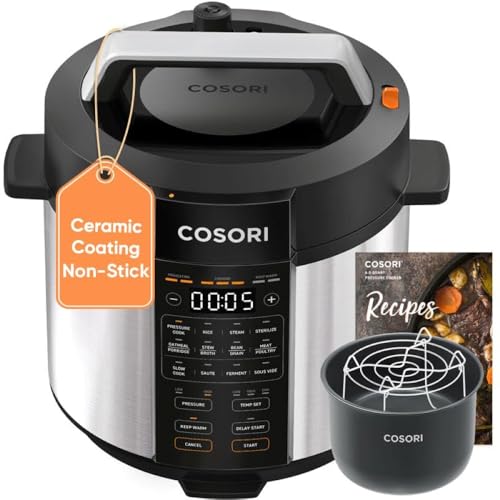
Cosori Pressure Cooker 6QT 9-in-1
Badge: Best for Sous Vide and Easy Clean
Strengths
- Programmable 9-in-1 breadth that includes sous vide at a tier where rivals often withhold it.
- Ceramic-coated pot: programmed staples like rice, grains, and porridges release cleanly and wash in moments.
- Twelve listed safety features, the strongest count among the electrics here.
Trade-offs
- The ceramic coating is a long-term wear item; stainless rivals ask less care.
- A smaller accessory ecosystem than the Instant Pot family’s.
- Powerful at 1100W, but huge frozen loads still need patience to reach pressure.
Mini spec box
- Capacity: 6 Qt
- Control type: programmable electric, 9-in-1
- Functions: pressure cook, rice cooker, slow cook, sous vide, sauté (per listing)
- Inner pot: ceramic coating
- Power: 1100W
- Safety: 12 safety features (per listing)
The Cosori’s programmable case rests on two pillars. The first is sous vide at a sensible tier: precise, gentle, set-and-forget cooking that shares the programmable philosophy — specify parameters, walk away, return to exact results — applied to a completely different technique. A cook who programmes pressure on weekdays and sous vide on weekends gets two instruments for one footprint. The second pillar is daily texture: the ceramic pot makes the sticky, starchy staples of programmed cooking — the rice cycles, the grain bowls, the morning porridge — release and rinse with an ease stainless never quite matches. Programmed cooking is repetitive cooking, and small daily frictions, removed, are worth as much as headline features.
The counterweights are known and manageable: treat the coating with wood and silicone, accept a future replacement pot as a possibility, and source spares a touch more deliberately than the biggest brand demands. For the cook whose programme library leans sticky and varied, the Cosori is not the alternative to the benchmark; it is arguably the better machine.
Best for: varied programmable cooks who want sous vide included and easy cleanup daily / Not suited for: buyers who want a coating-free pot and the deepest accessory bench

Instant Pot Duo Mini 3 Quart Electric Pressure Cooker
Badge: Best Compact Programmable
Strengths
- Full programmability — the Duo’s 7-in-1 program set with manual control — in a genuine 3-quart compact.
- Small batches pressurise fast, suiting one- and two-person programmed routines perfectly.
- The brand’s recipe and accessory support in miniature, rare at this size.
Trade-offs
- Capacity is the ceiling: no batch cooking, no entertaining, no large cuts.
- Fewer accessories exist for the 3-quart size than for the 6-quart mainstream.
- Outgrowing it is expensive; size honesty at purchase is essential.
Mini spec box
- Capacity: 3 Qt
- Control type: programmable electric, 7-in-1
- Functions: pressure cook, slow cook, rice, steam, sauté, yogurt, warm, sterilise (per listing)
- Construction: stainless steel
- Extras: companion app with a large recipe library (per listing)
Compact programmable cookers are often fraudulent compacts — small shells with their programming stripped out. The Duo Mini is the honourable exception: the same programmable system as its big sibling, scaled honestly to 3 quarts. For a single cook or a couple, that means the full automated repertoire — rice on a program while the main grills, beans set in the morning, yogurt overnight — in a machine that fits the kitchen and the appetite. Small loads also reach pressure quickly, so the Mini’s programmed cooks are brisk in a way big pots cannot match on small food. As a second cooker beside a 6-quart, it is the connoisseur’s choice for parallel sides.
The warning is the familiar one, and it is about your future rather than the machine’s quality. Households grow, habits expand, guests arrive. If any of that is plausibly yours within a couple of years, programme your life at 6 quarts from the start. If your small household is settled, the Mini is not the budget compromise of this guide; it is the size-correct flagship of a small kitchen.
Best for: singles, couples, small kitchens, and second-cooker buyers wanting real programming / Not suited for: families and batch cooks


RVGMBO 12 Quart Stainless Steel Pressure Cooker and Canner
Badge: Best Manual Alternative for Scale
Strengths
- Twelve quarts of 18/8 stainless that doubles as a pressure canner — scale the programmable electrics here cannot offer.
- One-hand locking lid, induction and gas compatibility, glass lid and steamer rack included.
- No electronics at all: decades of service with gasket changes as the only real maintenance.
Trade-offs
- NOT programmable: no programs, no timer, no keep-warm. Every variable is set and held by you at the stove.
- Large, heavy, and storage-hungry, with a burner requirement to match.
- The manual learning curve at the largest, least forgiving scale.
Mini spec box
- Capacity: 12 Qt
- Control type: manual stovetop — NOT programmable
- Material: 18/8 stainless steel
- Type: 3-in-1 stovetop pressure cooker and canner
- Compatibility: induction and gas stovetop (per listing)
- Included: glass lid, steamer rack (per listing)
The manual alternatives in this guide exist for a specific reader: the one who arrived researching programmable cookers and realised, somewhere in the comparison tables, that their binding constraint was never automation. It was volume, or permanence, or the wish to own a tool rather than an appliance. The RVGMBO is that reader’s extreme answer — a 12-quart stainless cooker-canner that will process a harvest, feed a gathering, and outlast every electronic in this guide, while offering not a single program in exchange. Its inclusion is an act of respect for that reader, and its badge is an act of respect for everyone else: it says alternative, and it says why.
If you buy it, buy it as the manual instrument it is, with a notebook for your times and heats and a commitment to canning procedure from authoritative guidance if preserving is your aim. Bought in that spirit, it may be the most satisfying object in this entire pool. Bought by mistake, expecting a panel and a beep, it would be the most bewildering — which is precisely the mistake this guide’s labelling exists to prevent.
Best for: canners, crowd-scale cooks, and durability-first buyers converting from the programmable search / Not suited for: anyone who wants a machine to run the cook unattended

Peterboo 3Qt Stainless Steel Pressure Cooker
Badge: Best Manual Alternative for Small Batches
Strengths
- Eight-plus listed safety features, the densest protection in the pool for its size.
- Stainless, induction compatible, and quick to pressure on the small loads it is built for.
- A natural companion pot: grains and sides under pressure while a main cooks elsewhere.
Trade-offs
- NOT programmable: its multi-cooker positioning describes versatility of use, not electronic programs. You operate it manually at the stove.
- Three quarts caps its world at small batches.
- Newer brand, so confirm gasket availability at purchase.
Mini spec box
- Capacity: 3 Qt
- Control type: manual stovetop — NOT programmable
- Material: stainless steel
- Safety: 8+ safety features (per listing)
- Compatibility: induction (per listing)
- Sized for: 1–2 people (per listing)
The Peterboo mirrors the Duo Mini across the camp divide: same small-batch mission, opposite philosophy. Where the Mini automates small cooking, the Peterboo armours it — eight-plus safety features around a stainless pot that asks its cook to stay present for a short, quick cook. For a beginner who finds the idea of learning pressure manually appealing but wants every modern safeguard while they learn, it is a thoughtful starting pot. For an electric owner, it is the classic satellite: the side dish under pressure on the stove while the main occupies the programmable machine.
Its labelling lesson is this guide’s in miniature. “Multi-cooker” in a listing describes the range of jobs a pot can do; “programmable” describes who runs them. The Peterboo does many jobs, and you run all of them. Stated that plainly, it is a good pot with nothing to apologise for.
Best for: small households and beginners wanting a safety-rich manual pot, or as a satellite cooker / Not suited for: shoppers who want genuine programmed automation in a compact — that is the Duo Mini
Comparison Table
| Pick | Programmable? | Capacity | Signature strength | Link |
|---|---|---|---|---|
| Instant Pot Duo | Yes | 6 Qt | Balanced benchmark, deepest ecosystem | Check on Amazon |
| Instant Pot Pro | Yes | 6 Qt | Broadest programs, flagship controls | Check on Amazon |
| Cosori 6QT | Yes | 6 Qt | Sous vide plus ceramic easy-clean | Check on Amazon |
| Instant Pot Duo Mini | Yes | 3 Qt | Real programming, compact size | Check on Amazon |
| RVGMBO 12 Quart | No — manual | 12 Qt | Canner-scale stainless durability | Check on Amazon |
| Peterboo 3Qt | No — manual | 3 Qt | Safety density in a compact pot | Check on Amazon |
Four yeses, two honest nos. That ratio is this category’s real shape — a programmable mainstream with a durable manual tradition beside it — and the table refuses to blur it for tidiness.
How to Choose: Reading Programmability Like an Engineer
Ask the override question first. For any electric: can I set the time myself, and the pressure level, independently of the named programs? If yes, it is programmable in the sense that matters. If the panel only lets you choose among fixed programs with minor tweaks, you are buying the manufacturer’s recipe book in appliance form. Both electrics from Instant Pot and the Cosori here pass the override test; it is the first thing to verify on any other model you consider.
Count distinct techniques, not presets. Pressure, slow cook, rice and grains, steam, sauté, yogurt, sous vide, sterilise: these are techniques, and each genuinely extends the machine. Presets that merely rename a technique with a food — soup, stew, beans — add convenience but not capability. The Pro’s ten and the Cosori’s nine both contain real technique breadth; that, not the numerals, is their claim.
Grade the supporting features. Keep-warm that follows automatically, a delay option you can use safely, a display you can read across a kitchen, a lid that stores sanely. Programmable cooking is a daily system, and the supporting details are where daily satisfaction hides. The mainstream of this category is compared on exactly these grounds in Best Programmable Cookers, which widens the frame beyond pressure.
Match depth to frequency. Daily programmers should buy depth — the Pro’s breadth or the Cosori’s range will repay them. Weekly programmers should buy the benchmark and bank the difference. And cooks whose research has quietly converted them to steel should follow that instinct to the alternatives without a backward glance; a manual pot used joyfully beats a programmable flagship used resentfully, every week of its longer life.
How to Cook With a Programmable Pressure Cooker
- Start with the water test. One short programmed cycle with plain water teaches the panel, the valve, the sounds, and the release behaviour of your exact model.
- Programme in layers. Sauté first for browning, then set the pressure program; the machine cannot brown under pressure, and sequencing is the cook’s remaining craft.
- Override deliberately. Begin with a preset, taste the result, then adjust time manually next cook and note it. Your overrides, accumulated, become your personal program library.
- Use keep-warm as a tool, not a habit. It is perfect for stews and grains, unkind to delicate vegetables and seafood left sitting. Cancel it when the food would suffer.
- Respect delay-start safety. Programme ahead only with foods that tolerate waiting at room temperature — dried beans, grains, sturdy vegetables — and keep raw proteins out of long delays.
- Maintain the seal. Rinse lid and ring, check the valve, store ajar. Programmes execute perfectly only in a machine that seals perfectly.
Troubleshooting
Problem: the cooker counts down before reaching pressure or shows a burn notice → food has stuck to the base or liquid is too thick at the bottom; deglaze after sautéing, layer sauces on top, and add thin liquid before sealing.
Problem: a program finishes but food is underdone → the preset’s time did not fit your ingredient or altitude; switch to manual time, add the difference, and record the correction against that preset for your kitchen.
Problem: steam leaks from the lid rim during a programmed cook → stop the program, let pressure fall, and reseat or replace the sealing ring; a programmable machine with a tired seal is just a pot with opinions.
Programming Depth, Compared Honestly
It is worth stating the four electrics’ hierarchy in one place, because their differences are real but easy to exaggerate. The Mini and the Duo share a programming generation: the same core set, the same logic, differing in size and in the Mini’s briskness with small loads. Choosing between them is purely a capacity decision. The Cosori steps sideways rather than up: comparable depth, a different centre of gravity — sous vide breadth and ceramic convenience against the Duo’s steel and ecosystem. Choosing between them is a cooking-style decision. The Pro steps genuinely up: broader techniques, grains treated seriously, and a control experience refined for daily use. Choosing it over the Duo is a frequency decision — worth it for the daily programmer, wasted on the weekly one. No step in this hierarchy changes the fundamental physics of what pressure does to food. Beans cooked on the Mini’s program and beans cooked on the Pro’s are the same beans. What the money buys, step by step, is range, refinement, and fit — which is why this guide keeps returning you to your own cooking as the deciding instrument, rather than to any ranking printed here.
Altitude: The Variable Every Preset Forgets
Presets are calibrated near sea level, and altitude quietly rewrites their maths. Higher elevation means lower boiling points and a thinner atmosphere pressing back against the cooker, so pressure cooking at altitude takes longer — modestly for vegetables, substantially for dried beans and large, dense cuts — and can need a little more liquid. The practical consequence for programmable shoppers is specific: the override freedom this guide keeps praising is not a luxury feature, it is the altitude feature. A cooker that lets you extend a preset’s time becomes your local instrument; one that locks its programs asks you to run cycles twice and guess. If you live well above sea level, treat manual adjustability as a hard requirement, start your notebook with altitude corrections from the first cook, and expect beans to be your strictest teacher.
The manual alternatives meet the same physics from the other side. A stovetop pot’s working pressure is set by its regulator, and the high-altitude stovetop cook adjusts time and sometimes liquid in exactly the same spirit, guided by the notebook rather than the panel. Neither camp is altitude-proof; both are altitude-manageable in informed hands. What altitude punishes is blind trust — in a preset, in a recipe’s printed time, in a guide’s generic numbers. This guide’s timings are deliberately expressed as methods rather than absolutes for exactly that reason, and your kitchen’s elevation is one more reason to cook a forgiving first dish and write down what actually happened.
The Two-Cooker Programmable Kitchen
Once a household commits to programmable pressure cooking, a pattern emerges that this pool is unusually well shaped to serve: the second cooker. A 6-quart main machine — the Duo, the Pro, or the Cosori — handles the centre of dinner, while a compact second machine runs the supporting course in parallel: rice in the Mini while the main braises, vegetables steamed in the small pot while the big one slow cooks. Parallel pressure cooking changes weeknight logistics more than any single feature upgrade, because the bottleneck in most kitchens is not capacity but sequencing. The Duo Mini exists in this guide partly for that role, and its programmability is the point: a satellite that also runs itself keeps the whole system unattended, which a manual satellite — however good as a pot — cannot do.
The economics deserve a word, because two machines sound extravagant until they are compared with the alternative: one flagship stretched across every job, queuing dishes that wanted to cook simultaneously. A benchmark main plus a compact satellite frequently costs less, in total, than the single premium machine it outperforms in real evening logistics — and each machine works within its ideal load range instead of compromising. Buy the main first, live with it for a season, and let genuine sequencing pain, not speculation, justify the satellite. When the pain is real, you will know exactly which compact to add, and this guide’s Mini review will be waiting.
Energy, Noise, and the Small Print of Electric Cooking
Programmable electrics bring practical characteristics that rarely headline a review but shape ownership. Energy use is a genuine virtue: a sealed, insulated electric cooker is among the most efficient ways to cook a stew or a batch of beans, drawing modest power for a shorter time than an oven or a hob-simmered pot, and heating the kitchen far less in summer. Noise is another quiet win — a faint valve hiss at release is the loudest moment of most cooks, which matters in open-plan homes and around sleeping children in a way stovetop pots, with their rhythmic regulator chatter, cannot always match. Counter footprint and cord management are the corresponding small print: these are appliances that live out or demand real cupboard space, their lids open tall under cabinets, and their keep-warm convenience tempts owners to leave them plugged in and resident. None of this is hidden cost exactly, but all of it belongs in a complete decision.
Set against it, the manual alternatives’ small print is equally real: burner occupancy for the cook’s duration, a watchful presence in the kitchen, and storage for pots that are honest cookware-sized objects. The two camps do not differ in whether they impose on a household; they differ in the currency — counter space and electricity on one side, attention and hob time on the other. Mature buying consists of choosing your currency deliberately, which is why this guide has refused, from its first paragraph, to let either camp borrow the other’s language.
Recipe Ecosystems: The Invisible Program Library
One asset never appears in a spec box, yet it shapes programmable ownership as much as any button: the recipe ecosystem written for your machine. A programmable cooker’s real program library is not the presets on its panel; it is the accumulated body of recipes, timing charts, and troubleshooting notes that owners of that model have published and refined. The Instant Pot models in this guide sit at the centre of the largest such ecosystem in the category — their listings themselves point to companion apps with extensive recipe libraries — which means a Duo or Pro owner who meets a new ingredient can find a tested time for that exact machine in moments. The Cosori’s ecosystem is smaller but real and growing, and its owner’s task is correspondingly a little more translational: adapting timings from the category’s common stock, which experienced cooks do without thinking and beginners learn within a few cooks.
Weigh this honestly in your choice. A first-time pressure cook benefits disproportionately from the deepest ecosystem, because their first season is a sequence of small questions — how long for these beans, this grain, this cut — and each answered question keeps the machine in use and the habit forming. A confident cook who already owns a notebook of timings carries their ecosystem with them and can buy on hardware alone. This is the same infrastructure logic this series applies to accessories and spare parts, extended to knowledge — and it is why the benchmark, rather than the most exotic machine, so often earns the best-first-buy recommendation in programmable categories.
Common Buying Mistakes
- Buying presets instead of programmability. Verify manual time and pressure override before any preset count impresses you.
- Assuming “multi-cooker” means programmable. The Peterboo in this very pool is a manual stovetop pot with multi-cooker positioning. Read control types, not adjectives.
- Paying flagship depth for weekly use. Programming breadth only repays daily cooks. Match the tier to your frequency.
- Ignoring keep-warm and delay behaviour. These supporting features shape daily life more than a tenth program ever will. Check how they engage and whether they can be cancelled.
- Delay-starting unsafe loads. Raw meat waiting hours in a warm pot is a safety failure disguised as convenience. Programme ahead only with suitable foods.
- Forgetting the seal. Every programmable virtue depends on a sound sealing ring. Maintain it, spare it, replace it on schedule.
Final Recommendation
For most buyers, the Instant Pot Duo 6 Qt remains the programmable benchmark: flexible, proven, and supported like nothing else in the category. Daily power users should step up to the Instant Pot Pro, and cooks who prize sous vide and easy cleanup should take the Cosori seriously as the better-balanced machine for their style. Small households get the real thing in the Duo Mini. And if your research has converted you to steel and scale, the RVGMBO waits — manual, massive, and magnificent at its own game. Decide by override freedom and frequency of use, check the live price, and programme your first water test the day it arrives.
Frequently Asked Questions
What makes a pressure cooker “programmable”?
The ability to set cooking pressure and time yourself and have the machine execute them automatically, usually alongside built-in programs for common foods, automatic keep-warm, and sometimes a delay start. A cooker with only fixed presets and no manual override is only partly programmable; a stovetop pot, however refined, is not programmable at all.
Which picks here are not programmable?
Two: the RVGMBO 12-quart and the Peterboo 3Qt, both manual stovetop cookers. They are included as alternatives for shoppers whose real priorities turn out to be scale, durability, or manual control, and they are labelled as not programmable in their badges, spec boxes, and this answer.
Is the Pro worth it over the Duo?
For daily users, yes: broader techniques including sous vide and grains specialisation, plus a more refined control experience, repay the premium across hundreds of cooks. For weekly users, no: the Duo programmes everything they will actually cook, and the saving is better spent on ingredients and a spare ring.
Cosori or Instant Pot for a first programmable cooker?
Both are sound first machines. Choose the Cosori if sous vide appeals and you value the ceramic pot’s easy cleanup; choose the Duo if you want the largest recipe and accessory ecosystem behind you while you learn. Either way, run the water test, cook something forgiving first, and keep notes from day one.
Can I leave a programmable cooker alone?
That is its design purpose: once sealed and started, a programmable electric manages pressure, timing, and the switch to keep-warm without supervision. Sensible limits apply — keep the area around the steam release clear, do not delay-start perishable loads, and be home for the first few cooks while you learn your model’s behaviour. After that apprenticeship, the machine’s unattended reliability is precisely what you paid for, and you should use it without a second thought: load it, programme it, and let dinner be the thing in your day that simply handles itself.
Should I buy a second, smaller programmable cooker?
If sequencing is your bottleneck — a main and a side that both want pressure at the same hour — a compact second machine like the Duo Mini transforms weeknight logistics more than upgrading your main cooker would. Buy the main cooker first and live with it for a season. If you repeatedly find yourself waiting for the pot to free up, the satellite purchase has justified itself with evidence. If you do not, you have saved the money and the counter space, and the single machine was the right fleet all along.
What is the best first dish to programme?
Something forgiving that teaches the machine’s character: a bean soup, a lentil stew, or a batch of dried beans. These tolerate timing experiments, demonstrate the ramp to pressure and the release options, and produce a good dinner even when your first settings are imperfect. Avoid delicate fish, quick vegetables, and anything foamy or precious until the water test and a couple of forgiving cooks have taught you how your model behaves in your kitchen, at your altitude, with your ingredients.
Do programmable cookers need special maintenance?
The same seal discipline as any pressure cooker — lid and ring rinsed, valve checked, ring replaced when it stretches or cracks — plus ordinary appliance care for the housing and panel. There are no user-serviceable electronics inside, which is exactly why the manual alternatives outlive them; maintain what you can, and the machine will serve for years.