Disclosure: topratedkitchenware.com is reader-supported. When you buy through links on our site, we may earn an affiliate commission from Amazon and other retailers, at no extra cost to you.
Where to buy
The six models below are the verified picks for anyone comparing the best quality electric pressure cookers. Each name links to its Amazon listing, where you can check the latest price on Amazon, confirm the current configuration, and read the newest owner feedback before you decide.
- Instant Pot Duo 6 Qt 7-in-1 Electric Pressure Cooker
- Cosori Pressure Cooker 6QT 9-in-1
- Instant Pot Duo Mini 3 Quart Electric Pressure Cooker
- Instant Pot Pro 6 Qt 10-in-1 Electric Pressure Cooker
- Sweetcrispy 16-in-1 Electric Pressure Cooker 8QT
- Instant Pot Duo Plus 6 Qt 9-in-1 Electric Pressure Cooker
Read the full guide ↓ for what quality actually consists of in an electric pressure cooker, which builds deliver it, and which corners reveal themselves only after a year of ownership.
Quality in an electric pressure cooker is not a mystery, but it is widely misdescribed. It is not the preset count, which is software. It is not the finish alone, though finish hints at it. Quality in this category is a stack of physical and organisational facts: a pot made from material that will look and cook the same in five years; a sealing system engineered in layers and supported with spare parts; heating and sensors that hold their calibration; controls that survive daily thumbs; and a manufacturer whose support, accessories, and documentation will still exist when you need them. The best quality electric pressure cookers are the ones that stack those facts highest, and this guide’s six verified picks were chosen and ordered on exactly that basis — from the flagship Instant Pot Pro, through the benchmark Duo and its Plus sibling, the feature-rich Cosori, and the compact Duo Mini, to the big Sweetcrispy, whose quality case is newer and is assessed with the candour a newer record deserves.
A note on the pool’s shape, because it is itself a quality finding: four of the six picks come from one brand family. That is not favouritism; it is what a quality-filtered pool looks like in a category where one maker has spent years compounding the unglamorous virtues — parts pipelines, accessory depth, documentation, a vast base of long-term owner evidence — that quality is actually made of. The two outsiders earn their places on merit: the Cosori, whose safety count and ceramic pot represent a genuinely different quality philosophy executed well, and the Sweetcrispy, whose 8-quart capacity brings family-scale electric cooking to households the mainstream sizes underserve. Both are judged by the same stack of facts, and their reviews state plainly where their records are thinner, because a quality guide that will not discuss evidence depth is not a quality guide.
What follows is a full framework before it is a ranking: how these picks were chosen, detailed reviews with strengths and trade-offs for each, a comparison table, a buying guide that teaches you to inspect quality in any listing — including the wider world of Best Quality Range Cookers, where similar material logic applies at larger scale — a care and technique section aimed at making quality last, and the mistakes that lead buyers to purchase the appearance of quality instead of the thing itself.
Key Takeaways
- Quality in an electric pressure cooker is a stack: pot material, layered safety, sensor and heating consistency, control durability, and the manufacturer’s parts and support ecosystem.
- Stainless steel pots are the longevity benchmark; a good ceramic coating trades some lifespan for daily ease. Choose by your habits.
- The Instant Pot Pro tops this pool on overall quality; the Duo is the benchmark where quality and value balance; the Duo Plus and Cosori contest the step between.
- Safety systems are a quality signal you can count: the Cosori lists twelve safety features, and layered protection distinguishes serious builds at every tier.
- Parts availability is quality over time. A cooker whose ring and pot are replaceable in year five is a higher-quality purchase than a sealed bargain.
- Check the latest price on Amazon for each pick, and judge the figure against years of expected service, not against the cheapest ticket in the category.
In this guide
Quick Picks
| Pick | Badge | Capacity | Quality signature | Link |
|---|---|---|---|---|
| Instant Pot Pro 6 Qt | Best Overall Quality | 6 Qt | Flagship build, broadest programs | Instant Pot Pro 6 Qt |
| Instant Pot Duo 6 Qt | Best Quality Benchmark | 6 Qt | Proven stainless platform, deepest support | Instant Pot Duo 6 Qt |
| Instant Pot Duo Plus 6 Qt | Best Quality Mid-Range | 6 Qt | Benchmark platform, broader programs | Instant Pot Duo Plus 6 Qt |
| Cosori Pressure Cooker 6QT | Best Quality Feature Set | 6 Qt | 12 safety features, ceramic pot, sous vide | Cosori Pressure Cooker 6QT |
| Sweetcrispy 16-in-1 8QT | Best Quality Big Capacity | 8 Qt | Family scale, ceramic pot, generous bundle | Sweetcrispy 16-in-1 8QT |
| Instant Pot Duo Mini | Best Compact Quality | 3 Qt | Full quality stack, honestly shrunk | Instant Pot Duo Mini |
The badges rank quality within roles, not price. Note that the benchmark badge may matter more to most buyers than the flagship one: quality you can afford, supported for years, is the category’s real sweet spot.
How These Picks Were Chosen
This is a research-led guide built on a verified product pool checked against Amazon’s catalogue data. Every pick was confirmed as a genuine electric pressure cooker, with its materials, functions, and safety claims taken from the catalogue record. Quality assessment then proceeded on evidence rather than aura. Verified specifications anchored the physical side — pot materials, capacities, wattage where listed, safety feature counts where stated. Manufacturer documentation and the structure of each brand’s support ecosystem anchored the organisational side. And the accumulated pattern of long-term owner feedback anchored the judgement that matters most: which machines are still sealing, still accurate, and still loved after years of weekly use, and which begin shedding parts, coatings, and goodwill in year two.
Two quality traps were deliberately avoided. The first is novelty bias: the newest model is not the highest-quality model until time says so, which is why proven platforms anchor this guide and the newest entrant, the Sweetcrispy, is recommended with its shorter record stated openly. The second is feature inflation: program counts were treated as software, weighed lightly, while pot material, safety architecture, and parts depth were weighed heavily, because those are the attributes an owner lives with after the unboxing week. Where a listing did not state a specification, this guide leaves it unstated rather than borrowing the class average — the same discipline applied in the neighbouring quick-cooking category surveyed in Best Quick Cookers.
No prices are printed, because they move and because quality advice anchored to a stale figure rots with it. The links lead to live listings; judge today’s number against the service life each review describes. That ratio — price divided by honest years — is the only arithmetic this guide ultimately recommends, here and across quality-led categories generally, including the range-cooker market outlined in Best Range Cookers Uk for readers furnishing a whole kitchen at once.
The 6 Best Quality Electric Pressure Cookers
Ordered by the quality stack as defined above: build, safety, support, and record. Every review names its pick’s quality compromise as plainly as its quality claim.

Instant Pot Pro 6 Qt 10-in-1 Electric Pressure Cooker
Badge: Best Overall Quality
Strengths
- The most complete quality stack in the pool: flagship construction and controls, the broadest program set, and the brand’s full support ecosystem behind it.
- Ten functions including sous vide and dedicated grains programming, executed on the proven 6-quart platform.
- Fit and finish that daily users feel: this is the machine in the pool built to be used hard, every day, for years.
Trade-offs
- The premium tier; its quality is real but priced, and occasional users will not amortise it.
- More interface to learn than the simpler models.
- Its black finish shows its working life more honestly than plainer housings.
Mini spec box
- Capacity: 6 Qt
- Functions: 10-in-1 — pressure cook, slow cook, rice and grains, steam, sauté, sous vide, yogurt, warm, sterilise (per listing)
- Finish: black
- Brand support: full Instant Pot ecosystem
Quality, at the top of a category, looks like the absence of weak layers, and that is the Pro’s case. Its program breadth is the visible part — grains treated as a discipline, sous vide included, the full mainstream repertoire — but the deeper quality is coherence: controls that match the machine’s ambitions, a platform size with total accessory coverage, and a manufacturer whose documentation, parts, and community knowledge form the category’s reference library. An owner who meets any question in year four — a seal, a setting, a technique — finds it answered. That organisational depth is unglamorous and decisive, and it is why the flagship, rather than any cheaper sibling, takes this guide’s quality crown.
The honest caveat is utilisation. Quality this complete is wasted on a cooker used monthly, not because the machine objects but because the premium never converts into lived value. The Pro is the right purchase for the household that will run it several times a week for years — the exact usage pattern its build anticipates. Bought into that life, it is the easiest recommendation in this guide. Bought as a trophy, it is an expensive one.
Best for: daily users who want the category’s most complete quality stack in one machine / Not suited for: occasional cooks, who should take the benchmark below and bank the difference

Instant Pot Duo 6 Qt 7-in-1 Electric Pressure Cooker
Badge: Best Quality Benchmark
Strengths
- A stainless steel pot on a proven platform: the material and the design with the longest quality record in the pool.
- The deepest parts and accessory ecosystem in the category, which is quality expressed over time.
- Seven functions covering the realistic week, with manual control beneath the programs.
Trade-offs
- No sous vide, and plainer controls than the flagship.
- The sealing ring’s flavour absorption requires the spare-ring habit for varied menus.
- So widely sold that bundles vary; verify box contents on the listing.
Mini spec box
- Capacity: 6 Qt
- Functions: 7-in-1 — pressure cook, slow cook, rice, steam, sauté, yogurt, warm, sterilise (per listing)
- Construction: stainless steel
- Extras: companion app with a large recipe library (per listing)
If the Pro is quality at full stretch, the Duo is quality at its most proven. Its stainless pot is the single most quality-determinative component in any electric cooker — the part that meets food, heat, and scrubbing daily — and stainless is the material with nothing to wear off. Its platform has accumulated the longest owner record in the category, which in quality terms is evidence no launch specification can imitate: millions of cooks, years of seals and cycles, and a failure literature so well documented that every weakness is known, minor, and manageable. And its ecosystem means the machine’s quality is maintainable — rings, pots, lids, and answers, all in permanent supply. For most households, this combination is not the budget version of quality. It is quality, at the point where the curve of diminishing returns bends.
Choose the Duo when your quality priorities are material and longevity, and the flagship’s extra techniques leave you cold. Its compromises are refinements forgone, not substance — a distinction this guide regards as the mark of a benchmark.
Best for: most households, as the proven quality purchase of the category / Not suited for: sous vide seekers and daily power users who will genuinely use the Pro’s breadth

Instant Pot Duo Plus 6 Qt 9-in-1 Electric Pressure Cooker
Badge: Best Quality Mid-Range
Strengths
- The benchmark’s stainless platform and ecosystem, with a broader nine-function program set.
- Quality where it compounds: same maintainable build, more weekly techniques covered.
- A measured step up that keeps every ownership advantage of the Duo.
Trade-offs
- Incremental rather than transformational over the Duo; the step must be priced, not assumed.
- Still no sous vide at this rung.
- Shares the family ring-flavour quirk.
Mini spec box
- Capacity: 6 Qt
- Functions: 9-in-1 — pressure cook, slow cook, rice, yogurt, steam, sauté, warm, sterilise (per listing)
- Construction: stainless steel
- Extras: companion app with a large recipe library (per listing)
The Duo Plus is the quality ladder’s sensible middle rung: everything that makes the Duo a benchmark — stainless pot, proven platform, total ecosystem — with two more functions’ worth of weekly breadth. In quality terms, its argument is that breadth, exercised, is a form of durability: a machine that covers more of your cooking stays central to your kitchen, gets maintained, gets its ring replaced on time, and earns its counter space for a decade. Appliances die of disuse and neglect as often as of failure, and the Plus’s extra coverage is insurance against both.
Its buying discipline is spacing. When the Plus’s live price sits a modest step above the Duo’s, it is the quality buy for regular cooks. When the gap widens toward the Pro, the flagship’s completeness argues back. Ladder logic, applied with today’s numbers, decides — which is why this guide gives you the ladder and the links rather than a frozen verdict.
Best for: regular cooks who want benchmark quality with broader weekly coverage / Not suited for: buyers on a day when its price crowds the Pro’s, or minimalists happy with the Duo’s seven
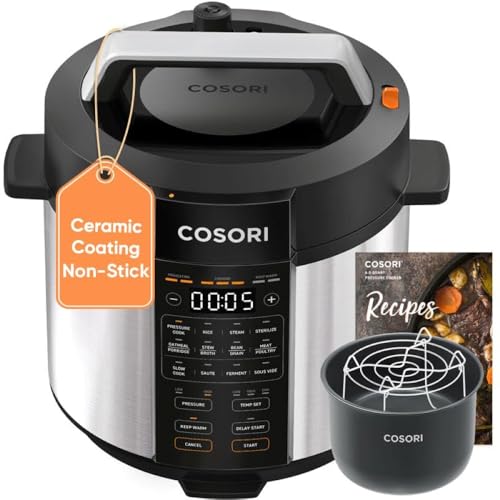
Cosori Pressure Cooker 6QT 9-in-1
Badge: Best Quality Feature Set
Strengths
- Twelve listed safety features — the strongest explicit safety architecture among these electrics, and safety is quality’s foundation.
- A quality feature set with real substance: sous vide joins pressure, rice, slow cook, and sauté at 1100W.
- The ceramic-coated pot delivers daily ease that keeps the machine in constant, satisfying use.
Trade-offs
- The coating is the quality compromise: superb daily, finite over years, where stainless is effectively permanent.
- Accessory and parts depth trails the leading brand’s.
- The stainless exterior needs wiping to keep its looks.
Mini spec box
- Capacity: 6 Qt
- Functions: 9-in-1 — pressure cook, rice cooker, slow cook, sous vide, sauté (per listing)
- Inner pot: ceramic coating
- Power: 1100W
- Safety: 12 safety features (per listing)
The Cosori represents a different quality philosophy, executed seriously. Where the Instant Pot family stakes quality on material permanence and ecosystem, Cosori stakes it on safety architecture and daily experience: a dozen named safety features, a function set whose every entry is a real technique, and a pot surface engineered for the way programmed staples actually behave. There is a respectable argument that this is the more modern definition — quality as the total of protection, precision, and pleasure in daily use — and the Cosori makes it as well as any machine in the pool. Owners who cook sticky, varied, frequent menus often find it the most satisfying machine here, which is itself a quality outcome: satisfaction is what keeps a cooker maintained and central for years.
The counterargument is time. A coating, however good, is a surface with a lifespan, and the Cosori’s quality story therefore includes a probable replacement pot in its middle years — a cost and a errand the stainless picks never impose. Weigh your horizon and your habits. Gentle hands and a five-year view favour the Cosori’s daily excellence. Rough handling and a decade’s ambition favour steel. Quality, honestly, is fit between machine and owner, and this pick is the guide’s clearest illustration.
Best for: safety-conscious, varied cooks who value sous vide and easy daily cleanup / Not suited for: buy-for-a-decade minimalists who want a coating-free, all-steel pot

Sweetcrispy 16-in-1 Electric Pressure Cooker 8QT
Badge: Best Quality Big Capacity
Strengths
- Eight quarts of electric capacity — the only family-scale-plus option in this quality pool — with a ceramic pot.
- A generous out-of-box package: 12 presets across its program set and a recipe book included.
- Broad weekly coverage — slow cook, rice, steaming, sauté, soup, yogurt — so the big machine earns its footprint.
Trade-offs
- The quality record is young: a newer brand without the leaders’ decade of owner evidence or parts depth, and this guide weights that honestly.
- The 16-in-1 headline counts stored timings generously; judge the machine on capacity, pot, and build.
- Ceramic pot care rules apply, at the largest and heaviest size in the pool.
Mini spec box
- Capacity: 8 Qt
- Functions: 16-in-1 with 12 presets — slow cook, rice, steamer, sauté, soup, yogurt maker and more (per listing)
- Inner pot: ceramic pot
- Included: recipe book (per listing)
- Record note: newer brand; long-term evidence still accumulating
The Sweetcrispy’s quality case is narrower and more specific than the others, and this review will not inflate it. What it offers is genuine: the pool’s only 8-quart electric, a ceramic pot suited to big sticky batches, a broad program set, and a bundle that starts a large family cooking on day one. For a household whose quality requirement is headed by capacity — where a 6-quart machine, however proven, simply fails the workload — the Sweetcrispy is not a compromise but the answer, and its build, as far as its record extends, is respectable.
Where candour is required is the record’s length. Quality in this guide is substantially a claim about time, and the Sweetcrispy has had less of it: fewer years of owner evidence, a thinner parts pipeline to verify, an ecosystem still forming. The prudent buyer responds not by refusing the machine but by diligence — confirm the spare ring and pot are orderable today, register the product, keep the documentation — converting unknowns into managed risks. Bought that way, by a household that truly needs its quarts, it is a defensible quality purchase. Bought casually as a like-for-like substitute for the proven platforms, at a size you do not need, it is the pool’s weakest quality logic.
Best for: large families whose quality brief starts with genuine 8-quart electric capacity / Not suited for: buyers who prioritise a long-proven record and deep parts support over size

Instant Pot Duo Mini 3 Quart Electric Pressure Cooker
Badge: Best Compact Quality
Strengths
- The full quality stack — stainless pot, proven platform, brand ecosystem — scaled honestly to 3 quarts.
- Small loads reach pressure quickly and cook efficiently, a genuine quality for small households.
- As a second cooker, it brings benchmark quality to the satellite role.
Trade-offs
- Capacity caps its world at small-batch cooking.
- The 3-quart accessory range is narrower than the 6-quart’s.
- Quality per quart costs more at this size, as with all compacts.
Mini spec box
- Capacity: 3 Qt
- Functions: 7-in-1 — pressure cook, slow cook, rice, steam, sauté, yogurt, warm, sterilise (per listing)
- Construction: stainless steel
- Extras: companion app with a large recipe library (per listing)
Compact appliances are where quality usually goes to be negotiated away, which is why the Duo Mini closes this guide as a small exemplar. It keeps the benchmark’s defining quality decisions — the stainless pot, the full function set, the ecosystem — and changes only the volume. The result is a machine whose quality needs no asterisk for its size, serving singles and couples with the same material integrity as the family models, and serving larger households as the quality satellite beside a 6-quart main. In a category full of cute compromises, that integrity is rarer than it should be.
Its single quality-adjacent risk is fit: a household that outgrows 3 quarts will replace the machine early, and no build quality survives being the wrong size. Buy it for a settled small household or a defined satellite role, and it is among the soundest quality purchases in this entire pool.
Best for: small households and second-cooker buyers who refuse to compromise on build quality / Not suited for: families and batch cooks, whatever the build
Comparison Table
| Pick | Capacity | Pot | Quality centre of gravity | Link |
|---|---|---|---|---|
| Instant Pot Pro | 6 Qt | Stainless platform (brand) | Completeness: build, breadth, support | Check on Amazon |
| Instant Pot Duo | 6 Qt | Stainless steel | Proven longevity and ecosystem | Check on Amazon |
| Instant Pot Duo Plus | 6 Qt | Stainless steel | Benchmark build, broader coverage | Check on Amazon |
| Cosori 6QT | 6 Qt | Ceramic coating | Safety architecture and daily ease | Check on Amazon |
| Sweetcrispy 8QT | 8 Qt | Ceramic pot | Capacity, with a younger record | Check on Amazon |
| Instant Pot Duo Mini | 3 Qt | Stainless steel | Uncompromised compact build | Check on Amazon |
The fourth column is the honest summary of this guide: six machines, four distinct quality philosophies, each defensible for the owner it fits. Quality is a stack, but it is also a match.
How to Choose: Inspecting Quality in Any Electric Pressure Cooker
Start at the pot. It is the component that meets food, heat, acid, and abrasion daily. Stainless steel is the permanence play; quality ceramic coatings are the ease play with a finite horizon. Ask which your habits honour, and check that a replacement pot exists and is priced sanely for the model — a machine whose pot cannot be replaced has a built-in expiry date.
Count and question the safety architecture. Layered systems — lid locks that respect pressure state, controlled release, overpressure paths, sensor oversight — are quality’s foundation in a pressure appliance. Listings that enumerate their safety features, as the Cosori’s twelve do, are making a checkable claim. Listings that offer only adjectives are not.
Audit the ecosystem before you need it. Spare sealing rings in stock, accessory depth in your size, documentation and recipes written for the exact model, a support channel that answers. This organisational layer decides whether a five-year-old cooker is an asset or an orphan, and it is where the pool’s leading brand earns its dominance in this guide. The same audit applies across quality categories — it is the method behind this series’ coverage of Best Range Cookers 90cm and other large appliances, where parts depth matters even more.
Discount the software. Programs are updatable, marketable, and cheap to multiply; they are the weakest quality evidence on a listing. Weight them last, after pot, safety, and support, and never let a function count talk you out of a material downgrade.
Divide price by honest years. Estimate the service life each candidate realistically offers in your hands — proven platforms and steel pots at the long end, young brands and coatings at the shorter — and compare price per year rather than price per purchase. Quality buying is mostly this division, done calmly.
How to Make Quality Last: Care and Technique
- Treat the seal as the system. Rinse the lid and ring after every cook, check the valve’s freedom, store the lid ajar so the ring airs, and replace the ring when it stretches, cracks, or starts passing steam. Most “quality failures” in this category are seal neglect wearing a disguise.
- Match utensils to the pot. Stainless tolerates anything; ceramic asks for wood and silicone. The pot you protect is the pot that lasts, and the rule costs nothing but attention.
- Cook within the design. Respect fill lines and liquid minimums, deglaze after sautéing to protect the base and the sensors beneath it, and let natural release handle foamy and full loads. Machines age fastest when routinely pushed past their brief.
- Keep the exterior honest. Wipe spills from the housing and rim, keep the condensation collector emptied, and never immerse the base unit. Electronics forgive kitchens, not baths.
- Run the water test seasonally. A short water cycle every few months confirms seal, valve, and heating in one pass — the cheapest quality audit you will ever perform.
Troubleshooting
Problem: the cooker takes longer to reach pressure than it used to → the sealing ring is ageing; clean and reseat it first, replace it if the improvement does not hold, and check the valve for residue.
Problem: food sticks or the burn notice appears more often → the pot base needs a thorough deglaze and clean; on ceramic, inspect the coating for wear, and review whether metal utensils have been at work.
Problem: flavours linger between dishes → the ring is carrying them; wash and air it thoroughly, and adopt the two-ring habit — one for savoury, one for mild — that this series recommends for every electric in the pool.
The Quality Curve: Where Extra Money Stops Helping
A closing framework for the whole guide. Quality in this category rises steeply at first: the step from a no-name cooker with an undocumented seal to a proven platform with a steel pot and a parts pipeline is the largest quality jump money can buy here, and it is embodied by the Duo. It rises more gently through the Duo Plus’s breadth to the Pro’s completeness, where the returns become refinement and range rather than substance. And it does not rise at all when money is spent on the wrong axes — on preset counts, on capacity you will not fill, on a young brand’s promises in place of a record. The Sweetcrispy and the Cosori sit instructively on this curve: each spends its quality budget on a real axis, capacity and safety-and-ease respectively, and each is therefore recommendable to the owner whose brief matches that axis, while remaining the wrong buy for owners whose brief does not. There is no view from nowhere in quality buying. There is only the stack of facts, your cooking, and the honesty to match them.
How Quality Shows Up in Daily Use
Abstract quality becomes concrete within the first month of ownership, in moments too small for spec sheets. The lid closes with a positive, repeatable action and the seal seats without coaxing. The cooker reaches pressure in a consistent time for a consistent load, week after week, because its sensor and heating element hold their calibration. The sauté function browns evenly rather than scorching a hotspot in the pot’s centre. The display and controls respond identically on the hundredth use as on the first, and the keep-warm holds food at temperature without drying the edges of the pot. None of these moments has a marketing name. Together, they are what owners mean when they say a machine feels solid, and their absence — a lid that needs jiggling, a seal that passes steam on Tuesdays, a hotspot that burns every third stew — is what owners mean when a machine feels cheap, whatever its ticket said.
This is also why the long owner record matters so much in this guide’s judgements. Daily-use quality is a property that reveals itself across hundreds of cycles, and the only honest evidence for it is the accumulated testimony of people who have run those cycles. The proven platforms in this pool carry that testimony in depth. The newer entrant carries promise and early satisfaction, which are real but different things. A quality guide’s job is not to punish newness; it is to label evidence as evidence and promise as promise, and let the buyer’s own risk appetite finish the decision. That labelling, applied consistently, is the difference between this guide and a ranking assembled from launch-day press releases.
Warranty and Support: Quality’s Paper Trail
A manufacturer’s confidence in its own build is documented, if you know where to look. Warranty terms are the first document: their length and, more importantly, their practical accessibility — whether claiming requires shipping a heavy appliance at your expense to a distant depot, or whether the brand resolves common failures with parts and guidance. Support responsiveness is the second document, written informally across owner forums and question sections: brands whose representatives answer, whose manuals are complete and findable, and whose error codes are documented behave like organisations that expect their machines to be serviced rather than discarded. Parts pricing is the third document, and the most honest of all. A brand that sells its sealing rings and pots at fair, stable prices is telling you it profits from your machine’s longevity. A brand whose parts are scarce or priced to push replacement is telling you the opposite, in numbers.
Apply this paper-trail test to the pool and the ordering in this guide explains itself. The leading family’s documentation, parts pricing, and answered questions form the category’s reference standard — an infrastructure of confidence built over years. The Cosori’s support story is respectable and improving, a mid-sized brand behaving like one that intends to keep its customers. The Sweetcrispy’s paper trail is, for now, the thinnest — not damning, simply short — and the diligent buyer’s response is to create their own documentation at purchase: register the product, save the manual and the receipt, order the spare ring while it is certainly available. Quality, in the end, is partly manufactured and partly administered. Buy the machine whose administration you trust, and administer your own ownership with the same care.
Matching Quality to the Cook: A Short Guide
Because quality is a match as well as a stack, it helps to end the analysis with the cooks themselves. The daily family cook, running the machine four or five times a week through stews, grains, and soups, extracts the most from the flagship and benchmark tiers: their quality is denominated in cycles, and this cook supplies cycles in abundance. The deliberate hobbyist, cooking twice a week but ranging widely — sous vide experiments, yogurt, grains from three continents — is the Cosori’s and the Pro’s natural owner, because technique breadth is the quality axis their kitchens exercise. The batch-and-freezer cook should read the Sweetcrispy’s section twice: capacity is their binding constraint, and a quality machine that cannot hold their batch is, for them, not a quality machine at all. The small-household cook, finally, should resist the category’s gravitational pull toward bigness. The Duo Mini’s uncompromised small build will serve a settled couple better, for longer, than a family flagship run half-empty — because the deepest quality failure of all is not a worn coating or a tired ring. It is a good machine in the wrong kitchen, quietly unused. Match first, and every pick in this guide becomes the quality pick for somebody.
Common Buying Mistakes
- Judging quality by preset counts. Software is the cheapest layer of a cooker. Judge pot, safety, and support first.
- Ignoring the replacement-parts test. If the ring and pot are not orderable today, the machine’s quality has an expiry date printed in invisible ink.
- Treating a young brand’s claims as a record. Newer entrants may prove excellent; until they do, price the uncertainty and do the spares diligence at purchase.
- Buying flagship quality for monthly use. Unused quality does not compound. Match the tier to your frequency and let the saving feed you.
- Abusing a coated pot like a steel one. The Cosori and Sweetcrispy ask for gentle utensils; ignore that and you will shorten exactly the component their quality case rests on.
- Neglecting the seal and blaming the machine. Most electric pressure cooker decline is maintenance decline. The five-minute habit in the care section above is the cheapest quality upgrade in this guide.
Final Recommendation
For the most complete quality in an electric pressure cooker, buy the Instant Pot Pro and use it daily, as it was built to be used. For the quality purchase most households should actually make, buy the Instant Pot Duo — proven steel, total support, and a record no rival here matches — stepping to the Duo Plus when its broader programs match your week and its price sits a fair step above the benchmark. Choose the Cosori if safety architecture, sous vide, and easy-clean ceramic define quality for your cooking, and the Sweetcrispy only if 8-quart capacity heads your brief and you accept its younger record with the diligence described. Small households should take the Duo Mini without a moment’s quality anxiety. Inspect the stack, divide by honest years, and buy once.
Frequently Asked Questions
What is the single biggest quality factor in an electric pressure cooker?
The inner pot’s material, closely followed by the manufacturer’s support ecosystem. The pot meets food and abrasion daily, so stainless steel’s permanence or a coating’s finite ease shapes the machine’s whole life. The ecosystem decides whether the wear items — rings, pots, lids — can be replaced in year five, which is where quality is ultimately proven or lost.
Is stainless steel always better than ceramic coating?
For longevity, yes; for daily experience, not necessarily. Stainless tolerates any utensil and lasts the machine’s life, but sticky foods cling more and cleanup takes longer. A good ceramic coating releases food beautifully and cleans in moments, at the cost of gentle handling and an eventual replacement. Quality is the match between the material and your habits, not a universal ranking.
Does a higher price guarantee higher quality?
No, but in this pool the relationship is unusually honest at the top: the Pro’s premium buys documented breadth, finish, and the same deep support as its siblings. Where price stops tracking quality is in preset inflation and in capacity or novelty premiums. Use the stack test in this guide — pot, safety, support, record — rather than the ticket, and the exceptions identify themselves.
How long should a quality electric pressure cooker last?
With seal maintenance and sensible use, the proven platforms in this guide should serve for years of regular cooking; stainless-pot models have the longest realistic horizon, since their main wear items are the ring and, eventually, nothing else structural. Coated pots may need one pot replacement within the machine’s life, a modest and predictable cost when the replacement is stocked and fairly priced. No electric should be expected to match a stovetop pot’s decades, and quality buying prices that truth in from the start, choosing electronics for the automation they give today rather than for an immortality they never promised.
Are more safety features a real quality difference?
Yes, when they are enumerated systems rather than adjectives. Layered protection — locking logic, controlled release, overpressure paths, sensor oversight — is engineered, testable quality, and the Cosori’s twelve listed features represent a genuine architectural commitment. Treat unnamed “advanced safety” claims with correspondingly less weight.
How can I test a new cooker’s quality in the first week?
Run three small audits. First, the water test, twice: the cooker should reach pressure in a similar time on both runs, seal without rim leaks, and release cleanly — consistency is quality’s earliest signature. Second, a sauté test: brown a batch of onions and watch for an aggressive centre hotspot, which predicts years of scorched stews. Third, a sticky test: cook rice or porridge and judge the release and the cleanup honestly against the pot’s material promises. A machine that passes all three calmly has shown you its build where it matters. A machine that struggles in week one will not improve in year two, and the return window is the right place to act on that knowledge.
Does wattage indicate quality?
Only weakly. Wattage — the Cosori in this pool lists 1100W — governs how briskly a cooker heats and reaches pressure, and very low wattage in a large cooker is a legitimate warning sign. But beyond adequacy for the size, more watts are not more quality; sensor accuracy, heating evenness, and seal integrity matter far more to results and longevity. Treat wattage as a sufficiency check, never as a ranking. The same caution applies to every headline number in this category: counts and outputs are easy to print and cheap to inflate, while the qualities that decide a decade of ownership — materials, seals, support — are printed quietly or not at all, which is precisely why this guide reads listings the way it does.
Is the Sweetcrispy a quality cooker or just a big one?
Both, with a caveat this guide has stated throughout: its capacity and package are real, and its build is respectable as far as its record extends — but the record is young, without the leaders’ years of owner evidence or parts depth. Buy it for the size, with the spares diligence done at purchase, and it is a defensible quality choice. Buy it as a proven-platform substitute and you have misread what quality means.


