Disclosure: topratedkitchenware.com is reader-supported. When you buy through links on our site, we may earn an affiliate commission from Amazon and other retailers, at no extra cost to you.
Where to buy
Quick cooker is the friendly name for the electric pressure cooker, and the best reviewed quick cookers are dominated by one family’s gravity: four Instant Pot models spanning the 3-quart Mini, the classic Duo, the Duo Plus, and the Pro. Around them orbit the pool’s two genuine alternatives, Cosori’s ceramic-pot 9-in-1 with sous vide, and Sweetcrispy’s 8-quart, 16-in-1 batch machine. All six are linked and all are true quick cookers; the choice is size, pot material, and how far beyond pressure you want to roam.
- Instant Pot Duo 6 Qt 7-in-1 Electric Pressure Cooker — Best Overall. Check on Amazon for the latest price.
- Cosori Pressure Cooker 6QT 9-in-1 — Best Ceramic Pot. Check on Amazon for the latest price.
- Instant Pot Duo 7-in-1 Mini, 3 Quart — Best for Singles and Small Batches. Check on Amazon for the latest price.
- Instant Pot Pro 6 Qt 10-in-1 Electric Pressure Cooker — Best Premium Instant Pot. Check on Amazon for the latest price.
- Sweetcrispy 16-in-1 Electric Pressure Cooker 8QT — Best Large Capacity. Check on Amazon for the latest price.
- Instant Pot Duo Plus 6 Qt 9-in-1 Electric Pressure Cooker — Best Middle Ground. Check on Amazon for the latest price.
Read the full guide ↓
The quick cooker, the electric multi-cooker that pressure cooks on weeknights and slow cooks on Sundays, has a reviewed landscape unlike any other appliance: one brand’s ecosystem so deep that its base model is the category’s default setting, surrounded by challengers who compete on specific, intelligent differences. This guide to the best reviewed quick cookers maps that landscape honestly. The Instant Pots are here in force because the evidence puts them here; the Cosori and Sweetcrispy are here because each beats the defaults at something real.
Start with size, because quick cookers punish the wrong capacity daily. The 3-quart Duo Mini serves singles, couples, and side dishes. The four 6-quart machines, Duo, Duo Plus, Pro, and Cosori, are the family standard the recipe world assumes. The 8-quart Sweetcrispy is the batch and potluck class. Then consider the pot itself: stainless across the Instant Pot range, ceramic-coated in the Cosori and Sweetcrispy, a cleanup-versus-durability trade that owners feel after every single meal.
Finally, the ecosystem question, which this category makes unavoidable. Recipes, accessories, and troubleshooting knowledge accumulate around popular models like snow around a fence post, and a first-time buyer is purchasing entry into that library as much as a pot. Challengers answer with hardware: sous vide included, ceramic surfaces, bigger capacity. Readers comparing the recipe side can browse Best Pressure Cookers Recipes; this guide weighs the machines themselves, with prices and ratings left unprinted where they belong, in the live listings.
Key Takeaways
- Four Instant Pots anchor the pool because the category’s recipe ecosystem anchors to them; that gravity is a feature, not a bias.
- Size classes: 3 qt for singles and sides, 6 qt as the family standard, 8 qt for batch cooking.
- Cosori’s ceramic pot and included sous vide make it the strongest non-Instant-Pot argument here.
- Sweetcrispy’s 8 qt ceramic 16-in-1 is the capacity pick for meal prep and crowds.
- Every machine pressure cooks well; choose on size, pot material, and the functions your week actually uses.
In this guide
Quick Picks
| Pick | Badge | Standout trait | Best for |
|---|---|---|---|
| Instant Pot Duo 6 Qt 7-in-1 Electric Pressure Cooker | Best Overall | Capacity: 6 qt | Most households wanting the safest, best-documented first pressure cooker |
| Cosori Pressure Cooker 6QT 9-in-1 | Best Ceramic Pot | Capacity: 6 qt | Cleanup-first cooks and anyone wanting sous vide included |
| Instant Pot Duo 7-in-1 Mini, 3 Quart | Best for Singles and Small Batches | Capacity: 3 qt | Singles, couples, small kitchens, and as a second side-dish pot |
| Instant Pot Pro 6 Qt 10-in-1 Electric Pressure Cooker | Best Premium Instant Pot | Capacity: 6 qt | Experienced pressure cooks upgrading, and feature-first buyers |
| Sweetcrispy 16-in-1 Electric Pressure Cooker 8QT | Best Large Capacity | Capacity: 8 qt | Meal preppers, large households, and potluck cooks |
| Instant Pot Duo Plus 6 Qt 9-in-1 Electric Pressure Cooker | Best Middle Ground | Capacity: 6 qt | Buyers who want more than the base Duo without going full Pro |
How These Picks Were Chosen
The verified pool was assessed on pressure-cooking fundamentals, size-class honesty, inner pot material, function relevance rather than function count, safety design, and ecosystem support. Specifications come only from the verified listings. Where the guide discusses reputation, it speaks in patterns, the Duo’s decade of default status, the Mini’s second-pot career, rather than invented scores, and no prices or ratings are printed.
The method is research-led and role-based. Quick cookers are unusually sensitive to household fit: the same machine is liberation in a batch-cooking kitchen and a cupboard monument in a two-person flat that eats out. Badges therefore name roles, overall, ceramic, small-batch, premium, capacity, middle ground, and the final recommendation is a matching exercise rather than a coronation.
The 6 best reviewed quick cookers, pick by pick

Instant Pot Duo 6 Qt 7-in-1 Electric Pressure Cooker
Badge: Best Overall
Strengths
- The default recommendation for a decade, with the deepest recipe ecosystem anywhere
- 6 qt size feeds families without overwhelming counters
- Sauté-then-pressure in one pot makes weeknight stews genuinely one-pot
Trade-offs
- 7-in-1 is the leanest function list in this pool
- No sous vide mode, unlike newer rivals
- The sealing ring absorbs strong food odors over time
Key specs from the verified listing:
- Capacity: 6 qt
- 7-in-1 functions: pressure cook, slow cook, rice, yogurt, steam, sauté, warm/sterilize
- Stainless steel build
- Companion app with a large recipe library
The Duo is the machine that defined the category, and it remains the default for a reason that has little to do with its spec sheet: the world cooks from it. The recipe ecosystem — books, sites, the brand’s own app library — is written assuming this pot’s buttons and behavior, which means a new owner is never more than a search away from a tested answer for any ingredient. Six quarts is the family sweet spot, and the stainless pot sautés properly before the lid goes on.
Judged purely on functions, newer rivals out-list it: no sous vide, fewer presets. Judged on outcomes, it pressure cooks, slow cooks, steams, makes rice and yogurt, and keeps food warm with a reliability that built the category’s reputation. The known ownership notes are minor and manageable: the silicone ring picks up curry and chili odors (a spare ring for desserts is the standard fix), and the learning curve is a weekend, not a project. If you buy one quick cooker and never think about it again, this is still the one.
Best for: Most households wanting the safest, best-documented first pressure cooker / Not suited for: Sous vide enthusiasts, or anyone wanting the newest feature set
Check on Amazon to see the latest price and availability for the Instant Pot Duo 6 Qt 7-in-1 Electric Pressure Cooker.
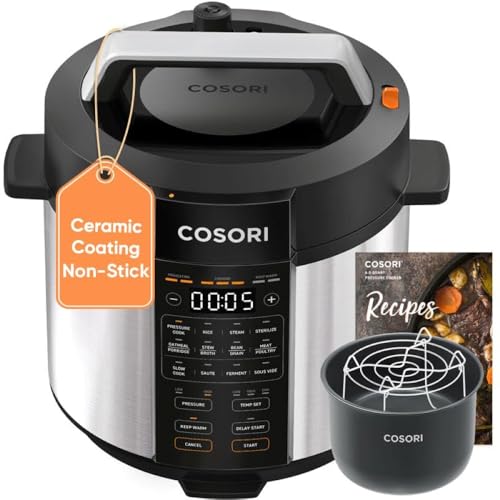
Cosori Pressure Cooker 6QT 9-in-1
Badge: Best Ceramic Pot
Strengths
- Ceramic-coated pot releases rice and sauces with noticeably easier cleanup
- Sous vide at this tier widens what a quick cooker can do
- 12 named safety features suit cautious first-time pressure cooks
Trade-offs
- Ceramic coatings need gentler utensils than bare stainless
- Less recipe ecosystem written specifically for its panel
- Silver finish shows splashes near the sauté station
Key specs from the verified listing:
- Capacity: 6 qt
- 9-in-1 functions including sous vide
- Ceramic-coated inner pot
- 12 safety features
- Power: 1100W
- Stainless steel exterior, silver
Cosori’s entry makes two arguments the Instant Pot range does not. The first is the ceramic-coated inner pot: rice releases cleanly, tomato sauces stop welding themselves to the base, and cleanup after a sauté-and-pressure stew is a soak-and-wipe instead of a scrub. For people whose main pressure-cooker complaint has always been the washing up, that is not a detail, it is the decision. The second argument is sous vide, built into a 6-quart 9-in-1 at a mainstream tier.
The twelve safety features are worth naming for the audience that still associates pressure cooking with grandmother’s rattling stovetop bomb. Modern electric cookers are layered with locks, sensors, and pressure regulation, and Cosori says so explicitly, which helps nervous first-timers actually use the machine. The trade-offs are ecosystem and care: fewer recipes are written for its exact panel, and ceramic wants wooden or silicone utensils. For cleanup-first buyers, it is the strongest alternative here.
Best for: Cleanup-first cooks and anyone wanting sous vide included / Not suited for: Anyone who treats inner pots roughly with metal utensils
Check on Amazon to see the latest price and availability for the Cosori Pressure Cooker 6QT 9-in-1.

Instant Pot Duo 7-in-1 Mini, 3 Quart
Badge: Best for Singles and Small Batches
Strengths
- 3 qt size cooks for one or two without a week of leftovers
- Full Duo function set in a counter-friendly body
- Perfect second pot for rice and sides while the big pot works
Trade-offs
- Too small for batch cooking, meal prep, or a whole chicken
- Recipes written for 6 qt need quantity and timing judgment to scale
- Per-quart, you pay for the miniaturization
Key specs from the verified listing:
- Capacity: 3 qt
- 7-in-1 functions: pressure cook, slow cook, rice, steam, sauté, yogurt, warm/sterilize
- Stainless steel build
- App recipe library access
The Duo Mini applies a simple truth the big pots ignore: a single person or a couple does not need six quarts of chili. Three quarts cooks dinner for one or two with a sensible leftover portion, makes a proper small batch of rice or steel-cut oats, and fits counters and cupboards that the family sizes bully. It keeps the full Duo repertoire — pressure, slow cook, sauté, steam, yogurt — so nothing about the cooking changes except the scale.
Its second career is as a sidekick. Households with a 6 or 8 quart pot routinely add the Mini for rice, grains, and vegetables cooking alongside the main event, which is a genuinely better workflow than sequential batches. The limits are arithmetic, not quality: it will not batch-cook for the freezer, fit a whole chicken, or host a potluck stew. Buy it for the household size you actually are, and it may be the most-used pot in this entire roundup relative to its footprint.
Best for: Singles, couples, small kitchens, and as a second side-dish pot / Not suited for: Batch cookers and large families
Check on Amazon to see the latest price and availability for the Instant Pot Duo 7-in-1 Mini, 3 Quart.

Instant Pot Pro 6 Qt 10-in-1 Electric Pressure Cooker
Badge: Best Premium Instant Pot
Strengths
- The most capable Instant Pot in the pool, with sous vide included
- Refined controls and cooking programs over the base Duo
- 6 qt family size with the full recipe ecosystem behind it
Trade-offs
- Premium tier within the brand’s range
- More programs to learn than the set-and-forget Duo
- Black finish shows dust and splashes between wipes
Key specs from the verified listing:
- Capacity: 6 qt
- 10-in-1 functions including sous vide
- Black finish
- Functions: pressure cook, slow cook, rice and grains, steam, sauté, sous vide, yogurt, warm, sterilize
The Pro is what the Duo grows up into. Ten functions add sous vide and more granular programs to the familiar base, the controls are a generation more refined, and the whole machine feels aimed at the cook who used a Duo for years and wants the better version rather than a different brand. It keeps the decisive Instant Pot advantage — the enormous recipe world written for these pots — while closing the feature gap that rivals like the Cosori opened.
For upgraders, the judgment is easy: everything you know transfers, and the new capabilities are real rather than decorative. Sous vide in a pressure cooker body will not replace a dedicated circulator for the obsessed, but for the occasional steak or egg-bite experiment it is genuinely useful. First-time buyers should ask whether they will use the extra depth; the Duo remains cheaper to learn. But if the question is which single machine in this pool does the most, the most capably, the Pro is the answer.
Best for: Experienced pressure cooks upgrading, and feature-first buyers / Not suited for: Anyone wanting the simplest possible first cooker
Check on Amazon to see the latest price and availability for the Instant Pot Pro 6 Qt 10-in-1 Electric Pressure Cooker.

Sweetcrispy 16-in-1 Electric Pressure Cooker 8QT
Badge: Best Large Capacity
Strengths
- 8 qt capacity handles big batches, large cuts, and potlucks
- Ceramic pot eases cleanup after saucy batch cooking
- Preset count covers most foods without manual programming
Trade-offs
- 8 qt is a large footprint and a heavy lift when full
- Smaller brand ecosystem than Instant Pot’s
- Half-full small meals cook less happily in a big pot
Key specs from the verified listing:
- Capacity: 8 qt
- 16-in-1 functions with 12 presets
- Ceramic inner pot
- Functions include slow cook, rice, steam, sauté, soup, yogurt
- Recipe book included
Sweetcrispy’s play is size plus surface: the biggest pot in this pool at 8 quarts, lined with a ceramic-coated inner pot, fronted by sixteen functions and twelve presets. For the batch cooker’s actual life — double chili for the freezer, a pork shoulder for the week, soup for a crowd — capacity is not a luxury, it is the constraint that decides whether the recipe fits, and this is the machine here that removes it.
The ceramic pot matters most at exactly this scale, because an 8-quart batch of baked beans or curry is where cleanup goes to die in a bare pot. The recipe book in the box is a thoughtful touch for a brand without Instant Pot’s internet-sized library. The cautions are the big-pot cautions: it is heavy when full, it wants storage space, and a two-person Tuesday dinner rattles around in it. Meal preppers and large households will not care. For them, this is the pool’s capacity champion.
Best for: Meal preppers, large households, and potluck cooks / Not suited for: Singles and small kitchens
Check on Amazon to see the latest price and availability for the Sweetcrispy 16-in-1 Electric Pressure Cooker 8QT.

Instant Pot Duo Plus 6 Qt 9-in-1 Electric Pressure Cooker
Badge: Best Middle Ground
Strengths
- Two more functions than the Duo in the same trusted platform
- 6 qt family size with full ecosystem support
- A natural step-up that stays familiar to Duo users
Trade-offs
- Overlaps heavily with both the Duo and the Pro; know why you are choosing it
- No sous vide headline like the Pro and Cosori
- Same sealing-ring odor habit as the rest of the family
Key specs from the verified listing:
- Capacity: 6 qt
- 9-in-1 functions: pressure cook, slow cook, rice, yogurt, steam, sauté, warm, sterilize and more
- Stainless steel build
- Companion app recipe library
The Duo Plus occupies the sensible middle of the Instant Pot range: nine functions instead of the Duo’s seven, the same 6-quart stainless platform, the same ecosystem of recipes and accessories, and a control experience a step more polished than the base model. For buyers who looked at the Duo, thought ‘nearly,’ and do not need the Pro’s sous vide ambitions, this is the one the range intends for you.
That positioning is also its caveat. Sitting between two famous siblings, the Plus asks you to be clear about what the extra functions buy in your kitchen, because the cooking fundamentals — pressure performance, pot, core programs — are the family fundamentals throughout. What you are really choosing is the interface and program depth you will live with for years. On that basis the Plus earns its place: it is the version many Duo owners describe wishing they had bought first, which is a quietly strong review in itself.
Best for: Buyers who want more than the base Duo without going full Pro / Not suited for: Sous vide seekers; look at the Pro or the Cosori
Check on Amazon to see the latest price and availability for the Instant Pot Duo Plus 6 Qt 9-in-1 Electric Pressure Cooker.
Comparison Table
| Pick | Badge | Key specs | Best for | Amazon |
|---|---|---|---|---|
| Instant Pot Duo 6 Qt 7-in-1 Electric Pressure Cooker | Best Overall | Capacity: 6 qt; 7-in-1 functions: pressure cook, slow cook, rice, yogurt, steam, sauté, warm/sterilize; Stainless steel build | Most households wanting the safest, best-documented first pressure cooker | Check on Amazon |
| Cosori Pressure Cooker 6QT 9-in-1 | Best Ceramic Pot | Capacity: 6 qt; 9-in-1 functions including sous vide; Ceramic-coated inner pot | Cleanup-first cooks and anyone wanting sous vide included | Check on Amazon |
| Instant Pot Duo 7-in-1 Mini, 3 Quart | Best for Singles and Small Batches | Capacity: 3 qt; 7-in-1 functions: pressure cook, slow cook, rice, steam, sauté, yogurt, warm/sterilize; Stainless steel build | Singles, couples, small kitchens, and as a second side-dish pot | Check on Amazon |
| Instant Pot Pro 6 Qt 10-in-1 Electric Pressure Cooker | Best Premium Instant Pot | Capacity: 6 qt; 10-in-1 functions including sous vide; Black finish | Experienced pressure cooks upgrading, and feature-first buyers | Check on Amazon |
| Sweetcrispy 16-in-1 Electric Pressure Cooker 8QT | Best Large Capacity | Capacity: 8 qt; 16-in-1 functions with 12 presets; Ceramic inner pot | Meal preppers, large households, and potluck cooks | Check on Amazon |
| Instant Pot Duo Plus 6 Qt 9-in-1 Electric Pressure Cooker | Best Middle Ground | Capacity: 6 qt; 9-in-1 functions: pressure cook, slow cook, rice, yogurt, steam, sauté, warm, sterilize and more; Stainless steel build | Buyers who want more than the base Duo without going full Pro | Check on Amazon |
How to Choose a Quick Cooker: Size, Functions, and the Ecosystem Question
Size the pot to your household and your ambitions
Three quarts serves singles and couples and doubles as a side-dish pot. Six quarts is the family standard that most recipes assume. Eight quarts is the batch-cooking and entertaining class. The subtlety is that pressure cookers should not be filled beyond about two-thirds for most foods, and less for foaming ones like beans and grains, so usable capacity is meaningfully below the headline number. Buy for the largest meal you cook monthly, not the largest you can imagine.
Functions are worth money only when they match habits
Every machine here pressure cooks, and that core is where most owners live. The honest way to value the rest: slow cooking replaces a separate appliance only if you slow cook; sous vide matters only if the idea of precise water-bath steaks genuinely appeals; yogurt pays off in households that eat it weekly. A 16-in-1 list is not sixteen times better than a 7-in-1 list. It is a menu, and you should order from it with your real week in mind.
The inner pot material shapes cleanup for years
Stainless steel pots are durable, dishwasher-happy, and ideal for hard searing, with the known habit of holding onto rice and sauces until soaked. Ceramic-coated pots release food dramatically more easily and forgive the cleanup, in exchange for gentler utensil discipline. Neither is wrong; they suit different cooks. The sealing ring, whichever pot you choose, will absorb strong odors, and a spare ring for mild and sweet dishes is the cheapest quality-of-life accessory in the category.
Do not underrate the recipe ecosystem
A pressure cooker is a technique as much as an appliance, and technique runs on recipes tested for specific buttons and behaviors. The biggest brands carry an enormous library of books, sites, and app recipes written for their panels, which shortens the learning curve from months to weekends. Smaller brands counter with presets and included recipe books. Either path works, but a first-time buyer should know which kind of support they are choosing before the first pot of beans.
How to Pressure Cook With Confidence: First Pots, Timing, and Release
Modern electric pressure cookers are safe, quiet, and forgiving. The learning curve is real but short, and it runs through these fundamentals.
- (‘Always include enough thin liquid.’, ‘Pressure is made from steam, and steam needs water, broth, or another thin liquid, typically at least a cup in a 6-quart pot. Thick sauces alone can scorch before pressure builds; layer them on top and stir after cooking.’).
- (‘Sear first for depth, right in the pot.’, ‘Use the sauté function to brown meats and bloom aromatics before the lid goes on. Deglaze with a splash of liquid and scrape up the browned bits; that is both flavor and burn-notice prevention in one move.’).
- (‘Fill to two-thirds, and half for foaming foods.’, ‘Beans, grains, and pasta expand and foam. Respecting the fill lines is what separates a clean cook from a sputtering valve and a geyser of bean liquid.’).
- (‘Choose your release deliberately.’, ‘Natural release, where pressure falls on its own, suits meats, beans, and anything that benefits from gentle finishing. Quick release suits vegetables and seafood that overcook in minutes. Many recipes split the difference: ten minutes natural, then release the rest.’).
- (‘Rest, then season and brighten.’, ‘Pressure cooking mutes fresh flavors slightly. A final hit of acid, fresh herbs, or a knob of butter after opening wakes the dish up in a way no extra pressure time can.’).
- (‘Keep the ring and valve clean.’, ‘Wash the sealing ring, check the float valve moves freely, and clear the steam release of residue. Ten seconds of attention prevents nearly every pressure failure owners report.’).
Troubleshooting
Problem: The burn notice appears → Usually a thick sauce or fond stuck to the base. Cancel, release pressure, add thin liquid, scrape the bottom thoroughly, and restart. Layering tomato products on top rather than stirring them in prevents most repeats.
Problem: The pot never reaches pressure → Check the sealing ring is seated all the way around, the release valve is set to sealing, and there is enough thin liquid. A ring slightly askew is the cause more often than any other.
Problem: Food comes out undercooked → Pieces were likely too large or the pot was overfilled. Cut evenly, cook in two batches if needed, and remember you can always reseal and add a few minutes; undercooking is the fixable direction.
Wash the inner pot and lid after every use, let the sealing ring air out rather than storing it sealed inside the pot, and keep a second ring for desserts and mild dishes. Wipe the rim and the condensation collector, check the anti-block shield under the lid periodically, and store the cooker with the lid ajar or upside down so odors never move in permanently. These small habits are why well-kept electric pressure cookers routinely serve for many years.
The Ecosystem Effect: Why Recipes Are a Hardware Feature
Buy a popular quick cooker and you inherit a library: thousands of recipes written for its exact buttons, timing charts tested on its exact heating curve, and a forum answer for every error message it can produce. That inheritance shortens the learning curve from months to weekends and quietly raises the machine’s success rate, because most pressure-cooking failures are recipe failures, wrong liquid, wrong release, wearing a hardware costume. The Instant Pot range’s dominance in this pool is substantially this effect, and it is rational for first-time buyers to weight it heavily.
Challengers are not wrong to compete on hardware instead; they are answering a different buyer. The experienced cook who already owns the technique does not need the library and can spend the money on a ceramic pot or an 8-quart capacity. Knowing which buyer you are is the whole decision, and the recipe-led browsing at Best Pressure Cookers Soups or Best Pressure Cookers Tested will quickly reveal whether the ecosystem’s voice sounds like help or like noise to you.
Stainless Versus Ceramic: The Pot Decision You Make Three Times a Day
Inner pot material sounds like a footnote and behaves like a headline, because you wash the pot after every meal the machine ever makes. Stainless steel, the Instant Pot standard, sears hard, shrugs off metal utensils and dishwashers, and holds onto starchy films until they are soaked. Ceramic coating, in the Cosori and the big Sweetcrispy, releases rice and sauces with a wipe and asks for wooden or silicone tools and a little gentleness in return. Over a year of dinners, that daily friction difference outweighs most function-list differences.
There is a cooking dimension too. Stainless fond develops beautifully for deglazing, which is flavor; ceramic’s easy release makes delicate grains and porridges calmer, which is convenience. Neither wins in the abstract. The cook who browns meat aggressively three nights a week and the cook whose pot lives on rice, soups, and saucy batch meals should choose different pots, and this pool, helpfully, lets them. The insert-focused angle continues at Best Pressure Cookers Wit Ceramic Inserts for readers who want to go deeper.
Related Angles Worth a Look
Readers comparing this shortlist with the neighbouring brief can continue to Best Pressure Cookers Soups, which covers that angle of the same product family in the same spirit: matched picks, stated trade-offs, and no invented numbers.
Readers comparing this shortlist with the neighbouring brief can continue to Best Pressure Cookers Sweethome, which covers that angle of the same product family in the same spirit: matched picks, stated trade-offs, and no invented numbers.
Readers comparing this shortlist with the neighbouring brief can continue to Best Pressure Cookers Tested, which covers that angle of the same product family in the same spirit: matched picks, stated trade-offs, and no invented numbers.
Readers comparing this shortlist with the neighbouring brief can continue to Best Pressure Cookers Uk, which covers that angle of the same product family in the same spirit: matched picks, stated trade-offs, and no invented numbers.
Readers comparing this shortlist with the neighbouring brief can continue to best pressure cookers wit ceramic inserts, which covers that angle of the same product family in the same spirit: matched picks, stated trade-offs, and no invented numbers.
Ownership Costs: Rings, Pots, and the Appliances a Quick Cooker Retires
A quick cooker’s running costs are close to zero: a replacement sealing ring now and then, descaling-free by design, and electricity that compares kindly with heating an oven. Its real economics are substitutional. A machine that credibly replaces a slow cooker, a rice cooker, a steamer, and a yogurt maker returns counter space and cupboard space with every function a household actually uses, which is why this guide insists on matching the function list to the week rather than admiring its length.
The second economy is food itself. Tough, inexpensive cuts become tender under pressure; dried beans cost a fraction of canned; stocks extract value from bones and scraps that would otherwise leave in the trash. Households that cook from ingredients routinely find the pot pays its way in grocery arithmetic within a season, quite apart from the takeout dinners it quietly prevents on tired weeknights.
Building the Habit: The First Ten Cooks
Cook one, the water test, teaches the controls without risking dinner. Cooks two through four should be forgiving and instructive: a soup, a batch of beans, steel-cut oats, each one demonstrating liquid rules, fill limits, and release choices in low-stakes form. By cook five, most owners attempt the dish they bought the machine for, a stew, a shoulder, a curry, and discover the sauté-then-pressure rhythm that makes weeknight cooking feel unfairly easy.
Keep a small notebook or a notes file: dish, liquid, minutes, release, verdict. Ten entries in, you own a personal timing chart no book can give you, calibrated to your machine, your altitude, and your ingredients. That chart is the difference between owners who use the pot weekly for years and owners whose pot becomes a cupboard monument, and it costs nothing but the honesty to write down what actually happened.
Which of the best reviewed quick cookers fits your household?
Badges summarize, but households are specific. This section walks the six picks one by one in the language of daily life, who each machine suits, what it asks of its owner, and what would make a different pick the smarter buy, so you can match a model to your mornings, your counter, and your patience rather than to a ranking.
Choose the Instant Pot Duo 6 Qt 7-in-1 Electric Pressure Cooker if this sounds like you: most households wanting the safest, best-documented first pressure cooker. Its defining trait from the verified listing is this: capacity: 6 qt. The honest cost of ownership is equally specific: 7-in-1 is the leanest function list in this pool. Weigh that against its clearest strength, that it the default recommendation for a decade, with the deepest recipe ecosystem anywhere, and the decision usually makes itself. It is a linked pick you can check on Amazon from the sections above, and it is not the right answer for this reader: sous vide enthusiasts, or anyone wanting the newest feature set. If that last sentence describes your household better than the first one did, keep reading down the list rather than forcing the fit, because one of the other five was almost certainly specced with your kitchen in mind.
Choose the Cosori Pressure Cooker 6QT 9-in-1 if this sounds like you: cleanup-first cooks and anyone wanting sous vide included. Its defining trait from the verified listing is this: capacity: 6 qt. The honest cost of ownership is equally specific: ceramic coatings need gentler utensils than bare stainless. Weigh that against its clearest strength, that it ceramic-coated pot releases rice and sauces with noticeably easier cleanup, and the decision usually makes itself. It is a linked pick you can check on Amazon from the sections above, and it is not the right answer for this reader: anyone who treats inner pots roughly with metal utensils. If that last sentence describes your household better than the first one did, keep reading down the list rather than forcing the fit, because one of the other five was almost certainly specced with your kitchen in mind.
Choose the Instant Pot Duo 7-in-1 Mini, 3 Quart if this sounds like you: singles, couples, small kitchens, and as a second side-dish pot. Its defining trait from the verified listing is this: capacity: 3 qt. The honest cost of ownership is equally specific: too small for batch cooking, meal prep, or a whole chicken. Weigh that against its clearest strength, that it 3 qt size cooks for one or two without a week of leftovers, and the decision usually makes itself. It is a linked pick you can check on Amazon from the sections above, and it is not the right answer for this reader: batch cookers and large families. If that last sentence describes your household better than the first one did, keep reading down the list rather than forcing the fit, because one of the other five was almost certainly specced with your kitchen in mind.
Choose the Instant Pot Pro 6 Qt 10-in-1 Electric Pressure Cooker if this sounds like you: experienced pressure cooks upgrading, and feature-first buyers. Its defining trait from the verified listing is this: capacity: 6 qt. The honest cost of ownership is equally specific: premium tier within the brand’s range. Weigh that against its clearest strength, that it the most capable Instant Pot in the pool, with sous vide included, and the decision usually makes itself. It is a linked pick you can check on Amazon from the sections above, and it is not the right answer for this reader: anyone wanting the simplest possible first cooker. If that last sentence describes your household better than the first one did, keep reading down the list rather than forcing the fit, because one of the other five was almost certainly specced with your kitchen in mind.
Choose the Sweetcrispy 16-in-1 Electric Pressure Cooker 8QT if this sounds like you: meal preppers, large households, and potluck cooks. Its defining trait from the verified listing is this: capacity: 8 qt. The honest cost of ownership is equally specific: 8 qt is a large footprint and a heavy lift when full. Weigh that against its clearest strength, that it 8 qt capacity handles big batches, large cuts, and potlucks, and the decision usually makes itself. It is a linked pick you can check on Amazon from the sections above, and it is not the right answer for this reader: singles and small kitchens. If that last sentence describes your household better than the first one did, keep reading down the list rather than forcing the fit, because one of the other five was almost certainly specced with your kitchen in mind.
Choose the Instant Pot Duo Plus 6 Qt 9-in-1 Electric Pressure Cooker if this sounds like you: buyers who want more than the base Duo without going full Pro. Its defining trait from the verified listing is this: capacity: 6 qt. The honest cost of ownership is equally specific: overlaps heavily with both the Duo and the Pro; know why you are choosing it. Weigh that against its clearest strength, that it two more functions than the Duo in the same trusted platform, and the decision usually makes itself. It is a linked pick you can check on Amazon from the sections above, and it is not the right answer for this reader: sous vide seekers; look at the Pro or the Cosori. If that last sentence describes your household better than the first one did, keep reading down the list rather than forcing the fit, because one of the other five was almost certainly specced with your kitchen in mind.
Notice what this walk-through did not do: it did not crown a single winner and dismiss the rest. In a mature category, the spread of good machines exists because households genuinely differ, in size, in taste, in budget rhythm, and in how much complexity they enjoy before coffee, before dinner, before the guests arrive. The best purchase in this guide is the one whose strengths you will use weekly and whose trade-offs you will barely notice, and that machine is a different model for different readers of the same page.
Common Buying Mistakes
Filling past the lines
Pressure cookers need headspace, and foaming foods need more. Overfilling causes sputtering valves, undercooked centers, and memorable messes.
Stirring in the tomato sauce
Thick sauces on the bottom scorch and trigger burn notices. Layer them on top, cook, and stir at the end.
Quick-releasing everything
Meats and beans want natural release; blasting the valve toughens proteins and can spray liquid. Match the release to the food.
Storing the ring inside the closed pot
That is how a cooker develops a permanent curry perfume. Air the ring out and keep a second for mild dishes.
Judging by function count
Sixteen functions you never open are worth less than seven you use weekly. Buy the menu you will actually order from.
Final Recommendation
First-time buyers should take the Instant Pot Duo and inherit the ecosystem, or the Duo Plus if its extra programs match their ambitions. Cleanup-first cooks should take the Cosori, upgraders and feature seekers the Instant Pot Pro, small households the Duo Mini, and batch cookers the 8-quart Sweetcrispy. Every machine here pressure cooks capably; the reviewed difference is fit, and fit is a question about your kitchen that this guide has tried to make easy to answer honestly.
Shortlist links: Instant Pot Duo 6 Qt 7-in-1 Electric Pressure Cooker, Cosori Pressure Cooker 6QT 9-in-1, Instant Pot Duo 7-in-1 Mini, 3 Quart. Each opens the live listing, where the current price and availability are stated accurately, unlike any number a static guide could print.
Frequently Asked Questions
Is electric pressure cooking safe?
Modern electric cookers are built with layered safeguards: locking lids that cannot open under pressure, regulated pressure, temperature monitoring, and controlled release valves. Models like the Cosori here name a dozen safety features. Follow fill limits and keep the ring and valve clean, and the category’s safety record is excellent.
What size Instant Pot should a family buy?
Six quarts is the standard answer and the size most recipes assume. It handles family dinners and batch cooking for most households. Go to eight quarts for large families and serious meal prep, and three quarts for singles, couples, or as a second pot for sides.
What is the difference between natural and quick release?
Natural release lets pressure fall slowly on its own, finishing meats and beans gently. Quick release vents steam immediately, stopping cooking fast for vegetables and seafood. Many recipes use a hybrid: a short natural rest, then release the remainder.
Why did I get a burn notice?
Something thick or sugary stuck and scorched on the pot’s base, usually a stirred-in tomato sauce or un-deglazed fond. Add thin liquid, scrape the bottom clean, layer thick sauces on top without stirring, and restart. It is the most common and most fixable pressure cooker message.
Can a pressure cooker replace a slow cooker and rice cooker?
For most households, yes. Every machine here slow cooks and makes rice credibly, which is how a 7-in-1 earns its counter space. Dedicated appliances still win narrow contests, a rice cooker for daily perfect rice, but the multi-cooker wins the kitchen-space war.
Do I need a second sealing ring?
It is the cheapest upgrade in the category. Rings absorb odors from curries, chilis, and beans, and a second ring reserved for rice, yogurt, and desserts keeps flavors where they belong. Rings are inexpensive and swap in seconds.


