Disclosure: topratedkitchenware.com is reader-supported. When you buy through links on our site, we may earn an affiliate commission from Amazon and other retailers, at no extra cost to you.
Where to buy
The quickest route to each recommendation is below. Linked picks go straight to their Amazon listing, where you can check on Amazon for the current details before you buy. Picks labeled prose-only are discussed for comparison and carry no purchase link in this guide, for the honesty reasons explained in their reviews. Read the full guide ↓ for the reasoning, the comparisons and the buying advice before you decide.
- Crock-Pot Programmable Slow Cooker 8-Quart Black Stainless — Best Overall for Volume
- Crock-Pot Programmable Slow Cooker with MyTime 7-Quart — Best for Timed Service
- Hamilton Beach 6 Quart Slow Cooker — Best Workhorse
- Crock-Pot Oval Manual Slow Cooker 7-Quart — Best Classic Crock
- Cosori Rice Cooker 10 Cup — Most Versatile
- Aroma Housewares 20 Cup Digital Rice Cooker and Slow Cooker — Best for Rice and Slow Cook Combo Duty
The search for the best professsional slow cookers, misspelling and all, usually comes from someone whose cooking has outgrown casual duty: a caterer holding sides for service, a church or office kitchen feeding a crowd, a serious home cook running chili for a fundraiser, or a small food business bridging the gap before true commercial equipment. An honest disclosure belongs at the top of this guide. None of the verified picks below is a certified commercial appliance with the ratings a health inspector looks for; they are the largest, sturdiest and most capable home slow cookers and multi-function machines in the verified pool, selected and framed for professional-style demands. If your operation requires certified commercial equipment, that is a different purchase through restaurant supply channels, and this guide says so plainly.
Within that honest frame, professional-style use has a clear profile. Capacity comes first, because service quantities dwarf family dinners. Durability comes next: stoneware that tolerates daily cycles, controls that survive different staff members operating them, and lids that travel without drama. Scheduling matters too, since professional cooking is timed cooking, and a programmable finish beats a dial when a side dish must land exactly at service. Finally, cleanup speed is a labor cost, so dishwasher-safe inserts are not a luxury in this context but an operating feature.
The six picks below are ordered for that workload, from the eight-quart programmable Crock-Pot that anchors high-volume holding, through the scheduling MyTime model, to the multi-function machines that let a small operation cover rice, steaming and slow cooking from one footprint. Every specification is taken from listings verified through the Amazon Creators API, and each review is candid about the line between heavy home duty and true commercial service, so you can judge exactly where each machine belongs in your kitchen.
Readers comparing across the wider cooker shelf often also weigh guides such as Best Progammable Pressur Cookers and Best Programmable Cookers, which cover neighboring formats and help place the picks below in context.
Key Takeaways
- Honest framing: these are heavy-duty home machines for professional-style workloads, not certified commercial appliances.
- Capacity leads the decision: the eight-quart Crock-Pot is the volume anchor of this list.
- Programmable timing is a service feature, not a convenience, when dishes must land at a set hour.
- Dishwasher-safe stoneware is a labor decision in any kitchen where someone is paid to wash up.
- Multi-function picks consolidate rice, steam and slow cooking for small operations short on space.
In this guide
Quick Picks
Six machines, six distinct jobs. The badges below are used consistently through the detailed reviews, so you can move between this summary and the full sections without translating between two sets of labels. Where a pick is prose-only, the badge says so in plain language.
| Pick | Badge | Best for | Link |
|---|---|---|---|
| Crock-Pot Programmable Slow Cooker 8-Quart Black Stainless | Best Overall for Volume | The largest capacity in this group for big-batch cooking, parties and freezer prep | Check on Amazon |
| Crock-Pot Programmable Slow Cooker with MyTime 7-Quart | Best for Timed Service | MyTime scheduling works backwards from your mealtime instead of a fixed cook duration | Check on Amazon |
| Hamilton Beach 6 Quart Slow Cooker | Best Workhorse | Straightforward three-setting control that anyone in the house can run | Check on Amazon |
| Crock-Pot Oval Manual Slow Cooker 7-Quart | Best Classic Crock | Classic oval stoneware holds roasts, whole chickens and large cuts in a natural shape | Check on Amazon |
| Cosori Rice Cooker 10 Cup | Most Versatile | Slow-cook mode sits inside a genuinely versatile 18-in-1 machine, so one appliance covers rice, steaming and slow cooking | Check on Amazon |
| Aroma Housewares 20 Cup Digital Rice Cooker and Slow Cooker | Best for Rice and Slow Cook Combo Duty | Large cooked capacity handles family-size batches and potluck quantities | Check on Amazon |
How These Picks Were Chosen
This is a research-led guide, and it does not claim hands-on testing that did not happen. Picks were drawn from a verified product pool checked through the Amazon Creators API, which confirmed each product’s identity, brand, capacity, listed functions and image. Products were then compared on the criteria that decide satisfaction with this appliance type: capacity against household size, control style against daily routine, cooking surface against cleaning tolerance, and format against the actual meaning of the keyword. That last test mattered most in this guide. Picks that matched the keyword’s product type were linked normally; picks that matched the wider category but not the keyword’s specific demand, whether that was a brand, a pressure function or a simplicity requirement, were kept visible as clearly labeled prose-only comparisons instead of being linked as if they matched.
Specifications quoted in the mini spec boxes come only from the verified listing data, and anything not present in that data was left out rather than filled in from memory. Prices and fixed ratings were excluded by design, because both change constantly and neither helps a durable decision. What remains is the slower, more useful material: how each machine cooks, who it suits, where it compromises and how it compares with the alternatives a real buyer will consider, including the neighboring guides at Best Programmable Pressure Cookers for readers whose needs sit between categories.
The 6 Best Professsional Slow Cookers for Heavy-Duty Use
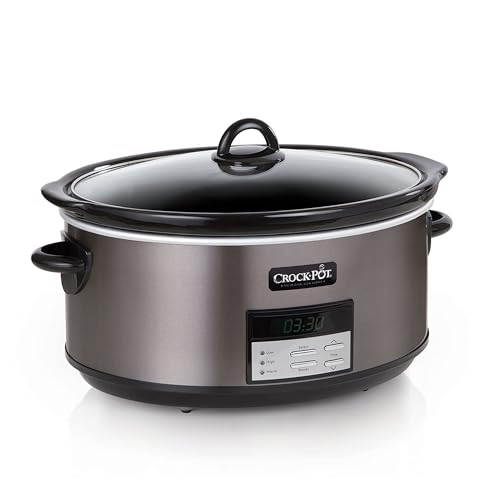
Crock-Pot Programmable Slow Cooker 8-Quart Black Stainless
Badge: Best Overall for Volume
Strengths
- The largest capacity in this group for big-batch cooking, parties and freezer prep
- Long digital timer window covers very slow, all-day recipes
- Automatic Warm keeps food at serving temperature after the cook ends
Trade-offs
- Big footprint on the counter and in the sink
- A half-empty large crock can overcook smaller recipes around the edges
- Heaviest option here when the stoneware is full
At a glance
- Capacity: 8-quart, for 10 or more people
- Timer: digital timer up to 20 hours
- Settings: automatic Warm after cooking
- Insert and lid: dishwasher-safe stoneware pot and lid
- Finish: black stainless steel
Judged against a professional-style workload, Crock-Pot Programmable Slow Cooker 8-Quart Black Stainless earns its place through capacity, consistency and the ability to be run by whoever is on shift without a training session. Its eight-quart volume and long timer make it the natural anchor machine for service quantities. It holds its own across long services, cleans up at the speed a working kitchen needs, and asks little in return beyond sensible handling of its insert and lid. That combination of throughput and forgiveness is what heavy use actually rewards, far more than novelty features that complicate a service.
In the kitchen, the pattern of use matters more than any single specification. This is a machine for the cook described in its badge line, used at the rhythm that badge implies: planned batches rather than last-minute improvisation, recipes chosen to suit its vessel shape and control style, and a cleaning routine matched to its cooking surface. Buyers who recognize their own habits in that description tend to keep machines like this for years; buyers who are honest that their habits differ should keep reading, because one of the other five profiles on this page was written for them instead.
Best for: cooks who want best overall for volume performance in this category / Not suited for: buyers whose needs are described by a different badge on this page
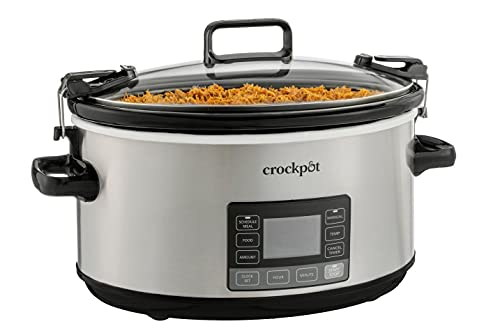
Crock-Pot Programmable Slow Cooker with MyTime 7-Quart
Badge: Best for Timed Service
Strengths
- MyTime scheduling works backwards from your mealtime instead of a fixed cook duration
- Locking lid makes it the natural pick for transporting chili and stews
- Programmable control suits long, unpredictable workdays better than a manual dial
Trade-offs
- More electronics to learn than a three-setting dial model
- Locking lids should not be latched during cooking unless the manual for your use says so
- Digital models reset differently after outages than manual models, so check food temperature on return
At a glance
- Capacity: 7-quart, feeds 9 or more people
- Technology: MyTime adjusts cooking to finish at a set time
- Lid: Cook and Carry locking lid
- Controls: programmable digital
Judged against a professional-style workload, Crock-Pot Programmable Slow Cooker with MyTime 7-Quart earns its place through capacity, consistency and the ability to be run by whoever is on shift without a training session. Its finish-time scheduling is the feature a timed service feels most directly. It holds its own across long services, cleans up at the speed a working kitchen needs, and asks little in return beyond sensible handling of its insert and lid. That combination of throughput and forgiveness is what heavy use actually rewards, far more than novelty features that complicate a service.
In the kitchen, the pattern of use matters more than any single specification. This is a machine for the cook described in its badge line, used at the rhythm that badge implies: planned batches rather than last-minute improvisation, recipes chosen to suit its vessel shape and control style, and a cleaning routine matched to its cooking surface. Buyers who recognize their own habits in that description tend to keep machines like this for years; buyers who are honest that their habits differ should keep reading, because one of the other five profiles on this page was written for them instead.
Best for: cooks who want best for timed service performance in this category / Not suited for: buyers whose needs are described by a different badge on this page

Hamilton Beach 6 Quart Slow Cooker
Badge: Best Workhorse
Strengths
- Straightforward three-setting control that anyone in the house can run
- Stoneware crock and glass lid both go in the dishwasher
- Six-quart size is the sweet spot for most families and most recipes as written
Trade-offs
- No programmable timer or automatic finish-time adjustment
- Basic feature set gives you less control over very long cooks
- Glass lid does not lock for transport
At a glance
- Capacity: 6-quart
- Settings: 3 cooking settings
- Insert: dishwasher-safe stoneware crock
- Lid: glass lid, dishwasher-safe
- Model: 33665G, silver
Judged against a professional-style workload, Hamilton Beach 6 Quart Slow Cooker earns its place through capacity, consistency and the ability to be run by whoever is on shift without a training session. Its three-setting simplicity is a genuine asset when volunteers or rotating staff run the kitchen. It holds its own across long services, cleans up at the speed a working kitchen needs, and asks little in return beyond sensible handling of its insert and lid. That combination of throughput and forgiveness is what heavy use actually rewards, far more than novelty features that complicate a service.
In the kitchen, the pattern of use matters more than any single specification. This is a machine for the cook described in its badge line, used at the rhythm that badge implies: planned batches rather than last-minute improvisation, recipes chosen to suit its vessel shape and control style, and a cleaning routine matched to its cooking surface. Buyers who recognize their own habits in that description tend to keep machines like this for years; buyers who are honest that their habits differ should keep reading, because one of the other five profiles on this page was written for them instead.
Best for: cooks who want best workhorse performance in this category / Not suited for: buyers whose needs are described by a different badge on this page

Crock-Pot Oval Manual Slow Cooker 7-Quart
Badge: Best Classic Crock
Strengths
- Classic oval stoneware holds roasts, whole chickens and large cuts in a natural shape
- Dead-simple dial controls with nothing to program and nothing to reset after a power flicker
- Removable stoneware moves from base to table to refrigerator easily
Trade-offs
- No timer, so it will not switch itself to Warm at a set hour
- Manual control means you manage start times yourself on long workdays
- Stoneware is heavy when full and needs two hands and a clear path
At a glance
- Capacity: 7-quart, serves 8 or more people
- Settings: High, Low and Warm
- Insert: removable oval stoneware
- Controls: manual dial
Judged against a professional-style workload, Crock-Pot Oval Manual Slow Cooker 7-Quart earns its place through capacity, consistency and the ability to be run by whoever is on shift without a training session. Its oval stoneware handles the large, awkward cuts that event cooking so often involves. It holds its own across long services, cleans up at the speed a working kitchen needs, and asks little in return beyond sensible handling of its insert and lid. That combination of throughput and forgiveness is what heavy use actually rewards, far more than novelty features that complicate a service.
In the kitchen, the pattern of use matters more than any single specification. This is a machine for the cook described in its badge line, used at the rhythm that badge implies: planned batches rather than last-minute improvisation, recipes chosen to suit its vessel shape and control style, and a cleaning routine matched to its cooking surface. Buyers who recognize their own habits in that description tend to keep machines like this for years; buyers who are honest that their habits differ should keep reading, because one of the other five profiles on this page was written for them instead.
Best for: cooks who want best classic crock performance in this category / Not suited for: buyers whose needs are described by a different badge on this page


Cosori Rice Cooker 10 Cup
Badge: Most Versatile
Strengths
- Slow-cook mode sits inside a genuinely versatile 18-in-1 machine, so one appliance covers rice, steaming and slow cooking
- Ceramic-coated inner pot is easy to release food from and simple to wipe clean
- Delay timer and long keep-warm window suit set-ahead weekday cooking
Trade-offs
- It is a rice cooker first, so the slow-cook bowl shape and heating pattern differ from a deep stoneware crock
- The wide function list means more menu steps than a simple dial slow cooker
- Ceramic coating still needs non-metal utensils to stay in good condition
At a glance
- Capacity: 10-cup uncooked / 20-cup cooked
- Functions: 18-in-1, including saute and slow cook
- Inner pot: ceramic coating
- Keep warm: 24-hour keep warm and delay timer
- Includes stainless steel steamer basket
Judged against a professional-style workload, Cosori Rice Cooker 10 Cup earns its place through capacity, consistency and the ability to be run by whoever is on shift without a training session. Its eighteen functions let a small operation cover rice and steaming without extra appliances on the line. It holds its own across long services, cleans up at the speed a working kitchen needs, and asks little in return beyond sensible handling of its insert and lid. That combination of throughput and forgiveness is what heavy use actually rewards, far more than novelty features that complicate a service.
In the kitchen, the pattern of use matters more than any single specification. This is a machine for the cook described in its badge line, used at the rhythm that badge implies: planned batches rather than last-minute improvisation, recipes chosen to suit its vessel shape and control style, and a cleaning routine matched to its cooking surface. Buyers who recognize their own habits in that description tend to keep machines like this for years; buyers who are honest that their habits differ should keep reading, because one of the other five profiles on this page was written for them instead.
Best for: cooks who want most versatile performance in this category / Not suited for: buyers whose needs are described by a different badge on this page

Aroma Housewares 20 Cup Digital Rice Cooker and Slow Cooker
Badge: Best for Rice and Slow Cook Combo Duty
Strengths
- Large cooked capacity handles family-size batches and potluck quantities
- Slow-cook function is built in alongside rice and steam programs
- Stainless steel exterior wipes down easily after messy cooks
Trade-offs
- Rice-cooker format means a shallower cooking vessel than a classic oval crock
- Digital controls are more than some set-and-forget cooks want
- Takes meaningful counter space when the steamer setup is in use
At a glance
- Capacity: 10-cup uncooked / 20-cup cooked
- Functions: digital rice cooking, slow cook, food steaming
- Exterior: stainless steel
- Format: countertop multicooker with steamer function
Judged against a professional-style workload, Aroma Housewares 20 Cup Digital Rice Cooker and Slow Cooker earns its place through capacity, consistency and the ability to be run by whoever is on shift without a training session. Its large cooked capacity suits the rice-plus-slow-cook combination that underpins many event menus. It holds its own across long services, cleans up at the speed a working kitchen needs, and asks little in return beyond sensible handling of its insert and lid. That combination of throughput and forgiveness is what heavy use actually rewards, far more than novelty features that complicate a service.
In the kitchen, the pattern of use matters more than any single specification. This is a machine for the cook described in its badge line, used at the rhythm that badge implies: planned batches rather than last-minute improvisation, recipes chosen to suit its vessel shape and control style, and a cleaning routine matched to its cooking surface. Buyers who recognize their own habits in that description tend to keep machines like this for years; buyers who are honest that their habits differ should keep reading, because one of the other five profiles on this page was written for them instead.
Best for: cooks who want best for rice and slow cook combo duty performance in this category / Not suited for: buyers whose needs are described by a different badge on this page
Comparison Table
Readers still deciding between appliance families will also find the related formats in Best Propane Regulators For Kettle Corn Cookers worth a look before they commit.
The table compresses the six profiles into the attributes buyers compare most. It deliberately contains no prices and no ratings, both of which change too quickly to belong in a durable guide; use it to shortlist, then read the full review of your finalist before deciding.
| Pick | Badge | Key attribute | Watch out for | Link |
|---|---|---|---|---|
| Crock-Pot Programmable Slow Cooker 8-Quart Black Stainless | Best Overall for Volume | Capacity: 8-quart, for 10 or more people | Big footprint on the counter and in the sink | Check on Amazon |
| Crock-Pot Programmable Slow Cooker with MyTime 7-Quart | Best for Timed Service | Capacity: 7-quart, feeds 9 or more people | More electronics to learn than a three-setting dial model | Check on Amazon |
| Hamilton Beach 6 Quart Slow Cooker | Best Workhorse | Capacity: 6-quart | No programmable timer or automatic finish-time adjustment | Check on Amazon |
| Crock-Pot Oval Manual Slow Cooker 7-Quart | Best Classic Crock | Capacity: 7-quart, serves 8 or more people | No timer, so it will not switch itself to Warm at a set hour | Check on Amazon |
| Cosori Rice Cooker 10 Cup | Most Versatile | Capacity: 10-cup uncooked / 20-cup cooked | It is a rice cooker first, so the slow-cook bowl shape and heating pattern differ from a deep stoneware crock | Check on Amazon |
| Aroma Housewares 20 Cup Digital Rice Cooker and Slow Cooker | Best for Rice and Slow Cook Combo Duty | Capacity: 10-cup uncooked / 20-cup cooked | Rice-cooker format means a shallower cooking vessel than a classic oval crock | Check on Amazon |
How to Choose the Right Slow Cooker for Your Kitchen
Sizing a slow cooker honestly
Capacity is the first decision and the one most buyers get wrong in both directions. A slow cooker works best when it is between half and three-quarters full: too empty and thin sauces reduce and edges scorch, too full and the food may not move through the temperature range evenly or on schedule. As a working rule, allow roughly one quart of capacity per person for main-dish cooking, then round up if you cook roasts with vegetables around them or batch-freeze chili. A six-quart model covers most family recipes exactly as they are written in mainstream cookbooks, which is why it remains the default recommendation. Seven and eight-quart models earn their footprint when you regularly cook for a crowd, double recipes for the freezer, or buy large bone-in cuts that simply do not fit a smaller oval. Two further checks matter more than headline quarts. First, shape: an oval crock accepts a whole chicken, a rack of ribs folded once, or a pork shoulder far more gracefully than a round one of the same volume. Second, filled weight: stoneware plus six quarts of stew is a serious lift from counter to table, so be honest about who will be carrying it and whether the sink and refrigerator shelf can take the insert.
Heat settings, timers and the Warm question
Low and High on a slow cooker are not two different final temperatures so much as two different speeds of getting there; both settings eventually settle in a similar simmering range, with High arriving much sooner. That is why converting a recipe is mostly a time conversion, not a temperature one. The setting that genuinely changes your life is Warm, and more importantly whether the cooker switches to it automatically. A manual dial model will happily keep cooking on Low until you come home, which is fine for a six-hour stew and a problem for a delicate chicken dish on a ten-hour day. Programmable models solve that with a timer that drops to Warm, and the most advanced scheduling models in this guide work backwards from the hour you want to eat. Whichever you choose, treat Warm as a holding setting for a reasonable window, not an all-day storage plan, and refrigerate leftovers promptly once the meal is over.
Stoneware, ceramic coatings and metal pots
The cooking vessel decides how the cooker behaves and how you clean it. Traditional stoneware is thick, holds heat evenly, resists thermal shock reasonably well when handled sensibly, and goes from base to table looking like a serving dish. Its costs are weight and fragility: a dropped or badly knocked crock is a replacement part, not a repair. Ceramic-coated metal pots, like the one on the multi-function pick in this list, are far lighter and usually release sticky food more easily, but the coating asks for non-metal utensils and gentler scrubbing. Bare stainless steel, common on pressure-cooker pots used for slow cooking, is the toughest of all and tolerates almost any utensil, though sauces can cling more and the pot shows every scorch until you soak it. None of these materials is automatically the safest or the best; they are different trade-offs in weight, care and heat behavior, and the right answer depends on how you cook and who does the washing up.
One final buying discipline applies to every pick on this page: decide the job before the machine. Write down the two or three dishes you will actually cook most, the number of people they feed and the hour they need to be ready, then let that short note eliminate most of the list. Buyers who start from features end up with impressive appliances that fight their routines; buyers who start from dinner end up with the right one. Readers still torn between formats will find the neighboring comparison at Best Propane Regulators For Kettlecorn Cookers useful before committing.
How to Use and Care for Your Slow Cooker
Good results with this appliance type are mostly a sequence of small, repeatable habits. The routine below is written for the machines in this guide and generalizes across them, with the differences that matter noted where they occur.
- Fill the crock between half and three-quarters full, layering dense vegetables such as potatoes and carrots near the bottom and sides where the heat arrives first, and placing meat on top so its juices baste everything as it cooks.
- Resist lifting the lid. Every peek releases a cushion of steam and heat that the cooker needs many minutes to rebuild, so add significant time if you open it repeatedly; check doneness near the end of the window instead.
- Brown meat and bloom spices in a pan first when the recipe rewards it. Slow cookers do not brown, so that ten-minute step is where much of the deep flavor in a stew actually comes from.
- Add dairy, fresh herbs, quick-cooking vegetables and pasta near the end. Cream and cheese split or turn grainy over long cooks, peas and spinach need minutes rather than hours, and pasta swells into mush if it rides along all day.
- Thicken at the finish rather than the start. A cornstarch slurry stirred in for the last half hour on High, or simply cooking with the lid ajar at the end, gives you control that flour added at the beginning never will.
- Cool and store properly: move leftovers into shallow containers and refrigerate them rather than leaving the whole crock out, and reheat until steaming throughout before serving again.
Troubleshooting
Problem: the finished dish tastes watery and flat. Slow cookers trap moisture, so almost no liquid evaporates. Next time, cut added liquid by roughly a third compared with a stovetop version, brown the meat first, and finish with acid, salt and fresh herbs, which restore the brightness long cooking dulls.
Problem: meat is tender but dry. This is usually the wrong cut or too long on High. Choose well-marbled, collagen-rich cuts such as shoulder and chuck, cook on Low for the longer window, and make sure the meat sits in enough liquid to braise rather than roast in steam.
Problem: vegetables are mushy while the meat is perfect. Cut root vegetables larger, add tender vegetables in the last hour, and place the densest items at the bottom where they cook in liquid rather than steaming apart on top.
Home heavy-duty versus certified commercial: know the line
Professional buyers should understand the distinction this guide keeps returning to. Certified commercial equipment is built and labeled for commercial food service, with electrical and sanitation listings that inspectors and insurers recognize, and it is sold through restaurant supply channels at commercial prices. Heavy-duty home appliances, including every pick here, are built for households and carry household listings, however robust they feel. For many real-world situations, including community kitchens, offices, events, catering support tasks and home-based cooking that does not fall under commercial inspection, a large home machine is entirely appropriate and dramatically cheaper. For a licensed food business cooking for the public, the certified route is the correct one. Naming that line clearly protects you better than any review can, and it is why each pick below is described by what it can genuinely do rather than by a professional label it has not earned.
Running slow cookers like a small operation
Treating slow cooking professionally is mostly process. Standardize two or three base recipes per machine and write down the fill level, setting and time that worked, because staff and volunteers rotate. Label cords and lids so matched parts stay together across a busy service. Plan the power: several large cookers on one circuit can trip a breaker mid-service, so spread machines across circuits and test the layout before the event, not during it. Hold food hot with the lid closed, stir on a schedule for even temperature, and cool leftovers in shallow pans rather than in the deep crock, which chills too slowly. None of this requires commercial equipment; it requires the discipline that makes any equipment perform professionally, and it is the difference between a chaotic fundraiser and a calm one.
However you decide, keep the wider shelf in view: the guide at Best Propane Table Top Cookers covers the adjacent need most buyers weigh alongside this one, and a few minutes there can prevent the classic mistake of solving the wrong problem beautifully.
Going Deeper
Low and slow cooking is fundamentally about collagen. Tough, inexpensive cuts are rich in connective tissue that only becomes silky gelatin after hours at a gentle simmer, which is why a shoulder can emerge spoon-tender from a slow cooker while a lean steak cut emerges tired and dry from the same treatment. Choosing the right cut matters more than choosing between two similar machines, and it is the happiest kind of cooking economics: the cheapest cuts in the case are often the best suited to the method. Build your shopping around that fact and the appliance pays for itself in both money and effort.
Food safety in slow cooking deserves one calm paragraph. Start with thawed ingredients for long cooks, because a large frozen mass can spend too long warming through the middle range where bacteria multiply. Keep the lid on, cook on Low or High as the recipe directs rather than on Warm, and bring leftovers to a full simmer when reheating. None of this is cause for anxiety; it is the same common sense applied to any gentle cooking method, and modern cookers with sound lids and honest heating elements handle the job reliably when the basics are respected.
A slow cooker rewards a weekly rhythm. Many households settle into a pattern of one soup, one braise and one batch of grains or beans across a week, each producing leftovers that improve overnight as flavors meld. Planning two meals around one large cook, serving the braise fresh on day one and reworking the remainder into sandwiches, tacos or a pasta sauce later, is where the appliance quietly saves the most money and the most weeknight decision-making. The machines in this guide differ in size and scheduling, but they all serve that rhythm equally well once the capacity matches the household.
Sauce management separates good slow cooking from great slow cooking. Because evaporation is minimal, flavors dilute rather than concentrate, so season a little more assertively than you would on the stove, hold back delicate herbs and dairy for the finish, and keep a slurry or a reduction step in your back pocket. Tomato paste, miso, soy sauce, dried mushrooms and a final splash of vinegar or citrus are the quiet workhorses here, each adding depth that survives the long cook or restores brightness at the end. Master those moves and the difference between models matters far less than the difference between cooks.
Transporting a slow cooker is its own small discipline, and it is where locking lids earn their keep. Fill the crock no more than three-quarters, latch the lid only for the journey if your model provides a lock, set the whole cooker in a box or on a towel in the footwell rather than on a seat, and plug in on Warm at the destination rather than trying to keep cooking in transit. At a potluck, bring a serving spoon and a short extension cord, claim your outlet early, and label the dish if it contains common allergens. These habits turn the cooker from a home appliance into the most reliable dish at any shared table.
Energy use is an underappreciated virtue of the format. A slow cooker draws modest power over many hours and heats the kitchen far less than an oven running for the same dinner, which matters in summer and in small homes. It also forgives the cheapest ingredients in the shop, turning dried beans, root vegetables and collagen-rich cuts into the best meals of the week. When you total the electricity, the grocery savings and the dinners rescued from the takeout menu, a well-chosen slow cooker is among the hardest-working purchases a kitchen can make, provided its size and controls match the household it serves.
Seasoning strategy deserves a final word, because long cooking changes how flavors behave. Salt early and moderately, since you can correct at the end but not subtract. Whole spices, bay, dried chilies and hardy herbs like thyme and rosemary survive the long cook and perfume it; delicate herbs, citrus zest and anything green and fresh belong in the final minutes. Heat from chilies mellows and spreads, sweetness concentrates in onions and carrots, and bitterness can creep in from overcooked garlic or spice blends left too long on High, all of which argues for tasting before serving and finishing deliberately rather than seasoning entirely at the start.
Common Buying Mistakes
Buying capacity for the biggest day of the year. A cooker sized for a holiday crowd spends fifty weeks cooking small batches badly. Size for the ordinary week, and borrow, batch or supplement for the exceptional day.
Confusing the format with the function. A machine that lists a function is not always the machine built around it. This guide labels multi-function and comparison picks plainly for exactly this reason; read badges and formats before headline features.
Ignoring the vessel. The pot or crock is what you lift, soak, scrub and store every single time. Its material, weight and dishwasher status will shape your satisfaction more than a program you use twice.
Skipping the manual’s safety and care pages. Seals, lids, fill lines and surface care are not fine print; they are the difference between a machine that performs for a decade and one that disappoints in a season.
Chasing a headline number instead of a routine. Programs, functions and capacity figures are easy to compare and mostly beside the point. The right question is whether the machine fits the dinners you actually cook, at the hours you actually cook them.
Final Recommendation
Start with the Crock-Pot Programmable Slow Cooker 8-Quart Black Stainless if you want the single safest answer to this search: it matches the keyword’s demand most completely and balances capacity, control and daily usability better than any other pick here. From there, let your constraint choose. If capacity is the constraint, move to the largest linked pick and accept its footprint. If simplicity is the constraint, choose the pick whose badge promises the least machinery and enjoy the calm that follows. If your honest reading of the comparison sections says your needs sit outside the keyword altogether, the prose-only profiles and the neighboring guides exist to point you onward rather than to force a fit.
The closest alternative is the Crock-Pot Programmable Slow Cooker with MyTime 7-Quart, which trades the top pick’s particular strengths for its own, as its review details. Between those two profiles most buyers will find their answer; the remaining picks serve the specific situations their badges describe, and serve them well.
For the specialist case, the Hamilton Beach 6 Quart Slow Cooker is the deliberate choice, narrower than the leaders and better than either at its stated job.
Frequently Asked Questions
Are these slow cookers certified for commercial kitchens?
No, and this guide is explicit about that. They are the largest and most capable home models in the verified pool, suited to professional-style workloads such as events, community kitchens and catering support. A licensed operation subject to commercial inspection should buy certified commercial equipment through restaurant supply channels.
What size works for events and catering support?
Eight quarts is the practical anchor size for service quantities, and running two machines with staggered start times often beats one oversized unit for both capacity and menu variety. Six and seven-quart models serve well as the second and third machines in that setup.
Can these machines hold food for a long service?
The programmable picks switch to Warm automatically, which suits a service window well. Keep lids closed, stir occasionally for even heat, and treat holding as a matter of hours around the event rather than indefinite storage, refrigerating leftovers promptly afterward.
Manual or programmable for a team kitchen?
Programmable models protect the schedule when different people start dishes at different times. Manual models protect against user error, since anyone can run a dial. Many small operations use one programmable anchor and simple manual support machines, which is exactly the mix this list provides.
How do I stop a breaker tripping during service?
Spread cookers across different circuits, avoid sharing a circuit with kettles or other high-draw appliances, and test the full layout under load before the event. It is a boring step that prevents the most common professional slow-cooking failure of all.
What breaks first under heavy use?
Stoneware inserts chip when they are rushed, lids get mismatched between similar machines, and cords suffer in transport. Label parts, carry inserts in their bases, and budget for a replacement crock as an operating cost if you run the machines weekly.


