Disclosure: topratedkitchenware.com is reader-supported. When you buy through links on our site, we may earn an affiliate commission from Amazon and other retailers, at no extra cost to you.
Where to buy
This shortlist for the best natural cleaners for toilets is the strictest in this series: of the six verified products reviewed, only two earn links as natural bowl cleaners — a plastic-free tablet and a bulk antibacterial gel from a plant-derived brand. The other four are reviewed in prose with their reasons printed: three are pipe products rather than bowl cleaners, and one is a conventional caustic gel that fails the natural test outright. If you want to see a guide’s standards, look at what it refuses to link. The shortlist for the best natural cleaners for toilets is:
- BLUELAND Toilet Bowl Cleaner Tablets — Check on Amazon
- method Antibacterial Toilet Bowl Cleaner, Spearmint (6 Pack)
- Roebic K-97 Main Line Cleaner (covered in prose only — see its review below)
- Green Gobbler Enzyme Drain Cleaner (covered in prose only — see its review below)
- Drano FlowGuard Build-Up Remover (covered in prose only — see its review below)
- Drano Max Gel Drain Clog Remover (covered in prose only — see its review below)
Read the full guide ↓ for how each product was judged, where it genuinely helps, where it does not, and the safety and technique notes that matter more than brand names in this category.
A roundup of the best natural cleaners for toilets should be a small, confident list, because the two halves of the phrase both exclude most of the cleaning aisle. Natural excludes the bleach gels and caustic openers that dominate conventional shelves. Cleaners for toilets excludes the drain, pipe and main-line products — however biological — that never touch a bowl’s porcelain. Apply both screens honestly to a verified pool and the list narrows fast, which is a finding, not a failure: this guide links the two products that pass both screens, and spends equal care explaining the four that do not, so you can apply the same screens to any shelf you ever stand in front of.
The two linked picks could hardly be more different in form. BLUELAND’s tablets are the ingredient-and-waste purist’s answer: plastic-free, made without chlorine bleach, dyes, ammonia or parabens, and aimed by name at limescale, rust and ring stains. Method’s six-pack is the pragmatist’s answer: an antibacterial gel from a plant-derived brand, bought in bulk, that states clean-and-sanitise action for households whose definition of natural stops short of giving up sanitising. Between them they mark the two honest poles of the category, and most households live at one pole or the other.
The four prose-only reviews are not filler. A main-line bacteria treatment, an enzyme drain gallon, an enzyme build-up remover and a caustic clog gel each get a fair hearing and a clear verdict, because each is exactly the kind of product a natural-minded shopper might pick up by mistake — three by category confusion, one by shelf placement. Learning to spot those four mistakes is worth as much as the two recommendations, and it is knowledge that transfers to every future purchase, including the off-grid and portable contexts touched on by Best No Plumbing Toilets For Small Spaces, where cleaner choice matters even more.
Key Takeaways
- Only two of six verified pool products pass both screens — natural positioning and actual bowl-cleaner job — and only those two are linked.
- BLUELAND tablets are the purist pole: plastic-free, no chlorine bleach, dyes, ammonia or parabens, aimed at limescale and ring stains.
- Method’s six-pack is the pragmatist pole: antibacterial action stated, from a plant-derived brand, in bulk.
- Roebic, Green Gobbler Enzyme and Drano FlowGuard are pipe products — biological, but not bowl cleaners — and are prose-only.
- Drano Max Gel is prose-only for the opposite reason: it is a bowl-adjacent conventional caustic gel, and it is not a natural cleaner by any definition used here.
- Apply the two screens — is it natural, and is it for the bowl — to any product this guide does not cover.
In this guide
Quick Picks
Two linked cleaners at the category’s two poles, then four prose-only products with the screen each one failed. The badges on the prose entries name the failure, so the table itself teaches the method.
| Product | Badge | Why it is here | Listing |
|---|---|---|---|
| BLUELAND Toilet Bowl Cleaner Tablets | Best Overall — the Purist Pole | Plastic-free tablets naming limescale, rust and ring stains as targets | Check on Amazon |
| method Antibacterial Toilet Bowl Cleaner, Spearmint (6 Pack) | Best Pragmatist Pole | Antibacterial gel from a plant-derived brand, six-bottle pack | Check on Amazon |
| Roebic K-97 Main Line Cleaner | Prose-Only: Pipe, Not Bowl | Biological main-line treatment — natural in method, wrong in stage | Prose only |
| Green Gobbler Enzyme Drain Cleaner | Prose-Only: Drain, Not Bowl | Enzyme gallon for drains and grease traps — the same screen, the same verdict | Prose only |
| Drano FlowGuard Build-Up Remover | Prose-Only: Build-Up Remover, Not Bowl Cleaner | Enzyme build-up prevention for drains — safe for toilets means the pipe, not the polish | Prose only |
| Drano Max Gel Drain Clog Remover | Prose-Only: Not a Natural Cleaner | A conventional caustic clog gel — included as the category’s clearest negative example | Prose only |
How These Picks Were Chosen
The method for this guide deserves its own explanation, because its result — two links from six products — is the point. Every product came from the Creators API-verified pool, with its listing language treated as the evidence. Screen one asked whether the product is a toilet bowl cleaner: three products are formulated for pipes, drains and main lines, and were moved to prose regardless of how biological their formulas are. Screen two asked whether the listing supports a natural positioning: one further product, a conventional caustic gel, states no such positioning and indeed belongs to the chemical school the natural shopper is leaving, so it too is prose-only — reviewed fairly as a product, rejected plainly as an answer to this keyword.
The link mathematics follow the house rule: each prose-only pick removes the four links it would have carried, so this guide carries eleven Amazon links instead of twenty-seven, and the reduction is recorded in the sources file rather than disguised by padding the linked picks with extra links. No performance numbers, germ percentages or descaling times are claimed anywhere in the guide; the comparisons rest on stated formula positioning, stated targets, format and pack facts from the listings.
Why publish a guide whose pool mostly fails its own screens? Because that is the real shape of the natural category in shops and search results alike: a few genuine answers surrounded by adjacent products wearing similar colours. A reader who finishes this guide can walk into that aisle and sort it in a minute — bowl from pipe, natural from conventional, stated claim from label decoration. Readers assembling a whole low-impact bathroom, sometimes starting from Best New Toilets or Best No Clog Toilets, will find that sorting skill worth more than any single bottle recommended here.
The Best Natural Cleaners for Toilets: 2 Linked Picks and 4 Prose-Only Verdicts

BLUELAND Toilet Bowl Cleaner Tablets
Badge: Best Overall — the Purist Pole
Strengths
- The listing’s exclusion list is the most complete in the category: no chlorine bleach, dyes, ammonia or parabens
- Plastic-free solid format removes packaging waste from every clean
- Targets are stated as limescale, rust, hard water and ring stains — the natural school’s hardest soils
- Septic-safe positioning suits the tank households who dominate this school
Trade-offs
- Dissolve-and-wait pace is the slowest in the guide; it rewards planners
- No aim: under-rim jets get only what the water carries to them
- A maintenance rhythm product — a neglected bowl needs gel work before tablets can hold it
| Detail | From the product listing |
|---|---|
| Format | Format: solid cleaning tablets, plastic-free |
| Pack size | Pack size: 28 tablets |
| Scent | Scent: lemon cedar |
| Stated targets | Stated targets: limescale, rust, hard water and toilet ring stains |
| Stated septic safe | Stated septic safe |
| Made without chlorine bleach, dyes, ammonia or parabens | Made without chlorine bleach, dyes, ammonia or parabens |
BLUELAND takes the top badge because it is the only product in the pool that passes both screens at full strength. Its natural claim is not a leaf logo but a list: plastic-free tablets, no chlorine bleach, no dyes, no ammonia, no parabens, septic-safe. And its cleaner claim is equally specific — limescale, rust, hard water and ring stains are named as targets, which are precisely the soils that make shoppers doubt natural products in the first place. A maker that names both its exclusions and its hardest targets is making checkable promises, and in a category built on vibes, checkable is the highest praise available.
In use, the tablet is a habit device: drop it in during the weekly bathroom round, let it dissolve and work while the rest of the room is done, brush, flush. That rhythm will not rescue a bowl that has been ignored for a season, and this guide does not pretend otherwise — bring such a bowl back with gel treatments first, then let the tablets hold it. Households whose whole brief is footprint — the same readers who weigh Best Natural Recipie For Cleaning Toilets mixtures for their zero-packaging purity — will recognise this as the commercial product closest to their philosophy, with a consistency the kitchen mixture cannot match.
On the facts, the BLUELAND Toilet Bowl Cleaner Tablets is a pack of plastic-free solid tablets scented lemon cedar that are dropped into the bowl to attack limescale, rust, hard water marks and ring stains without chlorine bleach, dyes, ammonia or parabens. It is the only pick that maxes both screens, which is why a two-link guide still has a clear winner. The listing details in the spec box above are the whole of what the maker states about size, format and intended use, and this guide deliberately goes no further than those stated details: no performance percentages, no laboratory claims and no invented specifications have been added. Read them as a description of what the product is designed to do, then match that design honestly against the problem in your bathroom before you buy.
Best for: ingredient- and waste-led households wanting the category’s purest stated answer / Not suited for: under-rim problems as the main soil, and rescue cleaning on a deadline
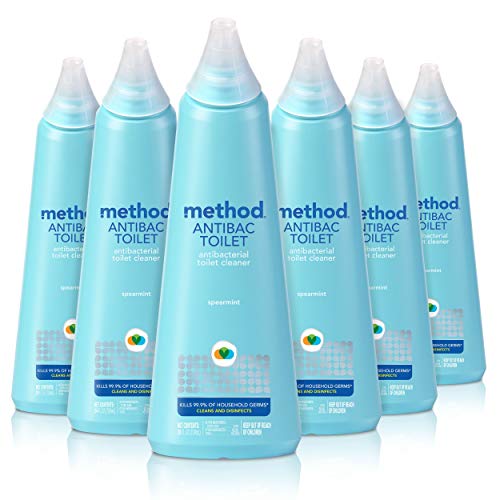
method Antibacterial Toilet Bowl Cleaner, Spearmint (6 Pack)
Badge: Best Pragmatist Pole
Strengths
- States clean-and-sanitise action in one step, on bowl, seat and under the rim
- Tough-on-grime positioning suits high-traffic family bowls
- Six-pack format is a complete stocking system for multi-bathroom homes
- Brand’s plant-derived roots place it in the natural aisle honestly, if not at its purist end
Trade-offs
- Antibacterial formula is the compromise: strict plant-only households should choose the tablet pick
- Spearmint is the only scent, at the largest pack commitment in the guide
- A gel’s strength is aim and contact — wasted if flushed through in seconds
| Detail | From the product listing |
|---|---|
| Format | Format: liquid bowl cleaner gel |
| Pack | Pack: six 24 fl oz bottles |
| Scent | Scent: spearmint |
| Antibacterial formula, labelled to kill household germs | Antibacterial formula, labelled to kill household germs |
| Stated use | Stated use: toilet bowls, seats and under the rim |
Method’s six-pack holds the other pole of the category, and this guide links it without embarrassment because its positioning is stated, not smuggled. The brand was built on plant-derived cleaning; this product adds an antibacterial claim for the households — parents of small children, carers, hosts, the immunologically cautious — who will not trade stated sanitising away for any philosophy. Its listing describes one-step cleaning and sanitising of the bowl, seat and under-rim, with a tough-on-grime brief, and the six-bottle format turns that into a system: every bathroom stocked, every clean the same, no cupboard archaeology before guests arrive.
The honest label for this pick is natural-leaning rather than natural-pure, and the guide prints that distinction in the review rather than the footnotes, because a plural roundup earns trust by grading its own picks. If your household’s rule is about avoiding the harshest conventional chemistry while keeping a sanitising step, this is your product and the category’s best bulk buy. If your rule is an ingredient exclusion list, the tablet above is your product. Both rules are respectable; confusing them is the only mistake.
On the facts, the method Antibacterial Toilet Bowl Cleaner, Spearmint (6 Pack) is the same spearmint antibacterial bowl gel, sold as a six-bottle pack for multi-bathroom homes, rentals and anyone who stocks cleaning supplies in bulk. It defines the category’s pragmatic boundary — linked, with the boundary printed on it. The listing details in the spec box above are the whole of what the maker states about size, format and intended use, and this guide deliberately goes no further than those stated details: no performance percentages, no laboratory claims and no invented specifications have been added. Read them as a description of what the product is designed to do, then match that design honestly against the problem in your bathroom before you buy.
Best for: households that require stated antibacterial action within a gentler brand, at bulk scale / Not suited for: strict ingredient-exclusion households
Roebic K-97 Main Line Cleaner
Badge: Prose-Only: Pipe, Not Bowl
Strengths
- A genuinely biological formula from a specialist maker
- Addresses the main line, the most consequential pipe in the house
- Helps prevent the sewer and septic clogs that back up into toilets
Trade-offs
- Produces no visible cleaning effect in a bowl, ever — that is not its stage
- Works over days inside a closed pipe
- Fails screen one of this guide: not a bowl cleaner
| Detail | From the product listing |
|---|---|
| Format | Format: bacteria and enzyme liquid |
| Bottle size | Bottle size: 32 fl oz |
| Stated purpose | Stated purpose: main line cleaning |
| Stated action | Stated action: breaks down organic build-up |
| Stated benefit | Stated benefit: helps prevent sewer and septic line clogs |
Roebic K-97 is the friendliest failure in this guide: a bacteria-and-enzyme main-line cleaner whose method — living biology digesting organic build-up — is arguably the most natural technology on this page. It fails on geography. Poured into a toilet, it transits the bowl in seconds and goes to work in the main line, where its benefits are real and invisible. A shopper who bought it to remove a ring or freshen a bowl would conclude, wrongly, that either the product or the natural idea itself does not work. Both conclusions would be category errors, and this review exists to prevent them.
Buy it, by all means, when the problem is the line: toilets and drains slowing together, a septic system to protect, a history of deep clogs. In that story it is a leading product. In this guide’s story — cleaners that scrub, stain-treat and freshen the porcelain a person can see — it has no role, and linking it here would be precisely the kind of keyword-matching dishonesty this roundup was written to refuse.
On the facts, the Roebic K-97 Main Line Cleaner is a bacteria-and-enzyme liquid made for the main sewer or septic line rather than a single fixture, where it breaks down organic build-up over time. The listing details in the spec box above are the whole of what the maker states about size, format and intended use, and this guide deliberately goes no further than those stated details: no performance percentages, no laboratory claims and no invented specifications have been added. Read them as a description of what the product is designed to do, then match that design honestly against the problem in your bathroom before you buy.
Best for: recognition only — main-line and septic maintenance, on its own category’s terms / Not suited for: any visible bowl-cleaning purpose
Prose-only pick: no Amazon link or product image is shown for this product in this guide, for the reason recorded in the article sources file. It is covered so you can recognise it on a shelf and judge it against the linked picks.
Green Gobbler Enzyme Drain Cleaner
Badge: Prose-Only: Drain, Not Bowl
Strengths
- Positioned as an alternative to caustic chemicals — philosophically adjacent to this guide
- Targets oils and fats, the drain system’s signature build-up
- A gallon covering up to eight treatments is serious maintenance value
Trade-offs
- Its stage is the inside of drains and traps, not the bowl’s surface
- Enzyme pace is days; a cleaning session is minutes
- Fails screen one of this guide: not a bowl cleaner
| Detail | From the product listing |
|---|---|
| Format | Format: enzyme liquid drain cleaner |
| Bottle size | Bottle size: 1 gallon |
| Stated yield | Stated yield: up to 8 treatments |
| Stated targets | Stated targets: oils and fats |
| Stated uses | Stated uses: grease traps and septic tanks |
| Stated safe for pipes; anti-glug bottle design | Stated safe for pipes; anti-glug bottle design |
| Maker positioning | Maker positioning: an alternative to caustic chemicals |
The Green Gobbler gallon repeats Roebic’s lesson at a different address: drains, grease traps and septic tanks, where its enzymes break down the oils and fats that coat pipe walls. Its positioning as an alternative to caustic chemicals will catch the natural shopper’s eye first — it is meant to — and the product honours that positioning in its own territory. But territory is the whole question in this roundup. Nothing in its stated job involves a bowl’s porcelain, a ring stain, a rim jet or a seat, and a gallon of it will not clean any of those things.
The transferable skill is reading past philosophy to function. Two products can share an enzyme philosophy and share nothing else; one maintains a drain system beautifully while the other scrubs a bowl. Keep this gallon for the system it names — it is a good product there — and let the two linked picks handle the porcelain. A household running both is not confused; it is correctly equipped at two different stages of the same plumbing.
On the facts, the Green Gobbler Enzyme Drain Cleaner is a gallon of enzyme cleaner that digests oils and fats in drains, grease traps and septic systems, positioned by its maker as an alternative to caustic chemicals. The listing details in the spec box above are the whole of what the maker states about size, format and intended use, and this guide deliberately goes no further than those stated details: no performance percentages, no laboratory claims and no invented specifications have been added. Read them as a description of what the product is designed to do, then match that design honestly against the problem in your bathroom before you buy.
Best for: recognition only — enzyme maintenance of drains, traps and septic systems / Not suited for: bowl cleaning of any kind
Prose-only pick: no Amazon link or product image is shown for this product in this guide, for the reason recorded in the article sources file. It is covered so you can recognise it on a shelf and judge it against the linked picks.
Drano FlowGuard Build-Up Remover
Badge: Prose-Only: Build-Up Remover, Not Bowl Cleaner
Strengths
- Enzyme approach fits the biological school this guide respects
- Listing is commendably honest: it prevents clogs and is not for existing blockages
- Stated safe for pipes, septic systems and toilets
Trade-offs
- Removes build-up inside drains; it does not clean, stain-treat or freshen a bowl’s surface
- Preventive only — useless against today’s visible grime
- Fails screen one of this guide: a pipe treatment, not a bowl cleaner
| Detail | From the product listing |
|---|---|
| Format | Format: enzyme build-up remover |
| Bottle size | Bottle size: 60 oz |
| Active approach | Active approach: enzymes that help prevent clogs |
| Maker-stated limit | Maker-stated limit: helps prevent clogs, not for existing blockages |
| Stated safe for pipes, septic systems and toilets | Stated safe for pipes, septic systems and toilets |
| Stated purpose | Stated purpose: removes drain build-up |
FlowGuard is the subtlest of the three pipe products, because its listing says the words safe for toilets — and means the toilet’s drain, not its bowl. It is an enzyme build-up remover: dosed into the system, it digests the film that narrows pipes, preventing clogs before they form. That is maintenance of the plumbing, performed invisibly, on a schedule. It will not lift a ring, brighten a waterline or leave a bowl looking cleaned, because none of those surface jobs is in its stated brief, and its maker deserves credit for printing the product’s limits — not for existing blockages — in plain sight.
Its prose place here completes the pipe trio and sharpens the roundup’s central distinction: inside the pipe versus on the porcelain. Natural shoppers meet this distinction everywhere, because biological products are marketed with the same green visual language whether they treat a surface or a system. Read for the stage, not the colour scheme, and you will never buy a build-up remover to do a bowl cleaner’s job — or blame it, afterwards, for declining to.
On the facts, the Drano FlowGuard Build-Up Remover is an enzyme treatment that removes the gradual build-up inside drains before it becomes a blockage, and whose own packaging is honest that it is not for existing blockages. The listing details in the spec box above are the whole of what the maker states about size, format and intended use, and this guide deliberately goes no further than those stated details: no performance percentages, no laboratory claims and no invented specifications have been added. Read them as a description of what the product is designed to do, then match that design honestly against the problem in your bathroom before you buy.
Best for: recognition only — scheduled prevention of drain build-up / Not suited for: visible bowl cleaning, stain removal or freshening
Prose-only pick: no Amazon link or product image is shown for this product in this guide, for the reason recorded in the article sources file. It is covered so you can recognise it on a shelf and judge it against the linked picks.
Drano Max Gel Drain Clog Remover
Badge: Prose-Only: Not a Natural Cleaner
Strengths
- In its own category — conventional drain gels — it is a leading, clearly labelled product
- Stated to cut through standing water to reach organic clogs
- Stated safe for all pipes and septic systems
Trade-offs
- It is not a natural cleaner under any definition this guide uses — the opposite school entirely
- It is also a drain gel, not a bowl cleaner, so it fails both screens
- Strong chemistry near a natural routine defeats the routine’s purpose
| Detail | From the product listing |
|---|---|
| Format | Format: pourable gel clog remover |
| Bottle size | Bottle size: 32 oz |
| Stated targets | Stated targets: hair, grease, soap and food clogs |
| Stated to cut through standing water | Stated to cut through standing water |
| Stated safe for all pipes and septic systems | Stated safe for all pipes and septic systems |
| Label positioning | Label positioning: kitchen and bath drains, with pipe-corrosion protection |
Drano Max Gel closes the reviews as the control sample: the conventional product against which the word natural is defined. It is a strong gel for hair, grease, soap and food clogs in drains, made to cut through standing water — competent, popular, and entirely outside this keyword. It fails screen two absolutely, because nothing in its positioning is natural-school; it also fails screen one, being a drain product rather than a bowl cleaner. Its inclusion in the verified pool is the most useful accident in this guide, because it lets the roundup show its work: a product can be famous, effective and highly rated in its own aisle and still be a wrong answer here, twice over.
Nothing in this verdict disparages the product in its own category, where a household with a hair-choked drain and no natural commitments may choose it rationally. But a household building a natural routine should understand that one bottle of caustic gel in the cupboard changes the cupboard: it tempts shortcuts, it cannot be mixed or sequenced casually with biological products, and its presence usually signals that the routine, not the product shelf, needs attention. The natural school’s answer to a clogged drain is in the prose reviews above it — enzymes, patience, and prevention.
On the facts, the Drano Max Gel Drain Clog Remover is a thick gel formula that the maker positions for tough hair, grease, soap and food clogs, including clogs sitting under standing water. The listing details in the spec box above are the whole of what the maker states about size, format and intended use, and this guide deliberately goes no further than those stated details: no performance percentages, no laboratory claims and no invented specifications have been added. Read them as a description of what the product is designed to do, then match that design honestly against the problem in your bathroom before you buy.
Best for: recognition only — conventional drain clearing, outside this guide’s brief entirely / Not suited for: any natural-cleaning purpose, and any bowl-cleaning purpose
Prose-only pick: no Amazon link or product image is shown for this product in this guide, for the reason recorded in the article sources file. It is covered so you can recognise it on a shelf and judge it against the linked picks.
Comparison Table
The table grades every pool product against this keyword’s two screens, so the two linked rows and the four prose rows can be audited at a glance. This is the whole method of the guide on one page.
| Product | Size / pack | Standout point | Listing |
|---|---|---|---|
| BLUELAND Toilet Bowl Cleaner Tablets | 28 tablets | Ingredient and waste purity, with the mineral stains named as the job | Check on Amazon |
| method Antibacterial Toilet Bowl Cleaner, Spearmint (6 Pack) | 24 fl oz bottles, pack of 6 | Stated sanitising action, bought in bulk, inside a natural-leaning brand | Check on Amazon |
| Roebic K-97 Main Line Cleaner | 32 fl oz bottle | Main-line bacteria and enzymes, working invisibly inside the sewer line | Prose only |
| Green Gobbler Enzyme Drain Cleaner | 1 gallon bottle | Enzyme digestion of oils and fats in drains, traps and septic tanks | Prose only |
| Drano FlowGuard Build-Up Remover | 60 oz bottle | Enzyme prevention of drain build-up, on a dosing schedule | Prose only |
| Drano Max Gel Drain Clog Remover | 32 oz bottle | Conventional gel chemistry for hair, grease and soap clogs in drains | Prose only |
How to Choose the Best Natural Cleaners for Toilets
Run the two screens in order, on any product, anywhere. Screen one: is it a bowl cleaner? The listing will say bowl, rim, seat or stains if it is; it will say drain, pipe, line, trap or septic if it is not. Screen two: is it natural by your household’s definition? Look for stated positioning — plant-based, biobased, essential oils, plastic-free, named ingredient exclusions — and treat a green colour scheme or a leaf motif as decoration, not evidence. A product that passes both screens is a candidate. A product that passes one is a different purchase wearing this keyword’s clothes, and it should be bought, if at all, under its own name.
Then grade by soil. The natural school’s honest territory is maintenance soil: weekly grime, fresh rings, light limescale, ordinary odour. Within that territory, choose by your dominant stain — mineral households toward the products that name limescale and rings, family households toward the one that states sanitising, waste-led households toward the plastic-free format. Outside that territory — built scale, a season of neglect — plan a restoration first, with repeated gel treatments or the mechanical step from the mineral deposit guide, and only then install a natural routine to hold the recovered standard.
Price the system, not the bottle. A natural routine consumes product steadily and predictably, so pack format and per-bathroom stationing dominate the real cost: a bulk gel that is always present beats a premium single that runs out and gets replaced in a panic by whatever the corner shop stocks. Tablets invert the maths — no bottle, no storage, a count you can plan by. Either way, check the current price on Amazon for the pick that passes your screens, and buy the format that matches your household’s geography and rhythm rather than the format with the most impressive shelf presence.
Finally, protect the routine from its two assassins: impatience and contamination. Impatience judges a maintenance system by a rescue test and abandons it in week one. Contamination keeps a caustic gel in the same cupboard, reaches for it once, and resets the biological, habitual and psychological basis of the switch. Decide the trial period in advance — a month of weekly use — clear the cupboard accordingly, and let the routine be judged on the territory it claims.
How to Run a Natural Toilet-Cleaning Routine
A routine, written down, is what separates households that succeed with natural cleaners from households that merely bought some. This is the routine the linked picks are built for.
- Pick your pole first: tablets for the purist household, the antibacterial gel for the pragmatist one — and commit for a month before judging.
- Station the product in the bathroom it serves, with its brush. A cleaner stored elsewhere is a cleaner used eventually.
- Weekly, wet the bowl with a flush, then apply: tablet dropped in to dissolve, or gel under the rim and around the waterline.
- Give the product its full stated contact time, and spend the wait on the seat, lid, base and exterior with a cloth.
- Brush thoroughly — rim jets, waterline, trap entrance — in slow, complete circles.
- Flush, inspect in good light, and re-treat a surviving mark next session rather than escalating today.
- Monthly, do the low-water treatment on any forming ring: water level down, product on the stain undiluted, longer wait, brush, flush.
- Seasonally, check the tank: a leaking flapper or rusting part is a stain factory no cleaner outruns.
- Keep the cupboard honest: no caustic rescue gel beside the natural stock, so the routine is never one bad morning from abandonment.
- Review at the month mark: if the bowl has held its standard on the routine, the switch has worked — restock in the format that fits.
Notice what this routine never does: it never mixes products, never doubles doses in frustration, and never asks a maintenance cleaner to perform a rescue. Those three restraints are the difference between the natural school as a system and the natural school as a shopping phase. Keep them, and the products in this guide are more than sufficient; break them, and no product in any school will save the routine.
Troubleshooting
Problem: a ring keeps forming despite weekly tablets → the water is hard and the ring is winning on contact time; add a monthly low-water gel-style treatment with a tablet dissolved in a lowered bowl, and check the flapper for a mineral-feeding leak.
Problem: the household keeps reaching for a conventional spray for the seat and exterior → that is a routine-design issue, not a discipline issue; station a suitable general bathroom cleaner from the same natural school beside the bowl product so the nearest product is an acceptable one.
Problem: a family member declares natural does not work → ask which job failed: a pipe problem judged in the bowl, a rescue judged as maintenance, or a scent nobody likes. Each has a different fix, and two of the three are not the cleaner’s fault.
Reading a Natural Label Like an Auditor
Natural claims live on a ladder of specificity, and shoppers should learn to hear the rungs. At the top are checkable statements: named exclusions (no chlorine bleach, dyes, ammonia or parabens), stated formats (plastic-free), stated positioning (biobased, plant-based, made with essential oils) and stated septic compatibility. In the middle are brand reputations — makers whose whole catalogue argues their intent, which is evidence, but of a softer kind. At the bottom are pure signals: green packaging, leaf imagery, words like pure and simple with no stated content behind them. The two linked picks in this guide were linked on top-rung evidence; the prose-only verdicts show what happens to products whose evidence points at a different category altogether.
Apply the ladder beyond this guide and it keeps working: a product whose listing states its targets, its exclusions and its limits is a product whose maker expects to be checked. In the natural aisle, that expectation is the closest thing to a certification a shopper can hold in one hand — and it is free, printed on every listing, waiting to be read.
Why This Guide Links Two Products, and Why That Is the Point
A roundup that links everything it reviews teaches nothing except abundance. This one began with six verified products and linked two, and the four refusals carry the information: three products were the wrong stage of the plumbing, and one was the wrong school of chemistry. Those are the two errors that account for nearly every disappointed natural-cleaning purchase — buying a pipe product for a bowl, or buying a conventional product in natural colours. A reader who internalises the two screens will make neither error again, in this category or any adjacent one.
There is a quieter benefit: honesty compounds. A guide that refuses four links it could have taken is a guide whose two remaining links mean something, and a shopper who trusts the refusals can act on the recommendations without a second research project. That is the transaction this series aims for on every keyword — fewer, better-supported recommendations, with the reasoning left visible on the page.
Common Buying Mistakes
Mistake one: buying by philosophy instead of function. An enzyme is a beautiful idea that does nothing visible in a bowl; check the product’s stage before its school.
Mistake two: trusting colour over language. Green packaging is a design choice; stated exclusions and stated targets are evidence. Buy the evidence.
Mistake three: keeping a caustic gel as a backup. One rescue pour resets the routine’s habits and its biology; if a rescue is truly needed, it is a signal about the routine or the plumbing, not a shopping event.
Mistake four: judging at week one. Natural routines are month-shaped. Decide the trial in advance and hold it.
Mistake five: assuming natural means surface-safe everywhere. These are toilet products with toilet directions; other fixtures and materials need their own stated approvals.
Final Recommendation
Buy BLUELAND Toilet Bowl Cleaner Tablets (Check on Amazon) if your household’s natural rule is written as an ingredient and waste list — it is the purest stated answer in the category and its mineral targets are the right ones. Buy method Antibacterial Toilet Bowl Cleaner, Spearmint (6 Pack) (Check on Amazon) if your rule is gentler-mainstream with a stated sanitising step, kept in stock at bulk scale. Either purchase, run as the routine in this guide, will hold a toilet clean without conventional chemistry. And leave the four prose-only products to their own aisles, where three of them are genuinely excellent and the fourth is at least honestly labelled — for a different job than yours.
The shortest summary of this entire roundup fits on an index card: bowl, not pipe; stated, not coloured; routine, not rescue. Shop by it and the natural aisle stops being confusing.
Frequently Asked Questions
How many of these products are actually natural toilet cleaners?
Two of the six reviewed, by this guide’s two screens: the BLUELAND tablets, which state plastic-free format and named ingredient exclusions alongside mineral targets, and the method six-pack, an antibacterial gel from a plant-derived brand, linked with that distinction stated. Three pool products are biological pipe treatments — natural in method, wrong in stage — and one is a conventional caustic gel. The prose reviews explain each verdict in full.
Are enzyme cleaners natural toilet cleaners?
They are natural-method products for pipes, not cleaners for toilets in the bowl sense. Enzymes digest organic build-up inside drains, lines and tanks over hours and days; they do not scrub, stain-treat or freshen porcelain. Households often own both kinds — an enzyme for the system, a gel or tablet for the bowl — and the mistake this guide exists to prevent is expecting either to do the other’s job.
Do natural cleaners kill germs?
Most plant-based and biobased bowl cleaners are positioned as cleaners, and their listings are quoted that way here. The method pick in this guide states antibacterial, clean-and-sanitise action, which is why it anchors the pragmatist end of the category. Households with a specific sanitising requirement should buy on a stated claim like that one, and should also value thorough, frequent ordinary cleaning, which does much of the practical work in any bathroom.
What is the best natural cleaner for hard water rings?
Of the linked picks, the BLUELAND tablets name limescale, rust, hard water and ring stains directly as targets, which is the strongest stated claim in this line-up. Technique decides the rest: treat early, lower the water for ring work, honour contact time, and repeat weekly. Built scale that survives a month of that rhythm needs the mechanical step described in the mineral deposit guide before any natural cleaner maintains the result.
Can natural cleaners be used in a home with a septic tank?
The linked tablet pick states septic-safe positioning, and the natural school’s bleach-free, modest-dose rhythm is the tank-friendly pattern generally. Check each product’s own listing statement before buying, keep doses as directed, and remember that the biological pipe products reviewed in prose here are the ones actually aimed at the septic system itself — as maintenance, not as bowl cleaners.
Why not just use the strongest cleaner occasionally?
Because the strongest-cleaner strategy is what produces the problems this category solves: harsh storage, harsh smells, chemistry that cannot be mixed or sequenced casually, and bowls that swing between neglected and blitzed. The natural routine trades peak force for frequency, and on a weekly rhythm it holds a higher average standard with a calmer cupboard. Households that try both systems for a month each rarely return to the blitz.


