Disclosure: topratedkitchenware.com is reader-supported. When you buy through links on our site, we may earn an affiliate commission from Amazon and other retailers, at no extra cost to you.
Where to buy
Shopping for the best macerating composting toilets means comparing fixtures you will live with for years, so every pick below is sold through Amazon, where you can confirm the exact configuration, check dimensions against your space, and read recent owner feedback before you commit. Here are the six models covered in full below:
- VEVOR 700W Macerating Toilet System — Check on Amazon
- Simple Project 750W PRO Macerating Toilet System
- SUPERFLO 750W Macerating Toilet System
- SUPERFLO 600W Macerating Toilet System
- Simple Project Upgrade 600W Macerating Toilet System
- Simple Project 600W Macerating Toilet System (2-Piece Kit)
Read the full guide ↓
If you are searching for the best macerating composting toilets, you have probably already discovered that this category rewards careful reading more than almost any other bathroom purchase. Shoppers often run these two technologies together, so this guide is honest about the split from the start: the six picks below are macerating (upflush) systems, which grind waste and pump it to an existing drain, while true composting toilets are dry systems that need no drain at all. if your space has power and a drain somewhere in the building, a macerating system behaves most like a normal bathroom. if it has neither, skip to the dry-toilet discussion in the fit sections below. This guide is built for a room where a conventional gravity drain is missing, too far away, or below the level of the sewer line, and every recommendation below is judged against that setting first, not against a showroom checklist.
What follows is a research-led comparison of six options, with honest trade-offs stated plainly for each one. You will find what each model does well, where it asks something of you in return, and which type of household it genuinely suits. If you are also weighing nearby options, our notes on Best Macerating Rv Toilets cover the adjacent category in the same detail.
Key Takeaways
- A macerating system trades a gravity drain for a pump, which is what makes below-grade and far-from-stack bathrooms possible.
- Pump wattage, inlet count, and venting decide real-world satisfaction far more than bowl styling does.
- Every pick needs power and a discharge route; walk both paths on paper before ordering anything.
- These systems digest waste and toilet paper only. Everything else is a jam waiting for a bad moment.
- The best first choice for most readers is the first pick below; stronger pumps and extra inlets earn their place in bigger projects.
In this guide
Quick Picks
| Pick | Badge | Where to check it |
|---|---|---|
| VEVOR 700W Macerating Toilet System | Best Overall | Check on Amazon |
| Simple Project 750W PRO Macerating Toilet System | Most Powerful Pump | Check on Amazon |
| SUPERFLO 750W Macerating Toilet System | Best Multi-Fixture Capacity | Check on Amazon |
| SUPERFLO 600W Macerating Toilet System | Best One-Piece Layout | Check on Amazon |
| Simple Project Upgrade 600W Macerating Toilet System | Best Venting Setup | Check on Amazon |
| Simple Project 600W Macerating Toilet System (2-Piece Kit) | Best Established Kit | Check on Amazon |
The badges above are used consistently through the detailed reviews, so you can track a pick from this table to its full section without losing the thread. Readers comparing system layouts often also look at Best Macerator Toilets, which approaches the same rooms from a different angle.
How These Picks Were Chosen
This guide was built by comparing the verified listings for this product family feature by feature: for each candidate we recorded the form, the power or capacity figures actually named in its listing, and the operating requirements it places on the room. Products were then ranked for a room where a conventional gravity drain is missing, too far away, or below the level of the sewer line, because a toilet that delights in a large suburban suite can be the wrong answer in a basement, a conversion, or a cabin.
Three filters did most of the work. First, core-attribute honesty: a pick has to be the kind of product the keyword actually describes, and anything that only looked the part was demoted or, in one case in this series of guides, held to prose-only coverage with the reason stated in its review. Second, ownership burden: we weighted emptying, cleaning, power, venting, and service access as heavily as headline features, because those are what owners talk about a year in. Third, listing transparency: models whose titles state concrete figures, dimensions, wattage, capacity, or flush data, were easier to recommend honestly than models described only in adjectives.
A note on method and limits: this is research-based guidance, not a hands-on laboratory test, and we do not claim to have installed every unit in a test bathroom. Where a figure appears in a spec box below, it comes from the verified listing data for that product. Where the listing is silent, we say nothing rather than invent a number, and we suggest confirming the detail on the product page before ordering, especially dimensions and electrical requirements.
Finally, each article in this series is written for its own search, not copied from a sibling. A shopper arriving here cares about the best macerating composting toilets question specifically, so the ranking below is weighted for that question: the same product can place differently in a neighboring guide whose setting, budget logic, or headline constraint is different, and that is deliberate rather than inconsistent.
The 6 Best Macerating Composting Toilets

VEVOR 700W Macerating Toilet System
Badge: Best Overall
Strengths
- Includes a dual flush that keeps light flushes light.
- Includes a 700W macerator pump, at the stronger end of residential upflush power.
- Includes three inlet connections for the toilet plus additional fixtures.
Trade-offs
- The pump needs power, so the bathroom depends on an outlet and a working circuit.
- A macerator cycle is audible in a way a gravity flush is not, even on quiet-rated designs.
- Only waste and toilet paper belong in the bowl; wipes and hygiene products can jam the blade.
At a glance:
- Macerator pump listed: 700W
- Inlets listed: 3
- Flush: dual flush
- Brand: VEVOR
The VEVOR 700W Macerating Toilet System earns its place here on the strength of what its listing actually promises: a dual flush that keeps light flushes light; a 700W macerator pump, at the stronger end of residential upflush power; three inlet connections for the toilet plus additional fixtures. In practice that combination is aimed squarely at a room where a conventional gravity drain is missing, too far away, or below the level of the sewer line. Buyers in that setting tend to care less about novelty and more about whether the daily routine stays uneventful week after week, and this is the ground on which this model makes its case.
Day to day, expect the experience of the VEVOR 700W Macerating Toilet System to be defined by its strongest listed features rather than by any single headline. The design choices visible in the listing, its form, its controls or connections, and the figures the maker chose to publish, all point the same way: this is a considered option for its badge category, not a random badge collector. It also plays well with the realities of its setting, where space, power, water, and waste handling each impose limits that a conventional bathroom never thinks about.
The honest limitation is the mirror image of its strengths. The pump needs power, so the bathroom depends on an outlet and a working circuit, and that is not a footnote; for some households it will be the deciding factor, and it should be weighed before ordering rather than discovered during installation. Households whose situation clashes with that limitation should look seriously at the neighboring picks in this guide, several of which trade places on exactly this point.
Ownership, as opposed to installation day, is where the VEVOR 700W Macerating Toilet System should be judged. The routine it imposes is predictable, and the models that age best in this category are the ones whose core function never needs explaining twice. Its case rests on fundamentals, its form, its listed figures, and its fit for the room, rather than on a novelty that could wear thin by the second month.
Best for: buyers who want best overall performance in a room where a conventional gravity drain is missing, too far away, or below the level of the sewer line / Not suited for: anyone unwilling to accept the main trade-off above
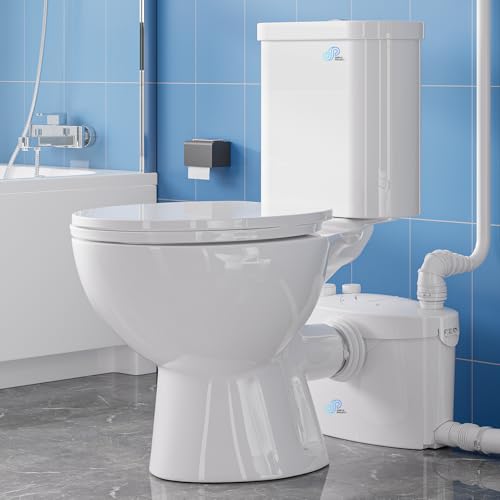
Simple Project 750W PRO Macerating Toilet System
Badge: Most Powerful Pump
Strengths
- Includes a dual flush that keeps light flushes light.
- Includes a 750W macerator pump, the strongest class in this guide.
- Includes four inlet connections, enough for a toilet plus a full set of bathroom fixtures.
Trade-offs
- The pump unit adds a service item behind or beside the bowl that a normal toilet does not have.
- Discharge and vent routing still need planning, even though no floor has to be broken.
- Guests need one sentence of instruction: treat it like a toilet, not a disposal.
At a glance:
- Macerator pump listed: 750W
- Inlets listed: 4
- Flush: dual flush
- Brand: Simple Project
The Simple Project 750W PRO Macerating Toilet System earns its place here on the strength of what its listing actually promises: a dual flush that keeps light flushes light; a 750W macerator pump, the strongest class in this guide; four inlet connections, enough for a toilet plus a full set of bathroom fixtures. That feature set maps directly onto a room where a conventional gravity drain is missing, too far away, or below the level of the sewer line, which is the test this guide applies to every pick. The question is never whether a feature sounds impressive in a listing, but whether it will still be earning its place on an ordinary Tuesday six months from now.
In daily use, the Simple Project 750W PRO Macerating Toilet System will be judged on rhythm rather than spectacle: how naturally it fits the morning routine, how little attention it demands between uses, and how calmly it handles the unglamorous jobs. Its listing emphasizes a dual flush that keeps light flushes light, and that emphasis shows in where the design effort went. For a room where a conventional gravity drain is missing, too far away, or below the level of the sewer line, that priorities-in-the-right-order quality matters more than any single extra function.
The honest limitation is the mirror image of its strengths. The pump unit adds a service item behind or beside the bowl that a normal toilet does not have, and that is not a footnote; for some households it will be the deciding factor, and it should be weighed before ordering rather than discovered during installation. Households whose situation clashes with that limitation should look seriously at the neighboring picks in this guide, several of which trade places on exactly this point.
Look past the first week and the Simple Project 750W PRO Macerating Toilet System asks for a steady, unremarkable routine: use it as intended, keep up the simple care its type requires, and it should stay in the background of the household, which is exactly where a toilet belongs. That steadiness, more than any feature, is what its badge is really claiming.
Best for: buyers who want most powerful pump performance in a room where a conventional gravity drain is missing, too far away, or below the level of the sewer line / Not suited for: anyone unwilling to accept the main trade-off above

SUPERFLO 750W Macerating Toilet System
Badge: Best Multi-Fixture Capacity
Strengths
- Includes a 750W macerator pump, the strongest class in this guide.
- Includes four water inlets, enough for a toilet plus a full set of bathroom fixtures.
- Includes upflush discharge that can pump waste upward to a drain above the bathroom’s level.
Trade-offs
- A power cut pauses the bathroom entirely, which matters more in some rooms than others.
- The discharge pipe run should stay accessible where possible; burying every joint invites future demolition.
- Pump cycling adds a small, ongoing electricity cost that a gravity toilet never charges.
At a glance:
- Macerator pump listed: 750W
- Inlets listed: 4
- Brand: SUPERFLO
The SUPERFLO 750W Macerating Toilet System earns its place here on the strength of what its listing actually promises: a 750W macerator pump, the strongest class in this guide; four water inlets, enough for a toilet plus a full set of bathroom fixtures; upflush discharge that can pump waste upward to a drain above the bathroom’s level. Judged for a room where a conventional gravity drain is missing, too far away, or below the level of the sewer line, the appeal is concrete rather than cosmetic: the listed strengths solve the problems that setting actually creates, and the spec box below shows the figures the maker was willing to commit to in writing.
What owners tend to notice after the first month is not the headline feature but the absence of friction, and the SUPERFLO 750W Macerating Toilet System is specified in that spirit. Nothing in its listing suggests a product trying to be clever at the expense of the basics; the published figures and the form both serve the core job first. Readers whose setting matches its badge should read the trade-off list below as the real decision document, because that is where this model asks for something back.
The honest limitation is the mirror image of its strengths. A power cut pauses the bathroom entirely, which matters more in some rooms than others, and that is not a footnote; for some households it will be the deciding factor, and it should be weighed before ordering rather than discovered during installation. Households whose situation clashes with that limitation should look seriously at the neighboring picks in this guide, several of which trade places on exactly this point.
Long-term satisfaction with the SUPERFLO 750W Macerating Toilet System will hinge on fit rather than features: fit with the room’s dimensions, fit with the household’s habits, and fit with the service routine its type demands. Where those three fits line up, this is the kind of purchase owners stop thinking about, in the best possible sense.
Best for: buyers who want best multi-fixture capacity performance in a room where a conventional gravity drain is missing, too far away, or below the level of the sewer line / Not suited for: anyone unwilling to accept the main trade-off above

SUPERFLO 600W Macerating Toilet System
Badge: Best One-Piece Layout
Strengths
- Includes a 600W macerator pump sized for a standard residential bathroom.
- Includes three water inlets for the toilet plus additional fixtures.
- Includes a rear-outlet bowl designed to connect straight into the macerator unit.
Trade-offs
- In very cold outbuildings, the unit and its lines need the same freeze thinking as any plumbing.
- Replacement pumps and seals are brand-specific parts, ordered rather than grabbed off a shelf.
- The system rewards a careful installer; sloppy pipe support turns into noise and vibration complaints.
At a glance:
- Macerator pump listed: 600W
- Inlets listed: 3
- Layout: one-piece system
- Brand: SUPERFLO
The SUPERFLO 600W Macerating Toilet System earns its place here on the strength of what its listing actually promises: a 600W macerator pump sized for a standard residential bathroom; three water inlets for the toilet plus additional fixtures; a rear-outlet bowl designed to connect straight into the macerator unit. In practice that combination is aimed squarely at a room where a conventional gravity drain is missing, too far away, or below the level of the sewer line. Buyers in that setting tend to care less about novelty and more about whether the daily routine stays uneventful week after week, and this is the ground on which this model makes its case.
Day to day, expect the experience of the SUPERFLO 600W Macerating Toilet System to be defined by its strongest listed features rather than by any single headline. The design choices visible in the listing, its form, its controls or connections, and the figures the maker chose to publish, all point the same way: this is a considered option for its badge category, not a random badge collector. It also plays well with the realities of its setting, where space, power, water, and waste handling each impose limits that a conventional bathroom never thinks about.
The honest limitation is the mirror image of its strengths. In very cold outbuildings, the unit and its lines need the same freeze thinking as any plumbing, and that is not a footnote; for some households it will be the deciding factor, and it should be weighed before ordering rather than discovered during installation. Households whose situation clashes with that limitation should look seriously at the neighboring picks in this guide, several of which trade places on exactly this point.
Ownership, as opposed to installation day, is where the SUPERFLO 600W Macerating Toilet System should be judged. The routine it imposes is predictable, and the models that age best in this category are the ones whose core function never needs explaining twice. Its case rests on fundamentals, its form, its listed figures, and its fit for the room, rather than on a novelty that could wear thin by the second month.
Best for: buyers who want best one-piece layout performance in a room where a conventional gravity drain is missing, too far away, or below the level of the sewer line / Not suited for: anyone unwilling to accept the main trade-off above

Simple Project Upgrade 600W Macerating Toilet System
Badge: Best Venting Setup
Strengths
- Includes a 600W macerator pump sized for a standard residential bathroom.
- Includes three water inlets for the toilet plus additional fixtures.
- Includes upflush discharge that can pump waste upward to a drain above the bathroom’s level.
Trade-offs
- Descaling and seal care are periodic jobs that a conventional toilet simply does not have.
- A rental or guest setting multiplies the flush-rule risk, because not everyone reads the note.
- The bowl selection within a kit is narrower than the open market for conventional toilets.
At a glance:
- Inlets listed: 3
- Brand: Simple Project
The Simple Project Upgrade 600W Macerating Toilet System earns its place here on the strength of what its listing actually promises: a 600W macerator pump sized for a standard residential bathroom; three water inlets for the toilet plus additional fixtures; upflush discharge that can pump waste upward to a drain above the bathroom’s level. That feature set maps directly onto a room where a conventional gravity drain is missing, too far away, or below the level of the sewer line, which is the test this guide applies to every pick. The question is never whether a feature sounds impressive in a listing, but whether it will still be earning its place on an ordinary Tuesday six months from now.
In daily use, the Simple Project Upgrade 600W Macerating Toilet System will be judged on rhythm rather than spectacle: how naturally it fits the morning routine, how little attention it demands between uses, and how calmly it handles the unglamorous jobs. Its listing emphasizes a 600W macerator pump sized for a standard residential bathroom, and that emphasis shows in where the design effort went. For a room where a conventional gravity drain is missing, too far away, or below the level of the sewer line, that priorities-in-the-right-order quality matters more than any single extra function.
The honest limitation is the mirror image of its strengths. Descaling and seal care are periodic jobs that a conventional toilet simply does not have, and that is not a footnote; for some households it will be the deciding factor, and it should be weighed before ordering rather than discovered during installation. Households whose situation clashes with that limitation should look seriously at the neighboring picks in this guide, several of which trade places on exactly this point.
Look past the first week and the Simple Project Upgrade 600W Macerating Toilet System asks for a steady, unremarkable routine: use it as intended, keep up the simple care its type requires, and it should stay in the background of the household, which is exactly where a toilet belongs. That steadiness, more than any feature, is what its badge is really claiming.
Best for: buyers who want best venting setup performance in a room where a conventional gravity drain is missing, too far away, or below the level of the sewer line / Not suited for: anyone unwilling to accept the main trade-off above

Simple Project 600W Macerating Toilet System (2-Piece Kit)
Badge: Best Established Kit
Strengths
- Includes a 600W macerator pump sized for a standard residential bathroom.
- Includes four water inlets, enough for a toilet plus a full set of bathroom fixtures.
- Includes upflush discharge that can pump waste upward to a drain above the bathroom’s level.
Trade-offs
- Cycle frequency follows use, so a busy family bathroom works the pump harder than a workshop toilet.
- Sound carries through lightweight partition walls more than through masonry, a layout consideration.
- If the building later gets a proper gravity renovation, the macerating system becomes redundant by design.
At a glance:
- Inlets listed: 4
- Layout: two-piece kit
- Brand: Simple Project
The Simple Project 600W Macerating Toilet System (2-Piece Kit) earns its place here on the strength of what its listing actually promises: a 600W macerator pump sized for a standard residential bathroom; four water inlets, enough for a toilet plus a full set of bathroom fixtures; upflush discharge that can pump waste upward to a drain above the bathroom’s level. Judged for a room where a conventional gravity drain is missing, too far away, or below the level of the sewer line, the appeal is concrete rather than cosmetic: the listed strengths solve the problems that setting actually creates, and the spec box below shows the figures the maker was willing to commit to in writing.
What owners tend to notice after the first month is not the headline feature but the absence of friction, and the Simple Project 600W Macerating Toilet System (2-Piece Kit) is specified in that spirit. Nothing in its listing suggests a product trying to be clever at the expense of the basics; the published figures and the form both serve the core job first. Readers whose setting matches its badge should read the trade-off list below as the real decision document, because that is where this model asks for something back.
The honest limitation is the mirror image of its strengths. Cycle frequency follows use, so a busy family bathroom works the pump harder than a workshop toilet, and that is not a footnote; for some households it will be the deciding factor, and it should be weighed before ordering rather than discovered during installation. Households whose situation clashes with that limitation should look seriously at the neighboring picks in this guide, several of which trade places on exactly this point.
Long-term satisfaction with the Simple Project 600W Macerating Toilet System (2-Piece Kit) will hinge on fit rather than features: fit with the room’s dimensions, fit with the household’s habits, and fit with the service routine its type demands. Where those three fits line up, this is the kind of purchase owners stop thinking about, in the best possible sense.
Best for: buyers who want best established kit performance in a room where a conventional gravity drain is missing, too far away, or below the level of the sewer line / Not suited for: anyone unwilling to accept the main trade-off above
Comparison Table
| Pick | Badge | Form / type | Defining feature from its listing | Check it |
|---|---|---|---|---|
| VEVOR 700W Macerating Toilet System | Best Overall | 700W | A dual flush that keeps light flushes light | Check on Amazon |
| Simple Project 750W PRO Macerating Toilet System | Most Powerful Pump | 750W | A dual flush that keeps light flushes light | Check on Amazon |
| SUPERFLO 750W Macerating Toilet System | Best Multi-Fixture Capacity | 750W | A 750w macerator pump, the strongest class in this guide | Check on Amazon |
| SUPERFLO 600W Macerating Toilet System | Best One-Piece Layout | 600W | A 600w macerator pump sized for a standard residential bathroom | Check on Amazon |
| Simple Project Upgrade 600W Macerating Toilet System | Best Venting Setup | 3 | A 600w macerator pump sized for a standard residential bathroom | Check on Amazon |
| Simple Project 600W Macerating Toilet System (2-Piece Kit) | Best Established Kit | 4 | A 600w macerator pump sized for a standard residential bathroom | Check on Amazon |
Read the table as a map, not a verdict: the right row is the one whose form and defining feature match your room, your power situation, and your tolerance for routine chores. If two rows still look tied after that, the detailed reviews above separate them on trade-offs, which is where real ownership differences live. Shoppers planning a whole room rather than a single fixture may also find Best Made Toilets useful background.
How to Choose the Right Option Among the Best Macerating Composting Toilets
Map the discharge route before anything else
A macerating system pumps waste through a small discharge pipe that can run upward and then across to the soil stack. On paper, measure the vertical lift from the pump to the stack connection and the horizontal run after it. Staying comfortably inside the system’s class, rather than at its absolute limit, is what separates a quiet, reliable install from one that strains on every cycle.
Match pump power and inlets to the room you are building
A powder room with just a toilet and a small sink asks little of a pump. A full bathroom adding a shower and a laundry connection asks much more, and that is where the stronger pumps and the three- and four-inlet systems in this guide earn their badges. Count the fixtures honestly, including the washing machine you are quietly planning to add next year.
Venting is not optional decoration
The macerator and the fixtures it serves need air. Kits that plan a vent connection into the design make the plumber’s job cleaner and the system’s behavior calmer, with fewer gurgles and slow drains. If a kit’s venting story is vague in its listing, ask the question before purchase, not after the walls are closed.
Bowl choice still matters
Elongated bowls are the comfort default for adults; standard bowls save precious inches in a half bath carved from a closet or under-stair void. One-piece systems look tidier and wipe down faster, while two-piece kits are easier to carry down basement stairs and position in tight rooms. Neither is an upgrade over the other; they solve different rooms.
Respect the blade’s short menu
A macerator is engineered for human waste and toilet paper. Wipes marketed as flushable, hygiene products, cotton items, and dental floss are the classic causes of jams and service calls across every brand in this category. The cheapest macerating toilet to own is the one whose household follows that one rule, so build the rule into the household from day one.
One more filter belongs in every shortlist: the total project around the toilet. Readers planning the wider room at the same time will find Best Management Practices Construction Hawaii Toilets a useful companion read before money is committed.
How to Install a Macerating Toilet System
- Lay out the room on paper first: toilet position, pump position, discharge route to the stack, vent route, and the inlet each extra fixture will use.
- Assemble the bowl and macerator unit dry, without sealant, to confirm clearances, inlet alignment, and access to the pump for future service.
- Run the discharge pipe with smooth, supported rises and no sags where slurry could settle, and connect into the stack with the fitting your local code expects.
- Connect the additional fixtures to their inlets, the vent to its route, and only then make the final sealed connections at the pump.
- Connect power, fill the system with water, and run several test flushes while watching every joint; a macerating install should be proven dry before the room is finished around it.
- Brief the household on the one rule that protects the blade: waste and toilet paper only, nothing else, ever.
Care centers on the pump. Descale on the schedule and with the product class the maker allows, because the wrong chemicals can attack seals and the blade housing. Keep the area around the unit accessible rather than boxing it in permanently, listen for changes in the cycle sound, which is the earliest warning most owners get, and re-teach the waste-and-paper-only rule whenever guests, cleaners, or new tenants enter the picture.
Troubleshooting: three problems owners actually meet
Problem: the pump runs but the bowl clears slowly: stop flushing, check for a blockage at an inlet or a sagging discharge run, and confirm the vent is not blocked; repeated forced flushes turn a small restriction into a flooded floor.
Problem: the motor hums without starting properly: cut power and treat it as a jam until proven otherwise; something outside the waste-and-paper menu is the usual cause, and the unit should be serviced rather than coaxed.
Problem: gurgling from a connected sink or shower: suspect venting or a partially restricted discharge; air has to move for water to move, and a vent or line check by a plumber resolves most cases without replacing the pump.
Most ownership questions in this category are variations on the three above. If your situation is really about choosing between neighboring product types rather than fixing one, Best Map Ratings On Commercial Toilets is the comparison readers usually want next.
Macerating, Explained Without the Sales Language
A macerating toilet is a normal-feeling toilet connected to an extraordinary drain. Inside the pump unit, a blade reduces waste and paper to a slurry, and a pump pushes that slurry through a small pipe, upward if needed, to the building’s soil stack. Because the pipe is small and pressure-driven, it can run through wall cavities and along routes a four-inch gravity pipe never could. That is the entire magic, and also the entire responsibility: the system depends on power, on a clear discharge path, and on users respecting the blade’s short menu. Households that understand those three dependencies tend to be happy for years. Households that were sold magic without the footnotes tend to meet a plumber socially.
Where These Systems Earn Their Keep, and Where They Do Not
The strongest cases are consistent: a basement bathroom below the sewer line, a bathroom added far from the stack, a garage or workshop toilet, an attic conversion, an in-law suite created inside an existing shell. In each, the alternative is breaking concrete or abandoning the bathroom, so the pump’s modest demands are cheap at the price. The weakest case is a bathroom that could have had a conventional gravity toilet all along. There, a macerating system adds a pump, a power dependency, and a rule set to solve a problem that did not exist, and this guide would steer that reader back to a standard fixture without hesitation.
Kit, Bowl, and Pump: How the Pieces of a System Fit Together
It helps to see the purchase as three decisions wearing one box. The bowl decision is about comfort and space: shape, height class, and one-piece or two-piece layout. The pump decision is about power, inlet count, and how the unit behaves acoustically in a quiet house. The connection decision, discharge route, vent route, and service access, is about your specific building, and it is the one most often under-planned. The kits in this guide bundle the first two decisions sensibly, which removes the classic mismatch of a bowl whose outlet geometry fights the pump behind it. The third decision remains yours and your installer’s, and the guides’ repeated advice stands: draw it, measure it, and walk it before anything is ordered, because a system that fits the building on paper almost always fits it in fact.
Before You Order: A Final Fit Check for the Best Macerating Composting Toilets
Think through service access as if you were the plumber, because one day someone will be. Leave the pump reachable, keep unions where the design allows them, and photograph the pipe runs before any wall or boxing is closed. The ten minutes that takes is the cheapest insurance in the entire project.
Consider who else will use the room. Rental units, in-law suites, and guest bathrooms all argue for the simplest, most proven kits and a small framed note about what must never be flushed. Family bathrooms under your own roof can reasonably choose more capacity and more inlets, because the rule will actually be taught at home.
Plan the electrical supply with the same care as the plumbing. The pump deserves a properly protected circuit, reachable without moving the toilet, and in a conversion or outbuilding, a plan for what happens in a power cut. A bathroom that cannot flush during an outage is acceptable for a workshop and unacceptable for a home’s only toilet, so let the room’s role decide how much backup thinking is required.
Finally, price the project honestly against the alternative. Where the alternative is breaking and re-pouring concrete, these systems are usually the economical route by a wide margin. Where a gravity route exists at similar cost, the gravity route wins on lifetime simplicity, and a good installer will tell you so.
Keep a small commissioning checklist for the first week of use: listen to several cycles, check every joint twice, confirm the connected fixtures drain without argument, and note the sound the system makes when healthy. That baseline note is what lets you spot a change months later, long before a change becomes a failure.
Choose the installer conversation carefully as well. A plumber who has fitted macerating systems before will talk about venting, access, and discharge routes unprompted. One who treats the job as a normal toilet swap is telling you something important, and it is cheaper to hear it before the work than after it.
Common Buying Mistakes
- Treating the pump’s maximum lift as the design target, instead of staying comfortably inside it with margin for real-world pipe runs.
- Counting fixtures optimistically and leaving the future shower or washing machine out of the inlet and capacity plan.
- Boxing the pump into a sealed void with no service access, converting a simple future repair into demolition.
- Letting the flushable-wipes habit anywhere near the bowl. The blade’s menu is short and it does not negotiate.
- Forgetting venting until the fixtures gurgle, when a planned vent route would have cost almost nothing at install time.
Every mistake on that list is cheap to avoid at the reading stage and expensive to forgive after installation, which is the entire reason guides like this one exist. A slower hour with a tape measure and the listing details will outperform any amount of post-purchase troubleshooting.
Final Recommendation
For most readers searching for the best macerating composting toilets, start with the VEVOR 700W Macerating Toilet System (Check on Amazon). It takes the first badge in this guide because it balances the category’s core promises with the fewest demands on the room and the household, and it is the pick we would hand to a friend renovating a room where a conventional gravity drain is missing, too far away, or below the level of the sewer line without a long caveat speech.
If your priorities lean the other way, toward the specific strength carried by our second pick, the Simple Project 750W PRO Macerating Toilet System (Check on Amazon) is the alternative to study closely. Beyond those two, let the badge list do its work: each remaining pick is the right answer to a narrower question about space, capacity, power, or routine, and the detailed reviews state those questions plainly. Readers still torn between families can close the loop with Best Marine Toilets, then come back and choose with a clearer head.
Frequently Asked Questions
These are the questions that decide whether a macerating project goes smoothly or becomes a story told at dinner parties. Most of them have short answers, and all of them are cheaper to ask now than after the pump is plumbed in and the walls are closed.
Can a macerating toilet really pump waste upward?
Yes, that is its defining trick. The pump discharges through a small pipe that can rise vertically to reach a soil stack above the bathroom’s level, which is why basements below the sewer line are this category’s home ground.
What must never go into a macerating toilet?
Anything other than human waste and toilet paper. Wipes of every marketing description, hygiene products, cotton items, and similar solids are the standard causes of jams and service calls across all brands.
How loud is a macerator cycle?
A cycle is brief and audible, more like a disposal’s short run than a conversation-stopper. Designs that list quiet or silent engineering, and one pick here that states a decibel figure, sit at the calmer end; installation quality, especially pipe support, also shapes what you hear.
Can one system serve a sink and shower too?
Yes, that is what the inlet count means. Systems listing three or four inlets are designed to accept the toilet plus additional fixtures such as a basin, shower, or laundry, provided the discharge route and venting are planned for the combined load.
Does a macerating toilet need venting?
Yes. The pump and its connected fixtures need air movement to drain and discharge properly, and kits that plan a vent connection into the design make that requirement easier to meet cleanly.
What happens in a power cut?
The pump cannot cycle without power, so the bathroom is effectively paused until power returns. For a secondary bathroom that is a minor footnote; for a home’s only bathroom, it is a genuine planning consideration.


