Disclosure: topratedkitchenware.com is reader-supported. When you buy through links on our site, we may earn an affiliate commission from Amazon and other retailers, at no extra cost to you.
Where to buy
All six verified picks for this guide to best hot air grills are listed below, and every name links to its Amazon listing so you can check the latest price on Amazon, confirm the current configuration, and read the newest owner feedback before ordering. Each detailed review below also carries its own Check on Amazon link.
- Monument Grills 4 Burner Propane Gas Grill with Advanced Broil Zone, Mesa II — Best Overall. The fastest-heating, most convection-focused design in the guide.
- Weber Spirit E-425 Gas Grill — Best for Searing Plus Roasting. A sear zone and boost burners inside a strong lid-down roaster.
- Nexgrill Propane 4 Burner Gas Grill with Side Burner — Best for Large Households. The most hot-air cooking volume, with cabinet storage.
- Nexgrill Propane 4-Burner Gas Grill with Stainless Steel Lid — Best Mid-Size Convection. A stainless lid over 526 square inches of even, enclosed heat.
- Charbroil Performance Series 4-Burner Gas Grill Cabinet with Side Burner — Best Cabinet Design. Enclosed storage beneath a four-burner convection chamber.
- IdeaMaxx 3-Burner Propane Gas Grill with Cast Iron Grates — Best Compact Hot Air. Cast iron heat mass in a smaller, folding-shelf format.
Read the full guide ↓ for what “hot air” cooking really means on a grill, how each pick circulates and holds heat, and the lid-down method that makes the most of it.
The phrase best hot air grills points at something real, even if it is rarely explained: a modern lidded gas grill is, at heart, a hot air machine. Close the lid and the burners stop being mere flames under a grate — they become the engine of a convection chamber, heating air that circulates around the food, roasting it from every side the way an oven does, while the grate beneath still delivers direct-heat searing. That dual character is why the same appliance can blister peppers in minutes and gently roast a whole chicken for an hour. This guide takes the keyword seriously on those terms: it ranks six verified propane grills by how well they create, circulate, and hold hot air — preheat speed, lid and cookbox design, burner layout for even circulation, and the grate mass that keeps temperatures steady when cold food lands. If what you want is food cooked by moving hot air rather than by flame contact alone, you are in the right guide.
Honesty about scope matters here. These are not countertop air fryers with baskets, and they are not fan-assisted appliances; no grill in this pool has a convection fan. Their hot air circulation is natural convection inside a well-sealed, well-heated chamber, driven by burner power and lid design — the same principle, at outdoor scale, that has cooked food since the first covered grill. Judged that way, the differences between models are genuine and worth money: how fast the chamber reaches cooking temperature, how evenly the air heats across the grate, and how quickly the temperature recovers after the lid opens. The picks below were verified against Amazon catalogue data on 2026-11-20, this guide is research-led rather than test-kitchen based, and every specification quoted comes from that verified data. Readers whose interest is really maximum flame heat should also see Best Hot Grills, and those shopping the broader home picture will find Best Homemade Grills a useful companion.
Key Takeaways
- A lidded gas grill cooks by hot air convection whenever the lid is down — which should be most of the time. Preheat speed, lid seal, and burner layout decide how good that convection is.
- The Monument Mesa II leads this guide because its verified specification is built around fast, fierce enclosed heat: a broil zone and a chamber that reaches high temperature in minutes.
- Grate mass is the flywheel of hot air cooking: cast iron and enamelled cast iron hold the chamber’s temperature steady when food goes on.
- Bigger chambers (the two Nexgrills) cook more food by hot air at once; compact chambers (the IdeaMaxx) heat faster and suit smaller households.
- Lid discipline is free performance: every unnecessary peek dumps the hot air you paid to create.
- None of these grills has a convection fan — their circulation is natural, driven by burner heat and chamber design, and this guide judges them on exactly that basis.
In this guide
Quick Picks
Six enclosed gas grills, ranked for hot air cooking. Badges match the detailed reviews exactly.
| Pick | Badge | Who it suits |
|---|---|---|
| Monument Grills Mesa II 4 Burner with Broil Zone | Best Overall | Cooks who want the fastest preheat and strongest enclosed-heat performance |
| Weber Spirit E-425 Gas Grill | Best Sear-and-Roast | Households splitting time between fierce searing and lid-down roasting |
| Nexgrill Propane 4 Burner Gas Grill | Best for Large Households | Big families needing the largest hot-air chamber plus storage |
| Nexgrill 4-Burner with Stainless Steel Lid | Best Mid-Size Convection | Mid-size households wanting even enclosed heat in a tidier footprint |
| Charbroil Performance Series 4-Burner Cabinet | Best Cabinet Design | Households valuing enclosed storage under a four-burner chamber |
| IdeaMaxx 3-Burner Propane Gas Grill | Best Compact Hot Air | Small spaces that still want cast iron heat mass and quick preheats |
How These Picks Were Chosen
Picks come from a verified pool checked against Amazon’s catalogue data on 2026-11-20. Because this keyword is about hot air performance, the assessment weighted the verified specifications that govern convection cooking: burner count and listed output (the engine), cooking area (the chamber’s working volume), grate material (the flywheel), and lid construction where the data states it (the seal). Manufacturer descriptions and owner feedback patterns informed the judgements, and where the verified data does not give a figure, this guide does not invent one. We did not bench-test these grills with thermocouples, and we will not dress research up as laboratory work.
The ranking follows from that weighting. The Monument Mesa II leads because its verified specification is the most explicitly heat-focused in the pool — an advanced broil zone and a fast time to high temperature are claims about exactly the qualities this keyword cares about. The Weber Spirit E-425 follows, pairing a boost-burner sear zone with enamelled cast-iron grates that stabilise the chamber. The two Nexgrills split the volume argument: the larger for households, the stainless-lidded model as the mid-size convection pick. The Charbroil Performance contributes the cabinet proposition, and the IdeaMaxx closes the list as the compact whose cast iron mass punches above its size. Throughout, we have been careful with language: these grills circulate hot air by natural convection, and the guide says so, because a reader misled about a fan that does not exist has been misled about the product. For a neighbouring look at enclosed cooking from the charcoal side, Best House Grills covers lidded kettles whose covers create a similar convection effect over a coal fire.
The 6 Best Hot Air Grills in Detail

Monument Grills 4 Burner Propane Gas Grill with Advanced Broil Zone, Mesa II 410FBZ
Badge: Best Overall
Strengths
- The Advanced Broil Zone concentrates enclosed heat for broiling and searing — the most hot-air-forward feature in this guide.
- A chamber rated to reach 500°F in 5 minutes means the convection environment is ready before your food is prepped, not after.
- Foldable side shelves and a stainless build keep a performance grill practical on ordinary patios.
Trade-offs
- Fast, fierce heat demands attention; thin foods move from perfect to overdone quickly under a broil zone.
- It is a full four-burner fixture — compact patios should look to the IdeaMaxx instead.
- Its fast-assembly design still requires a careful build; rushing assembly is how lids end up misaligned and chambers leak heat.
Mini spec box
- Format: 4-burner propane gas grill
- Feature: Advanced Broil Zone
- Heat-up: reaches 500°F in 5 minutes (manufacturer figure in verified listing)
- Construction: stainless steel; foldable side shelves
- Model: Mesa II 410FBZ
The Mesa II is the pick that treats hot air as the main event. Most grills heat a chamber as a side effect of having burners; this one’s verified specification leads with a broil zone and a five-minute run to high temperature, which signals a chamber designed to fill with fierce, circulating heat quickly and hold it. In practical cooking that means two things. First, broiling — cheese bubbling on burgers, peppers blistering, a gratin finishing — becomes a grill technique rather than an indoor afterthought, because the air above the food is genuinely hot, not merely warm. Second, recovery is fast: open the lid, load the grate, close it, and the chamber is back at temperature before the food has warmed through. For households that cook lid-down by default — roasting, baking, finishing — that responsiveness changes the feel of every cook.
The honest limitation is that speed and intensity are not free virtues. A broil zone will punish distracted cooking, and delicate items need the cooler zones this grill’s four burners also provide. Assembly deserves respect, too: a fast-assembly design only seals as well as the care taken building it, and hot air performance lives and dies by the lid’s fit. Take the build slowly, and this is the strongest hot air performer in the guide, in a premium-leaning tier that its specification justifies.
Best for: lid-down cooks who prize fast preheats and broiling power / Not suited for: small patios or cooks who prefer gentle, forgiving heat
Check on Amazon to check the latest price on Amazon and confirm the current configuration.

Weber Spirit E-425 Gas Grill
Badge: Best Sear-and-Roast
Strengths
- The Sear Zone with boost burners gives this chamber a top gear: circulating air hot enough to finish seared food without moving it indoors.
- Porcelain-enamelled cast-iron grates act as a heat flywheel, steadying chamber temperature through lid openings and cold-food loads.
- Four burners allow a true gradient — fierce at the sear zone, gentle at the far side — which is how convection cooking becomes versatile.
Trade-offs
- A premium-tier pick; households that rarely roast or broil will not use what they paid for.
- Boost heat is unforgiving of inattention on thin cuts.
- Full-size footprint, like all the four-burner picks here.
Mini spec box
- Format: 4-burner propane gas grill
- Feature: Sear Zone with boost burners
- Grates: porcelain-enamelled cast-iron
- System: Weber Works rails
- Finish: black
If the Monument is the hot air specialist, the Weber Spirit E-425 is the complete convection all-rounder. Its chamber does the two halves of lid-down cooking with equal conviction: the boost-burner sear zone creates the fiercest pocket of heat in the guide for direct work, while the enamelled cast-iron grates store that heat and release it steadily, so roasts and trays experience an even, oven-like environment rather than a series of hot gusts every time the lid lifts. That flywheel effect is the least glamorous and most consequential trait in hot air cooking, and it is why experienced cooks forgive this grill its premium tier.
Its limitation is proportionality, as with any flagship: a household whose grilling is sausages and burgers on summer Sundays will use a fraction of this chamber’s talent. But for cooks who genuinely split their time between searing and roasting — steak finished in its own heat, chicken roasted whole, vegetables blistered then softened lid-down — the E-425 is the most balanced hot air instrument in the pool.
Best for: households that both sear hard and roast often / Not suited for: occasional grillers or the smallest households
Check on Amazon to check the latest price on Amazon and confirm the current configuration.

Nexgrill Propane 4 Burner Gas Grill, Stainless Steel Body with Side Burner
Badge: Best for Large Households
Strengths
- 626 square inches is the largest chamber volume here — the most food cooked by circulating hot air in a single session.
- 60,000 BTUs of burner power heats that big chamber properly and recovers its temperature after loading.
- Built-in thermometer, electronic ignition, side burner, and double-door cabinet make the big chamber manageable day to day.
Trade-offs
- A large chamber takes the longest to preheat for a small meal and uses the most fuel doing it.
- Evenness across a very wide grate depends on using the burner zones thoughtfully; the corners will always be calmer than the centre.
- Its size dominates modest patios.
Mini spec box
- Format: 4-burner propane gas grill with side burner
- Output: 60,000 BTU
- Cooking space: 626 square inches
- Body: stainless steel; double-door cabinet; built-in thermometer; electronic ignition
Hot air cooking scales beautifully until the chamber gets so large that heating it evenly becomes the challenge — and the Nexgrill is the guide’s answer to that challenge at household scale. Its 60,000 BTU burner array has the power to bring 626 square inches of enclosed space to temperature and, more importantly, to bring it back after a cold tray of chicken lands on the grate. For a big family, that means the whole dinner roasts together in circulating heat rather than in anxious relays. The side burner and cabinet keep the supporting cast — sauces, tools, tank — inside the same tidy footprint.
The limitation is the mirror of the virtue: volume. Two chops in a 626-square-inch chamber is a wasteful preheat, and the wide grate’s calmer corners require the cook to rotate food thoughtfully on mixed loads. Households of two or three should take the mid-size Nexgrill below or the IdeaMaxx. Households of five-plus, or hosts by temperament, will find this the least strained hot air cooker in the guide.
Best for: large families and hosts cooking full meals in one chamber load / Not suited for: small households doing mostly small cooks
Check on Amazon to check the latest price on Amazon and confirm the current configuration.
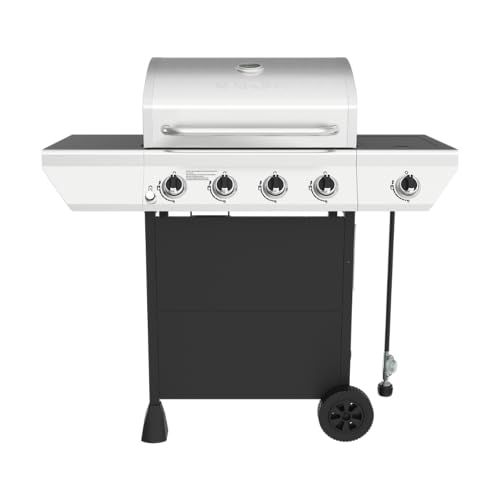
Nexgrill Propane 4-Burner Gas Grill, Side Burner and Stainless Steel Lid
Badge: Best Mid-Size Convection
Strengths
- A stainless steel lid over the chamber suits the convection brief: a durable, heat-holding cap for the hot air system.
- 52,000 BTU across four burners over 526 square inches is a well-matched power-to-volume ratio for even enclosed cooking.
- Matte finish cast iron grates add the heat mass that steadies the chamber, with electronic ignition and a built-in thermometer for control.
Trade-offs
- Cast iron grates need seasoning care, unlike coated alternatives.
- It lacks the larger Nexgrill’s cabinet storage, so tools live elsewhere.
- Mid-size means exactly that: party quantities will still mean two waves.
Mini spec box
- Format: 4-burner propane gas grill with side burner
- Output: 52,000 BTU
- Cooking space: 526 square inches
- Lid: stainless steel; grates: matte finish cast iron
- Extras: built-in thermometer; electronic ignition
This second Nexgrill is arguably the purest expression of the hot air idea in the guide: a stainless-lidded chamber of sensible volume, power matched to that volume, and cast iron mass under the food. At 526 square inches it feeds a mid-size household in one load, preheats faster than its big sibling, and its power-to-area balance favours the evenness that convection cooking is for. The thermometer and electronic ignition keep the routine frictionless, which matters because lid-down cooking is a habit, and habits survive on low friction.
Its honest limitations are cast iron upkeep and the absence of cabinet storage. Neither is serious; both are worth naming so the buyer who hates seasoning grates chooses a coated alternative with open eyes. For the mid-size household that roasts as much as it grills, this is a deeply sensible centre of the guide — and its more portable-leaning design brief suits patios that cannot take the largest model.
Best for: mid-size households wanting even, enclosed heat without maximum bulk / Not suited for: buyers needing cabinet storage or the largest capacity
Check on Amazon to check the latest price on Amazon and confirm the current configuration.

Charbroil Performance Series 4-Burner Gas Grill Cabinet with Side Burner
Badge: Best Cabinet Design
Strengths
- Four burners give the zone gradient that makes a chamber versatile — fierce, moderate, and resting air in one enclosure.
- The enclosed cabinet keeps the whole operation tidy beneath the chamber, which suits patios used as living space.
- A side burner extends the hot-air kitchen with a hob for sauces and sides.
Trade-offs
- Its verified title data leads with format rather than heat figures, so heat-focused shoppers should read the full listing before deciding.
- No specialised broil or sear zone; its convection is capable and general rather than extreme.
- Black cabinet finishes show garden dust readily.
Mini spec box
- Format: 4-burner propane gas grill, cabinet style, with side burner
- Model reference: 463253925
- Finish: black
- Storage: enclosed cabinet
The Charbroil Performance brings the hot air chamber to households that care how the patio looks while it cooks. Four burners lay out the gradient that convection cooking exploits — food can start in fierce air, move to moderate air, and rest in gentle air without leaving the enclosure — and the side burner keeps the accompanying pot in the same workspace. The cabinet below is its signature: tank, tools, and supplies behind doors, so the cooking station reads as furniture.
The limitation, stated plainly, is specialisation. This chamber does not claim a broil zone or a boost sear; it is a capable general convection environment, and heat-obsessed cooks should take the Monument or the Weber. Buyers for whom the Performance is right will know it from their patio: if tidiness and a composed four-burner setup matter as much as the last degree of heat, this is their pick.
Best for: households wanting a tidy cabinet grill with genuine four-zone convection / Not suited for: cooks chasing maximum broil or sear intensity
Check on Amazon to check the latest price on Amazon and confirm the current configuration.

IdeaMaxx 3-Burner Propane Gas Grill with Cast Iron Grates
Badge: Best Compact Hot Air
Strengths
- A small chamber heats fast and holds its air temperature efficiently — compact convection with little wasted preheat.
- Cast iron grates give a small grill the heat flywheel that bigger chambers get from sheer burner power.
- 38,200 BTU from three burners is strong for the class, and foldable shelves fit the grill to tight spaces.
Trade-offs
- Chamber volume limits whole-meal roasting for more than a small household.
- Cast iron requires seasoning and drying discipline.
- No side burner for the extra pot.
Mini spec box
- Format: 3-burner propane gas grill
- Output: 38,200 BTU
- Grates: cast iron
- Shelves: foldable side shelves
- Finish: black
Compact chambers have a genuine hot air advantage that big-grill marketing never mentions: there is less air to heat, so the environment comes to temperature quickly and responds nimbly to the dials. The IdeaMaxx exploits that with cast iron grates — the flywheel that keeps a small chamber steady — and an output figure that is muscular for three burners. For a couple or a small family roasting a chicken, tray-baking vegetables, or finishing skewers in circulating heat, it delivers the essential hot air experience without the preheat penalty or the footprint of the four-burner picks.
The limitation is volume, honestly stated: the chamber that heats so fast also fills so fast, and a household of five will outgrow it. Cast iron care applies as well. Within its intended scale, though, it is the guide’s most efficient answer — and for small-space readers comparing across this cluster, Best Hotpot Grills To Buy covers another compact, table-centred cooking style entirely, while this grill remains the outdoor hot air choice.
Best for: small households and tight patios wanting fast, efficient convection cooking / Not suited for: large families or cooks who need a side burner
Check on Amazon to check the latest price on Amazon and confirm the current configuration.
Comparison Table
| Pick | Burners | Output / area | Hot air standout | Link |
|---|---|---|---|---|
| Monument Mesa II | 4 | Reaches 500°F in 5 mins | Advanced Broil Zone | Check on Amazon |
| Weber Spirit E-425 | 4 | Sear Zone, boost burners | Enamelled cast-iron heat flywheel | Check on Amazon |
| Nexgrill 4 Burner (large) | 4 + side | 60,000 BTU; 626 sq in | Largest convection volume | Check on Amazon |
| Nexgrill 4-Burner (stainless lid) | 4 + side | 52,000 BTU; 526 sq in | Balanced power-to-volume | Check on Amazon |
| Charbroil Performance Cabinet | 4 + side | Cabinet format | Four-zone gradient; tidy storage | Check on Amazon |
| IdeaMaxx 3-Burner | 3 | 38,200 BTU | Fast-heating compact chamber; cast iron | Check on Amazon |
How to Choose a Grill for Hot Air Cooking
Judge a grill for hot air cooking the way you would judge an oven, because that is the job. First, the chamber: a lid that fits well and a cookbox with enough depth for air to circulate around food, not just beneath it. Second, the engine-to-volume match: burner output should be generous for the cooking area, since heating air — and reheating it after every lid lift — is where the energy goes. The figures in this guide let you compare that match directly, from the IdeaMaxx’s concentrated three-burner chamber to the large Nexgrill’s 60,000 BTU spread over 626 square inches. Third, the flywheel: heavy grates, ideally cast iron in some form, store heat and smooth the temperature swings that convection cooking is prone to. Fourth, control: a readable thermometer and burners that hold a low setting without flaring or dying, because roasting lives at moderate temperatures held for a long time.
Size the chamber to your household with the same arithmetic as any grill — roughly 70–90 square inches per person for mixed loads — but remember the hot air corollary: an oversized chamber is not just wasted space, it is wasted preheat on every single cook. The household that mostly roasts for three will be happier, and faster, in the mid-size Nexgrill or even the IdeaMaxx than in the largest chamber here. And be clear-eyed about the category itself: if you specifically want fan-forced countertop air frying, that is a different appliance family, and no pick in this guide pretends to be it. What these grills offer is outdoor-scale natural convection — roasting, broiling, and baking in circulating heat, with a grate’s sear available in the same session.
How to Cook With Hot Air on a Grill: The Lid-Down Method
Technique decides whether a grill’s convection potential becomes dinner. Work this sequence and any pick in this guide will perform at its best.
- Preheat the chamber, not just the grate. Light all burners, close the lid, and wait until the thermometer settles at your target. A hot grate under cold air is a sear waiting to disappoint a roast.
- Set a gradient. Configure burners so the chamber has a fierce side and a gentle side. Hot air cooking is zone cooking with the lid as the equaliser.
- Load quickly, close promptly. Have everything on one tray. Every ten seconds of open lid is hot air on the patio instead of around the food.
- Cook by thermometer and time, not by peeking. The lid thermometer tells you the chamber’s state; an instant-read probe tells you the food’s. Peeking tells you neither and costs you both.
- Use the air to finish. Sear first over direct heat if you want crust, then move food to the gentler zone and close the lid — the circulating air finishes the centre evenly without burning the surface.
- Rest in residual heat. Burners off, lid closed, food resting in the warm chamber for a few minutes beats a cold board in a draughty kitchen.
- Clean the air path. Grease on heat plates and in the cookbox smokes and flavours the air badly. A brief burn-off and brush after fatty cooks keeps the chamber’s air clean.
Troubleshooting. Problem: the chamber temperature swings wildly → check for wind exposure, a poorly seated lid, or burners set too low to sustain the target; shield the grill’s position and preheat longer. Problem: tops of food pale while bottoms scorch → your gradient is inverted for this dish; move food to the gentle zone and let the air, not the grate, do more of the work. Problem: everything tastes of old smoke → the cookbox and heat plates need cleaning; burnt grease aerosolises into the circulating air on every cook until it is removed.
What Hot Air Cooking Does Best: A Dish-by-Dish Case
It helps to name the food. Whole chickens and joints are the flagship dishes of grill convection: the air roasts them evenly on all sides, the skin renders in the moving heat, and no turning rota is required. Tray bakes — vegetables, potatoes, stuffing in a pan — behave exactly as they do in an indoor oven, freeing the kitchen during big meals. Fish, especially whole fish and thick fillets, cooks gently and evenly in moderate circulating air, protected from the fierce direct heat that dries it. Baking is the surprise: flatbreads, pizzas, and even cobblers in a cast-iron pan succeed in a well-preheated chamber, which is why the fast-heating Monument and the flywheel-grated Weber earn their places at the top of this guide. Delicate items — asparagus, sliced vegetables, prawns — benefit least from pure convection and most from the grate, which is precisely why a grill beats a pure hot air appliance for mixed meals: it offers both environments in one box, and the cook moves food between them. Understanding that duality is the whole skill this keyword points at, and any of the six picks will teach it.
Keeping the Chamber Honest: Maintenance for Convection Performance
Hot air performance degrades through three quiet channels, and all three are cheap to prevent. Grease is the first: it coats heat plates and cookbox walls, smokes into the circulating air, and eventually flares. A burn-off after fatty cooks and a seasonal deep clean keep the air clean. Blocked burner ports are the second: they create cold lanes in the chamber that no amount of lid discipline fixes, and a gentle port clean restores them. The third is the lid itself — hinges and fit. A lid that sits crooked leaks the very air this guide is about; check its alignment after assembly and after any move, and adjust rather than tolerate. Add the ordinary gas habits — leak checks on tank changes, a cover between cooks, the tank valve closed when idle — and a grill bought for its convection will still be delivering it years later.
Hot Air Versus Direct Heat: Knowing Which One Your Dinner Needs
The most useful judgement a grill cook develops is which environment a given food wants. Direct heat — food over the flame, lid open or closed briefly — is for thin, fast, surface-driven cooking: steaks and chops that need a crust, burgers, skewers, sliced vegetables, anything whose centre cooks in the time its surface browns. Hot air — lid down, food in the circulating chamber — is for everything thicker, more delicate, or more composite: whole birds, joints, fish, trays, bakes, and any food that must cook through without its surface racing ahead. Most real dinners use both in sequence, which is why this guide’s picks all combine a capable grate with a capable chamber. The classic pattern is sear-then-roast: crust the food over direct heat, then move it to the chamber’s gentle zone and let the air finish it. The reverse — roast gently first, then sear at the end over the fiercest zone — suits thick cuts and is exactly what a boost or broil zone makes easy. Cooks who internalise this two-environment thinking stop asking whether a grill is “good” in the abstract and start asking the productive question: how good is its grate, and how good is its air? The detailed reviews above answer both halves for each pick, in that order.
There is also a fuel and patience economy to the choice. Direct cooking is fast and hot; convection cooking is slower and steadier, and it rewards the cook who sets the chamber and leaves it alone. Weeknight cooking often splits the difference — a fast direct cook for the main, the chamber’s residual heat for bread or vegetables — and the grills here all support that rhythm. The one unforgivable error is indecision at the grill: food moved constantly between environments, lid up and down, zones changed mid-cook. Pick the environment, commit for the phase, and let physics work.
Wind, Weather, and the Honest Limits of Outdoor Convection
A chamber of hot air outdoors lives at the mercy of the weather in ways an indoor oven never does, and a credible guide should say so. Wind is the chief enemy: it strips heat from the lid’s surface, finds every seam, and can tilt a chamber’s temperature noticeably on a gusty evening. The defences are placement — a sheltered position, never an enclosed one — patience in preheating, and the heavier-lidded, better-sealed designs that this guide’s upper picks represent. Cold ambient temperatures lengthen preheats and increase fuel use; none of these grills is defeated by a cold evening, but all of them work harder in one, and winter roasting times stretch accordingly. Rain is a practical rather than thermal problem: a grill can cook in it, but the cook’s comfort and the food’s journey to the table suffer, and electrical ignition components prefer to stay dry. None of this diminishes the category — outdoor convection in imperfect weather is still the best way to roast at scale without heating the house — but buyers in exposed, windy sites should weight lid quality and chamber mass even more heavily than this guide already does, and should budget for a well-fitted cover as part of the purchase, not an afterthought.
Tools That Make Hot Air Cooking Better
A short list of equipment multiplies what any chamber in this guide can do. A leave-in probe thermometer is the first: it reports the food’s internal temperature with the lid closed, which is the entire discipline of convection cooking — knowledge without peeking. A heavy roasting pan or cast-iron skillet turns the chamber into a true oven for trays, bakes, and pan sauces, and it catches the drippings that would otherwise smoke on the heat plates. A sturdy rack that lifts food off the grate improves air circulation around whole birds and joints, evening the roast. Heatproof gloves matter more in lid-down cooking than in open grilling, because everything — pan, rack, grate — comes out of a hot chamber at once. A simple oven thermometer, placed in the chamber for a few cooks, teaches you your own grill’s truth: where its lid thermometer flatters or understates, and where the calm corners live. That knowledge, once gained, is permanent, and it transfers to every recipe you will ever cook on the grill. Finally, a fitted cover protects the chamber and lid fit between cooks; convection performance is a property of a well-kept box, and the cover is how the box stays well-kept. None of these items is exotic, and together they cost a fraction of the difference between tiers — which is why this guide consistently advises buying the right-sized grill and the short tool list, rather than the largest grill and nothing else.
Common Buying Mistakes
- Expecting a fan. These are natural-convection chambers, not fan appliances. Buy them for outdoor-scale roasting and broiling, not as giant air fryers.
- Judging by grate temperature alone. Hot air cooking lives in the chamber; preheat speed, lid fit, and grate mass matter as much as peak heat.
- Oversizing the chamber. Every extra square inch is preheat time and fuel on every cook. Match volume to household.
- Cooking with the lid up. That is just a stove with a view. The hot air you paid for leaves in seconds.
- Ignoring grate material. Lightweight grates let chamber temperature lurch; cast iron in some form is the flywheel that smooths it.
- Skipping assembly care. A rushed build leaves a leaking lid, and a leaking lid quietly cancels the entire premise of the purchase.
Final Recommendation
For the strongest hot air performance, start with the Monument Mesa II — its broil zone and rapid heat-up make it the most convection-focused grill in this guide. Read the top three reviews here: Monument Grills Mesa II 4 Burner, Weber Spirit E-425 Gas Grill, Nexgrill Propane 4 Burner Gas Grill. Choose the Weber if your cooking splits evenly between searing and roasting, the large Nexgrill if your household needs maximum chamber volume, the stainless-lidded Nexgrill for the balanced mid-size answer, the Charbroil Performance if cabinet tidiness leads, and the IdeaMaxx if your space is compact but your standards are not. Whichever you choose, cook with the lid down — that is where the hot air is.
Frequently Asked Questions
What is a hot air grill, exactly?
In this guide, it is a lidded grill used as a convection chamber: burners heat air that circulates around food under a closed lid, roasting it evenly while the grate provides direct-heat searing. It is natural convection — none of these grills has a fan.
Is a hot air grill the same as an air fryer?
No. An air fryer is a small countertop appliance with a fan forcing air around a basket. A grill’s chamber is far larger, fan-free, and adds a searing grate. They share a principle — cooking in moving hot air — at very different scales and with different strengths.
Why does preheat speed matter so much?
Because convection cooking cannot start until the air itself is hot, and it must recover after every lid opening. A chamber that reaches temperature in minutes, like the Monument in this guide, makes lid-down cooking practical on weeknights, not just weekends.
Which pick is best for roasting a whole chicken?
Any four-burner pick will do it well. The Weber’s enamelled cast-iron grates give the steadiest chamber, the large Nexgrill gives the most room for a chicken plus a tray, and the Monument reheats fastest if you need to open the lid to baste.
Do cast iron grates really affect hot air cooking?
Yes. They store heat and release it steadily, smoothing the temperature dips that happen when the lid opens or cold food goes on. In a convection chamber, that flywheel effect is a genuine performance trait, not a cosmetic one. It is most noticeable in the first minute after a cold tray goes in: a light grate lets the chamber sag and recover slowly, while a heavy cast iron grate holds the line, radiating its stored heat back into the air and keeping the roast on schedule.
Can I bake on these grills?
Yes — flatbreads, pizzas, tray bakes, and pan desserts all work in a fully preheated, lid-down chamber. Use the thermometer, give the chamber time to stabilise, and treat the grill as the outdoor oven it becomes in this mode. Baked goods are actually the purest test of a grill’s hot air quality, because they cannot hide behind a sear: a tray of rolls or a pan of cobbler rises and browns only as evenly as the air around it, so a grill that bakes well — steady chamber, no savage hot lane, a lid that holds its heat through one careful check — has proven the very quality this guide set out to rank. If baking matters to you, weight the flywheel grates and lid quality in the detailed reviews even more heavily than the headline heat figures.
How do I stop the chamber temperature from swinging?
Preheat longer, shield the grill from wind, keep the lid closed, clean grease from the heat plates, and check the lid’s fit. If swings persist, a burner port clean usually restores the even heat the chamber depends on. It also helps to cook with the weather rather than against it: on a cold or windy evening, choose dishes that tolerate a slightly longer roast, keep the menu’s timing loose, and let the chamber run a touch hotter than the recipe’s calm-day setting to offset what the wind takes from the lid. Experienced outdoor cooks treat those adjustments as part of the craft, the same way sailors trim for wind — and the grills in this guide, with their readable thermometers and responsive burners, give you the instruments to do it well.


