Disclosure: topratedkitchenware.com is reader-supported. When you buy through links on our site, we may earn an affiliate commission from Amazon and other retailers, at no extra cost to you.
Where to buy
This guide to the best microwaves w carousel according to consumer reports takes the testing mindset seriously rather than borrowing its authority: it evaluates six verified carousel models against the criteria that independent laboratory testing has taught buyers to value — heating evenness, defrosting quality, speed, usability, and noise — without inventing scores for ovens no lab notebook here can claim. Each name below links to its Amazon listing, where you can check the latest price on Amazon and read current owner feedback alongside the criteria in this guide.
- BLACK+DECKER Countertop Microwave Oven, 0.9 Cu.Ft, 900W, Stainless Steel
- TOSHIBA Microwave Oven, 0.9 Cu.Ft, 900W, Black Stainless Steel
- TOSHIBA Countertop Microwave Oven, 1.2 Cu.Ft, 1000W, Black
- COMFEE’ Countertop Microwave Oven, 0.7 Cu.Ft, 700W, Black
- Farberware Countertop Microwave Oven 1.1 cu.ft, 1000 Watts, Stainless Steel
- Chefman Countertop Microwave Oven 0.9 Cu. Ft., 900 Watts, Black
Read the full guide ↓ for how laboratory-style criteria read these six ovens, how to run the classic evenness check in your own kitchen, how to use published test thinking without being ruled by it, and why two households reading the same honest table can — and should — walk away with two different ovens, each of them right for the kitchen it will actually live and work in.
Shoppers who search for the best microwaves w carousel according to consumer reports are really asking for a method, not a mascot. Independent consumer testing earned its influence by doing what brochures never do: cooking standardised loads the same way in every oven, measuring temperatures at multiple points instead of admiring a single steaming centre, defrosting the same frozen block in every machine, timing water heating, working the controls with fresh eyes, and listening — literally — to how loud the appliance is while it works. This guide honours that method honestly, and it tries to honour the reader the same way, by showing its reasoning instead of asking for trust it has not earned. It does not claim any laboratory tested these six models, and it prints no invented scores. Instead it takes the criteria that method established, explains why each one predicts your daily experience, and evaluates six verified carousel microwaves against them from their confirmed specifications and documented behaviours, so you can shop with a tester’s eyes whether or not a tester has visited your shortlist.
All six picks are rotating-turntable countertop models confirmed through the Creators API, spanning compacts to a family sensor oven, and spanning with them the full range of control philosophies a criteria-based shopper will meet anywhere in this category at any point on the price spectrum. Each receives a badge, a detailed review organised around test-style criteria, a mini spec box from verified facts, and a verdict. The buying guide translates laboratory criteria into kitchen questions, the how-to section includes the famous evenness check you can perform at home on any oven, and the closing sections explain how to read ratings culture — scores, stars, and owner reviews alike — without surrendering your judgement to any of them. Readers comparing methodologies will find Best Microwaves Wirecutter a natural next read, and those weighing long-term support can continue into Best Microwaves Warranty.
Key Takeaways
- Laboratory testing’s great contribution is criteria, not verdicts: evenness, defrost quality, speed, usability, and noise predict ownership better than any feature list.
- Evenness is the carousel’s home criterion — rotation exists to average the cavity’s hot and cool zones, and sensor models add judgement on top of it.
- Defrosting separates ovens more honestly than reheating does; programmed defrost by weight, as on the Farberware here, is a tester’s favourite tool.
- All six picks here are verified carousel models; the family Toshiba’s humidity sensor is the control most aligned with how testers judge reheating.
- You can replicate the spirit of lab testing at home with a layer of marshmallows or a plate of mashed potato and a thermometer’s patience.
- Check the latest price on Amazon when you decide, and let criteria — not any single score, including ours — make the final call.
- Bring your own weighting to every table in this guide: the family weighting, the freezer weighting, and the small-room weighting produce three different winners from the same six verified ovens, and all three winners are correct.
- Keep the evidence streams separate in your mind — verified specifications for design, owner patterns for durability, your tape measure for fit — and let each stream veto only what it actually measures.
In this guide
Quick Picks
| Pick | Badge | Capacity | Power | Tester’s note |
|---|---|---|---|---|
| BLACK+DECKER 0.9 Cu.Ft | Best All-Rounder | 0.9 cu ft | 900W | Balanced spec, intuitive controls |
| TOSHIBA 0.9 Cu.Ft Black Stainless | Best for Apartments | 0.9 cu ft | 900W | Removable 10.6-inch turntable, mute |
| TOSHIBA 1.2 Cu.Ft Black | Best for Families | 1.2 cu ft | 1000W | Humidity sensor, 12.4-inch turntable |
| COMFEE’ 0.7 Cu.Ft | Best Compact | 0.7 cu ft | 700W | ECO mode, sound on/off |
| Farberware 1.1 cu.ft | Best for Defrosting | 1.1 cu ft | 1000W | Defrost by weight or time, multi-stage |
| Chefman 0.9 Cu. Ft. | Best Mid-Size Manners | 0.9 cu ft | 900W | Eco mode, mute, express cook |
Read the badges as criteria verdicts. No oven here wins every laboratory category — none ever does — and the reviews below are explicit about which criterion each pick serves best and which it concedes.
How These Picks Were Chosen
The pool for this guide is verified countertop carousel models confirmed through the Creators API, with every capacity, wattage, and feature taken from live listings. Onto that pool we applied the testing criteria as a selection filter: we wanted the size classes a laboratory would compare — compact, mid-size, family — represented by models whose specifications speak to the criteria, including a sensor model for reheating judgement, a defrost-programming model for the frozen test, and compacts whose usability can be judged on their panels. Owner feedback patterns were read the way a tester reads a complaint log: looking for recurring, specific failures — latch trouble, tray wobble, illegible panels — rather than for applause.
Two honesty commitments govern this guide. First, no laboratory results are claimed for these models: where we say an oven is built to do well on a criterion, we are reasoning from its verified design, and we say so. Second, no prices or numerical scores are printed for any pick; criteria and listings are the honest currency here, so check the latest price on Amazon at decision time. Shoppers interested in radiation questions that testing culture also addresses can read Best Microwaves With Least Radiation, and those who want keep-warm behaviour compared can visit Best Microwaves With Keep Warm.
The Best Microwaves W Carousel According to Consumer Reports Criteria in Detail
Each review follows the same pattern: what the machine is, its badge, three strengths, three trade-offs, a mini spec box limited to verified facts, a criterion-by-criterion reading, and a verdict. The criteria language is deliberate — it is the vocabulary this keyword asks for.
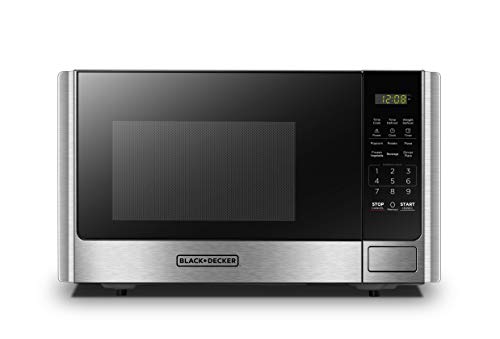
BLACK+DECKER Countertop Microwave Oven, 0.9 Cu.Ft, 900W, Stainless Steel
Badge: Best All-Rounder
Strengths
- Usability is its laboratory virtue: a push-button door and a standard preset layout that fresh eyes operate correctly first time.
- Balanced speed and capacity: 900 watts and 0.9 cubic feet sit at the class’s tested centre.
- Ten power levels give the control range evenness and defrost criteria reward.
Trade-offs
- No sensor, so the reheating criterion depends on the operator’s timing.
- No mute function for the noise criterion in quiet homes.
- Stainless finish needs regular wiping to stay presentable.
Mini spec box: Capacity 0.9 cu ft · Power 900W · Finish: stainless steel · Carousel turntable design · 10 power levels · Push-button door · Child safety lock · 6 auto cook presets.
Criterion by criterion, this is the oven a tester would call sound. Evenness: the carousel and a right-sized cavity do the standard work, and 900 watts is strong enough that portions reach temperature before edges dry. Speed: at the class average, matching packaged assumptions with a small margin. Defrosting: timed and power-level based, competent in practised hands. Usability: the standout — the door, the layout, and the presets are the ones a stranger operates without a manual, which is precisely what usability testing measures. Noise: unremarkable in operation, with beeps that cannot be silenced, its one conceded criterion.
That profile — no weaknesses except silence, no brilliance except usability — is what all-rounder means in a laboratory vocabulary, and for first kitchens and family replacements it is usually the correct purchase. Testers distrust gimmicks for a reason: the ovens that age best are the ones whose every criterion is adequate and whose daily operation is effortless.
Best for: households wanting the tested centre of the category / Not suited for: buyers who want sensor judgement or silent beeps

TOSHIBA Microwave Oven, 0.9 Cu.Ft, 900W, Black Stainless Steel
Badge: Best for Apartments
Strengths
- The noise criterion is served properly: a mute function for thin walls and late hours.
- A removable 10.6-inch turntable supports the evenness criterion and washes in the sink.
- LED interior lighting aids the usability criterion — you can see the food’s state without opening the door.
Trade-offs
- No sensor, so reheating judgement is the operator’s.
- Six auto menus is a modest list.
- The dark finish shows dust readily.
Mini spec box: Capacity 0.9 cu ft · Power 900W · Finish: black stainless steel · 10.6-inch removable turntable · 6 auto menus · Mute function · Child lock · LED lighting.
Laboratories measure noise because apartments exist, and this Toshiba is the pick in this guide that takes that criterion seriously at the mid-size. Its mute function addresses the beeps; its LED light addresses the midnight usability test, where a dim panel and a dark cavity fail lesser ovens; and its removable turntable addresses the hygiene-over-time question that evenness testing implies — a carousel kept clean keeps its evenness, and a tray that lifts out gets cleaned. On speed and capacity it matches the BLACK+DECKER’s tested centre exactly, so the comparison between them is a pure criteria choice: manners and maintainability against door simplicity and preset familiarity.
For apartment households, that choice usually resolves toward this Toshiba, because its conceded criteria — sensor absence, a shorter menu list — matter less in small kitchens than the criteria it wins every single night.
Best for: apartment dwellers judged by noise and usability criteria / Not suited for: sensor seekers

TOSHIBA Countertop Microwave Oven, 1.2 Cu.Ft, 1000W, Black
Badge: Best for Families
Strengths
- The reheating criterion’s best tool in this guide: a humidity sensor that judges doneness by steam.
- The widest carousel here at 12.4 inches, removable for the cleaning evenness depends on.
- Twelve auto menus, mute, and ECO mode cover the usability and standby criteria.
Trade-offs
- Defrosting remains conventional pulsing; the Farberware’s programming serves planners better.
- A large cabinet that small kitchens must measure.
- Black finish can dim panel legibility in dark corners.
Mini spec box: Capacity 1.2 cu ft · Power 1000W · Finish: black · 12.4-inch removable turntable · Smart humidity sensor · 12 auto menus · Mute function · ECO mode · Easy-clean interior.
Reheating is the test category that predicts family satisfaction, because families reheat more than they cook, and they reheat the hardest load in the repertoire: the mixed plate. This Toshiba attacks that category from both sides a laboratory respects — rotation for spatial evenness, a humidity sensor for temporal judgement — and it is the only pick here that does both at family scale. Its speed criterion is the guide’s best among the timed-and-sensor class, its capacity criterion is unambiguous, and its usability extras are complete.
Its honest concession is the defrost category, where conventional pulsing and manual staging remain the method. Families whose frozen food arrives in labelled portions and planned sequences should weigh the Farberware’s programming seriously; families whose frozen food arrives as tonight’s improvisation will find this sensor’s judgement the greater daily gift.
Best for: families whose main test is the reheated mixed plate / Not suited for: small counters or programmed-defrost devotees


COMFEE’ Countertop Microwave Oven, 0.7 Cu.Ft, 700W, Black, ECO Mode
Badge: Best Compact
Strengths
- Sound on/off control serves the noise criterion in shared rooms.
- ECO mode addresses the standby consumption testers increasingly note.
- One-touch usability for the compact repertoire, with a child safety lock.
Trade-offs
- The speed criterion is conceded by design: 700 watts is the compact pace.
- Capacity excludes plates and family loads entirely.
- A simpler panel than the Chefman 0.9’s mid-size set.
Mini spec box: Capacity 0.7 cu ft · Power 700W · Finish: black · Carousel turntable design · ECO mode · Sound on/off · One-touch buttons · Child safety lock · Intended for dorm, apartment, and office use.
A tester judging compacts changes the weighting, and under compact weighting this COMFEE’ reads well: evenness within single portions is carousel-complete, usability is one-touch simple, noise is controllable, and standby behaviour — a criterion invisible in a family kitchen and decisive in a dorm — is explicitly designed for. Its conceded criteria, speed and capacity, are the class’s definition rather than its failure.
Choose it when the room is shared and the portions are single, and judge it as laboratories judge its class: against the job it was built for. Against that job, it is a complete little oven.
One more criterion deserves a sentence here, because compact buyers raise it constantly: perceived build. A small oven that will be opened by a dormitory floor’s worth of hands lives or dies by its door and latch, and the COMFEE’ keeps the conventional, serviceable arrangement its class has standardised — a panel of honest buttons, a lock for households with children, and no delicate touch surfaces to fail under shared use. Testers call this design conservatism; residents of shared rooms call it the correct decision, and on this criterion the two vocabularies agree completely.
Best for: dorms, offices, and standby-conscious small rooms / Not suited for: plates, families, or speed


Farberware Countertop Microwave Oven 1.1 cu.ft, 1000 Watts, Stainless Steel
Badge: Best for Defrosting
Strengths
- The defrost criterion’s best toolkit here: defrost by weight or by time, inside a multi-stage programme.
- Ten power levels with an LED display serve the control criteria precisely.
- Family capacity at full pace for the speed and size criteria.
Trade-offs
- No sensor for the reheating criterion; judgement is programmed, not sensed.
- No mute function for the noise criterion.
- Stainless finish requires upkeep.
Mini spec box: Capacity 1.1 cu ft · Power 1000W · Finish: stainless steel · Carousel turntable design · 10 power levels · Multi-stage cooking · 6 preset options · Defrost by weight or time · LED display · Express cooking.
Defrost testing is where laboratories earn their scepticism, because it is where marketing claims go to die: the frozen block reveals every oven’s low-power honesty. The Farberware’s answer is procedural rather than electronic — weigh the food or time it, let the programme stage the thaw and the cook, and use the ten power levels as the fine control — and in practised hands that procedure is exactly what the criterion rewards. Its multi-stage ability remains rare in this class and is the reason organised households defend this oven warmly.
Its conceded criterion is reheating judgement, where it asks the cook to supply what the Toshiba’s sensor supplies automatically. Testers would call that a fair trade openly arrived at, and so does this guide.
Best for: planners who defrost by programme and cook in stages / Not suited for: hands-off reheating or silent operation

Chefman Countertop Microwave Oven 0.9 Cu. Ft., 900 Watts, Black
Badge: Best Mid-Size Manners
Strengths
- The noise and standby criteria both served: a mute button and Eco mode at mid-size.
- Ten power levels and six presets with express cook make a complete usability set.
- Balanced capacity and pace at the tested centre of the class.
Trade-offs
- No sensor for reheating judgement.
- Family serving ware exceeds its comfortable capacity.
- Black finish shows dust and pale splashes.
Mini spec box: Capacity 0.9 cu ft · Power 900W · Finish: black · Carousel turntable design · 10 power levels · 6 cooking presets · One-touch express cook · Eco mode · Child safety lock · Mute button.
The Chefman is the criteria diplomat: no category won outright, none conceded badly. Evenness is carousel-standard, speed is class-centre, usability is complete, and the behavioural criteria — noise, standby — are served better than by any other mid-size pick here. Laboratories respect this profile because ownership is a sum of criteria, and an oven with no failing grade tends to out-satisfy an oven with one brilliance and one annoyance.
For singles and couples, that makes it arguably the most rational purchase in the guide: the Toshiba 0.9 counters with light and a removable tray, the BLACK+DECKER with its door, and the Chefman with the quietest, leanest daily behaviour. Criteria shopping ends in exactly such honourable ties, broken by the household’s own weighting.
There is a final, quieter argument for the diplomat’s profile that laboratories understand and brochures never make: criteria interact. A mute button makes an owner more willing to reheat at midnight, which makes the oven more useful; an Eco mode makes leaving it plugged in guiltless, which makes it more available; a complete panel makes the second cook in the household as competent as the first. The Chefman’s specification reads modestly line by line and generously in combination, and combination — the sum a household actually lives with — is the thing a criteria method exists to estimate.
Best for: singles and couples weighting behaviour criteria highly / Not suited for: sensor seekers or family capacity
Comparison Table
| Model | Capacity | Power | Strongest criterion | Conceded criterion | Link |
|---|---|---|---|---|---|
| BLACK+DECKER 0.9 | 0.9 cu ft | 900W | Usability | Noise (no mute) | Check on Amazon |
| TOSHIBA 0.9 Black Stainless | 0.9 cu ft | 900W | Noise and maintainability | Reheating judgement | Check on Amazon |
| TOSHIBA 1.2 Black | 1.2 cu ft | 1000W | Reheating (sensor) | Programmed defrost | Check on Amazon |
| COMFEE’ 0.7 | 0.7 cu ft | 700W | Standby and simplicity | Speed and capacity | Check on Amazon |
| Farberware 1.1 | 1.1 cu ft | 1000W | Defrosting | Reheating judgement | Check on Amazon |
| Chefman 0.9 | 0.9 cu ft | 900W | Behaviour (mute, Eco) | Reheating judgement | Check on Amazon |
A criteria table instead of a score table is this guide’s method in one view: every oven is strong somewhere and honest somewhere else. Readers who like their controls equally explicit can compare Best Microwaves With Big Buttons before choosing. Photograph the table if it helps, annotate it with your own weighting in the margin, and take the annotated version — not anyone’s headline verdict — to the listing when you buy; that small act is the difference between shopping by criteria and merely reading about them.
How to Choose Using Test Criteria
Weight the criteria by your kitchen, not by a laboratory’s average. A testing programme must publish one weighting for everyone; you are allowed a personal one. Families should weight reheating and capacity first. Freezer-driven households should weight defrosting first. Apartment and dorm buyers should weight noise and standby first. Singles should weight usability and size. Apply your weighting to the comparison table and the guide re-ranks itself for your kitchen — which is exactly what criteria are for.
Distrust any single number, including a wattage. Testers learned long ago that headline specifications predict less than behaviour: a well-controlled 900-watt oven reheats more evenly than a crude stronger one, and a sensor’s judgement outweighs a menu list’s length. Read spec boxes — including ours — as evidence about design, then ask the criteria question: what will this design do to my actual food, in my actual week?
Use owner reviews the way testers use complaint logs. Patterns matter; anecdotes decorate. A recurring, specific complaint — a latch, a tray, a panel — across many owners is data. A single furious paragraph is weather. Read for the pattern, weight it by how closely the reviewer’s household resembles yours, and let it break ties rather than make decisions.
Check the physical criteria last and literally. Dimensions, turntable diameter, door swing, and vent clearance are the only criteria that can make a good oven unusable. Measure your counter and your largest plate, compare them with the listings, and let arithmetic veto what enthusiasm chose.
Keep a fortnight log, like a tester keeps a notebook. The most underused instrument in appliance shopping costs nothing: two weeks of noting what you actually microwaved, in what vessel, with what result. That log converts this guide’s criteria from abstractions into your household’s measured weightings. If the log shows eleven reheats, three defrosts, and a daily mug, you now know — not guess — that reheating judgement and usability outrank defrost programming for you, whatever any table says. Testers trust logs over impressions because impressions edit themselves; paper does not. Bring that discipline home and every future appliance purchase, not just this one, gets cheaper to make correctly.
How to Test Your Own Microwave Like a Laboratory
The evenness check. The classic home version of the laboratory test uses a single layer of marshmallows spread across a plate or a sheet of suitable paper lining the tray: run the oven briefly and watch where browning starts and how unevenly it spreads. A plate of mashed potato, probed in several places after a reheat cycle, teaches the same lesson with dinner. You are not producing a score; you are learning your cavity’s map — where its strong zones sit — which makes you a better operator of any oven you own.
The defrost check. Freeze a uniform block of mince flat, then defrost it by your oven’s usual method and note the spread between the first-cooked edge and the last-frozen centre. Repeat with staged rests and a lower power level. The improvement you will see is the entire defrost literature in one experiment, and it transfers to every oven in this guide.
Setup, use, and care, tester-style. Seat the turntable ring and tray level, confirm smooth rotation with the water test, and keep a simple log for the first fortnight: the meals you repeat, the times that worked, the power levels that behaved. That log is your personal test report, more predictive for your kitchen than any published table. Clean by the steam method, wash removable trays in the sink, keep vents clear, and treat the door gently — laboratories retire ovens for latch wear more often than for electronics, and households can postpone that day with ordinary care.
Troubleshooting mini-guide.
- Problem: your evenness check shows one fierce hot spot → what to do: confirm the tray rotates through the full cycle under load, centre dishes, and use the map you have learned — place dense items where the field is strong and delicate items where it is gentle — rather than assuming the oven is faulty.
- Problem: defrosting cooks edges while the centre stays frozen → what to do: shorten bursts, lower the power level, add standing rests, and separate pieces early; on the Farberware, switch to defrost by weight so the programme stages the process for you.
- Problem: controls confuse a household member despite a standard layout → what to do: reduce the household’s repertoire to the three commands actually used — reheat, defrost, popcorn or express — and mark them if needed; usability testing counts the commands a product makes easy, not the ones it merely offers.
The Five Criteria, Explained Like a Tester
Evenness is the criterion that justifies this keyword’s existence, because it is the one the carousel was invented to serve. A laboratory loads identical food into every oven, cooks it identically, and measures the temperature spread across the load. The spread is the score behind the score: a narrow spread means the field, the rotation, and the power delivery cooperated; a wide one means somebody’s dinner has a cold postcode. At home the same physics applies at smaller scale, which is why the mashed-potato probe test in this guide’s how-to section is not a toy — it is the criterion, domesticated. Among these six picks, evenness is served by rotation everywhere, by family-scale trays on the Toshibas, and by the sensor’s judgement about when the now-even load is actually done.
Defrosting is the criterion of honesty. Reheating forgives; a frozen block does not. Testers thaw the same weight in every machine and record the gap between the most-cooked and least-thawed points, because that gap is what your dinner will taste like. Ovens answer the test three ways: brute patience (low power and rests, available to every pick here), procedure (the Farberware’s defrost by weight and multi-stage programming, which systematise the patience), and power-supply design (inverter steadiness, which this pool’s six do not include and which this guide therefore does not pretend to judge). A buyer whose freezer feeds the table should rank this criterion first and read the Farberware review twice.
Speed is the criterion of least mystery and most exaggeration. Laboratories time a standard water load because water does not argue; the result tracks wattage closely enough that the spec box nearly tells the story. What speed testing adds is the correction for ovens whose real pace trails their paper pace — one more reason to reason from verified listings and owner patterns rather than from brochure arithmetic. In this guide the spread runs from the compact’s calm 700 watts to the family class at 1000, and the honest summary is that speed decides between near-equals and should rarely decide anything else.
Usability is the criterion owners feel and shoppers undervalue. Testers hand the oven to fresh eyes and count hesitations: can a stranger open the door with full hands, set a minute, defrost by weight, silence the beeps, read the panel in poor light? The picks here spread across that test instructively — the BLACK+DECKER’s push-button door and standard layout, the apartment Toshiba’s LED light, the Chefman’s express route to the commonest command, the COMFEE”s one-touch compact panel. None of these appears in a wattage column, and all of them appear in your second year of ownership, which is why laboratories bother to measure them at all.
Noise is the criterion of architecture. A detached kitchen forgives what a studio flat cannot, and testing programmes measure both operating sound and the electronic voice — the beeps — because households complained about both for decades before anyone quantified them. The mute functions on the Toshiba and Chefman picks, and the sound control on the COMFEE’, are this criterion answered in design. If your oven will live within earshot of sleep, weight noise like a family weights capacity; the laboratory already does.
What Testing Cannot Tell You
Criteria have limits, and a guide in the testing tradition should state them. No laboratory test measures whether an oven suits your counter’s depth, your plates’ diameter, your household’s handedness with a door, or your tolerance for a black finish’s dust. No standardised load is your load: the tester reheats the laboratory’s plate, not your grandmother’s casserole in its awkward dish. And no test published this year measures the latch in year five, which is why owner patterns — the other evidence stream this guide uses — exist as the criteria’s necessary partner.
The mature method is therefore a braid: criteria to shortlist, specifications to verify, owner patterns to veto, and your own measurements to decide. Buyers who braid all four rarely return appliances. Buyers who follow any single strand — a score, a star average, a neighbour’s enthusiasm, a wattage — are the returns department’s regulars. This guide was written to be one strand of your braid, the criteria strand, and it is content with that honest role.
How to Read Ratings Culture Without Being Ruled by It
This keyword sits inside a larger habit worth examining: the outsourcing of judgement to scores. Scores compress; compression hides weightings; and hidden weightings are how a family ends up with an oven that tested brilliantly at defrosting it never does. The healthier habit, which this guide has tried to model, is to borrow the criteria and keep the weighting. Ask of any review — laboratory, editorial, or owner — four questions: what loads did they cook, what did they measure, whose kitchen does their weighting describe, and what did the oven concede? A review that answers those is useful at any score. A review that offers only a number is a rumour with decimals.
Owner feedback deserves the same discipline in reverse. Its strength is volume and duration — thousands of kitchens, years of latches — and its weakness is selection: the delighted and the furious write, the contented reheat in silence. Read it for failure patterns and for the texture of daily life with the machine, and you will extract its real value without mistaking its loudest voices for its average ones.
A Worked Example: Two Households Read the Same Table
Criteria only earn their keep in application, so watch two households read this guide’s comparison table. The first is a family of five in a house with a deep counter and a freezer habit. Their weighting puts reheating and capacity at the top, defrosting second, noise last — nobody sleeps near their kitchen. Their table resolves quickly: the sensor Toshiba in black wins reheating outright and ties capacity, the Farberware’s defrost programming tempts them, and the deciding question becomes whether their frozen food arrives planned or improvised. Planned, and the Farberware’s procedure wins a household that will actually use it; improvised, and the sensor’s judgement wins, because a programme nobody sets defrosts nothing. Either verdict is rational, and the table supported both — the household supplied the difference.
The second household is a couple in a one-room flat where the kitchen is also the office and the bedroom. Their weighting inverts the first: noise and usability lead, capacity trails, speed is irrelevant at their portions. Their table resolves to a different winner entirely — the apartment Toshiba’s mute and light, or the Chefman’s mute and Eco behaviour — and the family flagship that won the first household’s table finishes last on theirs, too large and too loud-voiced for the room. Same six ovens, same verified facts, opposite verdicts, both correct. That is the entire philosophy of criteria shopping in one demonstration, and it is why this guide refuses to crown a single winner for a keyword whose searchers live in both households.
Common Buying Mistakes
- Shopping for a score instead of a criterion. Decide which test category your kitchen lives in, then choose the oven that serves it.
- Assuming a laboratory has tested your exact shortlist. Apply the criteria yourself from verified specifications, as this guide does, rather than imagining a verdict that may not exist.
- Letting wattage impersonate performance. Control quality and rotation decide evenness; wattage mostly decides pace.
- Ignoring the noise criterion in a small home. Testers measure noise because households live with it; a mute function is a test result you feel nightly.
- Reading owner reviews for applause. Read them for recurring, specific failures — the pattern is the data.
- Skipping your own evenness check. Ten minutes with a plate teaches you your cavity’s map and makes you a better operator of whichever oven you buy.
Final Recommendation
By criteria, the guide’s verdicts are these: the BLACK+DECKER 0.9 Cu.Ft wins the usability criterion outright and remains the all-rounder for households whose meals repeat; reheating-led families, however, should weight the sensor criterion first, which makes the sensor Toshiba in black this guide’s family winner, with the TOSHIBA 0.9 Black Stainless taking the apartment criteria of noise and maintainability for smaller households that live within earshot of their kitchen. Defrost-led planners should take the Farberware 1.1, compact rooms the COMFEE’, and criteria diplomats the Chefman 0.9. Apply your own weighting to the table, check the latest price on Amazon for the winner, and you will have shopped the way the testing tradition intends: by evidence, weighted by your own life.
Frequently Asked Questions
Did Consumer Reports actually test these exact models?
This guide claims no such thing, and you should be suspicious of any page that implies a laboratory verdict it cannot show. What this guide does is apply the criteria that independent testing established — evenness, defrosting, speed, usability, noise — to six verified models, reasoning openly from their confirmed designs. For a laboratory’s own current verdicts, consult the laboratory’s own publications directly.
What is the most important test criterion for a family microwave?
Reheating evenness, because reheating is the family’s dominant microwave job and the mixed plate is its hardest load. Rotation addresses the spatial half of that criterion and a humidity sensor the temporal half, which is why the family pick in this guide combines both.
How do testers check heating evenness?
By cooking standardised loads identically in every oven and measuring the result at multiple points — classically with foods that visibly record temperature differences, and with temperature probes across a reheated load. The home version in this guide’s how-to section, using marshmallows or mashed potato, teaches the same lesson about your own cavity.
Why does defrosting get its own criterion?
Because it is the task where ovens differ most and marketing helps least. A frozen block exposes low-power honesty: pulsing ovens cook edges in bursts, programmed defrost stages the process intelligently, and inverter ovens — outside this guide’s six — glide continuously. If your household thaws weekly, weight this criterion first. And run the home defrost check from this guide on whichever oven you buy, in its first week, while the return window is open and the lesson is still free; a laboratory would call that acceptance testing, and it is the most valuable ten minutes in this entire article.
Should I trust owner reviews or laboratory criteria more?
Use each for what it measures. Criteria tell you how an oven class behaves under controlled loads; owner patterns tell you how a specific model survives years of latches, trays, and panels in real kitchens. A purchase decided by criteria and vetoed only by a recurring owner-reported failure pattern is about as rational as appliance shopping gets.
How often do test results change for the same category?
Categories move slowly and models move constantly. The criteria — evenness, defrosting, speed, usability, noise — have been stable for decades because the physics and the households are stable. The models satisfying them rotate with every model year, finishes change, and control panels are redesigned. That is why this guide teaches the criteria rather than memorising verdicts: a reader who owns the method can evaluate next year’s models, including ones no laboratory has reached yet, with the same confidence as this year’s.
Are compact microwaves judged by the same criteria?
Yes, with different weightings, as this guide’s compact review demonstrates. Evenness within a single portion, usability of a small panel, noise in a shared room, and standby behaviour dominate the compact judgement, while raw speed and capacity recede because the class defines them modestly. Judging a compact by family criteria is the mirror image of judging a flagship by dorm criteria — both errors come from borrowing a weighting that belongs to a different household.
Do higher wattages always test faster?
On a standardised water-heating task, generally yes — pace follows power. But speed is one criterion among five, and the differences over a reheated plate are small beside the differences in evenness, judgement, and noise that decide satisfaction. Testers report speed faithfully and then refuse to let it crown the winner alone; shoppers should do the same. If your own log shows that most of your cycles are drinks and single bowls, the speed spread across this entire guide amounts to a few minutes a week — a quantity worth knowing precisely because it is so easy to overpay for.


