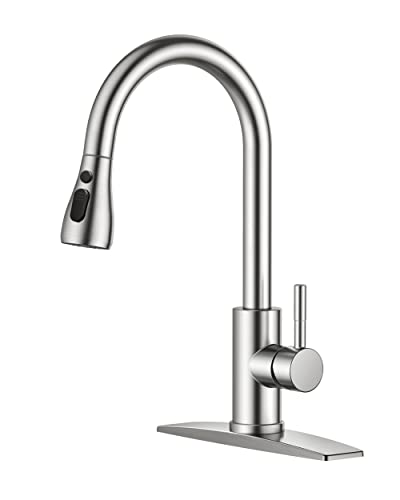
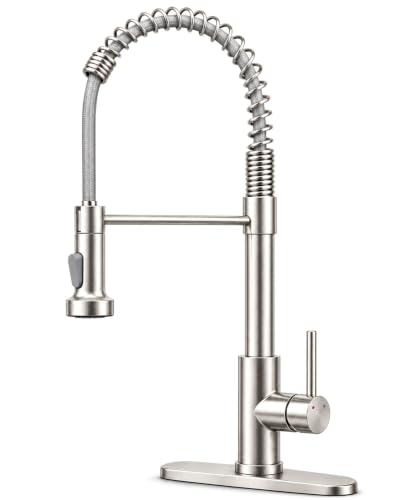
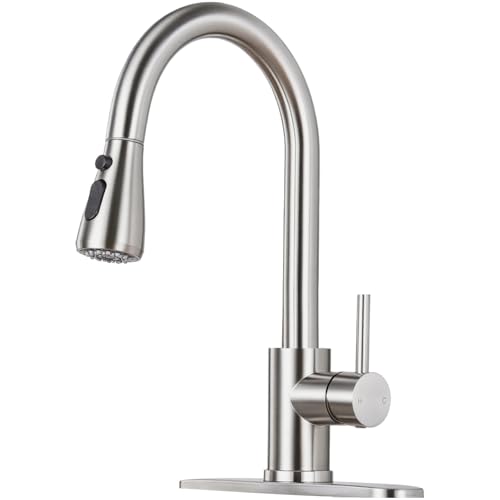
Disclosure: topratedkitchenware.com is reader-supported. When you buy through links on our site, we may earn an affiliate commission from Amazon and other retailers, at no extra cost to you.
Where to buy
The six faucets below are the verified picks for this guide to best kitchen faucets for water flow. Each name links to its Amazon listing, where you can check the latest price on Amazon, confirm the current configuration and deck fit, and read the newest owner feedback before you decide.
- WEWE Touchless Kitchen Faucet with Soap Dispenser Set
- GIMILI Matte Black Touchless Kitchen Faucet
- VFAUOSIT Pull-Down Kitchen Faucet
- WEWE High-Arc Pull-Down Kitchen Faucet
- FORIOUS Pull-Down Kitchen Faucet
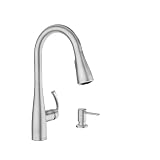
- Moen Essie Pulldown Kitchen Faucet 87014SRS
Read the full guide ↓ for the ranking logic, the honest limitations of every pick, and the checks that matter more than any headline claim.
Shoppers hunting for the best kitchen faucets for water flow usually have a specific frustration: a stockpot that takes forever to fill, a spray that could not rinse porridge off a plate, or an old faucet that has faded to a trickle. Here is the honest starting point this guide is built on: in the United States, kitchen faucet flow is regulated, and most modern faucets are designed to the same legal ceiling — so the real differences between models are not headline flow numbers. They are how the water is shaped, how well the spray holds together, how the aerator and nozzles resist clogging, and how much of the theoretical flow survives your home’s actual pressure.
That is why the six picks below were chosen for flow quality rather than flow claims: multi-mode sprayers that let you switch between a fast-filling stream and a forceful rinse, nozzle designs you can clean in seconds so flow does not decay, and cartridges and bodies that do not strangle the supply. Each review explains the flow-relevant design honestly, including what a listing does not state. Homes on private supplies face extra flow variables, covered in the companion guide to Best Kitchen Faucets For Well Water.
Key Takeaways
- Kitchen faucet flow is regulated to a common ceiling in the US — shop for flow quality and clog resistance, not headline numbers.
- Spray modes are the practical flow tool: a coherent stream fills fast, a forceful spray mode rinses, a wide mode is gentle on produce.
- Flow decays through clogged aerators and nozzles; rub-clean silicone nozzles keep a faucet flowing like new with a fingertip.
- Your home’s pressure and pipe condition cap what any faucet can deliver — diagnose the house before blaming the faucet.
- Any listing that promises miraculous flow beyond the regulated norm is marketing; the honest spec is design, not miracles.
In this guide
Quick Picks
Six faucets made the final cut for best kitchen faucets for water flow. The table gives the short version; the detailed reviews below give the full reasoning, the trade-offs and the buyer each faucet suits best.
| Pick | Badge | Why it stands out | Listing |
|---|---|---|---|
| WEWE Touchless Kitchen Faucet with Soap Dispenser Set | Best Overall | Touchless activation keeps raw-food residue off the handle. | Check on Amazon |
| GIMILI Matte Black Touchless Kitchen Faucet | Best Hands-Free Flow Control | Matte black finish makes a deliberate design statement. | Check on Amazon |
| VFAUOSIT Pull-Down Kitchen Faucet | Best Compact Flow | Compact bar-sink proportions suit smaller sinks and secondary prep areas. | Check on Amazon |
| WEWE High-Arc Pull-Down Kitchen Faucet | Best Nozzle Design | Soft silicone nozzles wipe clean with a fingertip when mineral film builds up. | Check on Amazon |
| FORIOUS Pull-Down Kitchen Faucet | Best Classic Flow | Classic high-arc silhouette pairs with farmhouse and traditional kitchens. | Check on Amazon |
| Moen Essie Pulldown Kitchen Faucet 87014SRS | Best Brand Support | Established national brand with widely available replacement parts. | Check on Amazon |
How These Picks Were Chosen
This guide is research-led. We built the shortlist from faucets whose listings state their materials, certifications and configurations plainly, then checked every product against the specifications its maker publishes: body material, cartridge type, spray modes, swivel range, hole fit and any certification such as NSF 61, NSF 372 or cUPC. Products whose listings hid those basics, or whose stated configuration contradicted itself, were dropped. Six faucets remained, and they are the six reviewed below.
Ranking weighed the things that decide daily satisfaction rather than headline novelty. First came construction: stainless steel bodies and ceramic cartridges outrank plated plastic and unnamed valve gear. Second came fit: a faucet that matches common one-hole and three-hole decks, or states its limitation honestly, serves more readers than a beautiful misfit. Third came upkeep — easy-clean nozzles, spot-resistant finishes and swivels that actually reach both basins. Style counted, but only after those three.
A note on honesty: this is a desk-researched guide, not a lab test. We did not plumb these faucets into a test wall, and we do not claim hands-on flow measurements. Where a listing leaves a specification unstated, the review says so instead of guessing. Prices move constantly, so no article here prints a fixed price; each pick links to its Amazon listing so you can check the current figure at the moment you buy. Ratings shift just as fast, so we describe design and specification rather than quoting numbers that would be stale within weeks.
The 6 Best Options for Best Kitchen Faucets for Water Flow
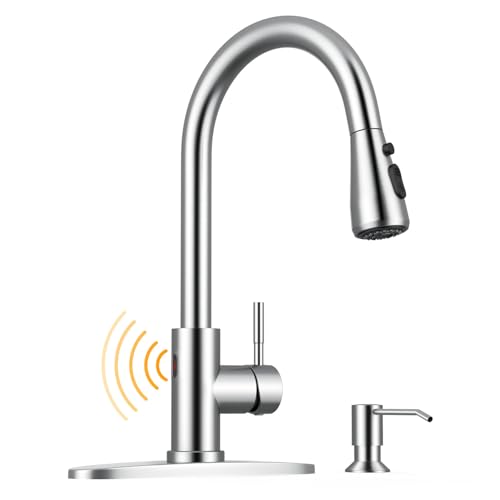
WEWE Touchless Kitchen Faucet with Soap Dispenser Set
Badge: Best Overall
The WEWE touchless set adds a sensor to the formula used elsewhere in this guide: SUS 304 stainless steel in brushed nickel, a three-mode pull-down sprayer on a 360-degree swivel, a ceramic cartridge and easy-clean nozzles. Waving a hand or a pan past the sensor starts and stops the water, which is a genuine hygiene upgrade when your hands are coated in raw chicken or dough. The set also bundles a soap dispenser, clearing the detergent bottle off the counter and using a spare deck hole productively. The trade-offs are the standing ones for touchless designs: a sensor to power, a higher tier than manual models, and one more component to understand at installation time.
The WEWE touchless set leads on flow quality: three modes to match the task, easy-clean nozzles to keep them honest, and sensor control that starts full flow without a soapy hand throttling the handle halfway.
Strengths
- Touchless activation keeps raw-food residue off the handle
- Bundled soap dispenser clears a bottle off the counter
- Same SUS 304 body, ceramic cartridge and easy-clean nozzles as the manual WEWE models
Trade-offs
- Sensor operation adds batteries or a power routine to maintain
- Touchless sets sit in a higher qualitative tier than manual equivalents
- Dispenser hole requirement should be checked against your deck
Mini spec box
- Style: Touchless pull-down with soap dispenser set
- Finish: Brushed nickel
- Spray modes: 3
- Swivel: 360°
- Body: SUS 304 stainless steel
- Installation: 1- or 3-hole fit
- Cartridge: Ceramic
- Nozzles: Easy-clean design
Best for: buyers who want best overall in a touchless pull-down design / Not suited for: buyers whose deck, clearance or style needs point to a different pick in this guide
GIMILI Matte Black Touchless Kitchen Faucet
Badge: Best Hands-Free Flow Control
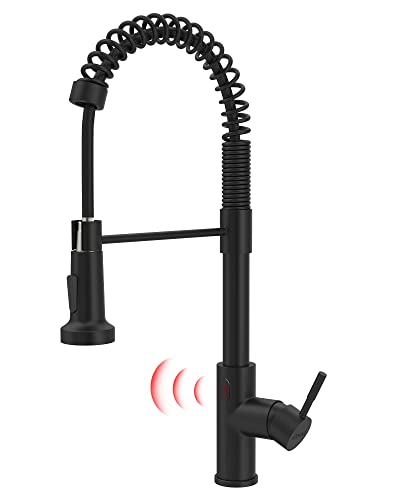
The GIMILI is the design-forward outlier: a matte black, commercial-style spring faucet with a motion sensor for hands-free control. The spring sprayer gives it the professional silhouette, the sensor keeps messy hands off the single handle, and the single-hole installation keeps the sink deck uncluttered. The maker positions it for modern farmhouse kitchens, where black hardware against pale counters and aprons is a deliberate look. Matte black does ask for a little more visual upkeep, since pale mineral film shows against the dark finish, and the single-hole format must match your deck or be adapted. For buyers building a kitchen around black accents, it is the only pick here that fully commits to that scheme.
The GIMILI’s spring sprayer delivers the most directable rinse in the group — a professional-style jet you aim rather than a stream you accept — which is what heavy riners actually mean by good flow.
Strengths
- Matte black finish makes a deliberate design statement
- Motion sensor plus spring sprayer is the most hands-free format here
- Single-hole installation keeps the deck visually clean
Trade-offs
- Single-hole fit only, so multi-hole decks need a plate solution confirmed first
- Matte finishes show pale mineral film more than brushed nickel
- Sensor hardware adds a power and placement consideration
Mini spec box
- Style: Touchless spring pull-down
- Finish: Matte black
- Activation: Motion sensor, hands-free control
- Handle: Single handle
- Installation: Single hole
- Suggested style in listing: Modern farmhouse kitchen
Best for: buyers who want best hands-free flow control in a touchless spring pull-down design / Not suited for: buyers whose deck, clearance or style needs point to a different pick in this guide

VFAUOSIT Pull-Down Kitchen Faucet
Badge: Best Compact Flow
The VFAUOSIT is the compact member of this line-up: a modern pull-down faucet positioned by its maker for bar sinks, which means a slimmer body and a shorter visual footprint than a full-size chef-style model. Its spray head offers three modes and rides on a 23-inch retractable hose, long enough to reach around a sink basin and into a pot set beside it. The listing emphasises lead-free construction certified to NSF 61/372 with cUPC listing, a cold-start handle that defaults to cold water when centred, and a tool-free installation design intended to shorten the swap from an old faucet. For households that want pull-down convenience without a towering spout, this is the scaled-down interpretation of the idea.
The VFAUOSIT’s three modes in a compact body show flow quality is not about faucet size; its 23-inch hose lets you put the stream inside the pot instead of watching it arc from above.
Strengths
- Compact bar-sink proportions suit smaller sinks and secondary prep areas
- Three spray modes cover rinsing, filling and a wider sweep for produce
- Lead-free construction with NSF 61/372 and cUPC listings for drinking-water contact
Trade-offs
- Bar-sink sizing can feel undersized over a deep, wide main sink
- Tool-free fittings still need a careful leak check after the first day of use
- Cold-start handle behaviour takes a few days to become habit
Mini spec box
- Style: Pull-down sprayer, modern bar sink faucet
- Spray modes: 3
- Retractable hose: 23 in
- Certifications in listing: Lead-free, NSF 61/372, cUPC
- Handle safety: Cold-start design
- Installation: Tool-free design
Best for: buyers who want best compact flow in a pull-down, bar sink design / Not suited for: buyers whose deck, clearance or style needs point to a different pick in this guide
WEWE High-Arc Pull-Down Kitchen Faucet
Badge: Best Nozzle Design
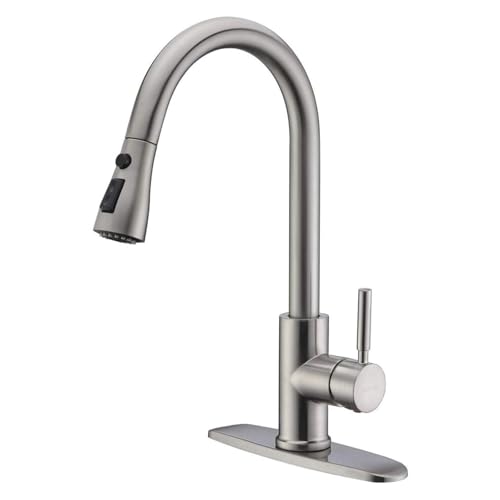
This WEWE high-arc model is the specification-rich all-rounder of the group. The body is SUS 304 stainless steel in brushed nickel, the spout swivels a full 360 degrees, and the pull-down head reaches about 20 inches with three spray modes. Its most practical detail is the soft silicone nozzle face: instead of soaking the head in vinegar when the spray pattern frays, you rub the nozzles with a fingertip to break up mineral film. A ceramic cartridge handles the daily open-close cycling, and the faucet fits either a single-hole deck or a three-hole deck with its plate. It is the design that asks the fewest compromises from a typical family kitchen.
The WEWE high-arc is the flow-maintenance champion: silicone nozzles you rub clean in seconds mean its spray pattern in year three resembles day one, which no sealed nozzle design can promise.
Strengths
- Soft silicone nozzles wipe clean with a fingertip when mineral film builds up
- Full 360-degree swivel plus a 20-inch pull-down reach covers wide double basins
- SUS 304 stainless body and ceramic cartridge are the durable-spec pairing to look for
Trade-offs
- High arc needs cabinet clearance above the sink on some layouts
- Brushed nickel hides spots well but still shows grease film near the handle
- Three-hole installs rely on the deck plate look, which not everyone likes
Mini spec box
- Style: High-arc pull-down
- Finish: Brushed nickel
- Spray modes: 3
- Swivel: 360°
- Pull-down reach: 20 in
- Body: SUS 304 stainless steel
- Installation: 1- or 3-hole
- Cartridge: Ceramic
Best for: buyers who want best nozzle design in a high-arc pull-down design / Not suited for: buyers whose deck, clearance or style needs point to a different pick in this guide

FORIOUS Pull-Down Kitchen Faucet
Badge: Best Classic Flow
The FORIOUS takes the classic route: a traditional high-arc profile in brushed nickel over stainless steel, a single lever handle, and a pull-down sprayer for the jobs a fixed spout cannot reach. It ships with a deck plate so the same faucet covers a one-hole or three-hole sink deck, and the maker is unusually explicit that the design also serves farmhouse, camper, laundry, RV and bar sinks. That versatility matters for buyers furnishing a second sink or a utility space with the same hardware as the main kitchen. The listing is lighter on engineering detail than some competitors, so the appeal here is the proven shape, the flexible fit and the breadth of settings it suits.
The FORIOUS keeps flow simple and classic — a single-handle pull-down with no modes to manage — suiting households whose flow problem was a dying old faucet, not a need for spray variety.
Strengths
- Classic high-arc silhouette pairs with farmhouse and traditional kitchens
- Single-handle control is simple for every age of user
- Maker explicitly rates it for laundry, RV and bar sinks as well as kitchens
Trade-offs
- Listing gives fewer hard specifications than some rivals here
- Classic styling is less at home in ultra-minimal modern kitchens
- Pull-down head is a moving part that eventually needs inspection
Mini spec box
- Style: Classic high-arc pull-down
- Finish: Brushed nickel on stainless steel
- Handle: Single handle
- Installation: Deck plate for 1 or 3 hole
- Suggested uses in listing: Farmhouse, camper, laundry, RV, bar sinks
Best for: buyers who want best classic flow in a classic high-arc pull-down design / Not suited for: buyers whose deck, clearance or style needs point to a different pick in this guide
Moen Essie Pulldown Kitchen Faucet 87014SRS
Badge: Best Brand Support
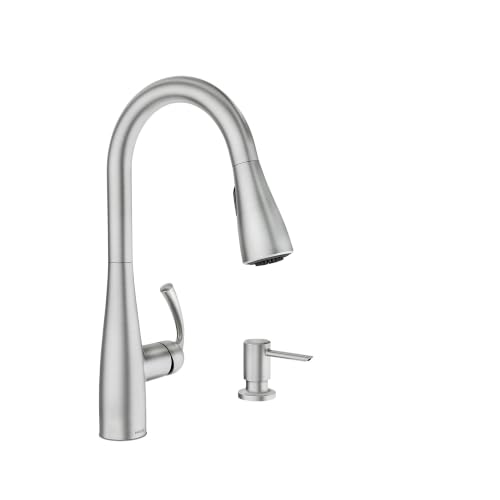
The Moen Essie is the brand-name anchor of this group. Moen is one of the long-established American faucet makers, and the Essie pairs its pulldown format with the Spot Resist Stainless finish, which is formulated to reduce the appearance of fingerprints and water spots between cleanings. The model number 87014SRS identifies the exact configuration, which helps when you need a cartridge, a hose or a finish-matching accessory years later: parts for major-brand faucets are stocked by far more retailers than parts for obscure imports. The listing title keeps its claims modest, so treat the Essie as the conservative choice — a known maker, a spot-hiding finish and a shape that fits almost any kitchen.
The Moen Essie’s flow case is support: a major-brand cartridge and aerator ecosystem means the parts that govern flow are replaceable for years, keeping performance recoverable rather than disposable.
Strengths
- Established national brand with widely available replacement parts
- Spot Resist finish is designed to show fewer fingerprints and water spots
- Clean, transitional styling works across most kitchen styles
Trade-offs
- Listing title states fewer features than the value brands, so check details carefully
- Brand-name ranges usually sit in a higher qualitative price tier
- Pulldown hose and cartridge are wear parts like any moving design
Mini spec box
- Style: Pulldown kitchen faucet
- Finish: Spot Resist Stainless
- Model: 87014SRS
- Brand: Moen
Best for: buyers who want best brand support in a pulldown design / Not suited for: buyers whose deck, clearance or style needs point to a different pick in this guide
Comparison Table
Only attributes stated in the makers’ listings are compared here — no prices, no ratings, and no invented specifications. Where a listing does not state an attribute, the table says so.
| Pick | Style | Finish | Spray | Swivel | Hole fit | Badge | Listing |
|---|---|---|---|---|---|---|---|
| WEWE Touchless Kitchen Faucet with Soap Dispenser Set | Touchless pull-down | Brushed nickel | 3-mode sprayer | 360° | 1 or 3 hole | Best Overall | Check on Amazon |
| GIMILI Matte Black Touchless Kitchen Faucet | Touchless spring pull-down | Matte black | Spring pull-down sprayer | Spring arc | Single hole | Best Hands-Free Flow Control | Check on Amazon |
| VFAUOSIT Pull-Down Kitchen Faucet | Pull-down, bar sink | Not stated in listing title | 3 spray modes | Not stated in listing title | See listing details | Best Compact Flow | Check on Amazon |
| WEWE High-Arc Pull-Down Kitchen Faucet | High-arc pull-down | Brushed nickel | 3-mode sprayer | 360° | 1 or 3 hole | Best Nozzle Design | Check on Amazon |
| FORIOUS Pull-Down Kitchen Faucet | Classic high-arc pull-down | Brushed nickel | Pull-down sprayer | Not stated in listing title | 1 or 3 hole (deck plate) | Best Classic Flow | Check on Amazon |
| Moen Essie Pulldown Kitchen Faucet 87014SRS | Pulldown | Spot Resist Stainless | Pulldown sprayer | Not stated in listing title | See listing details | Best Brand Support | Check on Amazon |
How to Choose Between These Faucets
Begin with compatibility, because it is binary. Your deck’s hole count and layout decide which of these six faucets can install at all: single-hole models need a single-hole deck or a confirmed plate solution, while the one-or-three-hole models with deck plates adapt to both common layouts. Measure the backsplash clearance for the handle and the overhead clearance for the arc while you are under there with a tape. Ten minutes of measuring prevents the most common faucet return of all — the beautiful faucet that physically cannot live on your sink.
Then weigh the working geometry. Arc height should clear your tallest routine vessel with room to spare; reach should centre the stream over your main basin; swivel should match your basin count. A 360-degree swivel is wasted on a small single basin and indispensable on a wide double. Pull-down reach — the hose length figures stated in some listings here — decides whether the sprayer can fill a pot on the counter or only patrol the sink. Think about the last month of cooking and cleaning, and let those tasks, not a showroom pose, set the geometry you need.
Internals separate a five-year faucet from a fifteen-year one. Stainless steel bodies in the SUS 304 grade resist the corrosion that kills plated bodies from inside. Ceramic cartridges give smooth, drip-resistant control and are the replaceable wear part when a faucet eventually drips. Lead-free construction with NSF/ANSI 61 and 372 certification and cUPC listing covers the health side of the specification. When two faucets look alike in photographs, these are the lines in the listing that tell you which one is actually built better — and makers who publish them are telling you something about themselves, too.
Cleaning design deserves more weight than shoppers give it. Spray faces clog with mineral film wherever water is hard; silicone, rub-clean nozzles turn a descaling soak into a ten-second fingertip rub. Spot-resistant finishes cut the wiping that brushed and matte finishes still need. A spring spout has more surface to dry than a smooth arc. None of this appears in the hero photograph, and all of it decides whether the faucet still pleases you in its second year. The reviews in this guide call out the cleaning design of every pick for exactly this reason.
Control style is the last filter. A single lever is fastest for mixed-temperature adjustments with one hand — the other hand usually holds the pan. Touchless sensors remove the handle from the hygiene equation entirely, at the cost of batteries and a sensor to keep unobstructed. Classic two-handle designs, absent from this particular shortlist, suit period kitchens and users who like separate control. Match the control to the cook: households that prep raw meat and dough daily feel touchless benefits weekly; households that mostly rinse and fill may never miss it.
Close the decision with tier logic. Decide how long this faucet must serve. A decade-long kitchen justifies stainless internals, a ceramic cartridge and a brand or seller you can reach in year six. A short-horizon refresh can trade some of that away for style or sensor novelty. Check the live price on each shortlisted listing — this guide deliberately prints none — and ask of each step up: what do I feel, weekly, for this difference? The faucet that survives that question is your answer.
How to Install, Use and Maintain Your Kitchen Faucet
Installation follows the same skeleton for most single-handle pull-down faucets. Shut off the hot and cold stops under the sink and open the old faucet to drain pressure. Disconnect the supply lines, remove the mounting hardware from below, and lift the old faucet out. Clean the deck thoroughly — old putty and mineral crust are the enemies of a flat, leak-free seat. Set the new faucet (with its deck plate if your deck needs it), feed the hoses and shank through, then secure the mounting nut or the maker’s tool-free fastener from below. Connect hot to hot and cold to cold, hang the pull-down hose weight at the marked position, and leave the cabinet doors open for the first day.
Before first use, remove or open the spray head as the manual directs and flush the lines for a minute to clear any debris from the work — grit left in a new cartridge is a self-inflicted wound. Then test methodically: run hot and cold, swing the swivel through its full arc, pull the sprayer to full extension, and check every joint under the sink with a dry paper towel. A towel shows a weep that a fingertip misses. Recheck after a day of normal use; small settling leaks announce themselves early or not at all.
Daily use is mostly about the sprayer. Dock the head fully after each use so the hose weight hangs free and the loop stays clear of stored bottles. Switch spray modes with the water running at moderate pressure rather than forcing the button against full flow. If your model has easy-clean silicone nozzles, give the face a fingertip rub once a week — ten seconds that prevent the slow fraying of the spray pattern. Wipe the finish with a soft cloth as part of the evening clear-down; detergents and abrasive pads are what finishes die of, not water.
Monthly, unscrew or open the spray head if your design allows and rinse its screen. Quarterly, look under the sink: check the hose loop for chafing where it passes the cabinet edge, confirm the counterweight still sits at its mark, and run the paper-towel test on the supply connections. Annually, exercise the shut-off stops themselves — a stop that never moves will not move the day you need it.
Troubleshooting follows a short pattern. Problem: the spray pattern frays or spits sideways → mineral film is distorting the nozzles; rub the silicone face clean, or soak the head in a cup of vinegar for an hour and rinse. Problem: the pull-down head no longer retracts fully → the hose loop is snagged or the counterweight has slipped; clear the loop’s path under the sink and reset the weight at its marked position. Problem: a slow drip from the spout after shut-off → the cartridge is wearing or grit is lodged in it; flush the head screen first, and if the drip persists, plan a cartridge replacement — it is the designed wear part, and replacing it restores the faucet instead of replacing the faucet.
Why Faucets Lose Flow — and How to Get It Back
Most ‘weak faucet’ complaints are not the faucet’s design at all. The usual culprit is mineral and sediment loading the aerator screen and spray face: flow strangles gradually, the spray pattern frays and spits, and pressure seems to vanish. The fix order matters. First, clean the spray face — rub-clean silicone nozzles take seconds; other heads unscrew for a rinse or a vinegar soak. Second, rinse the aerator or head screen. Third, check the under-sink stops are fully open and the supply lines unkinked. Only after those free steps should you suspect the cartridge or the house pressure.
House-side causes are real: ageing galvanised pipe narrows from inside, pressure regulators drift, and a water softener or filter adds resistance. A simple test separates house from faucet: time how long the tub or a garden tap takes to fill a known container, and compare the kitchen’s performance. If every outlet is weak, the faucet was never the problem. If only the kitchen suffers, the aerator-to-cartridge path in the faucet is where to work. The high-arc designs in this guide, like those in Best Kitchen Faucets High Arc, add one more variable — height costs a whisper of pressure at the outlet — but a healthy system never notices it.
Stream, Spray and Sweep: Matching Flow Shape to the Job
Think of flow as three tools. The stream — a coherent, aerated column — is the filler: fastest into pots, quietest, least splash. The spray — water broken into directed jets — is the rinser: it scrubs by impact, clears plates and basin corners, and feels stronger than the stream at identical flow, because the same water arrives concentrated. The wide or sweep mode is the produce and delicate-glass setting: broad, soft, and splash-controlled. A three-mode sprayer, fitted to most picks in this guide, is really a gearbox for one regulated flow rate, letting you spend the same water three ways.
That framing also explains why chasing flow numbers disappoints: two faucets at the same regulated rate can feel completely different because one shapes its water well and keeps its nozzles clean, while the other sprays through a clogged, fraying face. Buy the shaping and the cleanability — the WEWE models’ rub-clean nozzles, the GIMILI’s aimable spring jet — and maintain them monthly. Do that, and the flow you bought is the flow you keep. Long-term owners comparing notes in Best Kitchen Faucets Gardenweb return to this point constantly: maintenance, not model choice, is what separates strong year-five flow from weak.
Pressure, Pipes and the House Behind the Faucet
Every flow conversation eventually leaves the faucet and arrives at the house. Static pressure — what a gauge on an outside tap reads with nothing running — is only half the story; dynamic pressure, what remains while water is moving, is what a filling pot experiences. Long pipe runs, corroded galvanised sections, a partially closed main valve, an ageing pressure regulator and whole-house filters all tax dynamic pressure before the faucet sees a drop. A new faucet installed into a taxed system will be blamed for the system’s sins, which is why this guide insists on the tub-and-bucket comparison test before any purchase is judged a failure.
The good news is that the faucet’s share of flow quality — shaping, mode choice, cleanability — is entirely within your control at purchase, and it is the share that decides how satisfying the regulated flow feels. A coherent stream fills a pot as fast as physics allows; a well-formed spray rinses with authority; a nozzle face kept clean preserves both for years. Buy those qualities, maintain them monthly, and your faucet will deliver everything your house can give it. If the house itself is the limit, a plumber’s pressure test costs less than a second wrong faucet and tells you exactly where the ceiling sits.
Flow and the Rest of the Kitchen: Dishwashers, Filters and Heaters
The kitchen faucet shares its supply with neighbours that also have opinions about flow. An under-sink filter or a reverse-osmosis unit adds resistance on its own line; a tankless water heater needs a minimum flow to fire, which an ultra-restrictive aerator can fail to reach — a real, if uncommon, pairing problem that shows up as lukewarm water at low settings. Dishwashers fill on their own valves and care little about the faucet, but the person washing up while it runs cares about pressure dips on shared, tired pipework.
None of this argues against any pick in this guide; it argues for commissioning the whole station after installation. Run the faucet at low flow and confirm the heater responds; run hot and cold together with the dishwasher filling and note the change; check the filter’s flow against its maker’s expectation. Five minutes of system checks turns a faucet purchase into a kitchen that works as a system — which is what ‘good water flow’ actually means in a lived-in home, as opposed to a number on a box.
Handles, Ergonomics and Who Actually Uses This Faucet
A faucet is operated hundreds of times a week, often one-handed, often with wet or messy hands, and often by people the buyer forgets to consider: children reaching up, older relatives with weaker grips, a partner holding a pan in the other hand. Handle design decides whether those moments are effortless or faintly annoying forever. A single lever, used by every pick in this guide, is the ergonomic default for good reason — one hand sets flow and temperature together, the wrist or even the back of the hand can work it when fingers are coated, and there is no second handle to knock against the backsplash.
Lever geometry matters within that format. A longer lever gives more leverage and finer temperature control near the middle of the range, where most kitchen work lives; a compact lever suits tight decks where swing space is scarce. Side-mounted levers keep the spout silhouette clean and can help where a window or shelf crowds the space behind the sink; top-mounted levers read most intuitively to guests. None of this appears in a hero photograph, and all of it is felt daily — which is why the detailed reviews note handle arrangement alongside the more glamorous sprayer details.
Touchless activation, offered by two designs in this programme’s wider pool, is the ergonomic extreme: no grip at all, just presence. For households cooking with raw proteins, dough or garden soil, that is a genuine quality-of-life change rather than a gadget. For everyone else, a well-shaped lever on a ceramic cartridge delivers the same smoothness with nothing to power. Judge by your household’s hands, not by the showroom’s novelty ranking, and the handle stops being an afterthought — it becomes the part of the faucet you chose most deliberately.
What to Do on the Day the New Faucet Goes In
Flow quality is partly installed, not just bought, so installation day deserves a flow checklist of its own. Flush the supply lines into a bucket before connecting the new faucet, so the grit disturbed by the work never reaches the new cartridge or screen. Connect the supplies fully, open both stops completely — a half-open stop is a silent flow tax that owners blame on faucets for years — and route the pull-down hose without kinks. Then commission the flow properly: run each spray mode for a full minute, note how the stream holds together, and rinse the spray head’s screen once more after that first flush, because installation debris collects there within the first hour.
Finally, set your baseline. Time the filling of your largest pot and keep the number in your phone. That unglamorous figure is your flow health record: when, two years from now, the same pot takes noticeably longer, you will know the system has drifted — and the maintenance sections of this guide will tell you the order to win it back, starting with a fingertip on the nozzle face. Flow, treated that way, stops being a specification you bought once and becomes a quality you keep.
Remember, too, that flow is a feeling as much as a measurement. A stream that holds together sounds right, lands where it is aimed and rinses with confidence; a frayed, spitting spray feels broken even when a stopwatch says the rate is identical. That is why this guide chased shaping and cleanability rather than numbers, and why the monthly ten-second nozzle habit is worth more than any specification printed on a box. Buy the faucet that shapes water well, keep its face clean, and your kitchen will feel like it has strong water — because, in every way that matters at the sink, it will.
There is also a conservation footnote that belongs in any honest flow discussion: shaping water well is how a household uses less of it without feeling deprived. A spray that rinses decisively finishes the job sooner; a stream that fills without splashing wastes nothing over the rim; a nozzle face kept clean keeps both truths in force. The regulated ceiling that frustrates number-chasers is, from this angle, a design brief — and the faucets in this guide are the ones that answer it with engineering rather than excess. Strong-feeling water and responsible water turn out, at the modern sink, to be the same water.
Common Buying Mistakes
Flow shopping has its own mythology, and believing it leads to the classic errors below:
- Buying by silhouette alone and discovering the deck fit, handle clearance or hose loop does not work in your cabinet.
- Skipping the under-sink inspection: a pull-down hose loop needs a clear drop, and a packed cabinet is the top cause of poor retraction.
- Choosing a finish for the photograph instead of your water — matte and polished finishes show hard-water film far faster than brushed ones.
- Ignoring certifications: a kitchen faucet is a drinking-water device, and lead-free, NSF-verified construction is not a luxury detail.
- Over-tightening connections at installation until washers distort, then blaming the faucet for the weep that follows.
- Letting the spray face clog for a year and concluding the faucet has weak pressure, when ten seconds of nozzle cleaning was the whole problem.
- Forgetting the shut-off stops: never exercising them means they seize, and the day you need them is the day that matters.
- Ordering before measuring arc height against the cabinet, shelf or window above the sink.
Final Recommendation
Choose the WEWE touchless set if you want the most complete flow toolkit — modes, cleanable nozzles and effortless full-flow starts. Pick the WEWE high-arc if long-term flow maintenance is your priority, the GIMILI for the most forceful directed rinse, or the VFAUOSIT for compact three-mode versatility. The FORIOUS and the Moen Essie serve buyers who want classic delivery with, in the Moen’s case, the deepest parts support. And before replacing anything, clean your current faucet’s aerator and spray face: a surprising share of flow problems end there, free. If your supply is a private well, read Best Kitchen Faucets For Well Water next — sediment changes the maintenance maths entirely.
Our three headline recommendations, with live listings: WEWE Touchless Kitchen Faucet with Soap Dispenser Set GIMILI Matte Black Touchless Kitchen Faucet VFAUOSIT Pull-Down Kitchen Faucet — check the latest price on Amazon for each before you decide.
Frequently Asked Questions
What flow rate should a kitchen faucet have?
In the US, kitchen faucets are built to a regulated maximum that most modern models share, so chasing a bigger number is mostly futile. What varies meaningfully is spray shaping, mode choice and how well the design resists clogging. Judge those, and check your home’s pressure, before judging a faucet’s flow.
Why does my new faucet feel weaker than my old one?
Usually installation debris in the aerator or spray head from the swap itself, a partially opened stop valve, or a kinked supply line. Flush the head, rinse the screen and check the stops before concluding the faucet is at fault.
Do pull-down sprayers reduce flow?
The hose and head add some resistance, but a healthy modern pull-down delivers its rated flow comfortably. Where pull-downs lose flow over time is at the spray face, as mineral loads the nozzles — which is why cleanable nozzle designs feature so strongly in this guide.
Does a high-arc faucet reduce pressure?
Raising water a few extra inches costs a negligible amount of pressure in a healthy system. If a high-arc faucet feels weak, the cause is almost always clogging, supply restrictions or house pressure — not the arc. Clean first, diagnose second.
How do I keep flow strong over the years?
Rub or rinse the spray face monthly, rinse the aerator screen seasonally, and keep the cartridge healthy by addressing drips early. The rub-clean silicone nozzles on the WEWE picks turn the monthly job into seconds.
Can a faucet increase my home’s water pressure?
No faucet creates pressure; it can only waste less of what your system delivers. If the whole house is weak, the answer lies in the supply — a regulator, ageing pipe or a pump question — and a plumber’s pressure test will tell you more than any faucet listing.