Disclosure: topratedkitchenware.com is reader-supported. When you buy through links on our site, we may earn an affiliate commission from Amazon and other retailers, at no extra cost to you.
Where to buy
This guide to the best induction cooktops for rvs brings together six verified portable induction burners, each checked through the Creators API, with Amazon links so you can check the latest price on Amazon for the exact model. The plural in the keyword is doing real work here: RVs are not one vehicle but a family of them — Class A motorhomes with residential ambitions, compact Class B camper vans, family travel trailers, fifth wheels with island kitchens, toy haulers feeding a crowd — and the right burner depends on which of those you call home on wheels. Every pick below was judged across that range: electrical appetite, deployed and stowed size, how many mouths it can feed, and how its controls behave in a busy camp kitchen. Read the full guide ↓ for badges, honest trade-offs, a comparison table and a rig-by-rig choosing section.
- ChangBERT Induction Cooktop, Commercial Grade — Best Overall for RVs. Best for most rigs, with stainless commercial-style build, a large 8-inch coil and a 10-hour timer.
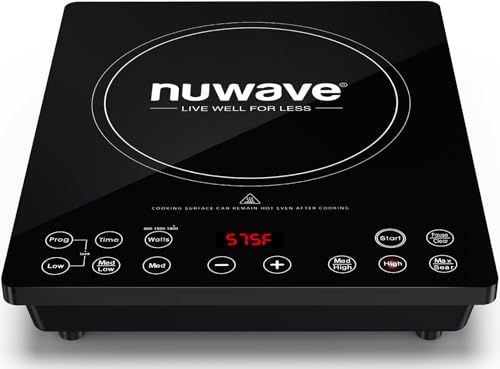
- Nuwave Double Pro Cooktop, Induction Countertop Burner — Best for Family Dinners. Best for two-pot cooking in larger rigs, with dynamic wattage options for power management.
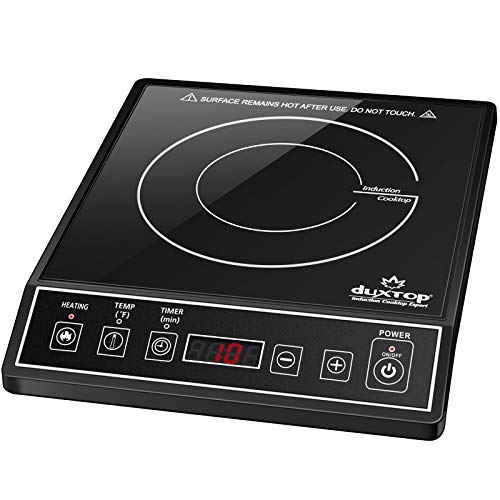
- Duxtop 1800W Portable Induction Cooktop, Black 9100MC — Best for Camper Vans. Best for Class B and small trailers where a simple, proven single burner is the correct size of ambition.
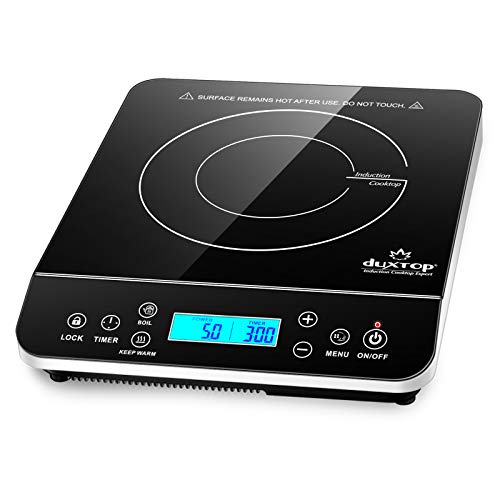
- Duxtop Portable Induction Cooktop, Black 9610LS — Best Wipe-Clean Galley Pick. Best for tidy family galleys, with an LCD sensor-touch face.
- Nuwave Pro Chef Induction Cooktop — Best Temperature Precision. Best for serious cooks, with 94 temperature settings across a wide range in fine increments.
- 1800W Portable Induction Cooktop, Touch Control (ISILER) — Best Presets and Safety Lock. Best for families with kids around the galley, with 7 cooking presets and a safety lock.
Shopping for the best induction cooktops for rvs goes wrong most often at the moment a buyer treats all RVs as the same kitchen. They are not. A Class A with a generous counter run, a residential-style fridge and a large inverter lives in a different culinary universe from a Class B van where the counter is a fold-down flap and every stored item must earn its volume monthly. A fifth wheel parked seasonally on a full-hookup site has effectively a house’s electrical service; a travel trailer boondocking in the desert has a battery bank and a prayer to the solar forecast. The six burners in this guide span that spectrum deliberately, and the reviews keep asking the only question that matters: which rigs, which travellers, which style of camp cooking does this burner actually serve?
The shared ground is why induction suits RVs of every class in the first place. Propane cooktops — the factory default across the industry — heat the cabin along with the food, add combustion moisture to a small sealed volume, demand carbon monoxide vigilance, and boil water with a patience that tests families at breakfast. Induction heats the pan directly, stops instantly, works in wind when a burner is used at an outdoor kitchen, and scales its appetite down in fine steps when the electrical system asks it to. For a seasonal fifth wheel on shore power, that means faster, cooler, pleasanter cooking. For a van at the edge of its battery budget, it means cooking at deliberately reduced levels that still get dinner done. The technology bends across the whole RV family; the art is matching the model to your branch of it.
Portability is the other shared virtue. All six picks are countertop units that deploy when cooking and stow when living, which respects the central fact of RV design: the kitchen is also the lounge, the office and sometimes the bedroom. A portable burner also travels between venues — galley counter on a wet Tuesday, outdoor kitchen or picnic table on a golden Friday — in a way no built-in cooktop in any rig class can. Travellers who want to understand the underlying technology more deeply, including the terminology itself, will find it unpacked in Best Inductive Cooktops, while this article keeps the wider, multi-rig lens its keyword asks for.
Key Takeaways
- Match the burner to the rig class: camper vans need compact singles, larger motorhomes and fifth wheels can host doubles and heavy-duty builds.
- All six picks are 1800W-class portables that stow away — deployed size and stowed size both matter, and they are different measurements.
- Fine temperature control is a family feature, not a luxury: the Nuwave Pro Chef’s 94 settings in small increments suit everything from baby-food warming to proper searing.
- A safety lock and presets, as on the ISILER pick, change the calculus when children cook or wander in a small shared space.
- Dynamic wattage options on the double burner let bigger rigs cook two pots while respecting pedestal and inverter limits.
- Magnetic, multi-purpose cookware remains the universal requirement — test your existing pans before buying anything.
In this guide
Quick Picks
| Pick | Badge | Format | Best-matching rigs | Check |
|---|---|---|---|---|
| ChangBERT Induction Cooktop, Commercial Grade | Best Overall for RVs | Single, stainless | Class A and C motorhomes, fifth wheels, full-timers | Check on Amazon |
| Nuwave Double Pro Cooktop | Best for Family Dinners | Double burner | Larger rigs with real counter runs and family crews | Check on Amazon |
| Duxtop 1800W Portable Induction Cooktop, Black 9100MC | Best for Camper Vans | Single, compact | Class B vans, teardrops, small travel trailers | Check on Amazon |
| Duxtop Portable Induction Cooktop, Black 9610LS | Best Wipe-Clean Galley Pick | Single, touch panel | Family trailers where the galley must stay spotless | Check on Amazon |
| Nuwave Pro Chef Induction Cooktop | Best Temperature Precision | Single, commercial-grade | Serious cooks in any rig class with bench room | Check on Amazon |
| 1800W Portable Induction Cooktop (ISILER) | Best Presets and Safety Lock | Single, touch control | Families with children, new RV cooks | Check on Amazon |
Use the rig column as your first filter and the badge as your second. A van traveller who falls for the double burner’s charms before measuring a fold-down counter is shopping for disappointment, while a fifth-wheel family that buys the tiniest single will feel its ceiling at every group dinner. The detailed reviews now walk through each pick rig by rig, pan by pan.
How These Picks Were Chosen
This guide is research-led, not a hands-on convoy test, and it says so openly. All six burners come from a verified pool checked through the Creators API on 2026-11-20; each product’s ASIN, official title and image were recorded before drafting, and every specification quoted here — wattage, temperature-setting counts and ranges, timer lengths, coil sizes, preset counts, the safety lock, the double burner’s wattage options — appears in those verified titles. Where listings are silent, such as on exact unit weights, the guide discusses the practical consideration without inventing numbers.
The evaluation was run through a multi-rig lens on purpose. Each burner was considered against five questions. How does it behave on a rationed electrical system, and can its power be stepped down gracefully? How much counter does it claim while cooking, and how much cabinet while travelling? How many people can it realistically feed in a normal camp dinner pattern? How does its interface cope with multiple cooks, including younger or less experienced ones, in a confined shared space? And how tough is it, across seasons of being stowed, deployed and wiped down in rigs that move? A burner could score brilliantly for a Class A and poorly for a van, and the reviews say which, rather than averaging the answer into mush.
All six pool picks are genuine portable induction burners, so none required demotion to prose-only for a fuel-type mismatch. What separates them is fit across the RV family — which is exactly the separation this keyword exists to explore.
The 6 Best Induction Cooktops for RVs in Detail

ChangBERT Induction Cooktop, Commercial Grade Portable Cooker
Badge: Best Overall for RVs
Strengths
- Premium stainless steel countertop body with a large 8-inch heating coil — the toughest construction story in this guide.
- NSF certified according to the listing, a sanitation-and-build signal that suits daily, family-scale use.
- A 10-hour timer on the 1800W platform, ready for slow camp cooking days at powered sites.
Trade-offs
- Commercial intent means a workmanlike presence; design-led van interiors may prefer sleeker glass.
- The 8-inch coil wants right-sized pans; a giant family skillet will overhang the heating zone.
- Heavier-duty builds reward a dedicated stowage plan rather than casual tossing into a bay.
Spec box (verified listing data only): Power: 1800W. Heating coil: large 8 inch. Build: premium stainless steel. Certification named in listing: NSF. Timer: 10 hours. Type: commercial grade portable cooker, countertop burner.
The ChangBERT earns Best Overall for RVs because the median RV kitchen works harder than the median house kitchen. In a motorhome or fifth wheel that hosts a family for a season — or a couple for a year — the burner is not an occasional gadget but daily infrastructure, deployed on counters that flex, in air that ranges from desert-dry to coastal-damp, by cooks of varying patience. Stainless commercial-style construction and a certification callout in the listing speak directly to that duty, and the ten-hour timer supports the slow, set-it-going style of camp cooking that powered sites make easy.
Its fit is broadest in the middle and upper size classes: Class A and C motorhomes, fifth wheels and larger trailers with a real counter and a cabinet that can be its home. In a compact van it is not too powerful or too capable — it is simply more appliance than the space rewards, and the Duxtop singles below serve that branch of the family better. Knowing which branch you are in is most of this purchase.
Best for: motorhomes, fifth wheels and full-time families cooking daily / Not suited for: compact camper vans counting every stored litre
Check on Amazon to check the latest price on Amazon for the ChangBERT induction cooktop.

Nuwave Double Pro Cooktop, Induction Countertop Burner
Badge: Best for Family Dinners
Strengths
- Two induction zones: the only pick that cooks a true two-pot family dinner in parallel.
- Dynamic wattage options of 900, 1500 and 1800W in the listing — built-in power diplomacy for pedestals and inverters.
- A wide stated temperature range from 50°F to 575°F, shatter-proof ceramic glass and a seamless touch panel.
Trade-offs
- The largest deployed and stowed footprint in the guide; small rigs need not apply.
- Two zones share the unit’s power options, so simultaneous maximum performance is a managed expectation, not a given.
- Touch controls in a family scrum of wet hands and helping children require a towel-and-patience system.
Spec box (verified listing data only): Type: double induction cooktop, portable countertop. Temperature range in listing: 50°F–575°F. Wattage options in listing: 900 / 1500 / 1800W with Dynamic Watt Technology. Heating coil: 8 inch. Surface: shatter-proof ceramic glass. Controls: seamless IMD touch panel.
Family RV cooking fails at the sequencing bottleneck: one burner means the children’s pasta, the adults’ sauce and anyone’s vegetables form a queue, and dinner becomes a relay. The Double Pro removes the bottleneck for rigs that can host it — and the wattage options are what make that honest rather than reckless, letting the cook cap total draw to what a 30-amp pedestal shared with the rest of the rig, or a modest inverter, can sustain. In a larger motorhome’s outdoor kitchen, deployed on a stable table, it becomes the social centre of the campsite: two pans going, people gathered, the rig’s interior staying cool.
The disqualifier is pure geometry, and it should be applied without sentimentality. Measure the counter it would occupy and the cabinet it would sleep in; if either answer is “just barely”, choose a single and cook in sequence like the rest of the RV world. Families in genuinely large rigs, though, will find this the one pick that changes what dinner can be.
Best for: families in Class A/C motorhomes, fifth wheels and large trailers / Not suited for: camper vans and any rig where its footprint must be argued for
Check on Amazon to check the latest price on Amazon for the Nuwave Double Pro.
Duxtop 1800W Portable Induction Cooktop, Black 9100MC
Badge: Best for Camper Vans
Strengths
- The proven Duxtop 1800W platform (9100MC, BT-M20B) in its simplest black form — maximum track record, minimum fuss.
- A compact single-burner footprint that respects the van law: everything stored must be small, tough and multi-purpose.
- Straightforward operation that any travelling companion can use without a briefing.
Trade-offs
- No preset library or long-timer story in its listing; cooks wanting programmes should look at the ISILER or Nuwave picks.
- One burner, one pot — van cooking’s familiar, accepted choreography.
- Black glass shows travel dust between wipes, a minor cosmetic tax.
Spec box (verified listing data only): Power: 1800W. Type: portable induction cooktop, countertop burner. Model: 9100MC, BT-M20B. Finish: black. Burners: 1.
Camper vans are the strictest editors in the RV world: if an object is bulky, fragile, single-purpose or complicated, it is evicted. The 9100MC survives that editing on merit. It is a single, full-power induction burner from the category’s most established portable name, small enough to stow in the odd-shaped spaces vans provide, and simple enough to deploy on a fold-down counter or a camp table without ceremony. For the solo traveller or couple whose cooking runs to skillet dinners, soups, eggs and pasta, it covers the repertoire completely.
What it asks in return is acceptance of sequence — one pot at a time — and of a feature set trimmed to the essentials. Van travellers generally accept both trades instinctively, because the alternative is carrying a bigger appliance to cook meals their space cannot serve anyway. Among small-rig picks in this guide, this is the default recommendation; the touch-panel sibling below is the upgrade for cooks who prize a spotless galley.
Best for: Class B vans, teardrops and small trailers with solo or couple crews / Not suited for: family cooking or preset-led cooks
Check on Amazon to check the latest price on Amazon for the Duxtop 9100MC.
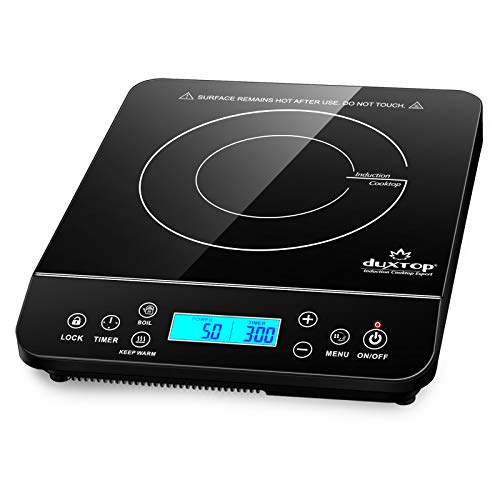
Duxtop Portable Induction Cooktop, Black 9610LS
Badge: Best Wipe-Clean Galley Pick
Strengths
- LCD sensor-touch controls (9610LS, BT-200DZ) on a flat face: no knobs, no rims, nothing to harbour galley grime.
- The same proven 1800W Duxtop platform as the van pick, in black, for cooks who want tidiness with their track record.
- In family trailers, a one-wipe surface keeps the shared living-cooking space feeling like a lounge again by evening.
Trade-offs
- Touch panels need dry fingertips; a designated burner towel is part of the ownership kit.
- Single burner sequencing applies, as with all the singles here.
- Mid-cook wipe-downs can disturb settings — clean deliberately, with the unit off or locked into your routine.
Spec box (verified listing data only): Power: 1800W. Type: portable induction cooktop, countertop burner. Controls: LCD sensor touch. Model: 9610LS, BT-200DZ. Finish: black. Burners: 1.
The family trailer galley has a unique burden: it is a kitchen that must disappear. Breakfast’s evidence cannot linger in a space that becomes the children’s homework desk and the evening’s lounge, and this is where a seamless touch face stops being a style preference and becomes a sanitation system. One pass of a cloth returns the burner to a black glass slab that looks like furniture; there are no control crevices quietly storing the week’s cooking in a warm, enclosed box on wheels.
Its demands are the familiar touch-panel ones — dry hands, deliberate cleaning — and in a family context they argue for a small routine: towel on a hook beside the counter, burner wiped when cool after each meal, settings adjusted by the cook rather than by helpful small hands passing by. Families who run that routine rate this pick first; families who cook in cheerful chaos may prefer the forgiveness of physical controls elsewhere in the guide.
Best for: family trailers and tidy galleys in any rig class / Not suited for: cooks who adjust controls with wet hands throughout the meal
Check on Amazon to check the latest price on Amazon for the Duxtop 9610LS.

Nuwave Pro Chef Induction Cooktop, Commercial-Grade Portable Burner
Badge: Best Temperature Precision
Strengths
- 94 temperature settings spanning 100°F to 575°F in 5°F increments, per the listing — precision no other pick here approaches.
- A large 8-inch heating coil and a powerful 1800W platform with commercial-grade positioning.
- Shatter-proof ceramic glass surface, a reassuring phrase for equipment that travels.
Trade-offs
- Precision is wasted on cooks who only ever boil and fry; simpler picks serve them with less to learn.
- Commercial-grade intent brings a more serious, less minimalist presence on the counter.
- Single burner: the precision is deep, but it is still one vessel at a time.
Spec box (verified listing data only): Power: 1800W. Temperature settings: 94, from 100°F to 575°F in 5°F increments. Heating coil: large 8 inch. Surface: shatter-proof ceramic glass. Positioning: commercial-grade portable burner.
Some RV cooks are campers who cook; others are cooks who camp. The Pro Chef is for the second tribe. Ninety-four temperature settings in fine increments turn the burner into an instrument: chocolate held without a bain-marie, delicate sauces kept below the split point, oil brought to an exact frying temperature and held there while batches of fish from the lake go through. In a rig, where the kitchen may be the owner’s primary creative space for months of travel, that precision converts a portable burner from an appliance into a practice.
The honest caveat is audience size. Most camp cooking — pasta, eggs, burgers, reheats — uses perhaps four temperatures, and a cook who lives in that repertoire will never touch the depth this unit offers. But RVs carry their owners’ real lives, including their serious hobbies, and for the traveller whose hobby is cooking itself, this is the pick that respects it. It also shares the family’s travel virtues: a single footprint, a tough-sounding glass claim in its listing, and full power when the site allows.
Best for: serious cooks travelling in any rig with a stable counter spot / Not suited for: boil-and-fry minimalists who will never use fine temperature steps
Check on Amazon to check the latest price on Amazon for the Nuwave Pro Chef.

1800W Portable Induction Cooktop, 8 Inch Heating Plate, Touch Control (ISILER)
Badge: Best Presets and Safety Lock
Strengths
- 7 cooking presets plus 10 power and 10 temperature settings — guided cooking for newer or younger cooks in the crew.
- A safety lock named in the listing, a meaningful feature when small children share a compact living space with the galley.
- Touch control on an 8-inch heating plate in a compact, portable design aimed squarely at family practicality.
Trade-offs
- Presets are starting points, not guarantees; family cooks still supervise, lock or no lock.
- A less established name in this company, with a smaller owner community to consult.
- Touch controls share the dry-fingertip requirement of the other panels here.
Spec box (verified listing data only): Power: 1800W. Heating plate: 8 inch. Settings: 10 power and 10 temperature. Presets: 7 cooking presets. Features named in listing: timer, safety lock. Controls: touch. Design: compact, portable.
Family RVs run on distributed competence: a teenager reheats lunch, a grandparent starts the potatoes, a parent finishes the meal. The ISILER is designed for that crew reality. Presets give less experienced cooks a sane starting point instead of a blank panel, the timer bounds their sessions, and the safety lock addresses the scenario every RV parent has pictured — small hands exploring a flat, interesting surface at exactly counter height in a space where the kitchen is also the playroom. No feature replaces supervision, but features that support it are worth real money in this branch of the RV family.
Its limits are depth and pedigree: ten power and temperature settings are plenty for family cooking but not the Pro Chef’s instrument-grade range, and the brand’s owner community is younger. For the family that prioritises safe, guided, everyday usability over precision or heritage, those are the right trades to make.
Best for: families with children and multi-cook crews in trailers and motorhomes / Not suited for: precision cooks or brand-heritage buyers
Check on Amazon to check the latest price on Amazon for the ISILER portable induction cooktop.
Comparison Table
| Pick | Burners | Control depth | Standout feature | Rig fit | Check |
|---|---|---|---|---|---|
| ChangBERT Commercial Grade | 1 | Standard | 10-hour timer, stainless, NSF named | Motorhomes, fifth wheels | Check on Amazon |
| Nuwave Double Pro | 2 | Wide range, touch | 900/1500/1800W wattage options | Large rigs, families | Check on Amazon |
| Duxtop 9100MC Black | 1 | Standard | Proven compact simplicity | Vans, small trailers | Check on Amazon |
| Duxtop 9610LS Black | 1 | LCD touch | Wipe-clean seamless face | Family trailers | Check on Amazon |
| Nuwave Pro Chef | 1 | 94 settings, 5°F steps | Instrument-grade precision | Serious cooks, any rig | Check on Amazon |
| ISILER Touch Cooktop | 1 | 10 + 10 settings, 7 presets | Safety lock for family crews | Families with children | Check on Amazon |
The table’s last column is the one to shop by. Specifications travel between rigs unchanged; fit does not. The next section turns fit into a decision procedure, class by class.
How to Choose an Induction Cooktop for Your RV Class
Class B camper vans and teardrops: buy small, buy proven, buy simple. Your counter is a flap, your storage is a puzzle, and your electrical system is the most modest in the family. A compact single like the Duxtop 9100MC, run mostly at gentle levels off the inverter and at full enthusiasm on hookups, is the correct scale of ambition. Spend remaining budget on one excellent magnetic skillet that also works over a fire.
Travel trailers and Class C motorhomes: the versatile middle. You have a real counter and a real cabinet, a family-sized appetite and a mid-sized electrical system. Singles with strong timers and family features — the ChangBERT for durability, the ISILER for its lock and presets, the 9610LS for galley tidiness — all fit; choose by crew, not by spec sheet. This is also the class where a second, inexpensive cooking method (the factory propane hob, a camp stove) most naturally complements a single induction burner on group nights, a pairing strategy the budget shortlist at Best Induction Cooktops Under $200 helps cost out.
Class A motorhomes and fifth wheels: you can host the guide’s biggest ideas. The Double Pro’s two zones and wattage diplomacy make sense on your counters and your electrical service, and the ChangBERT’s commercial build matches your likely daily duty. Seasonal and full-time rigs in this class should weight durability and timers heavily, because your burner will log more hours in a season than a house cooktop logs in a year of weekends.
Every class, the same three checks: magnet-test the pans you already carry; measure deployed counter and stowed cabinet separately; and write down your electrical reality — pedestal size you typically book, inverter rating, battery capacity — before falling for any feature. Those three acts of honesty predict satisfaction better than any review, including this one, and they are the same discipline recommended for fixed small kitchens in Best Induction Electric Cooktops.
How to Set Up a Portable Induction Burner in Any RV
- Claim a stable, level, heat-safe station. A galley counter, an outdoor kitchen shelf or a sturdy camp table — flat enough that a full pot cannot walk, solid enough for the crew size you cook for.
- Plug into the rig’s own outlet, directly. No extension leads or power strips for a high-draw appliance, and a mental note of what else shares the circuit — air conditioner, microwave and burner rarely all fit at once.
- Centre a magnet-tested pan on the coil marking. Family-size pans should sit within the coil’s honest reach; the 8-inch coils named on several picks suit the mid-size cookware RVs already carry.
- Assign the power budget out loud. In multi-cook families, one person owns the electrical picture for the meal — who is running what, at what level — which prevents the breaker from teaching the lesson instead.
- Cook with lids and sequence. Lids speed boils and cut cabin steam; on singles, cook in the order that lets finished dishes hold — sauces and grains wait gracefully, fried things do not.
- Use the lock and the timer when the crew includes children. Features only protect when they are habits; make engaging them part of setup, not an afterthought.
- Cool, wipe, stow — in that order, every time. Let the fan finish, wipe the glass once safe, and return the burner to its padded, assigned place before the rig moves or the space converts back to living.
Troubleshooting. Problem: the pedestal or rig breaker trips at dinner → the classic RV pile-up of burner plus air conditioning plus microwave; stagger the big loads or cap the burner at a lower level or wattage option. Problem: a pan is not detected → it is non-magnetic, warped, or far smaller than the coil; verify with a flat cast-iron skillet. Problem: the touch panel ignores inputs during family cooking → wet fingertips; dry hands on the designated towel, or choose push-button and preset-led models for the wettest cooking styles.
Feeding a Crowd from a Small Galley: Menus and Methods That Work
The RV family’s recurring miracle is group dinner from a one-burner kitchen, and it is a method, not an accident. Build menus around one-pot anchors — chilli, curry, stew, pasta cooked in its sauce — where the single burner carries the whole meal and the ChangBERT’s or ISILER’s timer minds it while people gather. Use the burner in waves for breakfast: eggs last, everything else held warm in a low oven, on the propane hob, or wrapped and rested. Deploy the double burner, if your rig hosts one, for the two genuine bottlenecks of camp cuisine: pasta water beside sauce, and rice beside stir-fry. And embrace the outdoor station — a portable on a camp table under the awning keeps heat, smells and the cook’s audience all outside, turning the galley’s limits into the evening’s entertainment. Travellers refining these methods will find kindred thinking in Best Infrared Portable Cooktops, where another flameless technology is judged by the same outdoor, rationed-power standards.
Two supporting habits make the method reliable rather than lucky. The first is a holding strategy decided before cooking starts: a low oven if the rig has one, a lidded pot wrapped in towels, or a second small appliance whose only job that night is keeping finished food warm without further cooking. The second is mise en place with RV discipline — everything chopped, measured and staged before the burner lights, because a single-burner kitchen has no spare zone in which a forgotten ingredient can wait while you catch up. Families who adopt both habits stop experiencing one-burner cooking as a constraint and start experiencing it as a rhythm: prep together, cook in sequence, eat together, and let the galley return to being a living room before dessert. That rhythm, repeated across a season of sites, is ultimately what the right burner is buying — not a specification, but an evening that works.
Outdoor Kitchens, Awning Cooking and Campground Etiquette
Many RVs now travel with an outdoor kitchen, and even those without one tend to grow an informal version: a folding table under the awning, a burner, and the evening’s cooks and audience arranged around it. Portable induction is unusually well suited to that venue. There is no flame for the evening breeze to bully, no gas bottle to connect and disconnect, and no lingering element staying hot where children and dogs circulate — the surface cools quickly once the pan leaves it, and switching off is absolute. In bear-aware country and in fire-restriction areas, a flameless outdoor burner also sidesteps a category of rules and worries that flame cooking must constantly negotiate, though local regulations always govern and should be checked rather than assumed.
Etiquette scales with rig size. In a busy campground, cooking smells, generator hours and shared pedestals are all communal resources. Induction scores well on all three when used thoughtfully: it produces no generator demand at a powered site, it cooks fast so the pedestal’s capacity is borrowed briefly, and its relative quiet — a fan’s hum rather than a roaring burner — respects the acoustic commons. The double-burner family feast and the van dweller’s quiet one-pot supper can coexist on the same row precisely because this technology asks so little of the neighbours. That social fit is an underrated reason the RV community, across all classes, has adopted portable induction faster than almost any other cooking upgrade of the past decade.
Storage Engineering: Giving the Burner a Home That Protects It
Across every rig class, the difference between a burner that lasts one season and one that lasts five is usually a storage decision made in the first week. Glass tops fail from point impacts and from heavy objects resting on them during travel, not from cooking. The reliable solutions are unglamorous: a padded sleeve or the original box in a low cabinet; a vertical slot between dividers, like a cutting board’s place; or a flat berth under a mattress or dinette cushion where weight is distributed and nothing hard shares the space. Cords should be loosely coiled and never used as the handle for a dangling unit, and the burner should travel clean — grit between glass and cabinet floor is sandpaper with a thousand miles to work.
Build the stowage into the purchase decision itself. Before ordering any pick in this guide, stand in your rig and physically point at where it will sleep, then measure that space in all three dimensions, including the door or hatch it must pass through. Travellers who do this once almost never join the ranks of those trying to sell a nearly new burner at a campground swap meet because it fits nowhere. It is the least technical advice in this article and, across the whole RV family from teardrop to Class A, the advice most strongly correlated with owners who still love their choice years later.
Common Buying Mistakes
- Shopping for “RVs” as if they were one vehicle. A van and a fifth wheel need different burners. Start from your class, not from a generic ranking.
- Measuring the counter but not the cabinet. The burner lives in storage most of its life. If it has no padded home, it will eventually have a cracked top.
- Ignoring the crew. Children, grandparents and guest cooks change the right answer — locks, presets and forgiving controls are family specifications.
- Assuming two burners means double power. Zones share an appliance’s electrical reality; the wattage options exist to manage it, so read them before promising simultaneous feasts.
- Bringing non-magnetic pans from home. The magnet test takes ten seconds at home and saves the first trip’s dinners.
- Buying precision you will never use — or durability you desperately need, too late. Full-timers should pay for build; weekenders should pay for simplicity; both should skip the other’s invoice.
Final Recommendation
Across the whole RV family, the balanced first choice is the ChangBERT Induction Cooktop, Commercial Grade — tough, timer-rich and equally at home in a motorhome galley or a fifth wheel’s outdoor kitchen. Families in larger rigs who cook two-pot dinners should step up to the Nuwave Double Pro Cooktop, Induction Countertop Burner, while van travellers should choose the Duxtop 1800W Portable Induction Cooktop, Black 9100MC without a moment’s regret. Precision cooks will treasure the Nuwave Pro Chef, tidy family galleys the Duxtop 9610LS, and crews with young children the safety-locked ISILER. Decide by rig class and crew first, features second — in RVs, fit is the feature everything else depends on. Take one final measurement before ordering anything, of the doorway, hatch or cabinet mouth the burner must pass through every single trip, because a unit that fits its shelf but not the route to that shelf will live resentfully on the counter, and counters, in every class of RV, are already fully employed.
Resale, Hand-Me-Downs and Second Rigs: The Portable Advantage
One quiet advantage of the portable format appears when rigs change. A built-in cooktop is sold with the vehicle; a portable burner moves to the next rig, the home kitchen, the college-bound child’s first apartment, or the campsite kit of a friend who has watched yours work for a season. Travellers who upgrade from a trailer to a motorhome routinely report their burner as the single piece of galley equipment that simply came along, unchanged, while everything around it was renegotiated. That continuity also disciplines the purchase: a well-chosen portable is not a rig accessory with a vehicle’s lifespan, but a small appliance with its own, and it should be bought — on build, controls and fit for your hands — with that longer horizon in mind.
Noise, Lights and Sleeping Travellers
Small shared spaces make small disturbances communal, and induction behaves well on this front too. The cooling fan is audible in a silent rig but far quieter than a rangehood or a roaring flame burner, and it stops when the cooking does. Control displays can be bright in a darkened van where someone is already asleep a metre away; cooks on late shifts learn to angle the unit or shield the panel with the pan’s lid placement, and push-button models with modest displays earn quiet gratitude on those nights. None of this decides a purchase alone, but across months of shared-space living, these minor courtesies compound into the difference between an appliance the whole crew likes and one only the cook defends.
Frequently Asked Questions
Which induction cooktop suits a camper van best?
A compact, simple single burner — in this guide, the Duxtop 9100MC. Vans reward small stowed size, straightforward controls and full power in a single zone, run gently on the inverter and fully on hookups. Anything larger must justify itself against the van’s counter and storage, which are the scarcest resources in the entire RV family.
Can one portable burner feed a family in a travel trailer?
Yes, with the one-pot and sequencing methods described in this guide: anchor meals that cook in a single vessel, dishes cooked in waves with finished items held warm, and lids used aggressively to save time and power. Families who regularly want two pots at full pace simultaneously, in a trailer with the counter to host it, are the natural audience for the Nuwave Double Pro.
Are induction cooktops safe in RVs with children?
They remove the open-flame and combustion risks of propane, and the surface itself only becomes hot from the pan sitting on it — though that still demands normal hot-cookware care. For family rigs, models with a safety lock and presets, like the ISILER pick, add a layer of protection against curious hands and give younger cooks guided settings, provided adults still supervise cooking as they would anywhere.
How do I know if my RV’s electrical system can handle one?
Write down three numbers: the pedestal service you usually book, your inverter’s continuous rating, and your usable battery capacity. An 1800W burner at full power is a major load; at reduced levels — which induction handles gracefully — it fits far more systems. Plan to stagger other big loads like air conditioning and the microwave, and treat full-power boiling as a short, deliberate spend.
What pans work across all these RV burners?
Magnetic, flat-based pans sized near the coil: cast iron and induction-ready stainless are the universal travellers, and they also work on propane hobs and campfires, which makes them the space-efficient choice for any rig. Test what you own with a fridge magnet before buying replacements, and favour one skillet and one lidded pot as the core kit.
Should full-timers choose differently from weekend travellers?
Yes. Full-timers should weight build toughness, timer depth and control forgiveness — the ChangBERT’s commercial-style brief — because their burner is daily infrastructure. Weekend and seasonal travellers get more value from simplicity and easy stowage, since their burner must justify its space across long idle weeks. Both should skip paying for the other’s priorities.