Disclosure: topratedkitchenware.com is reader-supported. When you buy through links on our site, we may earn an affiliate commission from Amazon and other retailers, at no extra cost to you.
Where to buy
The four linked models below are the verified plug-in induction burners for this guide to the best electric cooktops 110v, all built for standard household outlets. Two further models from the research pool turned out to be gas cooktops, which have no place in a 110V electric ranking; they are covered in honest prose only, without links. Each linked name leads to its Amazon listing, where you can check the latest price on Amazon before you buy.
- Duxtop 9600LS Portable Induction Cooktop with LCD Sensor Touch, 1800W
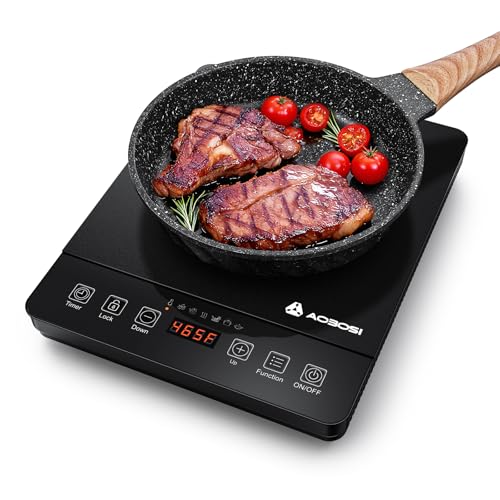
- AAOBOSI Portable Induction Cooktop, 1800W
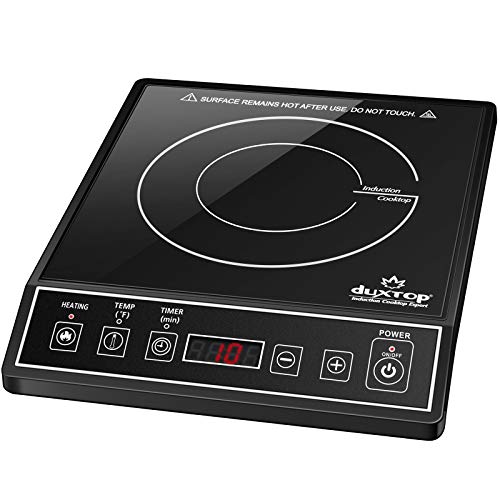
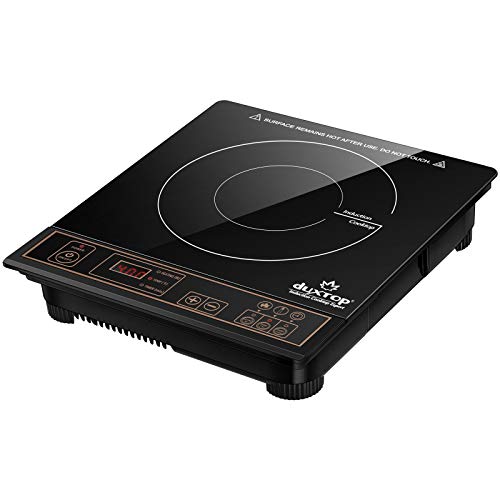
- Duxtop 8100MC Portable Induction Cooktop, 1800W, Gold
- OneSetNuf 1800W Portable Induction Cooker, Stainless Steel
- VEVOR Gas Cooktop 30 Inch, 5 Burners (covered in prose) (covered in prose below; no link for the reason explained in its review)
- ThermoMate 36 Inch Gas Cooktop, 5 Italy Sabaf Burners (covered in prose) (covered in prose below; no link for the reason explained in its review)
Read the full guide ↓ for the ranking logic, the honest limitations of every pick, and the buying checks that matter more than any headline claim.
The appeal of the best electric cooktops 110v is written into the voltage itself: 110V (the standard household supply class in American homes, nominally 120V at the outlet) means the cooktop plugs into an ordinary socket, with no electrician, no dedicated circuit installation and no landlord negotiation. That single fact defines the audience for this guide: renters, students, RV and tiny-home cooks, office kitchens, renovation survivors and anyone adding a burner where a wired-in cooktop cannot go. Every linked pick below is a portable induction burner designed for exactly that plug-and-cook life.
Induction is the natural technology for the 110V format, because it converts a standard outlet’s limited wattage into heat more efficiently than any coil or radiant element: an 1800W induction burner boils water faster than a much more powerful-feeling radiant hotplate, and simmers more gently. The four linked picks are all 1800W induction models from Duxtop, AAOBOSI and OneSetNuf, separated by their controls, presets and build. The two remaining pool models were verified as gas cooktops and are reviewed in prose only, since a gas hob neither plugs into 110V nor answers this keyword at all. Readers working in very small spaces may also find Best Electric Cooktops 24 Inch useful, since compact-format thinking overlaps heavily with the plug-in category.
A practical warning frames the whole guide: 1800W is most of what a standard circuit comfortably gives. These burners are powerful, but they expect to be the main load on their circuit while they run. The buying guide covers the outlet arithmetic in plain terms, because the only bad 110V cooktop experience is a breaker tripping halfway through dinner, and it is entirely avoidable with a little placement thought.
Key Takeaways
- 110V cooktops plug into standard household outlets: no electrician, no hardwiring, no landlord permission needed.
- All four linked picks are 1800W induction burners, the practical maximum for the format and genuinely fast in use.
- Induction is the right 110V technology: it turns limited wattage into pan heat more efficiently than coil or radiant elements.
- The two gas models in the research pool are reviewed in prose only; a gas hob is not a 110V electric cooktop by any definition.
- Give the burner its own outlet while cooking: 1800W plus a kettle on one circuit is a tripped breaker.
- Portable 110V burners double as RV, dorm, office and renovation-gap cooking, then store in a cupboard.
In this guide
Quick Picks
Four linked plug-in induction burners ranked for standard-outlet life first, then the two gas alternatives in labelled prose-only rows. Badges match the detailed reviews.
| Pick | Badge | Standout trait | Where to check it |
|---|---|---|---|
| Duxtop 9600LS Portable Induction Cooktop with LCD Sensor Touch, 1800W | Best Overall 110V Pick | LCD sensor touch panel, silver finish, on Duxtop’s proven 1800W plug-in platform | Check on Amazon |
| AAOBOSI Portable Induction Cooktop, 1800W | Best for Apartments and RVs | 20 temp and power levels, 4 presets, 4-hour timer; listing targets apartments and RVs | Check on Amazon |
| Duxtop 8100MC Portable Induction Cooktop, 1800W, Gold | Best Proven Plug-In | The original long-running Duxtop 1800W portable, model BT-180G3, in gold | Check on Amazon |
| OneSetNuf 1800W Portable Induction Cooker, Stainless Steel | Best Heavy-Duty 110V Pick | Commercial-grade stainless plug-in cooker, push-buttons, 18 temp settings, 10-hour timer | Check on Amazon |
| VEVOR Gas Cooktop 30 Inch, 5 Burners (covered in prose) | Prose-Only: Gas Alternative | 30 inch built-in gas, 5 burners, NG/LPG convertible (prose-only in an electric guide) | Prose-only in this guide |
| ThermoMate 36 Inch Gas Cooktop, 5 Italy Sabaf Burners (covered in prose) | Prose-Only: Large Gas Alternative | 36 inch built-in gas, 5 Sabaf burners, 304 stainless, CSA certified (prose-only) | Prose-only in this guide |
How These Picks Were Chosen
The pool for this guide was verified model by model against a single question: does it cook electrically from a standard household outlet? Four models passed cleanly, all portable induction burners rated at 1800W, which is the format’s practical ceiling and the class of appliance this keyword describes. Two pool models failed the test completely: both are gas cooktops, one 30 inch and one 36 inch, requiring a gas supply and permanent installation. They are reviewed in prose only, without links or images, because describing the alternative honestly helps readers who arrived undecided, while linking them would misrepresent the category.
The four qualifying burners were ranked on the things that separate near-identical wattages: control design (touch panel versus buttons), preset and timer provision, temperature granularity, and build intent from domestic to commercial. That spread is why the ranking mixes brands and philosophies rather than crowning a single type. Readers comparing this plug-in class with the wider electric field will find the technology background in Best Electric And Induction Cooktops helpful, and those furnishing a whole small kitchen should note Best Electric Cooktops For Small Kitchens as a companion read.
As with every guide on this site, the research is specification-led rather than hands-on, no prices or ratings are printed because both change constantly, and each link exists so you can check the latest price on Amazon at the moment of purchase. The prose-only reviews follow the same honesty rules: full descriptions, clear reasons, no links.
The Best Electric Cooktops 110V: 4 Plug-In Picks and 2 Gas Alternatives
Reviews one to four are the guide’s recommendations, each a true plug-in 110V-class induction burner with a link. Reviews five and six describe the gas models found in the pool, in prose only, so the record is complete and the category line stays bright.
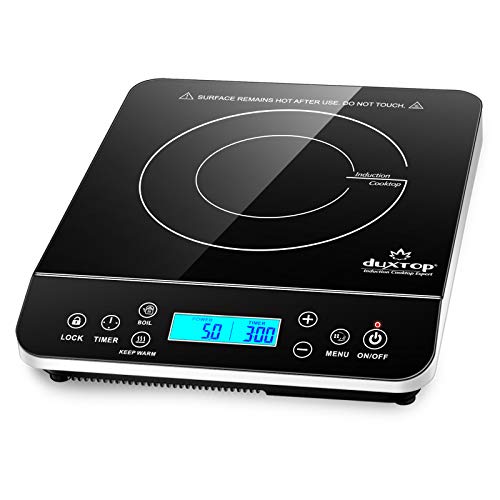
Duxtop 9600LS Portable Induction Cooktop with LCD Sensor Touch, 1800W
Badge: Best Overall 110V Pick
Strengths
- Seamless LCD touch panel keeps the whole face wipeable and the settings precise
- Runs entirely from a standard outlet at up to 1800W
- Silver finish hides the dust and droplet marks of permanent counter duty
Trade-offs
- Touch controls want dry fingers
- Occupies most of a circuit’s comfortable capacity while running
- Single burner, like every true 110V portable
Mini spec box
- Type: Portable induction cooktop, countertop burner
- Power: 1800W, standard household outlet class
- Controls: LCD sensor touch (per listing)
- Model: 9600LS / BT-200DZ
- Finish: Silver
For plug-in cooking, the 9600LS is the most complete package in this guide. It draws its full 1800W from an ordinary outlet, which in induction terms is serious power: water boils quickly, a stir-fry pan recovers heat fast after ingredients land, and the low end settles into the kind of steady simmer that makes 110V hotplates of the coil era feel like a different species. The LCD sensor touch panel is the other half of its appeal, giving tapped, repeatable settings on a face with no seams, which suits an appliance that will typically live out on the counter of a small kitchen rather than in a cupboard.
The silver finish deserves its sentence: black glass shows every fingerprint and dried droplet, while silver reads clean between wipes, a small mercy in the studio flats, offices and rental kitchens where 110V burners do most of their work. The model also inherits Duxtop’s long production history in this exact format, so its behaviour on a standard circuit, from fan note to pan detection, is among the best documented in the category. Predictability matters when the appliance is your whole stove.
The constraints are the format’s, stated plainly. One burner is one burner, and 1800W means the burner wants its circuit largely to itself while it runs; pair it with a kettle on the same outlet run and you are scheduling a breaker trip. Touch controls, as ever, prefer dry hands. Within those honest limits, this is the 110V burner this guide would hand to a renter, a student or a small household and expect to hear no complaints.
Best for: Renters, studios and small households wanting one polished plug-in burner as a main stove / Not suited for: Multi-pan family cooking or anyone who needs two burners at once

AAOBOSI Portable Induction Cooktop, 1800W
Badge: Best for Apartments and RVs
Strengths
- The listing explicitly aims the unit at apartments, RVs and outdoor cooking, the heartland of 110V use
- 20 temperature and power levels give finer control than most plug-in rivals
- A 4-hour timer suits the slow jobs small kitchens still need done
Trade-offs
- Compact size caps the largest pans it heats evenly
- Touch-style controls need dry fingers
- Less long-term owner history than the Duxtop models
Mini spec box
- Type: Portable induction cooktop
- Power: 1800W, standard household outlet class
- Control range: 20 temperature and power levels
- Presets: 4 preset modes
- Timer: 4-hour timer
- Intended settings: Apartments, RVs and outdoor cooking (per listing)
The AAOBOSI is the pick whose own listing reads like this guide’s brief: it names apartments, RVs and outdoor cooking as its settings, which is a precise description of where 110V cooking matters. In an RV or a small apartment, the burner plugs into the same ordinary outlets as everything else, draws its 1800W without any electrical work, and stores in a cupboard or locker when the counter is needed for something else. Its flat top is also marketed as easy to clean, which in a small space, where the cooking surface is inches from everything, is more hygiene necessity than luxury.
Control provision is its second strength: 20 temperature and power levels is finer granularity than most of the plug-in field offers, and the 4 preset modes plus a 4-hour timer cover the slow, unattended end of cooking (stocks, braises, keeping a pot warm through an evening) that small kitchens often assume they must give up. For a one-burner household, that range is the difference between a burner that handles snacks and a burner that handles dinner, including the dinner that takes three hours.
Its limits are size and history. The compact footprint that makes it storable also caps pan size, and big stockpots will overhang and heat less evenly at the edges. It also lacks the Duxtop models’ long public track record, so buyers are trading documentation for features. For the apartment and RV cooks it is designed for, that trade is well judged, and it is the most purpose-built 110V pick in the guide.
Best for: Apartments, RVs, dorms and outdoor cooking stations on standard outlets / Not suited for: Cooks who regularly use oversized stockpots
Duxtop 8100MC Portable Induction Cooktop, 1800W, Gold
Badge: Best Proven Plug-In
Strengths
- The most established 110V induction burner in the guide, with years of owner reporting
- Simple, compact and entirely outlet-powered
- An ideal first burner for testing induction without any installation
Trade-offs
- Older, plainer controls than the 9600LS
- Gold finish is a strong visual statement
- Basic feature set: no elaborate presets or long timers
Mini spec box
- Type: Portable induction cooktop, countertop burner
- Power: 1800W, standard household outlet class
- Model: 8100MC / BT-180G3
- Finish: Gold
- Brand: Duxtop
If the 110V category has a founding appliance, it is this one. The Duxtop 8100MC has been plugging into ordinary outlets and cooking on them for longer than most rivals have existed, and that history is its specification: a standard-circuit induction burner whose strengths, quirks and lifespan are documented by an unusually large owner base. For a buyer whose entire requirement is a burner that works from a normal socket, works today and keeps working, that record is worth more than any feature list.
The cooking itself is the classic portable induction experience: fast boils, responsive adjustments, a surface that stays comparatively cool around the pan, and a compact body that moves from cupboard to counter in one hand. In the settings where 110V matters (a dorm room, a granny flat, a workshop kitchen, a holiday let), its simplicity is the feature. There is nothing to install, nothing to configure and very little to learn, which is why it remains the default recommendation for a first plug-in burner.
Age trims the edges rather than the core. The controls and display are plain next to the 9600LS, the feature set skips the presets and long timers found elsewhere in this guide, and the gold finish will either charm your kitchen or clash with it, with little middle ground. None of that stops it cooking dinner tonight from a wall socket. Buy it for proven simplicity; step up to its sibling for polish.
Best for: First-time plug-in buyers, dorms and anyone valuing a long track record over features / Not suited for: Buyers wanting presets, long timers or a discreet finish

OneSetNuf 1800W Portable Induction Cooker, Stainless Steel
Badge: Best Heavy-Duty 110V Pick
Strengths
- Commercial-grade stainless build on a standard outlet, for workloads home burners avoid
- Push-button controls work with wet or gloved hands
- 18 temperature settings and a 10-hour timer, the longest timer among the linked picks
Trade-offs
- Utilitarian appearance and more weight than domestic portables
- Button seams need a deliberate wipe when cleaning
- Built for duty rather than delicacy
Mini spec box
- Type: Portable induction cooker, plug-in
- Power: 1800W, standard household outlet class
- Body: Stainless steel, commercial-grade
- Power control: Dual IGBT (per listing)
- Temperature settings: 18
- Controls: Push-button
- Timer: 10-hour
The OneSetNuf brings a commercial kitchen’s priorities to a household outlet. Its listing describes a commercial-grade stainless steel cooker with dual IGBT power control, 18 temperature settings and a 10-hour timer, and that combination points at a specific 110V user: the one who cooks long and hard in a place with no wired-in stove. Market traders, caterers working halls with ordinary sockets, keen preservers running a burner all day, and landlords fitting hard-used rental kitchens will all recognise the appeal of equipment that treats a standard outlet as a workplace.
The push-button controls are a deliberate part of that appeal. Where touch panels demand dry fingers, buttons answer wet, floured and gloved hands without complaint, and in a working environment that is not a detail. The stainless body follows the same philosophy: wash it down, wipe it dry, and do not worry about cosmetics. Even its 10-hour timer, the longest among this guide’s linked picks, serves the workload story, covering stocks and slow jobs that shorter timers abandon mid-recipe.
The costs are domestic ones. It looks and feels like equipment rather than an appliance styled for a home, it carries more weight than the household portables when it is time to store it, and its button row introduces seams that a seamless panel never asks you to wipe. Households cooking ordinary dinners will be happier with the Duxtop or AAOBOSI picks. Workloads, rather than dinners, are what this burner is for, and for them it is the strongest 110V tool here.
Best for: Caterers, market traders, heavy users and hard-worked rental kitchens on standard outlets / Not suited for: Style-led home kitchens wanting the lightest, sleekest burner
VEVOR Gas Cooktop 30 Inch, 5 Burners (covered in prose)
Badge: Prose-Only: Gas Alternative
Strengths
- Five burners on a 30 inch built-in footprint for households committed to gas
- NG/LPG convertible, so it suits both mains gas and bottled supply
- Thermocouple protection and a stainless steel design per the listing
Trade-offs
- It is a gas appliance in a guide about electric and induction cooking, so it carries no link here
- Open flame means grates and caps to clean, the burden induction avoids
- Requires a gas supply and professional installation
Mini spec box
- Type: Built-in gas cooktop
- Size: 30 inch
- Burners: 5
- Output note: 12250 BTU (per listing)
- Fuel: Natural gas / LPG convertible
- Safety: Thermocouple protection (per listing)
This VEVOR appears in the guide deliberately and without a link, and the reason should be stated plainly: it is a gas cooktop, and this is a guide to electric and induction cooking. Including it as a linked recommendation would mislead the readers this page exists for. It is covered in prose because some shoppers arrive at this keyword still undecided between fuel types, and for them a concrete gas alternative is more useful than silence. As specified, it is a 30 inch built-in with five burners, convertible between natural gas and LPG, with thermocouple protection and a stainless steel design, aimed by its listing at apartments, RVs and camping-adjacent installations as well as ordinary kitchens.
If you choose this route, choose it knowing what it asks: a gas supply, professional installation, ventilation thought through, and the traditional cleaning load of grates and burner caps. What it gives back is flame: instant visual feedback, compatibility with every pan material including rounded woks, and cooking that continues through a power cut. Those are real virtues, and households that value them should buy a gas cooktop proudly rather than an induction burner reluctantly. But they should buy it from a gas guide, with gas comparisons, which is why this review informs without linking.
Best for: Readers who realise, mid-research, that they actually want flame cooking / Not suited for: Anyone committed to electric or induction, who should take the four linked picks above
ThermoMate 36 Inch Gas Cooktop, 5 Italy Sabaf Burners (covered in prose)
Badge: Prose-Only: Large Gas Alternative
Strengths
- A full 36 inch, five-burner layout for serious multi-pan cooking
- Italy Sabaf burners and 304 stainless steel construction per the listing
- CSA certified with thermocouple protection
Trade-offs
- Gas fuel places it outside this guide’s electric and induction brief, hence no link
- A 36 inch built-in is a permanent, professional installation
- All the cleaning and ventilation demands of open flame apply
Mini spec box
- Type: Built-in gas cooktop (gas hob)
- Size: 36 inch
- Burners: 5 Italy Sabaf power burners (per listing)
- Material: 304 stainless steel
- Fuel: NG/LPG convertible
- Certification: CSA certified, thermocouple protection (per listing)
The ThermoMate is the second prose-only entry in this guide, included for the same reason as the VEVOR and at a larger scale. On its own gas terms it is a substantial appliance: a 36 inch built-in hob with five Italy Sabaf power burners, a body of 304 stainless steel, NG/LPG convertibility, thermocouple protection and CSA certification, all per its verified listing. For a household building a serious gas kitchen, those are the right specification headings to compare, and this is plainly a heavy-duty domestic hob rather than a token alternative.
None of that changes the fuel question this page is organised around. A reader searching for electric and induction cooktops is usually doing so for reasons gas cannot answer: no gas supply to the property, a preference for flameless cooking around children, easier cleaning, or the precision and speed of induction. Linking a gas hob as if it were one more electric option would betray those readers. So the ThermoMate is described honestly, credited with its genuine strengths, and left unlinked. If its specification is the one that excites you, your real search is a gas cooktop guide, and you should follow that instinct properly rather than compromising here.
Best for: Large households who conclude they want a full-size gas hob after all / Not suited for: The electric and induction shoppers this guide is written for
Comparison Table
Fuel and power source come first in this table, because they are what the keyword is about: if it does not plug into a standard outlet and cook electrically, it is not a 110V electric cooktop, whatever its other merits. The gas rows are unlinked for exactly that reason.
| Pick | Fuel / supply | Power / output | Format | Standout trait | Check |
|---|---|---|---|---|---|
| Duxtop 9600LS Portable Induction Cooktop with LCD Sensor Touch, 1800W | Portable induction, plug-in | 1800W | Single burner | LCD touch panel, silver | Check on Amazon |
| AAOBOSI Portable Induction Cooktop, 1800W | Portable induction, plug-in | 1800W | Single burner | 20 levels, 4 presets, 4h timer | Check on Amazon |
| Duxtop 8100MC Portable Induction Cooktop, 1800W, Gold | Portable induction, plug-in | 1800W | Single burner | Established gold model | Check on Amazon |
| OneSetNuf 1800W Portable Induction Cooker, Stainless Steel | Portable induction, plug-in | 1800W | Single burner, 8 in coil | Push-button, 10h timer | Check on Amazon |
| VEVOR Gas Cooktop 30 Inch, 5 Burners (covered in prose) | Built-in gas | 12250 BTU (listing) | 5 burners, 30 in | Prose-only: wrong fuel for this guide | Prose-only |
| ThermoMate 36 Inch Gas Cooktop, 5 Italy Sabaf Burners (covered in prose) | Built-in gas | 5 Sabaf burners | 36 in, 304 stainless | Prose-only: wrong fuel for this guide | Prose-only |
How to Choose the Best Electric Cooktops 110V
Do the circuit arithmetic before anything else
A standard American household circuit typically offers 15 or 20 amps, and an 1800W burner uses most of a 15-amp circuit’s comfortable capacity on its own. That is not a flaw; it is the physics that makes 110V burners powerful. The practical rules follow from it: give the burner its own outlet while it cooks, avoid running a kettle, microwave or toaster oven on the same circuit at the same time, and be thoughtful in older properties with tired wiring. Follow those rules and plug-in cooking is uneventful for years. Ignore them and the breaker will teach them to you mid-dinner.
Understand why induction owns this format
At a fixed 1800W ceiling, efficiency is everything. A coil or radiant hotplate spends part of that budget heating an element and the air around the pan; induction spends nearly all of it in the pan. That is why every linked pick in this guide is an induction model, and why the format’s reputation has changed: a modern 1800W induction burner outperforms the plug-in hotplates most people remember. The trade is the magnetic-pan requirement, settled in seconds with a fridge magnet, and it is a trade this guide regards as settled in induction’s favour.
Match the burner to the setting it will live in
110V burners serve more settings than any other cooktop class: dorms, RVs, offices, rentals, renovation gaps, garden kitchens, market stalls. Each setting weights features differently. RV and dorm cooks should prize compact storage and simple controls (the AAOBOSI and 8100MC). Working environments should prize build and buttons (the OneSetNuf). A permanent small-kitchen installation should prize the interface it will touch daily (the 9600LS). Naming your setting honestly is the fastest route through this guide, faster than comparing any specification.
Take timers and presets seriously in one-burner homes
A single burner household cooks sequentially, so unattended capability matters: a burner that can hold a braise for hours on a timer frees the cook in a way a second burner would in a bigger kitchen. The linked picks span 4-hour and 10-hour timers, and presets that turn routine jobs into one touch. If your one-burner life includes slow cooking, weight those features heavily. If everything you cook is fifteen minutes at the stove, skip them and buy simplicity instead.
Plan for the pan check and the storage check
Two measurements decide satisfaction after purchase. First, pans: induction needs magnetic bases, and an 8 inch class coil wants pans of roughly matching footprint for even heating, so audit the cupboard with a magnet and a ruler. Second, storage: a portable that lives in a cupboard needs a cupboard it fits, ideally standing upright, with its cord managed. Measure both before ordering. Readers furnishing compact spaces end-to-end will find the layout thinking in Best Electric Cooktops For Small Kitchens pairs naturally with this guide, and those with a wall oven to match should see Best Electric Cooktops And Wall Ovens.
How to Set Up and Use a 110V Plug-In Cooktop Safely
Plug-in does not mean careless. The steps below are the whole installation manual for this category, and following them is what separates years of uneventful cooking from a drawer of tripped breakers and error codes.
- Choose the outlet deliberately: plug the burner directly into a wall outlet on a circuit that will not be shared with other high-draw appliances while you cook. Avoid extension cords and power strips entirely.
- Give it a flat, heat-safe, dry surface: portable burners need stable footing away from sink splash, with clearance around the vents. Never run one on a towel, a tray or an unstable board.
- Magnet-test and match your pans: confirm each pan’s base is magnetic and roughly matches the coil size; centre the pan on the marked zone before switching on.
- Start lower than your instincts: induction delivers full heat to the pan almost immediately, so preheats are short and first boils arrive early. Learn your burner’s simmer setting in the first week.
- Keep the panel and your fingers dry: touch models respond best to dry contact; button models forgive more but still deserve a wipe-down before cooking.
- Let the fan finish: many portables run a cooling fan briefly after switch-off. Leave the unit plugged in and undisturbed until the fan stops rather than packing it away hot.
- Store it dry and upright: once fully cool, store the burner upright where possible, cord loosely coiled, so the glass face is protected and the unit is ready to lift out.
Cleaning follows the induction pattern: wipe the flat top while warm after cooking, lift sugary spills promptly, and keep abrasives away from glass surfaces. The stainless OneSetNuf tolerates a more commercial wash-down routine, but its top deserves the same gentleness as the others. Once a week, lift the burner and wipe the counter beneath it; that hidden film is the one cleaning debt portable owners accumulate without noticing, and it takes under a minute to prevent.
Troubleshooting
Problem: The breaker trips when the burner runs → what to do: move the burner to an outlet on a different circuit and stop pairing it with a kettle, microwave or toaster oven on the same run; an 1800W burner is a near-full load by design
Problem: The burner displays an error and refuses to heat → what to do: check the pan: it must be magnetic, flat and centred, and large enough for the detector; test with a cast iron pan to confirm the burner itself is healthy
Problem: Cooking seems weak with a very large pot → what to do: the pot likely overhangs the coil significantly, so only its centre is being driven; use a pan closer to the coil size, or accept slower, gentler heating for oversized vessels
Where 110V Cooktops Earn Their Keep
The settings that justify this category share one trait: a wired-in cooktop is impossible, forbidden or pointless there. Rentals where the lease forbids electrical work. Dorm rooms and bedsits with a socket and a dream. RVs and boats where the supply is standard and the space is not. Office kitchens, garden rooms, market stalls, church halls, and the long renovation months when the main kitchen is a building site. In every case the 110V burner is not a compromise appliance; it is the only appliance, and a good induction one cooks far beyond what its plug suggests.
There is also a growing second group: households with full kitchens who add a 110V burner as a flexible extra. It hosts the overflow pan at holidays, moves outside for fish and frying that would perfume the house, and provides a cooking station for a teenager’s first solo meals away from the main stove’s drama. Judged as an addition rather than a replacement, the category’s single-burner limit stops mattering, and its plug-anywhere freedom becomes the whole point. That is why this guide ranks single burners seriously instead of treating them as toys.
110V vs 240V: What the Voltage Actually Changes
Full-size built-in electric cooktops in American homes usually run on 240V circuits, which let each burner draw far more power and let several burners run hard at once. A 110V-class burner cannot match that total throughput, and this guide will not pretend otherwise: two large pans at a rolling boil simultaneously is 240V territory. What surprises most buyers is how much of daily cooking lives comfortably inside 1800W of induction: pasta for four, a proper stir-fry in batches, sauces, eggs, braises and everything that simmers. The honest gap is peak multi-pan output, not ordinary dinner.
The practical conclusion is about matching, not ranking. A household replacing a family range should install the 240V appliance its cooking demands, using the format guides such as Best Electric Cooktops 36 Inch for that class. A household whose cooking is one or two pans at a time, or whose property cannot take a 240V installation, loses almost nothing with a good 110V induction burner and gains the freedom to put it anywhere. Voltage is a constraint to plan around, not a verdict on your cooking.
Sharing a Small Kitchen with a Plug-In Burner
The lived reality of a 110V burner is choreography, and small kitchens reward cooks who plan it. One burner means courses arrive in sequence, so the smart pattern is to cook in order of reheating tolerance: grains and braises first, where they can hold warm; sauces next; and the fast, fragile items, eggs, fish, greens and anything fried, last, at the moment of eating. The timers on the AAOBOSI and OneSetNuf exist precisely for this pattern, holding the early jobs safely while the cook’s attention moves on. Households that adopt the sequence stop experiencing one burner as a limitation and start experiencing it as a timetable, which is a much friendlier thing.
Counter discipline is the other half of the choreography. A portable burner earns a permanent parking spot, ideally the same place every time, with its outlet, its two or three proven pans and a heat-safe landing zone for hot lids within reach. Setting up and packing away for every meal is the habit that kills portable cooking, because the friction compounds daily; a burner that is already out, plugged in and wiped down gets used, and one that lives at the back of a cupboard does not. If your space allows only one small luxury, spend it on that permanent spot. It converts the appliance from an occasional tool into the kitchen’s working stove, which is what the best models in this guide are built to be.
The same logic applies to guests and seasons. A plug-in burner that lives ready can be redeployed in seconds when the kitchen fills: moved to a side table as a drinks-station warmer, carried to the garden for a fry-up that would otherwise scent the whole house, or handed to a visiting relative whose cooking style needs its own territory. Those small redeployments are where the format quietly outearns a fixed appliance, and they only happen when the burner is stored ready rather than buried. Readiness, in the end, is the whole 110V philosophy: ordinary power, ordinary space, no ceremony, and dinner cooked properly anyway.
Common Buying Mistakes
- Running the burner through an extension cord or power strip. High-draw appliances belong directly in a wall outlet; cords and strips are the classic overheating risk.
- Sharing the circuit with a kettle or microwave. The combined load trips breakers and, in older wiring, stresses the circuit; give the burner its own run while cooking.
- Assuming a gas hob is a plug-in alternative. Two models in this guide’s own pool made that category error; fuel and supply type are core attributes, not footnotes.
- Skipping the magnet test. Non-magnetic pans simply will not heat on induction, and discovering that at dinner time is an avoidable misery.
- Buying for the biggest pot you own. Coil size governs even heating; match the burner to your everyday pans and treat the giant stockpot as the exception it is.
- Packing the burner away while its fan still runs. Let the cooling cycle finish; heat-soaking a stored unit shortens its life.
Final Recommendation
For most readers, the Duxtop 9600LS is the 110V recommendation: a polished, seamless, genuinely powerful plug-in burner on a proven platform, equally at home as a renter’s main stove or a small kitchen’s permanent countertop appliance. It is the fullest answer this category gives to an ordinary outlet.
Start with the Duxtop 9600LS Portable Induction Cooktop with LCD Sensor Touch, 1800W if you want the safest all-round choice in this guide. If its particular trade-offs do not fit your kitchen, the AAOBOSI Portable Induction Cooktop, 1800W is the strongest alternative for the reasons covered in its review, and the Duxtop 8100MC Portable Induction Cooktop, 1800W, Gold earns its place as the third route worth a serious look before you decide.
Specialise from there. The AAOBOSI is the apartment and RV specialist with the finest level control and the long timer; the 8100MC is the proven, simple original; the OneSetNuf is the heavy-duty worker for commercial-style loads. And if the prose-only gas reviews clarified that your kitchen actually has a gas supply and a cook who wants flame, pursue that in a gas guide with a clear conscience. The only wrong purchase here is one that does not match your supply, your circuit and your cooking, and this guide has given you the checks for all three.
Related guides
Frequently Asked Questions
Is 110V the same as a normal household outlet?
Effectively yes for shopping purposes. American household outlets are nominally 120V, and appliances described as 110V are built for that standard supply class. A cooktop sold as 110V plugs into an ordinary wall socket with no special wiring, which is the entire point of the category.
Can an 1800W plug-in burner really cook a family dinner?
It can cook the components of one, sequentially or with one pan on the go at a time: pasta, sauces, proteins and vegetables all sit comfortably within 1800W of induction. What it cannot do is run several large pans at full power simultaneously. One-burner households cook in sequence and use timers and holding strategies, which the linked picks support to different degrees.
Why are two models in this guide only in prose?
Verification showed they are gas cooktops: they need a gas supply and permanent installation, and they do not plug into 110V at all. Since fuel and supply type are the core attributes of this keyword, they are described honestly for readers still deciding, but they receive no links or images in a 110V electric guide.
Can I run a 110V cooktop from an extension cord in an RV or hall?
You should not. High-draw heating appliances belong directly in a wall outlet; extension cords and power strips rated below the load are an overheating risk and can also cause voltage drop that upsets the burner. If the outlet is not where the cooking is, move the cooking, or have a proper outlet installed.
Do I need new pans for a plug-in induction burner?
Only if your current pans are not magnetic. Cast iron and magnetic stainless steel work; plain aluminium and copper do not. The fridge-magnet test answers it per pan in seconds. Flat bases close to the coil size heat most evenly.
Will a 110V burner trip my breaker?
Not if it has the circuit largely to itself. An 1800W burner is a near-full load for a standard 15-amp circuit, so running a kettle or microwave on the same circuit at the same time is the usual cause of trips. Give the burner its own outlet run while cooking and trips become a non-event.