Disclosure: topratedkitchenware.com is reader-supported. When you buy through links on our site, we may earn an affiliate commission from Amazon and other retailers, at no extra cost to you.
Where to buy
The six models below are the verified picks for this guide to the best drip coffee makers under 50. Each name links to its Amazon listing, where you can check the latest price on Amazon — vital in this tier, where prices swing the most — confirm the current configuration, and read the newest owner feedback before you decide.
- BUNN Speed Brew Platinum Thermal Coffee Maker (CSB3T)
- Hamilton Beach FlexBrew Advanced 5-in-1 Coffee Maker
- KRUPS 12-Cup Programmable Thermal Carafe Coffee Maker
- Cuisinart 10-Cup Thermal Classic Coffeemaker (DCC-1170BKNAS)
- SECPOEDR Grind and Brew Coffee Maker with Built-In Grinder
- Gevi 10-Cup Grind & Brew Coffee Maker
If you follow only one link from this box, start with the KRUPS — Check on Amazon — the most complete thermal pot machine competing in this band. Read the full guide ↓ for the ranking logic, the honest limitations of every pick, and the checks that matter more than any headline claim.
Shopping for the best drip coffee makers under 50 takes a particular kind of honesty. This is the tightest mainstream band in drip coffee, and every machine in it is a negotiation: something was traded away to reach the shelf at this level, and the only real question is whether what was traded is something you will miss. The good news, and the reason this guide exists, is that the negotiation can go well. The six picks below include thermal carafes that hold coffee hot for hours, a genuinely fast commercial-style brewer, a hybrid that brews pots and pods, and two machines that grind beans and brew in one body. Those are not the feature lists of hopeless appliances. They are the feature lists of machines whose makers chose their compromises carefully — and this guide’s job is to show you exactly where each compromise sits, so you can pick the one whose trade-offs do not touch your routine.
Two ground rules govern everything that follows. First, no fixed prices are printed here, because in this band prices move more than anywhere else in the category; every pick links to its live listing so you can check the latest price on Amazon on the day you buy, and a model that has drifted within reach of the band should be judged on features, not on an old screenshot. Second, specifications come only from each model’s verified listing — where a listing is quiet, this guide is quiet. You will find six detailed reviews with strengths, trade-offs, and verdicts, a comparison table, a buying guide on spending a small budget in the right order, a full how-to on setup and care (care matters twice as much at this price), and a frank section on which compromises are normal here and which are warnings. If your ceiling can stretch, Best Drip Coffee Makers Under $75 shows what the next band adds; if it cannot, this page is written to make the tight band work.
Key Takeaways
- At this level, every machine trades something away. The skill is choosing a pick whose trade-off is a feature you never use.
- Four of the six picks brew into thermal carafes, which is remarkable in this band and the main reason this shortlist tastes above its tier.
- The KRUPS is the best all-round pot machine here; the BUNN is the pick when speed is the whole point.
- Two picks — the SECPOEDR and the Gevi — grind and brew in one body, a combination that usually costs far more counter money and cash.
- Descaling is not optional maintenance at this price; it is the difference between a machine that lasts years and one that fades in months.
- Always verify the live price before buying in this band — it is the most promotion-driven tier in drip coffee.
In this guide
Quick Picks
| Pick | Badge | Why it is here | Link |
|---|---|---|---|
| BUNN Speed Brew Platinum Thermal Coffee Maker (CSB3T) | Best for Speed | Fast commercial-style brewing into a 10-cup thermal carafe. | Check on Amazon |
| Hamilton Beach FlexBrew Advanced 5-in-1 Coffee Maker | Most Versatile | 12-cup thermal drip plus single-serve pods and grounds. | Check on Amazon |
| KRUPS 12-Cup Programmable Thermal Carafe Coffee Maker | Best Overall | Double-wall thermal carafe, three strengths, 24-hour programmability. | Check on Amazon |
| Cuisinart 10-Cup Thermal Classic Coffeemaker (DCC-1170BKNAS) | Best Compact Pot | A proven 10-cup programmable thermal machine in black. | Check on Amazon |
| SECPOEDR Grind and Brew Coffee Maker with Built-In Grinder | Best with a Built-In Grinder | Grinds and brews 10 cups, programmable, with a 2-hour keep warm function. | Check on Amazon |
| Gevi 10-Cup Grind & Brew Coffee Maker | Best Touch-Screen Grind & Brew | Built-in grinder, glass carafe, touch screen, reusable filter, 1.5L tank. | Check on Amazon |
How These Picks Were Chosen
This is a research-led guide, assembled by comparing verified listings for machines competing in the under $50 band, reading what manufacturers actually claim about their brewing and carafe systems, and mining owner feedback for the failures that repeat. In this band, the failure pattern is well known: carafes that pour down their own sides, lids that warp, cycles that slow as scale builds, coffee that is hot for minutes. Picks were ranked by how completely their designs answer those specific failures within the budget — thermal insulation where it matters, proven brand support behind them, controls that cover a real morning — and by how honest their listings are about what they are. Machines that promise everything and specify nothing were left out.
The band itself needs a word of method. Prices at this level are the most volatile in the category: promotions, coupons, and retailer pricing move models in and out of the under $50 line regularly. This guide therefore selected machines that compete in and around this band on the strength of their feature sets, printed no fixed prices, and put a check-price link on every pick. Treat the band as a shopping frame and the live listing as the referee. A model sitting slightly above the line on the day you shop may still be the right buy if its carafe and brewing system outclass everything actually under it — the buying guide below explains how to make that call without breaking your budget’s spirit.
One more filter deserves naming: support. At this price, the difference between a bargain and a write-off is often whether a replacement carafe or lid can be found in two years. The brands in this list are established names with findable parts, and that is a deliberate part of the ranking, not an accident of it. Shoppers comparing carafe quality specifically should also read Best Drip Coffee Makers With Carafe, which isolates the vessel from the machine across the wider field.
The 6 Best Drip Coffee Makers Under 50

BUNN Speed Brew Platinum Thermal Coffee Maker (CSB3T)
Badge: Best for Speed
Strengths
- Speed Brew design finishes the pot fast, which suits households that drink immediately.
- Thermal carafe in stainless steel and black — insulation, in a band where glass is common.
- Commercial-bred simplicity: the design budget went to the brew cycle, not the display.
Trade-offs
- Verify its live price carefully; BUNN models frequently sit at a band edge rather than deep inside it.
- Fewer programmable frills than the KRUPS or the FlexBrew.
- 10-cup ceiling for households that serve bigger groups.
Mini spec box
- Capacity: 10-cup
- Carafe: Thermal
- Design: Speed Brew Platinum
- Finish: Stainless steel, black
- Model: 55200 CSB3T
In a guide about a tight budget, the BUNN is the pick that argues value can mean pace. Its Speed Brew design gets a full pot brewed and into a thermal carafe quickly, and for the household that drinks the pot within the hour — commuters, early shifts, school-run kitchens — that speed is worth more than any menu of settings. The thermal carafe matters doubly here, because a fast machine paired with a glass carafe and a hot plate would give the speed away again in stewed flavour; instead the coffee is sealed into insulation while it is at its best. The stainless and black build looks like equipment, which in this band is a compliment: the money visibly went to the machine, not the styling.
The honest cautions are price position and focus. BUNN’s name carries weight and its models often hover near a band’s ceiling, so check the latest price on Amazon before assuming it fits a strict ceiling; if it sits above the line on your shopping day, judge it against the next band up rather than forcing the comparison. And it is a single-minded machine — buyers who want timers, strength menus, and small-batch modes will find more of their list in the KRUPS below. For the drink-it-now household, though, this is the pick most likely to change the morning.
Best for: rushed households that finish the pot quickly / Not suited for: strict-ceiling buyers on a day its price sits high, or feature collectors
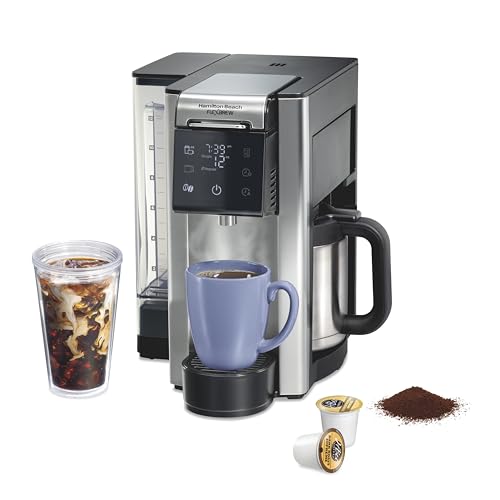
Hamilton Beach FlexBrew Advanced 5-in-1 Coffee Maker
Badge: Most Versatile
Strengths
- 5-in-1 design: 12-cup thermal drip plus single-serve brewing for pods and grounds.
- The drip side is programmable and thermal — the pot is a real brewer, not a bonus.
- Removable 60 oz reservoir encourages fresh water, the cheapest quality upgrade there is.
Trade-offs
- Also check its live price; hybrid machines are frequent promotion movers in this band.
- Two systems to clean, and a bigger counter footprint than a plain drip maker.
- Pods as a daily habit cost more per cup than pot brewing — use the pod side as the exception.
Mini spec box
- Configuration: 5-in-1 drip and single serve
- Drip capacity: 12-cup thermal, programmable
- Single serve: Pods and grounds, hot and iced
- Reservoir: Removable, 60 oz
- Finish: Black
The FlexBrew’s argument in this band is replacement math: one machine that retires a drip maker and a pod brewer can be the cheapest way to own both, even before counting the counter space it returns. The design holds up its end — the drip side brews a programmable 12-cup pot into a thermal carafe, which puts it ahead of many dedicated drip machines at this level, and the single-serve side covers pods and loose grounds for the one-cup moments that would otherwise reheat the morning pot into sadness. The removable 60 oz reservoir is the detail owners end up praising, because a tank you can carry to the tap gets fresh water daily without a jug-balancing act.
The cautions are running costs and upkeep. Two brew systems mean two cleaning routines, and the pod side is a convenience that charges rent: used daily, pods outspend pot coffee steadily. Discipline — pot by default, pods by occasion — keeps this machine the bargain it promises to be. Households that already know pods are the main event should compare the hybrid field in Best Drip Coffee Makers With Pod before deciding, but mixed homes shopping a tight band will not find a broader talent set than this.
Best for: mixed households replacing two machines on a budget / Not suited for: minimalists and pod-every-day drinkers watching running costs

KRUPS 12-Cup Programmable Thermal Carafe Coffee Maker
Badge: Best Overall
Strengths
- Double-wall thermal carafe keeps coffee hot for hours — stated as up to 4 hours in the listing — with no warming plate.
- Three brew strengths plus 24-hour programmability: the fullest control set among the pot machines here.
- No plate means the last cup is not the most cooked cup.
Trade-offs
- No published small-batch setting; full pots are its natural territory.
- You cannot see the coffee level through a thermal carafe.
- No extra talents — no iced mode, no pods, no grinder. It is a pot machine, purely.
Mini spec box
- Capacity: 12-cup
- Carafe: Double-wall thermal, keeps coffee hot 4 hours
- Controls: 24-hour programmable, 3 brew strengths
- Warming plate: None
- Brand: KRUPS
If one machine in this band shows how far careful compromises can go, it is the KRUPS. Start with the carafe: double-wall thermal insulation that the listing describes as keeping coffee hot for hours, with no warming plate involved — a specification you would happily accept at twice the band. Add three brew strengths, so the pot can be tuned to the beans and the drinkers, and full 24-hour programmability, so the long morning starts fresh. Nothing here is decorative, and that is the point: every part of the design budget touches the coffee. For the graze-the-pot household — remote workers, slow weekend mornings, parents drinking in shifts — this is the machine whose strengths align exactly with the routine.
The limitations are omissions rather than flaws. There is no small-batch mode for the two-cup household, no second talent to fall back on, and the thermal carafe hides its level, a small daily guess you learn to make by cups poured. Buyers who want a grinder in the same body should look at the two picks below; buyers who want a pot that stays right for hours should stop here. In a band defined by trade-offs, the KRUPS trades away extras and keeps the essentials — the correct direction, and why it wears the Best Overall badge.
Best for: pot households that drink slowly through the morning / Not suited for: small-batch brewers and multi-talent shoppers

Cuisinart 10-Cup Thermal Classic Coffeemaker (DCC-1170BKNAS)
Badge: Best Compact Pot
Strengths
- 10-cup thermal format matched to small and medium households.
- Programmable, from a long-running Cuisinart line with findable parts.
- Black finish hides the daily evidence of a working kitchen.
Trade-offs
- Its live price can sit near the band’s ceiling; verify before committing a strict budget.
- Fewer published extras than the KRUPS — no strength menu is listed.
- Ten cups is a hard ceiling for entertaining.
Mini spec box
- Capacity: 10-cup
- Carafe: Thermal
- Controls: Programmable
- Finish: Black
- Model: DCC-1170BKNAS
The Thermal Classic is the conservative pick in this band, and conservative has real value when the budget cannot absorb a mistake. Cuisinart’s Classic line is a known quantity: a programmable 10-cup thermal machine that does the daily job without novelty, from a brand whose replacement carafes and parts stay findable — the ownership detail that matters most at this price. Ten cups suits the two-to-four-drinker household precisely, and a machine that works near its designed batch size brews more evenly than an oversized one run at a third. The black finish is the right kind of boring for a counter that sees daily use.
The cautions are headroom and price position. There is no published strength menu or small-batch mode to rival the KRUPS’s control set, and Cuisinart’s band position should be checked live, since brand-name models in this tier often sit at the ceiling rather than beneath it. If the live figure breaks your ceiling, the SECPOEDR and Gevi below compete differently; if it fits, this is the low-drama purchase of the six — the one least likely to surprise you in either direction.
Best for: small households wanting a proven, low-drama machine / Not suited for: entertainers and buyers who want a strength menu

SECPOEDR Grind and Brew Coffee Maker with Built-In Grinder
Badge: Best with a Built-In Grinder
Strengths
- Built-in grinder plus brewer in one body — fresh-ground coffee without a second appliance.
- 10-cup programmable platform with a 2-hour keep warm function.
- Stainless steel build at a band where plastic dominates.
Trade-offs
- Grind-and-brew machines have more parts in the brew path, so cleaning discipline matters more.
- Keep-warm functions suit drinkers who finish within that window; long grazers should prefer thermal insulation.
- A newer name than the legacy brands here — weigh parts availability accordingly.
Mini spec box
- Capacity: 10-cup
- Grinder: Built-in
- Controls: Programmable
- Keep warm: 2-hour keep warm function
- Build: Stainless steel
Fresh-ground coffee is the upgrade every drip drinker is told to make, and the usual obstacle is buying, housing, and cleaning a separate grinder. The SECPOEDR removes the obstacle by building the grinder into a 10-cup programmable brewer: beans in, pot out, one footprint. The flavour logic is sound — coffee stales fastest after grinding, so grinding seconds before brewing captures aroma that pre-ground coffee loses in the bag — and in this band the combination is genuinely unusual. The 2-hour keep warm function covers the normal morning window, and the stainless build lifts it above the all-plastic feel common at this level.
The honest trade-offs are maintenance and brand depth. A grinder in the brew path means ground coffee and humidity meet in more places, so the cleaning routine in the how-to section is not optional with this machine; skip it and the flavour advantage inverts. SECPOEDR is also a newer name than Cuisinart or KRUPS, so long-term parts support is less proven — a fair consideration at any price, worth stating plainly here. Buyers who accept the cleaning bargain get the freshest-tasting route in this band; the wider grind-and-brew field is compared in Best Drip Coffee Makers With Grinder.
Best for: fresh-ground flavour without a separate grinder / Not suited for: low-maintenance households and brand-history-first buyers

Gevi 10-Cup Grind & Brew Coffee Maker
Badge: Best Touch-Screen Grind & Brew
Strengths
- Built-in grinder with a glass carafe, so you can watch the pot level at a glance.
- Touch screen controls and programmable brewing in a modern format.
- Reusable filter included, trimming the recurring cost of paper filters.
Trade-offs
- Glass carafe on a 90-minute warm plate holds heat by cooking gently — drink within that window for best flavour.
- Touch controls are a preference, not an upgrade; button loyalists should look elsewhere.
- Like the SECPOEDR, the grind path needs regular cleaning to stay sweet.
Mini spec box
- Capacity: 10-cup, 1.5L tank
- Grinder: Built-in
- Carafe: Glass, 90-min warm plate
- Controls: Touch screen, programmable
- Filter: Reusable filter included
The Gevi is the modernist entry in this band: a 10-cup grind-and-brew machine with a touch screen, a glass carafe you can read at a glance, a reusable filter that removes a recurring purchase, and a 1.5L tank. It makes the same fresh-ground argument as the SECPOEDR — beans ground moments before brewing taste more alive than pre-ground — and packages it for buyers who like their appliances current. The glass carafe is a deliberate trade: visibility and a familiar pour, in exchange for a 90-minute warm plate instead of insulation. Households that finish a pot inside that window will never taste the difference; households that graze for hours will, and should choose the KRUPS instead.
Two honest notes complete the picture. Touch screens divide people — they wipe clean beautifully and offer no tactile feedback, so decide which camp you are in before buying. And as with any grind-and-brew, the grinder’s path must be brushed and cleaned on schedule, or yesterday’s grounds season today’s pot. Judged fairly, the Gevi is the pick for the buyer who wants fresh-ground coffee, modern controls, and no paper-filter subscription, in one body, in this band — a combination nothing else here attempts. For the insulation-first version of the same shopper, Best Drip Coffee Makers With Insulated Carafe ranks the thermal field on its own terms.
Best for: modern-control fans who want fresh-ground coffee and a visible pot / Not suited for: long grazers and button loyalists
Comparison Table
| Model | Capacity | Carafe | Standout feature | Controls | Link |
|---|---|---|---|---|---|
| BUNN Speed Brew Platinum CSB3T | 10-cup | Thermal | Fast brew cycle | Speed-focused design | Check on Amazon |
| Hamilton Beach FlexBrew Advanced | 12-cup + single serve | Thermal | Pods and grounds single serve | Programmable drip, 60 oz reservoir | Check on Amazon |
| KRUPS Thermal Carafe | 12-cup | Double-wall thermal | Keeps coffee hot for hours, no plate | 24-hour programmable, 3 strengths | Check on Amazon |
| Cuisinart Thermal Classic | 10-cup | Thermal | Compact proven format | Programmable | Check on Amazon |
| SECPOEDR Grind and Brew | 10-cup | Keep-warm design | Built-in grinder | Programmable, 2-hour keep warm | Check on Amazon |
| Gevi Grind & Brew | 10-cup | Glass, warm plate | Built-in grinder, touch screen | Programmable, reusable filter | Check on Amazon |
How to Choose the Best Drip Coffee Maker Under 50
Spend a small budget in the right order. The order is: carafe, brew path, controls, everything else. The carafe decides whether the pot is worth drinking in its second hour, which is why four of these six picks insulate rather than plate-warm. The brew path — how water meets grounds, and in two picks here, whether beans are ground seconds before — decides the flavour ceiling. Controls decide whether the machine fits your morning: a timer you use daily outranks a strength menu you touch monthly, though the KRUPS manages to include both. Everything else — finish, display, styling — is where a tight budget should refuse to go, and the discipline of these picks is that they mostly refuse too.
Next, choose your compromise deliberately, because at this level you are choosing one whether you admit it or not. The honest menu of compromises in this guide is short: give up extra talents and keep a superb pot (KRUPS), give up menus and keep speed (BUNN), give up simplicity and keep two machines in one (FlexBrew), give up insulation and keep visibility plus a grinder (Gevi), or give up brand history and keep fresh-ground value (SECPOEDR). None of these is a wrong answer. The wrong answer is the machine whose compromise is the thing you use most — a grazer buying a warm-plate glass carafe, a pod household buying a pot-only machine. Name your routine first, and the compromise chooses itself.
Capacity arithmetic matters here too, because returns are a hassle nobody budgets for. Count two pot-cups per regular drinker per morning session. Two drinkers live at four to six cups; the 10-cup picks cover them with headroom. Four drinkers live at eight to ten; take a 12-cup pick or accept a second brew. And remember that coffee-maker cups are small measures, not mugs — a 10-cup machine fills roughly five generous mugs, which surprises someone every day. When in doubt between two sizes in this band, the one whose full batch matches your biggest regular morning is the one that will brew most consistently, because drip machines are happiest near their designed batch.
Finally, handle the price like a professional. This band is promotion-driven: the same machine can sit inside the line during an event and outside it a week later. Check the latest price on Amazon on your buying day, compare the feature set against Best Drip Coffee Makers With Thermal Carafe if insulation is your priority, and let a model that has drifted slightly over the line win on merit if its carafe and brew path clearly outclass the field — a budget is a tool for getting value, not a fence that keeps it out.
How to Set Up, Use, and Care for a Budget Drip Maker
First setup. Wash the carafe and removable parts in warm soapy water, then run two full cycles of plain water before the first real pot. This clears manufacturing residue and teaches you the machine’s seating, pouring, and filling quirks while the stakes are zero. For the two grind-and-brew picks, also run the grinder empty once and brush out the path, so the first beans meet a clean machine.
Daily routine. Fresh cold water every brew; yesterday’s tank water makes yesterday’s coffee. Keep a steady ratio — roughly one to two tablespoons of ground coffee per cup — and adjust it over several pots, changing one thing at a time. Preheat thermal carafes with a hot rinse on cold mornings. Close lids between pours. For grind-and-brew models, empty and brush the grounds path daily; coffee oils and humidity turn a neglected grind path stale faster than any other part of the machine.
Descaling — the budget owner’s most important habit. Mineral scale coats the heating element, slows the cycle, lowers brew temperature, and is the leading reason machines in this band seem to “wear out” within a year or two. Most have not worn out; they are insulated from their own heater by rock. Descale on the maker’s cycle at a rhythm matched to your water hardness — hard-water homes, think in months, not years — and follow with plain-water rinses. No single habit extends a budget machine’s life further, and none is skipped more often.
Troubleshooting.
- Problem: coffee has become weak and the cycle slower over months → descale first. Scale explains both symptoms at once, and the fix costs one cycle.
- Problem: the pot tastes stale even with fresh beans → wash the carafe with hot soapy water and clean the grind path or brew basket thoroughly; old coffee oils season every new pot.
- Problem: coffee is hot at brewing and cold too soon → if the carafe is thermal, preheat it and keep the lid closed; if it is glass on a warm plate, drink within the plate’s window or pour the fresh pot into a warmed insulated server.
Which Compromises Are Normal at This Price — and Which Are Warnings
Normal compromises look like the picks in this guide: fewer materials that feel premium, a shorter feature menu, a single-minded design, a newer brand name. They are visible in the listing, stable over the machine’s life, and priced into the band. A machine that trades a touchscreen for a thermal carafe has compromised well. A machine that trades small-batch finesse for a full-pot strength menu has compromised honestly. You can live with normal compromises for years, because they never touch the mornings you actually have.
Warning compromises are different: they hide. A carafe that pours badly is a warning, because you will fight it daily and no listing admits it — owner feedback is where it surfaces. A brew path that cannot be cleaned is a warning, especially on grind-and-brew machines. A brand with no findable replacement carafe is a warning, because a dropped carafe then retires the whole machine. And a listing long on adjectives and empty of specifics — no capacity logic, no carafe construction, no control detail — is the loudest warning of all. This guide’s six picks were chosen to sit on the right side of that line; use the same test on anything else you consider in this band.
A Week With Each Kind of Pick: What Ownership Actually Feels Like
Specifications describe a machine; a week describes owning it. With the thermal pot machines — the KRUPS and the Cuisinart Classic — the week is uneventful in the best way: the timer fires, the pot waits properly, the carafe rinses clean, and by Friday the machine has disappeared into the routine, which is the highest praise a budget appliance can earn. With the BUNN, the week is defined by the clock: the pot is simply ready sooner, every day, and the household’s departure time quietly reorganises around coffee that no longer needs a head start. Owners of fast machines rarely go back, not because the coffee is dramatically different, but because the morning is.
The hybrid and the grind-and-brew machines make their weeks more interesting and more demanding. The FlexBrew household discovers by Wednesday that the pod side has handled two odd-hour cups that would once have been reheated pot coffee — and also that two systems now take turns needing a rinse. The grind-and-brew household tastes the freshest coffee of the six picks on Monday and learns by Thursday that the grind path wants its brush-out, every time, without negotiation. Neither demand is unreasonable; both are simply the rent on the talent. The buyers who thrive in this band are the ones who choose rent they are happy to pay. The buyers who struggle chose a talent they admired in the listing and resented in the kitchen. Read the reviews above with your own week in mind, and the right pick usually names itself.
Reading Owner Feedback in the Budget Band
Budget-band feedback needs one extra filter beyond the usual: separate the machine’s faults from the band’s nature. A review complaining that a machine in this tier lacks a feature the tier rarely includes is information about the shopper, not the product. A review complaining that the same part failed in the same way, echoed by others, is information about the product — and it is the pattern this guide screened for when it favoured established brands and simple, provable designs. Longevity comments matter most of all here. In premium tiers, a two-year-old review update is a bonus; in this band it is the whole ballgame, because the difference between the best and worst purchases at this level is rarely the first month’s coffee. It is whether the machine is still making it, unchanged, in year three.
Use feedback, finally, to test the compromise you are about to accept. If you are choosing the Gevi’s glass carafe, read the comments from slow drinkers. If you are choosing the SECPOEDR’s grinder, read the comments about cleaning. If you are choosing the BUNN’s focus, read the comments from people who wanted a timer. Every pick in this guide has a routine it serves beautifully; the feedback of people living that routine is the closest thing to a test drive this band offers.
What Owners in This Band Report After a Year
The most useful feedback in any budget category is the anniversary report — the owner who returns after a year to say what survived. In this band, those reports follow a pattern worth knowing before you buy. Thermal carafe owners report the calmest years: the machines ask little, the coffee stays consistent, and the complaints that do appear are about lids and pouring rather than about the brew. Grind-and-brew owners report the happiest flavour and the busiest upkeep, and their anniversary verdicts split almost perfectly on one variable — whether the household settled into the two-minute cleaning habit in the first month. Hybrid owners report a discovery: the second system gets used either far more than expected, becoming the household’s afternoon machine, or far less, becoming counter decoration with a cleaning schedule. Both outcomes are knowable in advance, if you are honest about your household’s odd-hour coffee habits before you buy rather than after.
The failure reports are equally patterned, and equally useful. The largest single category is not breakage; it is decline — machines that still run but brew slower and cooler than they did, which is scale announcing itself in owners who were never told descaling exists. The second category is carafe accidents with no replacement available, which is why this guide weighted brand support as a selection filter rather than a footnote. The third is fit regret: the grazer who bought the warm plate, the pod household that bought the pot-only machine, the couple who bought twelve cups for two drinkers. Every one of those regrets was preventable at the moment of purchase with the questions this guide asks — routine first, compromise chosen deliberately, maintenance accepted knowingly. A year from now, your own anniversary report will be written by the decision you make with this page open. Make it a boring one.
When a Slightly Higher Shelf Price Is the Cheaper Buy
Budget discipline has a paradox at its centre: sometimes the machine that costs a little more on the day costs much less across its life. The mechanism is replacement. A machine bought purely for its position inside the band, whose carafe cannot be replaced or whose brand offers no parts, is one accident away from a second full purchase — at which point it has cost more than the better-supported machine ever would have. The picks in this guide were filtered for exactly that durability of ownership: established names, findable carafes, designs simple enough to keep. If your shopping day finds one of them sitting a little above the line while a lesser machine sits inside it, the arithmetic of the second purchase is the honest way to decide. A budget is a plan for spending well across years, not a photograph of one afternoon — and the cheapest machine is the one you only buy once.
A Final Word on Expectations in This Band
Set the expectation correctly and this band delights; set it by the standards of machines costing several times more and it will always feel like a compromise. The correct expectation is this: a well-chosen pick from this guide will make genuinely good coffee, on a timer, into a carafe that treats it properly, for years — provided you descale it, wash the carafe, and chose the compromise that does not touch your routine. That is not a small thing. It is, in fact, most of what any coffee maker at any price actually delivers, and the six households in six different routines described across this page are the proof. Buy with your mornings in mind, maintain with the calendar in mind, and let the band’s reputation catch up with your experience.
Common Buying Mistakes
- Assuming the band price is stable. This tier is promotion-driven. A price you saw last month is a rumour; check the live listing.
- Buying glass and a hot plate to save money, then grazing for hours. The plate stews the pot. If you drink slowly, insulation is not optional — it is the purchase.
- Skipping descaling because the machine was cheap. Scale is the main killer in this band, and it is preventable for the cost of a descaling cycle.
- Letting a hybrid’s pod side become the default. Pods as a daily habit quietly outspend the savings that made the machine a bargain.
- Ignoring parts availability. A bargain with no replacement carafe is a rental. Established brands earn their place in this band partly on parts.
- Judging a grind-and-brew by its first week. The flavour test comes after a month of your real cleaning routine, not before it.
Final Recommendation
For most shoppers, the best drip coffee maker under 50 in this group is the KRUPS: a double-wall thermal carafe with hours of plate-free holding, three strengths, and full programmability — Check on Amazon. Rushed households should take the BUNN Speed Brew Platinum — Check on Amazon — mixed households the FlexBrew, and fresh-ground hunters the SECPOEDR or the touch-screen Gevi. Small households wanting a proven name should choose the Cuisinart Thermal Classic. Verify the live price on your buying day, pick the compromise that does not touch your routine, descale on schedule, and this band will serve you far beyond its reputation.
Frequently Asked Questions
Can a drip coffee maker under $50 really make good coffee?
Yes, if its compromises are chosen well. The picks here include thermal carafes, a fast commercial-style brewer, and two grind-and-brew machines — feature sets that produce genuinely good daily coffee. What the band cannot do is everything at once, which is why this guide names each pick’s trade-off plainly.
Why are no exact prices listed for the picks?
This band’s prices are the most promotion-driven in the category and change constantly, so a printed figure would mislead quickly. Every pick links to its live listing so you can check the latest price on Amazon at the moment you buy.
Is a thermal carafe realistic at this price?
It is the surprise of the band: four of the six picks here brew into thermal carafes, including a double-wall KRUPS design that holds coffee hot for hours without a warming plate. Insulation, not the plate, is what a slow-drinking household should insist on at any price.
Are grind-and-brew machines worth it in this band?
For flavour per appliance, yes — grinding seconds before brewing captures aroma pre-ground coffee loses. The bargain comes with a cleaning obligation: the grind path must be brushed and cleaned regularly, or the advantage inverts. The SECPOEDR and Gevi are the two routes here.
How long will a coffee maker in this band last?
Years, if descaled on schedule. Most early failures at this price are mineral scale coating the heating element — a maintenance issue, not a manufacturing one. Carafe care and a findable-parts brand do the rest.
What should I check first when a budget machine’s coffee turns weak?
Descale it, then check your ratio and grind. Scale lowers brew temperature and slows the cycle, stale carafe oils flatten flavour, and too-coarse grounds under-extract. In that order, those three explain nearly every “my machine got worse” story in this band.
Should I stretch to the next band instead?
Only if your routine needs what this band omits — a dedicated small-batch mode, a named hotter-brewing system, or a specific extra talent. If your mornings are ordinary pots drunk at a normal pace, this band’s best picks will not feel like a compromise in the cup.


