Disclosure: topratedkitchenware.com is reader-supported. When you buy through links on our site, we may earn an affiliate commission from Amazon and other retailers, at no extra cost to you.
Where to buy
The six models below are the verified picks for this guide to the best drip coffee makers under 75. Each name links to its Amazon listing, where you can check the latest price on Amazon, confirm the current configuration, and read the newest owner feedback before you decide.
- KRUPS 12-Cup Programmable Thermal Carafe Coffee Maker
- Cuisinart 10-Cup Thermal Classic Coffeemaker (DCC-1170BKNAS)
- SECPOEDR Grind and Brew Coffee Maker with Built-In Grinder
- Gevi 10-Cup Grind & Brew Coffee Maker
- BLACK+DECKER 12 Cup Thermal Programmable Coffee Maker (CM2046S)
- Cuisinart PerfecTemp 12-Cup Thermal Drip Coffee Maker (DCC-3400NAS)
If you follow only one link from this box, start with the KRUPS — Check on Amazon — the most complete thermal pot package in this middle band. Read the full guide ↓ for the ranking logic, the honest limitations of every pick, and the checks that matter more than any headline claim.
The best drip coffee makers under 75 occupy the most interesting ground in the category: the middle band. Below it, every machine is a visible negotiation, with something obvious traded away. Above it, you start paying for refinement — quieter builds, finer finishes, brand prestige — as much as for coffee. In between sits this band, where a careful shopper can buy a thermal carafe that holds a pot for hours, a named brewing system, a built-in grinder, or an even-extraction showerhead, and sometimes two of those in the same machine. The six picks below were chosen to map that opportunity honestly: four thermal pot machines of different characters, and two grind-and-brew models that put fresh-ground coffee inside a mid-band budget. None of them is the cheapest way to make coffee. All of them are defensible ways to make good coffee for years.
The rules of this guide are the house rules, stated once here. No fixed prices are printed, because band prices move; every pick carries a link so you can check the latest price on Amazon on your buying day, and models near the band’s edge should be judged on the feature set you are actually getting. Specifications come only from each model’s verified listing — nothing is invented, and where a listing is silent, the review is silent too. What follows is six detailed reviews with strengths, trade-offs, and blunt verdicts, a comparison table, a buying guide explaining what this band’s extra headroom buys over the tightest tier, a how-to section on setup and long-term care, and a direct comparison of the middle band against its neighbours. Shoppers whose real interest is the home routine as a whole will also find Best Drip Home Coffee Makers useful, since it ranks many of the same machines by household fit rather than by price.
Key Takeaways
- The under $75 band is where compromises stop being visible in the cup: thermal carafes, strength control, and real brewing systems all live here.
- The KRUPS is the best all-round pot machine in the band; the Cuisinart PerfecTemp is the pick for brewing-system quality.
- Two grind-and-brew picks — SECPOEDR and Gevi — deliver fresh-ground coffee without a separate grinder purchase.
- Compared with the tightest band, the extra headroom here buys carafe quality, control depth, and brand support more than raw capacity.
- Prices near the band edge move often; verify the live figure and buy the feature set, not the snapshot.
- Descaling and carafe care decide whether a mid-band machine serves for years — the care section is part of the purchase.
In this guide
Quick Picks
| Pick | Badge | Why it is here | Link |
|---|---|---|---|
| KRUPS 12-Cup Programmable Thermal Carafe Coffee Maker | Best Overall | Double-wall thermal carafe, three strengths, 24-hour programmability. | Check on Amazon |
| Cuisinart 10-Cup Thermal Classic Coffeemaker (DCC-1170BKNAS) | Best Compact Pot | A proven 10-cup programmable thermal machine in black. | Check on Amazon |
| SECPOEDR Grind and Brew Coffee Maker with Built-In Grinder | Best with a Built-In Grinder | Grinds and brews 10 cups, programmable, 2-hour keep warm, stainless build. | Check on Amazon |
| Gevi 10-Cup Grind & Brew Coffee Maker | Best Modern Grind & Brew | Touch screen, built-in grinder, glass carafe, reusable filter, 1.5L tank. | Check on Amazon |
| BLACK+DECKER 12 Cup Thermal Programmable Coffee Maker (CM2046S) | Best for Even Extraction | VORTEX showerhead saturation with a 12-cup thermal carafe and strength control. | Check on Amazon |
| Cuisinart PerfecTemp 12-Cup Thermal Drip Coffee Maker (DCC-3400NAS) | Best Brewing System | PerfecTemp hotter brewing in a double-wall stainless thermal carafe. | Check on Amazon |
How These Picks Were Chosen
This guide is research-led. Picks were selected by comparing verified listings for machines competing in the under $75 band, studying manufacturer descriptions of brewing and carafe systems, and reading owner feedback with a bias toward the complaints — because in the middle band, complaints are diagnostic gold. At lower prices, owners forgive; at this level they expect, and their reports separate machines that merely include a feature from machines that execute it. A thermal carafe that genuinely holds heat through a morning, a strength control that visibly changes the cup, a showerhead that leaves no dry pockets in the basket: those execution details, repeated across owner reports, are what ranked this list.
Three filters structured the selection. First, the carafe-and-brew-path filter: priority to machines whose money visibly went into insulation, extraction, or grinding — the parts that touch coffee. Four of the six picks are thermal; the two glass-carafe exceptions earn their place with built-in grinders, a trade stated openly in their reviews. Second, the routine filter: each pick had to own a recognisable morning — the grazer, the small household, the fresh-ground devotee, the extraction perfectionist — rather than being adequate for everyone and right for no one. Third, the support filter: established brands and findable parts, because a mid-band purchase is a multi-year commitment and should be serviceable like one.
On the band itself: prices in this tier drift with promotions and seasons, and a model may sit at the band’s edge or just inside it depending on the week. That is why this guide prints no fixed figures and links every pick to its live listing. Judge the durable things — carafe construction, brewing system, capacity fit, control depth — and let the live price confirm the band on the day you buy. Readers isolating the carafe question should cross-check Best Drip Coffee Makers With Thermal Carafe, where many of these same machines are ranked on vessel performance alone.
The 6 Best Drip Coffee Makers Under 75

KRUPS 12-Cup Programmable Thermal Carafe Coffee Maker
Badge: Best Overall
Strengths
- Double-wall thermal carafe keeps coffee hot for hours — the listing states up to 4 hours — with no warming plate.
- Three brew strengths and 24-hour programmability give the fullest pot-machine control set in this band.
- Every design decision serves the pot; there is no decorative spending to apologise for.
Trade-offs
- No published small-batch setting; its home territory is the full pot.
- No second talent — no grinder, no pods, no iced mode.
- Thermal carafes hide the coffee level from view.
Mini spec box
- Capacity: 12-cup
- Carafe: Double-wall thermal, keeps coffee hot 4 hours
- Controls: 24-hour programmable, 3 brew strengths
- Warming plate: None
- Brand: KRUPS
The KRUPS earns Best Overall in the middle band by being complete where it counts. The double-wall thermal carafe is the foundation: hours of plate-free holding, which means the pot’s last cup tastes like its first rather than like a reduction of it. Three brew strengths let the household tune extraction to the beans — a lighter hand for a delicate roast, full strength for the blend that has to stand up to milk — and 24-hour programmability means the pot is brewed at waking, not before. In the band below, a machine like this is a pleasant surprise; in this band it is the standard the others are measured against, and it still clears it.
The honest limitations are about range, not quality. There is no small-batch mode, so the two-cup household is better served by a machine designed for small pots; there is no grinder or pod side, so single-talent households should look at the SECPOEDR, the Gevi, or a hybrid from another shortlist. But for the central case — a household that brews a real pot and drinks it across a morning — nothing in this band puts the whole package together more convincingly. It is the pick to buy when you want to stop thinking about coffee makers for several years.
Best for: pot households that drink across the morning / Not suited for: small-batch brewers and multi-talent shoppers

Cuisinart 10-Cup Thermal Classic Coffeemaker (DCC-1170BKNAS)
Badge: Best Compact Pot
Strengths
- 10-cup thermal format honestly sized for small and medium households.
- Programmable operation from a long-running line with findable replacement parts.
- Black finish that tolerates a working kitchen.
Trade-offs
- Fewer published controls than the KRUPS — no strength menu is listed.
- Ten cups caps out quickly when guests arrive.
- Less brewing-system identity than its PerfecTemp sibling at the end of this list.
Mini spec box
- Capacity: 10-cup
- Carafe: Thermal
- Controls: Programmable
- Finish: Black
- Model: DCC-1170BKNAS
There is a particular buyer this machine serves perfectly: the one who has been burned by novelty before and wants a known design, correctly sized, from a brand that will still sell the carafe in five years. The Thermal Classic is that purchase. Ten cups matches the two-to-four-drinker household without the waste and inconsistency of an oversized brewer run at a third, programmability covers the weekday, and the thermal carafe keeps the weekend pot honest. Nothing about it is experimental, and in the middle band — where money is real but not unlimited — proven is a feature, not a lack of imagination.
The trade-offs are headroom and control depth. Entertainers will outgrow ten cups; tinkerers will miss a strength menu; and buyers who want the most deliberate brewing system in the band should skip to the PerfecTemp at the end of this list, accepting its band-edge position as the price of that system. The Classic’s buyer is not missing out — they are declining to pay for talents outside their routine, which is the defining skill of good mid-band shopping.
Best for: small households wanting a proven thermal machine / Not suited for: entertainers and control-depth seekers

SECPOEDR Grind and Brew Coffee Maker with Built-In Grinder
Badge: Best with a Built-In Grinder
Strengths
- Built-in grinder and brewer in one body: fresh-ground flavour without a second appliance or a second purchase.
- 10-cup programmable platform with a 2-hour keep warm function for the normal morning window.
- Stainless steel build that lifts it above the band’s all-plastic norm.
Trade-offs
- The grind path needs regular cleaning; the flavour advantage depends on it.
- Keep warm is a window, not insulation — long grazers should take the KRUPS.
- A newer brand than the legacy names here, with a shorter parts track record.
Mini spec box
- Capacity: 10-cup
- Grinder: Built-in
- Controls: Programmable
- Keep warm: 2-hour keep warm function
- Build: Stainless steel
The middle band is where grind-and-brew stops being a curiosity, and the SECPOEDR is the straightforward expression of the idea: beans ground in the same body, seconds before brewing, into a 10-cup programmable pot. The flavour reasoning is the strongest in home coffee — ground coffee stales quickly, so grinding at the moment of brewing captures what pre-ground leaves behind — and the economic reasoning is just as strong, because the alternative is a separate grinder purchase plus the counter space to house it. The 2-hour keep warm window covers a normal morning honestly, and the stainless build gives the machine a substance that suits its band position.
The obligations are real and should be bought knowingly. Coffee oils and humidity meet inside a grind path, so the cleaning routine in this guide’s how-to section is part of the product; households that will not brush out a grind path should buy the KRUPS and a bag of good pre-ground instead, and be happier. The brand is newer than the legacy names in this list, which is a fair caveat on long-term parts. For the buyer who accepts the bargain, this is the freshest-tasting route in the band — and the natural bridge to the dedicated field in Best Drip Coffee Makers With Grinder.
Best for: fresh-ground flavour on a mid-band budget / Not suited for: low-maintenance households and slow all-morning grazers

Gevi 10-Cup Grind & Brew Coffee Maker
Badge: Best Modern Grind & Brew
Strengths
- Built-in grinder paired with a glass carafe — fresh-ground coffee with the pot level always visible.
- Touch screen controls and programmable brewing in a contemporary format.
- Reusable filter included, removing a recurring consumable from the budget.
Trade-offs
- Glass carafe with a 90-minute warm plate: heat by gentle cooking, so drink within the window.
- Touch controls polarise; there are no physical buttons to fall back on.
- The grind path needs the same cleaning discipline as any grind-and-brew.
Mini spec box
- Capacity: 10-cup, 1.5L tank
- Grinder: Built-in
- Carafe: Glass, 90-min warm plate
- Controls: Touch screen, programmable
- Filter: Reusable filter included
The Gevi takes the grind-and-brew idea and dresses it for the present: touch screen controls, a programmable cycle, a 1.5L tank, and a glass carafe that keeps the pot’s level in plain sight. That last choice is the machine’s defining trade and it is a legitimate one. Many drinkers simply like seeing their coffee — how much is left, how strong it looks — and for households that finish a pot within the warm plate’s 90-minute window, glass costs them nothing in the cup. The reusable filter is a quiet budget virtue, deleting a recurring purchase that paper-filter households make forever without noticing.
The cautions mirror the SECPOEDR’s, with one addition. The grind path needs regular cleaning to stay sweet; the touch interface will delight one buyer and annoy another, and only you know which you are; and slow grazers should be honest that a warm plate is not insulation — for their routine, the thermal picks in this list, or the dedicated ranking in Best Drip Coffee Makers With Insulated Carafe, are the right shelf. Within its intended routine — fresh-ground, modern, finished by mid-morning — the Gevi is a complete and likeable machine.
Best for: modern-control fans who finish the pot by mid-morning / Not suited for: long grazers and physical-button loyalists
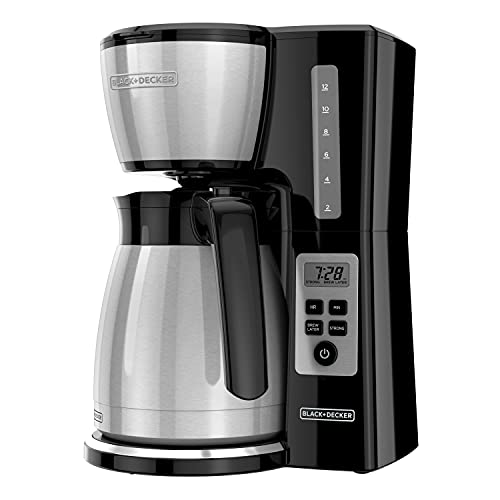
BLACK+DECKER 12 Cup Thermal Programmable Coffee Maker (CM2046S)
Badge: Best for Even Extraction
Strengths
- VORTEX Technology showerhead saturates grounds evenly, the foundation of a balanced pot.
- 12-cup thermal carafe with brew strength control and programmability.
- Black and steel finish suits most kitchens and hides daily wear well.
Trade-offs
- No dedicated small-batch setting is published.
- Even extraction is its specialty; it is not a named hotter-brewing system like PerfecTemp.
- Thermal carafe pouring is slower than glass, especially at the end of the pot.
Mini spec box
- Capacity: 12 cup
- Carafe: Thermal
- Controls: Programmable, Brew Strength control
- Showerhead: VORTEX Technology
- Finish: Black/Steel
- Model: CM2046S
Under-extraction is the most common flavour fault in home drip coffee, and it is usually a distribution fault: water finds one path through the grounds and leaves the rest nearly dry, so the pot is simultaneously weak and bitter. The CM2046S is built around fixing exactly that. Its VORTEX showerhead spreads water across the whole bed of grounds, and the difference shows up as a pot that tastes uniform — the first cup and the last cup recognisably the same coffee. Around that centrepiece sits a complete mid-band package: a 12-cup thermal carafe, programmable timing, and brew strength control for the days a bolder cycle is wanted.
The limitations are specialisation and small pots. A household that brews four cups most days has no dedicated small-batch mode to lean on here, and a household whose core complaint is lukewarm brewing should compare the PerfecTemp below, whose system targets heat directly. But for the large middle of drip drinkers — full pots, everyday beans, a suspicion that their current machine makes uneven coffee — the BLACK+DECKER answers the right question, and its even-extraction badge is the one most likely to be tasted rather than merely read about.
Best for: full-pot households that suspect uneven extraction / Not suited for: small-batch specialists and heat-first buyers

Cuisinart PerfecTemp 12-Cup Thermal Drip Coffee Maker (DCC-3400NAS)
Badge: Best Brewing System
Strengths
- PerfecTemp hotter brewing — the most deliberate extraction system in this band.
- Double-wall stainless steel thermal carafe protects the brew the system worked to make.
- Brew Strength control rounds out a complete, flavour-first package.
Trade-offs
- It lives at the band’s edge; verify the live price before assuming it fits your ceiling.
- Stainless thermal carafes hide the coffee level.
- Silver finish shows splashes in a busy kitchen.
Mini spec box
- Capacity: 12-cup
- Carafe: Double-wall stainless steel thermal
- Brewing system: PerfecTemp hotter brewing
- Controls: Brew Strength control
- Finish: Silver
- Model: DCC-3400NAS
Every band has a pick that defines its ceiling, and in this one it is the PerfecTemp. Cuisinart’s system is designed around hotter brewing, which is the variable that separates a sweet, fully extracted pot from a thin, sour one, and it is paired here with a double-wall stainless steel thermal carafe so the result is preserved rather than stewed. Brew strength control completes a machine that treats flavour as the product. When this model sits inside the band on a given week, it is arguably the strongest value in the entire drip category: a brewing system from a higher shelf, at a middle-band number.
The caveat is precisely that band position. PerfecTemp models drift around this tier’s ceiling, so the live listing is the referee — check the latest price on Amazon, and if it has moved above the line, judge it against the next band up rather than pretending otherwise. The other notes are minor: a hidden coffee level in the steel carafe, a finish that shows splashes. Buyers for whom extraction quality is the whole point should start here and work backwards; buyers who want the complete pot package without band-edge anxiety should take the KRUPS and never look back.
Best for: flavour-first buyers who catch it inside the band / Not suited for: strict-ceiling shoppers on a week it sits above the line
Comparison Table
| Model | Capacity | Carafe | Standout feature | Controls | Link |
|---|---|---|---|---|---|
| KRUPS Thermal Carafe | 12-cup | Double-wall thermal | Keeps coffee hot for hours, no plate | 24-hour programmable, 3 strengths | Check on Amazon |
| Cuisinart Thermal Classic | 10-cup | Thermal | Compact proven format | Programmable | Check on Amazon |
| SECPOEDR Grind and Brew | 10-cup | Keep-warm design | Built-in grinder | Programmable, 2-hour keep warm | Check on Amazon |
| Gevi Grind & Brew | 10-cup | Glass, warm plate | Built-in grinder, touch screen | Programmable, reusable filter | Check on Amazon |
| BLACK+DECKER CM2046S | 12 cup | Thermal | VORTEX even saturation | Programmable, Brew Strength | Check on Amazon |
| Cuisinart PerfecTemp DCC-3400NAS | 12-cup | Double-wall stainless thermal | PerfecTemp hotter brewing | Brew Strength control | Check on Amazon |
How to Choose the Best Drip Coffee Maker Under 75
Begin with what this band’s headroom actually buys, because it is not what most shoppers assume. Over the tightest tier, the extra money here rarely buys more cups or more watts. It buys execution: a double-wall carafe instead of a single-wall one, a strength control that changes the cup instead of decorating the panel, a showerhead engineered for saturation, a grinder integrated into the body, a brand whose replacement carafe will exist in five years. When you compare two mid-band machines, ask where the difference lives. If it lives in the brew path or the carafe, it is worth paying for. If it lives in the display, it is not.
Capacity comes second, with the usual arithmetic: roughly two pot-cups per regular drinker per morning. The 10-cup picks here — the Cuisinart Classic, the SECPOEDR, the Gevi — are correctly sized for the majority of households, and they will brew more consistently than a 12-cup machine run at half. The 12-cup picks — KRUPS, BLACK+DECKER, PerfecTemp — are for four-drinker homes and regular entertainers. Remember that maker cups are small measures; five generous mugs empty a “10-cup” pot. Size for the biggest routine morning, not the biggest imaginable one, and let guests wait for a second brew on the rare days it is needed.
Third, pick your talent and let it pick your machine. This band offers four: hours of plate-free holding (KRUPS), fresh-ground integration (SECPOEDR and Gevi, differing in carafe philosophy), even extraction (BLACK+DECKER), and hotter brewing (PerfecTemp). Each is a legitimate reason to spend toward the band’s top; none of them stacks with the others in a single machine at this level, which is the band’s one real frustration. Pod flexibility, notably, is not in this six — households that need it should shop the hybrid field through Best Drip Coffee Makers With Pod rather than forcing this one — while carafe-led shoppers can compare the wider vessel field in Best Drip Coffee Makers With Carafe.
Last, handle the price professionally. Check the latest price on Amazon on the day you buy, treat band-edge models as feature purchases rather than band trophies, and remember that a machine slightly over a self-imposed line that serves for six years is cheaper than a machine under the line that disappoints for six months and gets replaced. The band is a guide to value, not a moral boundary.
How to Set Up and Care for a Mid-Band Drip Coffee Maker
First setup. Wash the carafe and removable parts in warm soapy water, then run two full plain-water cycles before the first pot. Use the second cycle to learn the machine: carafe seating, pour behaviour, water marks, and — on the grind-and-brew picks — the sound and flow of the grinder running empty, followed by a brush-out of the path. Five unhurried minutes here prevent a month of small annoyances.
Daily routine. Fresh cold water for every brew; preheat thermal carafes with a hot rinse on cold mornings; keep a steady ratio of roughly one to two tablespoons of ground coffee per cup and adjust it over several pots, one variable at a time. Close thermal lids between pours. On grind-and-brew machines, empty the basket and brush the grind path daily — the flavour you bought the machine for lives or dies on that habit. On the Gevi, the reusable filter wants a rinse after each brew and a proper wash weekly, or its mesh slowly seasons the pot.
Descaling and deep care. Scale is the mid-band machine’s main enemy, precisely because these machines are worth keeping: mineral build-up on the heating element slows the cycle and drops brew temperature months before it stops the machine outright. Descale on the maker’s recommended cycle at a rhythm set by your water hardness, and follow with plain-water rinses. Wash thermal carafes daily with hot soapy water and soak weekly; wipe showerheads weekly so distribution stays even; check carafe lid seals whenever holding performance seems to fade, because a tired seal impersonates a failed carafe.
Troubleshooting.
- Problem: coffee has gradually become less hot and the cycle slower → descale. Scale insulates the heating element, and one cycle usually restores both speed and temperature.
- Problem: the pot tastes uneven — strong at first, thin later, or bitter and weak at once → suspect distribution and ratio: clean the showerhead area, confirm the basket is seated, and re-check that the grounds bed is level and fully wetted.
- Problem: a grind-and-brew machine’s coffee has turned muddy or stale-tasting → deep-clean the grind path and brew basket; old grounds and oils accumulate there first, and they season every new pot until removed.
The Middle Band vs Its Neighbours: Where the Money Stops Mattering
Against the band below, this tier’s advantage is execution depth: double-wall insulation, strength menus, engineered showerheads, integrated grinders, and brand support are normal here and exceptional there. Against the band above, this tier gives up refinement rather than results — quieter operation, finer materials, more elaborate temperature management — the kind of differences an enthusiast can taste and describe, but that most households, drinking good beans from these six machines, will never miss at breakfast. That is the honest shape of the category’s value curve, and it is why the middle band attracts the shoppers who research hardest: it is the last stop where money buys coffee rather than ceremony.
The exception proves the rule, and it sits in this list: the PerfecTemp, a brewing system from the shelf above, periodically priced at this band’s edge. When a higher-tier system crosses into the middle band, the value curve briefly breaks in the shopper’s favour. The general lesson is to shop the boundary, not the label — verify live prices, compare systems rather than stickers, and let the occasional band-crosser come to you.
Four Household Profiles for the Middle Band
The grazer household. Coffee is brewed once and visited for hours — remote workers, weekend readers, parents in shifts. Your pick is the KRUPS, full stop: double-wall insulation, hours of holding, no plate quietly ruining the pot’s second half. Every other consideration is secondary to the carafe, and this band’s best carafe-for-the-routine is wearing the Best Overall badge.
The flavour household. You buy beans with opinions and notice when a pot is thin. Your pick is the PerfecTemp when its live price sits inside the band, and the BLACK+DECKER CM2046S when it does not — hotter brewing and even saturation are the two halves of extraction, and this band unusually offers a specialist in each. Your second purchase should be a descaling schedule, because flavour households are the first to taste scale’s slow theft.
The fresh-ground household. You already believe the grinder gospel and want it without a second appliance. Your pick is the SECPOEDR if you drink across a couple of hours and prefer its stainless, keep-warm format, or the Gevi if you finish by mid-morning, like modern controls, and want to watch the pot. Either way, adopt the daily brush-out before the machine arrives, not after the first stale pot teaches you.
The set-and-forget household. You want the machine decided, correctly, for years. Your pick is the Cuisinart Thermal Classic: a proven design, correctly sized, from a brand with findable parts, that asks for nothing but descaling and delivers a proper thermal pot on a timer. In a band full of talents, dependability is itself a talent, and it is yours.
Ownership Costs in the Middle Band
A mid-band machine should be budgeted as a system, not a sticker. The recurring lines are modest but real: filters, unless your pick’s reusable filter removes them; descaling solution on a hardness-matched rhythm; and, for grind-and-brew owners, nothing more exotic than the two daily minutes the grind path asks for. Replacement carafes are the contingency line — thermal carafes are durable but not immortal, and the established brands in this list keep theirs findable, which converts a potential machine-ending accident into a minor purchase. Electricity is a minor line for drip brewing generally, and thermal carafes trim it further by retiring the warming plate’s long, low draw.
Set against those costs is the avoided cost that justifies the band: the coffee itself. A household brewing daily spends far more on beans across a machine’s life than on the machine, and a brewer that extracts evenly and holds heat properly wastes less of that spend on thin pots and reheated mugs. That arithmetic is the middle band’s real pitch — not luxury, not savings, but a fair price for not wasting the ingredient you buy every week. The six picks here were chosen to honour it.
How to Read Owner Feedback in the Middle Band
Middle-band owners are the category’s most demanding reviewers, because they paid enough to expect execution and not so much that they rationalise flaws. That makes their feedback unusually trustworthy, if you read it for execution rather than inclusion. A feature’s presence is on the listing; its performance is in the comments. Look for owners describing the second hour of the KRUPS’s carafe, the actual difference the BLACK+DECKER’s showerhead makes to a familiar bag of beans, the month-three state of a grind path on the SECPOEDR or the Gevi. Those are the reports that separate a specification from a result, and they are the same evidence this guide’s ranking rests on.
Sort complaints by their half-life. Complaints about finishes, footprints, and learning curves fade from reviews as owners adapt; complaints about seals, lids, pours, and slow temperature decline do not fade, because the machine keeps making them. A pick whose criticism is all of the first kind is a safer purchase than its average tone suggests, and a pick whose praise is all first-week enthusiasm should be discounted accordingly. Read for the owners whose routine matches yours, at the ninety-day mark, and the middle band becomes remarkably legible.
The Band-Edge Watchlist: Buying Models That Cross Tiers
Every price band has crossers — models engineered for the shelf above that promotions periodically pull into reach. This list contains the clearest example in the PerfecTemp, whose brewing system belongs to a higher tier and whose live price decides, week by week, which band it competes in. The strategy for crossers is patience plus readiness: decide in advance, from guides like this one, that the model is the right machine for your routine; then watch its listing and buy when the number crosses your line, rather than impulse-buying whichever model happens to be discounted on the day you look. The reverse error is just as common — refusing a crosser that sits slightly above the line on principle, then spending the difference anyway on a lesser machine’s replacement carafe two years later. Bands organise value; they should not be allowed to veto it.
What to Check on the Listing Before You Buy
Because this guide deliberately sends you to the live listing for the price, make the visit count by checking four more things while you are there. First, the configuration: band-edge models often exist in more than one size or finish, and the figure that caught your eye may belong to the variant you do not want — confirm the capacity and carafe type in the listing title against the pick you chose here. Second, the carafe description itself: the words double-wall, thermal, or glass should appear exactly as this guide’s review describes them; if a listing has changed its specification, trust the listing and re-run your decision. Third, the replacement carafe: search the same store for the model’s carafe or lid, and note whether it is offered — that thirty-second check is the cheapest insurance in this entire category. Fourth, the newest owner feedback, read with this guide’s filters: execution over inclusion, ninety-day reports over first-week enthusiasm, and complaints sorted by whether they fade or repeat.
None of this takes long, and all of it converts a guide’s research into a verified purchase. The middle band rewards exactly this kind of shopper — the one who decides on durable criteria, confirms the live details, and then stops shopping. The machines above will do the rest every morning.
A Short Note on Finishes, Counters, and Living With the Machine
It is unfashionable in a buying guide to discuss how a machine looks, and mostly rightly — the cup does not care. But a mid-band machine will sit on your counter for years, in your eye line at every breakfast, and two practical points deserve their sentence. First, finishes differ in forgiveness: black and stainless hide the daily evidence of coffee making, while white — the PerfecTemp’s finish in this list — shows every splash and asks for a wipe in exchange for its brightness. Neither is a flaw; they are different maintenance agreements, and you should sign the one your household will actually honour. Second, measure the counter before the machine arrives, including the height under cabinets with the lid open for filling, because a brewer that must be pulled forward every morning is a brewer whose routine friction compounds. The best machine in this band is the one that fits the kitchen’s real geometry as well as the household’s real routine — a sentence that sounds obvious and is ignored daily.
The Two-Pot Test: A Final Sanity Check Before Buying
Before committing to any pick in this band, run one mental experiment: imagine the machine’s second pot of the day, brewed for guests or for a second shift of work, with the first pot’s grounds still in the basket and the carafe still warm. Does the machine’s design make that second pot easy — a carafe that rinses fast, a basket that empties cleanly, controls that do not need re-teaching? Mid-band machines are bought for years of two-pot days, and the models in this guide were screened with that day in mind: thermal carafes that rinse and return, programmable platforms that reset without fuss, grind paths whose daily brush-out is measured in seconds. A machine that makes the second pot a chore will eventually make the first one a chore too, because households route around friction. Choose the machine whose whole day — not whose first hour — you would sign for.
Common Buying Mistakes
- Paying the band’s top for cosmetics. In this tier, money should land in carafes, showerheads, and brewing systems — not in finishes and displays.
- Assuming bigger is better. A 12-cup machine run at half capacity brews worse than a 10-cup machine run full. Size to the routine.
- Ignoring the carafe philosophy split. Thermal insulation and glass-on-a-plate serve different mornings. Choose for the morning you have, not the one in the photograph.
- Buying a grinder you will not clean. Grind-and-brew rewards a two-minute daily habit and punishes its absence. Be honest about which owner you are.
- Trusting a stale band price. Mid-band prices drift with promotions; the live listing is the only referee.
- Skipping descaling because the machine cost real money. Scale does not care what you paid; it coats premium and budget heaters with perfect fairness.
Final Recommendation
For most shoppers, the best drip coffee maker under 75 in this group is the KRUPS — a complete thermal pot package with hours of holding and a real strength menu: Check on Amazon. Flavour-first buyers should catch the Cuisinart PerfecTemp when it sits inside the band — Check on Amazon — fresh-ground households should take the SECPOEDR or the Gevi, extraction worriers the BLACK+DECKER CM2046S, and small households the Cuisinart Thermal Classic. Spend this band’s headroom on the brew path, size the pot to your routine, descale on schedule, and you will not shop this category again for years.
Frequently Asked Questions
What does the under $75 band buy that the band below does not?
Execution. Double-wall thermal carafes, meaningful strength control, engineered showerheads, integrated grinders, and stronger brand support are normal in this band and rare below it. Capacity barely changes; the quality of every part that touches the coffee does.
Is a built-in grinder worth it at this price?
If you will clean the grind path regularly, yes — grinding seconds before brewing is the largest flavour upgrade available in the band, and the SECPOEDR and Gevi deliver it without a separate grinder purchase. If you will not clean it, a pot specialist like the KRUPS will make you happier.
Thermal or glass carafe in this band?
Thermal, if your pot lives longer than an hour or so; glass, if you finish quickly and value seeing the level. The band offers both honestly — the Gevi is the glass pick here — but insulation is the default recommendation for flavour over time.
Why are exact prices not printed?
Mid-band prices move with promotions and seasons, and several picks sit near the band’s edge. A printed figure would go stale quickly, so every pick links to its live listing to check the latest price on Amazon on your buying day.
Does a 10-cup machine brew better than a 12-cup for a small household?
Usually, yes. Drip machines brew most consistently near their designed batch size, so a 10-cup machine run full outperforms a 12-cup machine run at a third for a small household — unless the larger machine has a dedicated small-batch setting.
How do I keep a mid-band machine performing for years?
Descale on a rhythm matched to your water hardness, wash the carafe daily, wipe the showerhead weekly, and clean grind paths daily on grind-and-brew models. Most performance decline in this band is maintenance debt, not machine failure.
When is it worth stepping up to the next band?
When you want the refinement layer — the most elaborate temperature management, quieter and more solid builds, or a specific premium system full-time rather than at a band edge. If your priorities are the cup and the routine, this band already covers them.


