Disclosure: topratedkitchenware.com is reader-supported. When you buy through links on our site, we may earn an affiliate commission from Amazon and other retailers, at no extra cost to you.
Where to buy
The six models below are the verified picks for this guide to the best drip coffee makers with carafe, chosen carafe-first. Each name links to its Amazon listing, where you can check the latest price on Amazon, confirm the current configuration, and read the newest owner feedback before you decide.
- SECPOEDR Grind and Brew Coffee Maker with Built-In Grinder
- Gevi 10-Cup Grind & Brew Coffee Maker
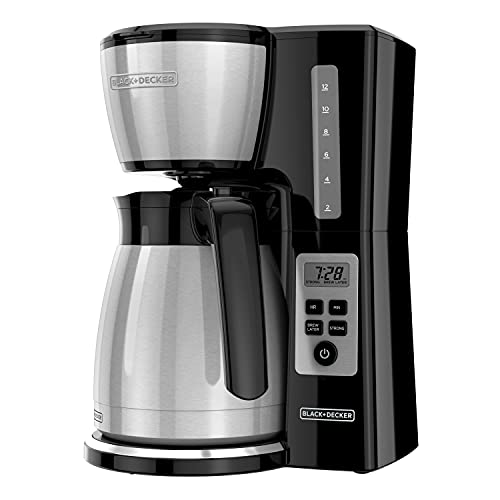
- BLACK+DECKER 12 Cup Thermal Programmable Coffee Maker (CM2046S)
- Cuisinart PerfecTemp 12-Cup Thermal Drip Coffee Maker (DCC-3400NAS)
- BLACK+DECKER CaféCraft 12-Cup Thermal Coffee Maker
- Cuisinart 12-Cup PerfecTemp Thermal Coffee Maker, White
If you follow only one link from this box, start with the Cuisinart PerfecTemp — Check on Amazon — whose double-wall stainless thermal carafe is the strongest vessel in this group. Read the full guide ↓ for the ranking logic, the honest limitations of every pick, and the checks that matter more than any headline claim.
It sounds like a small thing to shop for — the best drip coffee makers with carafe — until you realise the carafe is the part of the machine you touch every single day, the part that decides whether the second hour of the pot is worth drinking, and the part most likely to end the machine’s life in a kitchen accident. Brewers get the headlines, but carafes get the years. A thermal carafe holds coffee at drinking temperature by insulation and protects its flavour; a glass carafe shows you the pot at a glance and pours with a familiarity nothing else matches; a badly designed example of either will dribble down its own side, chip at the rim, and annoy you twice a day for as long as you own it. This guide therefore ranks six verified drip makers carafe-first: what the vessel is made of, how it holds heat, how it pours, how it cleans, and whether you will be able to replace it when — not if — it eventually meets the sink wrong.
The six picks divide honestly. Four brew into thermal carafes of different characters, from the PerfecTemp’s double-wall stainless steel to the CaféCraft’s family-size insulated pot. One, the Gevi, is the glass representative, chosen because its carafe comes with a built-in grinder and a modern control set that make the glass trade knowingly rather than cheaply. One, the SECPOEDR, pairs its pot with a grinder and a keep-warm function for households that drink within a defined window. Around the reviews you will find a comparison table, a buying guide that treats carafe construction as the technical subject it is, a how-to section on carafe care and heat-keeping habits, and a frank comparison of glass versus thermal for different routines. Readers who already know insulation is their answer should go straight to Best Drip Coffee Makers With Insulated Carafe; this guide is for everyone still deciding what their pot should be.
Key Takeaways
- The carafe is a daily-touch component and a flavour component: construction, pour, and heat behaviour matter more than most machine features.
- Thermal carafes hold heat by insulation and protect flavour for hours; glass carafes offer visibility and a familiar pour, and rely on a warm plate.
- The Cuisinart PerfecTemp’s double-wall stainless carafe is the strongest vessel here; the Gevi is the honest glass option, with a grinder included.
- A carafe you cannot replace is a machine with an expiry date — every pick here comes from a brand with findable parts.
- Preheating a thermal carafe and closing its lid between pours are free habits that noticeably extend the pot’s good hours.
- Judge a carafe by the last cup, not the first pour: heat holding and flavour holding are the real specifications.
In this guide
Quick Picks
| Pick | Badge | Why it is here | Link |
|---|---|---|---|
| SECPOEDR Grind and Brew Coffee Maker with Built-In Grinder | Best Grind-and-Brew Pot | Built-in grinder, 10-cup programmable brewing, 2-hour keep warm. | Check on Amazon |
| Gevi 10-Cup Grind & Brew Coffee Maker | Best Glass Carafe | Glass carafe with built-in grinder, touch screen, and reusable filter. | Check on Amazon |
| BLACK+DECKER 12 Cup Thermal Programmable Coffee Maker (CM2046S) | Best for Even Extraction | VORTEX saturation brewing into a 12-cup thermal carafe. | Check on Amazon |
| Cuisinart PerfecTemp 12-Cup Thermal Drip Coffee Maker (DCC-3400NAS) | Best Overall | Double-wall stainless thermal carafe with PerfecTemp hotter brewing. | Check on Amazon |
| BLACK+DECKER CaféCraft 12-Cup Thermal Coffee Maker | Best for Hot and Iced | A 12-cup thermal pot that also brews iced coffee. | Check on Amazon |
| Cuisinart 12-Cup PerfecTemp Thermal Coffee Maker, White | Best for Small Batches | PerfecTemp thermal brewing with a dedicated 1-4 cup setting. | Check on Amazon |
How These Picks Were Chosen
This is a research-led guide with a carafe-first method. Verified listings were compared on the vessel as much as the machine: carafe construction where the listing states it (double-wall stainless thermal, thermal, glass), the heat strategy that follows from it (insulation, keep-warm function, warm plate), capacity, and the supporting controls. Owner feedback was then read for the carafe-specific themes that repeat across the category — pouring behaviour, lid and seal durability, heat holding across a morning, cleaning effort, and the availability of replacement carafes — because those are the experiences that decide whether a machine is loved in year two. Machines whose carafes are known quantities from established lines rose; machines with anonymous, unreplaceable vessels did not, however attractive the brewer attached to them.
Two judgements in this list deserve explanation. First, the glass Gevi is included deliberately, not as a token: a meaningful share of households finish a pot quickly, prefer to see the level, and will trade insulation for visibility with open eyes, and the Gevi makes that trade while adding a grinder and a reusable filter. Second, the SECPOEDR’s keep-warm approach is treated as a legitimate third philosophy between insulation and plate-warming: a defined window of held temperature for households whose drinking fits inside it. Everything else here insulates, which reflects the guide’s editorial position — for the average pot that lives longer than an hour, insulation is the correct default — stated openly rather than smuggled into the rankings.
Specifications in this guide come only from the verified listing data for each model; where a listing does not describe a carafe detail, the review does not invent one. Prices are not printed, as house rule, because they move — check the latest price on Amazon through the links provided. Readers comparing the broader home field should also see Best Drip Home Coffee Makers, which ranks many of these machines by household fit, and Best Drip Pot Coffee Makers, the neighbouring shortlist for pot-led shoppers.
The 6 Best Drip Coffee Makers With Carafe

SECPOEDR Grind and Brew Coffee Maker with Built-In Grinder
Badge: Best Grind-and-Brew Pot
Strengths
- Built-in grinder means the freshest possible fill for the pot, seconds before brewing.
- 2-hour keep warm function matches a normal morning’s drinking window.
- Stainless steel build and 10-cup programmable platform.
Trade-offs
- Keep warm is a window rather than insulation; all-morning grazers should choose a thermal pick.
- The grind path needs regular cleaning to protect flavour.
- A newer brand, so long-term carafe availability is less proven than the legacy names.
Mini spec box
- Capacity: 10-cup
- Grinder: Built-in
- Controls: Programmable
- Keep warm: 2-hour keep warm function
- Build: Stainless steel
The SECPOEDR’s argument starts before the carafe: it grinds. Coffee filled into any vessel tastes best when the beans were ground moments before brewing, and this machine builds that step into a 10-cup programmable platform, so the pot it serves is as fresh as drip coffee gets without a separate grinder. Its heat strategy is the defined window — a 2-hour keep warm function that covers the standard morning honestly. For households whose pot is brewed at seven and finished by nine, that window is not a compromise at all; it is a correct specification, and the machine spends its budget on the grinder instead of on insulation the household would never use.
The trade-offs are the mirror image. Drink past the window regularly and a thermal pick will serve you better; neglect the grind path’s cleaning and the freshness advantage quietly reverses into staleness. The brand is also newer than the Cuisinart and BLACK+DECKER names elsewhere in this list, which matters in a carafe-led guide precisely because replacement vessels are a long-game question. Buyers who fit the window, though, get the freshest pot in this six — and the fuller grind-and-brew comparison lives in Best Drip Coffee Makers With Grinder.
Best for: fresh-ground households that finish the pot within a couple of hours / Not suited for: all-morning grazers and brand-history-first buyers

Gevi 10-Cup Grind & Brew Coffee Maker
Badge: Best Glass Carafe
Strengths
- Glass carafe: the pot’s level and strength are visible at a glance, and the pour is the familiar one.
- Built-in grinder plus touch screen controls and programmable brewing.
- Reusable filter included, and a 1.5L tank sized for the 10-cup pot.
Trade-offs
- The 90-minute warm plate holds heat by gentle cooking — flavour fades past that window.
- Glass is breakable in a way stainless thermal carafes are not; handle and budget accordingly.
- Touch controls divide opinion, and the grind path needs regular cleaning.
Mini spec box
- Capacity: 10-cup, 1.5L tank
- Grinder: Built-in
- Carafe: Glass, 90-min warm plate
- Controls: Touch screen, programmable
- Filter: Reusable filter included
Glass carafes survive in a thermal world because they offer two things insulation cannot: sight and ritual. You can see exactly how much coffee remains, judge its strength by its colour, and pour with the light, familiar balance that generations of drip drinkers grew up with. The Gevi is this guide’s glass standard-bearer because it wraps that carafe in a genuinely current machine — a built-in grinder for fresh-ground flavour, touch screen programmability, and a reusable filter that removes a recurring purchase. For the household that brews, drinks within the warm plate’s 90-minute window, and refills fresh when it wants more, the Gevi’s carafe is not a compromise; it is the preference, correctly served.
Honesty about glass requires the other paragraph. A warm plate holds temperature by continuing to cook, gently, and coffee held past the window tastes it. Glass also breaks — rarely, but memorably — and while replacement is straightforward for a current model, it is an interruption stainless owners never meet. And like every grind-and-brew here, the grinder’s path must be cleaned on schedule. Choose the Gevi with your routine in view and it is a delight; choose it for a four-hour grazing routine and the thermal picks above and below will quietly outperform it. Pod-curious households, incidentally, are on the wrong page entirely — Best Drip Coffee Makers With Pod is the hybrid shortlist.
Best for: visibility lovers who finish the pot within the warm window / Not suited for: slow grazers and the accident-prone
BLACK+DECKER 12 Cup Thermal Programmable Coffee Maker (CM2046S)
Badge: Best for Even Extraction
Strengths
- 12-cup thermal carafe sized for family pots, holding heat without a plate.
- VORTEX Technology showerhead saturates the grounds evenly, so the carafe holds a uniform pot.
- Brew Strength control and programmability complete the daily package.
Trade-offs
- You cannot see the coffee level through the thermal walls.
- Thermal carafes pour a little slower than glass, especially near empty.
- No dedicated small-batch setting is published.
Mini spec box
- Capacity: 12 cup
- Carafe: Thermal
- Controls: Programmable, Brew Strength control
- Showerhead: VORTEX Technology
- Finish: Black/Steel
- Model: CM2046S
A carafe can only hold what the brewer gives it, and the CM2046S makes sure the gift is worth holding. Its VORTEX showerhead is designed to saturate the grounds bed evenly, which produces a pot of uniform strength — and uniform pots are the ones that still taste right from an insulated carafe two hours later, because there is no weak top layer or bitter bottom layer to drift apart. The 12-cup thermal carafe itself is the family-size expression of the insulation philosophy: brew once on the programmable timer, close the lid, and let physics do what a warming plate does worse. The black and steel finish suits the role — a working vessel for a working kitchen.
The thermal trade-offs apply in full: no visible level, a pour that asks for a moment’s patience, and a preheat habit on cold mornings if you want the carafe’s best holding performance. There is also no published small-batch mode, so the household that usually brews four cups should compare the white Cuisinart below. As a family pot with an extraction system worthy of its carafe, though, the CM2046S is one of the most balanced machines in this guide.
Best for: families brewing full pots that must stay right for hours / Not suited for: level-watchers and small-batch households

Cuisinart PerfecTemp 12-Cup Thermal Drip Coffee Maker (DCC-3400NAS)
Badge: Best Overall
Strengths
- Double-wall stainless steel thermal carafe — the strongest heat-holding construction in this group.
- PerfecTemp hotter brewing gives the carafe a properly extracted pot to protect.
- Brew Strength control, in a premium silver finish.
Trade-offs
- Premium tier within this group.
- Stainless walls hide the coffee level completely.
- The silver finish shows splashes and fingerprints readily.
Mini spec box
- Capacity: 12-cup
- Carafe: Double-wall stainless steel thermal
- Brewing system: PerfecTemp hotter brewing
- Controls: Brew Strength control
- Finish: Silver
- Model: DCC-3400NAS
In a carafe-led guide, the PerfecTemp is the complete sentence: a brewing system designed for hotter, fuller extraction, delivering into a double-wall stainless steel thermal carafe that defends the result for hours. Double-wall construction is the meaningful spec in this entire category — two walls with insulation between them slow heat loss far better than a single wall can — and stainless steel adds the durability glass cannot offer, shrugging off the knocks that end glass carafes. The pot that goes in is worth protecting, too: PerfecTemp brewing plus brew strength control means the carafe is holding coffee that was right when it was made, which is the only kind worth holding.
The costs are the familiar thermal ones, plus tier. You judge the level by cups poured rather than by sight; the silver finish asks for wiping; and the model sits in this group’s premium tier, which is the honest price of the best vessel-and-brewer pairing here. Households that entertain will appreciate that a stainless carafe also travels to the table without a trivet anxiety. For carafe-first shoppers, this is the benchmark against which the rest of the list — and the dedicated field in Best Drip Coffee Makers With Thermal Carafe — should be measured.
Best for: carafe-first buyers who want the strongest vessel and brewer pairing / Not suited for: level-watchers and the tightest budgets

BLACK+DECKER CaféCraft 12-Cup Thermal Coffee Maker
Badge: Best for Hot and Iced
Strengths
- 12-cup thermal carafe for hot coffee, with an iced-coffee capability alongside.
- Programmable timing for fresh pots at waking.
- Insulation instead of a warming plate, so held coffee is not cooked coffee.
Trade-offs
- The iced talent is wasted on hot-only households.
- No visible coffee level, as with all thermal carafes here.
- Fewer published brew-customisation details than the Cuisinart pair.
Mini spec box
- Capacity: 12-cup
- Carafe: Thermal
- Modes: Hot and iced coffee
- Controls: Programmable
- Brand line: CaféCraft
The CaféCraft’s carafe has the most varied job description in this guide: hold a full pot of hot coffee at temperature through the morning, and anchor a machine that also brews iced coffee when the season turns. It handles the main job the right way — thermal insulation, programmable freshness, family capacity — and the iced capability is more than a party trick, because good iced coffee starts as strong hot coffee, which means the brewer and carafe discipline this guide cares about is doing double duty. For split households, one vessel serving both seasons is a counter-space and budget argument as much as a coffee one.
The limitations are focus and visibility. Hot-only households pay for a talent they will not use, and like every thermal owner you will learn the pot’s level by counting cups. Buyers who want maximum published control over the brew should compare the Cuisinarts on either side of this review. Buyers who want one honest thermal pot that also ends the summer iced-coffee improvisation will find the CaféCraft the most accommodating carafe in the list.
Best for: split hot-and-iced households / Not suited for: hot-only purists who want maximum brew control

Cuisinart 12-Cup PerfecTemp Thermal Coffee Maker, White
Badge: Best for Small Batches
Strengths
- PerfecTemp thermal brewing with a dedicated 1-4 cup setting — small pots get a properly filled carafe’s worth of care.
- Brew Pause for the first impatient cup, and Brew Strength Control for tuning.
- Thermal carafe holding that suits pots drunk over a morning.
Trade-offs
- White finish shows coffee splashes and needs regular wiping.
- Premium tier within this group.
- Full-pot households will rarely use its signature small-batch talent.
Mini spec box
- Capacity: 12-cup
- Carafe: PerfecTemp thermal carafe
- Brewing system: PerfecTemp
- Settings: 1-4 cup setting, Brew Strength Control, Brew Pause
- Finish: Stainless steel, white
Small pots are where carafes are usually an afterthought — a big vessel holding a little coffee, losing heat to its own empty space. This Cuisinart is the pick that takes the small pot seriously: the PerfecTemp thermal system brews it properly, the dedicated 1-4 cup setting adjusts the cycle to the batch, and the thermal carafe then holds those few cups at temperature instead of letting them fade against cold walls — especially if you use the preheat habit from this guide’s how-to section, which matters most exactly here, where the coffee-to-carafe ratio is least forgiving. Brew Pause and strength control complete a machine designed for deliberate, smaller-scale drinking that still keeps 12-cup capacity in reserve.
The honest notes are finish and tier: white shows the evidence of coffee making and asks for a wipe, and the model sits in the group’s premium tier alongside its silver sibling. Households that always brew full pots will find that sibling, or the BLACK+DECKER CM2046S, a more direct fit. Households whose weekday reality is four cups and whose weekend reality is twelve will find this the most thoughtfully matched carafe-and-brewer pairing in the six.
Best for: small weekday pots with full-pot backup / Not suited for: always-full-pot households and low-maintenance finishes
Comparison Table
| Model | Capacity | Carafe type | Heat strategy | Standout feature | Link |
|---|---|---|---|---|---|
| SECPOEDR Grind and Brew | 10-cup | Keep-warm design | 2-hour keep warm window | Built-in grinder | Check on Amazon |
| Gevi Grind & Brew | 10-cup | Glass | 90-min warm plate | Grinder, touch screen, reusable filter | Check on Amazon |
| BLACK+DECKER CM2046S | 12 cup | Thermal | Insulation | VORTEX even saturation | Check on Amazon |
| Cuisinart PerfecTemp DCC-3400NAS | 12-cup | Double-wall stainless thermal | Insulation, hotter brewing | PerfecTemp system | Check on Amazon |
| BLACK+DECKER CaféCraft | 12-cup | Thermal | Insulation | Hot and iced brewing | Check on Amazon |
| Cuisinart PerfecTemp, White | 12-cup | Thermal | Insulation, small-batch mode | 1-4 cup setting, Brew Pause | Check on Amazon |
How to Choose a Drip Coffee Maker by Its Carafe
Start with construction, because construction decides physics. A double-wall thermal carafe — two walls with an insulating gap — is the strongest heat holder and the flavour protector, and in stainless steel it is also the most durable vessel in the category. A single-wall thermal carafe insulates less completely but still beats any plate. Glass insulates not at all; it is a viewing window with a handle, paired with a warm plate that trades flavour for temperature over time. Keep-warm designs sit between: a defined window of held heat for households whose drinking fits inside it. None of these is a trick. Each is a bet about your routine, and the correct way to choose is to time your real pot: brew, note when the last cup is poured on an ordinary day, and buy the construction whose good window contains that time with room to spare.
Second, judge the pour, because you will perform it thousands of times. A good carafe pours in a controlled stream, cuts off cleanly without dribbling down its own side, and balances in the hand when full and when nearly empty. Listings rarely describe pouring, which is why this guide read owner feedback for it — dribble complaints are among the most repeated carafe criticisms in the category, and they never improve with familiarity. Lid design matters in the same daily way: a lid that seals fully protects heat between pours, and a lid that opens wide makes cleaning honest instead of hopeful.
Third, think about the end of the story at the beginning. Carafes are the component most likely to need replacement — a knock in the sink, a tired seal, a warped lid — and a machine whose carafe cannot be replaced is a machine with a hidden expiry date. Every pick in this guide comes from a brand whose parts remain findable; treat that as a specification, not a courtesy. Capacity interacts here as well: match the carafe’s size to your routine batch, because insulation works best on a reasonably full vessel, and a 12-cup carafe holding four cups loses heat to its own headspace faster than a right-sized one does. Small-batch households should note the white Cuisinart’s dedicated setting, which exists to manage exactly that physics.
Finally, weigh the brewer behind the carafe. The finest vessel cannot rescue a thin, under-extracted pot; it can only preserve it faithfully. That is why this list pairs its best carafes with deliberate brewing systems — PerfecTemp’s hotter brewing, the CM2046S’s even saturation, the grinders in the SECPOEDR and Gevi. Buy the pair, not the part.
How to Care for Your Carafe and Keep Coffee Hot Longer
The preheat habit. Before brewing into a thermal carafe, rinse it with hot tap water and let it stand full for a minute, then empty and brew. Cold walls — steel especially — drink the first pot’s heat; warmed walls let the coffee keep it. This is the single most effective free upgrade in drip coffee, and it matters most for small batches and cold kitchens.
Daily care. Wash the carafe every day with hot soapy water and a bottle brush that reaches the bottom; coffee oils coat the interior invisibly and turn rancid, seasoning every future pot with stale flavour. Rinse the lid mechanism too — old coffee hides in pour spouts and seals. For glass carafes, the same routine applies, plus care with thermal shock: do not set a hot glass carafe on a cold wet surface, and do not fill a cold one with boiling water from a kettle.
Weekly and monthly care. Soak the carafe weekly in hot water with a coffee-equipment cleaner or a baking-soda solution to lift the film a daily wash misses, and inspect the lid seal for warping or residue whenever holding performance seems to dip — a tired seal impersonates a failed carafe and costs a fraction as much to fix. Descale the brewer itself on the maker’s schedule, since scale slows the cycle and lowers brew temperature, and no carafe can hold heat the water never had.
Troubleshooting.
- Problem: the first cup is hot and later cups disappoint → preheat the carafe, close the lid fully between pours, and check the lid seal; heat is escaping at the top more often than through the walls.
- Problem: coffee tastes stale even with fresh beans → deep-clean the carafe and lid; rancid oil film on the interior is the usual cause, and it survives casual rinsing.
- Problem: the carafe dribbles down its side when pouring → wipe the rim and spout area clean and pour a little more slowly and decisively; if dribbling persists on a clean carafe, it is a design trait, and it is a legitimate reason to replace the vessel or the machine.
Glass vs Thermal Carafes: An Honest Comparison
Glass wins on sight, price of entry, and ritual. You always know where the pot stands; the pour feels like the one you grew up with; and replacement, when the inevitable knock comes, is simple for current models. Glass loses on everything that happens after the first twenty minutes: no insulation, a warm plate that slowly cooks the pot’s aromatics away, and a fragility that turns one careless sink moment into an interruption. Thermal wins on time — hours of honest heat and flavour — and on durability in stainless form. Thermal loses on sight: the level is a memory, not a glance, and the pour asks for a touch more patience. Keep-warm designs split the difference with a defined window and no illusions.
The deciding question is therefore not which carafe is better, but how long your pot lives. Under an hour, glass is a preference you may keep with this guide’s blessing — the Gevi exists for you. Beyond an hour, insulation is not an upgrade; it is the difference between drinking coffee and drinking its remains, and the four thermal picks here are ranked for exactly that territory. Households that cannot decide should count their last cups for a week. The pot’s real lifespan, measured honestly, chooses the carafe more reliably than any feature list.
Carafe Materials and Construction, Explained
Three constructions account for nearly every carafe in drip coffee, and each fails and succeeds in its own way. Borosilicate-style glass is light, transparent, and honest: it shows the coffee, pours familiarly, and asks only for care against knocks and thermal shock in return. Its weakness is physics — a single thin wall between hot coffee and room air — which is why glass is always paired with a warming plate, and why the plate’s slow cooking defines the glass pot’s flavour window. Stainless steel thermal carafes trade sight for strength: opaque, dent-resistant, and, in double-wall form, the best insulators in the category. Their weaknesses are domestic rather than thermal — fingerprints, a hidden coffee level, and a pour that rewards a steadier hand. Plastic-bodied thermal carafes, common lower in the market, insulate adequately and cost less, but they can hold odours across years of use in a way steel and glass do not, which is one reason none of this guide’s thermal picks relies on one as its headline vessel.
The details around the vessel matter as much as the wall. A lid is a heat component, not a cap: its seal decides how much of the carafe’s hard-won temperature escapes at the top between pours, and its mechanism decides whether the carafe can be cleaned honestly or only rinsed hopefully. A spout is a daily experience: the difference between a clean cut-off and a chronic dribble is measured in thousands of small irritations. A handle is a safety component when the vessel is full and hot. When you compare two carafes that look equivalent in a photograph, these are the differences that will still be speaking to you in year three — and they are exactly the differences owner feedback reports most faithfully, which is why this guide weighted it so heavily.
Four Household Profiles for Carafe Shoppers
The table-service household. Your pot leaves the kitchen and sits among people. A stainless thermal carafe is your vessel — it travels without a trivet worry, holds heat through a long brunch, and shrugs off the knocks of a busy table. The PerfecTemp is your pick, with the CM2046S as the family-size alternative.
The watch-the-pot household. You judge the morning by the level in the pot and drink it down within the hour. Glass was made for you, and the Gevi adds a grinder and modern controls to the ritual. Buy it knowingly, drink it promptly, and the warm plate’s window will never be a grievance.
The long-morning household. The pot is brewed once and visited until nearly noon. Insulation is not a preference for you; it is the product. The thermal picks are your shelf, sized by your drinker count, with the white Cuisinart’s small-batch mode covering the quiet weekdays between family weekends.
The fresh-above-all household. Your hierarchy starts at the bean, not the vessel. The SECPOEDR’s grinder-first design, or the Gevi’s if you want glass with it, puts the freshest possible coffee into the carafe — and your discipline about cleaning the grind path is what will keep that ranking true in month six.
How to Read Owner Feedback About Carafes
Carafe feedback is unusually honest, because a carafe cannot hide behind a feature list — it either pours cleanly or it does not, holds heat or does not, survives the sink or does not. Read it in three passes. The first pass is for the pour: search the comments for dribbling, spilling, and the phrase “down the side,” and weight recent reports over early ones, since a carafe’s pour does not change but a listing’s production run occasionally does. The second pass is for the second hour: comments about coffee still hot at mid-morning are the only direct evidence of insulation performance you will get before buying, and they outrank every adjective in the listing. The third pass is for the accident reports — dropped carafes, cracked glass, warped lids — not for the drama, but for what happened next: whether a replacement was findable, and how the owner felt about the machine afterwards. A carafe with a findable replacement and an owner who bought it and brewed on is a stronger endorsement than a perfect first month.
Replacing a Carafe: A Practical Guide
When a carafe does meet its end, replace by model, not by resemblance. Carafes are model-specific — lid geometry, height, and the brew-through mechanism differ between machines that look identical in photographs — so the correct replacement is the one listed for your exact model, which is another reason the established brands in this guide matter: their model-specific carafes stay findable. Before ordering, confirm whether the failure is really the vessel: a tired lid seal, a cracked lid, or a warped pour spout can each impersonate a dead carafe, and each is a smaller purchase than the whole vessel. After replacing, run the new carafe through the same first-use routine as a new machine — wash, rinse, and a plain-water cycle — and retire the old lid only once the new seal has proven itself across a full pot. Households that entertain should consider keeping the replacement conversation ahead of the accident entirely: knowing your carafe’s replacement exists, and where, converts a future emergency into a minor errand.
When the Carafe Is the Gift: Buying a Coffee Maker for Someone Else
Coffee makers are common gifts, and carafe logic makes them safer ones than most appliances — if you gift by routine rather than by novelty. For the new homeowner, gift capacity and insulation: a 12-cup thermal pick forgives every size of gathering and every slow morning of the first year. For the downsizer, gift the opposite: a right-sized 10-cup thermal machine that suits a smaller household’s real pot and counter. For the fresh-ground enthusiast, gift the grinder models, and include the honest note that the grind path likes a daily brush — a gift that comes with its one obligation stated is a gift that gets kept. What not to gift is the exotic talent the recipient never asked for: iced capability for the hot-only drinker, a touch screen for the button loyalist, a pod side for the pot purist. The carafe-first method of this guide is, in the end, just attentiveness formalised — know how long their pot lives, and the right vessel chooses itself.
A Note on Carafe Height, Cabinets, and Counter Fit
One carafe-adjacent measurement decides more purchases than any flavour debate: whether the machine fits where it will live, with its lid open. Drip makers are filled from the top, and a brewer that slides under a cabinet only when closed will spend its life being dragged forward every morning — a friction tax that households pay in annoyance and, eventually, in chipped carafes, because a machine pulled toward the counter’s edge is a machine whose vessel gets knocked. Measure the space with the machine’s filling posture in mind, not its resting one. The carafe itself has a second fit question: its height under the brew basket during the pour-over moment when you slide it out mid-cycle, and its width in the sink, where it will be washed daily by hands of different sizes. None of the picks in this guide is unusually tall or awkward — they were screened as everyday machines — but counters differ more than catalogues admit, and the thirty seconds with a tape measure is the cheapest diligence in this entire guide. A carafe you can fill, wash, and pour without choreography is a carafe you will still respect in year three.
Common Buying Mistakes
- Shopping the brewer and ignoring the vessel. The carafe decides the pot’s second hour and the machine’s daily feel. It deserves first-order attention.
- Assuming all thermal carafes are equal. Double-wall construction holds meaningfully better than single-wall; construction is the spec that matters.
- Buying glass for a grazing routine. A warm plate is a countdown, not a preservative. Match the vessel to the pot’s real lifespan.
- Never preheating the thermal carafe. Cold walls steal the first pot’s heat. A one-minute hot rinse is the cheapest performance upgrade in coffee.
- Ignoring replacement availability. A carafe you cannot replace is an expiry date you cannot see. Buy brands with findable parts.
- Leaving the lid open between pours. Most heat escapes at the top. The best-insulated carafe cannot defend an open lid.
Final Recommendation
For most carafe-first shoppers, the answer is the Cuisinart PerfecTemp DCC-3400NAS: the group’s strongest double-wall stainless thermal carafe, filled by a brewing system designed to be worth holding — Check on Amazon. Families should take the BLACK+DECKER CM2046S for its even-extraction pot at full size, split households the CaféCraft, and small-batch drinkers the white PerfecTemp — Check on Amazon. Glass loyalists who finish quickly will be happy with the Gevi, and fresh-ground hunters with the SECPOEDR. Whichever vessel you choose: preheat it, close it, wash it daily, and confirm a replacement exists before you need one.
Frequently Asked Questions
Which carafe type keeps coffee hot the longest?
A double-wall thermal carafe, like the one on the Cuisinart PerfecTemp in this guide. Insulation slows heat loss without adding new heat, so the coffee stays hot and keeps its flavour, while a glass carafe on a warm plate holds temperature by slowly cooking the pot.
Can I buy a replacement carafe for these machines?
Replacement availability is one of the reasons these picks come from established brands — carafes and lids for current models from makers like Cuisinart and BLACK+DECKER remain findable. Confirm the exact model match on the listing before ordering a replacement, since carafes are model-specific.
Why does coffee from a thermal carafe taste better after an hour?
Because nothing is cooking it. A warm plate keeps applying heat, which drives off aromatics and concentrates bitterness at the bottom of the pot. A thermal carafe simply slows cooling, so the coffee an hour later is a gentler version of the coffee that was brewed, not a stewed one.
How do I stop my thermal carafe losing heat so fast?
Preheat it with hot water before brewing, close the lid fully between pours, brew a batch size that reasonably fills it, and check the lid seal if performance has faded. Most heat loss is at the lid and into cold walls, both of which are habits, not defects.
Is a glass carafe ever the right choice?
Yes — for households that finish a pot within the warm plate’s window and value seeing the level and the familiar pour. The Gevi in this guide is the deliberate glass pick, and it adds a built-in grinder and reusable filter to the bargain.
What capacity carafe should I buy?
The one that matches your routine batch: roughly two maker-cups per regular drinker per morning. Insulation works best on a reasonably full carafe, so a right-sized 10-cup vessel often outperforms a half-empty 12-cup one for a small household.
How should I clean a thermal carafe?
Hot soapy water and a bottle brush daily, a weekly soak to lift oil film, and regular attention to the lid and pour spout where old coffee hides. Never leave coffee sitting in the carafe overnight; rancid oils season every future pot.


