Disclosure: topratedkitchenware.com is reader-supported. When you buy through links on our site, we may earn an affiliate commission from Amazon and other retailers, at no extra cost to you.
Where to buy
Four of the six machines assigned to this guide to the best drip coffee makers with thermal carafe brew into genuine thermal carafes, and those four are the linked picks below. The other two — a grind-and-brew machine with a keep-warm function and a grind-and-brew machine with a glass carafe — are reviewed in full as prose-only benchmarks, without links or images, because a guide about thermal carafes will not pretend a warm plate is one. Each name that is linked leads to its Amazon listing, where you can check the latest price on Amazon, confirm the current configuration, and read the newest owner feedback.
- KRUPS 12-Cup Programmable Thermal Carafe Coffee Maker
- Cuisinart 10-Cup Thermal Classic Coffeemaker (DCC-1170BKNAS)
- SECPOEDR Grind and Brew Coffee Maker with Built-In Grinder — prose-only benchmark: keep-warm design, no thermal carafe confirmed in its listing
- Gevi 10-Cup Grind & Brew Coffee Maker — prose-only benchmark: glass carafe on a warm plate, not a thermal carafe
- BLACK+DECKER 12 Cup Thermal Programmable Coffee Maker (CM2046S)
- Cuisinart PerfecTemp 12-Cup Thermal Drip Coffee Maker (DCC-3400NAS)
Start with the KRUPS — Check on Amazon — the pick whose double-wall thermal carafe and plate-free design state this category’s thesis most plainly. Read the full guide ↓ for the ranking logic, the honest limitations of every pick, and the checks that matter more than any headline claim.
A thermal carafe changes what a coffee maker is. Without one, the machine’s job ends at brewing and a warming plate spends the morning slowly undoing the brewer’s work. With one, the pot leaves the machine’s custody entirely — it can sit on the counter, travel to the table, or wait through a slow morning, holding its temperature by insulation and its flavour by simply not being cooked. The search for the best drip coffee makers with thermal carafe is therefore a search for two things at once: carafes built well enough to deserve the name, and brewers good enough to fill them. This guide ranks four verified thermal machines that meet both tests, and it reviews two further assigned machines honestly as prose-only benchmarks — capable grind-and-brew pots whose listings describe a keep-warm function and a glass carafe respectively, neither of which is a thermal carafe, and neither of which this guide will dress up as one.
The four linked picks divide the thermal territory cleanly: the KRUPS as the plate-free purist with hours of stated holding, the Cuisinart Classic as the right-sized compact, the BLACK+DECKER CM2046S as the even-extraction family pot, and the Cuisinart PerfecTemp as the premium pairing of hotter brewing with a double-wall stainless vessel. Around the reviews sit a comparison table, a buying guide on thermal construction — walls, lids, seals, and spouts — a how-to section on preheating, serving, and care, and an anatomy lesson on what actually makes a carafe “thermal.” Readers building a whole home routine around the pot should also see Best Drip Home Coffee Makers, which ranks the wider field by household fit.
Key Takeaways
- Four picks here brew into true thermal carafes and are linked; two assigned machines — one keep-warm, one glass — are reviewed prose-only because they are not thermal, and their reviews say so.
- The KRUPS is the category thesis in one machine: double-wall thermal carafe, hours of holding, no warming plate at all.
- A thermal carafe holds coffee by insulation, so flavour survives the morning; a warm plate holds it by cooking, so it does not.
- Lid seal, preheating, and batch size decide real-world holding as much as wall construction does.
- The PerfecTemp pairs the strongest brewing system here with a double-wall stainless carafe — the premium end of the category.
- Judge thermal machines by the cup at hour two and three; the first pour is free.
In this guide
Quick Picks
| Pick | Badge | Thermal carafe? | Link |
|---|---|---|---|
| KRUPS 12-Cup Programmable Thermal Carafe Coffee Maker | Best Overall | Yes — double-wall thermal | Check on Amazon |
| Cuisinart 10-Cup Thermal Classic Coffeemaker (DCC-1170BKNAS) | Best Compact Thermal Pot | Yes — thermal | Check on Amazon |
| SECPOEDR Grind and Brew Coffee Maker with Built-In Grinder | Best with a Built-In Grinder (Benchmark) | No — keep-warm design | Prose-only — see review |
| Gevi 10-Cup Grind & Brew Coffee Maker | Best Modern Grind & Brew (Benchmark) | No — glass carafe, warm plate | Prose-only — see review |
| BLACK+DECKER 12 Cup Thermal Programmable Coffee Maker (CM2046S) | Best for Even Extraction | Yes — thermal | Check on Amazon |
| Cuisinart PerfecTemp 12-Cup Thermal Drip Coffee Maker (DCC-3400NAS) | Best Brewing System | Yes — double-wall stainless thermal | Check on Amazon |
How These Picks Were Chosen
The method was thermal-first and evidence-bound. Each assigned machine’s verified listing was checked for the carafe it actually describes. Four passed cleanly: the KRUPS, with a double-wall thermal carafe and an explicit no-warming-plate design; the Cuisinart Thermal Classic; the BLACK+DECKER CM2046S; and the Cuisinart PerfecTemp, with a double-wall stainless steel thermal carafe. Two did not describe a thermal carafe at all: the SECPOEDR’s listing describes a grind-and-brew machine with a 2-hour keep warm function — a warming strategy, not an insulated vessel — and the Gevi’s listing states a glass carafe with a 90-minute warm plate, which is the thermal carafe’s opposite number. Under this guide’s rules, those two are reviewed in full but prose-only: no links, no images, and a plain statement of the mismatch in each review, so that readers who value their grinders can still judge them fairly against the thermal field.
Within the thermal four, ranking weighed carafe construction first (double-wall where stated, holding descriptions where published), then the brewer behind the vessel — PerfecTemp’s hotter brewing, the CM2046S’s even VORTEX saturation — then routine fit, from the Classic’s compact sizing to the KRUPS’s long-morning brief. Owner feedback was read for the hour-two and hour-three reports and for lid, seal, and pour behaviour, the three places thermal carafes succeed or fail in real kitchens. Specifications come only from the verified listings; prices are not printed, per house rule, so check the latest price on Amazon through the links. The neighbouring pot-first ranking in Best Drip Pot Coffee Makers covers much of the same ground without the thermal filter.
The 6 Best Drip Coffee Makers With Thermal Carafe — Four Thermal Picks and Two Honest Benchmarks

KRUPS 12-Cup Programmable Thermal Carafe Coffee Maker
Badge: Best Overall
Strengths
- Double-wall thermal carafe that the listing describes as keeping coffee hot for hours — up to 4 hours — the clearest holding claim in this guide.
- No warming plate at all: the carafe is the entire heat strategy, and the flavour shows it.
- Three brew strengths and 24-hour programmability complete the pot.
Trade-offs
- No published small-batch setting; full pots are its natural batch.
- The coffee level is invisible through the thermal walls.
- No extra talents — the purity is the point, and the limit.
Mini spec box
- Capacity: 12-cup
- Carafe: Double-wall thermal, keeps coffee hot 4 hours
- Controls: 24-hour programmable, 3 brew strengths
- Warming plate: None
- Brand: KRUPS
Most thermal machines hedge: an insulated carafe, yes, but a plate underneath just in case. The KRUPS does not hedge, and that is why it leads this guide. Its double-wall thermal carafe is asked to do the whole job — and the listing’s own description, coffee kept hot for hours with no warming plate, tells you the maker trusts it to. The coffee case for that trust is flavour: a pot that is never cooked after brewing tastes at hour three like a gentler version of itself, not like a reduction. Add three brew strengths for tuning the pot to the beans and full programmability for freshness, and the KRUPS is the complete thermal argument in a single machine — the one to buy when the search phrase is the whole requirement.
The limitations are omissions a thermal purist will happily accept: no small-batch mode, no second talent, no visible level. Households that need any of those should choose accordingly among the picks below. Households that need a pot to be right for hours need look no further, and this is the machine against which the category’s holding claims should be measured.
Best for: long-morning households that want the purest thermal pot / Not suited for: small-batch brewers and multi-talent shoppers

Cuisinart 10-Cup Thermal Classic Coffeemaker (DCC-1170BKNAS)
Badge: Best Compact Thermal Pot
Strengths
- 10-cup thermal carafe, right-sized so the vessel is usually full — and full carafes hold heat best.
- Programmable operation from a proven line with findable replacement carafes.
- Black finish, uncomplicated routine.
Trade-offs
- No published strength menu or small-batch mode.
- Ten cups caps out for entertaining.
- Less brewing-system identity than the PerfecTemp.
Mini spec box
- Capacity: 10-cup
- Carafe: Thermal
- Controls: Programmable
- Finish: Black
- Model: DCC-1170BKNAS
Thermal physics rewards honesty about size. A carafe insulates a full pot better than a half-empty one, because the coffee’s own thermal mass does half the work — and the Thermal Classic is sized so that an ordinary household’s ordinary morning actually fills it. Ten cups, programmable, in black, from a Cuisinart line whose replacement carafes remain findable: the specification reads plainly because the machine’s virtues are plain. It brews the pot, seals it into insulation, and disappears into the routine for years. In a category that rewards construction over novelty, that is a complete recommendation.
The trade-offs are headroom and control depth — no strength menu is published, and guests beyond ten cups mean a second brew. Households that regularly serve more should take a 12-cup thermal pick from this list. Households that do not will find the Classic the most quietly satisfying thermal purchase here, precisely because its carafe spends its life in the full, efficient zone where insulation performs best.
Best for: small households wanting right-sized thermal performance / Not suited for: entertainers and control-depth seekers
SECPOEDR Grind and Brew Coffee Maker with Built-In Grinder — Prose-Only Benchmark
Badge: Best with a Built-In Grinder (Benchmark)
Thermal status: this machine’s listing does not describe a thermal carafe. It describes a grind-and-brew machine with a 2-hour keep warm function — a warming window, not an insulated vessel — so it is reviewed here as a benchmark and deliberately not linked.
Strengths
- Built-in grinder delivers the freshest possible fill, ground seconds before brewing.
- 2-hour keep warm function covers a normal morning’s window.
- 10-cup programmable platform in stainless steel.
Trade-offs
- No thermal carafe — past its keep-warm window, the pot’s heat is not defended by insulation.
- The grind path needs regular cleaning.
- A newer brand with a shorter parts track record.
Mini spec box
- Capacity: 10-cup
- Grinder: Built-in
- Controls: Programmable
- Keep warm: 2-hour keep warm function
- Build: Stainless steel
The SECPOEDR earns its benchmark place by offering the one thing no thermal carafe can: a fresher pot to begin with. Its built-in grinder means the coffee entering the basket was beans seconds earlier, and for households that finish a pot inside two hours, its keep-warm window is an adequate heat strategy wrapped around a superior freshness strategy. Read in that frame — a morning-window machine for fresh-ground devotees — it is a genuinely appealing design, and this guide recommends it warmly for its own search.
But the frame of this guide is the thermal carafe, and honesty requires the distinction to stay bright: a keep-warm function applies heat for a window; a thermal carafe insulates for hours. A household that grazes past the window will taste the difference daily, and for that household the linked thermal picks are the correct purchase. The SECPOEDR remains prose-only here — respected, fully reviewed, and not mislabelled.
Best for: fresh-ground households that finish within the keep-warm window / Not suited for: long grazers shopping specifically for a thermal carafe
Gevi 10-Cup Grind & Brew Coffee Maker — Prose-Only Benchmark
Badge: Best Modern Grind & Brew (Benchmark)
Thermal status: this machine’s listing states a glass carafe with a 90-minute warm plate. Glass on a plate is the opposite of a thermal carafe, so it is reviewed here as a benchmark and deliberately not linked.
Strengths
- Built-in grinder and touch screen controls in a contemporary format.
- Glass carafe keeps the pot’s level visible at a glance.
- Reusable filter included; 1.5L tank; programmable brewing.
Trade-offs
- No thermal carafe — the warm plate holds heat by gentle cooking inside a 90-minute window.
- Glass is breakable in a way stainless thermal vessels are not.
- The grind path needs regular cleaning, and touch controls divide opinion.
Mini spec box
- Capacity: 10-cup, 1.5L tank
- Grinder: Built-in
- Carafe: Glass, 90-min warm plate
- Controls: Touch screen, programmable
- Filter: Reusable filter included
The Gevi is the benchmark for the modern, prompt household: fresh-ground coffee from a built-in grinder, a glass carafe you can read at a glance, touch-screen programmability, and no paper-filter habit thanks to the included reusable filter. For drinkers who finish a pot inside the warm plate’s window, its flavour cost versus thermal is theoretical, and its visibility and freshness advantages are daily. As a grind-and-brew machine it is complete and likeable, and this guide says so without reservation.
What it is not is a thermal carafe machine, and in this guide that sentence is the whole review’s frame. The plate that holds its pot is precisely the technology thermal carafes exist to replace, and a household shopping this search phrase — because their pot lives for hours and tastes it — would be mis-served by a link here. Prose-only, therefore, with the recommendation pointed at its own category, where it competes strongly. Readers whose drip interests run wider can compare styles in Best Dripping Coffee Makers.
Best for: modern fresh-ground households that drink promptly / Not suited for: anyone shopping specifically for thermal holding
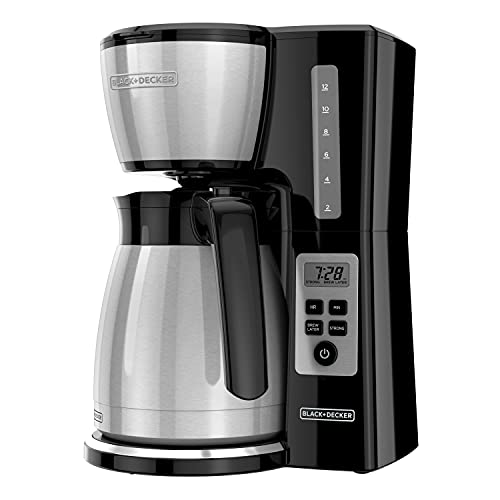
BLACK+DECKER 12 Cup Thermal Programmable Coffee Maker (CM2046S)
Badge: Best for Even Extraction
Strengths
- VORTEX Technology showerhead saturates grounds evenly, so the carafe holds a uniform pot.
- 12-cup thermal carafe sized for family pots.
- Brew Strength control and programmability.
Trade-offs
- No visible coffee level through the thermal walls.
- Thermal pouring is slower than glass, especially near the end of the pot.
- No dedicated small-batch setting is published.
Mini spec box
- Capacity: 12 cup
- Carafe: Thermal
- Controls: Programmable, Brew Strength control
- Showerhead: VORTEX Technology
- Finish: Black/Steel
- Model: CM2046S
A thermal carafe preserves what it receives, which makes the brewer’s evenness a thermal issue: a pot that brewed unevenly — strong at the bottom, thin at the top — drifts further apart as it sits, while a uniform pot stays itself for hours. The CM2046S is built for the uniform kind. Its VORTEX showerhead spreads water across the whole grounds bed, the 12-cup thermal carafe then holds the result at family scale, and brew strength control lets the household tune the recipe the carafe will keep. Programmable timing means the pot it preserves is a fresh one. For a family kitchen, that is the thermal package whole: even in, insulated after, right at the last cup.
The standard thermal trade-offs apply — a hidden level, a patient pour, a preheat habit on cold mornings — and there is no published small-batch mode for the household that usually brews four cups. Those households should compare the guide’s other thermal picks by routine rather than by capacity headline. As the family-size thermal machine with an extraction system worthy of its vessel, the CM2046S earns its place near the top of this category.
Best for: families brewing full, even pots that must hold for hours / Not suited for: small-batch households and level-watchers

Cuisinart PerfecTemp 12-Cup Thermal Drip Coffee Maker (DCC-3400NAS)
Badge: Best Brewing System
Strengths
- Double-wall stainless steel thermal carafe — the most durable and best-insulating vessel construction here.
- PerfecTemp hotter brewing gives the carafe a fully extracted pot to defend.
- Brew Strength control, in a premium silver finish.
Trade-offs
- Premium tier within this group.
- Stainless walls hide the coffee level completely.
- Silver finish shows splashes and fingerprints.
Mini spec box
- Capacity: 12-cup
- Carafe: Double-wall stainless steel thermal
- Brewing system: PerfecTemp hotter brewing
- Controls: Brew Strength control
- Finish: Silver
- Model: DCC-3400NAS
The PerfecTemp is this category’s premium sentence, in two clauses. Clause one: a double-wall stainless steel thermal carafe, the construction that insulates best and survives longest, immune to the sink knock that ends glass and indifferent to the dents that would worry lesser vessels. Clause two: PerfecTemp brewing, a system designed around hotter extraction, so the coffee sealed inside that carafe was worth sealing. Either clause alone would place the machine in this guide; together they make it the benchmark pairing of brewer and vessel, the one against which thermal shoppers should measure value at every tier below it.
The costs are tier and the usual thermal courtesies — a level judged by cups poured, a finish that asks for a wipe, a preheat habit for the carafe’s best work. Households for whom those are easy agreements get the strongest machine in this list. Households weighing dual-format machines instead — drip plus a second system — are shopping a different shelf, surveyed in Best Dual Brew Coffee Makers and its espresso-leaning cousin Best Dual Coffee Espresso Coffee Makers; within the thermal brief, the PerfecTemp is the ceiling.
Best for: buyers who want the best brewer-and-carafe pairing in the category / Not suited for: the tightest budgets and level-watchers
Comparison Table
| Model | Capacity | Carafe | Heat strategy | Standout feature | Link |
|---|---|---|---|---|---|
| KRUPS Thermal Carafe | 12-cup | Double-wall thermal | Insulation only — no plate | Keeps coffee hot for hours, 3 strengths | Check on Amazon |
| Cuisinart Thermal Classic | 10-cup | Thermal | Right-sized insulation | Compact proven format | Check on Amazon |
| SECPOEDR Grind and Brew | 10-cup | Keep-warm design — not thermal | 2-hour keep warm window | Built-in grinder | Prose-only benchmark |
| Gevi Grind & Brew | 10-cup | Glass — not thermal | 90-min warm plate | Grinder, touch screen, reusable filter | Prose-only benchmark |
| BLACK+DECKER CM2046S | 12 cup | Thermal | Insulation | VORTEX even saturation | Check on Amazon |
| Cuisinart PerfecTemp DCC-3400NAS | 12-cup | Double-wall stainless thermal | Insulation plus hotter brewing | PerfecTemp system | Check on Amazon |
How to Choose a Drip Coffee Maker With a Thermal Carafe
Verify the vessel first, in the listing’s own words. A thermal carafe should be described as thermal — ideally double-wall — and the machine should not lean on a warming plate to do the carafe’s job. The KRUPS in this guide is the model citizen: double-wall construction, a stated holding expectation, and no plate at all. Treat keep-warm functions and warm plates as what they are — different technologies with shorter, cooking-based windows — however good the machines carrying them may be on other merits, as the two benchmarks here honestly are.
Second, interrogate the lid and the seal, because the top is where thermal carafes win or lose. Heat escapes upward; a lid that seals fully, pours without being removed, and closes decisively protects more temperature than any wall specification. Owner feedback is your evidence — lid and seal comments are the most reliable holding-performance data in the category — and a model whose owners praise the second and third hours has passed the only test that matters. Third, size the vessel to the batch, because insulation is batch-sensitive: a full carafe’s coffee mass holds heat for the walls, while a half-empty one surrenders it to headspace air. The 10-cup Classic exists for households whose real pot is ten cups; forcing them into a 12-cup vessel would make their thermal performance worse, not their capacity better.
Fourth, choose the brewer as a brewer. The carafe preserves; it does not improve. PerfecTemp’s hotter brewing and the CM2046S’s even saturation are in this guide because a thermal pot deserves a properly extracted fill, and strength control matters because the pot you tune is the pot you will be drinking at hour three. Finally, confirm the replacement path before you need it: thermal carafes are durable, especially in stainless, but lids and seals are wear parts, and a brand whose carafe components stay findable — as with the established names linked here — turns year-three maintenance into an errand instead of a replacement. The alternate phrasing of this same search, Best Drop Coffee Makers, ranks the wider drip field for readers still deciding whether thermal is their filter at all.
How to Brew, Serve, and Care for a Thermal Carafe
Preheat, every time it matters. Rinse the thermal carafe with hot tap water, let it stand full for a minute, empty, and brew. Cold walls — steel above all — drink the first pot’s heat, and preheating returns it. The habit matters most for small batches and cold kitchens, and it is the difference between a carafe’s advertised holding and its actual holding.
Serve like insulation is listening. Close the lid fully between pours; most heat leaves at the top. Swirl the pot gently before the first pour so strength is even. Take the carafe to the table rather than leaving cups to travel — a stainless thermal carafe is built for the table, needs no trivet anxiety, and keeps the conversation’s coffee at temperature without a plate in sight. Brew the batch the occasion will drink: a right-sized pot holds better and wastes nothing.
Clean for flavour, inspect for heat. Wash the carafe daily with hot soapy water and a bottle brush, soak weekly against oil film, and clean the lid and spout where old coffee hides — held coffee sits in contact with the carafe for hours, so a seasoned carafe seasons the whole pot. Inspect the lid seal whenever holding seems to fade; a tired seal is the most common cause and the cheapest fix in the category. Descale the brewer on schedule, because scale lowers the temperature of the water the carafe is asked to hold.
Troubleshooting.
- Problem: coffee cools faster than the carafe’s reputation suggests → preheat thoroughly, close the lid between pours, brew a fuller batch, and check the lid seal; one of those four is almost always the cause.
- Problem: the last cups taste stale while the first were fine → deep-clean the carafe and lid; oil film punishes held coffee more than fresh, because contact time is the multiplier.
- Problem: the carafe dribbles at the table → clean the spout and rim, pour decisively rather than tentatively, and inspect the lid’s pour mechanism for residue build-up.
Anatomy of a Thermal Carafe: Walls, Lid, Seal, Spout
The wall is the famous part: two layers with an insulating gap that slows conduction, in stainless steel at the durable end of the category. But a thermal carafe is a system of four parts, and the other three decide as much. The lid is the thermal gatekeeper — it caps the opening where heat most wants to leave, and its design decides whether pouring requires opening the vessel to the room or merely tilting it past a sealed spout. The seal is the lid’s working edge, a wear part whose slow tiredness is the most common reason a good carafe’s holding fades in year two or three; it is also, mercifully, the cheapest component to renew. The spout is the daily experience — the difference between a clean cut-off and a chronic dribble, measured in thousands of pours.
Understanding the anatomy changes how you shop and how you maintain. Shopping, it tells you to weight owner comments about lids, seals, and pours as heavily as the wall specification, because the wall is the part least likely to fail you. Maintaining, it tells you where the performance lives: keep the seal supple and clean, keep the spout clear, close the lid like it matters — because thermally, it is the whole game. A thermal carafe is not a jug with insulation; it is a small, well-sealed thermos that coffee is brewed into, and treating it with a thermos’s respect is what unlocks the hours this category promises.
How to Read Holding Claims Without Being Fooled
Holding claims are the softest numbers in coffee, because there is no single standard test behind them: one maker’s “keeps hot for hours” may be measured on a full carafe in a warm room, another’s on the same carafe preheated, and neither is lying — they are simply reporting different mornings. The KRUPS listing in this guide is comparatively forthright, tying its double-wall carafe to a stated duration and the absence of a warming plate, and forthrightness itself is a signal worth rewarding. As a reader, translate every claim through your own conditions before comparing: your batch size, your kitchen’s temperature, your preheating discipline, and how often the lid opens. A carafe claimed at four hours, used at half batch in a cold kitchen with an active lid, may deliver two excellent hours — which may still be the best performance in its class, because every rival’s claim deflates by the same physics.
The reliable evidence, as throughout this guide, is patterned owner experience at the hours you care about. Search feedback for the specific hour — the second, the third — and for the conditions around it: full pot or small, preheated or not, grazed or poured once. Owners who describe a routine like yours are running your experiment for you. What you should never do is compare a maker’s best-case claim against another maker’s owner-reported worst case and call the difference a verdict; that asymmetry manufactures conclusions the products did not earn. Thermal performance is real, measurable in the cup, and honestly different between the constructions in this guide — double-wall over single-wall, sealed over open, full over partial — and those structural differences, unlike any single number, will still be true on your counter.
Serving From a Thermal Carafe: The Table Ritual
Something changes in a household when the pot can leave the machine. Coffee stops being a counter activity — individuals refilling at the source, the pot stewing or chilling where it was born — and becomes a table activity: the carafe in the middle, the conversation around it, refills poured without anyone leaving the room. Stainless thermal carafes, like the PerfecTemp’s in this guide, are built for exactly that migration: they need no trivet anxiety, they pour at the table without a cord, and they hold the coffee’s temperature through the length of a real breakfast rather than the length of a kitchen visit. Hosts notice a second effect: a carafe on the table ends the host’s refill labour, because guests can serve themselves from a pot that is still worth serving. It is a small domestic upgrade with an outsized effect on how a morning feels.
The ritual has its own small disciplines, and they are the same ones this guide teaches everywhere: preheat the carafe before the guests sit down, brew the batch the table will drink, close the lid between pours, and bring the carafe to the table full rather than topping it from a second source. A thermal carafe also forgives the host’s timing — the pot brewed when the cook was ready waits gracefully for when the table is — which is why brunch, the most timing-chaotic meal in the home repertoire, is the thermal carafe’s finest hour. Machines that keep their pots on plates can make fine coffee; they cannot make this morning. For households whose coffee life is social, that difference alone can justify the category.
Lids and Seals as a System: The Year-Two Maintenance That Matters
Ask owners of older thermal machines where the performance went, and the honest ones point at the top. The walls of a double-wall carafe do not tire; stainless and insulation have no moving parts and no fatigue curve worth naming. The lid assembly is another story: its seal flexes at every pour, meets coffee oils and heat daily, and slowly — over a year or two of family service — loses the perfect compliance that made the carafe airtight at its best. The symptom is always described the same way: the carafe “doesn’t hold like it used to.” The diagnosis is almost never the carafe. It is a seal that has taken a set, a lid mechanism furred with old coffee, or a spout gasket that no longer seats.
The maintenance response is correspondingly cheap and specific. Clean the lid assembly as a component, not as an afterthought — soak it, work its mechanism, clear the pour channel where old coffee varnishes the seal’s seat. Inspect the seal itself for flattening, cracking, or a permanent curve, and replace it — or the lid — when it shows them; for the established brands in this guide those parts remain findable, which is a selection criterion this guide applied before it was a maintenance tip. Households that perform this small annual ritual routinely report their thermal carafes holding at year three the way they held in month three. The lesson generalises beyond this category: in well-built kitchen equipment, performance rarely dies; it leaks, at the seals, and leaks can be fixed.
Thermal Carafes in Shared Spaces: Offices, Studios, and the Communal Pot
Although this guide is written for homes, the thermal carafe’s virtues compound in shared spaces, and many of these machines will live their lives in small offices, studios, salons, and workshop kitchens where the communal pot faces its hardest test: brewed by one person, drunk by many, over hours, with nobody owning the routine. A warming plate fails that test publicly — the last arrival gets the stewed remainder and judges the whole office by it. A thermal carafe passes it quietly: the pot brewed at nine is still itself at eleven, the carafe travels to a meeting table without a cord, and the machine’s counter footprint stays a machine, not a machine plus a plate plus a negotiation. The KRUPS’s plate-free design and the PerfecTemp’s stainless durability are the two picks whose briefs translate most directly to shared duty, while the Cuisinart Classic’s right-sized ten cups suit the small team’s real volume better than a cavernous pot brewed hopefully each morning.
Shared spaces add one discipline the home can sometimes skip: the named owner. A communal thermal carafe with no owner accumulates everyone’s coffee and nobody’s washing, and its holding performance will be blamed for what is actually a hygiene backlog. The fix is the same one this guide prescribes to households — a person, a calendar, a descaling rhythm — applied at office scale. Given that single act of organisation, a thermal machine in a shared space is among the highest-value appliances a small team can own, precisely because its benefits are distributed across everyone’s second cup.
Why “Thermal” and “Insulated” Are the Same Promise
Readers comparing across guides will meet both words — thermal carafe here, insulated carafe elsewhere — and should know they name the same construction and the same promise: a vessel that holds temperature by slowing heat loss rather than by adding heat. Manufacturers choose the word their market research prefers; the physics does not change with the label. What should change your decision is never the adjective but the specifics beneath it — double-wall or single, a stated holding expectation or silence, a plate underneath or none. This guide has used “thermal” because the search that brought you here used it, and it has ranked by construction throughout, so its conclusions transfer intact to any guide using the other word: the KRUPS is the purist’s pick under either label, the PerfecTemp the premium pairing, the Classic the right-sized one, and the two prose-only benchmarks remain what they are under any adjective — fine machines whose vessels belong to a different technology.
A Last Word Before You Choose
The thermal carafe is a modest technology with an immodest effect: it returns time to the coffee drinker. A pot that stays right for hours stops organising the morning around itself — nobody hurries a cup, nobody reheats one, nobody apologises for the last pour. The four linked picks in this guide deliver that effect at different sizes and tiers, and the two benchmarks mark, honestly, where the category’s boundary lies. Choose the vessel your routine deserves, maintain its seal, preheat its walls, and the morning becomes yours again.
Common Buying Mistakes
- Accepting “keep warm” as a synonym for thermal. A warming window is a heater on a timer; a thermal carafe is insulation. They are different technologies with different flavour outcomes.
- Judging by the first pour. Every carafe pours a hot first cup. The thermal test is hour two and three — read feedback for those hours specifically.
- Skipping the preheat. Cold steel walls tax the first pot before it is poured. One minute of hot water is the category’s cheapest upgrade.
- Leaving the lid open between pours. The top is the leak. The best double wall cannot defend an open vessel.
- Oversizing the carafe. A half-empty thermal carafe underperforms a full smaller one. Match vessel to batch.
- Ignoring the seal at year two. Fading holding is usually a tired lid seal — a small part, not a dead carafe.
Final Recommendation
For most shoppers, the best drip coffee maker with thermal carafe in this group is the KRUPS — double-wall insulation, hours of plate-free holding, and a real strength menu: Check on Amazon. Buyers who want the strongest brewer-and-vessel pairing should take the Cuisinart PerfecTemp — Check on Amazon — families the even-extracting BLACK+DECKER CM2046S, and small households the right-sized Cuisinart Thermal Classic. If your heart is set on a grinder, the two benchmarks are fine machines for their own searches — just do not buy either believing it is a thermal carafe. Preheat the vessel, close the lid, size the batch honestly, and the pot will keep its promise.
Related guides
Frequently Asked Questions
What makes a carafe “thermal”?
Insulated construction — typically double walls with an insulating gap — that slows heat loss without adding heat. A thermal carafe is defined by that construction, not by a warming feature: keep-warm functions and warm plates are heating strategies, and this guide treats them as different technologies, which is why two assigned machines here are prose-only benchmarks.
How long does a thermal carafe keep coffee hot?
Hours, depending on construction, batch size, and habits. The KRUPS in this guide is described by its maker as keeping coffee hot for up to 4 hours in its double-wall carafe. A full, preheated carafe with a closed lid sits at the top of any model’s range; a small batch in a cold carafe sits at the bottom.
Is a thermal carafe better than a warming plate?
For flavour over time, decisively. A plate holds temperature by cooking the coffee, which stews it bitter; a thermal carafe holds temperature by insulation, so the coffee coasts down gently and tastes like itself. Plates suit only pots finished very quickly.
Why are two machines in this guide not linked?
Because their listings do not describe thermal carafes — one is a keep-warm grind-and-brew design, the other a glass carafe on a warm plate. They are reviewed in full as benchmarks so you can judge their real merits, but linking them under a thermal headline would misdescribe them.
Should I choose a 10-cup or 12-cup thermal carafe?
The one your routine fills. Insulation performs best on a reasonably full vessel, so a two-to-four-drinker household usually gets better holding from a 10-cup carafe, while larger households should take the full 12 cups and brew a second pot for gatherings.
How do I care for a thermal carafe?
Wash it daily with hot soapy water and a bottle brush, soak weekly against oil film, clean the lid and spout regularly, and inspect the lid seal if holding fades. Preheat it before brewing and close the lid between pours — care and habits together decide the carafe’s real performance.
Can a thermal carafe be replaced if it is damaged?
For the established brands linked in this guide, model-specific replacement carafes and lids remain findable — one of the reasons they were chosen. Confirm the exact model match before ordering, and check whether only the lid or seal needs replacing before buying a whole vessel.


