Disclosure: topratedkitchenware.com is reader-supported. When you buy through links on our site, we may earn an affiliate commission from Amazon and other retailers, at no extra cost to you.
Where to buy
Shoppers hunting for the best economy coffee makers usually mean two things at once: a machine that sits in the lower tier at purchase, and a routine that does not quietly charge them for the privilege every single morning. This guide scores both. All six verified picks are single-serve machines from the accessible end of the market, and the reviews pay as much attention to what goes into them — pods, grounds, or both — as to the machines themselves, because the input drawer is where an economy brewer either stays economical or stops being one. Every pick is sold on Amazon; for each one, check the latest price on Amazon rather than trusting any number printed in an article, including this one. Read the full guide ↓
- Keurig K-Express (Mint)
- Hamilton Beach FlexBrew Advanced 4-in-1 Single Serve Coffee Maker
- Ninja Single Serve Coffee Maker (PB051)
- Keurig K-Elite (Brushed Silver)
- Keurig K-Express (Black)
- Keurig K-Express (Warm Stone)
Start with the arithmetic nobody puts on the box. A coffee maker’s purchase price is a single event; its consumables are a subscription you sign without noticing. A pod routine commits you to buying coffee in its most packaged, most portioned form, one small sealed cup at a time, for as long as you own the machine. A grounds routine buys coffee in a bag, in bulk, at the lowest cost per cup the market offers. Two households can own machines from the same price tier and end up with completely different yearly coffee bills based on that one difference — which is why this guide keeps returning to the question of what each machine can brew from, and why the two dual-input machines in the list carry such weight in the rankings.
The second economy is time and waste. A single-serve machine brews the cup you are about to drink and stops; nothing sits on a warmer being kept hot and then poured away at noon. For a one- or two-person household, that alone can halve the coffee thrown out compared with a full pot habit, and thrown-away coffee is money quite literally down the drain. The third economy is longevity: a simple machine, descaled on schedule and cleaned weekly, can serve for years, and every extra year divides the purchase cost thinner. Economy, in other words, is a system — machine, input, habit — and the picks below are ranked as systems, not as sticker prices. Readers whose kitchens run larger households should sanity-check the format against our guide to Best Eight Cup Coffee Makers before committing to single-serve at all.
A word about the shape of the list itself, because honesty about the pool is part of economy shopping. Three of the six picks are the same Keurig K-Express design in three finishes — Mint, Black, and Warm Stone. They were verified as separate listings, and we review them as separate entries, but we will tell you plainly where you are paying for a colour and where you are paying for a machine. One pick, the K-Elite, leans premium against the spirit of the keyword; it is included because the pool verified it, and its review explains exactly who should stretch for it and who should not. That kind of candour is what an economy guide owes you.
Key Takeaways
- The machine is the small cost; the consumable is the big one. Grounds-capable machines protect an economy purchase from an expensive routine.
- Two picks — the Hamilton Beach FlexBrew and the Ninja PB051 — brew grounds as well as pods, and they are the strongest long-run economy plays in the pool.
- Three picks are one design, the Keurig K-Express, in Mint, Black, and Warm Stone finishes; choose the finish by your kitchen, not by imagined performance differences.
- The K-Elite is the step-up pick: buy it for its place at the top of Keurig’s single-serve line, not as a budget choice, because it is not one.
- Single-serve brewing is itself an economy feature for small households: brew what you drink, pour nothing away, run no warming plate.
- Descaling on schedule is the cheapest feature in this guide — it is what turns a lower-tier machine into a many-year machine.
In this guide
Quick Picks
| Pick | Badge | Why it is here | Link |
|---|---|---|---|
| Keurig K-Express (Mint) | Best Overall | The balanced K-Express package — 42 oz reservoir, three brew sizes, Strong Brew — in a Mint finish. | Check on Amazon |
| Hamilton Beach FlexBrew Advanced 4-in-1 | Most Versatile | Pod packs or grounds, hot or iced, 45 oz reservoir — the economy of never needing a second machine. | Check on Amazon |
| Ninja Single Serve Coffee Maker (PB051) | Best for Big Cups and Brew Styles | Pods and grounds, four brew styles, up to 24 oz cups, and the biggest reservoir here at 56 oz. | Check on Amazon |
| Keurig K-Elite (Brushed Silver) | Best Step-Up Pick | The premium end of this list; buy it deliberately, for the long term, not as an economy pick. | Check on Amazon |
| Keurig K-Express (Black) | Best Reservoir Pick | The same proven K-Express design in Black, with the 42 oz removable reservoir and Strong Brew button. | Check on Amazon |
| Keurig K-Express (Warm Stone) | Best Style Pick | The K-Express in a warm neutral finish that disappears into calm, light kitchens. | Check on Amazon |
Read the Quick Picks table as a map, not a verdict. If your household is one person with one mug, the differences between these machines are small and the cheapest route through the list is fine. If your household is a mixture of pod drinkers, grounds drinkers, iced-coffee drinkers, and travel-mug carriers, the versatile machines repay their slightly higher tier every week by replacing purchases you would otherwise make separately.
How These Picks Were Chosen
This guide is research-led. The six machines come from the verified pick pool for this group, checked against Amazon’s Creators API on 2026-11-20, with titles, ASINs, and images recorded in the accompanying sources file. Every specification in the reviews is drawn from those verified titles only; where a listing does not state a feature, we do not claim it, and where the pool contains the same design in several finishes, we say so instead of manufacturing differences.
Economy scoring used four lenses. The first is tier position, judged qualitatively: where does this machine sit within its maker’s line and its format class — entry, mid, or premium-leaning? We deliberately print no prices, because prices move constantly and an economy guide built on stale numbers misleads within weeks; the tier judgement is the durable part. The second lens is input economics: pods only, or grounds as well? A grounds path is the strongest single predictor of a low cost per cup over years of ownership. The third lens is waste: does the machine brew realistic single servings, with sizes that let a household make what it will finish? The fourth is service life signals — simple operation, removable reservoirs that can be emptied and dried, parts that are easy to keep clean — because the cheapest machine is the one you do not replace.
Two honesty notes follow from that method. First, no pick was excluded for being premium-leaning, but the K-Elite’s review carries the warning its tier deserves. Second, economy is partly a household variable: a pod-only machine can still be the economical choice for a genuinely occasional drinker, for whom a bag of grounds would stale before it was finished. The reviews try to name the household each machine is economical for, rather than crowning one winner for everyone. Shoppers cross-shopping formats entirely will find a useful contrast in our guide to Best Electric Coffee Makers, which ranks the broader electric class without the budget lens.
The 6 Best Economy Coffee Makers

Keurig K-Express (Mint)
Badge: Best Overall
Strengths
- 42 oz removable reservoir — a family morning between refills
- Three brew sizes plus a Strong Brew button for control without cost
- Travel mug friendly, so the café stop disappears from the budget
Trade-offs
- Pod-only in its verified listing, so the input drawer is the expensive kind
- Same machine as the Black and Warm Stone entries — the finish is the difference
- No iced or grounds mode stated in the listing
Mini spec box
- Format: single serve K-Cup pod coffee maker
- Brew sizes: 3 brew sizes
- Reservoir: 42 oz, removable
- Extras: Strong Brew button, travel mug friendly, works with all K-Cup pods
- Colour in listing: Mint
The K-Express takes Best Overall in an economy guide not because it is the cheapest object in the pool — tier claims without prices would be guesswork — but because it is the most complete version of the basic economy proposition: a simple, single-serve Keurig with a real reservoir, three brew sizes, and a Strong Brew button, in the accessible part of its maker’s range. The 42 oz removable reservoir is the feature that does the daily work. It turns four staggered morning cups into a fill-once routine, it lifts out to be emptied and dried instead of growing stale water, and it removes the per-cup filling ritual that makes reservoir-free minis feel cheap in the wrong sense.
The economy case for the machine itself is straightforward: it replaces the café stop. Travel mug friendly clearance means the morning cup goes straight into the mug that leaves the house, and even a few replaced café coffees a week is the fastest payback any appliance in this guide can offer. The Strong Brew button matters here too, in a subtle way: it extracts more flavour from a standard brew size, which is the free alternative to brewing a larger cup you did not want just to get strength.
The honest limitation is the input. The verified listing is pod-only, and pods are the premium way to buy coffee, portion by portion. An economy buyer choosing this machine should do so with eyes open: the machine tier is friendly, the routine tier is not, and the way to keep the routine in check is volume discipline — pods bought in larger packs, and no second machine habit forming around it. If the input question is your deciding factor, the next two picks answer it directly.
Best for: pod-loyal households wanting the balanced, reservoir-equipped Keurig at the accessible end of the line / Not suited for: buyers whose economy priority is the lowest possible cost per cup

Hamilton Beach FlexBrew Advanced 4-in-1 Single Serve Coffee Maker
Badge: Most Versatile
Strengths
- Brews pod packs or grounds — the grounds path is the cheapest cup in this guide
- Hot and iced in one machine; no second purchase for summer
- Removable 45 oz reservoir feeds the whole household routine
Trade-offs
- Versatility means modes to learn; a one-button purist may never use half of it
- Larger counter presence than the mini machines in this list
- The pod path remains available, so the saving still depends on habit
Mini spec box
- Format: 4-in-1 single serve coffee maker
- Inputs: pod packs and grounds
- Modes: hot and iced coffee
- Reservoir: 45 oz, removable
- Brewing: fast brewing, per listing
- Colour in listing: Black
If economy is a system rather than a sticker, the FlexBrew Advanced is the best system in this pool. Its verified listing covers pod packs and grounds, hot and iced coffee, and a removable 45 oz reservoir — four combinations that in most kitchens would otherwise mean two machines and two sets of consumables. The grounds path is the headline: it lets the household default to bagged coffee, the lowest cost per cup available, while keeping pods as an option for guests, for variety packs someone was given, or for the one flavour a household member insists on. An economy machine that can say yes to both is an economy machine that never gets supplemented.
The iced mode deserves its economy credit too. Iced coffee at home is where café spending leaks worst in summer, because the drink feels like a treat rather than a staple. A machine that makes it from the same reservoir and the same bag of grounds closes that leak without a second appliance on the counter or a second product in the cupboard. Fast brewing, per the listing, supports the other half of the equation: a home routine that is slower than the café queue is a home routine that gets abandoned.
The trade-offs are real but mild. It is a bigger, busier machine than the minis here, and a household that will only ever brew one kind of cup is paying for flexibility it will not use — that household should buy simpler and bank the difference. And the pod drawer remains a temptation: the saving this machine offers is genuine but it is earned daily, at the moment of choosing grounds. For mixed households, though, nothing else in the pool protects the budget from as many directions at once.
Best for: mixed households that want one machine to end all the other coffee purchases / Not suited for: single-habit drinkers who would be paying for unused modes

Ninja Single Serve Coffee Maker (PB051)
Badge: Best for Big Cups and Brew Styles
Strengths
- Pods and grounds in one machine, with four styles of brewing
- Brews up to 24 oz cup sizes — the travel-mug and big-mug champion here
- 56 oz removable reservoir, the largest in this guide
Trade-offs
- The most feature-rich machine here, and feature-rich usually means a higher tier
- Big-cup brewing can waste coffee if the household’s mugs are small
- More settings to learn than a basic single-serve brewer
Mini spec box
- Format: single serve combo machine, K-Cup pods and grounds
- Brew styles: 4 styles of brewing
- Cup sizes: up to 24 oz
- Reservoir: 56 oz, removable
- Model: PB051
- Colour in listing: Black
The Ninja PB051 is the pick for the household whose economy problem is scale. Its verified listing combines K-Cup pods and grounds, four styles of brewing, cup sizes up to 24 oz, and a 56 oz removable reservoir — the largest tank in this guide. That combination attacks a specific kind of waste: the big-mug drinker who otherwise brews twice, or runs two pods through, to fill one travel mug. One brew at the right size, from grounds if you want the cheapest version of it, replaces both habits. For commuters filling a tall mug at dawn, that is a daily saving measured in pods and in minutes.
The four brew styles give the machine a second economy: range without replacement. A brewer that can vary its style is a brewer that survives a household’s changing tastes — the year someone switches to stronger coffee, the summer someone wants it over ice-style concentration — without a new purchase appearing on the card. Combined with the dual input, the PB051 is the most future-proofed economy buy in the pool: whatever the household drinks next year, this machine probably brews it.
Honesty requires the tier warning. Feature-rich machines sit higher in their lines, and this is not the lowest-tier object in the guide; a strict minimalist budget is better served by the K-Express or, for grounds drinkers, by keeping the routine simple. The PB051 earns its place on value density — cost spread across inputs, styles, sizes, and years — rather than on cheapness. Buy it as the one machine a varied household will not outgrow, and it is an economy pick; buy it for one small daily cup and it is over-specified.
Best for: big-mug drinkers and varied households who want one machine for years / Not suited for: minimalist budgets brewing one small cup a day

Keurig K-Elite (Brushed Silver)
Badge: Best Step-Up Pick
Strengths
- The flagship-feel Keurig single-serve in a brushed silver finish
- A buy-it-for-years proposition at the top of this list’s quality ladder
- Full K-Cup compatibility, per its format
Trade-offs
- Premium-leaning tier — the least economy machine in this guide, plainly stated
- Pod-only format, so the routine cost is the premium kind
- Its listing in the pool is brief; we claim no features beyond it
Mini spec box
- Format: single serve K-Cup pod coffee maker
- Brand line: Keurig K-Elite
- Finish in listing: Brushed Silver
Every economy guide should include one honest step-up option, clearly labelled, for the reader whose budget can stretch and whose priority is not replacing the machine for a long time. The K-Elite is that option here. It sits at the premium end of Keurig’s single-serve line, its verified listing is a brief one — a single serve K-Cup pod coffee maker in brushed silver — and we will not pad that listing with features it does not state. What can be said on the evidence is positional: within this pool, it is the machine bought for finish, presence, and top-of-line status, and its economy argument is entirely about longevity. A machine bought once and kept for many years can cost less per year than a cheaper machine replaced twice — but only if the keeper part actually happens.
Who should stretch for it? A committed pod household that has already decided the pod routine is worth its running cost, uses the machine several times a day, and wants the version of that routine that feels best to live with. For that household, the step-up is a rational allocation: the daily experience is the product. Who should not? Anyone whose search for an economy coffee maker is driven by a tight monthly budget — for that reader, the K-Elite’s tier and its pod-only routine pull in exactly the wrong direction, and the FlexBrew or the K-Express will serve the actual goal better for less commitment.
We include the K-Elite because the pool verified it and because pretending the premium option does not exist would make the guide less useful, not more honest. But its badge says step-up, not budget, and a reader who buys it should do so as a deliberate upgrade, eyes open, not as a bargain that slipped into the list.
Best for: committed pod households buying once, for the long term / Not suited for: tight budgets — this is the step-up, not the saving

Keurig K-Express (Black)
Badge: Best Reservoir Pick
Strengths
- 42 oz removable reservoir and three brew sizes
- Strong Brew button for strength without a larger, wasteful cup
- Black finish is the most forgiving of coffee splashes and kitchen wear
Trade-offs
- Identical machine to the Mint and Warm Stone entries — finish only
- Pod-only in its verified listing, with the running cost that implies
- No grounds or iced mode stated in the listing
Mini spec box
- Format: single serve K-Cup pod coffee maker
- Brew sizes: 3 brew sizes
- Reservoir: 42 oz, removable
- Extras: Strong Brew button, travel mug friendly, works with all K-Cup pods
- Colour in listing: Black
The Black K-Express is the same verified machine as the Mint one that leads this guide — same 42 oz removable reservoir, same three brew sizes, same Strong Brew button, same travel mug friendly design, same compatibility with all K-Cup pods. Its separate entry exists because the pool verified it separately, and its badge differs for a practical reason: black is the finish that hides a working kitchen. Coffee splashes, water marks, and the faint scuffs of daily use disappear against it, and a machine that still looks decent in year three is a machine nobody is tempted to replace in year three. In an economy guide, looking after the thing you bought is a financial strategy.
On the merits, everything in the Mint review applies: the reservoir turns staggered cups into a fill-once routine and lifts out for proper emptying and drying; the brew sizes keep portions honest; the Strong Brew button buys strength without volume. If anything, the Black version is the default recommendation of the three finishes for a hard-working family kitchen, a rental, or an office corner — anywhere the machine will be used by many hands and cleaned by whoever gets to it first.
The limitation is shared with its siblings and stated without varnish: pod-only. The routine cost is the premium kind, and the economy of this machine lives in its tier, its durability of appearance, and its replacement of café purchases — not in its input drawer. Households for whom cost per cup is the deciding metric should look at the two dual-input machines above, which is exactly the kind of trade-off comparison our guide to Best Electric Bonavita Coffee Makers cannot offer, since that brand’s drip format is a different economy again.
Best for: busy shared kitchens that want the reservoir Keurig in its most practical finish / Not suited for: grounds drinkers chasing the lowest cost per cup
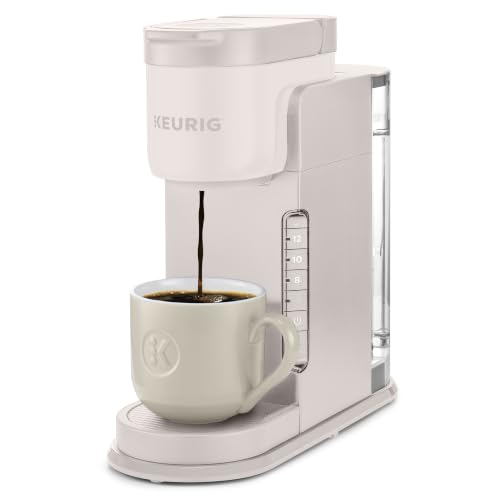
Keurig K-Express (Warm Stone)
Badge: Best Style Pick
Strengths
- Full K-Express specification: 42 oz reservoir, three brew sizes, Strong Brew
- Warm Stone finish suits light, warm-toned kitchens where black looks harsh
- Travel mug friendly, like its sibling finishes
Trade-offs
- Finish-only difference from the Mint and Black entries
- Light finishes show coffee splashes more readily — a small upkeep cost
- Pod-only in its verified listing
Mini spec box
- Format: single serve K-Cup pod coffee maker
- Brew sizes: 3 brew sizes
- Reservoir: 42 oz, removable
- Extras: Strong Brew button, travel mug friendly, works with all K-Cup pods
- Colour in listing: Warm Stone
The third K-Express finish, Warm Stone, completes the set, and its review can be the shortest on specifications because they are by now familiar: this is the same machine, in a warm neutral tone aimed at kitchens built around pale wood, stone counters, and soft light. Why does an economy guide spend a pick on a colour? Because appliances live where they are put, and a machine that clashes with the room gets exiled to a cupboard, used less, and eventually replaced by something that “fits” — the most wasteful purchase cycle in the kitchen. Choosing the finish that belongs in your kitchen the first time is, genuinely, an economy decision.
The counterpoint is upkeep: light finishes show coffee splashes and drip marks that black hides, so the Warm Stone owner signs up for a wipe-down habit the Black owner can skip. It is a small cost, paid in seconds, but it is the only functional difference between the three finishes and it deserves to be the deciding one alongside décor. On everything else — reservoir, brew sizes, Strong Brew, travel mug clearance, pod compatibility — the three entries in this guide are one machine, and any review that pretended otherwise would be selling you paint as engineering.
So the recommendation is simple. If you have decided the K-Express is your economy machine — pod routine accepted, reservoir valued — then choose among Mint, Black, and Warm Stone purely by kitchen and by temperament: Black for the hard-working shared counter, Warm Stone for the calm light kitchen and the owner who wipes as they go, Mint for a note of colour. The coffee will be identical; the satisfaction will not be.
Best for: style-led kitchens that have already chosen the K-Express on its merits / Not suited for: anyone expecting a different machine under the different finish
Comparison Table
| Pick | Inputs (verified) | Reservoir | Economy angle | Link |
|---|---|---|---|---|
| Keurig K-Express (Mint) | K-Cup pods | 42 oz, removable | Balanced tier, reservoir convenience | Check on Amazon |
| Hamilton Beach FlexBrew Advanced 4-in-1 | Pod packs or grounds | 45 oz, removable | Cheapest cup via grounds; replaces a second machine | Check on Amazon |
| Ninja PB051 | K-Cup pods and grounds | 56 oz, removable | Big cups in one brew; four styles, no outgrowing it | Check on Amazon |
| Keurig K-Elite | K-Cup pods | Not stated in listing | Step-up tier; economy only through long service | Check on Amazon |
| Keurig K-Express (Black) | K-Cup pods | 42 oz, removable | Practical finish that ages invisibly | Check on Amazon |
| Keurig K-Express (Warm Stone) | K-Cup pods | 42 oz, removable | The finish that fits, so it never gets replaced for looks | Check on Amazon |
How to Choose an Economy Coffee Maker
Choose on total cost of ownership, in three parts. Part one is the machine’s tier, judged qualitatively: entry designs like the K-Express ask the least commitment; versatile dual-input machines ask a little more and return it in flexibility; the step-up tier, represented here by the K-Elite, only makes sense amortised over many years. Part two is the input: price your routine, not your machine. A household brewing two cups a day spends far more on what goes into the brewer over three years than on the brewer, so a grounds path — FlexBrew, Ninja — is worth more than a small difference in machine tier. Part three is waste: brew sizes that match your mugs, a reservoir that suits your household’s rhythm, and no features you will pay for and never touch.
Household shape decides the format within those rules. One person, one mug: almost anything here works, and simplicity wins. A couple with staggered starts: a reservoir machine removes the refill friction that makes cheap machines feel cheap. A mixed household: dual input is not a luxury, it is the whole economy case, because the alternative is two machines and two consumable streams. A big-mug commuter: cup-size range, the Ninja’s up-to-24 oz, is the feature that stops double-brewing. And a household that regularly brews for a table of guests should question single-serve entirely — the batch formats explored in our guide to Best Electric Espresso Coffee Makers Home Use are a different purchase, but the honest economy move is buying the format that fits the life, once.
Finally, discount the features that do not touch cost. A finish is worth choosing carefully — it decides whether the machine lives on the counter — but it is not worth a tier jump. A brand’s premium badge is worth something only if you will keep the machine long enough to amortise it. And a mode you will use twice a year is worth almost nothing, however good it looks in a listing. Economy shopping is mostly the discipline of paying for the cup you drink every day and declining to pay for the cup you might drink someday.
One more test worth applying before you buy: the two-year question. Ask whether this exact machine, brewing this exact routine, still makes sense two years from now — same household, same mugs, same mornings. A machine that passes the two-year question at an entry tier beats a machine that fails it at any tier, because failure means a second purchase, and second purchases are where economy budgets actually die. Run the question honestly against the picks above: the dual-input machines pass it for the widest range of households, the K-Express passes it for settled pod households, and the step-up pick passes it only for households certain their routine will not change. If your answers keep shifting between two picks, choose the one whose routine is cheaper to run, since that is the cost you will pay every week rather than once.
How to Keep an Economy Coffee Maker Cheap to Own
The purchase is the beginning of the economy, not the end. Five habits keep a lower-tier machine performing like a long-term one. First, descale on schedule for your water: scale makes the element work harder, slows the brew, flattens the taste, and eventually kills machines that had years left in them — descaling solution is the cheapest insurance in the kitchen. Second, empty and dry the removable reservoir regularly instead of endlessly topping it up; fresh water tastes better and a dry tank discourages the slime that makes people replace machines in disgust. Third, rinse the pod holder or grounds basket weekly — coffee oils go rancid and make an economy machine taste like a neglected one. Fourth, brew the size you will finish; the cheapest cup is the one that is not poured away. Fifth, keep the manual’s cleaning routine somewhere you will actually see it, because a routine that depends on memory is a routine that lapses by March.
Troubleshooting, in problem-and-response form. Problem: the coffee has started tasting weak or bitter → check the routine before the machine: stale grounds, a dirty pod holder, or scale on the element are the usual causes, in that order; clean first, descale second, replace nothing yet. Problem: brews are getting slower and smaller → scale is narrowing the water path; run a full descaling cycle and then a plain-water rinse cycle before judging the result. Problem: one person’s cups taste fine and another’s do not → the household is probably splitting between pods and grounds at different freshness levels; date the bag of grounds when you open it, and treat month-old grounds, not the machine, as the suspect.
The Real Cost Per Cup: Pods Versus Grounds
Since this guide prints no prices, let us at least get the structure of the comparison right, because the structure is stable even as prices move. A pod bundles coffee, packaging, portioning, and convenience into a single small object, and you pay for all four in every cup. Grounds bundle only the coffee. The convenience in the pod is real — no measuring, no mess, a consistent portion — and for a low-volume drinker it can be worth its premium, because a bag of grounds bought for three cups a week may stale before it is finished, and stale grounds are waste wearing a cheaper disguise. But at household volume — two or more cups a day, every day — the structure reverses decisively: the per-cup premium is paid hundreds of times a year, and the dual-input machines in this guide exist precisely to let a household move its default volume onto grounds while keeping pods for the occasions that justify them. That is the single most valuable idea in this article, and it is why the FlexBrew and the Ninja outrank more basic machines on a long enough horizon. Readers curious how the same trade-off plays out in a pressure-brewed format can follow it into our guide to Best Electric Expresso Coffee Makers.
When the Cheapest Machine Is the Expensive One
A short warning section, because economy guides fail when they only praise cheapness. The cheapest machine is the expensive one when it is replaced early: bought without a reservoir for a household that needed one, bought pod-only by a household that drinks at grounds volume, bought in a finish that exiles it to a cupboard, bought too small for the travel mug it must fill every morning. Each of those mistakes converts a saving into a second purchase, and the second purchase is where the money actually goes. The defence is the unglamorous work in the How to Choose section above: name the household, name the routine, name the mug — then buy the machine that matches all three, at the lowest tier that genuinely does. That machine, kept for years and descaled on schedule, is the best economy coffee maker in the only sense that matters: the one you are still happily using when its cost per cup has fallen to nearly nothing. The manual formats in our guide to Best Electric French Press Coffee Makers make the same point from the opposite direction — the simplest tool, kept forever, is hard to beat on lifetime cost.
Common Buying Mistakes
The first mistake is shopping on machine price alone and ignoring the input drawer, then discovering the routine costs more than the saving. The second is the mirror image: paying a premium tier for a machine whose extra modes the household will never open. The third is buying three finishes’ worth of reviews as if they were three machines — in this pool the K-Express is one design, and your decision among its listings is a colour decision. The fourth is neglecting descaling until a lower-tier machine dies young and confirms a prejudice against lower-tier machines. The fifth is sizing by hope: buying a mini for a big-mug household, or a flagship for a one-cup drinker. Every one of these mistakes is a mismatch between the purchase and the routine, and every one is avoidable in the ten minutes it takes to describe your actual mornings honestly.
Final Recommendation
For most households, buy the Hamilton Beach FlexBrew Advanced 4-in-1: grounds for the cheap daily cup, pods when they earn their place, hot and iced from one reservoir — it is the economy system that covers the most life. If your household is pod-loyal and wants the balanced Keurig, the Keurig K-Express in whichever finish suits your kitchen is the sensible tier, with the reservoir and Strong Brew that make a basic machine feel complete. And if big mugs and changing tastes define your kitchen, stretch to the Ninja PB051 and let its size range and four brew styles carry the household for years. The K-Elite is a fine deliberate upgrade; it is simply not the answer to the question this guide’s title asks, and we would rather tell you that than sell it to you as one.
Frequently Asked Questions
What makes a coffee maker an economy pick?
Three things together: a lower or mid tier position at purchase, a routine that does not premium-price every cup, and a realistic service life of years rather than seasons. A machine can fail the economy test on any one of the three — a cheap machine with an expensive pod-only routine, or a versatile machine replaced early because it was the wrong size, both end up costing more than the picks that balance all three, which is how this guide ranked its six.
Are pods or grounds cheaper per cup?
Grounds, at any real household volume, because a pod charges you for packaging, portioning, and convenience in every single cup, while a bag of grounds charges only for coffee. The exception is the very occasional drinker, for whom a bag may stale before it is finished; that drinker’s waste can erase the grounds advantage, which is why dual-input machines like the FlexBrew and the Ninja are such a practical compromise — grounds for volume, pods for occasions.
Why does this guide list the same Keurig three times?
Because the verified pool contains the K-Express in three finishes — Mint, Black, and Warm Stone — as separate listings, and we review what the pool verified. They are the same machine: same 42 oz reservoir, three brew sizes, Strong Brew button, and travel mug clearance. The honest advice is to treat the three entries as one decision about the machine and a second, smaller decision about colour, upkeep, and how the finish fits your kitchen.
Is the K-Elite worth it in an economy guide?
Only as a deliberate step-up, and its review says so. It is the premium-leaning end of this list, pod-only, and bought for finish and top-of-line status. Its economy argument is longevity alone: bought once and kept for many years by a committed pod household, its cost per year can make sense. As a budget purchase it makes none, and readers on a tight budget should take the K-Express or a dual-input machine instead.
How long should an economy coffee maker last?
Years, if it is looked after — and looking after it is mostly descaling on schedule, keeping the reservoir fresh, and rinsing the parts that touch coffee. Most early deaths in this class are scale deaths or neglect deaths, not engineering deaths, which is why the How to Keep section of this guide matters more to your wallet than any single pick in it. A lower-tier machine maintained is a better economy buy than a premium machine neglected.
Does a reservoir matter for economy?
Indirectly, yes. A reservoir sized to your household — 42 to 56 oz across these picks — removes per-cup filling friction, and friction is what drives people back to café purchases. Removable reservoirs also empty and dry properly, which keeps water fresh and delays the stale-taste spiral that makes owners replace machines. It is not the headline feature, but it quietly protects the investment.
Should a small household buy a single-serve machine at all?
For one- and two-cup households, single-serve is usually the economy format: it brews what will be drunk, wastes nothing to a warming plate, and replaces café stops with travel-mug fills. The case weakens as the household grows or guests become frequent, because back-to-back single cups are slow and the consumables multiply — at that point a batch format deserves a serious look before you buy.


