Disclosure: topratedkitchenware.com is reader-supported. When you buy through links on our site, we may earn an affiliate commission from Amazon and other retailers, at no extra cost to you.
Where to buy
The best electric coffee makers share one defining trait: the machine itself heats the water and moves it through the coffee, start to finish, at the touch of a control — no stove, no separate kettle, no watching a pot. All six verified picks in this guide are exactly that kind of machine: plug-in, self-contained, single-serve electric brewers that take a kitchen from “I should make coffee” to a finished cup with one fill and one press. They differ in what they brew from — pods, grounds, or both — in how much water they hold, and in how much of the routine they automate, and those differences are what the rankings below are built on. Every pick is sold on Amazon; check the latest price on Amazon on the listing rather than relying on any figure printed elsewhere. Read the full guide ↓
- Elite Gourmet Single-Serve Coffee Maker (EHC111A)
- Keurig K-Mini Mate
- Tastyle Mini Single Serve Hot and Iced Coffee Maker (K310IC)
- Keurig K-Express (Evergreen)
- Keurig K-Express (Mint)
- Hamilton Beach FlexBrew Advanced 4-in-1 Single Serve Coffee Maker
It is worth pausing on why “electric” is a meaningful filter at all, because the alternatives are real and some people prefer them. A stovetop moka pot makes strong, characterful coffee but asks you to stand over a burner and judge the moment by ear. A French press is beautifully simple but the electricity still happens — in a separate kettle you must fill, boil, and pour at the right moment. A manual pour-over rewards skill and punishes distraction. An electric coffee maker folds the kettle, the timing, and the pour into one appliance: fill the tank, load the coffee, press the button, and the machine holds up its end of the bargain every time, including at six in the morning when you are in no condition to hold up yours. That consistency — the same cup on a tired Tuesday as on a rested Sunday — is the true product being sold in this category.
Within the electric class, this pool is entirely single-serve, and that shapes the guide. Single-serve electric brewers heat a cup-sized amount of water quickly, brew it, and stop; there is no carafe, no warming plate, and no second act. For one- and two-person households that is the format’s great virtue: fresh coffee per cup, almost nothing wasted, and a machine small enough to live on the counter permanently — which matters, because an electric brewer that lives in a cupboard is an electric brewer that gets used on weekends only. The six picks span the format’s range, from a one-touch 14 oz grounds brewer to a 45 oz reservoir machine that brews pods or grounds, hot or iced. Readers whose households need batch volume instead should weigh the formats in our guide to Best Electric Espresso Coffee Makers Home Use alongside this one before deciding which electric path fits the kitchen.
One practical promise before the rankings: this guide claims only what the verified listings state. Where a listing gives an electrical detail — a wattage, a voltage — we use it and explain it. Where it does not, we do not invent one, because a made-up specification in an electric appliance guide is worse than an absent one. What we can compare across all six is the brewing architecture each listing describes, and that turns out to be plenty.
Key Takeaways
- Electric means self-contained: these machines heat and brew in one body, with no stove and no separate kettle in the routine.
- All six picks are single-serve designs, so every cup is brewed fresh and on demand — no carafe, no warming plate, almost no waste.
- The Elite Gourmet is the only pick whose listing states a wattage (600W) and it adds auto shut-off; the Tastyle is the only one whose listing states its voltage (120V).
- Input choice is the big split: two picks brew grounds as well as pods (Tastyle, Hamilton Beach), one brews grounds and tea only (Elite Gourmet), and the Keurigs are pod machines.
- Reservoir picks (K-Express at 42 oz, FlexBrew at 45 oz) suit staggered household mornings; fill-per-cup minis suit solo drinkers and tiny counters.
- Descaling is the core maintenance of any electric brewer — scale insulates the heating element and is the usual cause of slow, lukewarm decline.
In this guide
Quick Picks
| Pick | Badge | Why it is here | Link |
|---|---|---|---|
| Elite Gourmet Single-Serve Coffee Maker (EHC111A) | Best Overall | One-touch electric brewing from grounds or loose-leaf tea, reusable filter, auto shut-off, 600W. | Check on Amazon |
| Keurig K-Mini Mate | Best for Small Spaces | The compact Keurig for dorms, desks, and small counters; brews up to a 12 oz cup. | Check on Amazon |
| Tastyle Mini Single Serve (K310IC) | Most Versatile | K-Cup pods or grounds, hot or iced, 6 to 14 oz sizes, 120V — the widest routine in a mini body. | Check on Amazon |
| Keurig K-Express (Evergreen) | Best Reservoir Pick | 42 oz removable reservoir, three brew sizes, Strong Brew button, travel mug friendly. | Check on Amazon |
| Keurig K-Express (Mint) | Best Style Pick | The same K-Express design in Mint, for kitchens where the machine is part of the décor. | Check on Amazon |
| Hamilton Beach FlexBrew Advanced 4-in-1 | Best for Mixed Households | Pod packs or grounds, hot or iced, removable 45 oz reservoir — one electric brewer for every habit. | Check on Amazon |
Two entries above are the same Keurig K-Express design in different finishes — Evergreen and Mint — verified as separate listings. Their reviews are honest about that: the machine underneath is identical, so read them as one engineering decision and one colour decision, and let the side-by-side entries help you compare the finishes rather than imagine a performance gap that does not exist.
How These Picks Were Chosen
The method is research-led and evidence-bound. All six machines come from the verified pick pool for this group, checked against Amazon’s Creators API on 2026-11-20, with the exact titles, ASINs, and images preserved in the sources file published with this article. Specifications in the reviews come only from those titles. That discipline matters most in an electric category, where wattages and voltages are the sort of numbers articles love to invent; here, the Elite Gourmet’s 600W and the Tastyle’s 120V appear because their listings state them, and no other machine is assigned an electrical figure it did not earn.
Scoring then weighed the things that separate electric brewers in daily life. First, the brewing routine: how many steps stand between a sleepy person and coffee, and how much of the heating and timing the machine absorbs. Second, input architecture — pods, grounds, or both — because it decides cost, waste, and flavour range for the machine’s whole life. Third, water handling: reservoir size and removability for households, or honest fill-per-cup simplicity for solo drinkers. Fourth, electrical manners: auto shut-off where the listing offers it, sensible cup-size ranges that avoid heating water nobody drinks, and fast, on-demand heating rather than kept-hot standby. Fifth, maintainability, because an electric brewer’s life is decided by scale and cleaning more than by any other factor.
The result is a list with a clear internal logic. Grounds-capable machines take the versatility honours, reservoir machines take the household honours, and the minis take the space honours — and every machine here clears the keyword’s bar without qualification, because every one of them is a genuine plug-in, self-contained electric brewer. Readers comparing against the older percolator tradition will find its modern electric descendants surveyed in our guide to Best Electric Perk Coffee Makers.
The 6 Best Electric Coffee Makers

Elite Gourmet Single-Serve Coffee Maker (EHC111A)
Badge: Best Overall
Strengths
- One-touch electric operation — the simplest routine in this guide
- Reusable filter brews grounds and loose-leaf tea, no pods required
- Auto shut-off and a stated 600W element sized to a single cup
Trade-offs
- 14 oz per brew, one mug at a time, water added per cup
- No pod option at all — pod households need a different pick
- No reservoir, so a household queue forms quickly
Mini spec box
- Format: single-serve electric coffee maker
- Brew size: 14 oz
- Power: 600W
- Controls: one-touch
- Filter: reusable filter for grounds and loose-leaf tea
- Extras: auto shut-off, dishwasher-safe parts, travel mug friendly, compact design
- Model: EHC111A
The Elite Gourmet is what the electric idea looks like stripped to its essentials, and that is why it leads this guide. A 600W element — the only wattage stated in any listing here — heats a single cup’s worth of water; a reusable filter holds grounds or loose-leaf tea; one touch starts it; auto shut-off ends the story if you walk away. There is no reservoir to stale, no pod mechanism to jam, no menu to learn. For a solo drinker, a desk, a dorm, or a guest room, this is the electric brewer as appliance in the best sense: invisible until wanted, obvious when used.
The grounds-and-tea flexibility gives it a range the pod machines cannot match. The same little machine that brews the morning coffee brews an evening loose-leaf tea through the same reusable filter, and the dishwasher-safe parts mean the filter routine survives contact with real life. Travel mug friendly clearance closes the loop for commuters: fill, brew, take the mug, and the machine has shut itself off behind you. Judged purely as an electric appliance — heat, brew, stop, safe — it is the most complete small package in the pool.
Its limits are the minis’ limits everywhere: 14 oz at a time and water added per cup. A household of three coffee drinkers will experience it as a queue with a kettle’s patience required, and a pod-loyal household gets nothing from it at all. But within its intended scale, nothing here beats it, and its combination of a stated wattage, auto shut-off, and a reusable filter makes it the reference point the other five are measured against.
Best for: solo drinkers, desks, dorms, and tea drinkers who want one small electric machine / Not suited for: multi-drinker households or pod routines
Keurig K-Mini Mate
Badge: Best for Small Spaces
Strengths
- Compact, portable electric brewer for dorms, offices, and small counters
- Brews up to a 12 oz cup, one at a time — only the water you need is heated
- The Keurig pod routine at its simplest and smallest
Trade-offs
- Pod-only in its verified listing; no grounds path stated
- No reservoir — every cup begins with a fill
- Strictly one cup per cycle
Mini spec box
- Format: single serve K-Cup pod coffee maker
- Brew size: up to a 12 oz cup
- Design: compact and portable, for small spaces, dorms, and offices
- Colour in listing: Black
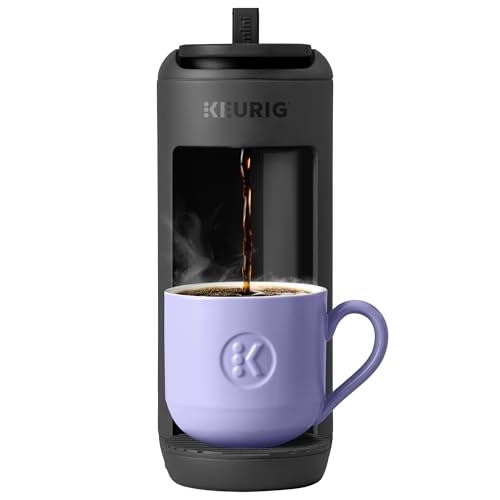
The K-Mini Mate is the electric brewer for places that barely have a kitchen. Its listing aims it squarely at small spaces, dorms, and offices, and its design follows: a compact body, a one-cup-at-a-time routine, and a maximum brew of 12 oz. Electrically, that routine is elegant — you add roughly the water you are about to drink, the machine heats that water and no more, and the cycle ends. There is no tank of hot water being maintained and no reservoir slowly ageing on the counter. For a single user in a small room, it is hard to argue with the physics.
It is also the purest pod experience in the guide, for better and worse. Better, because the K-Cup ecosystem is the deepest in single-serve coffee and the routine could not be simpler: pod in, button, cup. Worse, because the listing offers no grounds alternative, so the machine’s whole life is lived at pod convenience and pod cost, and its review in our economy-focused coverage would say the same. Here, the relevant point is format: if your space is the constraint — a dorm shelf, a desk corner, a camper counter — this is the electric machine that respects it.
The honest limitation is throughput. One cup per fill-and-brew cycle makes it a personal appliance, not a household one, and two people getting ready at the same time will feel the serial nature of their mornings. Buy it as a personal electric brewer and it is excellent at exactly that job.
Best for: dorms, desks, and solo drinkers in genuinely small spaces / Not suited for: shared household mornings
Tastyle Mini Single Serve Hot and Iced Coffee Maker (K310IC)
Badge: Most Versatile
Strengths
- Brews K-Cup pods or grounds — two electric routines in one mini body
- Hot and iced modes across a wide 6 to 14 oz size range
- Listing states 120V, the standard North American household supply
Trade-offs
- Mini format: one cup at a time, water added per brew
- More modes means a little more learning than a one-button machine
- Iced mode is a hot brew over ice, as its listing style describes
Mini spec box
- Format: single serve electric coffee maker, for K-Cup pods and ground coffee
- Brew sizes: 6 to 14 oz
- Modes: hot and iced coffee
- Power: 120V
- Extras: recipe book included
- Settings named in listing: home, travel, RV, office, dorm
- Model: K310IC, 2.0 version, Classic Black
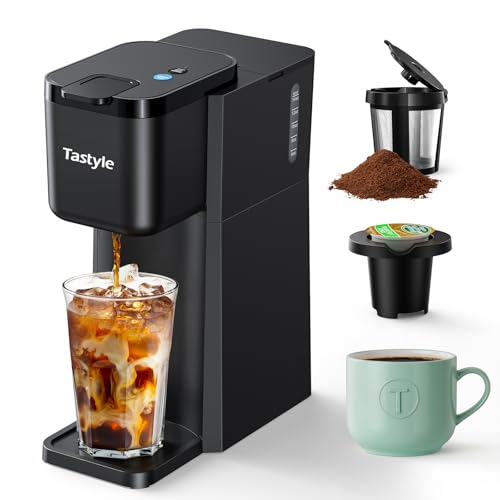
The Tastyle is the overachiever of this pool: a mini electric brewer whose listing covers pods and grounds, hot and iced coffee, and brew sizes from 6 to 14 oz — a range that lets one small machine follow a drinker from a short morning cup to a tall iced glass in July. Its electrical specification is also the most explicit here after the Elite’s wattage: 120V, standard North American household current, which is exactly what its listed settings — home, travel, RV, office, dorm — all share. That detail matters for the RV and travel use the listing names, where knowing a machine is built for the standard supply, and draws like an ordinary small appliance, is the difference between using it and leaving it boxed.
In daily terms, the dual input is the feature that keeps paying. Grounds on ordinary days keep the routine cheap and low-waste; pods cover guests and variety; the size dial keeps portions honest, so the machine heats the water for the cup you actually want rather than a fixed large one. The included recipe book, per the listing, nudges the machine beyond the one-button habit and into the iced and sized drinks it was built for.
The trade-off is the mini’s usual one: serial, single cups, with water added as you go, so a household rush hour is not its stage. It is best understood as a personal electric brewer with an unusually wide repertoire — the pick for one drinker whose tastes refuse to be pinned down, or for the RV and dorm settings its listing calls out, where one small machine must do everything.
Best for: solo drinkers wanting pods, grounds, hot, and iced from one mini machine / Not suited for: households brewing several cups at once

Keurig K-Express (Evergreen)
Badge: Best Reservoir Pick
Strengths
- 42 oz removable reservoir — the electric routine without per-cup filling
- Three brew sizes and a Strong Brew button
- Travel mug friendly and compatible with all K-Cup pods
Trade-offs
- Pod-only in its verified listing
- Identical machine to the Mint entry — the finish is the difference
- Reservoir water needs regular refreshing to taste its best
Mini spec box
- Format: single serve K-Cup pod coffee maker
- Brew sizes: 3 brew sizes
- Reservoir: 42 oz, removable
- Extras: Strong Brew button, travel mug friendly, works with all K-Cup pods
- Colour in listing: Evergreen
The K-Express is where the electric routine grows up into a household appliance. The 42 oz removable reservoir changes the morning’s shape: instead of filling per cup, the machine stands ready, and three brew sizes plus a Strong Brew button let each person in the house pull a different cup from the same tank. Electrically it remains an on-demand brewer — water heated for the cup being made, not a boiler kept at temperature all day — so the reservoir adds convenience without adding a kept-hot habit. Travel mug friendly clearance means the last act of the routine can be the commute, mug filled straight from the machine.
The Evergreen finish is this entry’s identity: a deep green that suits kitchens tired of black and stainless. As with its Mint sibling, we state plainly that the finish is the only difference between the two K-Express entries in this guide; the engineering, the reservoir, and the pod routine are one and the same. Choose Evergreen because the kitchen wants green, and expect exactly the machine the Mint review describes.
Its limitations are the pod format’s: no grounds path in the listing, so cost and waste ride on pods, and the reservoir asks for a small discipline — empty, rinse, and refill rather than topping up indefinitely — to keep the water fresh. Households happy in the pod world will find this the most complete electric expression of it in the pool; households on the fence about pods should read the FlexBrew review before deciding.
Best for: pod households wanting a ready-all-morning reservoir machine / Not suited for: grounds drinkers or per-cup freshness purists

Keurig K-Express (Mint)
Badge: Best Style Pick
Strengths
- Full K-Express specification in a fresh Mint finish
- 42 oz removable reservoir, three brew sizes, Strong Brew button
- Travel mug friendly, works with all K-Cup pods
Trade-offs
- Finish-only difference from the Evergreen entry
- Pod-only in its verified listing
- Light finishes show splashes sooner and ask for a wipe-down habit
Mini spec box
- Format: single serve K-Cup pod coffee maker
- Brew sizes: 3 brew sizes
- Reservoir: 42 oz, removable
- Extras: Strong Brew button, travel mug friendly, works with all K-Cup pods
- Colour in listing: Mint
Everything true of the Evergreen K-Express is true of the Mint one, because they are the same verified electric brewer wearing different colours: the 42 oz removable reservoir that stands ready through the morning, the three brew sizes, the Strong Brew button for a heavier cup without a bigger one, the travel mug clearance, and compatibility with all K-Cup pods. Its separate entry and its Best Style Pick badge exist because, for a machine that will live permanently on the counter — as electric brewers must, to earn their keep — appearance is a functional property. A brewer that suits the room gets used daily for years; a brewer that jars gets demoted to a cupboard and then to a replacement.
Mint is the finish for bright kitchens: white and pale-wood spaces where a black appliance reads as a hole in the room. The cost of that brightness is honesty about upkeep — coffee splashes and drip marks announce themselves on light finishes, so the Mint owner wipes the drip area as a habit rather than a chore. It is a small, real trade, and for many kitchens it is worth it every morning.
Beyond the finish, the assessment is the K-Express assessment: an excellent on-demand electric routine for pod households, bounded by the pod format’s cost and waste, and improved by the simple discipline of refreshing the reservoir. If the machine is right for you, let the kitchen choose between Mint and Evergreen; the coffee will not know the difference, but you will see it every day.
Best for: bright kitchens that have chosen the K-Express and want it to belong there / Not suited for: buyers expecting any functional difference from the Evergreen version

Hamilton Beach FlexBrew Advanced 4-in-1 Single Serve Coffee Maker
Badge: Best for Mixed Households
Strengths
- Pod packs or grounds — one electric machine for both household camps
- Hot and iced brewing from a removable 45 oz reservoir
- Fast brewing, per its listing, suits staggered busy mornings
Trade-offs
- The largest routine to learn in this guide — four modes in one machine
- Bigger counter presence than the minis
- Reservoir freshness discipline applies, as with the K-Express
Mini spec box
- Format: 4-in-1 single serve electric coffee maker
- Inputs: pod packs and grounds
- Modes: hot and iced coffee
- Reservoir: 45 oz, removable
- Brewing: fast brewing, per listing
- Colour in listing: Black
The FlexBrew Advanced closes the list as the electric brewer for households that cannot agree — and most households cannot. Its verified listing combines pod packs and grounds, hot and iced coffee, and a removable 45 oz reservoir, the largest tank among this guide’s reservoir picks. Electrically it is the same virtuous pattern as the rest of the list — on-demand heating, cup-by-cup brewing, nothing kept hot — but it wraps that pattern around every input and temperature the house is likely to ask for, which is why it, and not a second machine, ends up on the counter.
The practical consequence is consolidation. One plug, one reservoir, one descaling schedule, one machine to learn — replacing the common two-machine sprawl of a pod brewer for one partner and a grounds brewer for the other, plus the iced-coffee workaround in summer. Fast brewing, per the listing, keeps the serial nature of single-serve from becoming a queue when the house wakes at once. For a mixed household, this is the most complete electric answer in the pool, and its only real cost is complexity: four modes reward a household that will actually use them.
That caveat is the honest limitation. A single-habit drinker pays for flexibility they will never open, and would be better served by the Elite Gourmet’s one-touch simplicity or a K-Express’s focused pod routine. The FlexBrew earns its footprint only where variety is real. Where it is real, nothing else here matches it — a point worth weighing alongside the glass-and-vacuum tradition covered in our guide to Best Electric Siphon Coffee Makers, which solves variety by ceremony rather than by modes.
Best for: mixed households wanting one electric machine for pods, grounds, hot, and iced / Not suited for: single-habit drinkers who value one-button simplicity
Comparison Table
| Pick | Inputs (verified) | Reservoir | Electric note | Link |
|---|---|---|---|---|
| Elite Gourmet EHC111A | Grounds and loose-leaf tea, reusable filter | None in listing — fill per cup | 600W stated; auto shut-off | Check on Amazon |
| Keurig K-Mini Mate | K-Cup pods | None in listing — fill per cup | Heats only the cup being brewed, up to 12 oz | Check on Amazon |
| Tastyle Mini K310IC | K-Cup pods or grounds | None in listing — fill per cup | 120V stated; hot and iced modes | Check on Amazon |
| Keurig K-Express (Evergreen) | K-Cup pods | 42 oz, removable | On-demand heating from a standing reservoir | Check on Amazon |
| Keurig K-Express (Mint) | K-Cup pods | 42 oz, removable | Same electric design as Evergreen | Check on Amazon |
| Hamilton Beach FlexBrew Advanced 4-in-1 | Pod packs or grounds | 45 oz, removable | Four modes, fast brewing per listing | Check on Amazon |
How to Choose an Electric Coffee Maker
Begin with the routine, because an electric brewer is a routine made solid. Count the steps you will tolerate at your least awake: the Elite Gourmet and the K-Mini Mate reduce it to fill, load, press; the reservoir machines remove the fill step for days at a time; the FlexBrew adds mode choices in exchange for covering every drink the house wants. There is no wrong answer, only an honest one — a machine whose routine is one step too long will be quietly abandoned for the café, and an abandoned appliance is the worst purchase in this guide at any tier.
Next, choose the input for the machine’s whole life, not its first week. Pods maximise simplicity and variety of flavours; grounds maximise economy and minimise waste; dual-input machines — the Tastyle and the FlexBrew here — refuse the choice and are the safest buy for households whose tastes are mixed or still evolving. Then match the water system to the household: reservoirs for staggered multi-person mornings, fill-per-cup for solo drinkers who value freshness and counter space. Finally, weigh the electrical manners that listings actually state: auto shut-off for forgetful households, a stated voltage that matches your supply if you plan travel or RV use, and cup-size ranges that mean the machine heats the water you will drink — no more, because heating water you pour away is the one inefficiency every electric brewer lets you design out at purchase.
Placement deserves a sentence of its own. An electric brewer needs a socket within cord reach, clearance above for filling and for steam, and a permanent home — the counter, not a cupboard — if it is to be used daily. Measure the space under your cabinets before you fall for a machine, and remember that reservoir machines need room to lift the tank out. The manual methods in our guide to Best Electric French Press Coffee Makers make an instructive contrast here: they ask for counter space too, but they spend it on a kettle and a press rather than one integrated machine, which is precisely the trade this keyword exists to avoid.
How to Set Up, Use, and Descale an Electric Coffee Maker
Setup, once, done properly: place the machine on a level surface near a socket, with the clearance its manual asks for; rinse any removable reservoir and run one full cycle of plain water through the brewer before the first coffee, to clear manufacturing and packaging tastes from the water path; if your machine has a reservoir, fill it with fresh water rather than the oldest water in the house. Daily use is the routine you chose at purchase — fill or top up, load pods or grounds, choose the size that matches the mug actually in your hand, brew, and remove spent pods or grounds the same day rather than letting them sit in a warm, damp machine.
Descaling is the maintenance that decides an electric brewer’s lifespan, so treat it as the main event. Mineral scale coats the heating element and the water path, insulating the element so brews slow down and cool off, and narrowing the path so cups come up short. Follow the manufacturer’s schedule for your water hardness, use the solution type the maker recommends, and always run a plain-water rinse cycle afterwards. Wipe the exterior and drip area weekly, wash removable parts as their listings allow, and empty reservoirs for a dry rest whenever the machine will sit unused for a stretch.
Troubleshooting, in problem-and-response form. Problem: brews have become slow and the coffee tastes lukewarm → scale on the element is the first suspect in any electric brewer; descale fully, then judge. Problem: cups are coming out smaller than the size selected → check the reservoir level and the water path for scale or a spent pod left sealing the holder; refill, clean, descale if the pattern persists. Problem: the machine trips the kitchen breaker when it runs → it is sharing a circuit with another heavy appliance, most often a kettle or microwave; move one of them to a different circuit rather than blaming the brewer, and never run two heating appliances off one power strip.
Electric Versus Stovetop and Manual: An Honest Comparison
Electric brewers win on consistency, timing, and unattended operation: the machine heats, times, and stops, and it does so identically every day. Manual methods win on control, simplicity, and repairability: a press or a moka pot has almost nothing to fail, costs little energy infrastructure, and lets a skilled hand steer the result. Neither victory is total. The electric machine’s weakness is that it is an appliance — it can scale up, wear out, and eventually become e-waste — while the manual method’s weakness is that it is a chore with steps a tired person skips. This guide’s six picks all sit on the electric side of that line by definition, and they are chosen for readers who value the weekday-morning virtues: speed, sameness, and a cup that makes itself while you do something else. Readers who suspect they are actually ceremony people should browse the manual end of the category — including the press styles gathered under Best Electronic Coffee Makers coverage — before spending on automation they may not want.
Kitchen Electrics: Plugs, Circuits, and Common Sense
A short safety section, because these are water-and-heat appliances on a home circuit. Give the brewer its own socket where you can; heating appliances draw heavily while they run, and a brewer sharing a strip with a kettle is a breaker trip waiting for a busy morning. Keep the cord clear of the drip area and the machine’s steam path away from cabinet undersides if the manual warns about it — finishes suffer before anything dangerous happens, but both are avoidable. Auto shut-off, offered here by the Elite Gourmet, is worth real money in a forgetful household, and where a machine lacks it, the habit to build is a glance back at the counter as you leave. Finally, respect the stated supply: the Tastyle’s listing specifies 120V, standard for North American homes, and machines built for one supply should not be run on another through travel adapters that were never meant for heating appliances. None of this is complicated; all of it is cheaper than the alternative.
Iced Coffee, Travel Mugs, and the Rest of the Electric Day
An electric brewer earns its counter space across the whole day, not just at breakfast, and two of the patterns deserve a closer look. The first is iced coffee. Two picks here — the Tastyle and the Hamilton Beach FlexBrew — list hot and iced modes, and it is worth understanding what an iced mode on a machine of this class actually does: it brews a concentrated hot coffee directly over ice, so the melting ice brings the drink to drinking strength and temperature at the same moment. That is a different drink from a true cold brew, which steeps slowly in cold water, and neither is a substitute for the pressure-extracted iced drinks surveyed in our guide to Best Electric Expresso Coffee Makers — but for a household that wants a tall cold glass at four in the afternoon without a second appliance or a café run, the over-ice method from a machine already on the counter is the practical answer, and it costs nothing but the ice.
The second pattern is the travel mug, which appears in the verified listings of the Elite Gourmet and both K-Express finishes as an explicit design point: clearance under the spout for a tall mug, so the cup that leaves the house is filled at home. Electrically, this is the single-serve format at its most sensible — the machine heats exactly one mug’s worth of water, brews it into the vessel that will actually be drunk from, and stops, with no intermediate cup, no carafe, and no transfer losses of heat or coffee. Households building a commute routine should treat mug clearance as a first-order specification, checking their tallest mug against the machine before purchase, because a brewer that cannot fill the mug it was bought to fill will be worked around daily and resented weekly. Between the morning travel mug, the afternoon iced glass, and the evening cup of tea through the Elite Gourmet’s reusable filter, the best electric coffee makers in this guide are not breakfast appliances at all — they are the kitchen’s hot-drinks station, and they should be chosen, placed, and maintained with that whole day in mind.
Common Buying Mistakes
The first mistake is buying capacity you do not need: a reservoir machine for a solo drinker, or a mini for a family of four, each resented daily until replaced. The second is choosing on finish before format — the two K-Express entries here are one machine, and colour should be the last decision, not the first. The third is ignoring the input question and discovering, a month in, that the household’s real habit is the expensive or the wasteful one. The fourth is neglecting descaling and then blaming the machine’s quality for a decline that minerals caused. The fifth is placement by optimism: no socket, no clearance, no permanent counter home — three small facts that quietly decide whether an electric brewer becomes a daily tool or a stored intention.
Final Recommendation
For most solo drinkers and small households, buy the Elite Gourmet Single-Serve Coffee Maker: one touch, a stated 600W element, auto shut-off, and a reusable filter make it the purest electric routine in the guide. Households that live on pods and staggered mornings should take the Keurig K-Express — in Evergreen or Mint, by kitchen — and let its 42 oz reservoir carry the house. And mixed households should consolidate on the Hamilton Beach FlexBrew Advanced 4-in-1, whose pods-or-grounds, hot-or-iced range ends the two-machine era in one purchase. The Tastyle and the K-Mini Mate remain the specialist minis: one for the drinker who wants every mode in the smallest body, one for the smallest spaces of all.
Related guides
- Best Non Electric Manual Coffee Makers
- Best New Electric Coffee Makers
- Best Non Electric Coffee Makers
Frequently Asked Questions
What counts as an electric coffee maker?
A machine that heats the water and brews the coffee itself, in one body, from a wall socket — as all six picks here do. That distinguishes them from stovetop pots, which borrow the stove’s heat, and from manual presses and pour-overs, which borrow a kettle’s. The electric definition is about self-containment: fill it, load it, press a control, and the appliance does the thermal work and the timing for you.
Does wattage tell me which electric coffee maker is best?
Only narrowly. Wattage describes how much power the heating element can draw, which relates to how fast it can heat a given amount of water — it is not a quality score, and bigger is not automatically better in a single-serve machine that heats cup-sized volumes. In this guide only the Elite Gourmet’s listing states a wattage, 600W, and we report it as a fact about that machine rather than a ranking weapon; beware any guide that assigns wattages to machines whose listings never stated them.
Can I run these machines on any voltage?
Run a machine on the supply it was built for. The Tastyle’s listing states 120V, the standard North American household supply, and that is the supply its home, office, dorm, and RV settings share. Heating appliances are poor candidates for travel adapters and converters; if you brew in a country with a different standard, buy a machine built and listed for that standard rather than adapting one that is not.
Why do electric coffee makers need descaling?
Because they boil mineral-bearing water in a small, hot, narrow path — perfect conditions for scale. Scale insulates the heating element, so brews slow and cool, and it narrows the water path, so cups shrink. Descaling on the manufacturer’s schedule dissolves that build-up and is the single maintenance task that separates electric brewers that last for years from those that fade within a couple of seasons.
Are single-serve electric brewers wasteful?
Less than their reputation suggests on the coffee itself: they brew the cup you will drink and keep nothing hot, so almost no brewed coffee is poured away. The waste question is really about inputs — pods create per-cup packaging waste, grounds in a reusable filter create almost none — which is why this guide makes the input architecture of each pick explicit and gives its versatility badges to the machines that brew from grounds as well as pods.
What size reservoir do I need?
Match it to the household’s morning, not its best-case day. One drinker, one cup: a fill-per-cup mini is fresher and smaller, and the reservoir question disappears. Two to four staggered drinkers: the 42 to 45 oz removable reservoirs on the K-Express and FlexBrew cover a morning without refills and still lift out for proper emptying. Any larger appetite than that, regularly, is a sign the household may want a batch brewer instead of a single-serve machine.
Is an electric coffee maker better than a French press or moka pot?
Better at different things. The electric machine wins on speed, consistency, and unattended brewing — the weekday virtues. The press and the moka pot win on simplicity, control, and having almost nothing to break. Many kitchens end up with both: electric for the working week, manual for the slow weekend. This guide simply serves the readers who came for the electric side of that partnership.


