Disclosure: topratedkitchenware.com is reader-supported. When you buy through links on our site, we may earn an affiliate commission from Amazon and other retailers, at no extra cost to you.
Where to buy
If you are shopping for the best mixers for bread making, the six hand mixers below are the shortlist this guide is built around. Every pick is a handheld electric mixer — there is no stand mixer in this group — and the guide is written around that fact rather than in spite of it: these machines serve the home bread baker whose loaves are small, soft or enriched, and whose mixing method pairs short machine bursts with rests and folds. Prices and availability change often on Amazon, so use the links to check the current listing before you buy.
- Best Overall: Hamilton Beach 6-Speed Electric Hand Mixer with Easy Clean Beaters (62636J) — Check on Amazon
- Best for Dough-Named Versatility: LILPARTNER Hand Mixer Electric, 7-Speed, Light Pink — Check on Amazon
- Best Speed Control: Cuisinart Power Advantage Plus 9-Speed Hand Mixer, White (HM-90S) — Check on Amazon
- Best Compact Pick: KitchenAid 5 Ultra Power Speed Hand Mixer, Black Matte (KHM512) — Check on Amazon
- Best for Small Kitchens: KitchenAid 5 Ultra Power Speed Hand Mixer, Contour Silver (KHM512) — Check on Amazon
- Best Value Set: WEPSEN 5-Speed Electric Hand Mixer with Mixing Bowls Set — Check on Amazon
Read the full guide below for the detailed reviews, the comparison table and the method ↓
Choosing the best mixers for bread making starts with a question most product pages never ask: what kind of bread do you actually make? Bread is not one dough. It is a soft milk loaf that barely resists a spoon and a bagel dough that resists everything; a focaccia that pours and a pretzel dough that fights. The six machines in this guide are hand mixers, and hand mixers have a clear, honest territory in bread making — small batches, softer doughs, and the combining stage of almost any dough — plus a clear boundary beyond which a stand mixer with a dough hook is simply the right machine. This guide maps that territory carefully, pick by pick, so you can place your own baking on it before you spend anything.
Two of the picks stand slightly apart from the rest, and for bread makers they are the headline. The Hamilton Beach 62636J is the only machine here whose verified listing confirms actual dough hooks, alongside traditional beaters and a whisk, driven by a stated 275 watt motor. The LILPARTNER’s listing names dough outright among the jobs its five stainless accessories are for. The other four — a nine-speed Cuisinart and two colour variants of KitchenAid’s compact KHM512, plus WEPSEN’s bowl-bundle set — are beaters-and-whisk machines that handle the wet, early work of bread making gracefully and then hand over to time, rests and your hands. Every review below states its pick’s ceiling in plain language. Bread making rewards honesty about tools more than almost any other kitchen craft, because dough always tells you the truth in the end.
Key Takeaways
- All six picks are hand mixers suited to small, soft and enriched doughs and to the combining stage of stiffer ones.
- The Hamilton Beach 62636J is the only pick whose listing confirms dough hooks; the LILPARTNER’s listing names dough among its jobs.
- Method is the multiplier: mix to combine, rest for hydration, fold for strength. The machine replaces the messy first stage, not the whole craft.
- Batch discipline is non-negotiable — one small loaf at a time, and stop at the first sound of strain.
- Low speeds do the bread work. Nine speeds (Cuisinart) is about a gentle start in flour; a burst or hook matters more than a top gear.
- Weekly bakers of lean, stiff or doubled doughs should read the buying guide’s dividing line and consider a stand mixer instead — and bakers in between should note that a hand mixer bought now remains useful for cakes, creams and batters even if a stand mixer joins the kitchen later, so the staged route wastes nothing.
In this guide
Quick Picks
| Pick | Badge | Speeds | Attachments named in listing | Bread-making role |
|---|---|---|---|---|
| Hamilton Beach 6-Speed Hand Mixer (62636J) | Best Overall | 6 | Easy clean beaters, traditional beaters, dough hooks, whisk | The group’s only confirmed dough hooks; small-batch kneading support |
| LILPARTNER Hand Mixer Electric, Light Pink | Best for Dough-Named Versatility | 7 | 5 stainless steel accessories | Listing names dough, cream and cake; broadest accessory set |
| Cuisinart Power Advantage Plus 9-Speed (HM-90S) | Best Speed Control | 9 | Beater (as listed) | SmoothStart and fine low gears for flour work and wet doughs |
| KitchenAid KHM512, Black Matte | Best Compact Pick | 5 | Turbo Beaters | Drawer-sized help for small soft batches and combining |
| KitchenAid KHM512, Contour Silver | Best for Small Kitchens | 5 | Turbo Beaters | Same platform, neutral finish for shared and small kitchens |
| WEPSEN 5-Speed Hand Mixer Set | Best Value Set | 5 | Whisks, beater | Bundled bowls and measures equip a beginner’s whole workflow |
How These Picks Were Chosen
This guide is research-led. We compared verified listings for hand mixers and read each one for what it confirms — named attachments, speed counts, stated wattage, storage and cord features — rather than what its photographs imply. A listing that names dough hooks gets credited with dough hooks; a listing that names only beaters is reviewed as a beaters machine, however dough-adjacent its marketing feels. That discipline is why the Hamilton Beach 62636J leads this guide and why several famous names sit further down it.
Beyond the listings, we weighted the factors that decide real bread-making outcomes with a handheld machine: a first speed slow enough to keep flour in the bowl, attachments that survive sticky dough and wash clean, a cord arrangement that stays out of the mixture, and pause-friendly design, because bread work is intermittent by nature. Colour variants of one platform are identified as such wherever they appear. We did not bake with these machines for this guide and claim no hands-on testing; the assessments rest on verified specifications and on the well-understood mechanics of dough, which are not really in dispute.
We also deliberately excluded stand mixers from this particular shortlist, because the assignment for this guide was the hand-mixer shelf — the machines a small kitchen can store in a drawer and a new baker can buy without rearranging a budget. That exclusion is a scope decision, not a verdict: the buying guide below discusses the stand-mixer alternative in full, including the point at which it becomes the better purchase, because a guide that hides the alternative is not guiding you anywhere honest.
The 6 Best Mixers for Bread Making, Reviewed
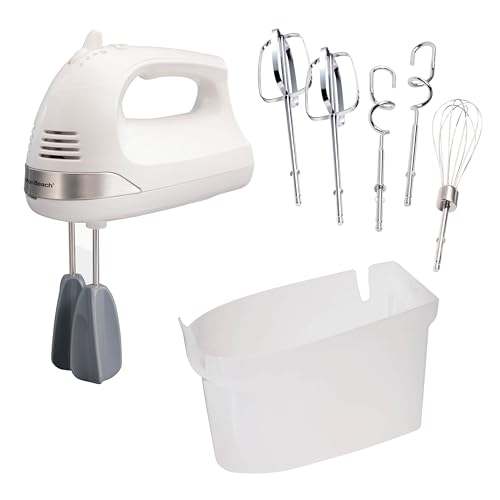
Hamilton Beach 6-Speed Electric Hand Mixer with Easy Clean Beaters (62636J)
Badge: Best Overall
Strengths
- Dough hooks are confirmed in the listing — the only pick here that can genuinely work a small dough rather than just combine it.
- A stated 275 watt motor is the strongest confirmed figure in this group.
- Traditional beaters, a whisk and easy-clean beaters make it a complete baking station in one snap-on case.
Trade-offs
- Hooks on a hand mixer still meet a hand mixer’s ceiling: small batches and moderate stiffness only.
- Six speeds is a workable range, though the Cuisinart’s nine offers finer low-end steps.
- You hold the machine against the dough’s resistance; long sessions tire the hand and wrist.
Mini spec box
- Format: electric hand mixer
- Speeds: 6
- Motor: 275 watts
- Attachments named in listing: easy clean beaters, traditional beaters, dough hooks, whisk
- Storage: snap-on storage case
- Colour: White
For bread making specifically, this is the most complete hand mixer in the guide, and the reason sits in one line of its listing: dough hooks. Hooks change what a hand mixer can honestly attempt. Where beaters combine and then surrender, hooks can keep working a small, moderate dough — pulling and folding it in the bowl for the first minutes of development while you guide the machine in slow circles. Pair that with a stated 275 watt motor, the strongest confirmed power figure here, and you have the one pick we would hand to a bread baker without immediately adding the words “early stages only.”
The ceiling still exists, and honesty requires naming it. A hand mixer with hooks is a small-batch tool: one loaf of sandwich bread, one batch of rolls, pizza dough for a family pizza night at moderate hydration. Double batches and stiff lean doughs will make it labour and heat, and the correct response is always to stop, rest the dough, and finish with folds. Used inside its envelope — and with the snap-on case keeping hooks, beaters and whisk together between bakes — it is the closest thing to a bread specialist this category offers.
Best for: regular small-batch bread bakers who want confirmed dough hooks and the group’s strongest stated motor / Not suited for: double batches, stiff lean doughs, or bakers who want to walk away while dough kneads

LILPARTNER Hand Mixer Electric, 7-Speed, Light Pink
Badge: Best for Dough-Named Versatility
Strengths
- The listing names whipping dough alongside cream and cake — dough is a stated job, not an inference.
- Five stainless steel accessories is the broadest attachment set in this guide.
- Seven speeds span a gentle combining gear and enough steps above it for batters and creams.
Trade-offs
- No wattage is stated in the listing, so power comparisons rest on the other picks’ confirmed figures.
- Light pink is the only finish offered in this listing.
- Like every hand mixer here, its dough work is small-batch work, whatever the listing’s enthusiasm.
Mini spec box
- Format: electric hand mixer
- Speeds: 7
- Accessories: 5 stainless steel accessories
- Listing-named jobs: whipping dough, cream, cake
- Attachments: dishwasher safe
- Colour: Light Pink
The LILPARTNER earns second place on intent. Its listing was written for exactly the mixed baking life most home bread makers actually live — dough one day, cream the next, cake at the weekend — and its five-piece stainless accessory set is meant to cover all of it. For bread making, that breadth translates into options: an attachment for the combining stage, others for the enriched doughs and batters that surround bread in a real kitchen, and dishwasher-safe cleanup when the dough is done, which anyone who has chiselled dried dough off an attachment will appreciate at full value.
Its limitation is the category’s limitation, plus one of information: with no wattage in the listing, we cannot rank its motor against the Hamilton Beach’s stated figure, and a careful buyer should read that silence plainly. What can be said is that its dough claim is explicit and its speeds are plentiful. For small, soft and enriched doughs — the doughs hand mixers exist for — it is a genuinely well-aimed machine, and for the baker whose bread making shares the week with cakes and creams, it may be the most natural single purchase in the guide. It is also, not coincidentally, a central pick in our Best Mixers For Cake guide.
Best for: bakers whose week mixes small doughs with cakes and creams, and who want one accessory set for all of it / Not suited for: bakers who want a stated wattage figure, or stiff and doubled doughs

Cuisinart Power Advantage Plus 9-Speed Hand Mixer, White (HM-90S)
Badge: Best Speed Control
Strengths
- Nine speeds — the most here — give the finest low-end control for incorporating flour without a dust cloud.
- SmoothStart anti-splatter technology ramps up gently, protecting both the dough and your walls.
- The snap-on storage case keeps the mixer and attachments together in one grab.
Trade-offs
- The listing positions it as a cake mixer and names a beater; no dough hooks are confirmed.
- Control is not torque — its bread role is wet doughs and combining, not kneading stiff masses.
- The white finish shows every splash until wiped.
Mini spec box
- Format: electric hand mixer
- Speeds: 9
- Features: SmoothStart anti-splatter, snap-on storage case
- Listing positioning: cake mixer, hand held mixer
- Colour: White
Bread making with a hand mixer is won or lost in the first thirty seconds, when dry flour meets moving beaters. The Cuisinart HM-90S is engineered for exactly that moment: SmoothStart eases the motor in rather than lunging, and nine speeds mean the early gears are genuinely early — you can creep from a bare stir to a working mix in small steps as the dough hydrates and tightens. For high-hydration doughs like focaccia, batter breads, and the wet first stage of any loaf, that calm control is the most valuable single feature in this guide.
The trade is equally clear. No dough hooks are confirmed in the listing, so the Cuisinart’s bread career is combining and wet-dough work; the moment a dough firms up, your hands and the clock take over through rests and folds. Bakers who make a lot of wet doughs and batter-style breads will not feel that as a limitation at all. Bakers of firm sandwich loaves should look at the Hamilton Beach above — or beyond this category entirely.
Best for: wet doughs, batter breads and bakers who hate flour clouds / Not suited for: firm doughs or buyers who need confirmed dough hooks

KitchenAid 5 Ultra Power Speed Hand Mixer, Black Matte (KHM512)
Badge: Best Compact Pick
Strengths
- Turbo Beaters push through thick mixtures without the clogging that stalls plain beaters.
- The lockable swivel cord keeps the cable out of the dough and locks to your preferred side.
- One-button beater release plus dishwasher-safe beaters make dough-day cleanup painless.
Trade-offs
- No dough hooks are named in the listing; bread work is combining-stage, small and soft.
- Five speeds is a modest range, and low-end steps are coarser than the Cuisinart’s.
- Black matte shows flour dust prominently between wipes.
Mini spec box
- Format: electric hand mixer
- Speeds: 5
- Attachments named in listing: Turbo Beaters
- Features: lockable swivel cord, easy-release button, dishwasher-safe beaters
- Colour: Black Matte
The KHM512 in black matte is the compact professional of the group — the mixer for the bread maker who bakes in a small kitchen, stores the machine in a drawer, and wants the combining stage of a small soft dough handled neatly without ceremony. Its Turbo Beaters are the detail that matters for bread: their design keeps thick mixtures moving instead of packing around the wires, which is precisely the failure mode of cheap beaters in a sticky dough. The swivel cord, locked to whichever side suits your stance, stops the cable trailing through the bowl — a small thing that becomes a big thing by the third bake.
Place it honestly and it shines: small batches, soft doughs, combining work, and a general baking life around the bread. Ask it to knead, or to handle a doubled recipe, and you are outside what its listing claims and what its compact format can give. Within its envelope it is arguably the most pleasant machine here to live with day to day.
Best for: small kitchens and occasional-to-regular small-batch bakers who value tidy handling / Not suited for: kneading, stiff doughs, or large batches

KitchenAid 5 Ultra Power Speed Hand Mixer, Contour Silver (KHM512)
Badge: Best for Small Kitchens
Strengths
- The identical KHM512 platform — Turbo Beaters, swivel cord, one-button release — in a neutral finish.
- Contour Silver suits shared kitchens and modern schemes where black or red would argue with the room.
- Dishwasher-safe beaters keep the dough routine simple from mix to sink.
Trade-offs
- It is the same machine as the black matte model; nothing about its bread ability differs.
- The same dough ceiling applies: no hooks named, small soft batches, combining stage.
- Five speeds, again, is the group’s joint-narrowest range.
Mini spec box
- Format: electric hand mixer
- Speeds: 5
- Attachments named in listing: Turbo Beaters
- Features: lockable swivel cord, easy-release button, dishwasher-safe beaters
- Colour: Contour Silver
We will not manufacture differences where none exist: this is the KHM512 platform in Contour Silver, and every word of the black matte review applies. It is listed separately because the pool includes it and because finish is a real deciding factor for a machine that may live on a counter — silver reads as a neutral appliance, forgives the visual chaos of a baking day better than black, and suits the rental and shared kitchens where a compact hand mixer is most often the only mixer there is.
For bread making, then, the advice is the same: use it for the combining stage of small, soft doughs, lean on rests and folds for development, and enjoy how little space and cleanup the whole routine takes. If you are choosing between the two KHM512 finishes, choose with your eyes; your dough will not know the difference.
Best for: buyers who want the KHM512 platform in a finish that blends into any kitchen / Not suited for: anyone expecting a different machine from the black matte version

WEPSEN 5-Speed Electric Hand Mixer with Mixing Bowls Set
Badge: Best Value Set
Strengths
- Four large stainless nesting bowls are included — bread making genuinely uses several bowls per bake.
- Measuring cups and spoons come in the box, covering a beginner’s weighing-and-measuring needs.
- Whisks and a beater handle combining, batters and the rest of a baking day.
Trade-offs
- The lightest-duty mixer here for dough: five speeds, no dough attachment named in the listing.
- If your kitchen already owns bowls and measures, the bundle’s value largely duplicates them.
- Stainless bowls are light and practical but offer no grip base for one-handed mixing.
Mini spec box
- Format: electric hand mixer with bowl set
- Speeds: 5
- Included: 4 large stainless steel nesting bowls, measuring cups and spoons
- Attachments named in listing: whisks, beater
The WEPSEN set is best understood as a bread-making starter kit that happens to be built around a hand mixer. Bread workflow is bowl-hungry: one bowl for the preferment, one for mixing, one for the rising dough, one for flour and salt waiting their turn. Four large stainless nesting bowls answer that hunger directly, and they nest away into a single bowl’s footprint afterwards — a real consideration in the small kitchens this guide keeps returning to. The included measuring cups and spoons suit the baker who has not yet moved to a scale.
The mixer itself is the modest part: five speeds, whisks and a beater, and no dough attachment named. It combines; it does not knead. For a beginner whose first loaves are soft and small, that is enough to learn the craft’s rhythm, and the kit around it removes every other equipment excuse. Experienced bakers with equipped kitchens should spend on the Hamilton Beach instead.
Best for: beginners setting up a bread kitchen from near zero / Not suited for: equipped bakers or doughs beyond the soft and small
Comparison Table
| Pick | Speeds | Motor (as listed) | Dough hooks confirmed | Bread-making role | Link |
|---|---|---|---|---|---|
| Hamilton Beach 62636J | 6 | 275 watts | Yes | Small-batch kneading support plus combining | Check on Amazon |
| LILPARTNER 7-Speed | 7 | Not stated | Dough named as a job | Small soft and enriched doughs | Check on Amazon |
| Cuisinart HM-90S | 9 | Not stated | No | Wet doughs and flour incorporation | Check on Amazon |
| KitchenAid KHM512, Black Matte | 5 | Not stated | No | Small soft batches, combining | Check on Amazon |
| KitchenAid KHM512, Contour Silver | 5 | Not stated | No | Small soft batches, combining | Check on Amazon |
| WEPSEN 5-Speed Set | 5 | Not stated | No | Combining; bowls support workflow | Check on Amazon |
How to Choose the Best Mixers for Bread Making: Matching Machine to Dough
Begin with hydration, the baker’s shorthand for how wet a dough is. Wet doughs — focaccia, ciabatta-style, high-hydration loaves — behave almost like thick batters at first and are the natural home of the hand mixer. Moderate doughs — sandwich loaves, rolls, enriched doughs — can be combined by any pick here and finished with folds, with the Hamilton Beach’s hooks extending how much of the work the machine can do. Stiff doughs — bagels, pretzels, low-hydration lean loaves — belong to stand mixers and strong arms. Place your three most-baked recipes on that scale and you have placed yourself in this guide.
Next, read listings the way this guide does: attachments first, speeds second, wattage third. Confirmed dough hooks outrank every other feature for bread. A stated wattage outranks silence. Speed count matters mostly at the bottom of the range — you want a first gear that stirs rather than launches — which is why the Cuisinart’s nine speeds and SmoothStart earn their bread credentials despite the absence of hooks. Then weigh the living-with-it features: swivel cords and one-button releases (KitchenAid), a bowl-friendly storage case (Hamilton Beach, Cuisinart), dishwasher-safe attachments (LILPARTNER, KitchenAid), and bundled bowls if your kitchen lacks them (WEPSEN).
Finally, think in years. A hand mixer bought for bread making will also cream, whip and beat its way through hundreds of other jobs — many readers will use the same machine for the bakes in our Best Mixers For Cake Business guide long before they wear it out on dough. If bread is a weekly ritual and growing, the honest long-term purchase may be a stand mixer, with a hand mixer as its companion. If bread is one pleasure among many in a small kitchen, the picks above are sized exactly right.
How to Make Bread with a Hand Mixer, Step by Step
- Weigh everything before you switch anything on. Bread rewards preparation, and a hand mixer gives you no free hand to measure mid-mix.
- Mix flour and water (and preferment, if using) on the lowest speed until just combined — one to two minutes. Cover and rest thirty minutes; this autolyse does more for your dough than ten minutes of beating.
- Add salt and any remaining ingredients. Mix on a low speed for one to two minutes until incorporated.
- If your mixer has dough hooks (the Hamilton Beach 62636J), work the dough on a low speed in slow circles for two to three minutes. With beaters, stop here — the combining is done.
- Rest the dough, covered, for thirty minutes, then give it a set of folds: wet hands, stretch one side up and over, rotate the bowl, repeat four to six times.
- Repeat rest-and-fold two or three times across the bulk rise. The dough should grow smoother and more elastic each round.
- Shape, proof and bake as the recipe directs. Rinse attachments immediately; fresh dough rinses off, dried dough does not.
Troubleshooting. Problem: dough wraps around the beaters and climbs toward the motor → it has firmed past beaters’ territory; stop, rest it, and continue with folds (or hooks, if your model has them). Problem: the mixer body grows warm and the pitch drops → the batch is too large or too stiff; split it, add rests, and never force a straining motor. Problem: the dough stays shaggy and tears instead of stretching → it needs time, not speed; extend the rests between folds and let hydration finish the work.
The Breads That Suit This Category — and the Ones That Outgrow It
Suit this category: focaccia and flatbreads; soft sandwich loaves in single batches; dinner rolls and enriched buns; milk bread; cinnamon-roll and sticky-bun doughs; pizza dough at moderate hydration for one or two bases; batter breads and no-knead styles where the mixer simply replaces the spoon. Outgrow it: bagels and pretzels at any scale; doubled lean loaves; very low-hydration doughs; and any bake where you want to walk away while a machine kneads — a hand mixer, by definition, keeps your hand on it. Naming your repertoire against those two lists is the most reliable buying advice in this entire article, because it converts a vague hope (“a mixer for bread”) into a specification a purchase can actually meet.
A Note on the Word “Mixer”
Search engines cheerfully confuse two different products under this word. If you arrived here while stocking a bar, you may want the Best Mixers For Brown Rum, the Best Mixers For Bushmills, the Best Mixers For Butterscotch Schnapps or the Best Mixers For Burnetts — those guides cover the sodas, juices and syrups that mix with spirits. This article is strictly about electric kitchen machines for dough, and nothing in a glass is reviewed here.
Preferments, Starters and Enriched Doughs: Where a Hand Mixer Quietly Excels
Some of bread making’s most flavourful techniques happen before the main dough exists, and they suit a hand mixer beautifully. A preferment — a poolish, a biga, a sponge — is a wet, batter-like mixture of flour, water and a little yeast, left to ferment for hours. Combining one takes thirty seconds of gentle mixing, exactly the work the Cuisinart’s SmoothStart or the KitchenAid’s low gear does without splashing a drop. A sourdough starter, similarly, needs its flour and water incorporated cleanly at every feed; a hand mixer is overkill for a small jar, but for bakers maintaining a larger starter for weekly bakes, a quick pass with a whisk or beater produces a smoother, more evenly hydrated starter than a spoon manages, and even hydration means predictable fermentation.
Enriched doughs are the other quiet strength. Brioche, challah, panettone-style doughs and sweet roll doughs all share a pattern: a moderate base dough, then butter — a lot of butter — added gradually. That gradual addition is hand-mixer work par excellence. You hold the machine, add a piece of soft butter, mix until it disappears, add the next. The dough stays supple because the fat coats the flour proteins, so the resistance that defeats beaters in lean dough never fully develops. The Hamilton Beach’s hooks can work an enriched dough further than most, and the LILPARTNER’s accessory set was plainly designed with this dough family in mind. If your bread ambitions lean rich and festive rather than lean and crusty, this entire category of machine is better matched to you than its reputation suggests.
Hand Mixer or Stand Mixer for Bread? An Honest Accounting
Since this guide keeps pointing at the boundary, it owes you a full accounting of what sits on the other side. A stand mixer with a dough hook kneads unattended, handles stiff doughs, doubles batches, and anchors itself to the counter while it works. It also costs several times what a hand mixer costs, claims a permanent block of counter or a heavy lift from a cupboard, and is frankly excessive for the baker who makes one soft loaf a week. A hand mixer costs little, stores in a drawer, cleans in a minute, and — with the method in this guide — covers the combining stage of nearly every dough and the full mixing of soft ones. It cannot knead stiff dough, cannot be left alone, and will not forgive doubled batches.
The bakers who get this decision right tend to share a habit: they buy for the next year of their actual baking, not for an imagined future bakery. If the next year holds weekly soft loaves, rolls and enriched bakes, a pick from this guide is the correct, sufficient purchase, and the price difference buys ingredients, a good scale and a proofing basket or two. If the next year holds a bagel project, a sourdough bakery habit at volume, or pizza nights for a crowd, the stand mixer is not an indulgence but the tool the recipes assume. And there is no shame in the staged route — hand mixer now, stand mixer when the baking proves it needs one — because the hand mixer remains useful for everything else in the kitchen long after the stand mixer arrives. Our Best Mixers For Cake Business coverage makes the same staged argument from the small-business side, where the second machine often arrives the month the orders do.
Keeping a Hand Mixer Alive on Dough Duty: Motor Discipline and Care
A hand mixer used for bread will outlive its warranty by years if you observe three disciplines. The first is thermal: small motors cool through airflow and rest, so work in bursts — a minute or two of mixing, then the rest the dough wants anyway. The rest-and-fold method is not just good for gluten; it is a cooling schedule for the machine, and the two rhythms reinforce each other so neatly that dough is arguably kinder to a hand mixer than a five-minute continuous batter marathon. If the body ever feels hot or the pitch sags, stop. Heat is the one warning a small motor gives before damage, and it always gives it during the batch you were tempted to double.
The second discipline is mechanical sympathy. Never start the mixer already buried in stiff dough; start in the wettest part of the bowl and let the mixture come to the beaters. Keep the beaters or hooks submerged enough to work but never grind them against the bowl’s base, and if dough climbs and wraps, stop and clear it with a spatula rather than revving through the wrap — a wrapped beater multiplies the load on the motor and the gearbox at exactly the moment the dough is most resistant. The third discipline is cleaning, already mentioned and worth repeating as care rather than convenience: dough left to dry on attachments hardens into something closer to plaster, and the scrubbing it then needs is what bends beater wires and stresses eject mechanisms. A rinse at the sink, while the dough is still soft, is the cheapest maintenance any of these machines will ever ask for. Store attachments in their case where one is provided — the Hamilton Beach and Cuisinart snap-on cases exist precisely so hooks and beaters are not bent at the bottom of a utensil drawer.
Reading a Bread Recipe with a Hand Mixer in Mind
One last skill ties the whole guide together: translating a recipe written for a stand mixer — as most modern bread recipes are — into hand-mixer terms. When the recipe says “knead on medium-low for eight minutes,” read it as “combine for two minutes, rest twenty, fold, rest twenty, fold” and expect the same dough at the end, an hour later and none the worse for it; gluten does not care whether time or machinery developed it, only that one of them did. When the recipe says “add the butter a tablespoon at a time with the mixer running,” a hand mixer follows that instruction literally and well. When it says “the dough should clear the sides of the bowl,” judge by eye during your folds rather than by chasing that moment with beaters. And when a recipe’s flour quantity exceeds your one-loaf envelope, scale it down rather than up — small loaves bake faster, stale slower, and teach you the recipe in half the flour. Bakers who learn this translation stop seeing a hand mixer as a compromise and start seeing it as a dialect: the same bread, spoken slightly differently.
Common Buying Mistakes
Mistake one: assuming every hand mixer kneads. Most combine; one pick here confirms hooks. Mistake two: doubling recipes. Dough resistance scales cruelly, and motors die on doubled batches. Mistake three: reading speed counts as strength — nine speeds is control, not torque. Mistake four: ignoring the rest. Bakers who skip the autolyse and the folds, then blame the mixer for a tight, tearing dough, have misidentified the problem; time is an ingredient. Mistake five: letting dough dry on attachments, turning a thirty-second rinse into a soaking project. Mistake six: buying both KHM512 finishes as if they were different machines — they are one platform in two colours, and the money is better spent on good flour, a reliable kitchen scale and a proper proofing basket.
Final Recommendation
For bread making, start with the Hamilton Beach 62636J: confirmed dough hooks, the group’s strongest stated motor, and a full attachment set make it the only pick that participates in kneading rather than just combining. If your breads run wet and your flour work needs a gentle hand, the Cuisinart HM-90S is the connoisseur’s alternative. The LILPARTNER suits the baker whose dough shares the week with cakes and creams; the KitchenAid pair suit small kitchens; the WEPSEN set suits beginners equipping from scratch. And if your honest repertoire is stiff, lean and doubled, let this guide talk you out of the category with gratitude — a stand mixer with a dough hook is waiting, and it is the right tool.
Frequently Asked Questions
What is the best type of mixer for bread making overall?
For most bread, a stand mixer with a dough hook is the category’s best tool, because it kneads hands-free and handles stiff doughs. This guide covers the hand-mixer end of bread making — small, soft and enriched doughs, and the combining stage of others — where the six picks above perform honestly and well.
Can I make sourdough with a hand mixer?
You can combine a small sourdough batch with one, and many sourdough methods barely need more: after combining, the dough develops through rests and folds during a long bulk ferment, which is exactly the rest-and-fold pattern this guide teaches. Keep the batch small and the hydration moderate to high, and a hand mixer fits sourdough practice surprisingly well.
How long should I run a hand mixer on dough?
In short bursts: one to two minutes to combine, and — with dough hooks — two to three minutes of gentle working, separated by rests. Continuous long running heats a small motor and overworks the dough’s surface. If you find yourself wanting ten straight minutes of kneading, that is the stand mixer’s job description introducing itself.
Why does my dough climb the beaters?
Because it has developed enough elasticity to grip and travel. It is a stage signal, not a malfunction: the combining work is done. Stop, rest the dough, and switch to folds — or to dough hooks if your model has them. Pushing beaters through climbing dough strains the motor and tears the dough.
Does the bowl material matter for bread making?
Depth matters more than material: a deep bowl keeps flour in and gives beaters room. Stainless bowls, like those in the WEPSEN set, are light and easy to handle with floury hands; heavier bowls stay put better during mixing. Avoid very shallow bowls for dough — they turn the combining stage into a flour event.
What bowl should I use for mixing dough with a hand mixer?
Choose the deepest, widest bowl you own. Depth keeps flour in during the first seconds and gives the dough room to move; width lets you circle the mixer and reach every pocket of dry flour. A bowl with some weight to it, or one you can brace against your body or a damp towel, helps because a hand mixer transfers the dough’s resistance into the bowl. The WEPSEN set’s four large stainless bowls are sized for exactly this work, and their nesting design means the resting bowl and the mixing bowl can both live in one cupboard slot.
How do I know when to stop mixing and start resting?
Stop when three things are true: no dry flour remains visible, the dough has formed a single shaggy mass rather than separate wet and dry zones, and the mixture has begun to feel like it pulls together when the beaters move. That point usually arrives within two minutes of gentle mixing at the lowest speeds, sometimes sooner for wet doughs and a little later for enriched ones. Everything after it — smoothness, elasticity, strength — develops better through rests and folds than through continued beating, so stopping early is not a shortcut; it is the technique itself.
Are the two KitchenAid picks really the same machine?
Yes. The black matte and contour silver models are both the KHM512 platform with the same speeds, Turbo Beaters, swivel cord and release button, as their listings confirm. Choose by finish and availability; the bread making is identical.


