Disclosure: topratedkitchenware.com is reader-supported. When you buy through links on our site, we may earn an affiliate commission from Amazon and other retailers, at no extra cost to you.
Where to buy
If you are shopping for the best mixers for cake business use, the six machines below are the shortlist this guide is built around. Two are stand mixers — the production backbone a cake business actually runs on — and four are hand mixers, which in a business kitchen play the supporting roles: finishing, small batches, frosting touch-ups and backup when the main machine is busy or down. Prices and availability change often on Amazon, so use the links to check the current listing before you buy.
- Best Overall: Cuisinart Stand Mixer, 12 Speed, 5.5 Quart, White Linen (SM-50) — Check on Amazon
- Best Second Station: Cuisinart Stand Mixer, 12 Speed, 5.5 Quart, Onyx (SM-50) — Check on Amazon
- Best Hand Mixer for Business Support: Hamilton Beach 6-Speed Electric Hand Mixer with Easy Clean Beaters (62636J) — Check on Amazon
- Best Premium Hand Mixer: Cuisinart 9-Speed Electric Hand Mixer with Storage Case, Brushed Chrome (HM-90BCS) — Check on Amazon
- Best for Finishing Work: KitchenAid 5 Ultra Power Speed Hand Mixer, Black Matte (KHM512) — Check on Amazon
- Best Backup Pick: Proctor Silex Easy Mix 5-Speed Electric Hand Mixer, Black (62511) — Check on Amazon
Read the full guide below for the detailed reviews, the comparison table, the production workflow and the sections on scaling, food safety and training a first helper ↓
Choosing the best mixers for cake business work is a different exercise from choosing a mixer for home baking, and the difference is not talent — it is repetition. A home baker makes a cake; a cake business makes the same cake forty times, to a deadline, at a standard a customer is paying for, on equipment that cannot take a day off. That changes what matters. Capacity matters, because batch size is money. Consistency matters, because the twelfth cake must match the first. Duty matters, because a machine that mixes twice a day, every day, lives a harder life in a month than a home machine lives in a year. And redundancy matters, because the morning a mixer fails with orders due is the morning you learn why professionals own backups.
This shortlist is built as a small business system rather than a single winner. The two Cuisinart SM-50 stand mixers — the same 12-speed, 5.5-quart platform in two finishes — are the production stations: hands-free creaming and batter work in a stainless bowl, with a whisk, a paddle and a dough hook covering everything from sponge to enriched celebration doughs. The four hand mixers are the support fleet: the Hamilton Beach with its full attachment set for overflow and variety work, the nine-speed Cuisinart for controlled finishing, the compact KitchenAid for detail and frosting work, and the Proctor Silex as the inexpensive spare that keeps a deadline alive when something else fails. Read the guide as a staffing plan for your kitchen, because that is what a business equipment list actually is.
Key Takeaways
- Business mixing is a system: stand mixers for production, hand mixers for finishing, small batches and backup.
- The Cuisinart SM-50 platform anchors the list — 12 speeds, a 5.5-quart stainless bowl, and a whisk, paddle and dough hook in the listing.
- The two SM-50 finishes are the same machine; in business terms that is a feature — one platform, one set of habits, two stations.
- Hand mixers earn their place in a business on frosting touch-ups, small test batches, colour-mixing and deadline insurance, not on main batter volume.
- Buy for repetition: consistent speeds, a bowl that suits your batch size, attachments you can clean fast and replace easily when — not if — one eventually wears out or gets dropped.
- Every pick is a home-class machine; the guide is honest about the point where order volume outgrows this class entirely, and about the queue, workaround and motor-sound signals that announce that point before a deadline does.
In this guide
Quick Picks
| Pick | Badge | Format | Speeds | Business role |
|---|---|---|---|---|
| Cuisinart Stand Mixer, White Linen (SM-50) | Best Overall | Stand mixer | 12 | Main production station for batters, creaming and doughs |
| Cuisinart Stand Mixer, Onyx (SM-50) | Best Second Station | Stand mixer | 12 | Parallel capacity on the identical platform |
| Hamilton Beach 6-Speed Hand Mixer (62636J) | Best Hand Mixer for Business Support | Hand mixer | 6 | Full attachment set for overflow, variety and enriched doughs |
| Cuisinart 9-Speed Hand Mixer (HM-90BCS) | Best Premium Hand Mixer | Hand mixer | 9 | Controlled finishing: frostings, glazes, gentle incorporation |
| KitchenAid KHM512, Black Matte | Best for Finishing Work | Hand mixer | 5 | Detail work, colour batches, quick whips with tidy cleanup |
| Proctor Silex Easy Mix 5-Speed | Best Backup Pick | Hand mixer | 5 | The spare that saves a deadline; small and light-duty tasks |
How These Picks Were Chosen
This guide is research-led and built from verified listings. Every specification used — speeds, bowl capacity, named attachments, stated wattage — comes from the listing itself, and where a listing is silent the review says so. For a business reader that discipline matters twice over, because equipment bought on assumed specifications is equipment that fails a production day.
We weighted business criteria ahead of home criteria: batch capacity and hands-free operation for the production picks; attachment range and stated motor figures for the support picks; and cleanability and storage across the board, because in a working kitchen the wash-up is part of the production line. We also applied an honesty ceiling: all six machines are home-class equipment, well suited to a home-based or micro cake business, market stall, or a café adding cakes to its counter — and the buying guide names the point at which a growing business should be looking at commercial-class machines instead. We claim no hands-on testing; the assessments rest on verified specifications and on the well-understood economics of small-batch food production.
The 6 Best Mixers for Cake Business Work, Reviewed

Cuisinart Stand Mixer, 12 Speed, 5.5 Quart, White Linen (SM-50)
Badge: Best Overall
Strengths
- Twelve speeds and a 5.5-quart stainless bowl make it a real production station: creaming, batter and dough in one footprint.
- The listing confirms the full trio — chef’s whisk, mixing paddle and dough hook — plus a splash guard with pour spout for adding ingredients mid-mix.
- Hands-free operation is the business feature: the machine creams while your hands portion, line tins or take the next order.
Trade-offs
- It is a home-class stand mixer; daily multi-batch marathons at growing volume will eventually outgrow it.
- One bowl means one batch at a time per station — the second-station pick below exists for that reason.
- White Linen shows the working day; it needs a wipe-down habit to stay customer-presentable.
Mini spec box
- Format: stand mixer
- Speeds: 12
- Bowl: 5.5 quart stainless steel
- Attachments named in listing: chef’s whisk, mixing paddle, dough hook
- Features: splash guard with pour spout
- Colour: White Linen
- Model: SM-50NAS
Every cake business has a machine the schedule is built around, and in this shortlist it is the SM-50 in White Linen. The specification reads like a production brief: twelve speeds spanning a stir to a whip, a 5.5-quart stainless bowl sized for serious home-business batches, and the three attachments that between them cover the entire cake repertoire — paddle for creaming and batters, whisk for sponges and creams, dough hook for the enriched celebration doughs and brioche-style products that broaden a menu. The splash guard with its pour spout is not a garnish in this context; adding sugar or flour to a running machine without stopping the line is a daily, practical saving.
The deeper business virtue is hands-free time. A stand mixer creaming butter and sugar for four minutes is four minutes in which the baker is doing something else billable — weighing the next batch, finishing yesterday’s cake, answering the customer at the door. Multiply that by every batch, every day, and the stand mixer is not a convenience but a second pair of hands at the exact moments a one-person business has none. Its honest ceiling is class: this is home equipment doing business work, superbly suited to a micro-bakery’s volumes and not a substitute for commercial machinery when orders outgrow it — a threshold the buying guide addresses directly.
Best for: home-based and micro cake businesses needing one dependable production station / Not suited for: high-volume commercial production beyond home-class duty
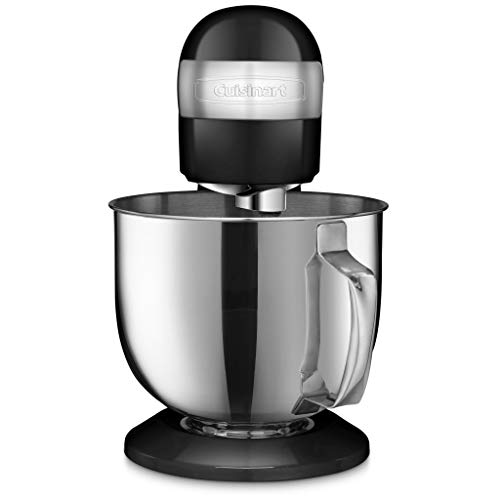
Cuisinart Stand Mixer, 12 Speed, 5.5 Quart, Onyx (SM-50)
Badge: Best Second Station
Strengths
- The identical SM-50 platform — same speeds, bowl and attachments — so training, habits and accessories carry across stations.
- A second station doubles batter throughput at peak and provides instant cover if the first machine is down.
- Onyx is the finish that hides a working day’s splashes in a busy production kitchen.
Trade-offs
- It is deliberately not a different machine; businesses wanting a larger second capacity should look beyond this class.
- Two stand mixers claim real counter space — a micro kitchen must plan the footprint.
- Buying the second station before orders justify it ties up budget that ingredients may need more.
Mini spec box
- Format: stand mixer
- Speeds: 12
- Bowl: 5.5 quart stainless steel
- Attachments named in listing: chef’s whisk, mixing paddle, dough hook
- Features: splash guard with pour spout
- Colour: Onyx
- Model: SM-50BK
Listing the same platform twice is not padding — in business terms, it is the strategy. The second SM-50, in Onyx, is how a growing cake business buys capacity without buying complexity: the same dial, the same bowl, the same attachments, so any helper you train learns one machine and can work at either station, and a whisk or paddle fits whichever mixer is free. Peak days stop being a queue — one station creams while the other whips — and a breakdown stops being a catastrophe, because production limps on at half speed instead of stopping.
The discipline is timing. A second station earns its counter space when your order book regularly collides with itself — two cakes due the same morning, a market day on top of custom orders. Before that point it is a handsome paperweight. The Onyx finish suits the role: darker, forgiving of splashes, and visually distinct enough that “the black one” becomes useful kitchen shorthand for which batch lives where.
Best for: businesses whose order book has begun to collide with itself at peak times / Not suited for: brand-new sellers whose volume has not yet justified a second station
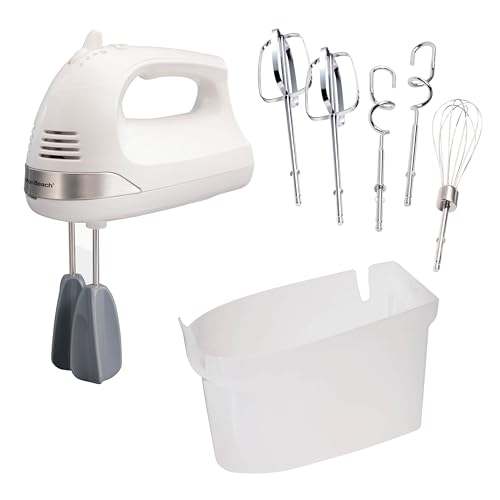
Hamilton Beach 6-Speed Electric Hand Mixer with Easy Clean Beaters (62636J)
Badge: Best Hand Mixer for Business Support
Strengths
- The fullest confirmed attachment set among the hand mixers: two beater styles, dough hooks and a whisk.
- A stated 275 watt motor — the strongest confirmed figure among the support picks.
- The snap-on case keeps the whole support toolkit together and grabbable mid-service.
Trade-offs
- It is a support tool: main batter volume belongs to the stand mixers, and using it as the primary machine will wear it and slow you.
- Six speeds is coarser control than the nine-speed Cuisinart for delicate finishing.
- No soft-start feature is named in the listing.
Mini spec box
- Format: electric hand mixer
- Speeds: 6
- Motor: 275 watts
- Attachments named in listing: easy clean beaters, traditional beaters, dough hooks, whisk
- Storage: snap-on storage case
- Colour: White
In a business kitchen, the most valuable hand mixer is the one that can become whatever the moment needs, and the 62636J’s attachment set makes it exactly that. The stand mixer is occupied with a batter when a small batch of ganache needs whipping — the Hamilton Beach, with its whisk, does it. A test batch of a new flavour, too small to justify the big bowl, gets mixed by hand unit with the beaters. An enriched dough for a special order meets the dough hooks. Its stated 275 watt motor, the strongest confirmed among the hand mixers here, suits this jack-of-all-trades brief, and the snap-on case means the whole capability lives in one grabbable object rather than scattered through drawers.
The management rule is role discipline: this machine supports production; it does not replace it. Businesses that lean on a hand mixer as the primary batter machine discover the cost in time and in motor life. Kept in its support role — overflow, variety, small batches, emergencies — it may be the highest-value-per-drawer-inch purchase in this entire guide.
Best for: businesses wanting one versatile hand mixer for overflow and variety work / Not suited for: use as the primary production machine

Cuisinart 9-Speed Electric Hand Mixer with Storage Case, Brushed Chrome (HM-90BCS)
Badge: Best Premium Hand Mixer
Strengths
- Nine speeds plus SmoothStart anti-splatter — the finest control here for frostings, glazes and gentle folding at finishing stage.
- A stated 220 W motor gives the support role a confirmed power figure.
- The six-piece set in a snap-on case, in brushed chrome, suits a customer-facing kitchen.
Trade-offs
- The listing describes a six-piece set without enumerating each piece.
- Premium positioning within the support fleet — its talents are wasted if your business never does delicate finishing.
- Still a hand mixer: it finishes production, it does not carry it.
Mini spec box
- Format: electric hand mixer
- Speeds: 9
- Motor: 220 W
- Features: SmoothStart anti-splatter technology, snap-on storage case
- Set: 6-piece
- Colour: Brushed Chrome
Finishing is where a cake business shows its quality — the mirror glaze, the buttercream beaten to silk, the meringue folded through a batter without losing its air — and finishing is a control game. The HM-90BCS is the control specialist of the support fleet: nine speeds with a SmoothStart ramp that lets you touch flour, cocoa or icing sugar without redecorating the kitchen, and low gears fine enough to fold without deflating. Its stated 220 W motor and cased six-piece set complete a tool that behaves like it was specced by someone who finishes cakes for money.
In the system this guide proposes, it owns the last ten percent of every cake: the frostings, the glazes, the whipped fillings, the small corrective batches when a colour needs adjusting. That is not a minor role — it is the part the customer sees and photographs. Businesses whose product is simple and rustic may not need its finesse; businesses selling finish should not be without something like it.
Best for: businesses selling finish — frostings, glazes and delicate work at the final stage / Not suited for: primary batter production or deliberately rustic product lines

KitchenAid 5 Ultra Power Speed Hand Mixer, Black Matte (KHM512)
Badge: Best for Finishing Work
Strengths
- Turbo Beaters handle thick frostings and batters without clogging, at detail-batch scale.
- The lockable swivel cord keeps cables out of finished surfaces — a real concern when the cake is already beautiful.
- One-button release and dishwasher-safe beaters keep turnaround between small jobs fast.
Trade-offs
- Five speeds and no named whisk limit its range to the simpler finishing tasks.
- Compact format means small batches only — detail work, not volume.
- Black matte shows icing sugar and flour prominently between cleans.
Mini spec box
- Format: electric hand mixer
- Speeds: 5
- Attachments named in listing: Turbo Beaters
- Features: lockable swivel cord, easy-release button, dishwasher-safe beaters
- Colour: Black Matte
Every production kitchen accumulates a category of tiny mixing jobs that are too small for the stand mixer’s bowl and too urgent to queue: a half-batch of buttercream in a custom colour, a quick whip of cream for one order’s filling, a glaze that needs thirty seconds of beating. The KHM512 is built for that category. It comes out of the drawer fast, its Turbo Beaters push through thick frosting without packing, its cord locks out of the way of finished work, and its beaters eject with one button and go in the dishwasher — so the whole job, from decision to clean machine, takes minutes.
Its limits are the compact format’s limits, and in this role they barely matter. It will not run your production, and it is not asked to. Judged as the detail tool of a business that already has its production stations sorted, it is the pick most likely to be used every single day.
Best for: colour batches, touch-ups and quick finishing jobs in a working cake business / Not suited for: any kind of production volume

Proctor Silex Easy Mix 5-Speed Electric Hand Mixer, Black (62511)
Badge: Best Backup Pick
Strengths
- Compact and lightweight — anyone on the team can grab it and work immediately.
- The bowl-rest feature suits the stop-start rhythm of small business side tasks.
- As the budget-positioned pick, it makes redundancy affordable: a spare that exists beats a premium machine that is broken.
Trade-offs
- 215 watts of peak power is light-duty language; it is not built for daily production loads.
- No case, whisk or soft start is named in the listing — the spec is deliberately minimal.
- Assign it light duties, or its service life in a business will be short.
Mini spec box
- Format: electric hand mixer
- Speeds: 5
- Motor: 215 watts of peak power (as listed)
- Features: bowl rest, compact and lightweight design
- Colour: Black
The Proctor Silex’s business case is a single sentence: it is the spare. Cake businesses do not fear much, but they fear the dead mixer on delivery morning, and the cheapest insurance against that morning is a simple, light machine in a cupboard that can cream, beat and whip at small scale while the main equipment is repaired or replaced. Its bowl rest and light weight suit it to the small side tasks of a production day as well — a quick glaze, a test sponge, a sample batch for a prospective client — keeping the main stations free for paid work.
Discipline matters: a light-duty machine given production duties will die young and take a deadline with it. Kept as backup and light-duty support, it is the most rational small purchase in this guide, and the one whose absence is felt most sharply exactly once — which is once too many.
Best for: deadline insurance and light side tasks in any size of cake business / Not suited for: daily production duty
Comparison Table
| Pick | Format | Speeds | Motor / Bowl (as listed) | Business role | Link |
|---|---|---|---|---|---|
| Cuisinart SM-50, White Linen | Stand | 12 | 5.5 qt stainless bowl | Main production station | Check on Amazon |
| Cuisinart SM-50, Onyx | Stand | 12 | 5.5 qt stainless bowl | Second station / cover | Check on Amazon |
| Hamilton Beach 62636J | Hand | 6 | 275 watts | Versatile support | Check on Amazon |
| Cuisinart HM-90BCS | Hand | 9 | 220 W | Controlled finishing | Check on Amazon |
| KitchenAid KHM512 | Hand | 5 | Not stated | Detail and colour batches | Check on Amazon |
| Proctor Silex 62511 | Hand | 5 | 215 watts peak | Backup and light duty | Check on Amazon |
How to Choose the Best Mixers for Cake Business Production
Choose by bottleneck, not by catalogue. Watch your own production for a week and find where time actually queues: if batters wait for the mixer, you need station capacity — the second SM-50. If finishing waits — frostings made in stolen moments, colours mixed at the last second — you need support depth, and the hand mixers earn their budget. If nothing queues but everything feels fragile, you need redundancy, and the Proctor Silex is the cheapest calm in this guide. Equipment bought against a diagnosed bottleneck pays for itself; equipment bought against a vague feeling becomes clutter with a cord.
Choose second by standardisation. A business lives on repeatability, and repeatability loves identical platforms: the same speeds meaning the same thing at both stations, attachments that swap, habits that transfer to any helper. That is the unglamorous genius of the two-SM-50 core in this shortlist. Variety is a home baker’s pleasure; in a business, every additional machine type is a training cost and a spare-parts question.
Choose also by serviceability in the small: attachments that are easy to source as replacements, bowls that can be bought singly when one is dropped on a tile floor at the worst moment, and designs whose wear parts — beaters, whisks, paddles — are treated as consumables rather than heirlooms. A business does not need a mixer that lasts forever; it needs a mixer whose small failures are cheap, quick and boring to fix, because in production the boring failure is the only acceptable kind.
Choose third by total workload honesty. These are home-class machines, and they suit home-based businesses, market traders, small cafés and side-hustle sellers building toward something bigger. When your week becomes dozens of cakes on a schedule — when a machine would run most of every day — the correct purchase leaves this category for commercial-class equipment with service networks behind it. Knowing that threshold in advance is not pessimism; it is how a business avoids spending twice.
How to Run a Production Morning: The Mixer Workflow
- Plan batches the night before: which cakes, in which order, at which station. The stand mixers take the longest batters first; support mixers are assigned their finishing jobs in writing, not improvised.
- Cream and mix production batters at the SM-50 stations, using the splash guard’s pour spout to add ingredients without stopping the line.
- While batters bake, move to finishing preparation: the Cuisinart HM-90BCS makes frostings and glazes with controlled, splash-free starts; the KitchenAid handles colour batches and small whips.
- Keep the Hamilton Beach as the floating tool — test batches, overflow, the enriched dough for the special order — cased and ready between jobs.
- Wash as you go. Attachments go straight into hot soapy water or the dishwasher at the end of each job; a production kitchen that lets frosting set on beaters is scheduling a scrubbing crisis into its own afternoon.
- At close, wipe down the stations, coil cords, case the hand mixers, and note anything that sounded wrong — a changed motor note is tomorrow’s breakdown announcing itself today.
Troubleshooting. Problem: the main station fails on a delivery morning → move the critical batter to the second station, demote everything else to the support fleet in size order, and call the customer early with a revised time rather than late with an apology. Problem: frosting consistency varies between batches → standardise the finishing machine and speed (the HM-90BCS’s repeatable nine speeds exist for this) and weigh ingredients rather than measuring by volume. Problem: attachments are never where they should be → the case-based picks are the fix; assign every support mixer a home and treat returning it as part of the job, not an afterthought.
Food Safety, Consistency and the Paper Side of Mixing
A business mixer touches food that strangers eat, which adds duties a home baker never meets. Attachments and bowls need a wash-rinse-sanitise rhythm appropriate to your local rules, and stainless bowls like the SM-50’s suit that rhythm well. Colour and flavour discipline matters commercially too: a whisk that carried red colouring into a white batch is not a home mishap, it is a remade cake. Build the habit of washing between colour-critical jobs — the hand mixers’ fast cleanup is an operational feature here, not a convenience. And keep the boring records: which machine, which batch, which day. When a customer reports a problem, the business that can trace its production is the business that survives the conversation.
Allergen discipline belongs in the same paragraph, because mixers are where cross-contact hides. A paddle that mixed a nut sponge and then, rinsed carelessly, a plain one has carried an allergen across your menu. Businesses solve this with process, not hope: a defined wash between allergen-critical batches, attachments inspected before use, and — in many small bakeries — a habit of scheduling allergen-containing bakes last in the day, so the deep clean that ends production resets every machine at once. The fast-cleaning hand mixers in this guide help, but the system is the safeguard, and building it early, while the menu is small, is far easier than retrofitting it after an incident teaches the lesson at full price.
A Note on the Word “Mixer”
One disambiguation, because suppliers and search engines both blur it: the drink world uses the same word for what goes with spirits — guides like the Best Mixers For Cake Vodka, the Best Mixers For Calypso Rum, the Best Mixers For Captain Morgan and the Best Mixers For Caramel Whiskey are about beverages, not machines. If your cake business also runs a bar, you need both vocabularies; this article only equips the kitchen side.
Scaling Signals: How Your Mixers Tell You the Business Is Growing
Equipment speaks before spreadsheets do, if you learn its language. The first signal is the queue: when batters regularly wait for a free station, or finishing regularly waits for a free hand mixer, capacity — not effort — is your constraint, and the correct response is a machine, not longer hours. The second signal is the workaround: when you catch yourself splitting batches awkwardly, mixing frosting in the batter bowl because the right bowl is occupied, or borrowing the backup for everyday work, the system has already outgrown its design and is borrowing from its own insurance. The third signal is sound: a motor whose note has changed — lower, rougher, warmer-running than it was — is a machine approaching the end of its comfortable duty, and in a business that sound should trigger a planned replacement while the old machine can still serve as the spare, rather than an emergency purchase on the worst possible morning.
There is a fourth signal, and it points the other way: the machine that never gets used. A support mixer still in its case at the end of a typical week is capital asleep — sell it, gift it to your future second location, or at least stop counting it in your capacity plans. Healthy small businesses keep their equipment fleet like they keep their menu: everything on it earning its place, nothing carried for sentiment. Reviewing the fleet once a season, against the order book’s actual shape, is the habit that keeps a growing bakery equipped exactly as much as it needs to be — no more, no less.
Menu Design Meets Mixer Capacity
One underappreciated business skill is designing the menu the mixers can actually serve. A menu of twelve cake varieties that each demand a different attachment, a different bowl size and a different finishing technique is a production nightmare wearing a creative hat. The businesses that run smoothly on equipment like this guide’s tend to share a structure: a core of cakes built on two or three batter families — a butter cake base, a sponge base, perhaps an enriched dough — varied by fillings, frostings and finishes, which is exactly where the hand mixers’ colour batches and controlled finishing shine. The variety the customer sees lives in the decoration; the sameness the kitchen needs lives in the mixing.
This is not a counsel of boredom. It is the opposite: a tight production core is what frees a small business to offer a rotating special — the one cake each week where the Hamilton Beach’s hooks or the Cuisinart’s whisk gets to do something new, tested in a small hand-mixed batch before it ever touches a production station. Test small, standardise what sells, and let the equipment fleet and the menu grow together in that order. The businesses that invert it — menu first, capacity be damned — are the ones whose mixers die in the second year and whose owners conclude, wrongly, that the machines were bad.
Training a Helper on This Fleet: Why One Platform Wins
The day a cake business hires its first helper, its equipment choices get audited by a stranger’s hands. This is where the standardised fleet in this guide quietly pays off. One stand-mixer platform across both stations means one dial to learn, one bowl release, one set of attachment habits — a helper trained on Monday at the White Linen station is fully competent at the Onyx station on Tuesday, and the owner’s hard-won feel for “speed four for creaming, speed two for folding” transfers without translation. The hand mixers divide by role rather than by novelty: the finishing Cuisinart, the floating Hamilton Beach, the detail KitchenAid, the spare Proctor Silex — each with a defined job a new team member can be taught in a sentence.
Write those sentences down. A one-page station card — which machine, which speed, how long, what to wash and where it lives — turns your private habits into the business’s standard, and standard is what a customer is actually buying when they order the same cake twice. Equipment cannot create that discipline, but the right fleet makes it easy to keep, and the wrong fleet — six unrelated machines with six personalities — makes it a daily negotiation. When you evaluate the picks in this guide, evaluate them as a team you will one day hand to someone else, because that handover is the moment a hobby becomes a business in the only sense that matters.
The Economics of a Batch: Where Mixer Choice Meets Margin
A cake business sells time as much as cake, and mixers are time machines in the literal sense. Consider what the stand mixer’s hands-free creaming returns: several unattended minutes per batch, every batch, every day — time that becomes decorating, packaging, or the next order’s prep. Consider what a soft-start finishing mixer returns: frostings that do not need re-making because the first one was not deflated or splashed, colours mixed in small exact batches instead of large approximate ones, with the ingredient savings that follow. Consider what the spare returns: not a daily saving at all, but the avoidance of the single most expensive event in a small bakery’s calendar — the refunded, apologised-for, reputation-denting failed deadline.
None of these returns appears on a price tag, which is why equipment comparisons that stop at purchase cost mislead businesses. The better mental model is cost per reliable batch across the machine’s working life, including the labour it saves and the disasters it prevents. Run that model honestly and the fleet in this guide sorts itself: the production station earns daily, the support fleet earns weekly, the spare earns once — catastrophically well. Budget in that order, and a small business’s equipment money goes where its risk actually lives.
Common Buying Mistakes
Mistake one: buying a single premium machine instead of a system — one mixer, however good, is a single point of failure with orders depending on it. Mistake two: pressing hand mixers into primary production, which wears them out and slows the line; support tools must stay support tools. Mistake three: buying the second station before the order book collides with itself, starving the ingredient budget for capacity you do not yet need. Mistake four: mixing platforms casually, so every station behaves differently and no helper can be trained once. Mistake five: ignoring cleanup time in the production plan — in a business, washing attachments is production time and should be scheduled like it. Mistake six: staying in home-class equipment past the volume where commercial machines, with their duty ratings and service support, become the cheaper honest option. Mistake seven: designing a menu of a dozen unrelated batters that no fleet this size can produce calmly — variety belongs in the fillings and finishes, where the support mixers make it cheap, not in a dozen production lines your stations cannot run.
Final Recommendation
Build the system in order. Start with the Cuisinart SM-50 stand mixer as your production station — twelve speeds, the full attachment trio and hands-free working make it the business’s engine. Add the Hamilton Beach 62636J as the support all-rounder and the Proctor Silex as your spare, then let the order book tell you when the second SM-50 station and the finishing specialists have earned their places. That sequence — engine, support, insurance, capacity — is how small cake businesses equip themselves without wasting money or risking deadlines, and it scales calmly from a kitchen-table side business to a small bakery with its first employee.
Frequently Asked Questions
Can I run a cake business with home-class mixers?
Yes, at home-business scale — custom orders, market stalls, small café supply — and thousands do. The machines in this guide are home-class, and the honest limit is duty: when mixing becomes most of every working day, commercial-class equipment with heavier duty ratings and service support becomes the right investment. Grow into that decision with your order book, not ahead of it.
Why does this guide list the same stand mixer twice?
Because a second identical station is a deliberate business strategy: parallel capacity at peak, instant cover during a breakdown, one platform for training and attachments. The two SM-50 finishes — White Linen and Onyx — are the same machine, and the guide says so openly rather than dressing a colour change up as a different product.
What do hand mixers actually do in a cake business?
Finishing and flexibility: frostings and glazes at controlled speeds, colour batches too small for the main bowl, whipped fillings, test batches of new flavours, overflow on peak days, and emergency cover. They are the support fleet — constantly used, never the production line itself.
How many mixers does a small cake business need?
A workable minimum is three roles: one production stand mixer, one versatile hand mixer for support, and one inexpensive spare that lives in its cupboard and is tested occasionally so you know it still works on the morning you need it. Busy businesses add a second production station before they add a third hand mixer, because batter capacity is usually the first bottleneck to bite.
Is the 5.5-quart bowl big enough for business batches?
For home-business batch sizes — the cakes one or two people can finish, decorate and deliver in a day — yes, it is a sensible working capacity, and its stainless construction suits a wash-heavy routine. Businesses routinely mixing for many cakes at once will feel the one-bowl rhythm and should treat that feeling as the signal for the second station.
Should I buy the second stand mixer before or after hiring help?
Before, in most cases. A second station multiplies one trained person’s output immediately, because batters stop queuing; a helper multiplies output only after training, and trains faster on a standardised fleet. The exception is the business whose bottleneck is decorating and finishing rather than mixing — there, hands beat machines, and the order of purchases reverses. Diagnose your own queue honestly and buy against it.
Can I use the hand mixers for customer cakes, or only for tests?
For customer cakes, confidently — in their roles. Frostings, glazes, colour batches, whipped fillings and small sponges made with the support fleet go into sold cakes every day in real businesses. What hand mixers should not do in a business is carry the main batter volume, because time and motor life, not quality, are what suffer.
What is the first sign I have outgrown this class of mixer?
A queue that survives your scheduling fixes. When batters still wait after you have staggered production sensibly, when the second station runs as constantly as the first, and when a single breakdown would cancel a full day’s orders despite your spare — the business has outgrown home-class equipment, and the next purchase belongs in the commercial category. Treat that moment as a success milestone: it means the order book, not optimism, is asking for the upgrade.
How should I clean mixers in a commercial routine?
Wash attachments immediately after each job in hot soapy water or the dishwasher where the listing allows, sanitise according to your local food-business rules, and never let frosting or batter dry on attachments — dried residue is both a hygiene problem and a scrubbing tax. Wipe machine bodies down daily; flour and sugar dust find every seam in a working kitchen.


