Disclosure: topratedkitchenware.com is reader-supported. When you buy through links on our site, we may earn an affiliate commission from Amazon and other retailers, at no extra cost to you.
Where to buy
Every linked pick in this guide to best rice cookers for small amount of rice is listed on Amazon, where you can check the latest price on Amazon, confirm the exact variant and read the current listing details before ordering. Listings and bundles change, so match the full model name on the listing to the pick reviewed below. Orders are placed on Amazon under its normal delivery and returns terms.
- Best Simple Small Batch: BLACK+DECKER Rice Cooker 6-Cup (Cooked) — Check on Amazon
- AROMA Rice Cooker ARC-363NG 3-Cup — Check on Amazon
- Zojirushi NS-ZCC10 Neuro Fuzzy Rice Cooker — Check on Amazon
- Zojirushi NS-TSC10 Micom Rice Cooker 5.5 Cup — Check on Amazon
- Dash Mini Rice Cooker 2-Cup — Check on Amazon
- BLACK+DECKER 16-Cup Rice Cooker RC516 — reviewed below as a prose-only reference pick (no purchase link; see the review for why)
Read the full guide ↓
Cooking a small amount of rice is the task full-size cookers are worst at, which is why the best rice cookers for small amount of rice are not simply smaller versions of family machines. A single cup of grains spread across the base of a big bowl loses moisture at the edges, cooks unevenly, and finishes as a thin, dried-out layer that is hard to serve and harder to wash up. A right-sized bowl keeps the grains in a deep enough bed to steam each other properly, and that geometry — not program count — is what this guide ranks.
Five of the six verified picks here are linked recommendations sized for modest batches, from a true personal mini that cooks one cup uncooked up to compact 3-cup and classic 5.5-cup machines that handle small batches gracefully. The sixth pick, a 16-cup family cooker, is reviewed honestly as a prose-only reference: it is a good machine for crowds and the wrong machine for this job, and including it shows exactly where the boundary of ‘small amount’ sits.
Alongside the reviews you will find the sizing maths in plain language, a how-to for perfect single and double portions, and the mistakes that ruin small batches even in good machines. If your small batches are usually a particular style, the sticky-rice shortlist at Best Rice Cookers For Sticky Rice and the texture discussion at Best Rice Cookers For Wetter Rice are natural next reads.
Key Takeaways
- Bowl geometry decides small-batch quality: grains need depth, not a thin layer across a wide base.
- The honest minimums in this pool run from 1 cup uncooked in the personal mini to small half batches in 5.5-cup Micom machines.
- A 16-cup cooker cannot cook a small amount well, whatever its other virtues — size mismatch is physics, not preference.
- Small batches dry out faster on keep warm; serve promptly or hold only for the length of the meal.
- Rinse and measure with extra care at small scale, because a spoonful of water either way is a bigger percentage of the batch.
- Check the latest price on Amazon and confirm the stated capacity — cooked versus uncooked cups — before ordering any compact cooker.
In this guide
Quick Picks
Six picks, one shortlist. The table below is the whole guide to best rice cookers for small amount of rice on one screen; the detailed reviews that follow explain the reasoning, the trade-offs and the kitchens each machine actually suits.
| Pick | Badge | Format (from listing title) | Best for | Amazon |
|---|---|---|---|---|
| BLACK+DECKER Rice Cooker 6-Cup (Cooked) | Best Simple Small Batch | Format: rice cooker with steaming basket | small households wanting a simple, easy-clean basic cooker | Check on Amazon |
| AROMA Rice Cooker ARC-363NG 3-Cup | Best Overall for Small Amounts | Format: small rice cooker, oatmeal cooker and soup maker | one- and two-person households cooking modest batches often | Check on Amazon |
| Zojirushi NS-ZCC10 Neuro Fuzzy Rice Cooker | Best Premium Small Batch | Controls (per listing title): Neuro Fuzzy logic | daily rice cooks who value texture refinement and a Japanese specialist design | Check on Amazon |
| Zojirushi NS-TSC10 Micom Rice Cooker 5.5 Cup | Best for Couples | Controls (per listing title): Micom (microcomputer) controls with LCD | households wanting Japanese Micom control in the classic 5.5-cup size | Check on Amazon |
| Dash Mini Rice Cooker 2-Cup | Best Personal Size | Pot: removable ceramic nonstick pot | solo cooks, dorm rooms and anyone cooking one serving at a time | Check on Amazon |
| BLACK+DECKER 16-Cup Rice Cooker RC516 | Reference Only — Too Large for This Brief | Controls (per listing title): one touch | large families, gatherings and weekly batch cooking | Prose-only reference |
How These Picks Were Chosen
Selection for this guide started from stated capacity in the verified listings, converted carefully: titles quote uncooked cups, cooked cups, or both, and confusing the two is how buyers end up with a machine twice the size they wanted. Each pick was then judged on the smallest batch it can cook well, not the largest it can cook at all. That is why a personal 2-cup-cooked mini and a 3-cup uncooked compact lead the list, and why the 5.5-cup Micom models qualify — their managed cooking handles modest loads at a sensible depth — while the 16-cup model does not.
The prose-only decision deserves a plain explanation. The BLACK+DECKER RC516 is a legitimate large cooker, but linking it as a recommendation for small amounts would mislead the exact reader this guide serves, so it is reviewed in full, without a purchase link or image, as the reference point for ‘too big’. That follows the same honesty rule used throughout this site: a pick that contradicts the keyword’s core attribute is described, not sold.
Badges mark batch roles. Best Personal Size is the one-serving answer, Best Overall for Small Amounts is the compact most small households should buy, and the premium badges mark the machines whose control refinement shows even at small scale. Readers who also cook Japanese-style small portions may want to compare the specialist angle at Best Rice Cookers Japan once they have settled their size.
The 6 Picks for best rice cookers for small amount of rice, Reviewed

BLACK+DECKER Rice Cooker 6-Cup (Cooked)
Badge: Best Simple Small Batch
Strengths
- Simple format that a first-time rice-cooker owner can use without reading a program chart
- Removable non-stick bowl lifts out for serving and straightforward washing
- Included steaming basket adds a vegetables-or-dumplings option above the rice
Trade-offs
- 6-cup cooked is a small ceiling; growing families will outgrow it quickly
- Basic controls offer no dedicated settings for different grain types
- Results depend heavily on your water measuring, with no fuzzy-logic safety net
Key specs (from the verified listing)
- Capacity (per listing title): 6-cup (cooked)
- Format: rice cooker with steaming basket
- Bowl: removable, non-stick
- Colour: white
This BLACK+DECKER is the straightforward end of the pool: a 6-cup cooked rice cooker with a steaming basket and a removable non-stick bowl, finished in white. There is no program library to learn and no display to decode, and for many buyers that is the point. You add rice and water, start the cook, and the machine handles the one job it was built for. The removable bowl is its practical strength, because it goes from cooker to table to sink without scraping rice out of a fixed pot, and the steaming basket lets a small portion of vegetables or dumplings cook in the same cycle. The limits are equally clear. Six cups cooked is a modest ceiling, the controls cannot adapt to different grains the way a fuzzy-logic model can, and your water ratio does most of the work. Judge it as an honest basic cooker for small, regular batches: buyers who measure carefully will get dependable rice, while buyers who want the machine to think for them should look at the digital picks in this guide instead.
At 6 cups cooked total, this BLACK+DECKER is small enough that a half batch still forms a proper bed of grains, which is the whole game for small amounts. Its simplicity helps too: no program to mis-set, just your measured rice and water and a lever. Measure carefully, because a basic cooker will not correct you, and let the finished rice rest covered before serving. For a single person or a couple who cook rice a few times a week in modest quantities, this is the low-friction answer — provided you accept that its ceiling, not its floor, is what you are really buying.
Best for: small households wanting a simple, easy-clean basic cooker / Not suited for: cooks who want grain-specific programs or large batches

AROMA Rice Cooker ARC-363NG 3-Cup
Badge: Best Overall for Small Amounts
Strengths
- Genuinely small 3-cup uncooked capacity built for modest batches
- 1.5 Qt footprint fits counters and cupboards that rule out full-size cookers
- Oatmeal and soup roles make a small appliance earn its storage space
Trade-offs
- 6-cup cooked ceiling is too small for entertaining or big batch prep
- Basic format has no fuzzy logic to correct a careless water measurement
- Auto keep warm should be used for hours, not all day, before texture suffers
Key specs (from the verified listing)
- Capacity (per listing title): 3-cup uncooked / 6-cup cooked, 1.5 Qt
- Format: small rice cooker, oatmeal cooker and soup maker
- Feature (per listing title): auto keep warm
- Model: ARC-363NG, white
The ARC-363NG is AROMA’s compact classic in this pool: 3 cups uncooked, 6 cups cooked, in a 1.5 Qt white body that the listing also describes as an oatmeal cooker and soup maker, with auto keep warm. Its virtue is proportion. A small batch sits at a sensible depth in a small bowl, so the grains at the edge and the grains in the middle meet similar heat and moisture, which is precisely where oversized cookers disappoint. The extra roles matter at this size, because a tiny appliance has to justify its cupboard space: morning oatmeal and a small pot of soup make it a daily tool rather than a rice-only gadget. Keep expectations aligned with the format. There is no fuzzy-logic correction layer, so rinsing and measuring still decide the result, and the cooked ceiling rules out party batches. For one or two people cooking rice often and in modest amounts, though, this is the kind of right-sized, uncomplicated machine that gets used instead of stored.
This 3-cup uncooked AROMA is the centre of the small-amount map: big enough for two generous servings with leftovers, small enough that one cup uncooked still cooks at a healthy depth in its 1.5 Qt bowl. That balance is why it takes Best Overall here. The oatmeal and soup roles matter at this scale as well, because a compact appliance that only cooks rice has to fight for cupboard space, while one that handles breakfast and a small soup earns its shelf. Use auto keep warm for the meal, not the afternoon, and small-batch texture stays where it should be.
Best for: one- and two-person households cooking modest batches often / Not suited for: large families or bulk batch cooking
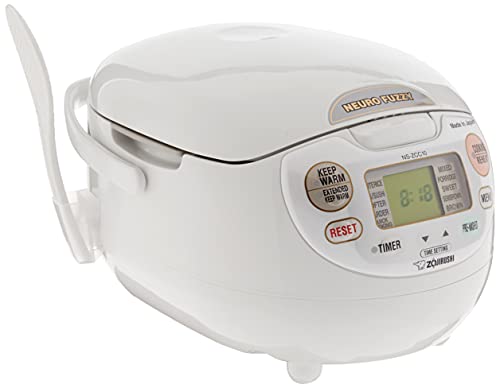
Zojirushi NS-ZCC10 Neuro Fuzzy Rice Cooker
Badge: Best Premium Small Batch
Strengths
- Neuro Fuzzy logic is designed to fine-tune the cook rather than run one fixed cycle
- Japanese specialist brand with a long rice-cooker focus behind the design
- Delay timer and automatic keep-warm suit set-and-forget weekday routines
Trade-offs
- Premium-tier positioning compared with the basic cookers in this pool
- The listing title does not state capacity, so size must be checked carefully before buying
- Buyers who only cook plain long-grain rice may never use its refinement
Key specs (from the verified listing)
- Brand / origin: Zojirushi, the Japanese rice-cooker specialist brand in this pool
- Controls (per listing title): Neuro Fuzzy logic
- Features (per listing title): automatic keep-warm, delay timer
- Format: rice cooker and warmer, white
- Note: the listing title does not state a cup capacity — confirm the exact size variant on the listing before ordering
The NS-ZCC10 is the connoisseur pick in this pool: Zojirushi’s Neuro Fuzzy cooker and warmer in white, with automatic keep-warm and a delay timer. Zojirushi is the Japanese specialist brand here, and the Neuro Fuzzy name describes a control system built to make small, continuous adjustments during the cook instead of following one rigid curve. That refinement shows up most with demanding grains, where a few minutes of soak behaviour and a gentler finish separate separate, glossy grains from a sticky slab. The delay timer supports the way these cookers are actually used in Japanese-style routines: rice measured in the morning, ready at dinner, then held on automatic keep-warm without constant attention. Two honest cautions belong in any recommendation. First, this is premium-tier equipment, and a household that cooks plain rice twice a month will not feel the difference it pays for. Second, the listing title does not state the cup capacity, so confirm the exact size variant on the listing itself before ordering. For daily rice cooks who notice texture, it is the benchmark the rest of this list is measured against.
A premium cooker in a small-amount guide needs justification, and the Neuro Fuzzy Zojirushi has one: managed cooking protects modest batches from the two classic small-batch failures, scorched base and firm top, by adjusting instead of blasting. If you cook a small amount of rice daily and care about texture — a bowl of good rice for one or two, cooked properly — the refinement is not wasted on the small scale; it is arguably most visible there. Note the listing title does not state capacity, so confirm the size variant on the listing, and treat this as the daily-ritual pick rather than the budget answer.
Best for: daily rice cooks who value texture refinement and a Japanese specialist design / Not suited for: occasional rice cooks who will not feel the premium difference

Zojirushi NS-TSC10 Micom Rice Cooker 5.5 Cup
Badge: Best for Couples
Strengths
- 5.5-cup size is the classic household capacity in Japanese-style cooker design
- Micom control with an LCD makes settings and timing easy to confirm at a glance
- Delay timer supports morning-setup, evening-ready rice routines
Trade-offs
- Premium-tier positioning next to the basic lever cookers in this pool
- 5.5 cups will be small for very large families cooking in one batch
- Refined controls are wasted on buyers who want a single lever and nothing else
Key specs (from the verified listing)
- Capacity (per listing title): 5.5 cup, 1.0 L
- Controls (per listing title): Micom (microcomputer) controls with LCD
- Feature (per listing title): delay timer
- Format: rice cooker and warmer
The NS-TSC10 pairs Zojirushi’s Micom — microcomputer — control with LCD controls and a delay timer in a 5.5-cup, 1.0-litre cooker and warmer. That capacity is worth pausing on: 5.5 cups uncooked is the long-standing standard household size in Japanese cooker design, large enough for a family dinner and small enough that a half batch still cooks at a sensible depth. The LCD matters in daily use more than spec sheets suggest, because you can confirm the setting and the timer at a glance instead of guessing from a lever position. Micom control gives the cook a managed curve rather than a simple on-off boil, which is the difference buyers are paying for with this brand. As with its Neuro Fuzzy sibling, the honest framing is value through repetition: cooked daily, the consistency compounds; cooked rarely, a basic cooker in this guide does the job for less commitment. Check the listing for the current variant details, measure your usual batch against the 5.5-cup ceiling, and this becomes an easy cooker to recommend to texture-focused households.
The 5.5-cup NS-TSC10 is the largest machine here that still belongs in a small-amount guide, and it belongs because Micom control plus a sensibly proportioned bowl let a half batch cook at depth. For couples who cook two cups uncooked most nights and a fuller pot when friends visit, it covers both ends without the thin-layer problem. The LCD and delay timer suit a set-it-in-the-morning routine for an evening portion. Below its comfortable minimum, though, physics returns: for a true single cup, the personal mini in this list is the more honest tool.
Best for: households wanting Japanese Micom control in the classic 5.5-cup size / Not suited for: very large families or lever-only simplicity seekers

Dash Mini Rice Cooker 2-Cup
Badge: Best Personal Size
Strengths
- True personal size: 1 cup uncooked is the smallest honest batch in this pool
- Removable ceramic nonstick pot is easy to serve from and wash
- Also handles oatmeal, quinoa and grains, so it earns its place in a tiny kitchen
Trade-offs
- 2 cups cooked is a hard ceiling — it cannot scale up for guests
- Simple mini format has no fuzzy logic or grain programs
- Keep warm on a tiny batch dries the edges faster than on a large batch
Key specs (from the verified listing)
- Capacity (per listing title): personal 1 cup uncooked, makes 2 cups cooked
- Pot: removable ceramic nonstick pot
- Feature (per listing title): keep warm function
- Also cooks (per listing title): oatmeal, quinoa and grains
- Colour: black
The Dash Mini is exactly what its listing title promises: a personal rice cooker that takes 1 cup uncooked and makes 2 cups cooked, with a removable ceramic nonstick pot and a keep warm function, in black. In a pool of family machines, it is the only design whose minimum batch is genuinely one serving, and that changes the cooking physics in its favour — a single portion fills its small pot properly instead of spreading thinly across the base of a big bowl. The ceramic nonstick pot lifts out for serving and washing, and the listing’s oatmeal, quinoa and grains roles make it a small-space all-rounder for dorm rooms, studio flats, office kitchens and solo cooks. The ceiling is absolute, though: 2 cups cooked is dinner for one, not a side dish for four, and there are no smart programs to lean on. Buy it as a personal appliance and it is excellent at its job; buy it hoping it will stretch to family meals and it will disappoint from the first Sunday lunch.
The Dash Mini is the only pick designed from the floor up for this exact keyword: 1 cup uncooked, 2 cups cooked, in a removable ceramic nonstick pot. A single serving fills it properly, so the grains steam each other instead of drying across a wide base, and the pot lifts out to eat from or wash in seconds. It also cooks oatmeal, quinoa and grains, which is how a personal appliance justifies itself in a dorm, studio or office kitchen. Its ceiling is absolute — it will never feed guests — but for the small amount itself, nothing else in this pool is as honestly sized.
Best for: solo cooks, dorm rooms and anyone cooking one serving at a time / Not suited for: families or anyone who hosts
BLACK+DECKER 16-Cup Rice Cooker RC516
Badge: Reference Only — Too Large for This Brief
Strengths
- Largest capacity in this pool for big families, gatherings and batch cooking
- One-touch operation keeps a big machine simple to run
- Steaming basket lets a large batch of vegetables cook above the rice
Trade-offs
- Far too large for small batches, which spread thin and cook unevenly in the big bowl
- Takes significant counter and storage space even when idle
- Basic one-touch control has no grain-specific programs
Key specs (from the verified listing)
- Capacity (per listing title): 16-cup cooked, 8-cup uncooked
- Controls (per listing title): one touch
- Extras: steaming basket, removable non-stick bowl
- Model: RC516
The RC516 is the volume pick: a 16-cup cooked, 8-cup uncooked BLACK+DECKER cooker with one-touch operation, a steaming basket and a removable non-stick bowl. Everything about it is scaled for feeding a crowd in one cycle — large families, meal-prep Sundays, potlucks and households where rice is a base for many plates. One-touch control is the right interface at this size, because the cook’s attention belongs on the rest of the meal, and the removable bowl keeps serving and cleanup manageable despite the volume. Its strength is also its boundary. A cooker built for 8 cups uncooked cannot give a 1-cup batch the depth it needs; small amounts spread across a wide bowl, lose moisture unevenly and finish dry at the edges. That is not a defect, it is geometry. So this model earns its place in guides about feeding many people, and it should be judged there — while small households should honestly pass it by for the compact picks in this same pool, however attractive a big capacity looks on paper.
This review exists to draw the line. The RC516 cooks 16 cups from 8 cups uncooked, and everything that makes it right for a family gathering makes it wrong here: a one-cup batch covers its wide bowl in a film of grains that dries at the edges while the centre steams. No program fixes bowl geometry. It is included, without a link, so that readers tempted by a big capacity ‘just in case’ can see the cost of that insurance clearly. If your life genuinely splits between solo portions and feeding a crowd, buy the small cooker for the portions and borrow, batch-cook or freeze for the crowd — do not ask one oversized bowl to do the small job badly every day.
Prose-only pick: this machine is reviewed in full for reference, but it carries no purchase link and no product image in this guide, because it does not honestly fit the brief of this keyword. The reasoning is recorded in the article’s sources file.
Best for: large families, gatherings and weekly batch cooking / Not suited for: small batches or one- and two-person households
Comparison Table
| Pick | Brand | Capacity (per listing title) | Standout point | Amazon |
|---|---|---|---|---|
| BLACK+DECKER Rice Cooker 6-Cup (Cooked) | BLACK+DECKER | 6-cup (cooked) | Simple format that a first-time rice-cooker owner can use without reading a program chart | Check on Amazon |
| AROMA Rice Cooker ARC-363NG 3-Cup | AROMA | 3-cup uncooked / 6-cup cooked, 1.5 Qt | Genuinely small 3-cup uncooked capacity built for modest batches | Check on Amazon |
| Zojirushi NS-ZCC10 Neuro Fuzzy Rice Cooker | Zojirushi | Zojirushi, the Japanese rice-cooker specialist brand in this pool | Neuro Fuzzy logic is designed to fine-tune the cook rather than run one fixed cycle | Check on Amazon |
| Zojirushi NS-TSC10 Micom Rice Cooker 5.5 Cup | Zojirushi | 5.5 cup, 1.0 L | 5.5-cup size is the classic household capacity in Japanese-style cooker design | Check on Amazon |
| Dash Mini Rice Cooker 2-Cup | DASH | personal 1 cup uncooked, makes 2 cups cooked | True personal size: 1 cup uncooked is the smallest honest batch in this pool | Check on Amazon |
| BLACK+DECKER 16-Cup Rice Cooker RC516 | BLACK+DECKER | 16-cup cooked, 8-cup uncooked | Largest capacity in this pool for big families, gatherings and batch cooking | Prose-only reference |
Read the table by role, not by row order: the right machine for best rice cookers for small amount of rice is the one whose capacity, controls and standout point match the work described in the reviews above.
How to Choose Among the best rice cookers for small amount of rice
Begin with your real minimum batch, written down in uncooked cups. One cup uncooked makes roughly two cups cooked, a generous single portion with a little left over. If that is your usual cook, your shortlist is the personal mini and the 3-cup compacts. If your usual cook is two cups uncooked for two people, the 3-cup class is ideal and the 5.5-cup Micom machines become reasonable. Buyers routinely overestimate their batch; a week of honest notes beats a guess, and it prevents the most common small-amount mistake, which is owning a cooker whose floor is above your ceiling.
Convert every capacity claim before comparing. Listing titles in this very pool quote 6-cup cooked, 3-cup uncooked, 16-cup cooked and 1-cup uncooked personal formats, and those numbers are not comparable until you convert them: cooked volume is roughly double uncooked. A ‘6-cup’ cooker can be the small one and a ‘5.5-cup’ cooker the larger one, depending on which measure the title uses. The verified titles in this guide are quoted exactly as written in each review’s spec box, so convert from those lines rather than from memory of a product name.
Weigh control against simplicity at small scale. Small batches are less forgiving of water error in percentage terms — a small splash is a large fraction of a one-cup batch — so fuzzy-logic and Micom control genuinely help the cooks who measure casually. Careful measurers, by contrast, get excellent small batches from the basic compact cookers here and never miss the electronics. Be honest about which cook you are on a tired Tuesday, not which cook you intend to become.
Plan what happens after the cook. Small amounts lose moisture quickly, so keep warm behaviour matters differently here: you want a gentle hold for the length of a meal, not a marathon setting. Alternatively, cook the small batch fresh each time — at this scale the cook is short — and refrigerate nothing. The related texture guide at Best Rice Cookers For Wetter Rice is worth reading if your small batches keep finishing drier than you like, because the fix is usually water and rest, not a new machine.
Finally, count the other jobs. At small scale, counter and cupboard space are the real budget, and a compact that also cooks oatmeal, soup or grains — as several picks here do, per their listing titles — displaces other appliances. A rice-only mini must be loved for rice alone. Let the machine’s second job break ties between two cookers that both size your batch correctly.
How to Cook a Perfect Small Batch of Rice, Step by Step
Small batches reward precision and punish autopilot. This routine scales the standard method down without losing the steps that matter.
- Measure one cup of uncooked rice with the cooker’s own cup, and note that every later judgement in this routine hangs on using that same cup.
- Rinse in a small sieve or the pot itself until the water runs mostly clear; at small scale, surface starch is a larger share of the finished texture.
- Add water to the matching small-batch line in the bowl, or to your measured ratio, remembering that a single spoonful either way is a big percentage of a small batch.
- Soak briefly if your grain benefits from it, especially short and medium grains; even a short soak evens out a small batch noticeably.
- Cook with the lid closed and do not peek — a small batch has little spare steam to lose.
- Rest the finished rice, covered, for about ten minutes; small batches equalise quickly but still need the pause.
- Fluff once, gently, and serve promptly. Small amounts dry at the edges if they sit, so plate the rice rather than leaving it exposed in the pot.
- If you cooked in a removable-pot mini, serve straight from the pot and wash it immediately; small pots are easiest to clean before the grains dry on.
Troubleshooting
Problem: the small batch is dry and crusty at the edges: The batch was too small for the bowl, or it sat too long before serving. Cook in a smaller cooker, add a spoonful more water next time, and serve as soon as the rest finishes.
Problem: one cup of rice turned into a starchy cake: Too much water for the scale, or no rinse. Rinse until mostly clear and reduce the water slightly; small batches amplify both errors.
Problem: the cooker switched to warm before the rice was done: Very small loads in a basic cooker can trip the sensor early. Use the machine’s stated minimum, soak the grains first so they need less active cooking, and rest the pot covered so residual steam finishes the batch.
Dorms, Studios and Solo Kitchens: Where Small Cookers Earn Their Keep
The small-amount question is usually a small-space question in disguise. In a dorm room, a studio flat or a shared house, the cooker competes for one socket and one shelf, and it often doubles as the serving dish. That is the environment the personal mini and the 3-cup compacts in this guide were effectively designed for: one appliance, one portion, minimal washing up, and a second talent — oatmeal in the morning — that keeps it in daily use rather than in a box under the bed.
Shared kitchens add a timing argument. A small batch cooks fast, so a compact cooker frees the shared counter sooner than a family machine running a full cycle, and a delay-timer Micom model can be loaded before a lecture or a shift and finish as you walk in. If you are furnishing a first kitchen, buy for the portions you cook alone most nights; guests can be fed with a bigger pot borrowed, a stovetop batch, or two quick cycles of the small machine. The Japanese specialist angle on cooking modest portions well is covered at Best Rice Cookers Japanese.
The Minimum-Batch Test: How to Judge Any Cooker for Small Amounts
Every cooker has a floor as well as a ceiling, but listings advertise ceilings. To judge a machine for small amounts, ask what its smallest sensible batch is and whether your usual portion sits comfortably above it. In this pool the floors are unusually honest: the mini is built around one cup uncooked, the compacts around one to three, the 5.5-cup Micom around a modest half load, and the 16-cup reference pick around several cups — which is precisely why it fails this brief despite being a perfectly good cooker.
You can apply the same test to any machine you already own. Cook your usual small portion and look at the geometry before you taste anything: if the grains form a bed with visible depth, the cooker can do the job; if they form a scattered layer you can see the bowl through, it cannot, and no setting will change that. That single observation will save more small batches than any program upgrade.
Freezing and Reheating: The Other Answer to Small Amounts
Some small-amount cooks solve the problem from the other direction: cook a proper batch in a mid-size cooker, portion it, and freeze the portions. Cooked rice freezes well in flat, single-serving packs, and a brief rest in a steamer or a covered reheat with a sprinkle of water brings back a texture that surprises people who have only had dried-out leftovers. If that routine suits you, the 5.5-cup Micom picks in this guide become small-amount machines by portioning rather than by batch, and the minimum-batch problem disappears.
The honest trade-off is freshness. A just-cooked single portion in the personal mini has a gloss and aroma that a reheated portion approaches but does not match, and households differ in how much they care. Decide which routine you will actually follow — daily small cooks, or a weekly batch and freeze — and let that decision, rather than a spec sheet, choose between the mini and the mid-size picks. Both answers are legitimate; buying for the routine you wish you had is the only wrong one.
Leftovers From Small Batches: Cook Once, Eat Twice, Waste Nothing
Small-batch cooking has one quiet advantage over family cooking: leftovers are portion-sized by nature. A cup of cooked rice left from a single batch is tomorrow’s lunch without any dividing, freezing gymnastics or dried-out family-pot remnants. Cool it promptly, refrigerate it in a sealed container, and treat it as an ingredient with a plan — fried rice, a rice bowl under a fried egg, or a reheated side softened with a sprinkle of water under a cover. Small-batch cooks who build that habit find their compact cooker working even harder than its size suggests.
The same logic disciplines the buying decision one last time. If your leftovers pattern is a single portion, the personal and 3-cup picks in this guide are not compromises — they are the exact shape of your cooking. If your pattern is a couple of portions plus tomorrow’s lunch, the 5.5-cup Micom class earns its larger footprint by cooking tonight’s dinner and tomorrow’s portion in one honest batch. Either way, the right question was never ‘how much rice can this machine cook’ but ‘how much rice does my life actually use, per sitting, per week’. Answer that, and the shortlist above ranks itself.
Common Buying Mistakes
- Buying a family-size cooker for solo portions and cooking thin, dried-out layers of rice.
- Comparing capacities without converting cooked cups to uncooked cups, and ending up with double the machine you wanted.
- Measuring a small batch casually, when a spoonful of water is a large percentage of the whole cook.
- Leaving a small batch on keep warm for hours, then blaming the cooker for dry edges.
- Assuming a mini cooker can stretch to guests, instead of planning a second cycle or a stovetop batch.
- Skipping the rinse at small scale, where surface starch dominates the finished texture.
Final Recommendation
For most small households the AROMA ARC-363NG is the recommendation to start from: a true 3-cup uncooked compact whose bowl is proportioned for the batches this guide is about, with oatmeal and soup roles that justify its shelf. Compare it with the Dash Mini before deciding — between them they cover the two core patterns here, the small household batch and the true single portion.
Start your shortlist with the BLACK+DECKER Rice Cooker 6-Cup (Cooked), and compare it against the AROMA Rice Cooker ARC-363NG 3-Cup before deciding — between them they cover the two most common use patterns in this guide.
Step up to the Zojirushi NS-TSC10 if two-person portions are the routine and a fuller pot must also be possible, or to the Neuro Fuzzy model if daily texture justifies a premium. Keep the BLACK+DECKER 6-cup cooked model in mind as the simple, careful-measurer option — and leave the 16-cup reference pick to the crowd-cooking guides where it belongs.
Frequently Asked Questions
What is the smallest amount of rice a rice cooker can cook well?
It depends on the bowl, not the category. The personal mini in this guide is built around 1 cup uncooked, which is a genuine single portion. Compact 3-cup cookers handle one cup uncooked comfortably. A family cooker may need several cups before the grains form a bed deep enough to cook evenly, which is why size matching matters more than brand.
Why does a small amount of rice dry out in a big cooker?
Geometry. A thin layer of grains spread across a wide bowl loses moisture at the edges while the base overheats, so the batch finishes unevenly and dries quickly. The same portion in a right-sized bowl sits in a deep bed and steams itself evenly. No program corrects a bowl that is simply too large for the batch.
Are cooked cups and uncooked cups the same thing?
No, and confusing them is the most common sizing mistake. Rice roughly doubles as it cooks, so a cooker described as 6-cup cooked holds about 3 cups uncooked, while a 5.5-cup uncooked Micom machine makes far more finished rice. Always convert listing titles to one measure before comparing models.
Can I cook half a cup of rice in a mini cooker?
In a personal mini designed around one cup uncooked, a half cup is below the comfortable floor and may finish unevenly. If half-cup portions are your routine, soak the grains first, use the exact water ratio, and rest the pot covered so residual steam finishes the batch — or cook a full cup and refrigerate the second portion for the next day.
Is a premium cooker worth it for small amounts?
Only if you cook small amounts often and notice texture. The Micom and Neuro Fuzzy picks in this guide protect modest batches from scorching and uneven finishes, and that consistency compounds over daily use. For twice-a-month rice, a careful basic compact delivers most of the result; the related discussion at Best Rice Cookers Heavy Com shows how roundup-style guides weigh the same trade-off.
How do I stop small batches sticking to the pot?
Rinse the grains, respect the water line, rest before fluffing, and serve from the pot promptly rather than letting the rice sit and dry onto the surface. A sound non-stick or ceramic-coated pot — both appear in this pool — releases small batches far more kindly than a worn bowl, so check pot condition before changing your recipe.


