Disclosure: topratedkitchenware.com is reader-supported. When you buy through links on our site, we may earn an affiliate commission from Amazon and other retailers, at no extra cost to you.
Where to buy
Short on time? This guide to the best slow cookers tested compares six verified models side by side, with the research method, the detailed sections and the buying advice laid out below. Start with the shortlist, then read the full guide for the reasoning behind every pick.
- Cosori Rice Cooker 10 Cup with Slow Cook — Best for Function-by-Function Testing
- Aroma Housewares ARC-150SB Digital Rice Cooker and Slow Cooker — Best Specialist Test Subject
- Crock-Pot Oval Manual Slow Cooker 7-Quart — Best Baseline for Comparison Testing
- Crock-Pot Programmable Slow Cooker with MyTime 7-Quart — Best Feature-Claim Test Subject
- Hamilton Beach 6 Quart Slow Cooker — Best Repeatability Test Subject
- Crock-Pot Programmable Slow Cooker 8-Quart — Best Endurance and Holding Test Subject
Read the full guide ↓
The word tested does a lot of unearned work in product writing, so this guide to the best slow cookers tested begins by earning it honestly: this page does not claim that its authors put these six machines through a laboratory program, and it prints no invented scores, times or rankings from trials that are not being represented. What it does — thoroughly — is show you what genuine testing of a slow cooker consists of, which verified characteristics of each model predict how it will behave under that testing, and how to run the decisive trials yourself in three ordinary dinners. A reader who finishes this page will know more about how these machines behave than a reader of a dozen score tables, because the method transfers and the scores never could.
That approach suits the category. Slow cookers differ in a small number of testable ways: how evenly and at what pace their gentle settings cook, how honestly their timers and holding modes treat a finished dish, how their vessels handle full and partial loads, and how they wash. Every one of those behaviors can be observed in a home kitchen with a standard battery — beans, a braise, a held stew — and a notebook. The detailed sections below assess each verified model against exactly those behaviors, framed as the expectations a fair test would check and the observations that would settle them.
The lens sections widen the frame: what separates a real test from a demonstration, why single-cook verdicts fail, and how to combine tested evidence with owner experience and ratings without letting any one source overrule the others. For a purchase-focused companion, see Best Slow Cookers To Purchase; for the browning-focused angle on the same category, Best Slow Cookers That Sear is the natural next read.
Two specialist comparisons extend the same discipline: the capacity questions behind Best Slow Cookers That Can Brown Meat and the band-focused shortlist in Best Slow Cookers Under $50 each show how a single stated criterion reorganizes an entire field of verdicts.
Key Takeaways
- This guide prints no invented test scores; it defines what real testing measures and shows how to verify each model’s behavior yourself.
- Four behaviors decide nearly everything: cooking evenness and pace, timer and holding honesty, full-versus-partial load behavior, and cleanup.
- A single cook proves almost nothing — repeated standard dishes under recorded conditions are the minimum unit of tested evidence.
- Each model below is assessed as a set of checkable expectations drawn from its verified specification, with the settling observation named.
- Combine sources in order: verified facts first, your own trials second, owner patterns third, scores last and lightest.
In this guide
Quick Picks
Ordered as test subjects, from the most instructive to the most specialized trial. Each badge names the testing question the model best helps you answer about the whole category.
| Pick | Badge | Capacity / format | Check |
|---|---|---|---|
| Cosori Rice Cooker 10 Cup with Slow Cook | Best for Function-by-Function Testing | 10 cup uncooked / 20 cup cooked | Check on Amazon |
| Aroma Housewares ARC-150SB Digital Rice Cooker and Slow Cooker | Best Specialist Test Subject | 20 cup cooked (10 cup uncooked) | Check on Amazon |
| Crock-Pot Oval Manual Slow Cooker 7-Quart | Best Baseline for Comparison Testing | 7 quart, serves 8+ people | Check on Amazon |
| Crock-Pot Programmable Slow Cooker with MyTime 7-Quart | Best Feature-Claim Test Subject | 7 quart, feeds 9+ | Check on Amazon |
| Hamilton Beach 6 Quart Slow Cooker | Best Repeatability Test Subject | 6 quart | Check on Amazon |
| Crock-Pot Programmable Slow Cooker 8-Quart | Best Endurance and Holding Test Subject | 8 quart, for 10+ people | Check on Amazon |
How These Picks Were Chosen
The pool was verified before any testing discussion began — brand, capacity format, control type, insert material and the features in each verified listing title, confirmed model by model — and the detailed sections assert nothing beyond that verified data. On a page whose subject is evidence, the order of operations is the message: facts first, expectations second, verdicts last and always revisable.
Ordering follows instructiveness as a test subject. Models whose key behaviors are specific, observable claims — a schedule that adjusts, a timer with a stated span, a multicooker’s row of functions — teach the most about how to test, because each claim carries its own settling observation. The classic manual machines anchor the list as baselines: their simplicity makes them the control instruments against which every feature claim in the pool can be measured.
No expectation in the sections below is dressed as a result. Where this guide writes that stoneware would be expected to cook evenly, or that a deep format would be expected to pace sauces differently, it names the trial that would confirm or refute the expectation, and invites the reader to run it. That is not hedging; it is what the word tested means when it is used carefully, and this page would rather teach the careful use than borrow the careless authority.
The 6 Best slow cookers tested
Each section states the model’s verified facts, the expectations those facts justify, and the specific observations that would settle them. Read them as test plans with opinions attached — the opinions are reasoned, and the plans let you overrule them.

Cosori Rice Cooker 10 Cup with Slow Cook
Badge: Best for Function-by-Function Testing
Strengths
- Slow cook sits inside an 18-in-1 program list, so one appliance covers rice, steaming and long braises
- Ceramic-coated inner pot is the easiest surface in this group to wipe clean after sticky sauces
- A delay timer and long keep-warm window suit set-ahead cooking days
Trade-offs
- Cup-based capacity is harder to compare with quart-sized crocks when you shop by roast size
- The slow-cook mode is one program among many, so the interface asks more of a first-time user
- No locking transport lid is stated in the verified title
Mini spec box
- Capacity: 10 cup uncooked, 20 cup cooked (per verified listing title)
- Programs: 18-in-1, including sauté and slow cook
- Inner pot: ceramic coating, non-stick
- Keep warm and delay timer: 24H keep warm and delay timer stated in the listing title
- Included: stainless steel steamer basket
- Control approach: fuzzy logic
As a test subject, the Cosori is a syllabus: eighteen programs, each a claim. A fair test proceeds function by function — the slow-cook program through the standard bean and braise battery, the rice through the household’s own standard, the steamer against a timer and a fork — and records a row of verdicts rather than a blended score. The expectation from its verified design is a strong row: fuzzy-logic control and a sealed, coated pot predict even, gentle behavior, and the settling observations are whether its slow-cook pace matches stoneware’s and whether the coated pot’s cleanup advantage survives a month of saucy cooks.
The Cosori is the multicooker of this group: a fuzzy-logic rice cooker first, with a slow-cook program built into an 18-in-1 menu that also sautés and steams. Its ceramic-coated inner pot behaves differently from stoneware — it heats as part of a sealed rice-cooker body, releases sticky grains and sauces readily, and goes from a morning porridge cycle to an afternoon braise without a second vessel on the counter. The stainless steel steamer basket matters more than it looks: vegetables, dumplings or eggs can ride above a stew instead of turning to mush inside it.
Treat its capacity honestly. Ten cups uncooked, twenty cups cooked, is a rice measure, not a quart measure, so judge it by the batch of grains or stew your household actually eats rather than by the headline number. The delay timer and extended keep-warm are the features slow-cooker traditionalists usually have to buy a programmable crock to get, and here they arrive in a machine that also handles weeknight rice without supervision.
Best for: testers willing to score a row of functions separately / Not suited for: anyone wanting one blended verdict with no conditions attached

Aroma Housewares ARC-150SB Digital Rice Cooker and Slow Cooker
Badge: Best Specialist Test Subject
Strengths
- Three roles in one footprint: rice cooking, slow cooking and steaming
- Digital controls are simpler to set than a multi-program flagship menu
- Stainless steel exterior wipes down easily in a busy kitchen
Trade-offs
- Cup capacity, like the Cosori, needs translating before you compare it with quart crocks
- No programmable slow-cook timer detail is stated in the verified title
- The rice-cooker format gives a rounder, deeper batch shape than an oval crock
Mini spec box
- Capacity: 20 cup cooked, 10 cup uncooked (per verified listing title)
- Functions: digital rice cooker, slow cooker and food steamer in one unit
- Exterior: stainless steel (SS exterior in the listing title)
- Model: ARC-150SB
The Aroma tests as a specialist, and the honest battery respects that: rice judged as rice, steamed food judged on tenderness and timing, and slow cooking judged on the spoonable dishes its deep format exists for — soups, porridges, curries. The expectation from its verified specification is competence within the specialty and strain outside it, and the settling observation is the roast test it was never built to pass. A test that fails a specialist for its specialty’s boundaries has measured the tester, not the machine; this guide records the Aroma’s verdicts inside its arena and says so.
Aroma built its name on rice cookers, and the ARC-150SB shows it: a digital countertop unit that cooks rice, steams food and slow cooks, wrapped in a stainless steel exterior that shrugs off splashes. For households whose slow cooking is mostly soups, congee-style porridges, steamed vegetables over grains and saucy one-pot meals, that triple role is a genuine space saver — one lid, one pot, one cord to store.
Where it differs from a classic crock is shape and expectation. The batch sits deeper and rounder, which suits spoonable food better than a wide flat roast, and the digital panel invites timed, set-and-leave cooking rather than dial-twiddling. Shoppers who slow cook mostly large whole cuts should picture that geometry before choosing it; shoppers who steam as often as they braise will feel at home immediately.
Best for: grain-centered households testing within the specialty / Not suited for: testers who insist every machine face the roast trial

Crock-Pot Oval Manual Slow Cooker 7-Quart
Badge: Best Baseline for Comparison Testing
Strengths
- The simplest control scheme in the group: one dial, High, Low and Warm
- Oval stoneware fits whole roasts and chickens in a natural orientation
- Removable stoneware moves from base to table to sink without fuss
Trade-offs
- No timer and no automatic switch to Warm, so someone must be home to change settings
- Manual control means cooking ends when you end it, not when a program ends it
- Stoneware is heavier than a coated metal insert
Mini spec box
- Capacity: 7 quart, serves 8+ people (per verified listing title)
- Settings: High, Low and Warm, manual dial control
- Insert: removable oval stoneware
- Exterior: stainless steel
The manual oval is the control instrument of any honest battery: with one dial and a stoneware vessel, it removes control-scheme variance so completely that differences in outcome can be blamed only on vessel and heat. The expectation is the category’s reference behavior — even, patient cooking of beans and braises, and an equally reference-grade failure in the hold trial, where no timer exists to rescue a delayed dinner. Every programmable claim in this pool is, in the end, a claim to beat this baseline by a margin worth its electronics, and the control is what makes the margin measurable.
This is the archetypal slow cooker: an oval stoneware crock in a stainless steel base, a single dial, and three honest settings. There is nothing to program, nothing to update and nothing to learn beyond the oldest rule in slow cooking — Low for the long day, High for the shorter one, Warm for holding dinner until people sit down. The seven-quart oval shape is the quiet advantage: roasts, whole chickens and ribs lie flat instead of being folded into a round pot.
Manual control cuts both ways, and this guide will not pretend otherwise. Without a timer, the cooker will not rescue a meal if your day runs long; it will simply keep cooking. For cooks who are home, who cook on weekends, or who pair the dial with a simple routine of starting Low in the morning and switching to Warm at dinner, that limitation rarely bites — and the absence of electronics removes the most common failure point in the category.
Best for: anyone establishing a baseline before judging feature claims / Not suited for: households whose decisive trial is the delayed dinner
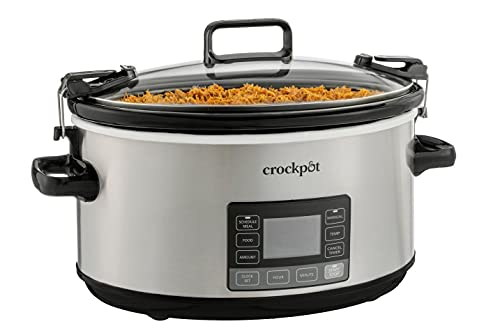
Crock-Pot Programmable Slow Cooker with MyTime 7-Quart
Badge: Best Feature-Claim Test Subject
Strengths
- MyTime adjusts the cooking cycle to finish when you ask it to, rather than when a fixed timer ends
- Locking Cook & Carry lid makes transport to gatherings far less risky
- Programmable convenience in a full seven-quart family format
Trade-offs
- More electronics means more to learn than a one-dial manual crock
- The schedule-based approach rewards cooks who plan a finish time
- Locking lids should not be clamped during everyday cooking unless the maker directs it
Mini spec box
- Capacity: 7 quart, feeds 9+ (per verified listing title)
- Technology: MyTime, which adjusts cooking to your schedule
- Lid: Cook & Carry locking lid
- Exterior: stainless steel
The MyTime model carries the pool’s boldest testable claim — that its cooking adjusts to finish at a set time — and bold claims are a tester’s gift, because they specify their own trial: one braise, three different finish times, texture compared across all three and against the control. The locking lid adds a second, simpler trial involving a car journey and a pot of chili, which it is expected to pass by design. If the schedule claim survives its trial, this model has earned something no other pick here offers; if it merely approximates, the trial will show that too, which is the point of running it.
The MyTime model answers the most common programmable-cooker complaint: food that finishes at the timer’s convenience instead of yours. Its MyTime technology adjusts cooking so the meal is ready at the time you set, which changes the slow cooker from a rough countdown into a dinner appointment. Around that idea sits a seven-quart Cook & Carry design with a locking lid, built for households that both cook at home and carry dishes to other people’s tables.
The locking lid deserves a calm note. It exists for transport — chili that survives a car ride — and it makes this the natural pick in the group for potlucks, tailgates and family gatherings across town. At home on the counter, most cooks leave lids unclamped and let the cooker breathe as designed. Judged as a package — schedule-aware cooking plus genuine portability — nothing else in this pool combines the same two strengths.
Best for: schedule-driven cooks ready to run the three-finish-times trial / Not suited for: cooks who prefer claims that need no testing

Hamilton Beach 6 Quart Slow Cooker
Badge: Best Repeatability Test Subject
Strengths
- Straightforward three-setting operation that a guest or teenager can run without instructions
- Dishwasher-safe crock and glass lid make cleanup a non-event
- Six quarts is the most flexible single size for everyday family cooking
Trade-offs
- No programmable timer is stated in the verified title
- Fewer features than the digital picks for schedule-driven households
- Glass lid is not a locking transport lid
Mini spec box
- Capacity: 6 quart (per verified listing title)
- Settings: 3 cooking settings
- Insert and lid: dishwasher-safe stoneware crock and glass lid
- Finish: silver
- Model: 33665G
The Hamilton Beach is the repeatability subject: three settings, six quarts, dishwasher-safe parts, and almost nothing that can vary between runs. The expectation a tester brings is boring excellence — the bean trial landing within a narrow time band cook after cook, the cleanup trial returning the same low effort — and in testing, that expectation is the most valuable one in this guide, because repeatability is what a household actually buys. A machine that tests brilliantly once and variably forever is a story; this one aims to be a constant.
Hamilton Beach keeps this cooker deliberately plain: six quarts of stoneware, three cooking settings, a glass lid, and parts that go straight into the dishwasher. That plainness is the product. There is no menu to scroll and no program to mis-set, so the cooker disappears into a routine — fill it in the morning, turn one control, come home to dinner. The six-quart size is the category’s everyday sweet spot, big enough for a family stew or a pork shoulder, small enough that a half batch still cooks evenly.
Cleanup is where this design quietly wins weeks. A dishwasher-safe crock and lid sound like a footnote until you have scrubbed a Sunday braise out of a pot that could not go in the machine; here the whole cooking vessel hands that job over. Households that want timers, apps or schedule adjustment should look at the programmable picks instead — this one’s promise is reliability through simplicity, and it keeps that promise completely.
Best for: households buying repeatability above all / Not suited for: cooks whose needs center on programmable timing
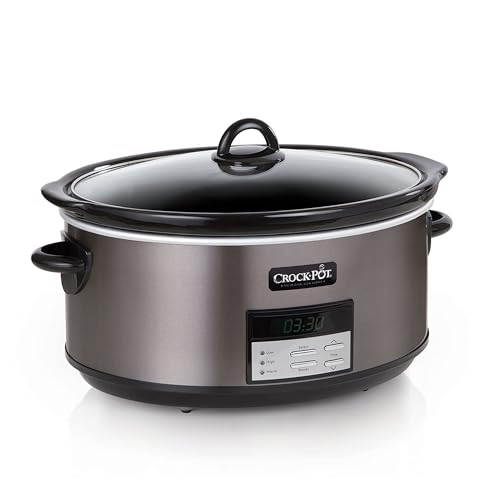
Crock-Pot Programmable Slow Cooker 8-Quart
Badge: Best Endurance and Holding Test Subject
Strengths
- The largest capacity in the group, sized for crowds and serious batch cooking
- A digital timer with automatic Warm covers long, unpredictable days
- Dishwasher-safe stoneware and lid keep a big cooker easy to live with
Trade-offs
- Eight quarts is oversized for small nightly meals and can under-fill
- The footprint and stoneware weight demand real counter and storage space
- Black stainless shows its finish best when wiped, like any dark appliance
Mini spec box
- Capacity: 8 quart, for 10+ people (per verified listing title)
- Timer: digital timer up to 20 hours
- Holding: auto warm setting
- Cleanup: dishwasher-safe lid and stoneware pot
- Finish: black stainless steel
The eight-quart programmable model is the endurance subject: its trials are the long timer run, the extended hold, and the full-load braise, with the half-load cook as the control condition that exposes big-vessel physics. The expectations from its verified specification are strong holding behavior and genuine crowd capacity, balanced against the predicted strain when a small batch spreads across a large floor. Its cleanup trial is also a handling trial — an eight-quart stoneware vessel, washed honestly, is a measurement of the household as much as of the machine.
When the batch is the point, this is the cooker in the group built for it: eight quarts, a digital timer that runs up to twenty hours, and an automatic switch to Warm when cooking ends. Game-day chili, a double batch of pulled pork, soup for a crowd — the capacity is not a spec-sheet flourish, it changes what you can cook in one pass. The black stainless finish gives the big body a calmer, more modern look than bright steel.
Size discipline matters with a cooker this large. Slow cookers cook best when reasonably full, so a household of two making a small stew will work against the design, while a household that batch cooks, entertains or freezes portions will use every quart. The dishwasher-safe stoneware and lid matter at this scale more than anywhere else in the group, because hand-washing an eight-quart crock is nobody’s favorite end to a party.
Best for: batch cooks testing endurance, holding and full loads / Not suited for: small households, whose loads test the vessel at its weakest
Comparison Table
Testing compares conditions before outcomes, so the table records each model’s format and control scheme — the variables every trial must hold or deliberately vary — with capacities quoted exactly as the verified listings state them.
| Pick | Capacity / format | Control style | Check |
|---|---|---|---|
| Cosori Rice Cooker 10 Cup with Slow Cook | 10 cup uncooked / 20 cup cooked | Digital, fuzzy logic, 18-in-1 programs | Check on Amazon |
| Aroma Housewares ARC-150SB Digital Rice Cooker and Slow Cooker | 20 cup cooked (10 cup uncooked) | Digital multi-function | Check on Amazon |
| Crock-Pot Oval Manual Slow Cooker 7-Quart | 7 quart, serves 8+ people | Manual dial, High / Low / Warm | Check on Amazon |
| Crock-Pot Programmable Slow Cooker with MyTime 7-Quart | 7 quart, feeds 9+ | Programmable, MyTime schedule adjustment | Check on Amazon |
| Hamilton Beach 6 Quart Slow Cooker | 6 quart | Three settings, simple control | Check on Amazon |
| Crock-Pot Programmable Slow Cooker 8-Quart | 8 quart, for 10+ people | Digital timer up to 20 hours, auto warm | Check on Amazon |
How to Choose a Slow Cooker on Tested Evidence — Yours
Rank evidence by proximity to your kitchen. A manufacturer’s claim describes an intention; a publication’s test describes its kitchen; owner patterns describe many kitchens statistically; your own three-dinner battery describes the only kitchen the machine will ever cook in. Let each source do its job in that order — claims to form expectations, tests and patterns to narrow the field, and your own trials to decide between finalists that survive the rest.
Choose finalists by the trial that matches your life. If your decisive scenario is the delayed weeknight dinner, the finalists are the machines with timing claims, and the settling test is the hold trial. If it is the Sunday batch, the finalists are the large vessels and the settling test is the full-load braise. Shoppers waste the most money testing — personally or by proxy — behaviors their households will never use.
Insist on failure criteria before you cook. Decide, in writing, what result would cross each finalist off: beans uneven after a fair duration, a hold that ruins texture, a cleanup that exceeds your patience twice. Criteria set in advance protect the decision from the most dangerous force in testing, which is liking a machine and then grading its exam generously.
Beware the single spectacular result. One legendary braise can come from a great cut, a lucky fill level or a kind afternoon as easily as from a great cooker. Tested evidence, properly so called, is the result that repeats under recorded conditions — which is why the cheapest upgrade to any household’s judgment is running the same standard dish twice before concluding anything.
Keep the verdict revisable. A test describes a machine at a moment, in a condition, under one roof. Seals age, households change, and a cooker that won your battery at one batch size may lose it at another. The tested mindset is not a ceremony performed before purchase; it is a standing habit of noticing, recording and updating — the same habit, at home scale, that separates real test kitchens from demonstration stages.
How to Test a Slow Cooker in Three Dinners
You do not need a laboratory; you need three standard dinners, a notebook and criteria written before the first cook. This is the complete protocol this guide’s expectations are built to be judged by.
- Dinner one, the bean trial: dried beans, water and aromatics on Low, undisturbed. Record fill level, duration and the evenness of tenderness between the top and bottom of the pot.
- Dinner two, the braise trial: one tough cut of uniform size over root vegetables, cooked to tenderness. Record duration, sauce behavior, any scorching or drying at the edges, and the honest cleanup effort afterwards.
- Dinner three, the hold trial: a finished stew held on Warm or its equivalent for the length of your real commute plus an hour. Record what the holding cost in texture and moisture.
- Repeat dinner one exactly. Compare the two runs before forming any conclusion; agreement is evidence, disagreement is a lesson about your variables.
- Score against the criteria you wrote in advance — not against perfection, and not against a different machine’s battery.
- Write the verdict page: strengths observed, strains observed, conditions recorded, and the household scenarios this machine has now earned or forfeited.
Three dinners and a repeat: that is the entire cost of converting an opinion into tested knowledge about the appliance that may cook a thousand of your meals. No score printed anywhere, by anyone, is worth more than that page of your own handwriting.
Troubleshooting
Problem: Your results contradict a published test you read → compare conditions before doubting either side: batch size, ingredient temperature and the age of dried goods each swing outcomes. Where conditions match and results still differ, trust your kitchen — it is the one the machine has to please.
Problem: A feature claim seems impossible to test at home → translate it into its observable consequence: schedule adjustment becomes three finish times for one braise; capacity becomes a full-load and half-load comparison. A claim with no observable consequence is not a feature but a slogan, and should be priced as one.
Problem: Everything tests adequately and nothing stands out → that is a common and honest result in a mature category; decide then on the untestable-by-cooking criteria — cleanup effort recorded across the trials, storage fit, control preference, and which machine your household reached for without thinking.
Demonstration Versus Test: How to Tell Them Apart Anywhere
A demonstration shows a product succeeding once, under chosen conditions, at the thing it does best. A test states a claim, fixes conditions, defines failure in advance, repeats, and reports what happened — including the runs that embarrassed the hypothesis. The two look similar in a headline and are opposites in evidentiary value, and the shopping internet runs overwhelmingly on the first while borrowing the vocabulary of the second. The word in this guide’s keyword is the most borrowed of all.
The tells are quick to check. Demonstrations feature hero dishes, single runs and adjectives; tests feature standard dishes, repetitions and numbers or careful comparisons. Demonstrations hide their conditions; tests publish them, because conditions are what let a reader judge transfer. Demonstrations never report a favored product’s failure; tests define failure before starting precisely so that reporting it is possible. Run any source — this one included — through those tells, and keep the ones that survive.
This page has tried to survive its own audit: its specifications are confined to verified data, its characterizations are labeled as expectations with settling observations attached, and it claims no trials it is not reporting. If that restraint reads as less exciting than a score table, consider that the excitement was the tell. Evidence is quieter than demonstration, and considerably more useful at dinner time.
Combining the Sources: Facts, Trials, Owners and Scores in Their Proper Order
Each evidence source has a job it does well and a job it does badly, and most bad purchases come from promoting a source past its competence. Verified specifications establish what a machine is — capacity, format, controls, materials — and nothing about how it feels to live with. Structured trials establish behavior under stated conditions, and nothing about other households’ conditions. Owner patterns establish what recurs across many kitchens over years, filtered through every bias the ratings method describes. Scores compress all of it into a mood, losing the reasons on the way down.
The order that respects each source is the order this program’s guides are built in: facts to form the field, trial logic to frame the questions, owner patterns to hunt for recurring warnings, and scores — read as distributions rather than verdicts — as the lightest final check. The browning-focused comparison in Best Slow Cookers That Brown Meat shows the same hierarchy applied to a single feature claim. Reverse the order and the shallowest source elects the winner before the deeper ones are heard.
There is a fifth source, and it outranks the rest for the finalist decision: your own recorded cooking. Three dinners in your kitchen, under your conditions, against criteria you set in advance, constitute tested evidence of the most relevant kind that exists. Everything else in this guide — the expectations, the batteries, the source hierarchy — exists to get you to that page of handwriting with your judgment intact and your criteria honest.
The Limits of Testing: What Three Dinners Cannot Tell You
Honesty about method includes honesty about its edges. Three dinners cannot measure durability — the seal in year four, the dial in year seven — which is why long-term owner patterns remain an irreplaceable source despite their noise. They cannot measure your household’s future: the baby, the new job, the moved house, each of which rewrites the criteria. And they cannot measure delight, the unquantifiable pleasure of a machine that suits a cook’s hand and eye, which real households weigh and real testers respect.
The mature position is therefore plural: test what can be tested, pattern-match what can only be observed over years, and leave a deliberate margin for the human remainder. A guide that promises a single instrument can settle the whole decision is selling the one thing this page refuses to stock — certainty without evidence.
After the Battery: Living With the Winner for a Year
Testing ends at purchase; evidence does not. The household that ran the three-dinner battery owns a baseline, and the year that follows is the long trial no guide can run for it: the seal’s patience, the dial’s manners in month nine, the vessel’s behavior across a winter of beans and a summer of pulled pork. Keep the notebook open beside the cooker and add a line a month — the observation habit that made the purchase smart is the same habit that will make the next one smarter.
Expect the verdict to evolve in one predictable direction: features fade, fundamentals compound. The program that dazzled in week one becomes invisible by month three, while the cleanup effort, the vessel’s weight and the control’s honesty present their bills weekly, forever. That is why this guide’s battery weighted those unglamorous trials so heavily, and why a year of living with a machine tends to vindicate boring excellence over opening-week brilliance with almost comic reliability.
When replacement eventually comes — years on, if the fundamentals were chosen well — the notebook turns the next purchase into a formality: criteria already written, baselines already recorded, a household that knows its batch sizes and its schedule’s true shape. Tested, in the end, is not a label a guide can award a product. It is a condition a household achieves about its own cooking, one recorded dinner at a time.
When to Stop Testing and Start Cooking
There is a point where more evidence stops improving the decision and starts postponing dinner, and a tested mindset includes knowing where it lies. It lies here: when two finalists have both survived the battery, when the owner patterns show no recurring warning you cannot live with, and when the remaining differences are matters of taste rather than performance. Past that point, the correct instrument is not another trial but a coin weighted by preference — which control your hand likes, which vessel your shelf welcomes — because a machine chosen with affection gets used, and use is the multiplier on every other virtue a cooker has. Test rigorously, decide warmly, and cook for years.
Common Buying Mistakes
- Accepting the word tested as a credential without asking what was cooked, how often, and what counted as failure.
- Treating a single spectacular result — yours or a publication’s — as a verdict instead of an invitation to repeat the cook.
- Setting failure criteria after seeing the results, which quietly guarantees the favored machine passes.
- Testing behaviors your household will never use while skipping the hold, cleanup and storage trials it lives with daily.
- Letting a compressed score overrule a structured trial, an owner pattern and your own notebook combined.
- Forgetting the limits: no short test measures year-five durability, so long-term owner evidence must stay in the decision.
Final Recommendation
On tested-evidence reasoning — checkable claims, repeatable behavior, honest failure modes — the first finalist to put through your own battery is the Hamilton Beach six-quart cooker, the pool’s repeatability constant, with the manual oval as the control every other result should be compared against. Between those two baselines, a household can calibrate the entire category in a week of dinners.
Then test your scenario’s champion: the MyTime model if the claim under examination is the schedule, the eight-quart programmable if it is endurance and holding, the Cosori or Aroma if it is a row of functions judged one by one. Write the criteria first, run the battery twice where it matters, and let your own page of handwriting — the only test result earned in the kitchen that counts — make the final call.
To act on this guide: start with the Hamilton Beach 6 Quart Slow Cooker — Check on Amazon; consider the Crock-Pot Oval Manual Slow Cooker 7-Quart — Check on Amazon; consider the Crock-Pot Programmable Slow Cooker with MyTime 7-Quart — Check on Amazon. Each link opens the current listing, where you can confirm the exact configuration, the included parts and the delivery options before you decide.
Frequently Asked Questions
Were these slow cookers actually tested for this guide?
This guide does not claim a laboratory testing program and prints no invented scores or timings. It verifies each model’s specifications from pool data, states the expectations those facts justify, and gives you the complete standard battery — beans, a braise, a held stew, each repeated and recorded — so the decisive testing happens in your kitchen, where its results actually apply.
What is the single most revealing test of a slow cooker?
The bean trial, repeated. Dried beans in water on Low expose evenness, true cooking pace and hot or cool spots with nowhere for a machine to hide, and running it twice under identical recorded conditions separates a cooker’s character from a day’s luck. Add the hold trial if your household’s life depends on delayed dinners.
How is a test different from a demonstration?
A test states a claim, fixes conditions, defines failure in advance, repeats the cook and reports failures alongside successes. A demonstration shows a product succeeding once, at its best dish, under chosen conditions. The vocabulary is often identical; the tells are repetitions, published conditions and admitted failures — check for those before trusting any source, including this one.
Can I really test a slow cooker before buying one?
You can test the decisive behaviors in the first week of ownership, inside any sensible return window: the three-dinner battery costs only meals you would cook anyway. Before purchase, narrow the field with verified facts and owner patterns; after purchase, let your own recorded trials confirm or return the machine while returning is still possible.
Why do published tests of the same cooker sometimes disagree?
Because tests answer the questions they ask, under the conditions they set. Different standard dishes, batch sizes, fill levels and failure criteria produce different honest verdicts. Compare the batteries before comparing the conclusions — and weight most heavily the test whose conditions resemble your kitchen’s real life.
What can testing never tell me about a slow cooker?
Durability across years, fit with a future household, and the simple pleasure of using a machine that suits you. Short tests measure behavior, not longevity; that evidence lives in long-term owner patterns. A sound decision tests what can be tested, consults owners for what cannot, and leaves an honest margin for the rest.


