Disclosure: topratedkitchenware.com is reader-supported. When you buy through links on our site, we may earn an affiliate commission from Amazon and other retailers, at no extra cost to you.
Where to buy
This guide to the best air fryers with least oil brings together six verified picks you can order online today. Every machine below is an air fryer first and foremost, and that matters for this topic: air frying as a method cooks with rapidly circulating hot air instead of a bath of oil, so all six picks can produce crisp food with a teaspoon of oil, a light spray, or no added oil at all, depending on the food. Each name below links to its Amazon listing, and every detailed review further down carries its own Check on Amazon link so you can check the latest price on Amazon for the exact model you are reading about.
- Gourmia French Door Air Fryer Toaster Oven — Best Oven-Style for Low-Oil Cooking. Best for households that cook wide, flat batches like sheet-pan vegetables and chicken thighs.
- Ninja Prestige Smart XL Countertop Oven DT501 — Best Premium. Best for cooks who want one powerful countertop oven that air fries big batches evenly.
- Chefman 6 Quart Dual Basket Air Fryer — Best Dual Basket. Best for couples and small families cooking a main and a side with almost no oil.
- Ninja Foodi 10 Qt DualZone XL DZ401 — Best for Families. Best for larger households cooking two foods at once, most nights.
- Ninja Foodi 8 Qt DualZone DZ201 — Best Balanced Dual Basket. Best for families who want dual-basket flexibility in a smaller footprint.
- OLIXIS Dual Basket 9.5 Quart Air Fryer — Most Flexible Temperatures. Best for cooks who want a wide listed temperature range and a ceramic crisper plate.
Read the full guide ↓ for badges, honest trade-offs, a comparison table and the low-oil technique advice that makes the real difference to your results.
Looking for the best air fryers with least oil usually starts with a disappointment: almost every air fryer advertises that it uses dramatically less oil than deep frying, because that is simply what the appliance does. A deep fryer submerges food in oil. An air fryer surrounds it with fast, superheated air and lets a thin film of fat — sometimes only what the food itself contains — do the crisping. So the honest question behind this search is not which machine magically uses the least oil. It is which machine helps you cook with the least oil in practice: even airflow so food crisps before it dries out, enough space that pieces are not steamed in a crowded pile, controls precise enough to cook delicate foods gently, and a format that suits the meals you actually make.
That is the lens for every pick below. A wide oven-style fryer spreads fries and vegetables in a single layer, which is the single biggest factor in crisping with minimal oil. A dual-basket machine lets a fatty main, like chicken wings, cook beside a lean side, like green beans, each at its own setting, so neither needs extra oil to compensate for the other’s cooking time. And a model with a broad temperature range lets you start low-oil cooking gently and finish hot for colour. If your wider shortlist includes coating questions as well, Best Air Fryers With No Ptoa covers the picks whose listings confirm ceramic or PFAS-free surfaces.
Key Takeaways
- Air frying itself is the low-oil method: all six picks cook with circulating hot air, so the differences that matter are airflow, space and control — not oil claims.
- Single-layer cooking is the biggest low-oil lever. Oven-style picks spread food wide; dual baskets split it into two properly spaced batches.
- A light oil spray or a single teaspoon tossed through fries or vegetables improves browning and helps seasoning stick, but more oil than that mostly makes food soggy rather than crisper.
- Foods with natural fat — chicken thighs, wings, salmon, sausages — need no added oil at all in any of these machines.
- The Gourmia French door oven is the easiest route to big, flat, low-oil batches; the Chefman and the two Ninja DualZone models suit households that cook a main and a side together.
- Preheating, drying food before cooking, and shaking or turning halfway matter more to low-oil crispness than which badge is on the box.
In this guide
Quick Picks
Six picks, six distinct jobs. The badges below are used again in the detailed reviews, so you can track a favourite from this summary straight to its full assessment, its strengths and trade-offs, and its honest limitation.
| Pick | Badge | Who it suits |
|---|---|---|
| Gourmia French Door Air Fryer Toaster Oven | Best Oven-Style for Low-Oil Cooking | Households cooking wide, flat batches in a single layer |
| Ninja Prestige Smart XL Countertop Oven DT501 | Best Premium | Cooks wanting one powerful oven that air fries large batches evenly |
| Chefman 6 Quart Dual Basket Air Fryer | Best Dual Basket | Couples and small families cooking a main and a side together |
| Ninja Foodi 10 Qt DualZone XL DZ401 | Best for Families | Larger households cooking two foods at once most nights |
| Ninja Foodi 8 Qt DualZone DZ201 | Best Balanced Dual Basket | Families who want dual-basket flexibility in a smaller footprint |
| OLIXIS Dual Basket 9.5 Quart Air Fryer | Most Flexible Temperatures | Cooks who want a wide listed temperature range and ceramic crisper plate |
How These Picks Were Chosen
This is a research-led guide, not a hands-on lab test, and it is honest about that. Each pick was cross-checked against the manufacturer’s verified Amazon listing data through the Creators API on 2026-11-20: the exact model, its format, its capacity and its listed functions had to be confirmed before a pick could be linked here. Only facts present in those verified titles — capacities, function lists, temperature ranges, materials and named features — are used as specifications in this article. Where a listing does not state a fact, this guide leaves it out rather than guessing.
For this particular keyword, one judgement call needs explaining openly. “Least oil” is not a specification any listing can prove, and no pick here is linked because of a marketing percentage. All six picks are air fryers, and air frying is inherently a low-oil cooking method compared with deep frying, so all six qualify for the topic. What separated them in the ranking was practical: how well each format supports the techniques that genuinely reduce oil — single-layer spacing, independent zones for foods with different fat contents, temperature ranges that allow a gentle start and a hot finish, and accessories like crisper plates that lift food out of its own rendered fat. Readers who prefer a tiered cooking surface for that spacing can also look at Best Air Fryers With Racks, which approaches the same problem from the accessory side.
What was compared across the pool: format (oven-style versus basket), total and per-zone capacity, listed functions beyond air fry, temperature range where stated, sync features that let two foods finish together, viewing windows, and surface materials where a listing confirms them. Price was deliberately excluded as a ranking factor, and this guide prints no fixed prices or fixed ratings, because both change constantly; use the Check on Amazon links to see the current position for any model.
The 6 Best Air Fryers With Least Oil
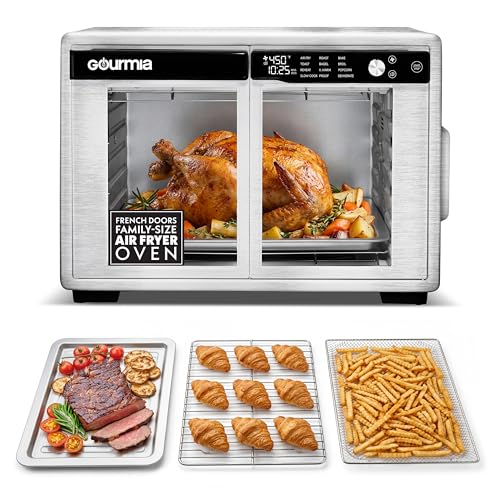
Gourmia French Door Air Fryer Toaster Oven
Badge: Best Oven-Style for Low-Oil Cooking
Strengths
- Wide oven format spreads fries, vegetables and chicken pieces in a single layer — the most reliable route to crisp results with a teaspoon of oil or less.
- French door design opens with one hand and gives a clear view of the whole tray, so you can judge browning without guesswork.
- Twelve cooking presets and adjustable time and temperature cover air frying through to baking and toasting in one appliance.
Trade-offs
- Oven-style air frying is usually a little slower than a small basket for tiny portions.
- The countertop footprint is far larger than a basket fryer, so measure your counter and cabinet clearance first.
- Dishwasher-safe trays help, but a wide oven interior still takes longer to wipe down than a single basket.
Mini spec box
- Format: French door air fryer toaster oven combo
- Capacity: 9-slice capacity, as listed
- Presets: 12 cooking presets
- Airflow: FryForce 360° technology, as listed
- Controls: Digital display, adjustable time and temperature
- Finish: Stainless steel
- Accessories: Dishwasher-safe trays, as listed
For low-oil cooking, layout beats raw power, and this Gourmia’s layout is the point. A tray of sweet potato wedges or a flat layer of chicken thighs sits in open moving air instead of steaming in a deep basket pile, so surfaces dry and brown with the thinnest film of oil — or, for thighs and wings, with none at all, because their own fat renders onto the tray below. The French doors make mid-cook turning easy, and turning is what lets a minimal-oil coating work: every surface gets its turn in the hottest air.
It suits households that cook family-size portions of roasted vegetables, sheet-pan style dinners and frozen snacks, and anyone replacing both a toaster oven and a basket fryer with one machine. The honest limitation is size and speed: for one person’s handful of fries, a big oven cavity is more appliance than the job needs, and preheating a larger space for a tiny snack is wasteful. Buy it for batches, and it earns its counter space every week.
Best for: families cooking wide, flat, low-oil batches / Not suited for: solo cooks making single small portions

Ninja Prestige Smart XL Countertop Oven DT501
Badge: Best Premium
Strengths
- Ten functions in one stainless steel countertop oven, with air fry alongside bake, toast, pizza and reheat.
- Generous listed capacity — the listing notes it fits a 12 lb turkey and bakes 20 cookies — so family batches cook in one spaced layer.
- Powerful 1800W output supports a hot, fast finish that browns food before it dries out.
Trade-offs
- It sits in a premium tier, so it only makes sense if you will use the oven functions, not just air fry.
- The XL format needs real counter depth and clearance above for heat.
- Ten functions mean a learning curve before the controls feel automatic.
Mini spec box
- Format: Countertop oven, 10-in-1
- Power: 1800W, as listed
- Capacity notes: Fits a 12 lb turkey; bakes 20 cookies, as listed
- Functions include: Air fry, bake, toast, pizza, reheat
- Finish: Stainless steel
- Model: DT501
The DT501 earns its place in a low-oil guide through evenness. Uneven airflow is the hidden reason home cooks add oil: when one corner crisps and another stays pale, a brush of extra oil feels like the fix. A large, powerful oven cavity that holds a whole tray at a consistent temperature removes that temptation — fries, Brussels sprouts and chicken pieces brown across the tray, so the teaspoon you started with is genuinely enough. Its size also means a whole family’s portions cook in one layer instead of two crowded basket loads.
It suits keen home cooks who will use it as a genuine second oven: roasting, baking and reheating alongside daily air frying. The honest limitation is commitment — counter space, budget tier and attention. If your air frying is mostly frozen snacks for two, this is more machine than the job requires, and one of the dual baskets below will serve you better.
Best for: keen cooks wanting one premium oven that air fries big batches evenly / Not suited for: small kitchens or snack-only air frying

Chefman 6 Quart Dual Basket Air Fryer
Badge: Best Dual Basket
Strengths
- Two independent 3 quart baskets let a fatty main and a lean side cook side by side, each at its own setting, so neither needs compensating oil.
- Easy View windows let you watch browning without opening the baskets and losing heat.
- Sync Finish brings both baskets to completion together, and auto shutoff adds a safety net.
Trade-offs
- Three quarts per basket limits batch size for larger families.
- The baskets are nonstick, which will not suit readers specifically avoiding nonstick surfaces.
- Two baskets mean two baskets to wash, even though they are dishwasher safe.
Mini spec box
- Format: Dual basket air fryer
- Capacity: 6 quart total; two independent 3 quart baskets
- Features: Easy View windows, Sync Finish, Hi-Fry, auto shutoff
- Baskets: Nonstick, dishwasher safe, as listed
- Controls: Digital
- Colour: Black
The Chefman’s low-oil advantage is separation. Chicken drumsticks release their own fat as they cook; green beans release nothing and dry out if they share that timetable. In a single basket, one of those foods gets compromised, and extra oil is the usual patch. Here each basket runs its own time and temperature, the windows let you check colour without dumping heat, and Sync Finish lands both on the plate together. Lean vegetables get a light spray and a shorter, hotter run; the chicken needs nothing added at all.
It suits couples and small families who cook complete two-part meals several nights a week. The honest limitation is capacity per basket: a 3 quart basket is a two-person portion of fries, not a party batch, and big households should step up to the 10 quart Ninja below. Readers comparing window designs specifically will find the dedicated guide at Best Air Fryers With Window useful alongside this one.
Best for: couples and small families cooking a main and a side with almost no oil / Not suited for: large families or nonstick avoiders

Ninja Foodi 10 Qt DualZone XL DZ401
Badge: Best for Families
Strengths
- Two independent 5 quart baskets give family-size portions room to spread out instead of steaming in a pile.
- Six functions — air fry, roast, broil, bake, reheat and dehydrate — cover most weeknight cooking in one unit.
- Match Cook applies one setting to both baskets for a single big batch; IQ Boost supports full-power cooking when both zones run.
Trade-offs
- The largest footprint of the basket picks here; it needs a permanent counter home.
- Two big baskets are overkill for one or two people.
- No viewing window is stated in the listing, so checking food means opening a basket.
Mini spec box
- Format: Dual basket air fryer, DualZone XL
- Capacity: 10 quart total; two independent 5 quart baskets
- Functions: Air fry, roast, broil, bake, reheat, dehydrate (6-in-1)
- Features: Match Cook, IQ Boost
- Colour: Grey
- Model: DZ401
Crowding is the enemy of low-oil cooking, and the DZ401 is the anti-crowding pick. Ten quarts split across two baskets means a family’s worth of chicken wings and potato wedges can each sit in a single layer with air moving around them. Wings need no oil at all — their skin renders and crisps in its own fat — and wedges need only the lightest toss in a teaspoon of oil because they are not steaming under a second layer. Match Cook turns the whole machine into one big fryer for a single food; the dual zones split it for a complete meal.
It suits larger families and anyone who batch-cooks proteins for the week. The honest limitation is sheer size, in the kitchen and at the sink: both baskets are big, and households of one or two will rarely fill them. If that sounds like you, the smaller DZ201 below keeps the same logic in a footprint that fits your cooking better.
Best for: larger families cooking two foods at once in uncrowded layers / Not suited for: small households or tight counters

Ninja Foodi 8 Qt DualZone DZ201
Badge: Best Balanced Dual Basket
Strengths
- The same six-function DualZone system as its bigger sibling, in a footprint more kitchens can house.
- Smart Finish synchronises two different foods to end together; Match Cook unifies both baskets for one batch.
- Eight quarts total is enough for most families to cook in a single, uncrowded layer per basket.
Trade-offs
- Per-basket portions are smaller than the DZ401, so very large families may cook in two rounds.
- No viewing window is stated in the listing.
- Readers wanting oven-style flat trays should look at the Gourmia or Ninja oven picks instead.
Mini spec box
- Format: Dual basket air fryer, DualZone
- Capacity: 8 quart total; two independent baskets
- Functions: Air fry, roast, broil, bake, reheat, dehydrate (6-in-1)
- Features: Smart Finish, Match Cook
- Colour: Grey
- Model: DZ201
The DZ201 is the balanced expression of the low-oil dual-basket idea. Salmon fillets in one basket need no added oil and a short, hot cook; asparagus in the other wants a light spray and a few minutes less. Smart Finish staggers the starts so both land together, which removes the classic failure mode — holding one food warm while the other finishes, then rescuing its texture with a oily re-crisp. Cooking each food once, correctly, is itself an oil-saving strategy.
It suits families of three to five and couples who regularly cook two-component meals. The honest limitation is the same as every dual basket: long or wide items, like a whole side of salmon or a large pizza, simply do not fit the basket shape. Households whose cooking leans that way should choose an oven-style pick from the top of this guide.
Best for: families wanting dual-basket, low-oil flexibility in a manageable size / Not suited for: very large families or wide, flat foods

OLIXIS Dual Basket 9.5 Quart Air Fryer
Badge: Most Flexible Temperatures
Strengths
- Independent temperature control across a wide listed 80–450°F range lets you start delicate foods gently and finish hot for colour.
- A ceramic crisper plate lifts food out of its own rendered fat, which helps lean cooking stay crisp rather than greasy.
- Ten functions, a sync setting and a shake reminder support the habits that make low-oil cooking work.
Trade-offs
- A newer brand name than Ninja or Cuisinart, with a shorter track record behind it.
- The wide temperature range is only useful if you actually adjust settings per food.
- At 9.5 quarts it still needs a generous counter footprint.
Mini spec box
- Format: Dual basket air fryer
- Capacity: 9.5 quarts across two baskets
- Temperature: Independent control, 80–450°F, as listed
- Functions: 10-in-1, including bake, broil, defrost and dehydrate
- Plate: Ceramic crisper plate, as listed
- Features: Sync setting, shake reminder
- Colour: Grey
Temperature control is an underrated low-oil tool. Lean chicken breast dries out at full blast; started a little lower and finished hot, it stays juicy inside with a browned surface and no oil bath to protect it. The OLIXIS lists the widest temperature span in this group, independently per basket, and its shake reminder prompts the mid-cook turn that minimal-oil food needs to brown evenly. The ceramic crisper plate also answers the surface question many low-oil shoppers ask next, and it is why this model appears in the coating-focused guide at Best Air Fryers With Stainless Steel Basket discussions of alternative cooking surfaces.
It suits experimenting cooks who adjust settings per recipe and households that want near-Ninja capacity with a ceramic plate. The honest limitation is brand history: Ninja and Chefman have longer records in this category, and buyers who value an established service network above features may prefer them.
Best for: cooks who use temperature control actively and want a ceramic crisper plate / Not suited for: buyers who prioritise the longest-established brands
Comparison Table
One view of all six: format, the headline capacity fact confirmed in the listing, and the badge each pick earned. Use it to build a shortlist of two, then read those two detailed reviews closely.
| Pick | Format | Headline size fact | Badge | Listing |
|---|---|---|---|---|
| Gourmia French Door Air Fryer Toaster Oven | Countertop oven | 9-slice capacity, as listed | Best Oven-Style for Low-Oil Cooking | Check on Amazon |
| Ninja Prestige Smart XL Countertop Oven DT501 | Countertop oven | Fits a 12 lb turkey, as listed | Best Premium | Check on Amazon |
| Chefman 6 Quart Dual Basket Air Fryer | Dual basket | 6 quart total, two 3 quart baskets | Best Dual Basket | Check on Amazon |
| Ninja Foodi 10 Qt DualZone XL DZ401 | Dual basket | 10 quart total, two 5 quart baskets | Best for Families | Check on Amazon |
| Ninja Foodi 8 Qt DualZone DZ201 | Dual basket | 8 quart total, two independent baskets | Best Balanced Dual Basket | Check on Amazon |
| OLIXIS Dual Basket 9.5 Quart Air Fryer | Dual basket | 9.5 quarts, 80–450°F independent control | Most Flexible Temperatures | Check on Amazon |
How to Choose an Air Fryer for Cooking With the Least Oil
Choose the format around your food, not the marketing. If your low-oil cooking is mostly flat, spreadable food — vegetable trays, chicken thighs, fish fillets, tofu — an oven-style model like the Gourmia or the Ninja DT501 gives it the single layer it needs. If your meals are two different foods with two different timetables, a dual basket protects each food’s texture without oily compromises. Neither format uses less oil by itself; each makes the low-oil technique easier for a different menu.
Size for a single layer. Do the honest maths on your most common meal. Four chicken breasts, a family portion of fries or a tray of vegetables should fit without stacking. A machine that is too small forces crowding, crowding causes steaming, and steaming is what pushes cooks to add oil and extra time. When in doubt between two sizes for low-oil cooking, the larger cavity usually wins — not for capacity bragging rights, but for air gaps between pieces.
Value temperature range and control. A wide range, like the OLIXIS’s listed 80–450°F, supports gentle dehydrating and reheating at the low end and hard browning at the top. Independent zone control matters just as much: fatty and lean foods genuinely need different treatment, and separate settings are what let both succeed with minimal added fat.
Check the cooking surface. Crisper plates and trays that lift food out of rendered fat keep low-oil results crisp instead of greasy. Surface material is also a preference question: most baskets here are nonstick, the OLIXIS lists a ceramic crisper plate, and the oven models cook on trays. Readers who want an oven format for exactly this flat, tray-based cooking should compare these picks with Best Air Fryers With Toaster Oven, where every pick is a countertop oven.
Think in tiers, not prices. This guide prints no prices because they move, but the tiers are stable: the Chefman and DZ201 sit in the mainstream tier, the DZ401 and OLIXIS in the larger-capacity tier, and the Ninja DT501 in the premium tier. Pay for the tier only when its format matches your cooking; a premium oven used only for fries is money spent on functions you never touch.
How to Cook With Almost No Oil in an Air Fryer
Technique decides your oil use far more than the machine does. Work through these steps and any pick in this guide will cook with a fraction of the oil of pan frying, let alone deep frying.
- Dry the food first. Pat chicken, fish and vegetables dry with a cloth or paper towel. Surface moisture turns to steam, steam prevents browning, and failed browning is what tempts cooks to add oil and time.
- Season, then oil lightly — or not at all. For lean foods, toss with a teaspoon of oil for a family batch, or use a refillable oil spray for an even film. For fatty foods like wings, thighs and salmon, skip the oil entirely.
- Preheat for a few minutes. Food hitting a hot cavity starts crisping immediately instead of sitting in warming air and releasing moisture.
- Arrange a single layer with gaps. Air must move around every piece. Cook a second batch rather than stacking the first; the second batch cooks faster in a hot machine anyway.
- Shake or turn halfway. Baskets want a shake; trays want a turn with tongs. This is what evens out browning when there is no oil bath to do it for you.
- Finish hot for colour. A final couple of minutes at the top of the range browns surfaces. Watch through the window if your model has one, or check briefly — colour develops fast at the end.
- Rest and season again. A minute’s rest settles juices; a final pinch of salt or squeeze of citrus restores the flavour punch that fat usually carries.
Troubleshooting low-oil results
Problem: food comes out pale and soggy → what to do: the layer was crowded or the food went in wet. Dry it, space it, preheat, and cook a smaller batch.
Problem: food is dry and tough → what to do: the temperature was too high for too long for a lean food. Start lower, finish hot, and use a probe or a test piece for thick proteins.
Problem: coating falls off breaded food → what to do: press the crumb on firmly, chill breaded pieces briefly before cooking, and spray the surface lightly so the coating hydrates and sets instead of blowing around.
How Much Oil Different Foods Actually Need
A practical reference, built from the method rather than from any brand’s claims. Fatty proteins — chicken wings and thighs with skin, salmon, sausages, well-marbled beef — need no added oil; their own fat renders and crisps them, and a crisper plate or tray that lifts them clear of that fat keeps the result crisp rather than greasy. Starchy vegetables like potato and sweet potato wedges are the teaspoon category: one teaspoon tossed through a family batch helps edges brown and seasoning cling. Lean vegetables — green beans, asparagus, broccoli — do best with a light spray, mainly to protect tips from drying before they char. Frozen prepared foods usually need nothing; their coatings already contain fat from manufacturing. Breaded fresh foods are the one case where a spray genuinely earns its place, because dry crumb needs a little moisture and fat to set into a crust.
Airflow, Spacing and Why Single-Batch Thinking Fails
The most common low-oil failure has nothing to do with oil at all. A cook fills a basket to the top because the capacity figure on the box sounded generous, cooks for the time a recipe suggests, and gets a pile that is crisp on top and steamed underneath. The fix feels counterintuitive: cook less food at once. Hot air can only crisp the surfaces it can reach, and in a stacked pile it reaches perhaps the top third. Two half-batches, each in a single layer, take barely longer than one overcrowded batch — the second batch enters a fully hot machine and cooks faster — and every piece comes out properly browned with the same teaspoon of oil spread across both.
This is also why headline capacity misleads low-oil shoppers. A basket’s quart figure describes volume, but crisping depends on floor area: how much food can sit in one layer. Oven-style models win on floor area per batch, which is why the Gourmia and the Ninja DT501 rank highly here despite basket models matching them on paper capacity. Dual baskets win a different way, by splitting one meal into two properly spaced floors. When you compare any two models, picture your actual dinner laid out flat inside them. The machine where dinner fits in one layer is the machine that will cook it with the least oil.
Shake and turn discipline belongs in the same conversation. In a deep fryer, oil surrounds every surface at once, so nothing needs moving. In an air fryer, the surface facing the element browns first, and a shake or turn halfway is what gives every other surface its turn. Skipping it produces the patchy result that sends people back to the oil bottle. Models with a shake reminder, like the OLIXIS, or windows that show you the food’s colour, like the Chefman, exist largely to support this one habit.
Reheating and Leftovers: Where Low-Oil Cooking Quietly Wins
One of the strongest everyday arguments for an air fryer in a low-oil kitchen is reheating. Leftover pizza, roast potatoes, fried chicken and pastries go limp in a microwave and dry out in a long oven reheat, so many households refresh them in a pan with fresh oil — quietly adding back the fat the original cooking avoided. An air fryer reheats in minutes with no added oil at all: the circulating air re-crisps surfaces using the fat already in the food. Several picks here list a dedicated reheat function, including both Ninja DualZone models and the Ninja DT501 oven, and it is worth using rather than improvising with a full-power air fry setting.
Work in a single layer again, give leftovers a few minutes rather than a full cooking cycle, and check early — reheated food moves from crisp to dried out quickly because it starts cooked. Dense items like roast potatoes benefit from a brief rest at room temperature first so the centre warms through; delicate items like pastry want a slightly lower temperature so the surface does not scorch before the filling heats. Build this habit and the machine stops being only a fryer substitute and becomes the appliance that keeps a low-oil kitchen practical on busy nights, when the alternative is a takeaway.
Choosing an Oil for High-Heat Air Frying
When you do use oil, the choice matters more than the quantity. Air fryers run hot, and delicate oils can smoke and taste bitter at the top of the range. Neutral, high-heat oils — avocado, light olive oil rather than extra-virgin, grapeseed or a standard vegetable oil — handle air fryer temperatures calmly and let the food’s own flavour lead. Save strongly flavoured oils for finishing: a few drops of sesame oil, chilli oil or good olive oil added after cooking deliver more flavour per drop than any amount cooked at high heat, which keeps total oil down while food tastes richer, not leaner.
Application matters too. Toss sturdy foods in a bowl with a measured teaspoon so every piece carries an even film; spraying mid-cook onto a hot basket wastes oil to evaporation and can leave propellant residue on nonstick surfaces, which is why several manufacturers recommend refillable pump sprays over aerosol cans. Measure honestly for the first week — most people discover their free-poured “little drizzle” was several teaspoons — and the habit of cooking with genuinely little oil becomes automatic.
Common Buying Mistakes
- Believing an oil percentage on the box decides your results. Every air fryer uses a fraction of deep-frying oil. Airflow, space and your technique decide whether your cooking is genuinely low-oil and still crisp.
- Buying too small, then crowding it. A compact fryer stacked full steams food, and steamed food sends you back to the oil bottle. Size for a single layer of your most common meal.
- Adding more oil when food looks pale. Pale usually means wet food, low heat or no preheat. Fix the cause; extra oil on steaming food makes it soggy, not crisp.
- Ignoring the second food. A single-zone machine forces a main and a side onto one timetable. If your meals have two parts, dual zones save more oil — and more frustration — than any single feature.
- Skipping the surface question. If you care about nonstick versus ceramic versus stainless trays, decide before you buy; the cooking surface is the one part of the machine you interact with every single day.
Final Recommendation
For most households, start with the format that matches your menu, because the machine you use every day with confidence is the one that will genuinely change how much oil your cooking uses over months and years, not just in the first enthusiastic week. If you cook wide, flat batches, the Gourmia French door oven makes low-oil cooking almost automatic, because the single layer does the work. If you cook complete two-part meals, the Chefman or the Ninja DZ201 will serve you better, and larger families should step up to the DZ401. The Ninja DT501 is the premium answer when one machine must genuinely act as a second oven, and the OLIXIS is the pick for cooks who will actually use its wide temperature range and ceramic plate.
Whichever you choose, confirm the measurements against your counter and cabinets, and check the latest price on Amazon on the day you order, because pricing in this category moves often. Then spend the first week cooking your staple meals, note the settings that worked, and you will know quickly that you bought well.
If you want a fast answer, start with one of these three and read its detailed review above: Gourmia French Door Air Fryer Toaster Oven, Ninja Prestige Smart XL Countertop Oven DT501, Chefman 6 Quart Dual Basket Air Fryer. Between them they cover the most common households this guide serves, and each links to its listing so you can check the latest price on Amazon today.
Frequently Asked Questions
Can you air fry with no oil at all?
Yes, for many foods. Anything with natural fat — chicken wings and thighs, salmon, sausages — crisps in its own rendered fat with no added oil. Lean foods can also cook with none, but a teaspoon or a light spray noticeably improves browning and helps seasoning stick, so most cooks use a tiny amount for vegetables and fries rather than none.
Does an air fryer really use less oil than pan frying?
Yes, by method rather than by brand. Pan frying cooks food partly submerged in oil that the food absorbs; air frying cooks with hot air and only the thin film you apply, if any. The exact saving depends on the food, but a family batch of fries that might absorb several tablespoons in a pan typically takes a teaspoon in an air fryer.
Why does my low-oil food come out soggy?
Almost always crowding or moisture. Stacked pieces trap steam, and wet surfaces steam before they brown. Dry the food, preheat the machine, cook in a single layer with gaps, and shake or turn halfway. Those four habits fix most soggy results without adding a drop of oil.
Is a spray or a teaspoon of oil better?
A spray gives the thinnest, most even film and is ideal for breaded foods and lean vegetables. Tossing with a teaspoon suits sturdy items like potato wedges, where you can coat every piece in a bowl before cooking. Both are low-oil approaches; choose by food, not by dogma, and avoid aerosol sprays with additives on nonstick surfaces if the maker advises against them.
Which format is best for low-oil cooking, basket or oven?
Neither wins outright. Oven-style models spread flat foods in a single layer and suit trays of vegetables and proteins. Dual baskets suit two foods with different needs cooking at once. Match the format to your most common meal and both will cook with very little oil.
Do crisper plates make a difference to oil use?
They help results rather than oil quantity. A crisper plate lifts food out of its own rendered fat, so fatty foods finish crisp instead of sitting in grease, and air circulates underneath lean foods for more even browning. It is a texture feature that supports low-oil cooking, not a substitute for spacing and drying.
Does the size of the air fryer change how much oil I need?
Indirectly, yes. A machine that is too small for your portions forces stacked layers, and stacked food steams instead of crisping, which tempts you to add oil and time to compensate. A machine with enough floor area for a single layer of your usual meal cooks that meal with the least oil. That is why this guide weights capacity and format so heavily, and why the largest dual basket here suits big families even though a smaller model advertises the same cooking method.
What foods should I never add oil to in an air fryer?
Fatty proteins and most frozen prepared foods need none — their coatings and skins already carry fat, and added oil only creates smoke and grease. Very fatty foods cooked at the highest settings can smoke as fat renders; cook them slightly lower and empty any collected fat from the basket or tray between batches if your model’s instructions advise it.