Disclosure: topratedkitchenware.com is reader-supported. When you buy through links on our site, we may earn an affiliate commission from Amazon and other retailers, at no extra cost to you.
Where to buy
Comparing the best korean chopsticks and want the shortlist first? Three of the six sets below are presented by their own listings as Korean or Korean Japanese style, and those three carry purchase links. The other three are solid stainless steel sets whose listings make no Korean claim at all, so they are reviewed in full but without links — Korean chopsticks have a distinctive geometry, and a guide with this title should link only sets whose makers actually claim it.
- MUYOS Stainless Steel Chopsticks, 5 Pairs, Silver — Best Lightweight All-Rounder (reviewed below, no purchase link)
- Greatamzor Multicolor Stainless Steel Chopsticks, 5 Pairs — Best for Family Tables (reviewed below, no purchase link)
- Greatamzor Titanium Plated Stainless Steel Chopsticks, 2 Pairs — Best Declared Korean Style
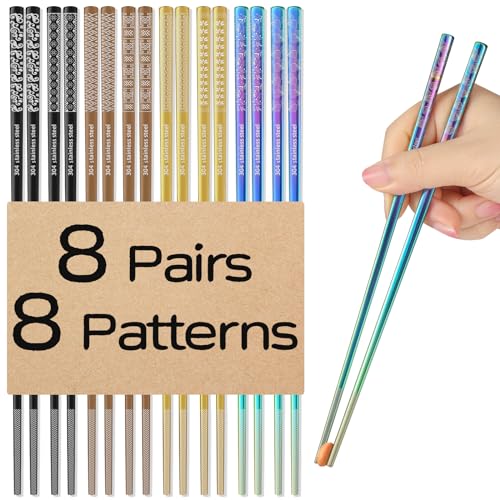
- NEWDRIP Multicolor Metal Chopsticks, 8 Pairs — Best Korean Style for a Crowd
- Lazycorner 304 Stainless Steel Chopsticks, 10 Pairs — Best Bulk Steel (reviewed below, no purchase link)
- IQCWOOD 304 Stainless Steel Chopsticks, 5 Pairs — Best Named Korean Japanese Style
Read the full guide ↓ for what makes a chopstick Korean — the flat profile, the metal tradition, the foods it was shaped by — and how each set measures against that standard.
Korean chopsticks are the metal ones, and the reason is dinner itself. A Korean table centers on dishes that punish wooden utensils: bubbling stews served boiling in heavy pots, tabletop grills where food is turned and cut at the table, and a rotating cast of fermented, pickled and marinated banchan with strong flavors that soak into porous materials. Stainless steel answers all of it — it does not absorb kimchi’s perfume, does not scorch near the grill, does not stain with gochujang — and Korean makers shaped it distinctively: mid-length, slender, and very often flat-sided, because a flat profile grips slippery pickled radish, glass noodles and marinated meats better than a round shaft, and because flat pairs stack, store and wash efficiently in busy kitchens. When shoppers look for the best korean chopsticks, that flat, grippy, heat-proof steel pair is the thing they are picturing, whether or not they have the words for it yet.
This guide judges six steel sets against the Korean standard using only verified listing evidence: the style claim itself, the stated length, the grip treatment and the steel. Three listings claim Korean or Korean Japanese style and are linked. Three claim nothing regional at all — a hollow-core lightweight set, a color-coded family set and a ten-pair bulk set — and they are reviewed honestly as general steel, because each is useful and none should be mislabeled. Along the way we explain the foods that shaped the Korean profile, how it differs from Japanese and Chinese geometry, how to choose within the style, and how to handle the one honest challenge of flat metal: it is the most demanding common chopstick to learn on, and the most rewarding once learned.
Key Takeaways
- Korean chopsticks are defined by metal construction, a mid-length around 9 to 9.25 inches in these listings, and — in the traditional form — a flat-sided profile that grips slippery fermented and pickled foods.
- Three sets here claim the style in their listings and are linked: the Greatamzor titanium-plated two-pair set (Japanese Korean), the NEWDRIP eight-pair set (Japanese Korean Chinese) and the IQCWOOD five-pair set, which names the Korean Japanese style outright.
- Steel is not a modern compromise in Korea; it is the tradition, chosen because stews arrive boiling, grills sit on the table and banchan flavors punish porous materials.
- On flat metal, texture is the difference between mastery and frustration: engraving and non-slip tips are functional necessities, not decoration.
- The three prose-only sets fail on labeling, not quality — none of their listings claims a Korean style, and two do not state a length.
- Flat metal pairs are the hardest common kind to learn on and the most precise once mastered; beginners should start with the most textured pair they can find.
In this guide
Quick Picks
| Pick | Badge | Pairs | Length | Style as listed | Link |
|---|---|---|---|---|---|
| MUYOS Stainless Steel Chopsticks | Best Lightweight All-Rounder | 5 pairs | Not stated in listing | Not stated | See review below |
| Greatamzor Multicolor Stainless Steel Chopsticks | Best for Family Tables | 5 pairs | 9 1/4 inches | Not stated | See review below |
| Greatamzor Titanium Plated Stainless Steel Chopsticks | Best Declared Korean Style | 2 pairs | Not stated in listing | Japanese Korean | Check on Amazon |
| NEWDRIP Multicolor Metal Chopsticks | Best Korean Style for a Crowd | 8 pairs | 9.25 inches | Japanese Korean Chinese | Check on Amazon |
| Lazycorner 304 Stainless Steel Chopsticks | Best Bulk Steel | 10 pairs | Not stated in listing | Not stated | See review below |
| IQCWOOD 304 Stainless Steel Chopsticks | Best Named Korean Japanese Style | 5 pairs | 9.25 inches | Korean Japanese style | Check on Amazon |
The style column divides this table the way it should be divided. The linked three make the Korean claim in writing; two of them back it with a stated 9.25 inch length. The prose-only three are uncommitted products — good steel, no regional promise — and a buyer who cares about the Korean profile should treat that silence as the answer it is. If your table is still deciding between regional geometries, the steel-and-stainless ranking in Best Korean Stainless Stell Chopsticks — original spelling preserved — applies this same evidence test with the material as the headline.
How These Picks Were Chosen
Every set was verified against its listing record before anything else: exact title, brand, pair count, steel description, stated length and stated features, with nothing admitted to the spec boxes that the listing does not state. The linking rule for this keyword is the style rule: a set is linked only when its own listing claims Korean or Korean Japanese style. Three pass. The Greatamzor titanium-plated set lists Japanese Korean; the NEWDRIP eight-pair set lists Japanese Korean Chinese; and the IQCWOOD set names a Korean Japanese style in so many words, alongside its 9.25 inch length. Three do not pass: the MUYOS, the multicolor Greatamzor and the Lazycorner listings describe general reusable steel chopsticks for daily meals, with no regional claim — and in the MUYOS and Lazycorner cases, no stated length either.
Those three are reviewed in full as prose-only entries, without links or product images, because Korean-style shoppers will meet them in every search and deserve a guided judgment rather than silence. Each prose-only review names exactly what is missing — the claim, the length, or both — and credits what the set genuinely offers, from hollow-core lightness to ten-pair depth. A set can be an excellent purchase and a wrong answer to this keyword at the same time; the reviews keep those two judgments separate.
The guide is research-led throughout: verified specifications compared, category knowledge about Korean table practice applied, owner-feedback themes weighed qualitatively, and no hands-on claims we cannot support. We print no prices and no fixed ratings or review counts — both drift too fast to belong in print — and the Check on Amazon links carry the live figures. A scope note: every set here is an adult eating pair in steel. Households equipping children should source training pairs separately, and households cooking at a wok should keep a dedicated long pair at the stove, as the guide to Best Long Chopsticks For Cooking explains — Korean eating pairs, like all eating pairs, are table tools, not cooking tools.
The 6 Best Korean Chopsticks, Reviewed in Detail
MUYOS Stainless Steel Chopsticks, 5 Pairs, Silver
Badge: Best Lightweight All-Rounder
Strengths
- Hollow-core design keeps the pair light — kind to smaller hands over long barbecue dinners.
- Non-slip tips help on the slippery banchan where light pairs usually struggle.
- Plain silver finish and five pairs make it an easy household set.
Trade-offs
- No Korean style claim in the listing — reviewed here without a purchase link.
- No stated length, so the Korean mid-length cannot be verified from the listing.
- Very light pairs can feel vague when turning meat on a grill or lifting stew ingredients.
Spec box: Material: stainless steel, hollow-core design · Pairs: 5 · Length: not stated in listing · Finish detail: non-slip tips · Care: dishwasher safe · Finish color: silver
The MUYOS set approaches Korean eating from the weight side. Korean meals can be long — a barbecue dinner with its rounds of meat, lettuce wraps and side dishes runs at a social pace — and a hollow-core pair asks less of the hand across that distance than any solid set here. Its non-slip tips are doing essential work in this cuisine specifically, because the foods that define the table — kimchi, pickled radish, japchae’s glass noodles — are a catalogue of slippery textures, and a light pair without tip treatment would be a frustrating tool among them. As a general lightweight set for daily meals, which is what its listing promises, it is well conceived.
But this guide’s question is narrower, and on that question the listing is silent twice over: no Korean claim, and no length with which to check the mid-length geometry that defines the style. We therefore review it without a link, as an honest all-rounder that a Korean-style buyer cannot verify as Korean from its own page. The honest limitation compounds at the grill: turning meat and portioning from a bubbling stew pot reward a pair with some planted weight, and the featherweight feel that rests the hand at the table can feel underpowered at the fire. Readers who prize lightness above labeling will still find much to like here — they will simply be buying it as what it verifiably is.
Best for: diners who want the lightest steel pair for long, relaxed meals / Not suited for: buyers who want the Korean style and its length confirmed in the listing
Greatamzor Multicolor Stainless Steel Chopsticks, 5 Pairs
Badge: Best for Family Tables
Strengths
- Stated 9 1/4 inch length sits in the mid-length band Korean pairs occupy.
- Square non-slip shaft with engraved texture — a profile that braces the fingers like the flat Korean form.
- Five colors let a family run the personal-pair system at a busy table.
Trade-offs
- No Korean style claim in the listing — reviewed here without a purchase link.
- Its copper coin pattern is a Chinese motif, not a Korean one.
- Bright colors suit family tables better than formal Korean settings.
Spec box: Material: stainless steel, multicolor finish · Pairs: 5 · Length: 9 1/4 inches · Finish detail: laser-engraved copper coin pattern, square non-slip shaft · Care: dishwasher safe
Profile is where this set makes its quiet case. The traditional Korean pair is flat-sided because flat faces brace the fingers and stop rotation; this Greatamzor set is square-shafted, which is the same mechanical idea in a different cross-section — flat faces to grip, no rolling on the table, and engraved texture along the shaft for the food end of the bargain. Add a stated 9 1/4 inch length in the Korean band and a color system that suits the communal, many-dishes rhythm of a Korean family table, and you have a set whose hardware argues Korean even though its listing never says the word.
The listing’s silence is nevertheless decisive here, and its one decorative statement points elsewhere — the copper coin is a Chinese emblem. Under a Korean heading, we link claims, not arguments, so the set is reviewed in full and linked nowhere. The honest limitation is coherence: on a table set for a formal Korean meal, rainbow steel with a Chinese coin pattern is a cheerful intruder. For a family that cooks across Asia and organizes by color, it may be the most practical set in this entire guide — bought, if bought, as exactly that, with eyes open about the label it does not carry.
Best for: families who want a braced, grippy profile and color-coded pairs / Not suited for: formal Korean settings or buyers who need the style claim in the listing

Greatamzor Titanium Plated Stainless Steel Chopsticks, 2 Pairs
Badge: Best Declared Korean Style
Strengths
- Listed explicitly as a Japanese Korean chopstick — the claim is in the title, not the photography.
- Titanium-plated black and silver finish gives a personal set a distinctive, kept-object feel.
- Laser-engraved non-slip texture, the grip system flat metal pairs depend on.
Trade-offs
- Only two pairs — a personal or couple’s set, not household infrastructure.
- Length is not stated, so mid-length proportions rest on the style claim.
- Plated finishes prefer gentle washing to stay pristine.
Spec box: Material: stainless steel, titanium plated · Pairs: 2 · Length: not stated in listing · Finish detail: laser engraved, non-slip · Colors as listed: black, silver · Style as listed: Japanese Korean · Presentation: gift set
This is the set for the diner who has already converted. Its listing commits to the Japanese Korean style in writing, its engraved texture supplies the grip that metal Korean pairs live or die by, and its titanium-plated finish — black with a depth that reads almost like lacquer, silver with a soft sheen — makes it the pair a person keeps, carries and recognizes as theirs. At a Korean table, where the pair works harder than in any other cuisine — turning, tearing, portioning from shared pots — a personal set with real texture is not an indulgence; it is the difference between participating in the meal and spectating at it.
The limitations are count and confirmation, the same pair that follows this set through every guide: two pairs cannot serve a household, and the unstated length means the mid-length geometry is promised by the style claim rather than published as a number. We accept the claim as the listing’s evidence — a maker who writes the style into the title is making a testable promise about the shape — while noting the gap because this guide notes it everywhere. For a household, pair this set with one of the multipacks below; for an individual or a couple who eat Korean food often and seriously, this is the most deliberate purchase in the roundup, and its durability story is told at length in the Best Long Lasting Chopsticks guide for readers who buy tools by the decade.
Best for: committed Korean-food diners who want a claimed style and a personal, gift-grade pair / Not suited for: families, hosts or anyone who needs more than two pairs

NEWDRIP Multicolor Metal Chopsticks, 8 Pairs
Badge: Best Korean Style for a Crowd
Strengths
- Eight pairs with Korean style claimed in the listing and a stated 9.25 inch length.
- Multicolor finish keeps personal pairs straight at a crowded, shared-dish table.
- Laser-engraved grip and dishwasher-safe steel throughout the set.
Trade-offs
- The listing claims Japanese, Korean and Chinese styles at once — versatility over specialization.
- The steel is described without a named grade.
- Eight pairs need an organizer to stay a system rather than a drawer of loose steel.
Spec box: Material: stainless steel, multicolor finish · Pairs: 8 · Length: 9.25 inches · Finish detail: laser engraved, non-slip · Care: dishwasher safe · Style as listed: Japanese Korean Chinese
Korean dining is communal by design — shared stews, shared grills, a dozen small dishes in the middle — and communal dining eats chopsticks. Pairs are dropped, borrowed, left in the stew pot’s orbit and carried off with leftovers; a household that hosts Korean dinners on a five-pair rotation feels the shortage by the second course. The NEWDRIP set is built for that reality: eight pairs, the Korean claim in writing, a stated 9.25 inch length in the style’s band, engraved texture for the slippery work, and colors so that in the cheerful chaos of a shared table, your pair remains findable. It is the crowd form of the Korean idea, and for hosts it is the easiest recommendation in this guide.
The honest limitations are breadth and anonymity. A listing claiming three regional styles is describing a versatile mid-length pair, and the purist seeking the flattest, most specialized Korean profile will not find that promise here — what is promised, and delivered on paper, is a claimed Korean-capable geometry at a stated length, eight deep. The steel, meanwhile, is named only as stainless, so alloy-focused buyers should compare the 18/8 sets elsewhere in this program. Neither point dents the set’s role: when the table is full and the stew is bubbling, depth and grip are the virtues that matter, and this set has both in writing. Readers furnishing the premium end of the same table will find the Best Luxury Chopsticks guide a useful companion before they decide where this workhorse ends and the occasion pairs begin.
Best for: hosts and families who serve Korean food to a crowd / Not suited for: single-profile purists or alloy-first buyers
Lazycorner 304 Stainless Steel Chopsticks, 10 Pairs
Badge: Best Bulk Steel
Strengths
- Ten pairs of food-grade 304 stainless steel — the deepest stock here.
- Lightweight, non-slip design brief suits high-turnover everyday use.
- Plain silver, dishwasher safe, matches any flatware drawer.
Trade-offs
- No Korean style claim in the listing — reviewed here without a purchase link.
- No stated length, so the style’s defining measurement is unverifiable from the listing.
- Bulk sets are built to a count; profile refinement is not their brief.
Spec box: Material: 304 stainless steel · Pairs: 10 · Length: not stated in listing · Finish detail: non-slip, lightweight · Care: dishwasher safe · Finish color: silver
There is a version of the Korean household — large, busy, feeding many people many dishes every day — for whom ten plain pairs of steel is not excess but Tuesday. The Lazycorner set serves that household’s logistics perfectly: 304 food-grade steel, a non-slip brief, dishwasher safety, and a count that absorbs loss, guests and the dishwasher’s schedule without anyone counting pairs at the door. As infrastructure, it is the strongest offer in this guide, and in a high-turnover kitchen its plainness is a feature — nothing to match, nothing to mourn.
As a Korean-style purchase, it offers no evidence: no claim, no length, and a bulk design brief that does not promise the flat, braced profile the style is known for. It is therefore prose-only here, with the limitation stated as plainly as the virtue. Our standing advice applies: let a set like this form the foundation layer of a hard-working drawer if your household needs one, and let one of the linked, style-claimed sets above be the pair you reach for when the meal is Korean and the details — the flat grip on kimchi, the control at the grill — are the point of the evening.
Best for: large households and high-turnover kitchens that need count above all / Not suited for: style-led buyers who want the Korean claim and geometry verified

IQCWOOD 304 Stainless Steel Chopsticks, 5 Pairs
Badge: Best Named Korean Japanese Style
Strengths
- The clearest claim here: the listing names a Korean Japanese style outright.
- Stated 9.25 inch length backs the claim with the style’s defining measurement.
- Five pairs in 304 stainless steel with non-slip tips — the complete everyday specification.
Trade-offs
- 304 is the general-purpose grade, leaner in nickel than the 18/8 sets elsewhere in this program.
- The hybrid Korean Japanese billing is versatility stated plainly, not single-tradition purity.
- Plain silver finish is a workhorse look rather than a gift look.
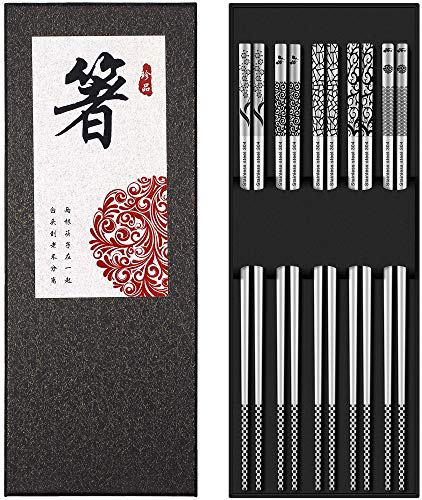
Spec box: Material: 304 stainless steel · Pairs: 5 · Length: 9.25 inches · Finish detail: non-slip tips, lightweight · Care: dishwasher safe · Style as listed: Korean Japanese style
The IQCWOOD set is the paperwork champion of this guide, and at a Korean table paperwork matters, because the style’s virtues are geometric and geometry can be stated. This listing states it twice over: the style is named — Korean Japanese style, as a style — and the length is given, 9.25 inches, squarely in the mid-length band where Korean pairs live. Around that verified core the rest of the specification is sensibly complete: five pairs, 304 steel, non-slip tips for the banchan test, lightweight construction for long meals, dishwasher safety for real life. A buyer who has absorbed this guide’s method — claim, dimensions, mechanism, care — will find every question answered on this listing’s face.
Its limitations are tier and taste. The 304 alloy is the honest general-purpose grade, a step below 18/8 in the nickel that preserves a finish across years; in a single meal, or a single year, you will not feel it. The hybrid billing will not satisfy a buyer seeking a single-tradition instrument — though it should be said that Korean and Japanese lengths genuinely overlap, making this hybrid one of the coherent ones. And the plain finish is a tool’s finish. For the everyday Korean-leaning table — stews on weeknights, banchan always, barbecue on weekends — this is the most straightforward verified purchase in the guide, and the natural first set before a household graduates to the personal luxury of the titanium-plated pair above or the novelty of the Best Lightsaber Chopsticks for a themed party night.
Best for: buyers who want the style named and the length stated in an everyday five-pair steel set / Not suited for: gift buyers or single-tradition purists
Comparison Table
| Pick | Pairs | Length | Steel | Style claim | Link status |
|---|---|---|---|---|---|
| MUYOS | 5 | Not stated | Stainless, hollow-core | None | Prose-only — no style claim |
| Greatamzor Multicolor | 5 | 9 1/4 in | Stainless | None | Prose-only — no style claim |
| Greatamzor Titanium Plated | 2 | Not stated | Stainless, titanium plated | Japanese Korean | Check on Amazon |
| NEWDRIP Multicolor | 8 | 9.25 in | Stainless | Japanese Korean Chinese | Check on Amazon |
| Lazycorner | 10 | Not stated | 304 stainless | None | Prose-only — no style claim |
| IQCWOOD | 5 | 9.25 in | 304 stainless | Korean Japanese style | Check on Amazon |
The claim column is the comparison that matters for this keyword. Three listings promise the Korean style and two of those publish the length that defines it; three promise nothing regional and are bought, if at all, for lightness, color or count. Neither group is dishonest — but only one group is answering the question this guide’s title asks.
How to Choose Korean Chopsticks
Start with the profile. The traditional Korean pair is flat-sided or lightly faceted, because the cuisine’s signature foods — kimchi, pickled radish, marinated meats, glass noodles — are slippery, and flat faces give both the fingers and the food more to hold. None of these listings uses the word flat, so judge by proxy: square or faceted shafts, engraved texture and explicit non-slip tip treatments are the mechanisms that deliver the flat pair’s virtues, and every linked set here has at least one of them in writing. A polished round steel pair, whatever its label, will teach you why the tradition went flat — the hard way, over a bowl of japchae.
Check the length against the band. Korean pairs live in the middle of the three styles, and the stated lengths in this guide — 9.25 inches on both linked multipacks — sit exactly there: long enough to work a shared stew pot at the table, short enough for individual rice bowls. Treat an unstated length as a gap to be filled by the style claim alone, as with the titanium-plated set, or as a reason to choose a documented set instead. Then judge the steel for the table it will serve. Korean food is thermally and chemically aggressive — boiling broth, grill heat, fermented acids, chili oils — and steel’s indifference to all four is the material’s whole argument. Grades differ in finish longevity rather than capability: 304 serves honestly, 18/8 shines longer, plating adds beauty that asks for gentler washing.
Finally, count for communal eating. Korean meals multiply dishes and diners; pairs should multiply with them. Five pairs suit a couple who eat Korean food weekly; eight to ten suit the hosting household. And be honest about skill: flat metal is the most demanding common format, so a household with beginners or children should weight texture heavily — or start learners on a grippier pair and let the flat metal be the graduation, not the first lesson. The machine-washing angle of that decision is covered in Best Machine Washable Chopsticks, since a set used this hard is washed this often.
How to Use and Care for Korean Steel Chopsticks
- Hold the pair with the standard two-stick grip — lower stick still on the ring finger, upper stick moving like a pencil — but expect flat or faceted shafts to feel different: they brace against the fingers rather than rolling between them.
- Grip slightly higher than you would with wooden pairs; metal’s smoothness punishes a low, loose hold, and the textured zone should meet your fingers as well as the food.
- At the grill, use the pair to turn and tear meat in coordination with kitchen scissors, the Korean table’s standard partnership — the chopsticks position, the scissors cut.
- For stews, work from the edge of the pot inward, lifting solids and letting broth drain before crossing to your bowl; never leave the pair resting in a boiling pot, where steel will carry the heat straight to your hand.
- With banchan, take small amounts often rather than large amounts once — the dishes are seasoned to be tasted across the meal, and small bites are also the mechanically easier ones on metal.
- Wash in the dishwasher freely for plain and engraved steel; rinse chili oil and fermented juices promptly, not because steel stains easily, but because the next meal deserves a neutral pair.
Troubleshooting. Problem: kimchi and pickles keep escaping → what to do: your contact point is on the smooth shaft; choke the grip so the textured tips do the holding, and approach slippery pieces from the side, pinching across their width. Problem: the pair gets uncomfortably hot at the grill or stew pot → what to do: it is conduction, not a defect — lift the pair out between tasks, rest it on its rest, and keep a dedicated longer pair for any actual cooking. Problem: beginners in the household are discouraged → what to do: start them on the most textured pair you own, seat them with forgiving foods like rice and grilled items before the noodle and pickle tests, and expect a week of dinners for the flat-metal feel to become normal.
The Foods That Shaped the Korean Pair
Every chopstick style is a fossil of its cuisine, and the Korean pair’s features decode neatly once you know the menu. The metal exists because of heat and fermentation: stews and soups served at a rolling boil in the vessel they were cooked in, grills fired on the table itself, and a battery of fermented side dishes whose flavors and acids would season a wooden pair permanently within a month. The mid-length exists because the table is shared but not vast — dishes sit within one diner’s extended reach, and the pair must travel from communal pot to personal bowl without the ceremony-length of Chinese pairs or the intimacy of Japanese ones. The flat profile exists because of texture: the cuisine’s most characteristic bites are its slipperiest, and generations of makers discovered that a flat face holds a piece of kimchi the way a round shaft simply cannot. Even the traditional pairing of chopsticks with a spoon is in the fossil record — soups and rice in Korea are spoon foods as much as chopstick foods, which is why Korean place settings include both and why the chopsticks were free to specialize in the gripping work. Buy the pair and you are buying the accumulated answers to that menu; the closer your own cooking comes to it, the more sense the answers make in your hand.
Korean Versus Japanese and Chinese Geometry
Set the three styles side by side and the spectrum is tidy. Japanese pairs are the shortest and pointiest, individualized by a cuisine of personal trays and fish. Chinese pairs are the longest, communal by design, built to cross a lazy Susan and descend into hot pots. Korean pairs hold the middle — mid-length, metal by tradition, flat by necessity — communal like the Chinese table but scaled to a smaller spread, and more heat-exposed than either. Hybrid listings like the Japanese Korean claims in this guide are honest products of the spectrum’s middle: the two shorter styles overlap enough in length that one pair can serve both credibly, especially in steel. What no single pair can be is all three at their best, which is why the triple claim on the NEWDRIP set should be read as versatility. Choose your position on the spectrum by your dominant cuisine, and let the other cuisines be served adequately rather than perfectly — that is the real-world settlement every mixed household in this guide’s audience eventually reaches.
Learning Flat Metal: A Week of Dinners
Because this guide keeps calling Korean metal the graduation format, it owes beginners a graduation plan. Dinners one and two: serve forgiving foods — rice, grilled meats, roasted vegetables, thick noodles — and focus only on the grip: upper third, lower stick still, upper stick moving like a pencil. Expect dropped bites; they are tuition, not failure. Dinners three and four: add the slippery middleweights — japchae, marinated mushrooms, sauced tofu — and practice the side-pinch, approaching pieces across their width so the textured tips engage fully. By now the flat or faceted profile should be revealing its purpose: notice how the shaft stops rotating in your fingers compared with the round wooden pairs you may have learned on. Dinners five and six: the banchan examination — kimchi, pickled radish, seasoned sprouts — taken in small, deliberate bites, plus one shared stew eaten with the pair kept out of the pot between lifts. Dinner seven: a full Korean meal at natural speed, grill if you have one, and the honest self-assessment: if the pair has disappeared into your hand — present but unnoticed — you have graduated, and the most demanding common chopstick has become your most precise one.
Two adjustments rescue most strugglers mid-week. The first is grip height: nearly every beginner holds metal too low, near the middle of the shaft, where leverage is worst and the smooth surface has the most say; moving the hand up a finger’s width transforms control overnight. The second is bite size: Korean food is seasoned to be eaten in small, frequent bites across many dishes, and the learner who takes banchan-sized portions succeeds days earlier than the one attempting noodle-shop mouthfuls. Neither adjustment costs anything, and together they explain why the same pair that humiliates a diner on Monday can feel inevitable by Sunday — the tool did not change, and that is precisely the tradition’s point: flat metal rewards the hand that learns it, permanently.
A final encouragement for households hesitating at the format’s reputation: the Korean pair’s difficulty is front-loaded and its rewards are back-loaded, which is the profile of every skill worth having at a table. The same flat metal that tests a beginner in week one is, by month two, the pair that makes every other chopstick in the drawer feel approximate — and the three linked sets in this guide, with their stated claims, lengths and grip treatments, are the most honest starting points the current market offers for making that journey.
Common Buying Mistakes
- Buying polished round steel for a Korean table. The cuisine’s foods are the slipperiest in the category. Texture or a faceted profile is the entry requirement, not an upgrade.
- Trusting a photograph of banchan. Any set can be photographed beside kimchi. The style lives in the listing’s claim and length, not its props.
- Treating a triple-style claim as a specialist promise. Japanese Korean Chinese means versatile mid-length. Buy it for range, not for purity.
- Resting steel pairs in boiling stew. Conduction is instant and unforgiving. The pair comes out of the pot between tasks, every time.
- Starting beginners on the smoothest flat pair. Flat metal is the graduation format. Beginners need the most textured pair in the drawer and a week of forgiving foods.
- Under-counting for communal meals. Shared dishes mean shared chaos; pairs get dropped and borrowed. Depth is a feature at a Korean table.
Final Recommendation
For the everyday Korean-leaning table, buy the evidence: the IQCWOOD five-pair set, with the style named and the length stated. For the hosting household, the NEWDRIP eight-pair set keeps the claim and multiplies it. For the committed diner, the titanium-plated Greatamzor is the personal pair this cuisine rewards. The three prose-only sets remain good steel for lightness, color and bulk — purchased, if you purchase them, as general tools rather than as the Korean answer they never claimed to be.
Frequently Asked Questions
Why are Korean chopsticks made of metal?
Because of the food. Korean stews arrive boiling in their cooking pots, grills sit on the table, and fermented side dishes carry strong flavors and acids that soak into wood and bamboo. Stainless steel shrugs off the heat, the acids and the flavors, washes completely clean and lasts for decades — which is why metal is not a modern substitute in Korea but the traditional material itself.
Why are Korean chopsticks flat?
The flat profile grips better. Korea’s signature foods — kimchi, pickled vegetables, glass noodles, marinated meats — are slippery, and flat faces give the fingers a braced hold and the food a wider contact than a round shaft can. Faceted and square profiles pursue the same advantage, which is why this guide treats them as the mechanism to look for when a listing does not use the word flat.
Are Korean chopsticks harder to use?
They are the most demanding of the three common styles, because metal is smooth and the flat profile is less forgiving of a loose grip than round wood. The learning curve is real but short — about a week of regular meals — and it is shortened considerably by choosing a pair with engraved or textured grip, as every linked set in this guide has. Beginners should start with the most textured pair available.
What length are Korean chopsticks?
Mid-length — between the short Japanese pair and the long Chinese pair. The verified multipacks in this guide state 9.25 inches, which sits in the heart of the Korean band: long enough to work shared dishes and tabletop pots, short enough for individual bowls. When a listing omits the length, as the two-pair set here does, the style claim is the only evidence of proportion, and this guide flags that gap wherever it occurs.
Can I use Korean chopsticks for Japanese or Chinese food?
Yes, comfortably for most home meals. The mid-length steel pair is the most versatile of the three styles, which is why so many listings claim Japanese Korean or all three styles at once. You give up the Japanese pair’s finest point for delicate fish work and the Chinese pair’s reach for hot pot — real but narrow losses that most mixed households happily accept for the convenience of one drawer.
Are flat chopsticks better than round ones?
For slippery foods and for storage, yes; for pure comfort in an untrained hand, not immediately. Flat and faceted profiles brace the fingers, stop rolling and present more contact to the food — the exact advantages Korean cuisine selects for. Round pairs feel more familiar to diners raised on wooden sets and are gentler during the first week of learning. The honest ranking is contextual: flat for the Korean table and for experienced hands, textured round or square for learners — which is why this guide’s linked sets all specify some form of grip treatment rather than leaving the profile to chance.
Do Korean chopsticks come with a spoon?
Traditionally, the Korean place setting pairs chopsticks with a long-handled spoon, because soups and rice are eaten with the spoon while the chopsticks handle the solids. None of the verified sets in this guide lists a spoon — they are chopstick sets — so buyers furnishing a fully traditional setting should source the spoon separately and match its finish to the pair they choose.