Disclosure: topratedkitchenware.com is reader-supported. When you buy through links on our site, we may earn an affiliate commission from Amazon and other retailers, at no extra cost to you.
Where to buy
Finding the best cooking chopsticks starts with an honest filter: a pair only belongs in a hot pan if its maker actually says so. Of the six verified stainless steel sets in our pool, three listings explicitly cover cooking as well as eating, and those three carry links below. The other three are eating pairs whose listings make no cooking claim, so we review them in full further down as prose-only mentions — useful context, no sales link, because we will not pretend a listing says something it does not.
- NEWDRIP Multicolor Metal Chopsticks, 8 Pairs — the largest set here, listed for cooking and eating at 9.25 inches.
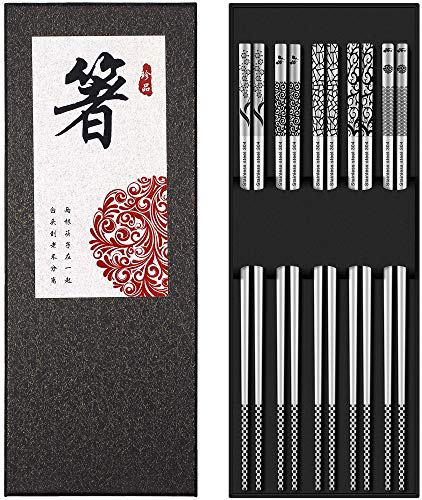
- Greatamzor 18/8 Stainless Steel Chopsticks, 5 Pairs — listed for cooking and eating, 9 1/4 inches, laser engraved.
- NEWDRIP 18/8 Stainless Steel Chopsticks, 8 Pairs — a second eight-pair option in 18/8 steel, listed for cooking and eating.
- Greatamzor Titanium Plated Chopsticks, 2 Pairs — reviewed below, prose-only: a premium eating and serving set whose listing makes no cooking claim.
- Lazycorner 304 Stainless Steel Chopsticks, 10 Pairs — reviewed below, prose-only: the biggest household multipack, listed for daily meals rather than cooking.
- IQCWOOD 304 Stainless Steel Chopsticks, 5 Pairs — reviewed below, prose-only: a lightweight eating pair listed for daily meals.
Read the full guide ↓ for what “cooking chopsticks” should actually do at the stove, where standard-length pairs shine, and where their limits honestly lie.
There are two kinds of chopsticks in a working kitchen. The first kind lives at the table. The second kind lives at the stove — turning dumplings in a skillet, fishing a taste of noodle out of boiling water, nudging chicken pieces apart in a wok, whisking eggs in a bowl too small for a whisk. People searching for the best cooking chopsticks are usually looking for that second kind, and they are usually surprised to learn how much of the job is about length, heat and honesty.
Here is the honesty up front, because this guide will repeat it until it sticks: truly dedicated cooking chopsticks — the extra-long pairs chefs use over deep fryers — are a specialty tool. Our verified pool contains standard-length stainless steel sets, three of which their makers explicitly list for cooking and eating. Those three are genuinely useful at the stove for the everyday tasks home cooks actually perform: stir-frying, turning, serving from the pan, tasting and plating. They are not the tool for reaching into a tall pot of frying oil, and this guide will tell you exactly where that line falls instead of letting a product photo imply otherwise.
What steel brings to the stove is real. It does not scorch, splinter or absorb flavors; it tolerates the dishwasher afterward; and a non-slip engraved surface keeps a grip on oily food that defeats tongs. If your cooking style is wok-forward, dumpling-heavy and noodle-rich, a cooking-rated steel pair earns its drawer space quickly. Let us sort the six sets by what they can truthfully claim.
Key Takeaways
- Only three of the six sets in our pool are listed by their makers for cooking and eating — the two NEWDRIP sets and the Greatamzor 18/8 set — and only those three carry purchase links in this guide.
- Standard-length steel pairs (9.25 to 9 1/4 inches here) excel at stir-frying, turning, pan-serving and tasting; deep frying in tall pots calls for dedicated extra-long cooking chopsticks, which this pool does not contain.
- Stainless steel is the stove-friendly material: no scorching, no flavor absorption, and dishwasher-safe cleanup after oily work.
- Laser-engraved, non-slip surfaces matter more in cooking than at the table, because the food is hotter, oilier and moving.
- Eight-pair multipacks suit households that cook and serve with the same tools — one pair in the pan, others already at the table.
- The three prose-only sets are reviewed honestly as eating pairs; buying one for stove work would be buying against its own listing.
In this guide
Quick Picks
| Pick | Badge | Pairs | Cooking status | Link |
|---|---|---|---|---|
| Greatamzor Titanium Plated Chopsticks | Best for Serving & Plating | 2 pairs | Prose-only — listing covers eating | See review below |
| NEWDRIP Multicolor Chopsticks | Best Overall for Cooking & Eating | 8 pairs | Listed for cooking and eating | Check on Amazon |
| Lazycorner 304 Chopsticks | Best Household Backup | 10 pairs | Prose-only — listed for daily meals | See review below |
| IQCWOOD 304 Chopsticks | Best Lightweight Eating Pair | 5 pairs | Prose-only — listed for daily meals | See review below |
| Greatamzor 18/8 Chopsticks | Best Stir-Fry Multitasker | 5 pairs | Listed for cooking and eating | Check on Amazon |
| NEWDRIP 18/8 Chopsticks | Best for Family Cooking | 8 pairs | Listed for cooking and eating | Check on Amazon |
The badges are used again in the detailed reviews. Note the pattern: cooking status in this guide is decided by the maker’s own listing, not by our optimism — that discipline is what keeps a buying guide honest.
How These Picks Were Chosen
We began with a verified pool of reusable stainless steel chopstick sets, confirmed through Amazon catalog data: brand, steel type, pair count, stated length, and stated uses. Then we applied this keyword’s rule strictly. A set could be recommended as a cooking chopstick — with a link — only if its listing explicitly included cooking among its uses. Three sets passed: the NEWDRIP multicolor eight-pair set, the Greatamzor 18/8 five-pair set, and the NEWDRIP 18/8 eight-pair set, each described by its maker for cooking and eating.
The other three sets are not bad products; they are simply listed for a different job. The titanium plated Greatamzor set is presented for eating and gifting, the Lazycorner ten-pair set for daily meals, and the IQCWOOD set for daily meals as well. Rather than dropping them silently, we review them fully as prose-only entries, because a cook assembling a whole drawer benefits from knowing which pairs to keep away from the stove — and because pretending an eating pair is a cooking pair is how guides lose trust.
This is a research-led guide; we did not run a test kitchen. Our judgments rest on confirmed listing facts and on well-established cooking practice: what length does at a pan, what steel tolerates, what engraved surfaces do for grip. Readers outfitting a whole utensil drawer may also want the Best Dishwasher Safe Chopsticks guide for the cleanup side of the decision, since cooking tools live or die by how easily they wash.
The 6 Sets, Sorted by What They Can Honestly Claim
Greatamzor Titanium Plated Stainless Steel Chopsticks, 2 Pairs
Badge: Best for Serving & Plating
Strengths
- Titanium plating gives a handsome black-and-silver finish that makes pan-to-plate serving look deliberate.
- Laser engraving adds grip for lifting finished food from a serving dish without slips.
- Premium Japanese Korean styling suits the final, visible end of the cooking process — plating.
Trade-offs
- The listing describes this set for eating, not cooking — it carries no purchase link in this guide for exactly that reason.
- Plated finishes and high pan heat are a poor long-term match; this is a serving tool, not a wok tool.
- Two pairs is a presentation set, not a working kitchen’s stock.
Mini spec box
- Material: stainless steel with titanium plating
- Set size: 2 pairs
- Finish: black and silver
- Design: laser engraved, non-slip
- Listing focus: eating; gift set; dishwasher safe
Every cooking guide needs its boundary marker, and this set is ours. It is a genuinely attractive pair of chopsticks — the two-tone finish photographs like jewelry and the engraving is functional as well as decorative — but its maker positions it for eating and gifting, and we take makers at their word. In a cooking article, its honest role is the last meter of the process: lifting arranged food from pan or platter to plate, where control and presentation matter and sustained heat does not.
If your cooking life is mostly plating — dinner parties where the pan comes to the table, sushi nights where the serving pair should look as good as the food — this set earns its place at the end of the line. Just do not ask it to live in a wok. Plated finishes reward gentler treatment than bare steel, and a tool bought for beauty should be used where beauty is the job.
Best for: serving and plating at the table / Not suited for: any sustained work in a hot pan

NEWDRIP Multicolor Metal Chopsticks, 8 Pairs
Badge: Best Overall for Cooking & Eating
Strengths
- The listing explicitly covers cooking and eating, across Japanese, Korean and Chinese styles — the broadest mandate in this pool.
- Eight pairs means the cook is never choosing between the pair in the pan and the pairs on the table.
- Laser engraving and a non-slip build address the oily-grip problem that defines stove work.
Trade-offs
- At 9.25 inches it is a standard-length pair: excellent at the wok’s edge and the skillet, not a deep-fryer reach tool.
- Multicolor styling is cheerful rather than professional-looking, if that matters in your kitchen.
- Eight pairs demand a storage plan or they colonize the utensil drawer.
Mini spec box
- Material: stainless steel
- Set size: 8 pairs, multicolor
- Length: 9.25 inches (per listing)
- Design: laser engraved, non-slip
- Use: cooking and eating; care: dishwasher safe; gift set
This is the set we would hand a home cook who asked the title question plainly. The maker lists it for cooking and eating, the engraved surface gives it purchase on oily, moving food, and the eight-pair count solves the real workflow problem of combination tools: when one pair is in the stir-fry, seven remain for serving and eating, so the same design flows from stove to table without a mid-recipe utensil swap.
At the stove, treat it as a precision instrument rather than a reach instrument. It turns dumplings, separates noodles in the pot, fishes out a tester piece of chicken, and moves finished food to plates with more delicacy than tongs manage. The color-coding quietly helps here too — many cooks dedicate one color to raw-meat handling during prep and keep the rest for cooked food and eating, a hygienic habit this set makes effortless.
The limitation is length, stated plainly: 9.25 inches is eating length. Over a shallow skillet or a wok, where the food sits close to the rim, that is fine and even preferable for control. Over a tall pot of frying oil, it puts your fingers in the steam and splatter zone. Cooks who deep-fry often should add a dedicated extra-long pair to the drawer; cooks who mostly stir-fry, boil and serve will find this set covers their actual week.
Best for: stir-fry households, cook-and-serve workflows, color-coded prep / Not suited for: deep frying in tall pots as the only tool
Lazycorner 304 Stainless Steel Chopsticks, 10 Pairs
Badge: Best Household Backup
Strengths
- Ten pairs is the deepest bench in this guide — a household can lose, lend and launder pairs without ever running out.
- 304 stainless steel is the standard food-grade grade, described by the listing as food grade and lightweight.
- Non-slip design and dishwasher-safe construction make it the definition of low-maintenance table stock.
Trade-offs
- The listing positions the set for daily meals and gifts — not cooking — so it appears here without a purchase link.
- The listing does not state a length, which cooks in particular would want to know.
- Ten identical silver pairs offer no color-coding for prep-versus-table separation.
Mini spec box
- Material: 304 stainless steel, food grade
- Set size: 10 pairs
- Finish: silver
- Design: non-slip, lightweight
- Listing focus: daily meals and gifts; dishwasher safe
Why does a ten-pair eating set belong in a cooking guide at all? Because real kitchens run on systems, and the Lazycorner set is the system that keeps the table supplied while the cooking-rated pairs do stove work. When the wok pair is busy and six people sit down, the meal does not pause — a deep bench of identical, dishwasher-safe eating pairs is what a functioning drawer looks like.
Judged on its own listing, the set is admirably plain: food-grade 304 steel, non-slip, lightweight, reusable, made for daily meals. Nothing about that profile is a cooking claim, and we will not upgrade it into one. Occasional light duty — stirring a sauce you are about to serve, moving a garnish — is within any steel pair’s physical ability, but a guide’s job is to follow the maker’s stated purpose, and this maker’s purpose is the table.
Buy it as infrastructure. It is the set that makes the cooking sets above practical, because nobody cooks well while doing utensil arithmetic.
Best for: stocking the family table so cooking pairs stay at the stove / Not suited for: buyers wanting a maker-rated cooking tool
IQCWOOD 304 Stainless Steel Chopsticks, 5 Pairs
Badge: Best Lightweight Eating Pair
Strengths
- 304 stainless steel in a lightweight build, sized at 9.25 inches for Korean and Japanese style eating.
- Non-slip tips handle the table’s slippery work — noodles, dumplings, glazed vegetables — with control.
- Five pairs is the classic household count for couples and small families.
Trade-offs
- Listed for daily meals, not cooking; it is reviewed here prose-only so nobody buys it under a false flag.
- Lightweight eating pairs are not the tool for heavy pan work like turning thick cuts.
- Silver-only finish, no color-coding option.
Mini spec box
- Material: 304 stainless steel
- Set size: 5 pairs
- Length: 9.25 inches (per listing)
- Design: lightweight, non-slip tips, Korean Japanese style
- Listing focus: daily meals; dishwasher safe
The IQCWOOD set plays the same honest role as the Lazycorner, at a smaller scale and with one extra virtue: it publishes its length. At 9.25 inches in lightweight 304 steel, it is a well-judged eating pair for the Korean and Japanese dishes its listing names, and its non-slip tips are the feature that decides most table-level satisfaction.
In a cooking household, this is the pair that waits at the setting while the rated pairs work — or the pair a cook grabs for the constant small tastings that happen beside the stove, a job that is technically eating and happens to be essential to cooking. What it is not, per its maker, is a cooking implement, and its lightweight build would be the wrong choice for levering heavy food around a pan regardless.
As a companion purchase alongside a cooking-rated set, it makes complete sense. As a cooking purchase on its own, it would be a category error, and this review exists to prevent exactly that error.
Best for: the eating side of a cooking household, tasting duty / Not suited for: pan work or as a sole “cooking chopstick” purchase
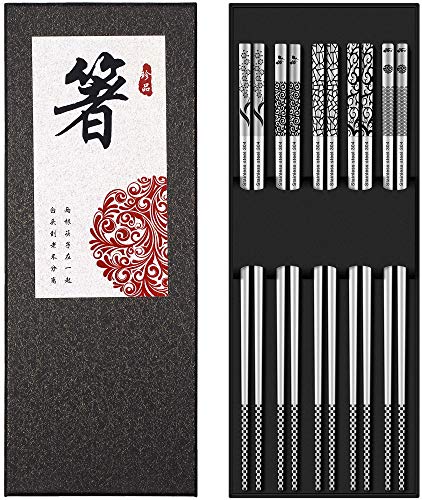
Greatamzor 18/8 Stainless Steel Chopsticks, 5 Pairs
Badge: Best Stir-Fry Multitasker
Strengths
- Listed for cooking and eating, with 18/8 stainless steel and a 9 1/4 inch length that balances pan control and table manners.
- Laser-engraved, non-slip surface is exactly the grip treatment oily stir-fry work demands.
- Five pairs keep the cook-and-serve flow going for a typical household without a second purchase.
Trade-offs
- Standard eating length again: fine at the wok and skillet, short over deep oil.
- The engraved pattern is described by the maker as cute — styling that will not suit every kitchen’s taste.
- Five pairs can run short for big cooking-and-hosting households; the eight-pair sets exist for them.
Mini spec box
- Material: 18/8 stainless steel
- Set size: 5 pairs
- Length: 9 1/4 inches (per listing)
- Design: laser engraved, non-slip, Japanese Korean style
- Use: cooking and eating; care: dishwasher safe; gift set
If the NEWDRIP multicolor set is the crowd-pleaser, the Greatamzor 18/8 is the cook’s five-pair answer: same cooking-and-eating mandate, same engraved non-slip logic, in a slightly longer 9 1/4 inch frame and a classic silver multipack format. For a household of two to four that stir-fries twice a week, this is the proportionate buy.
The 18/8 grade is the workhorse food-grade steel used across better kitchenware, and it shrugs off the two abuses cooking applies daily: heat and the dishwasher. In the pan, the engraved shaft earns its keep when you are separating chicken pieces mid-sear or lifting a tangle of noodles out of the pot to check doneness — tasks where smooth tongs crush and smooth chopsticks slip, and this pair does neither.
Its honest boundary matches its stablemate’s: length. Keep it at the wok, the skillet, the saucepan and the serving bowl, where its control is an advantage, and do not ask it to reach into deep fryers. Within that boundary, it is the most balanced cook-and-eat tool in this guide.
Best for: small households that stir-fry often / Not suited for: deep-fry duty or very large families

NEWDRIP 18/8 Stainless Steel Chopsticks, 8 Pairs
Badge: Best for Family Cooking
Strengths
- Eight pairs of 18/8 steel, listed for cooking and eating across Japanese, Korean and Chinese styles.
- Laser-engraved non-slip surface and a 9.25 inch length suit both pan work and the table.
- The natural choice when cooking and eating happen for a full family in the same meal.
Trade-offs
- All eight pairs share one look, so there is no built-in color system for raw-versus-cooked separation.
- Standard length limits deep-pot work, as with every linked pick here.
- Eight pairs of anything need a tray, crock or drawer organizer to stay tidy.
Mini spec box
- Material: 18/8 stainless steel
- Set size: 8 pairs
- Length: 9.25 inches (per listing)
- Design: laser engraved, non-slip
- Use: cooking and eating; care: dishwasher safe; gift set
The difference between this set and the multicolor NEWDRIP at the top of the guide is temperament. Same maker, same eight-pair capacity, same cooking-and-eating listing — but in uniform 18/8 steel with an engraved pattern, for households that want one consistent tool from prep bowl to place setting. Family cooking is a relay race: someone stirs, someone plates, everyone eats, and a uniform set of eight passes the baton without anyone hunting for “their” pair.
In practice, dedicate pairs by position rather than color: keep two pairs resident at the stove for cooking and tasting, and set the table with the rest. The engraved grip handles oily pan work, the steel handles the dishwasher afterward, and the count handles the reality that one pair is always mid-wash when the rice finishes.
Length discipline applies here too — 9.25 inches is a cook-and-eat compromise, optimized for the shallow pans and serving bowls of everyday family cooking. Households whose cooking centers on a deep fryer or a tall stockpot should treat any set in this guide as the partner to a dedicated long pair, not a replacement for one.
Best for: families wanting one uniform cook-and-eat set / Not suited for: color-coding households or deep-fry specialists
Comparison Table
| Pick | Pairs | Length (listing) | Maker-listed use | Link |
|---|---|---|---|---|
| Greatamzor Titanium Plated | 2 | Not stated | Eating / gift (prose-only) | — |
| NEWDRIP Multicolor | 8 | 9.25 inch | Cooking and eating | Check on Amazon |
| Lazycorner 304 | 10 | Not stated | Daily meals (prose-only) | — |
| IQCWOOD 304 | 5 | 9.25 inch | Daily meals (prose-only) | — |
| Greatamzor 18/8 | 5 | 9 1/4 inch | Cooking and eating | Check on Amazon |
| NEWDRIP 18/8 | 8 | 9.25 inch | Cooking and eating | Check on Amazon |
The most important column in this table is the fourth one. Everything else — count, length, finish — is preference. Whether the maker built and listed the pair for the stove is fact, and it is the fact this whole guide is organized around.
How to Choose Chopsticks for Cooking
Length is the first decision, and it is about heat geometry. A chopstick is a lever that ends in your fingers. The longer the pair, the farther your hand sits from oil, steam and splatter — and the less fingertip precision you keep. Dedicated frying pairs run very long for exactly this reason. The linked sets here, at 9.25 to 9 1/4 inches, sit at the control end of the spectrum: they are built for the shallow geometry of woks, skillets and saucepans, where food is near the rim and precision beats distance. Choose by the pans you actually own.
Material decides what the stove can do to the tool. Wood and bamboo are traditional cooking-chopstick materials and kind to nonstick coatings, but they scorch, absorb flavors and ask for hand washing. Stainless steel — every set in this guide — tolerates heat, oil and the dishwasher without complaint. Its one caution: metal on delicate nonstick deserves a lighter hand than wood, so cooks with prized coated pans often keep one wooden pair for that pan alone. Readers weighing a fully personalized drawer can browse the Best Custom Chopsticks guide later; for working tools, steel’s indifference to abuse wins most kitchens.
Grip is a safety feature at the stove. At the table, a slipped noodle is comedy. In a pan, a slipped piece of chicken is a splash. Laser engraving and non-slip texturing — present on all three linked sets — are not decoration in this context; they are how a smooth material earns the right to handle hot, oily food.
Count pairs like a cook, not a diner. Cooking consumes pairs: one for raw prep, one for the pan, one for tasting (never the raw pair), plus the table’s sets. That arithmetic is why the linked recommendations here start at five pairs and why the eight-pair sets suit family cooking so well. A two-pair gift set, however lovely, cannot run this rotation — which is one more reason the titanium set sits in the serving role.
Keep raw and cooked apart. The oldest rule of kitchen hygiene applies to chopsticks with full force: the pair that handled raw chicken does not touch the finished dish until it has been washed. Color-coded sets make the rule visible; uniform sets make it a matter of position and habit. Either system works — having no system does not.
How to Cook With Chopsticks: Core Techniques
- Stir-frying. Use the pair like two coordinated spatulas: slide under ingredients, lift, and turn rather than stirring in circles, which breaks delicate food. Keep the food moving in the hot zone and rest the pair across the wok’s edge between turns — steel tolerates the heat that would scorch wood left in the pan.
- Turning and separating. For dumplings, meat pieces and noodles mid-boil, the pair’s precision beats tongs: nudge pieces apart as they begin to stick, turn each piece individually, and lift one strand or piece free to test doneness.
- Tasting safely. Lift a small piece, let it cool a moment on the pair, and taste from a dedicated tasting pair — not the one stirring raw ingredients. This tiny discipline is the difference between a cook’s habit and a contamination story.
- Whisking and mixing. In a small bowl, a pair of chopsticks held loosely beats eggs, blends marinades and folds sauces more nimbly than a fork, and reaches corners a whisk cannot.
- Plating. Use the pair as tweezers with better manners: place herbs, arrange noodles in a swirl, and set the final piece exactly where it belongs. This is where the serving-styled sets earn their drawer space.
- Resting and washing. Never leave any pair sitting in hot oil unattended; set it on a rest or the pan’s edge. After service, everything goes in the dishwasher — all six sets here are listed dishwasher safe — and pairs dry fully before drawer storage.
Troubleshooting.
- Problem: food splashes when you turn it in the pan → your pair is too short for that pan’s depth, or you are lifting too high; turn pieces low and slow, and reserve tall pots for a dedicated long pair.
- Problem: noodles clump together while boiling → separate them with the pair in the first minute of cooking, stirring gently as they soften; waiting until they set guarantees the clump.
- Problem: you keep tasting with the cooking pair → park a dedicated tasting pair by the stove before you start; systems beat willpower in a busy kitchen.
What Standard-Length Pairs Can and Cannot Do at the Stove
Because this guide links only standard-length sets, it owes you a precise map of their territory. In their element: stir-fries of every kind, pan-fried dumplings and scallion pancakes, noodle pots of ordinary depth, egg dishes from whisking to scrambling in the pan, sautéed vegetables, and all serving and plating work. That list covers the overwhelming majority of home cooking that involves chopsticks at all, which is why makers list these pairs for cooking without embarrassment.
Outside their element: deep frying in tall pots, where oil depth puts a 9.25-inch pair’s handle — and your fingers — inside the danger zone; retrieving food from the bottom of a deep stockpot; and any task over open flame where you would not put your hand. None of those are failures of these products. They are the natural boundary of the eating-length format, and the fix is a specialty tool, not a different brand of the same tool.
Cooks building a complete drawer often end with three tiers: eating pairs at the table, a cooking-rated multipack like the ones linked here for daily stove work, and one extra-long pair for the fryer. Readers who eat at a desk or on the move more than they fry can explore the Best Daily Carry Chopsticks guide for the portable end of the spectrum, and those who care most about how a pair looks on the counter will find the Best Designed Chopsticks guide more their conversation.
Steel at the Stove: Heat, Pans and Coatings
Choosing steel for cooking raises three practical questions that deserve straight answers.
Heat. Stainless steel does not scorch, warp or melt at any temperature a home stove produces for food, which is why makers can list it for cooking without qualification. The pair will warm if left resting in a hot pan — metal conducts — so build the habit of resting it across the rim or on a spoon rest rather than inside the oil. Brief contact while turning food is a non-issue; abandonment is the only real mistake.
Nonstick coatings. This is steel’s one genuine controversy. A metal tip dragged hard across a delicate coated pan can mark the coating over time. The technique fix is real — lift and place rather than scrape and drag, and let food release before turning it — but honesty requires the caveat: if you own a prized nonstick pan and cook eggs in it daily, a wooden pair dedicated to that pan is a reasonable companion purchase. For stainless, cast iron, carbon steel and ceramic-coated cookware, the concern largely evaporates.
Woks and high-heat searing. Here steel is simply at home. Carbon-steel and cast-iron woks are metal themselves; a steel pair moving food across them is the traditional pairing in many kitchens, and the engraved grip of the linked sets handles the speed wok cooking demands. The pair also survives the wok’s seasoning process and the dishwasher afterward, a combination no wooden tool offers.
Put together, steel’s stove profile is: indifferent to heat, demanding of a little technique on coated pans, and unbeatable on cleanup. For most home kitchens, that trade resolves in steel’s favor quickly — and the three linked sets are where this guide’s readers should start.
Building a Cook’s Chopstick Drawer
One set rarely runs a whole kitchen. Cooks who use chopsticks daily tend to converge on the same three-tier drawer, and this guide’s six sets map onto it neatly.
Tier one: the stove pairs. These are your cooking-rated multipacks — the linked NEWDRIP and Greatamzor sets. They live within arm’s reach of the stove, not in the tableware drawer, because a tool you must fetch is a tool you will substitute for tongs. Keep at least two pairs in this tier so the raw-versus-cooked rotation never forces a mid-recipe wash.
Tier two: the table pairs. This is where the prose-only sets in this guide belong, and it is honorable work. The Lazycorner ten-pair bench or the IQCWOOD five-pair set keeps every seat supplied, absorbs the dishwasher lag, and means your stove pairs never get drafted into table service and lost to the cooking rotation. Households that skip this tier spend their lives counting chopsticks; households that build it stop thinking about chopsticks entirely, which is the goal.
Tier three: the specialists. The serving-and-plating pair (the titanium plated set’s honest role), a dedicated extra-long frying pair if you deep-fry, and perhaps a pair reserved for guests. Specialists earn their space by doing one job visibly better than the generalists — plating with a handsome pair genuinely changes how a dish lands on the table.
The tiers also clarify buying order. Start with tier one if you cook, tier two if you host, and add tier three when a specific meal keeps exposing a gap. Buying in that order means every purchase fixes a problem you have actually felt, instead of decorating a drawer against problems you imagine.
Technique Notes by Dish
Dumplings, potstickers especially. The critical moments are release and turn: slide the tips under a potsticker whose bottom has crisped, confirm it moves freely, then turn. A non-slip engraved pair grips the delicate wrapper without tearing it — the exact failure mode of tongs, which squeeze where chopsticks cradle.
Noodle soups and boiled noodles. Your pair is a doneness instrument. Lift a single strand clear of the steam, let it fall slack across the lower stick, and bite-test it. In the pot, keep strands separated during the first minute, when surface starch makes them eager to fuse into a single unusable rope.
Stir-fried proteins. Spread, do not stir. Use the pair to lay pieces in a single layer, leave them alone long enough to sear, then turn piece by piece. Constant stirring is the home cook’s most common chopstick error; the tool’s precision tempts you to fuss, and the discipline is to let the pan work.
Eggs. For the soft, folded styles, use the pair to draw the setting egg across the pan in slow strokes, creating large curds. For whisking, two sticks moved in a tight circle outperform a fork in any bowl small enough to hold in one hand.
Fried snacks and tempura-style pieces at home. In a shallow pan with modest oil depth, a standard-length pair turns pieces precisely — this is the shallow end of frying, where these sets remain appropriate. The moment the vessel becomes a deep pot, the boundary from the earlier section applies: switch tools, not technique.
One final note for cooks converting from tongs: give the switch two weeks of weeknight dinners before judging it. The first stir-fry will feel slower, the second less so, and by the end of the fortnight most cooks report that turning individual pieces — rather than grabbing at clusters — has quietly improved the food itself, because pieces sear instead of steam when they are placed rather than dropped. That improvement, more than novelty or tradition, is why cooking chopsticks keep their place in kitchens that also own excellent tongs: the two tools overlap, but they do not duplicate each other, and a cook who learns both reaches for each with intent.
Common Buying Mistakes
- Assuming any steel pair is a cooking pair. Makers list uses for a reason. Three sets in this very guide are eating pairs; buying them for the wok ignores their own listings.
- Using an eating-length pair over deep oil. The burn risk is geometric, not a matter of skill. Tall pots need long tools.
- Crossing raw and cooked pairs. One pair for raw prep, another for finished food, washing between — the rule has no exceptions for “just a quick taste.”
- Choosing smooth, untextured steel for pan work. Oil plus polish equals dropped food and splashes. Engraving and non-slip surfaces are functional, not decorative, at the stove.
- Buying a two-pair set as the kitchen’s whole stock. Cooking consumes pairs in parallel. Count the rotation — prep, pan, taste, table — before choosing a set size.
- Throwing away the disposable habit entirely. For picnics and packed lunches, single-use pairs still have a role; the Best Disposable Chopsticks guide covers when they make sense, so your good steel stays home.
Final Recommendation
Start with the NEWDRIP multicolor eight-pair set if your household cooks and eats in the same motion: it is maker-listed for both jobs, its colors run your raw-versus-cooked system for you, and eight pairs end utensil shortages permanently. Smaller households should take the Greatamzor 18/8 five-pair set for the same cooking-and-eating mandate in classic silver, and uniform-steel families have the NEWDRIP 18/8 eight-pair set. Whichever linked set you choose, add the discipline that makes it a cooking tool rather than a table tool in a hot place: respect the length boundary, keep raw and cooked pairs apart, and let the dishwasher do the cleanup — every set here is listed for it, a point the Best Fiberglass Chopsticks guide’s readers weigh differently, since fiberglass has its own care story.
Related guides
- Best Types Of Chopsticks To Use
- Best Wayt To Hold Chopsticks
- Best Chopsticks Yelp
- Best Version Of Chopsticks
Frequently Asked Questions
Are metal chopsticks safe to use in a hot pan?
Yes, with ordinary care. Stainless steel tolerates cooking temperatures without scorching or melting, which is why the linked sets are listed for cooking. Two cautions apply: metal conducts some heat on long, unattended contact, so rest the pair on the pan’s edge rather than leaving it in hot oil; and use a gentle touch on delicate nonstick coatings.
Why does this guide refuse to link three of its six picks?
Because their makers list them for eating and daily meals, not cooking. A buying guide that links an eating pair inside a cooking article is asking you to use a product against its stated purpose. The three prose-only sets are reviewed fully so you can judge them as eating pairs — they simply do not earn a cooking recommendation.
What length should true cooking chopsticks be?
It depends on the vessel. For woks and skillets, the 9.25-inch class linked here gives control where food sits near the rim. For deep frying and tall pots, dedicated cooking pairs run much longer to keep hands clear of oil and steam. Match the tool to the deepest pot you actually cook in.
Can I stir-fry with the same pair I eat with?
You can, and the linked sets are listed for exactly that double duty. The hygiene rule is about stages, not tools: a pair that touched raw ingredients gets washed before it touches finished food or your mouth. Multipacks make this easy — rotate pairs instead of rinsing mid-service.
Do engraved chopsticks really grip better in a pan?
Yes. Oil makes smooth steel treacherous, and laser engraving breaks the surface into thousands of tiny edges that hold both your fingers and the food. It is the same reason the linked sets all carry engraved or non-slip designs — in cooking, texture is equipment, not ornament.
How do I keep track of raw and cooked pairs?
Color is the easiest system: the multicolor NEWDRIP set lets you assign, say, one color permanently to raw prep. With uniform sets, use position — stove pairs live on a rest by the pan, table pairs live in the drawer — and wash any pair that changes roles.
How do I clean chopsticks after frying or oily stir-fries?
Rinse or load them promptly so oil does not dry onto the engraving, then run a normal dishwasher cycle — every set here is listed dishwasher safe. If a pair air-dries with a faint oily film after a heavy session, a drop of dish soap and a soft sponge restores it; steel holds no flavors, so yesterday’s garlic never survives into today’s dessert.
Are these chopsticks dishwasher safe after oily cooking?
Yes. Every set in this guide, linked and prose-only alike, is listed as dishwasher safe. Steel does not absorb oil or flavors, so a normal cycle restores a cooking pair completely — one of the practical reasons steel dominates working kitchens.