Disclosure: topratedkitchenware.com is reader-supported. When you buy through links on our site, we may earn an affiliate commission from Amazon and other retailers, at no extra cost to you.
Where to buy
Shoppers comparing the best types of chopsticks to use usually want two things at once: an honest shortlist and a clear view of what each option actually is. The six sets below are the verified options for this guide; each name links to its Amazon listing so you can check the latest price on Amazon before you decide.
- Greatamzor Metal Chopsticks, 18/8 Stainless Steel, 5 Pairs — Best All-Round Pick; 5 pairs, stainless steel (18/8).
- NEWDRIP 8 Pairs Metal Chopsticks, 18/8 Stainless Steel — Best Family Workhorse; 8 pairs, stainless steel (18/8).
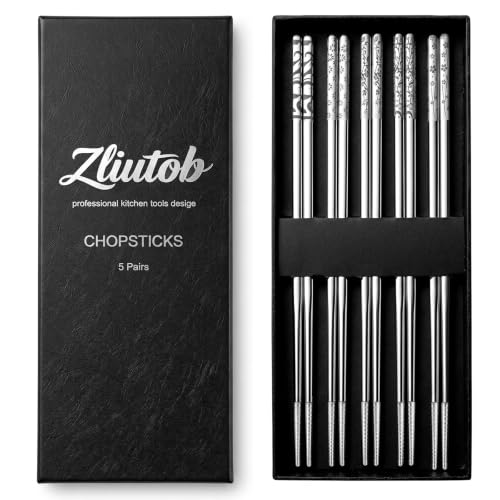
- Zliutob Metal Chopsticks, Stainless Steel, Non-Slip, 5 Pairs — Best Grip for Beginners; 5 pairs, stainless steel.
- LIXTONGR Dragon & Phoenix Black Stainless Steel Chopsticks, 2 Pairs — Best Premium Pick; 2 pairs, stainless steel (18/10).
- MUYOS Stainless Steel Chopsticks, 5 Pairs, Silver — Best Lightweight Pick; 5 pairs, stainless steel, hollow-core.
- Greatamzor Metal Chopsticks, Multicolor, Laser Engraved Copper Coin Pattern — Best for Color-Coded Families; Multipack (count per listing), stainless steel.
The full guide below explains the types themselves — how Chinese, Japanese and Korean styles differ, where cooking, training and travel pairs fit, and which of the six sets above matches each type — so you can buy by use case instead of by photograph.
Read the full guide ↓
There is no single best pair of chopsticks, only the best types of chopsticks to use for the food in front of you. A long Chinese-style pair that feels perfect for hot pot is clumsy with sushi; a short, fine-tipped Japanese pair that places a slice of sashimi exactly where you want it is the wrong tool for turning food in a wok. Once you understand the handful of types that exist — and the one variable that separates them, which is length paired with tip shape — choosing becomes straightforward.
This guide maps the types first: the three national styles, plus cooking pairs, training pairs, travel pairs and disposables, with the dishes each type serves best. It then reviews six verified reusable sets and matches each one to the types it genuinely covers, so you can see which single set spans your week and where a second, specialised pair earns its drawer space.
Most households end up with two types: an everyday pair matched to their main cuisine, and one specialist — longer for cooking, shorter and finer for Japanese dishes, or a grippy square-profile pair for a learner. The reviews and the type guide below are organised to help you pick exactly that combination.
Key Takeaways
- Length plus tip shape defines the type: long and blunt for Chinese dishes, short and pointed for Japanese, medium and flat for Korean.
- Cooking chopsticks are a separate type — noticeably longer to keep hands away from heat — not just table pairs used bravely.
- Square profiles and textured tips are the learner-friendly type: they do not roll, rotate or drop noodles as easily.
- Most households need two types at most: an everyday pair for their main cuisine and one specialist pair.
- All six sets reviewed here are reusable stainless steel, verified against their listings, and matched to types in each review.
- Disposable pairs have their place for guests and travel, but a reusable household set is the better default.
In this guide
Quick Picks
| Pick | Badge | Pairs | Material |
|---|---|---|---|
| Greatamzor Metal Chopsticks, 18/8 Stainless Steel, 5 Pairs | Best All-Round Pick | 5 pairs | Stainless steel (18/8) |
| NEWDRIP 8 Pairs Metal Chopsticks, 18/8 Stainless Steel | Best Family Workhorse | 8 pairs | Stainless steel (18/8) |
| Zliutob Metal Chopsticks, Stainless Steel, Non-Slip, 5 Pairs | Best Grip for Beginners | 5 pairs | Stainless steel |
| LIXTONGR Dragon & Phoenix Black Stainless Steel Chopsticks, 2 Pairs | Best Premium Pick | 2 pairs | Stainless steel (18/10) |
| MUYOS Stainless Steel Chopsticks, 5 Pairs, Silver | Best Lightweight Pick | 5 pairs | Stainless steel, hollow-core |
| Greatamzor Metal Chopsticks, Multicolor, Laser Engraved Copper Coin Pattern | Best for Color-Coded Families | Multipack (count per listing) | Stainless steel |
Use the badges to jump: each set is matched to the type of eating it serves best, and the detailed reviews explain which cuisines and dishes that type covers — and which it does not.
How These Picks Were Chosen
Every product in this guide comes from a verified pick pool checked against Amazon’s own catalog data on 2026-11-21, and only products whose listing titles confirm they are genuine chopsticks of the stated material, count and format were kept as linked picks. We compared the pool on the properties a buyer can actually verify before ordering: the steel grade when the listing states one, the number of pairs in the set, the stated length, the tip and grip treatment, and the finish. Where a listing title does not state a specification, this guide says so instead of filling the gap with a guess.
This is research-led guidance, not a hands-on lab test. We did not invent bench results, durability scores or tasting notes. Instead, each review separates what the listing itself confirms from the general, well-established behavior of the design — how hollow-core metal feels over a long meal, why a square profile stays put in the fingers, what laser engraving does for grip. That distinction matters with chopsticks, because two pairs that look identical in a photo can behave very differently at the table, and the honest differences are almost always in the stated specifications.
We also weighted the sets by how people actually buy chopsticks: as household systems, not single objects. A two-pair gift set and a ten-pair family set are not rivals; they answer different questions. The badges in this guide reflect that, so a pick can be the best answer for a beginner, a host or a gift buyer without pretending to be the best answer for everyone.
The 6 Best Types of Chopsticks to Use, Matched by Type
Every set below is stainless steel and reusable; the differences that matter are count, length where stated, grip geometry and finish. Each review names the type the set belongs to in practice, because a five-pair household set and a two-pair occasion set answer different questions even when the material is the same.
Greatamzor Metal Chopsticks, 18/8 Stainless Steel, 5 Pairs
Badge: Best All-Round Pick
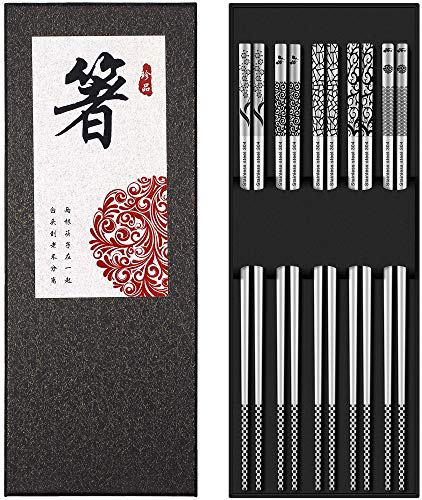
The 18/8 Greatamzor multipack is the balanced middle of this pool: five pairs, a stated 18/8 grade, a 9.25 inch length and a laser engraved non-slip pattern in a Japanese and Korean style format, sold as a gift set. Nothing about it is extreme, which is exactly its appeal — it is the set a buyer picks when they want one dependable answer for daily meals without specialising in any single direction.
In type terms this is the all-rounder: a stated 18/8 grade, five pairs and a 9.25 inch length place it between the Chinese and Japanese formats, which is why it covers the widest range of weeknight dishes in this pool. If you buy one type first, this middle format is the safest place to start.
The all-round Greatamzor set’s daily character is balance: nothing about a meal makes you wish for a different pair, and nothing about the pair makes you think about it at all. That invisibility is the actual product. Where specialist sets win their category meals — the occasion set at a celebration, the square-grip set in a learner’s hand — this set wins the ordinary Tuesday, which is most of the meals there are. Households replacing a mixed drawer of tired pairs usually find this profile, five honest pairs with stated specs, is the reset they wanted.
Strengths
- Stated 18/8 grade with five pairs covers most households
- Laser engraved non-slip tips help with noodles and dumplings
- 9.25 inch length works across Chinese, Japanese and Korean dishes
Trade-offs
- Five pairs may fall short for large dinner parties
- Engraving needs a quick rinse after oily or sticky food
- Gift set format costs presentation you may not need
| Specification | From listing title |
|---|---|
| Pairs in set | 5 pairs |
| Material | Stainless steel (18/8) |
| Stated length | 9.25 inches (per listing title) |
| Finish / grip | Laser engraved, non-slip, gift set format |
| Care | Dishwasher safe per listing title |
Best for: Most households wanting one all-round metal set / Not suited for: Hosts who regularly seat more than five chopstick users

NEWDRIP 8 Pairs Metal Chopsticks, 18/8 Stainless Steel
Badge: Best Family Workhorse
This NEWDRIP set pairs the family-size count of eight pairs with a stated 18/8 stainless steel grade and a 9.25 inch length, which puts it at the longer, Chinese-leaning end of the pool. The laser engraved non-slip pattern does the grip work, and the gift set format means the box presentation is a step above a plain multipack. For a household that eats with chopsticks daily, the combination of count, grade and length is the practical sweet spot of this group.
This set is the family-system type: eight pairs at a stated 9.25 inches with engraved non-slip tips. It suits households where chopsticks are the default utensil at every meal, because the count absorbs guests, lunch bags and the dishwasher cycle without the table ever running short.
In daily service this NEWDRIP set behaves like infrastructure: present at every meal, unremarkable in the best sense, and missed only when the dishwasher is full. The 9.25 inch length quietly becomes the household’s reference length — the size against which any future pair, wooden or metal, gets judged at the shop. That is worth knowing before you buy any family set: the first full-size set a household lives with tends to set its permanent standard, so choosing the length deliberately matters more than choosing it expensively.
Strengths
- Stated 18/8 grade plus eight pairs is a strong household combination
- 9.25 inch length suits shared dishes and family-style serving
- Laser engraved non-slip pattern helps beginners and children
Trade-offs
- Longer length can feel oversized for small hands
- Eight pairs is more than a small household will rotate through
- Engraved grooves need prompt rinsing after sticky sauces
| Specification | From listing title |
|---|---|
| Pairs in set | 8 pairs |
| Material | Stainless steel (18/8) |
| Stated length | 9.25 inches (per listing title) |
| Finish / grip | Laser engraved, non-slip, gift set format |
| Care | Dishwasher safe per listing title |
Best for: Daily chopstick households that want count, grade and length together / Not suited for: Diners who prefer short, Japanese-style pairs

Zliutob Metal Chopsticks, Stainless Steel, Non-Slip, 5 Pairs
Badge: Best Grip for Beginners
The Zliutob set is the grip specialist: its listing describes textured tips and a square grip section, the two geometry choices that matter most to anyone still building chopstick confidence. A square profile does not roll off the table, sits still in the fingers instead of rotating, and gives the thumb and index finger flat faces to brace against. For learners, that geometry is worth more than any finish.
This is the learner type in metal form. The square grip section and textured tips directly address the three things beginners struggle with — rolling, rotating and dropping — so if the types question in your house is really a confidence question, start here and graduate to sleeker pairs later.
The Zliutob set’s square section has a second career after the learning phase: it becomes the pair people grab for slippery food — glossy noodles, dumplings in oil, anything that punishes a smooth round profile. Learners graduate, but the geometry keeps earning its drawer space, which is why this set rarely becomes the abandoned trainer that hinged gadgets become. It also rests on the table without rolling into the soup, a small daily mercy that round-pair owners only appreciate when they visit.
Strengths
- Square grip section stays put in the hand and on the table
- Textured tips grip noodles and slick foods more securely
- Five pairs lets a learner keep the same pair everywhere
Trade-offs
- Steel grade is not stated in the listing title
- Square profile feels unfamiliar to lifelong round-chopstick users
- No stated length in the listing title to compare before buying
| Specification | From listing title |
|---|---|
| Pairs in set | 5 pairs |
| Material | Stainless steel |
| Stated length | Not stated in listing title |
| Finish / grip | Textured tips, square grip section |
| Care | Dishwasher safe per listing title |
Best for: Beginners and anyone whose chopsticks roll or rotate / Not suited for: Experienced users who prefer a traditional round profile

LIXTONGR Dragon & Phoenix Black Stainless Steel Chopsticks, 2 Pairs
Badge: Best Premium Pick
The LIXTONGR pair is the presentation piece of this pool: a black-finished 18/10 stainless steel set of two pairs carrying a Dragon and Phoenix motif, a non-slip grip section and a stated length of 9 inches. The 18/10 grade is the richest nickel blend in this group, which is the spec buyers look at when corrosion resistance and long-term surface stability matter most.
This is the occasion type: two pairs, the highest stated steel grade in the pool and a decorative black finish. It will not run a family table, and it is not meant to; it is the pair for the meals where presentation is part of the dish, and for gifts where one considered set beats five ordinary ones.
Living with the LIXTONGR set means treating it as tableware, not cutlery-drawer filler. The two pairs reward being stored in their presentation format and brought out deliberately; used that way, the black finish stays even and the motif stays crisp. Owners of occasion sets in every material report the same pattern: the pairs that are stored with intention are the pairs that still look ceremonial years later, while pairs that migrate into daily drawer service age like daily utensils. Decide which life this set will live before its first meal, and it will keep that life for a long time.
Strengths
- 18/10 stainless steel is the highest grade stated anywhere in this pool
- Non-slip grip section helps with noodles and other smooth foods
- Black Dragon & Phoenix finish makes it the natural gift or occasion pair
Trade-offs
- Only 2 pairs in the set, so it does not outfit a whole table
- Dark finishes can show wear at the tips over years of daily use
- The decorative motif will not suit buyers who want a plain utensil
| Specification | From listing title |
|---|---|
| Pairs in set | 2 pairs |
| Material | Stainless steel (18/10) |
| Stated length | 9 inches |
| Finish / grip | Black finish with Dragon & Phoenix motif |
| Care | Dishwasher safe per listing title |
Best for: Occasion dining, gifts and buyers who want the highest stated steel grade / Not suited for: Large households that need many matching pairs at once
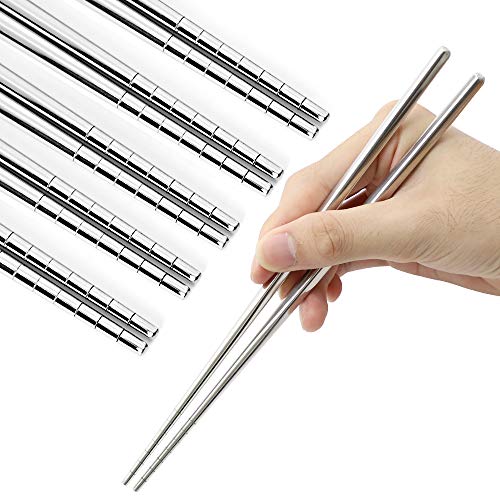
MUYOS Stainless Steel Chopsticks, 5 Pairs, Silver
Badge: Best Lightweight Pick
The MUYOS set is built around weight: the listing describes a hollow-core design, which is why these feel noticeably lighter in the hand than solid metal chopsticks. For eaters who find metal chopsticks fatiguing, or who are transitioning away from wood and bamboo, that lighter balance is the single most helpful property a metal pair can have. The set covers five pairs in a plain silver finish.
This is the light type. Hollow-core construction makes it the metal pair for people who love the weight of bamboo and wood but want reusable durability; over a long, slow meal the difference in hand fatigue is the whole story, and it is why this set earns its place despite an unstated grade.
Day to day, the MUYOS set’s lightness changes small habits: it is the pair people reach for when eating at a desk, reading, or lingering over a long bowl, because the hand simply forgets it is holding anything. The trade is feedback — some eaters use a pair’s weight to judge pinch pressure, and a hollow pair asks you to judge by sight and feel at the tips instead. After a week of meals most users stop noticing; those who came from bamboo often report they never notice at all, which is the strongest compliment a metal pair can earn.
Strengths
- Hollow-core build keeps the pair light during long meals
- Five pairs covers a small household or a couple with spares
- Plain silver finish matches any table setting
Trade-offs
- Steel grade is not stated in the listing title
- A very light pair gives less of the weighted feedback some experienced users prefer
- No engraved or textured grip feature is stated
| Specification | From listing title |
|---|---|
| Pairs in set | 5 pairs |
| Material | Stainless steel, hollow-core |
| Stated length | Not stated in listing title |
| Finish / grip | Silver, hollow-core build |
| Care | Dishwasher safe per listing title |
Best for: Metal newcomers and anyone who finds solid steel chopsticks heavy / Not suited for: Buyers who want a stated premium steel grade

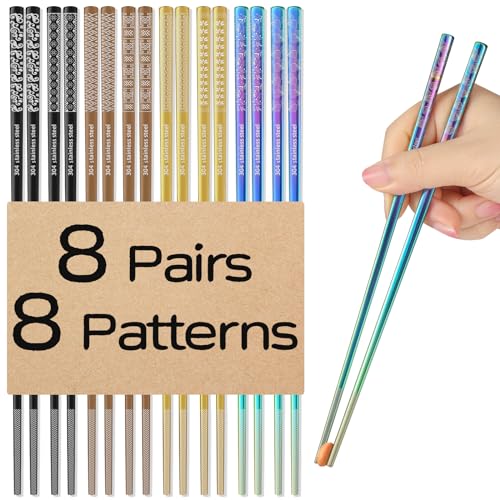
Greatamzor Metal Chopsticks, Multicolor, Laser Engraved Copper Coin Pattern
Badge: Best for Color-Coded Families
This Greatamzor set leans on two practical ideas: laser engraving and color. The engraved copper coin pattern is not only decorative; engraved texture at the tip and grip zones gives food and fingers something to hold on to, which is where smooth metal chopsticks usually fail. The multicolor finish lets each diner keep the same color at every meal, a small system that households with children tend to adopt quickly.
This is the personal-pair type: multicolor engraved sets turn ‘types’ into ‘mine’. In households where several people eat with chopsticks daily, color coding ends the nightly negotiation over whose pair is whose, and the engraved texture keeps the grip forgiving for younger eaters.
The color system on this Greatamzor set proves itself in the unglamorous moments: the dishwasher cycle, the lunch-bag unpack, the guest who asks which pair is clean. A color per person turns all three into non-events. The engraved pattern also changes the washing routine slightly for the better — a quick rinse straight after the meal keeps the grooves clear, and households that adopt the rinse habit find every engraved set in the drawer easier to live with, not just this one.
Strengths
- Laser engraved pattern adds real grip texture, not just decoration
- Multicolor finish lets each person claim a personal pair
- Square-style profile resists rolling off the table
Trade-offs
- Steel grade is not stated in the listing title
- Bright colors will not suit formal or minimalist tables
- Engraving grooves need a rinse soon after saucy meals
| Specification | From listing title |
|---|---|
| Pairs in set | Multipack (count per listing) |
| Material | Stainless steel |
| Stated length | Not stated in listing title |
| Finish / grip | Multicolor, laser engraved copper coin pattern, square profile |
| Care | Dishwasher safe per listing title |
Best for: Families who want color-coded personal pairs and extra tip grip / Not suited for: Formal dining rooms that call for plain, matching utensils
Comparison Table
| Pick | Pairs | Steel grade | Stated length | Finish / grip |
|---|---|---|---|---|
| Greatamzor Metal Chopsticks, 18/8 Stainless Steel, 5 Pairs — Check on Amazon | 5 pairs | 18/8 stainless steel | 9.25 inches (per listing title) | Laser engraved, non-slip, gift set format |
| NEWDRIP 8 Pairs Metal Chopsticks, 18/8 Stainless Steel — Check on Amazon | 8 pairs | 18/8 stainless steel | 9.25 inches (per listing title) | Laser engraved, non-slip, gift set format |
| Zliutob Metal Chopsticks, Stainless Steel, Non-Slip, 5 Pairs — Check on Amazon | 5 pairs | Stainless steel (grade not stated in listing title) | Not stated in listing title | Textured tips, square grip section |
| LIXTONGR Dragon & Phoenix Black Stainless Steel Chopsticks, 2 Pairs — Check on Amazon | 2 pairs | 18/10 stainless steel | 9 inches | Black finish with Dragon & Phoenix motif |
| MUYOS Stainless Steel Chopsticks, 5 Pairs, Silver — Check on Amazon | 5 pairs | Stainless steel (grade not stated in listing title) | Not stated in listing title | Silver, hollow-core build |
| Greatamzor Metal Chopsticks, Multicolor, Laser Engraved Copper Coin Pattern — Check on Amazon | Multipack (count per listing) | Stainless steel (grade not stated in listing title) | Not stated in listing title | Multicolor, laser engraved copper coin pattern, square profile |
Read the table by columns: pairs tells you the household size the set serves, grade tells you what the listing commits to, and finish tells you how the pair behaves in the hand. Where a cell says a specification is not stated, that absence is itself information — prefer the set whose stated facts match your priorities.
How to Choose Among the Types of Chopsticks
Match length to cuisine first. Chinese styles are the longest of the three national types, built for shared dishes, hot pots and reaching across a lazy Susan. Japanese styles are the shortest, built for individual place settings and precise work with fish. Korean styles sit between, traditionally flatter in profile to handle slippery kimchi and noodles and to rest stably on the table. If your cooking leans one way, that cuisine’s type is your everyday pair.
Match tip to food second. Fine, pointed tips separate fish flesh from bone and place small items precisely; they are wasted on, and can be damaged by, heavy communal dishes. Blunter tips grip noodles, dumplings and shared items more forgivingly. Look at your five most common chopstick meals and let their textures decide.
Treat cooking as its own purchase. Cooking chopsticks are longer than any table type, and using table pairs at the stove is the most common chopstick mistake in home kitchens: hands get hot, finishes suffer, control suffers. One long cooking pair, in bamboo, wood or metal, protects both you and your table sets. The dedicated cluster at Best Tips For Using Chopsticks covers grip technique once the type is chosen.
Count the table, not the meal. Buy for the largest group you serve monthly, plus spares. Multi-pair sets exist precisely because chopsticks migrate — to lunch bags, dishwashers and junk drawers — and a household that eats with them daily feels every missing pair.
Consider a training type honestly. If someone at your table is learning — a child, or an adult new to chopsticks — a square-profile, textured-tip pair is not a compromise; it is the correct type for that stage, and confidence built on it transfers to sleeker pairs later. Households shopping specifically for that stage will find the dedicated options under Best Training Chopsticks.
How to Use Each Type Well: Grip, Care and Storage
The grip is the same for every type. Rest the lower chopstick on the base of your thumb and the ring finger; it stays still. Hold the upper chopstick like a pencil between thumb, index and middle finger; it does all the moving. If the tips cross or scissor, the upper stick is gripped too far forward — slide back until the tips meet cleanly. Practice progression that works for any type: large marshmallows or bread cubes first, then noodles, then the true test, a single peanut or a slippery olive.
Let the type do its job. Use long pairs for shared dishes and cooking, fine tips for fish, and never use a decorative or lacquered pair as a cooking tool. Serving with the reverse ends of your own pair is the traditional hygienic move at shared tables when no serving chopsticks are provided.
Care for metal pairs simply. The stainless sets in this guide are dishwasher safe per their listings; rinse engraved patterns promptly after sticky sauces so residue does not dry into the grooves, and dry storage prevents water spots on polished finishes.
Troubleshooting. Problem: food rotates in the grip → the pair is too smooth or too round for that food; switch to a textured-tip or square-profile type for slippery dishes. Problem: hand cramps on long meals → the pair is too heavy or gripped too tightly; a hollow-core lightweight pair and a looser pencil grip solve most cases. Problem: tips will not meet → check you are holding the moving stick, not both; only the upper chopstick should travel.
The Three National Styles, Explained Plainly
Chinese style pairs are the longest and are usually blunt-tipped, designed around shared dishes, round tables and hot pots where reach and heat distance matter. In wood and bamboo they dominate cooking formats too. Japanese style pairs are the shortest and most pointed, reflecting a cuisine of individual servings and a great deal of fish, where the tip does delicate separating work. Korean style pairs are medium length and famously flatter in cross-section, traditionally metal, designed to grip slippery foods and to sit still on the table.
None of the three is more correct than the others; each is an answer to a cuisine. The practical mistake is buying the style whose photograph you liked and discovering it fights your actual menu. If your week is ramen, sushi and rice bowls, Japanese proportions will feel like home. If it is hot pot, stir-fries and shared platters, Chinese length earns its keep. Mixed households do what mixed restaurants do: keep the middle format for daily use — which is where the 9.25 inch sets reviewed here sit — and add specialists as dishes demand. For buyers whose table is specifically set for younger learners, Best Toddler Chopsticks covers the smallest formats.
Specialist Types: Cooking, Training, Travel and Disposable
Cooking chopsticks are the longest type of all, made to keep hands clear of oil and steam while turning, lifting and arranging food in pans and fryers. Training chopsticks add hinges, bridges or — in the reusable metal world — square profiles and textured tips that forgive an imperfect grip. Travel chopsticks collapse or come in cases; the LIXTONGR set in this guide is listed with travel among its uses, which suits a two-pair occasion set. Disposable pairs remain the pragmatic type for picnics, parties and takeaway, with bamboo the standard material.
The specialist question to ask is frequency. A type you use weekly deserves a dedicated, quality pair; a type you use twice a year can be borrowed from the everyday set or covered disposably. Most drawers need, at most, the everyday type plus one specialist — and the specialist is cooking length for keen cooks, grip geometry for learners, and nothing at all for everyone else. Readers narrowing the field for adult learners specifically will find Best Training Chopsticks Adult useful.
Reading a Chopstick Listing Like a Buyer, Not a Browser
Listings reward readers who know which words are specifications and which are decoration. Specifications: the steel grade when stated, the number of pairs, the length in inches, and named construction features like hollow-core builds, square grip sections and engraved or textured tips. Decoration: words about elegance, luxury and restaurant quality that commit the seller to nothing. Every review in this guide was built by separating those two layers, and you can repeat the method on any listing in seconds: underline the grade, the count, the length and the geometry, and ignore everything else until those four are known.
Two absences deserve attention. A listing that does not state its steel grade is not necessarily hiding a bad product — several good sets in this pool leave it unstated — but the absence removes one comparison you are entitled to make, so the set must win on geometry or count instead. And a listing that does not state length asks you to guess at the single most important fit variable; treat that guess as a cost and prefer, where you can, the sets that state it.
Building the Two-Pair Drawer: Combinations That Work
Since most households land on two types, the combinations matter. The most versatile pairing in this guide’s pool is a family workhorse plus a learner set: the NEWDRIP eight-pair covers the table, the Zliutob square-grip covers the learner and the slippery-food nights. The most pleasurable pairing is an all-round set plus the occasion set: daily invisibility from the Greatamzor 18/8, ceremony from the LIXTONGR when the meal deserves it. The most comfortable pairing is the hollow-core MUYOS plus anything at all, because lightness is a property no second set can add to a first.
What does not work is doubling a weakness: two smooth round sets teach a learner nothing new, and two two-pair sets still leave a family short on guest night. Buy the second type to cover the first type’s honest trade-off — each review in this guide names its set’s trade-offs precisely so the pairing decision can be made from them.
One Week of Meals, Matched to Types
Run a real week through the type system and the abstract becomes obvious. Monday’s ramen wants a medium pair with grip — engraved or textured — because broth-slick noodles punish smooth tips. Tuesday’s sushi wants the short, fine format, or at least the finest tips you own. Wednesday’s stir-fry, cooked and served from the same pan, wants cooking length at the stove and a forgiving table pair after. Thursday’s dumplings want blunt confidence. Friday’s hot pot wants the longest pair in the drawer and nothing decorative near the steam. The weekend’s mixed table — guests, children, a learner — wants count and square profiles.
No single type wins the whole week, which is the entire argument of this guide in one paragraph. But notice the middle format’s score: it places respectably every single night. That is why the all-round type is the first purchase and the specialists are the second — the week itself ranks them.
One more consideration that experienced buyers raise: consistency across a set matters more than any single specification. Pairs that match in length, weight and tip behavior disappear into the meal, while a mismatched set keeps reminding you it exists. Whatever material and format you choose from this guide, judge the set as a set — pick up two pairs, compare them side by side, and trust the comparison your hands report.
Storage deserves a sentence of its own. Chopsticks live best dry, separated and reachable — a simple holder by the table or a divided drawer insert in the kitchen. Pairs stored loose in a crowded cutlery drawer collect the small knocks that dull tips and wear finishes, whatever they are made of, and pairs stored damp collect worse. The thirty seconds of storage discipline after washing is the cheapest longevity available in this entire category.
Finally, buy for the eater you are becoming, not only the one you are. Households that eat with chopsticks tend to eat with them more over time, not less, as the skill stops being a skill and becomes simply how dinner works. A set chosen with a little headroom — an extra pair, a slightly better grip, a format that covers the next cuisine you plan to cook — tends to be the purchase that still looks wise several years later.
It is also worth deciding, before the first order, what happens when a pair is lost or damaged — because with chopsticks, unlike most cutlery, the pair is the unit and half a pair is nothing. Multi-pair sets absorb the loss silently; single premium pairs turn it into an event. Households that know their own chaos level choose accordingly, and the honest ones tend to keep one humble spare set in reserve regardless of what their best pairs are.
A last word on mixing materials at one table: it is completely normal, and restaurants do it without thinking. A wooden pair at one setting and a metal pair at another bother nobody, because the meal is the event, not the utensil audit. Choose each person’s pair for that person’s hands and habits, and let the table be as mixed as the family is.
Consider also the second-order benefit of choosing well once: a household that settles its chopstick system stops re-deciding it. The drawer simply works — pairs for the family, a pair for cooking, a pair for the learner, spares for guests — and the small nightly frictions of missing, mismatched or slippery pairs disappear from the meal entirely. Most kitchen purchases promise flavour or speed; this one promises the absence of annoyance, which over a thousand meals is worth more.
When you compare any two options in this guide and find them close, let the tie be broken by the meal you cook most, not the meal you admire most. Aspirational buying fills drawers with specialists for cuisines that happen twice a year, while the everyday pair — the one matched to the real Tuesday — quietly determines whether the whole system feels right. Every recommendation in this guide was made in that spirit, and it is the spirit in which the final choice should be made too.
And if the decision still feels larger than the object, remember what a pair of chopsticks actually is: two sticks, refined by centuries into one of the most efficient eating tools ever made, and cheap enough in every material that a household can afford to be honest about its habits. The guides, threads and reviews exist to make the choice considered — but the considered choice, once made, should be lived with lightly and eaten with daily.
There is a small ritual worth adopting with any new set: eat the first meal slowly, on purpose, with food you know well. Familiar food exposes a pair honestly — how it grips, how it balances, where it wants to rest — without the noise of a new recipe competing for attention. By the end of that meal you will know whether the set is right, and you will know it in your hand rather than in your opinion, which is where chopstick knowledge actually lives.
Common Buying Mistakes
Buying on appearance alone. Engraving, color and gift boxes are easy to judge from a photo; grip geometry, length and tip texture are what decide whether a pair gets used daily or abandoned in a drawer. Decide the practical properties first and let appearance break ties.
Ignoring length. A pair that is too long feels clumsy with small bowls and too short feels cramped with shared dishes and hot pots. Match the stated length to the cuisine you eat most, not to the cuisine you cook twice a year.
Assuming all metal chopsticks are the same. Stated grades differ, hollow and solid builds feel different, and square and round profiles behave differently in the hand. The listing title usually tells you which you are getting; read it before ordering.
Buying one pair when the household needs a system. Chopsticks get lost, left in lunch bags and held back in the wash. Households that eat with chopsticks daily are almost always happier with a multi-pair set and spares than with a single premium pair.
Skipping the care routine. Any reusable pair lasts longer when it is rinsed promptly, dried fully and stored dry. Neglect shortens the life of wood fastest, but engraved and plated metal also reward basic care.
Final Recommendation
If you buy one type first, buy the middle: a multi-pair set around the 9.25 inch format with non-slip or engraved tips, like the all-round and family sets at the top of this guide, covers the widest range of real meals. Add the specialist your life actually contains — square-profile grip for a learner, premium two-pair presentation for occasions, hollow-core lightness for long meals — rather than collecting types you will never reach for.
Start with the Greatamzor Metal Chopsticks, 18/8 Stainless Steel, 5 Pairs if you want the first-listed pick in this guide. Choose the NEWDRIP 8 Pairs Metal Chopsticks, 18/8 Stainless Steel when its badge matches your table better, and keep the Zliutob Metal Chopsticks, Stainless Steel, Non-Slip, 5 Pairs in mind as the third route compared throughout this guide.
Frequently Asked Questions
What are the main types of chopsticks?
The three national styles — long blunt Chinese, short pointed Japanese, medium flat Korean — plus specialist types: extra-long cooking chopsticks, training chopsticks with grip aids, travel chopsticks that collapse or carry in cases, and disposable pairs, usually bamboo.
Which type is best for beginners?
A medium-length pair with grip help: square profile, textured or engraved tips, and moderate weight. In this guide that is the Zliutob set, whose square grip section and textured tips are designed for exactly that stage.
Are metal chopsticks harder to use than wood or bamboo?
Smooth round metal can be slippery, which is why the metal sets worth buying add engraved, textured or square grip features. With those features, most people adapt within a few meals; hollow-core designs also match wood’s lightness more closely than solid metal.
How many pairs should a household own?
Enough for the largest group you serve regularly, plus spares for the wash and for lunch bags. That is why the pool here ranges from two-pair occasion sets to eight- and ten-pair household sets.
Can I cook with my table chopsticks?
You can, but you should not make a habit of it: cooking chopsticks are a longer type precisely because table length puts hands too close to heat. One dedicated long pair protects your hands and your table sets’ finishes.
What length should I choose?
Match your main cuisine: longer for Chinese dishes and shared plates, shorter for Japanese dishes and individual bowls, medium — around the 9.25 inch format of several sets here — for a mixed menu.