Disclosure: topratedkitchenware.com is reader-supported. When you buy through links on our site, we may earn an affiliate commission from Amazon and other retailers, at no extra cost to you.
Where to buy
For best tips for using chopsticks, start here. Technique comes first in this guide, but the sticks matter: every set below is a verified metal set with the grip features learners actually benefit from — textured or engraved tips, sensible lengths, dishwasher-safe builds. Use the links to check the latest price on Amazon once you know which features your hands need.
- IQCWOOD 304 Stainless Steel Chopsticks, 5 Pairs — Best Overall for Learners
- Greatamzor 18/8 Stainless Steel Chopsticks, 5 Pairs Gift Set — Best Grip Texture
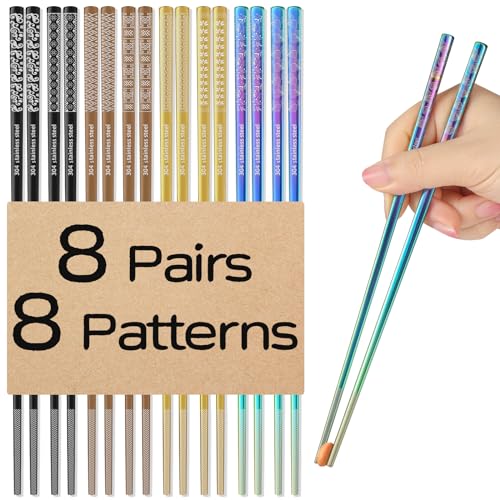
- NEWDRIP 18/8 Stainless Steel Chopsticks, 8 Pairs — Best for Big Households
- LIXTONGR Dragon and Phoenix Black Stainless Chopsticks, 2 Pairs — Best Gift Set
- Greatamzor Multicolor Stainless Chopsticks, 5 Pairs Gift Set — Best for Telling Yours Apart
- Greatamzor Titanium-Plated Stainless Chopsticks, 2 Pairs — Best Two-Person Set
Check on Amazon — start with our first pick, then read the full guide ↓ for the honest trade-offs behind every ranking.
The best tips for using chopsticks are useless if the sticks themselves are fighting you, which is why this guide pairs a full technique curriculum with six verified metal sets chosen for learnability. Slippery, heavy or over-long sticks make beginners squeeze, and squeezing is the root of nearly every dropped noodle. The sets below favour textured tips, engraved grip patterns and manageable weights — the physical features that let good technique form. If you are also shopping the wider category, Best Titanium Chopsticks covers the premium-material end of the same drawer.
Here is the honest shape of learning. The first meal is clumsy for everyone; the fifth is recognisably better; by the twentieth, the grip runs itself and your attention moves to the food. Technique tips compress that curve, but only if they are the right tips in the right order: rest position before movement, movement before speed, big forgiving foods before noodles, noodles before peas. This guide follows that order deliberately, in the how-to layer and in the way the picks are ranked.
Who should read on? Adult beginners who have decided this is the year, parents teaching themselves before teaching children, and returning users whose chopsticks live in a drawer because the last attempt ended in a fork. The picks are all adult metal sets — durable, grippy and dishwasher-safe — because a learner deserves tools that survive the learning. Parents shopping specifically for children should jump to Best Toddler Chopsticks after absorbing the technique here.
Key Takeaways
- The bottom stick does not move. Almost every beginner error comes from trying to move both sticks.
- Grip further back than feels natural: control comes from leverage, not from clutching near the tips.
- Textured or engraved tips matter more for learners than any other product feature.
- Practise in the right order: large soft foods, then noodles, then small round challenges like peas.
- A relaxed hand is a skilled hand — if your fingers ache, your grip is too tight and too low.
- Metal sets reward learners with durability and dishwasher care, at the cost of some early slipperiness that texture fixes.
In this guide
Quick Picks
Ranked for learners first: grip texture, weight and length lead, with set size and gift-worthiness as secondary virtues.
| Pick | Badge | Why it is here |
|---|---|---|
| IQCWOOD 304 Stainless Steel Chopsticks, 5 Pairs | Best Overall for Learners | 304 stainless, 5 pairs, 9.25 inch, with non-slip tips and a lightweight build. |
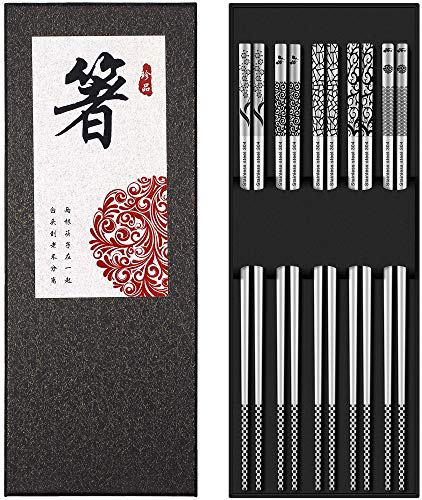
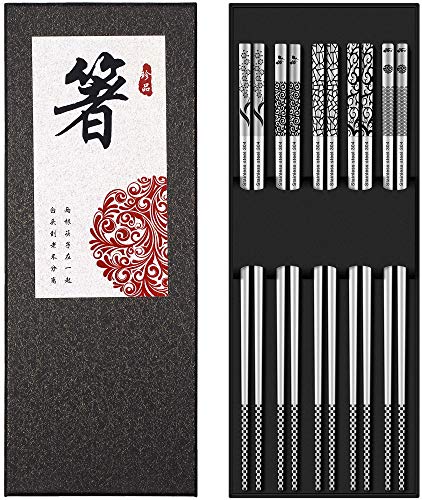
| Greatamzor 18/8 Stainless Steel Chopsticks, 5 Pairs Gift Set | Best Grip Texture | 18/8 stainless, 5 pairs, laser-engraved patterns that double as grip. |
| NEWDRIP 18/8 Stainless Steel Chopsticks, 8 Pairs | Best for Big Households | 18/8 stainless, 8 pairs, engraved non-slip design at a family-table scale. |
| LIXTONGR Dragon and Phoenix Black Stainless Chopsticks, 2 Pairs | Best Gift Set | 18/10 stainless, 2 pairs, Dragon and Phoenix motif in a gift box. |
| Greatamzor Multicolor Stainless Chopsticks, 5 Pairs Gift Set | Best for Telling Yours Apart | Multicolor stainless, 5 pairs, square profile with copper coin engraving. |
| Greatamzor Titanium-Plated Stainless Chopsticks, 2 Pairs | Best Two-Person Set | Titanium-plated stainless, 2 pairs in black and silver, engraved non-slip tips. |
How These Picks Were Chosen
Picks were verified against their Creators API listing records — alloy, set count, length, tip design and care instructions are reported only where the listing states them — and then ranked through a learner’s lens. Tip grip came first, because it decides whether food stays put long enough for technique to develop. Weight came second, because a tired hand squeezes and a squeezing hand drops things. Length and set count followed, and presentation last: a gift box is lovely, but it has never taught anyone to pick up a dumpling.
The technique content is the accumulated common sense of how chopsticks are actually taught: a stable rest stick, a moving top stick, fulcrum at the middle finger, and practice foods in a forgiving order. No laboratory claims are made and none are needed; this is a skill guide, and the evidence standard is whether the advice works at your next meal. Try the grip steps in the how-to layer with whatever sticks you own before buying anything — the right purchase will be obvious once your hands know what they are asking for.
One scope note. Every pick here is a standard adult set, because this keyword is about technique for general users. Readers whose real question is a child’s first pair, or a dedicated trainer with a connector, will find those briefs handled in Best Trainer Chopsticks and the toddler guide — different tools for different hands, linked rather than blurred together here.
Best Tips for Using Chopsticks: The 6 Sets That Help Most

IQCWOOD 304 Stainless Steel Chopsticks, 5 Pairs
Badge: Best Overall for Learners
Strengths
- 304 stainless is a food-grade, rust-resistant everyday alloy
- Textured non-slip tips help beginners hold onto noodles
- Five matched pairs cover a family table in one set
Trade-offs
- Metal tips are more slippery than wood or bamboo for experts
- 9.25 inch length is long for small children
- Metal conducts heat from hot pots more than wooden styles
Key specs from the listing: Material: 304 stainless steel; Set: 5 pairs; Length: 9.25 inches; Tips: non-slip, lightweight build; Care: dishwasher safe.
The IQCWOOD set takes the top badge for learners because its listing reads like a learner’s checklist: non-slip tips to forgive early technique, a lightweight build that delays hand fatigue, a standard 9.25 inch length that suits most adult hands, and 304 stainless that goes straight in the dishwasher after practice. Five pairs mean the household can learn together — and shared embarrassment, veterans agree, is the fastest teacher there is.
At the table, what decides whether a set like this gets reached for is feel: the section shape in the fingers, the way the tips meet, and whether food stays put without a squeeze that tires the hand. Those qualities do not photograph, which is why they are worth describing plainly. A set that feels secure at a relaxed grip will be used daily; a set that demands constant correction will drift to the back of the drawer no matter how handsome it looks.
Think about the second month of ownership. By then the set has been washed a hundred times, borrowed by guests, and used for everything from instant noodles to a careful anniversary dinner. The qualities that survive that month are not the ones in the listing photograph; they are alloy honesty, tips that still grip after a hundred dishwashers, and a weight that nobody at the table has quietly started avoiding. Judge this set against that month and its ranking explains itself.
Best for: adult beginners and households learning together / Not suited for: children, who need shorter, purpose-built sticks
Greatamzor 18/8 Stainless Steel Chopsticks, 5 Pairs Gift Set
Badge: Best Grip Texture
Strengths
- Laser-engraved patterns add grip as well as decoration
- 18/8 stainless is the classic cutlery-grade alloy
- Gift-set presentation suits housewarmings and holidays
Trade-offs
- Engraving grooves need a rinse to clear starchy residue
- Full-metal weight tires new users on long meals
- Japanese-Korean styling is shorter than Chinese banquet length
Key specs from the listing: Material: 18/8 stainless steel; Set: 5 pairs, gift set; Length: 9 1/4 inches; Design: laser-engraved, non-slip; Care: dishwasher safe.
Greatamzor’s engraved set is the texture pick. Laser engraving along the shaft gives fingers a reference they can feel — useful when you are learning where the sticks sit — and the patterned tips hold noodles that polished metal would surrender. As a gift set it also presents well, which matters if the learning is happening because someone who loves this food culture is joining the family table.
For learning and re-learning alike, feedback matters. Sticks that communicate — through texture, through a section that indexes naturally between the fingers — shorten the clumsy phase, because the hand can feel where the sticks are without looking. That is the lens to judge this set through if a learner will use it: not whether it is labelled for beginners, but whether its grip, weight and tips quietly help the hand do the right thing.
There is a social dimension to a set like this that spec sheets ignore. Chopsticks are handed to guests, lent to learners and read — fairly or not — as a statement about the household’s seriousness at the table. A set that looks intentional and behaves predictably flatters the host and reassures the guest, and in families where several generations eat together, that quiet confidence is worth as much as any engraving. It is part of why this set holds its position here.
Best for: learners who keep losing noodles to slippery tips / Not suited for: purists who prefer plain, unadorned sticks

NEWDRIP 18/8 Stainless Steel Chopsticks, 8 Pairs
Badge: Best for Big Households
Strengths
- Eight pairs is the biggest household count in this line-up
- Engraved non-slip patterning helps with oily noodles
- One set covers daily meals plus guests without mixing styles
Trade-offs
- Eight metal pairs add drawer weight and clatter
- Uniform 9.25 inch length will not suit every hand size
- Metal is unforgiving on delicate non-stick coatings
Key specs from the listing: Material: 18/8 stainless steel; Set: 8 pairs; Length: 9.25 inches; Design: laser-engraved, non-slip; Care: dishwasher safe.
Eight engraved pairs make the NEWDRIP set the household pick: enough for a full table of learners and the already-converted, all matching, all dishwasher safe. Uniformity is a genuine learning aid — switching between different sticks every meal resets your hands’ calibration — and this is the set that guarantees nobody at your table has to. The 9.25 inch length is the standard adult size throughout.
Durability is the long argument for every metal set here, and this one is no exception. It will not splinter, warp in the dishwasher or hold yesterday’s garlic. The ownership questions are smaller and more practical: how the finish ages, how the tips treat your pans, and whether the length matches the meals your household actually eats. Answer those three and you know whether this is your set.
Value in this category is a slow calculation. A set bought once and used for a decade costs less per meal than any disposable alternative, and stainless designs like this one are built for exactly that arithmetic. The honest variables are whether the finish ages gracefully, whether the tips stay true, and whether the household actually reaches for them — which returns, as every section of this guide does, to grip, weight and length suiting the hands that own them.
Best for: families and hosts who want one uniform set for everyone / Not suited for: solo diners who need at most two pairs

LIXTONGR Dragon and Phoenix Black Stainless Chopsticks, 2 Pairs
Badge: Best Gift Set
Strengths
- 18/10 stainless is the premium cutlery alloy in this line-up
- Dragon and Phoenix motif makes it a deliberate gift piece
- Two-pair gift-box format suits couples and weddings
Trade-offs
- Only two pairs, so it is not a family-table solution
- Black finish shows scratches more visibly over time
- 9 inch length is the shortest adult size compared here
Key specs from the listing: Material: 18/10 stainless steel; Set: 2 pairs; Length: 9 inches; Grip: non-slip; Packaging: gift box; Care: dishwasher safe.
The LIXTONGR set is the occasion pick: premium 18/10 stainless, a Dragon and Phoenix motif, two pairs in a gift box. As a learning tool it is entirely respectable — non-slip grip, sensible 9 inch length — but its real role is marking a moment: a wedding, a housewarming, a first proper dinner party. Buy it when the story matters as much as the sticks, and practise on it happily.
At the table, what decides whether a set like this gets reached for is feel: the section shape in the fingers, the way the tips meet, and whether food stays put without a squeeze that tires the hand. Those qualities do not photograph, which is why they are worth describing plainly. A set that feels secure at a relaxed grip will be used daily; a set that demands constant correction will drift to the back of the drawer no matter how handsome it looks.
Think about the second month of ownership. By then the set has been washed a hundred times, borrowed by guests, and used for everything from instant noodles to a careful anniversary dinner. The qualities that survive that month are not the ones in the listing photograph; they are alloy honesty, tips that still grip after a hundred dishwashers, and a weight that nobody at the table has quietly started avoiding. Judge this set against that month and its ranking explains itself.
Best for: gift-givers and couples setting a first table together / Not suited for: large families needing many pairs at once

Greatamzor Multicolor Stainless Chopsticks, 5 Pairs Gift Set
Badge: Best for Telling Yours Apart
Strengths
- Different colours per pair end the whose-are-whose argument
- Square profile rolls less on the table than round sticks
- Copper coin engraving adds grip texture along the shaft
Trade-offs
- Colour finishes need gentler washing to stay bright
- Square edges feel unfamiliar if you learned on round sticks
- Metal tips still slip on very oily foods for beginners
Key specs from the listing: Material: stainless steel; Set: 5 pairs, gift set; Length: 9 1/4 inches; Design: laser-engraved copper coin pattern, square profile; Grip: non-slip; Care: dishwasher safe.
The multicolor Greatamzor set solves the household problem nobody anticipates: identical sticks breed arguments and mix-ups. A colour per person ends both, and the square profile adds a second learner virtue — it does not roll off the table or the rest, and its edges index naturally between the fingers. The copper coin engraving is the grip texture, doing decorative and functional work at once.
For learning and re-learning alike, feedback matters. Sticks that communicate — through texture, through a section that indexes naturally between the fingers — shorten the clumsy phase, because the hand can feel where the sticks are without looking. That is the lens to judge this set through if a learner will use it: not whether it is labelled for beginners, but whether its grip, weight and tips quietly help the hand do the right thing.
There is a social dimension to a set like this that spec sheets ignore. Chopsticks are handed to guests, lent to learners and read — fairly or not — as a statement about the household’s seriousness at the table. A set that looks intentional and behaves predictably flatters the host and reassures the guest, and in families where several generations eat together, that quiet confidence is worth as much as any engraving. It is part of why this set holds its position here.
Best for: households where everyone wants their own identifiable pair / Not suited for: diners who strongly prefer a round profile

Greatamzor Titanium-Plated Stainless Chopsticks, 2 Pairs
Badge: Best Two-Person Set
Strengths
- Titanium plating gives the two-tone black-silver look
- Engraved non-slip tips help with noodles and dumplings
- Two pairs in contrasting colours suit a two-person table
Trade-offs
- Plating is a surface finish, not solid titanium construction
- Only two pairs in the box
- Plated finishes prefer hand washing to stay even
Key specs from the listing: Material: stainless steel with titanium plating; Set: 2 pairs, gift set; Colours: black and silver; Design: laser-engraved, non-slip; Care: dishwasher safe.
Two pairs, two finishes: the titanium-plated Greatamzor set is the couples’ pick, black and silver distinguishing the pairs at a glance. The engraved non-slip tips keep it learner-honest, and the plating gives metal sticks a softer visual warmth. Note the construction clearly — this is stainless with a titanium plating, a finish rather than solid titanium — and wash it a little gently to keep the two tones even.
Durability is the long argument for every metal set here, and this one is no exception. It will not splinter, warp in the dishwasher or hold yesterday’s garlic. The ownership questions are smaller and more practical: how the finish ages, how the tips treat your pans, and whether the length matches the meals your household actually eats. Answer those three and you know whether this is your set.
Value in this category is a slow calculation. A set bought once and used for a decade costs less per meal than any disposable alternative, and stainless designs like this one are built for exactly that arithmetic. The honest variables are whether the finish ages gracefully, whether the tips stay true, and whether the household actually reaches for them — which returns, as every section of this guide does, to grip, weight and length suiting the hands that own them.
Best for: couples who want a matched, distinguishable pair each / Not suited for: anyone specifically seeking solid titanium sticks
Comparison Table
Compare tip design and weight first — for a learner those two columns are the technique section in disguise.
| Pick | Key facts from the listing | Badge | Check |
|---|---|---|---|
| IQCWOOD 304 Stainless Steel Chopsticks, 5 Pairs | Material: 304 stainless steel; Set: 5 pairs | Best Overall for Learners | Check on Amazon |
| Greatamzor 18/8 Stainless Steel Chopsticks, 5 Pairs Gift Set | Material: 18/8 stainless steel; Set: 5 pairs, gift set | Best Grip Texture | Check on Amazon |
| NEWDRIP 18/8 Stainless Steel Chopsticks, 8 Pairs | Material: 18/8 stainless steel; Set: 8 pairs | Best for Big Households | Check on Amazon |
| LIXTONGR Dragon and Phoenix Black Stainless Chopsticks, 2 Pairs | Material: 18/10 stainless steel; Set: 2 pairs | Best Gift Set | Check on Amazon |
| Greatamzor Multicolor Stainless Chopsticks, 5 Pairs Gift Set | Material: stainless steel; Set: 5 pairs, gift set | Best for Telling Yours Apart | Check on Amazon |
| Greatamzor Titanium-Plated Stainless Chopsticks, 2 Pairs | Material: stainless steel with titanium plating; Set: 2 pairs, gift set | Best Two-Person Set | Check on Amazon |
How to Choose Chopsticks When You Are Still Learning
Choose grip before beauty. A learner’s first set should have textured, engraved or otherwise non-slip tips, because early success is mostly friction: food that stays between the tips long enough to reach your mouth. Polished showpiece sticks are for hands that already compensate automatically. Every set in this guide carries some grip provision, but they differ in degree — the engraved Greatamzor and the textured IQCWOOD sit at the high-grip end, and true beginners should start there.
Choose weight and length for your hand, not for the table’s look. Around nine to nine and a quarter inches suits most adult hands for eating; much longer is for cooking and serving. Lighter sticks delay the fatigue that makes learners squeeze, and squeezing is the enemy — it pops food out and aches by mid-meal. If you are between two sets, take the lighter one and the one whose section — square or round — sits still between your fingers when you mimic the grip in the shop or from the listing photos. The material debate continues at Best Titanium Chopsticks With Case for readers already thinking about a travel set.
Choose the count for your real table. Two pairs for a couple, five for a family, eight if guests are routine. Matching sets matter more than learners expect, because your hands calibrate to one tool; a drawer of mixed singles is a small daily tax on a developing skill. Stainless repays you here: one purchase, identically behaved pairs, dishwasher care, and no replacement cycle when a wooden pair warps mid-education.
How to Use Chopsticks: The Grip, Step by Step
Do this with a pair in hand and a bowl of something forgiving — popcorn, marshmallows or chunks of cheese — before your next real meal.
- Rest the bottom stick first. Lay one stick across the base of your thumb and rest its far end on your ring finger, tip pointing forward. This stick is furniture: once placed, it does not move for the whole meal.
- Add the top stick like a pencil. Hold the second stick between thumb, index and middle finger, above the first, the way you would hold a pen you are about to write with.
- Set your grip about a third of the way from the top end. Gripping near the tips feels safer and is actually weaker; further back gives the tips a wide, controlled opening.
- Move only the top stick. Practise opening and closing the tips by moving the upper stick up and down with index and middle finger while the bottom stick stays perfectly still.
- Check the tips meet. When closed, the tips should touch evenly. If they cross or scissor, slide your grip slightly and try again — alignment is a position problem, not a strength problem.
- Pick up big, soft, angular food first. Cheese cubes, popcorn and cooked vegetable chunks forgive everything. Take ten slow repetitions before any noodle is allowed near you.
- Graduate in order: noodles next, then dumplings and sushi, then the honest final exam — peas, beans and peanuts — one at a time, without a timer or an audience.
- Rest the sticks properly between mouthfuls: together, on a rest or across the bowl’s edge, never speared upright into food and never crossed, which are the two table manners every culture at the table will thank you for.
Problem: Food keeps squirting out sideways → what to do: you are squeezing. Open your grip slightly, move your hand a fraction further back, and let the tips close gently — chopsticks hold food by positioning, not by pressure.
Problem: The sticks cross like scissors → what to do: your top stick is angled. Rebuild the grip from step one, checking that both sticks start parallel and the tips meet flat before you pick anything up.
Problem: Your hand aches after five minutes → what to do: your grip is too low and too tight, or the sticks are too heavy for a learner. Slide back, consciously relax between bites, and consider a lighter hollow or slim set while you learn.
Practice Drills That Actually Work
Ten minutes of deliberate practice beats a month of hopeful meals. Drill one: move twenty popcorn pieces from bowl to bowl, slowly, rebuilding the grip every time it collapses rather than muscling through. Drill two: the staircase — pick up a grape, a cherry tomato, a pea, in that order, and notice how the required gentleness rises as the food gets rounder. Drill three: noodle lifts, raising a single strand clear of the bowl and lowering it back without breaking it, which teaches the soft close that real meals demand.
End every drill before frustration arrives. Motor learning consolidates between sessions, which is why three calm ten-minute practices outperform one furious hour — and why the advice in Best Training Chopsticks about structured progression applies even if you never buy a trainer and simply train deliberately on standard sticks like these.
Etiquette: The Tips Nobody Puts on the Packet
Technique gets the food to your mouth; etiquette decides whether you are invited back. The core rules travel across Chinese, Japanese and Korean tables with local variations: do not spear food, do not point with the sticks, do not pass food stick-to-stick, do not dig through a shared dish for the best piece, and rest your sticks neatly rather than planted upright in rice. None of this is trivia for a learner — hosts notice, kindly, and it costs nothing to get right from your first meal.
Serving ends matter too. Use the reverse ends of your sticks, or dedicated serving sticks, when taking from shared plates, and return food you have touched to your own plate rather than the communal dish. If that sounds like a lot, reduce it to one sentence: treat the shared table as everyone’s, and your sticks as guests in it. The rest is refinement you will absorb by watching the table you are lucky enough to sit at.
Length, Texture and Weight: Why the Sticks Matter
Length is the specification that quietly decides who a pair of chopsticks suits. Shorter Japanese-style sticks, around nine inches, put the tips close to the hand and reward the precise picking used for fish and small bites. Korean metal sticks sit in a similar range but are often flatter or square in section, a shape developed for slippery noodles and kimchi. Longer Chinese styles give reach into hot pots and serving bowls and keep fingers further from steam. None of this is etiquette trivia: a learner fighting sticks that are too long for their hand will blame their grip when the real problem is geometry, and a cook reaching into a wok with short sticks will feel the heat long before the food is turned.
Tip texture matters more with metal than with any other material. Polished stainless is nearly frictionless, which is why plain metal sticks have a reputation for dropping noodles. The fixes used across these sets are laser-engraved patterns, sandblasted or textured tip sections, and square profiles that resist rolling and add edges for food to catch on. For a learner, tip grip is worth more than any other feature, because early success is mostly about food staying put long enough to build confidence. For an experienced user the same texture is a minor preference. Match the texture to the stage of the user, not to the look of the set.
Weight and balance shape how tiring a meal feels. Solid metal sticks carry real heft, which some experienced users like for the sense of control, while hollow-core designs cut that weight dramatically and are noticeably kinder during long meals or for smaller hands. Learners often do better starting light, because a tired hand squeezes harder, and a harder squeeze is exactly what makes food squirt out from between the tips. If you are buying for a household with mixed experience, a mid-weight set with textured tips is the compromise that nobody at the table will complain about, and it is why so many of the sets compared here cluster around the same design choices.
Materials, Care and Everyday Use
Metal chopsticks behave differently around heat and coatings, and both points deserve honesty. Stainless steel conducts heat, so a pair left resting in a hot pot will warm along its length in a way bamboo never does; for table eating this is irrelevant, but for cooking it argues for longer sticks and for not leaving them sitting in the pan. At the other end, metal tips are hard on delicate non-stick surfaces, so the same pair that is perfect for the table should stay out of your best coated wok. Used with those two limits in mind, stainless sets repay you with decades of service, no splinters, no warping and no flavour retention between meals.
Care is where metal quietly wins the long game. Stainless sets go in the dishwasher, shrug off soy, turmeric and chilli oil without staining the way pale wood does, and never need oiling or special drying. The small print is about finishes: coloured and plated coatings stay brightest with gentler washing, and engraved patterns deserve a rinse before dried starch sets into the grooves. Beyond that, the routine is wash, dry, store. For anyone who has thrown away a warped, split or mould-smelling wooden pair, that simplicity is the entire argument for metal, and it is a strong one.
A set count is a household decision, not a bargain hunt. Two pairs suit a couple or a deliberate gift; five pairs cover the standard family table; eight and ten pair sets exist for households that host often or run a full table nightly. Buying bigger than your table means more pairs ageing in the drawer, which is harmless with stainless but pointless. Buying smaller than your table means mixing in odd pairs that feel different in the hand, which learners notice far more than experienced users do. Count your regular seats, add two for guests, and buy exactly that.
Serving, Cooking and Eating: One Pair or Three?
Chopsticks multitask in the cuisines that raised them: the same pair can stir, serve and eat. Metal sets complicate that picture in two practical ways. They conduct heat, which argues for longer sticks and brief contact when cooking; and they are hard on delicate coatings, which argues for keeping table sets out of non-stick pans entirely. Households that cook seriously with chopsticks often keep a long wooden cooking pair for the wok and metal sets for the table, and that division of labour is worth copying.
Serving has its own etiquette and its own tools: dedicated serving sticks, or the reversed ends of your own, keep shared dishes hygienic. The sets compared here are eating sets; treat them as such, add a cheap long pair for the stove if you cook this way often, and both tools will last longer and behave better.
Buying for a Household: A Short Negotiation Guide
Household chopstick purchases fail socially more often than mechanically. One person wants the premium pair, another wants twenty cheap ones, a third has opinions about colour, and the learner — whose needs should arguably lead — gets whatever the argument leaves behind. The workable order is needs first, numbers second, beauty last: establish whose hands are learning and what texture they need, count the seats and the spares, and only then let the table argue about finishes.
The sets in this guide map neatly onto that negotiation’s usual outcomes. Volume steel for the practical wing, a stated-grade gift set for the romantics, colour-coding for the peacemakers, hollow-core lightness for the member whose hands tire. None of those outcomes is a compromise in the pejorative sense; each is a household correctly identifying which variable it actually values.
Revisit the purchase annually, the way you would any shared tool. Learners graduate, children grow into longer sticks, finishes fade at different rates, and the set that was perfect for last year’s table can be quietly wrong for this year’s. Stainless makes the revision cheap to act on — one more argument, if any were needed, for the material this pool is honestly made of.
Care for metal sticks is mostly a promise you keep without thinking: wash them like cutlery, dry them like cutlery, store them like cutlery. The refinements are few. Coloured and plated finishes stay brightest with gentler cycles; engraved patterns appreciate a rinse before starch dries into the grooves; and any pair that has been travelling deserves a proper wash before it rejoins the home drawer. That is the whole liturgy, and its simplicity is the material’s argument.
Storage deserves one sentence of its own: keep pairs together, tips protected from the cutlery scrum, in a tray or a case rather than loose in a drawer’s geology. A pair that can be found together, undamaged, in the dark, is a pair that gets used — and use, as every section of this guide insists, is where skill and value both come from.
Noise and table manners deserve their honest sentence too. Metal sticks click against ceramic in a way wood never does, and in quiet, formal settings that sound is part of the set’s character — some diners love the precision of it, others find it restless. At an ordinary family table it vanishes into the meal’s ordinary music within a week. If your table is a hushed one, handle a metal set before committing the household to it; if it is a lively one, file the whole question under things that will never matter.
Finally, a word about the humble spare pair. Every household that eats with chopsticks regularly should own one unglamorous extra set — for the guest who arrives unexpected, the pair that vanishes into a lunch bag, the evening the dishwasher is full. The volume sets in this guide build that spare in by design; the two-pair gift sets argue for buying the spare separately and cheaply. Either way, the household that plans for the spare never has the small, silly argument that otherwise ends, reliably, with someone eating noodles with a fork.
One more consideration belongs in every chopstick decision, and it is the household’s future rather than its present. Learners become fluent, children grow into longer sticks, a partner arrives with their own preferences, and the set bought for this year’s table meets next year’s without asking permission. Stainless sets absorb that future gracefully — they do not wear out while the household changes around them — which is why the rankings here weight stated alloy and honest construction so heavily: the set is a small piece of household infrastructure, and it should be bought like one.
Common Buying Mistakes
Learners blame their hands for errors that belong to their tools and habits. These are the five to correct first.
- Learning on polished, slippery sticks and concluding you have no aptitude, when the tips were the problem all along.
- Gripping near the tips for a false sense of control, which weakens the close and aches within minutes.
- Moving both sticks instead of anchoring the bottom one — the single most common beginner error.
- Starting practice with noodles or peas instead of big, forgiving foods that let the grip form.
- Buying a drawer of mismatched singles, so your hands recalibrate from scratch at every meal.
Final Recommendation
Start with the IQCWOOD set if you are buying one set to learn on: non-slip tips, light build, standard length, five pairs for the household, and nothing about it will fight your developing grip. Pair it with the step-by-step in this guide and ten calm minutes of popcorn practice, and the skill will arrive faster than you expect.
Specialise from there. Take the engraved Greatamzor if slippery tips are your specific nemesis, the NEWDRIP eight-pair set if the whole table is learning, the multicolor set if ownership arguments loom, the LIXTONGR if the purchase is really a gift, and the two-tone plated set if a couple wants a pair each with a little ceremony. The technique is the same for all of them — which is, in the end, the most encouraging tip in this guide.
Start with Check on Amazon for our first pick, and compare it against Check on Amazon if the runner-up description sounds closer to your kitchen.
Frequently Asked Questions
How long does it take to learn chopsticks properly?
Most adults handle a normal meal confidently within five to ten uses, and feel genuinely fluent within a month of regular meals. Short, calm practice sessions with forgiving foods compress that curve considerably.
Why does the bottom chopstick stay still?
Because two moving sticks cannot form a stable grip. The bottom stick is a shelf resting on your ring finger and thumb base; the top stick is the only moving part, pressing food gently against that shelf. Every beginner breakthrough starts with this realisation.
Are metal chopsticks harder for beginners than wood or bamboo?
Plain polished metal, yes — it is slippery. Textured or engraved metal, like most sets here, closes most of that gap while adding durability and dishwasher care. Tip texture matters more than material.
What food should I practise with first?
Large, soft, angular pieces: popcorn, cheese cubes, cooked vegetables, chunks of bread. Move to noodles once the grip is calm, and save peas and peanuts for when you want a party trick.
How far back should I hold chopsticks?
About a third of the length from the top end. It feels exposed at first and gives you a wider, more controlled tip opening and far less hand fatigue than clutching near the tips.
Can children learn on these sets?
These are adult-length metal sets, and children learn better on shorter, lighter, purpose-built sticks. This guide’s technique steps transfer directly; the tools should not. See the toddler and trainer guides linked above for the right sizes.