Disclosure: topratedkitchenware.com is reader-supported. When you buy through links on our site, we may earn an affiliate commission from Amazon and other retailers, at no extra cost to you.
Where to buy
The best dishwasher safe chopsticks are the ones whose makers put the promise in writing — and every set below does exactly that. All six are reusable stainless steel sets whose listings explicitly state dishwasher-safe construction, so you can scrape the plate, load the basket and let the machine do the work, every night, for years. Each name links to its Amazon listing so you can confirm the claim yourself.
- MUYOS Stainless Steel Chopsticks, 5 Pairs — hollow-core lightweight pairs that take up minimal basket space.
- Greatamzor Multicolor Stainless Steel Chopsticks, 5 Pairs — color-coded pairs that come out of the wash as vivid as they went in.
- Greatamzor Titanium Plated Stainless Steel Chopsticks, 2 Pairs — the premium finish that still carries a dishwasher-safe listing.
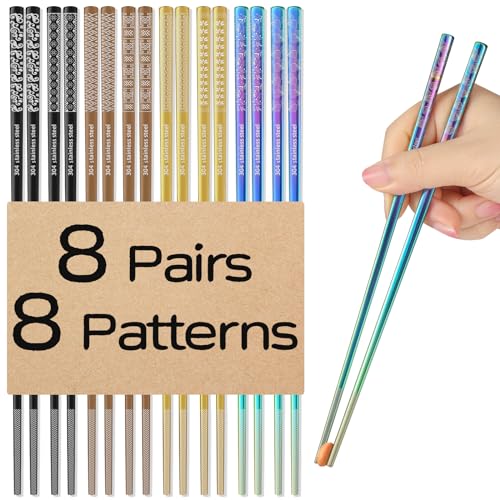
- NEWDRIP Multicolor Metal Chopsticks, 8 Pairs — eight pairs built for households that run the machine daily.
- Lazycorner 304 Stainless Steel Chopsticks, 10 Pairs — the ten-pair bench that means a clean pair is always waiting.
- IQCWOOD 304 Stainless Steel Chopsticks, 5 Pairs — straightforward 304 steel pairs for daily meals and daily washing.
Read the full guide ↓ for how to load, wash and store steel chopsticks so the dishwasher-safe promise holds for the life of the set — and which finishes ask for one small extra habit.
There is a quiet moment in every kitchen that separates the tools you love from the tools you tolerate: the moment dinner ends. Hand-wash-only utensils create a small negotiation at the sink — soak now, wash later, skip tonight — and negotiations repeated nightly become resentment. People searching for the best dishwasher safe chopsticks have usually lived that negotiation with wooden or lacquered pairs and decided, correctly, that their next set will go in the machine like the rest of the flatware.
Stainless steel is the material that keeps that promise without fine print, which is why this entire shortlist is steel. It does not warp at wash temperatures, does not absorb detergent or last night’s garlic, and does not ask to be oiled, dried by hand or stored specially. But “dishwasher safe” is a spectrum in practice: finishes differ, grades differ, and loading habits decide whether a set looks new in year three or merely survives. This guide treats the claim seriously — every pick’s listing states it outright — and then teaches the handful of habits that make the promise pay out in full.
If your household eats with chopsticks daily, the arithmetic is compelling: a machine-washed steel set converts a nightly chore into a non-event, and a multipack means the rotation never runs dry while the machine does its work. That is the whole case, and the six sets below make it at six different scales and styles.
Key Takeaways
- Every set in this guide is stainless steel whose listing explicitly states dishwasher-safe construction — the claim is verified, not assumed.
- The MUYOS five-pair set is the easiest default: lightweight hollow-core pairs, non-slip tips, and a plain silver finish that forgives every washing habit.
- Ten-pair and eight-pair sets (Lazycorner, NEWDRIP) suit dishwasher households best, because the rotation absorbs the machine’s cycle time.
- Colored and plated finishes are dishwasher safe too, but keep their looks longest on the top rack with prompt unloading.
- Water spots are mineral deposits, not damage — a rinse-aid habit or a quick towel pass keeps polished steel spotless.
- Steel grades here (304, 18/8-family, 18/10) are all food-grade dishwasher veterans; design and count should drive your choice, not grade anxiety.
In this guide
Quick Picks
| Pick | Badge | Pairs | Wash-day advantage | Link |
|---|---|---|---|---|
| MUYOS Chopsticks | Best Overall Dishwasher-Safe | 5 pairs | Plain finish forgives everything | Check on Amazon |
| Greatamzor Multicolor | Best Color Set | 5 pairs | Colors stay identifiable wash after wash | Check on Amazon |
| Greatamzor Titanium Plated | Best Premium | 2 pairs | Plated finish with a dishwasher-safe listing | Check on Amazon |
| NEWDRIP Multicolor | Best Big Multipack | 8 pairs | Rotation sized for daily machine runs | Check on Amazon |
| Lazycorner 304 | Best Bulk Bench | 10 pairs | Deepest clean-pair reserve | Check on Amazon |
| IQCWOOD 304 | Best Simple 304 Set | 5 pairs | No-fuss steel, stated length | Check on Amazon |
The badges repeat in the detailed reviews. In this guide, every badge is really a washing-and-rotation story: how the set behaves across hundreds of cycles is the product you are actually buying.
How These Picks Were Chosen
We began with a verified pool of reusable stainless steel chopstick sets confirmed through Amazon catalog data. This keyword’s rule was applied literally: a set qualified only if its own listing states dishwasher-safe construction. All six sets in the pool passed — a reflection of steel’s nature — so the ranking turns on the factors that separate good dishwasher citizens from great ones: finish forgiveness, pair count relative to cycle time, and how much basket discipline each design demands.
We also weighted the long game. A set is not dishwasher safe in any meaningful sense if its finish fades in a season or its colors become unrecognizable; the designs here — engraved patterns that are cut into the surface rather than printed on it, solid color finishes, and in the premium case a plated surface whose listing still carries the dishwasher-safe claim — are the ones whose appearance is built to survive the process, not just tolerate it. Where a finish asks for one extra habit, the review says so plainly.
This is a research-led guide, not a cycle-testing lab; our judgments rest on confirmed listing claims and established dishwasher practice. Readers replacing a whole drawer at once may want the Best General Purpose Chopsticks guide for the all-round view, while this article stays focused on the wash.
The 6 Best Dishwasher Safe Chopsticks
MUYOS Stainless Steel Chopsticks, 5 Pairs, Silver
Badge: Best Overall Dishwasher-Safe
Strengths
- Plain silver steel is the most forgiving finish in any dishwasher: no coating to baby, no color to fade.
- Hollow-core pairs are light in the basket and cannot trap water the way handled utensils do.
- Non-slip tips and a five-pair count cover daily meals with a sensible rotation.
Trade-offs
- The listing states no length or steel grade — the wash story is complete, the spec story is brief.
- Identical silver pairs can mingle with the household flatware and get sorted into the wrong drawer.
- Minimalist looks will not excite gift buyers.
Mini spec box
- Material: stainless steel, hollow-core lightweight design
- Set size: 5 pairs
- Finish: silver
- Tips: non-slip
- Care: dishwasher safe (per listing), reusable for daily meals
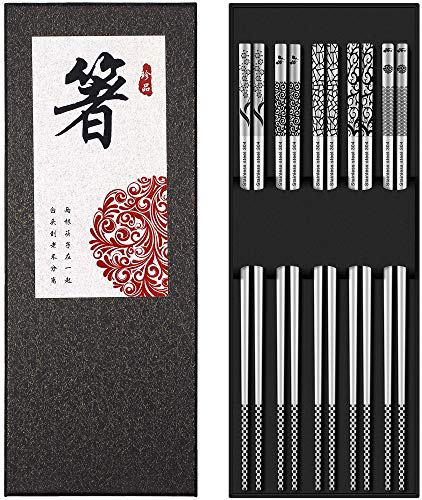
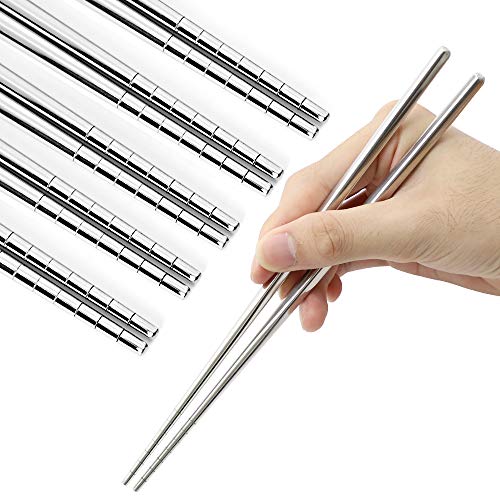
The best dishwasher-safe set is the one you never think about, and the MUYOS is engineered for oblivion. Its finish is bare steel — there is nothing on the surface that a wash cycle can take away. Its hollow core means the pair is light, dries fast, and has no seams, joints or handles where water and residue can linger. Load it, run the machine, put it away: that is the entire ownership experience, repeated indefinitely.
Five pairs is the right count for a couple or small household running the dishwasher nightly: tonight’s pairs wash while yesterday’s serve. The non-slip tips keep the eating half of the bargain — a set can be a washing champion and still fail at dinner, but this one grips like it means it.
If you want one upgrade over this default, it is only ever about scale or style: more pairs, or a finish with more personality. On pure wash-and-forget merit, this is the set to beat.
Best for: households wanting zero utensil maintenance / Not suited for: buyers who want stated specs or gift presentation

Greatamzor Multicolor Stainless Steel Chopsticks, 5 Pairs
Badge: Best Color Set
Strengths
- The listing confirms dishwasher-safe construction for a fully color-coded set — color and convenience in one purchase.
- The copper coin pattern is laser engraved into the steel, so the design cannot wash off; it is in the surface, not on it.
- Square, non-slip build keeps the eating performance equal to the plain sets.
Trade-offs
- Colored finishes keep their vividness longest on the top rack, away from the heating element’s harshest zone.
- Five colors is a family system; solo minimalists will find it busy.
- As with all colored utensils, abrasive scouring is off the table — unnecessary anyway, given the machine.
Mini spec box
- Material: stainless steel
- Set size: 5 pairs, multicolor
- Length: 9 1/4 inches (per listing)
- Design: laser-engraved copper coin pattern, square, non-slip
- Care: dishwasher safe (per listing); gift set
Colored utensils carry a reputation for being hand-wash divas, so the first fact matters: this set’s listing states dishwasher-safe construction outright. The second fact is why the claim is believable over years — the decorative pattern is laser engraved, cut into the steel itself. Dishwashers fade prints and lift decals; they cannot remove a pattern that is part of the metal’s surface. The color system that assigns each diner their pair survives the very process that makes the system hygienic.
In daily life, the wash routine is identical to the plain sets, with one refinement: give colored pairs the top rack. Distance from the heating element and from heavy pots that can bang against them keeps finishes vivid, and prompt unloading prevents the damp sitting that dulls any coated surface.
For families, this set closes the loop elegantly — pairs are identifiable before the meal, during it, and in the clean basket afterward, so the color system never breaks down at the sorting stage, which is where lesser systems quietly die.
Best for: families running color systems through daily wash cycles / Not suited for: bottom-rack-only loading habits

Greatamzor Titanium Plated Stainless Steel Chopsticks, 2 Pairs
Badge: Best Premium
Strengths
- A plated, premium finish whose listing still states dishwasher safe — the exception that proves steel’s rule.
- Laser engraving is in the surface, so the graphic detail is wash-proof by construction.
- Two pairs wash in any load without dominating the basket — the low-effort luxury option.
Trade-offs
- Plating is the finish that rewards care most: top rack, no abrasives, no nesting against heavy flatware.
- Two pairs means this set waits for its wash if both pairs are used daily — buy it as an occasion set.
- The listing states no length, so size-first buyers should check the product page.
Mini spec box
- Material: stainless steel with titanium plating
- Set size: 2 pairs
- Finish: black and silver
- Design: laser engraved, non-slip, premium Japanese Korean style
- Care: dishwasher safe (per listing); gift set
Premium finishes usually come with a care card and a warning. This set’s listing instead carries the dishwasher-safe claim, which makes it the most interesting washing story in the guide: a two-tone titanium plated surface that its maker is willing to send through the machine. The stainless core is why — the structure is indifferent to the cycle, and the plating is a hard metallic finish rather than a paint.
Our advice still adds one layer of prudence the listing does not demand. Treat the pair like the good flatware it resembles: top rack, separated from heavy items that could strike the surface, unloaded reasonably promptly. Those habits cost nothing and are how plated pieces stay handsome across years of cycles. What you should never do is scour it — with a machine doing the work, there is never a reason to.
As a two-pair set, its washing logistics are occasion-based: use, wash with the next load, return to the box or rest. Households wanting a premium pair inside a daily rotation should pair this purchase with a multipack from this guide for the workhorse shifts.
Best for: couples and gift buyers who refuse hand-washing on principle / Not suited for: high-volume daily rotation on its own

NEWDRIP Multicolor Metal Chopsticks, 8 Pairs
Badge: Best Big Multipack
Strengths
- Eight pairs is the rotation size that makes daily dishwashing effortless — a clean set always exists mid-cycle.
- Color-coding survives sorting: pairs come out of the basket already assigned to their diners.
- Listed for cooking and eating as well, so one wash system covers the kitchen’s whole chopstick inventory.
Trade-offs
- Eight pairs fill a basket section; small dishwashers will feel the footprint.
- Colored finishes prefer the top rack, which is the scarcest real estate in many machines.
- Cheerful colors will not suit every table’s mood.
Mini spec box
- Material: stainless steel
- Set size: 8 pairs, multicolor
- Length: 9.25 inches (per listing)
- Design: laser engraved, non-slip
- Care: dishwasher safe (per listing); cooking and eating; gift set
Dishwasher households live by rotation math: pairs in use, pairs in the machine, pairs clean and waiting. Eight is the count where the math disappears — even a household that runs the machine every other day never faces the clean-pair shortage that sends someone to the disposable stash. The NEWDRIP set is built for exactly that life, and its colors make the rotation self-organizing: each diner’s pair is recognizable in the basket, in the drawer and on the table.
Because the listing spans cooking and eating, this set also consolidates the wash: the pairs that stirred dinner and the pairs that served it go through the same cycle and return to the same drawer, one inventory with one care rule. Simplicity at the system level is a genuine feature, and busy households feel it nightly.
Plan the basket space honestly. Eight pairs want a dedicated section or a utensil cup of their own, and colored finishes claim top-rack territory. If your machine is compact, the five-pair sets in this guide deliver the same chemistry at a smaller footprint.
Best for: families running daily or near-daily wash cycles / Not suited for: compact dishwasher owners

Lazycorner 304 Stainless Steel Chopsticks, 10 Pairs
Badge: Best Bulk Bench
Strengths
- Ten pairs is the deepest reserve in the guide — the dishwasher can hold a full load hostage and dinner still proceeds.
- 304 stainless steel, described by the listing as food grade: the standard alloy of commercial and home kitchens alike.
- Lightweight, non-slip and silver — a uniform bench that matches everything and asks for nothing.
Trade-offs
- The listing states no length, a gap spec-driven buyers will need to close on the product page.
- Ten identical pairs require a sorting ritual, or the drawer becomes a pleasant silver thicket.
- Bulk is the opposite of gift presentation; buy it for infrastructure, not occasions.
Mini spec box
- Material: 304 stainless steel, food grade
- Set size: 10 pairs
- Finish: silver
- Design: non-slip, lightweight
- Care: dishwasher safe (per listing); daily meals and gifts
Every high-volume kitchen — and the Best Food Services Chopsticks guide makes the same point from the professional side — runs on bench depth. The Lazycorner ten-pack is bench depth for a home: pairs enough that the dishwasher’s timing stops mattering. Run the machine when it is full, not when the chopstick drawer is empty. That decoupling is a small domestic luxury, and it is this set’s entire design brief, executed plainly in food-grade 304 steel.
The washing itself could not be simpler: bare silver steel, no finishes to protect, no colors to preserve. Load them in a cup or section so the pairs stay together, and let the cycle do what it does. Lightweight construction means a full ten-pair load adds nothing meaningful to the machine’s burden.
The set’s demands are organizational, not chemical. Ten identical pairs need a home — a tray, a crock, a drawer divider — or they will colonize the utensil drawer in cheerful disorder. Give them thirty seconds of infrastructure and they will give you years of never thinking about clean chopsticks again.
Best for: big households, hosts, anyone decoupling dinner from the wash cycle / Not suited for: minimalists or gift buyers

IQCWOOD 304 Stainless Steel Chopsticks, 5 Pairs
Badge: Best Simple 304 Set
Strengths
- 304 stainless steel with the dishwasher-safe claim stated in the listing — the classic, verifiable combination.
- Publishes its length (9.25 inches), which several rivals omit; spec clarity is part of wash planning for basket fit.
- Lightweight with non-slip tips: easy in the basket, capable at the table.
Trade-offs
- Plain silver only — no color system for households that assign pairs.
- Five pairs is a small-household rotation; daily-wash families may want the eight or ten-pair sets.
- Korean Japanese styling at standard length will not double as long cooking pairs.
Mini spec box
- Material: 304 stainless steel
- Set size: 5 pairs
- Length: 9.25 inches (per listing)
- Design: lightweight, non-slip tips, Korean Japanese style
- Care: dishwasher safe (per listing); daily meals
The IQCWOOD set is the guide’s straight answer: 304 steel, five pairs, stated length, non-slip tips, dishwasher safe per the listing. In a category where several makers leave dimensions unstated, its completeness is worth naming — knowing a pair is 9.25 inches tells you how it will sit in your machine’s basket and your drawer before it arrives, and wash planning is this guide’s whole subject.
Day to day, expect the standard steel virtues with no asterisks: the cycle cleans it completely because there are no pores, seams or coatings to shelter residue; the lightweight build dries quickly; the tips keep their grip meal after meal because the texture is the steel’s own shape. Five pairs run a small household’s rotation comfortably alongside a nightly wash habit.
Choose it when you want the verified basics without a system to manage. Choose its bigger siblings when your household’s arithmetic — more diners, less frequent cycles — demands a deeper bench.
Best for: small households wanting verified, simple, machine-washed pairs / Not suited for: color-coding families or infrequent washers
Comparison Table
| Pick | Pairs | Steel (listing) | Finish care level | Link |
|---|---|---|---|---|
| MUYOS | 5 | Stainless, hollow core | Lowest — bare silver | Check on Amazon |
| Greatamzor Multicolor | 5 | Stainless | Low-medium — top rack for color | Check on Amazon |
| Greatamzor Titanium | 2 | Stainless, titanium plated | Medium — top rack, no abrasives | Check on Amazon |
| NEWDRIP Multicolor | 8 | Stainless | Low-medium — top rack for color | Check on Amazon |
| Lazycorner | 10 | 304 stainless | Lowest — bare silver | Check on Amazon |
| IQCWOOD | 5 | 304 stainless | Lowest — bare silver | Check on Amazon |
All six rows carry the same verified headline — dishwasher safe per the maker’s listing. The care-level column is about preserving appearance across years, not about permission to use the machine.
How to Choose Dishwasher Safe Chopsticks
Verify the claim in the listing, not the marketing. “Dishwasher safe” should appear in the product’s own specifications — it does for all six sets here. Be wary of listings that imply easy care with phrases like “easy to clean” while never making the machine claim; with wood and lacquer especially, that gap is where warped, split pairs come from. Steel sets that state the claim outright, as these do, are the safe buy.
Match pair count to your wash rhythm. The governing equation is simple: pairs needed = diners × days between cycles, plus a buffer pair or two. Nightly washers with two diners thrive on five pairs. Households running the machine every second or third day, or feeding five people, should start at eight or ten. Running dry mid-cycle is the only real failure mode of a dishwasher household, and it is purely a counting error.
Choose your finish by your habits. Bare silver steel (MUYOS, Lazycorner, IQCWOOD) forgives every loading style and never fades. Colored finishes add a household system and ask for the top rack. Plating adds ceremony and asks for separation from heavy flatware. All are legitimately dishwasher safe; they differ in how much of your attention the appearance budget consumes. Honest self-knowledge beats aspiration here — buy the finish your real Tuesday-night self will treat properly.
Prefer texture that is part of the metal. Laser engraving and formed texture survive unlimited cycles because there is nothing to strip. Printed or coated grip surfaces, where they exist in the wider market, are the first casualty of hot detergent water. Every set in this guide builds its grip into the steel itself, which is one reason they anchor the shortlist. Readers curious about non-steel easy-care materials can compare notes in the Best Fiberglass Chopsticks guide, where the washing story differs in interesting ways.
How to Load, Wash and Store Steel Chopsticks
- Load them in the utensil basket, tips up or down — consistently. Mixed directions tangle pairs and make unloading a small puzzle. Many households prefer tips down so the handled ends are what you grab; whichever you choose, keep pairs together in one section so they return to the drawer as pairs.
- Give slim items a section of their own. Chopsticks can slip through wide basket grids; if yours migrate toward the machine’s floor, lay them in the top rack’s flatware area or use a basket with a finer grid or a lid.
- Use your normal cycle and detergent. Steel needs no gentle program. The everyday cycle that handles your flatware handles these; save the delicate settings for glassware.
- Unload promptly and dry dark finishes. All steel benefits from not sitting in post-cycle steam, but black and plated finishes show mineral spots most readily. A ten-second towel pass on presentation pairs keeps them immaculate; everyday silver pairs can skip it without consequence.
- Store dry, paired and reachable. A tray, crock or drawer divider keeps pairs matched and tips aligned. Steel will not mildew or warp in storage, so the only goal is order.
Troubleshooting.
- Problem: white spots or a cloudy film after washing → mineral deposits from hard water, not corrosion; run a rinse aid, or wipe with a cloth dampened with a little vinegar, and unload before the steam settles.
- Problem: a pair comes out with food still in the texture → it was loaded against a plate that blocked the spray; give textured pairs breathing room in the basket and rinse sticky sauces off before loading.
- Problem: you keep finding a single stick in the machine → it slipped through the basket grid; switch that pair to the top rack or a lidded basket section.
Why Steel Wins the Dishwasher, Material by Material
It is worth understanding why this guide is all steel, because the alternatives each fail the machine in a characteristic way. Wood absorbs wash water, swells, and eventually splits along the grain; its finishes cloud and its surface roughens until it harbors residue. Bamboo shares wood’s thirst in a lighter body and is best treated as semi-disposable. Lacquered and painted pairs — often the most beautiful in the market — blister and peel under hot detergent cycles, which is why their makers so often print the hand-wash instruction this keyword’s shoppers are fleeing. Melamine-style and plastic pairs can warp near heating elements and degrade across repeated high heat.
Steel’s indifference is total by comparison: no absorption, no swelling, no coating required for the base metal to survive, and a surface that releases food and detergent alike. Its only dishwasher phenomena are cosmetic and manageable — water spots on polished finishes, and the theoretical dulling of colored surfaces over very long horizons, mitigated by the top-rack habit. Even the single-use world concedes the point by contrast: the Best Disposable Chopsticks guide exists for settings where washing is impossible, not preferable.
There is also a hygiene argument that matters to food-service thinking and transfers home: a non-porous surface that endures full-temperature machine washing with detergent is the easiest utensil surface to keep genuinely clean over years of service. Pores, cracks and lifted finishes are where yesterday’s meal retires; steel offers none of them a home.
One more steel advantage hides in plain sight: repairability of appearance. A wooden pair that has greyed and roughened cannot be restored to its first month; a steel pair that looks tired after a year of hard water and heavy loads can be brought back with a single vinegar wipe and a soft cloth, because the surface underneath the deposits is unchanged. The material does not accumulate history the way porous materials do. Every cycle starts from the same surface as the first, which is why owners of steel sets describe them in years rather than seasons — and why the secondhand advice in this category is so consistent: buy the steel set once, wash it without ceremony, and let every other utensil category in your kitchen be the one that needs replacing. That durability also compounds quietly in the background of a household budget and a landfill alike: a set washed a thousand times is a set that never had to be re-bought, re-packaged and re-shipped, which makes the dishwasher-safe steel pair the rare purchase that is simultaneously the laziest, the cheapest over time and the lightest on the world outside the kitchen. It is, in the end, the utensil equivalent of a good habit: unglamorous, repeatable, and quietly compounding in your favor every single day it is kept without ever needing to be thought about again.
The Rotation System: Pair Counts by Household
The most common reason a dishwasher household drifts back to disposables is not the machine — it is arithmetic. Here is the rotation worked out for the common household shapes, using the sets in this guide.
One or two diners, nightly cycles. A five-pair set is generous: two pairs in tonight’s wash, two in service, one resting clean. The MUYOS or IQCWOOD sets run this household indefinitely, and the clean-pair drawer never empties because the cycle and the meals keep the same daily rhythm.
Three to four diners, nightly cycles. Five pairs becomes tight the first time guests appear or a pair goes missing into a lunch bag. Eight pairs — the NEWDRIP set — restores the buffer: a full table’s worth can be in the machine while a full table’s worth is clean.
Any household, every-other-day cycles. Double the in-cycle inventory. Two diners now need the eight-pair class; four diners need the Lazycorner ten-pack and may still add a five-pair set in a second finish for guests. Infrequent washing is a legitimate lifestyle — it just has to be provisioned, and bulk steel is the cheapest provisioning there is.
Hosts. Count your largest regular gathering, not your family. A household of three that seats ten at holidays needs the ten-pack plus whatever the family set contributes, or the holiday meal ends with someone eating noodles with a fork and telling the story for years.
The pattern underneath: pairs are cheap, cycles are fixed, and shortages are always a planning failure rather than a product failure. Buy the count your rhythm demands and the dishwasher-safe promise becomes self-fulfilling — there is always a clean pair, so the machine always gets used, so there is always a clean pair.
Dishwasher Myths About Metal Utensils
Myth: dishwasher detergent dulls all steel quickly. Modern detergents are formulated for stainless flatware, which is the same material family as every set here. Polished finishes can soften in sheen over very long horizons, but the timeline is years, and brushed, engraved and textured surfaces — most of this pool — show essentially no change.
Myth: steel rusts in dishwashers. Food-grade stainless grades like the 304 and 18/10 in this guide are engineered against exactly this environment. The rust spots people occasionally see on utensils almost always trace to a non-stainless item in the same load shedding particles, or to carbon-steel knives washed alongside. A steel-only load of the kind these sets join does not produce them.
Myth: hollow items trap dirty water. A hollow-core chopstick is sealed; there is no opening for water to enter. The MUYOS design’s interior is as inaccessible to wash water as the inside of a saucepan’s wall is to soup. What hollow construction changes is weight and drying speed — both in the owner’s favor.
Myth: engraved patterns harbor grime through washes. Engraving is shallow surface texture, fully exposed to spray and detergent. It rinses clean in a cycle for the same reason a fork’s tines do: nothing is enclosed. The pre-rinse advice in this guide concerns sticky sauces sitting for hours before the wash, not any weakness of the pattern itself.
Myth: “dishwasher safe” is just marketing. For the sets here it is a listing-level claim tied to materials that genuinely do not care about the process. The marketing-speak to distrust is the vague kind — “easy care,” “simple to clean” — on materials like lacquered wood where the machine claim is conspicuously absent. This guide’s insistence on the stated claim is the filter that keeps myth and fact separate.
A Note on Detergents, Rinse Aid and Water
Since the machine does the work, its supplies deserve a short briefing. Standard dishwasher detergent — pod, powder or gel — is formulated for stainless flatware and needs no modification for chopsticks. Avoid the temptation to add abrasive boosters for a stubborn load; the cycle’s heat and time are the cleaning agents, and abrasives only tax finishes. If a pair emerges from an overloaded load with a starchy film, the fix is spacing and a re-run, not scrubbing.
Rinse aid is the quiet hero of steel utensils. It changes how water leaves the surface, sheeting off instead of beading, and beading is what dries into mineral spots. Households with hard water will see the difference on polished and black finishes within one cycle. If spots persist despite rinse aid, your water is hard enough that a softener or a vinegar wipe earns its place in the routine — the deposits remain cosmetic either way.
Finally, heat settings: the sanitize and high-heat dry options that trouble plastics and wood are irrelevant to steel. Run the cycle your dishes need. The chopsticks will match the flatware’s indifference, load after load, which is the entire reason this guide could be written about six steel sets without a single care warning rising above the level of etiquette.
When a Quick Hand Rinse Still Makes Sense
Advocating the machine does not require worshipping it. Three moments still favor the sink. The first is the single pair used for a midnight snack when the machine is mid-cycle or empty — a twenty-second rinse beats storing a dirty pair until tomorrow’s load. The second is the presentation pair before guests: the titanium plated set, washed in the machine as always, rewards a hand-dry and a visual check before it meets the table, because occasions are where its finish earns its keep. The third is travel and camping, where the pair gets the sink or the stream and the machine waits at home — steel’s tolerance of every washing method is precisely what makes it the one material for all of these moments.
Notice that none of these exceptions contradicts the guide’s thesis. The claim was never that steel must be machine-washed; it is that steel may be, without penalty, for years. Optionality is the luxury. Wooden pairs give you one permitted method and a list of prohibitions; these six sets give you the machine on weeknights, the sink when it is quicker, and no anxiety attached to either choice.
Common Buying Mistakes
- Trusting “easy clean” instead of a stated dishwasher-safe claim. The words are not synonyms. If the listing does not say the machine is safe, assume it is not.
- Under-counting pairs for your wash rhythm. A beautiful two-pair set plus a three-day wash cycle equals disposable chopsticks by Thursday. Do the rotation math before ordering.
- Loading plated or colored pairs like cookware. They are dishwasher safe, not dishwasher indifferent. Top rack, separated from heavy items, is the whole ask.
- Scouring what the machine would have cleaned. Abrasive pads are the fastest way to ruin a finish that hot water and detergent would have left perfect.
- Leaving pairs in post-cycle steam overnight. The habit that spots black finishes and dulls polish. Unload when the cycle ends, or at least crack the door.
- Buying hand-wash wooden pairs “for nice occasions” and expecting them to stay nice. One well-meaning guest loading the dishwasher ends the finish. If it cannot survive your kitchen’s real workflow, it will not survive your kitchen — a lesson gift buyers in particular should note before choosing occasion sets like those in the Best Gift Chinese Chopsticks guide.
Final Recommendation
Take the MUYOS five-pair set as the default: bare steel, hollow-core lightness and a verified dishwasher-safe listing make it the set with literally nothing to manage. Families should scale the rotation, not the complexity — the Greatamzor multicolor set if you run a color system, the NEWDRIP eight-pair or Lazycorner ten-pair sets if your wash cycle is infrequent or your table is large. The titanium plated Greatamzor set proves a premium finish can still live in the machine, provided you give it the top rack. Whichever you choose, the nightly negotiation at the sink is over: scrape, load, run, and let the Best Geek Chopsticks guide worry about the pairs bought for fun rather than for the wash.
Frequently Asked Questions
Can stainless steel chopsticks really go in the dishwasher every day?
Yes. Every set in this guide carries a dishwasher-safe claim in its own listing, and stainless steel is the same material family as the flatware your machine already washes daily. Indefinite daily cycles are the design assumption, not an abuse case. Finishes keep their looks longest with top-rack placement for colored or plated pairs.
What do 304, 18/8 and 18/10 mean for washing?
Very little in practice. All are food-grade stainless grades with strong corrosion resistance; 304 is the kitchen standard, and 18/10 carries extra nickel for polish and resilience. None of them rusts under normal dishwasher use, and none needs special detergent. Choose by design and pair count instead.
Why do my chopsticks come out with white spots?
Those are mineral deposits left when hard water dries on the surface — cosmetic, harmless and removable with a vinegar-dampened cloth. Rinse aid prevents most of them, and unloading promptly, before the steam settles and dries, prevents the rest. Dark and polished finishes show spots most, which is why they get the towel-pass advice.
Should chopsticks go in the basket tips up or tips down?
Either works; consistency matters more than direction. Tips down keeps the ends you grab cleaner at unloading and keeps sharp-ish tips away from reaching hands; tips up can wash the eating ends more freely in some baskets. Pick one, load pairs in their own section, and the machine does the rest.
Will the dishwasher fade colored chopsticks?
The sets here are listed dishwasher safe, and their engraved patterns are cut into the steel, so the design itself cannot wash away. Colored finishes on any utensil stay vivid longest with top-rack placement and prompt unloading. Expect years of service; treat bottom-rack, element-adjacent loading as the one habit to avoid.
Are dishwasher safe chopsticks more hygienic than hand-washed wooden ones?
They have structural advantages: steel is non-porous, and a machine cycle combines high heat with detergent in a way a quick hand wash rarely matches. Wood develops pores, cracks and lifted finish over time, each a shelter for residue. For households that eat with chopsticks daily, machine-washed steel is the lowest-effort route to a consistently clean utensil.
Can I put chopsticks in the dishwasher with the heated dry on?
Yes. Heated dry cycles that endanger plastics and warp wood leave stainless steel untouched — it is the same exposure your flatware already endures. If you use heated dry, the prompt-unloading advice matters slightly less, since the machine has already driven the moisture off; air-dry settings are where the steam-settling spots form.
How many pairs do I need if I run the dishwasher every other day?
Multiply your diners by two days and add a buffer. Two diners need at least four pairs in play, so a five-pair set works; four diners need eight or more, which is why the eight-pair NEWDRIP and ten-pair Lazycorner sets exist. When in doubt, size up — surplus pairs cost little and the rotation never notices them, while a shortage is felt at the very next meal.