Disclosure: topratedkitchenware.com is reader-supported. When you buy through links on our site, we may earn an affiliate commission from Amazon and other retailers, at no extra cost to you.
Where to buy
Each set of the best personal chopsticks below is sold through Amazon, where the linked listing shows the current finish, pair count and availability. A personal pair is chosen differently from a household set: you are looking for the pair your hand prefers and your eye can identify instantly, inside a set that gives you a spare or gives the rest of the household their own. All six picks are reusable stainless steel, and the reviews judge them on that personal basis.
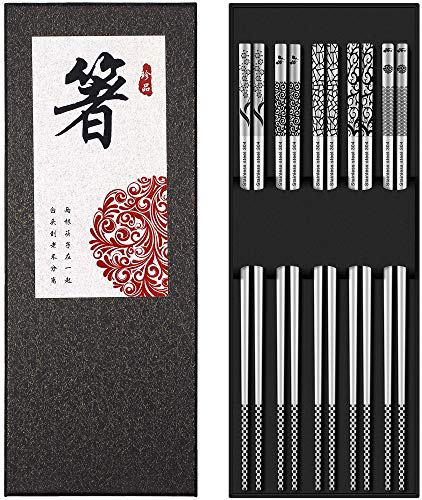
- Greatamzor 18/8 Stainless Steel Chopsticks, 5 Pairs — 9 1/4 inches, laser engraved, non-slip
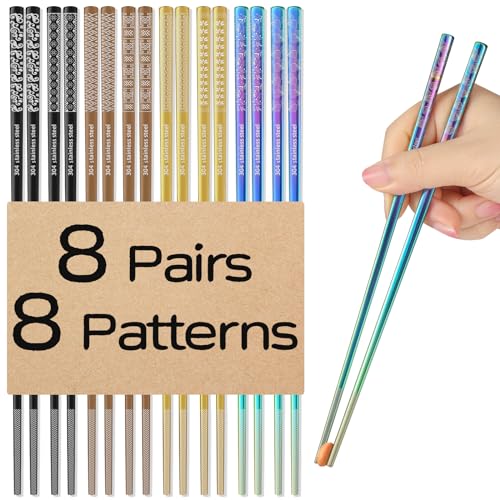
- NEWDRIP 18/8 Stainless Steel Chopsticks, 8 Pairs — 9.25 inches, laser engraved, cooking and eating
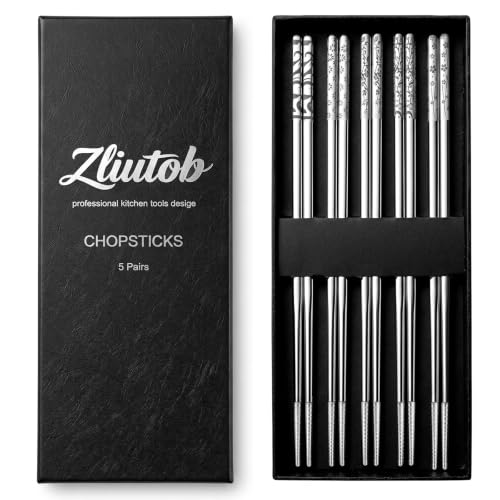
- Zliutob Metal Chopsticks, 5 Pairs — textured tips, square grip, non-slip
- LIXTONGR Dragon & Phoenix Black Stainless Steel Chopsticks, 2 Pairs — 18/10 steel, 9 inches, gift box
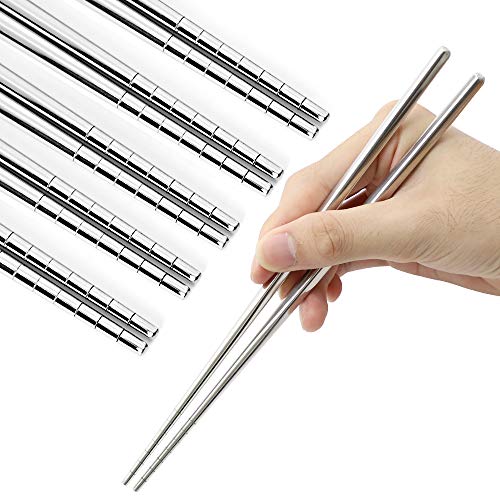
- MUYOS Stainless Steel Chopsticks, 5 Pairs — hollow-core lightweight, silver, non-slip tips
- Greatamzor Multicolor Stainless Steel Chopsticks, 5 Pairs — 9 1/4 inches, copper coin pattern, square
Read the full guide ↓
A Pair of Your Own: Why Personal Chopsticks Are a Real Category
The best personal chopsticks are not a smaller household set; they are a different idea. In many chopstick-using households, each person keeps their own pair — identified by color, pattern or finish, washed and returned to its own place, used by nobody else. The reasons are partly hygienic, partly practical (your pair is always where you left it, in the condition you left it), and partly something harder to name: a utensil you use three times a day becomes personal equipment, like a favorite mug or a good pen, and eating with your own pair feels different from eating with a drawer lottery. This guide takes that idea seriously and ranks six stainless steel sets by how well each serves as your pair.
The judging criteria are personal ones. Identification: can you tell your pair from across a table, instantly? Fit: does the pair’s weight, length and grip suit your hand and your food? Continuity: does the set give you a spare, or a system, so that “your pair” survives the dishwasher’s timing and the occasional loss? All six picks are steel — washable, durable, flavor-neutral — but they answer those questions very differently: through engraving, through color, through a black ceremonial finish that could belong to no one else, or through a grip and weight so suited to one hand that the pair becomes personal by feel. Buyers whose interest leans toward a pair marked as theirs in a more literal sense will find the neighboring discussion in Best Personalized Chopsticks; this guide’s version of personal is about ownership and fit rather than customization.
Key Takeaways
- A personal pair must be identifiable at a glance — by engraving pattern, color, finish or its own storage place.
- Fit is personal: weight, grip texture and profile should match your hand and your regular food, not a household average.
- Steel suits personal ownership — it washes completely, holds no flavors from anyone’s meals, and lasts for years of daily use.
- A spare of your pair, or a set deep enough to claim one from, keeps the habit unbroken when a pair is in the wash.
- Color-coded sets are the easiest personal system for shared households: claim a color once and the question never returns.
- Keep your pair in its own spot — a rest, a tray slot, a case — and the system runs itself.
In this guide
Quick Picks
| Pick | Badge | Key facts from the listing title | Link |
|---|---|---|---|
| Greatamzor 18/8 Stainless Steel Chopsticks, 5 Pairs | Best Overall Personal Pair | 18/8 stainless steel, 9 1/4 inches, laser engraved, non-slip | Check on Amazon |
| NEWDRIP 18/8 Stainless Steel Chopsticks, 8 Pairs | Best for Shared Households | 18/8 stainless steel, 8 pairs, 9.25 inches, laser engraved | Check on Amazon |
| Zliutob Metal Chopsticks, 5 Pairs | Best Grip Fit | Stainless steel, textured tips, square grip, non-slip | Check on Amazon |
| LIXTONGR Dragon & Phoenix Black Stainless Steel Chopsticks, 2 Pairs | Most Distinctive Pair | 18/10 stainless steel, 9 inches, black finish, gift box | Check on Amazon |
| MUYOS Stainless Steel Chopsticks, 5 Pairs | Best Light Personal Pair | Hollow-core lightweight, non-slip tips, silver | Check on Amazon |
| Greatamzor Multicolor Stainless Steel Chopsticks, 5 Pairs | Best Color-Claimed Pair | Multicolor, 9 1/4 inches, laser engraved copper coin pattern, square | Check on Amazon |
How These Picks Were Chosen
This is a research-led guide built from verified listing data, not a hands-on lab test. Each set was read for what it offers a single owner: an identifying feature (an engraved pattern, a color, a unique finish), a fit story (grip texture, profile, weight class, stated length where given), and a continuity story (pair count and spares). Steel was the baseline requirement because a personal pair is washed constantly and used daily; the material’s durability and complete washability are what make the personal-pair habit practical for years rather than months.
Where a title leaves a fact unstated — the Zliutob and MUYOS sets print no length, the Zliutob no grade — the review says so and judges the personal qualities that are confirmed. The ranking favors pairs an owner can identify and enjoy daily over pairs that are merely excellent household stock; a set can rank high as family infrastructure elsewhere and lower here, and vice versa. Readers setting up a full household system around personal pairs will find the sourcing side covered in Best Place To Buy Chopsticks.
The 6 Best Personal Chopsticks
Greatamzor 18/8 Stainless Steel Chopsticks, 5 Pairs
Badge: Best Overall Personal Pair
Strengths
- The laser-engraved pattern gives the pair a recognizable identity without any customization wait.
- Engraving doubles as full-shaft grip — a personal pair should feel unmistakably right in the hand, and this one does.
- 18/8 steel and a confirmed 9 1/4 inch length make it a pair for years of daily meals.
Trade-offs
- All five pairs share the pattern, so your pair is identified by its place and your habit, not by a unique mark.
- The engraved styling is traditional in character.
- A household where everyone adopts the same set needs a second identifier, like colored rests.
Mini spec box
- Material: 18/8 stainless steel
- Length: 9 1/4 inches
- Pairs in set: 5
- Surface: laser engraved, non-slip
- Care: dishwasher safe
- Style notes from title: Japanese Korean style, gift set
- Use notes from title: cooking and eating
A personal pair succeeds when your hand knows it before your eyes do, and that is this set’s argument. The laser-engraved pattern runs along the shaft, giving the pair a tactile signature — a faint texture your fingers register instantly — as well as a visual one. Pick it up in a drawer of mixed utensils and you know it is yours by feel. The engraving is also the grip, so the pair handles your regular food — noodles, dumplings, glazed dishes, steamed vegetables — with the security a daily pair needs, and the 18/8 steel underneath is the grade that makes “daily, for years” a realistic plan rather than a hope.
The five-pair format serves the personal habit well: claim one pair as yours, keep one as its spare, and let the household use the rest — or convert the whole box into a family of personal pairs, one per person, distinguished by rests or storage slots. The pattern is shared across the box, so within a single-set household your identification is positional rather than unique; households that need per-person visual identity should look at the multicolor set below. As the pair one person will reach for most often, though, this is the guide’s first choice: identifiable, grippy, durable and quietly handsome about it.
Best for: anyone establishing a daily personal pair with a tactile identity / Not suited for: households needing a different visual identity for each person’s pair from one box

NEWDRIP 18/8 Stainless Steel Chopsticks, 8 Pairs
Badge: Best for Shared Households
Strengths
- Eight identical engraved pairs let every member of a shared household claim a personal pair from one purchase.
- Your pair can live where you live — kitchen, desk, partner’s place — with identical spares behind it.
- Confirmed 9.25 inch length and an engraved grip make the claimed pair a genuinely good one.
Trade-offs
- Identical pairs need a place-based system — your pair is yours because of where it is kept.
- Eight pairs is a large box for a solo dweller seeking one pair.
- No per-pair visual distinction within the set.
Mini spec box
- Material: 18/8 stainless steel
- Length: 9.25 inches
- Pairs in set: 8
- Surface: laser engraved, non-slip
- Care: dishwasher safe
- Style notes from title: Japanese Korean Chinese style, gift set
- Use notes from title: cooking and eating
Shared households are where personal pairs go to die — unless the system is designed for them. This set’s answer is depth with uniformity: eight engraved 18/8 pairs, any of which can be claimed, so each person’s pair is real because the supply behind it is deep. Your pair lives in your tray slot; a housemate’s lives in theirs; the pair in the dishwasher is nobody’s crisis. Because every pair is the same good pair — engraved grip, confirmed length, steel that washes completely — claiming one never means settling for the odd set.
The discipline required is positional: identical pairs are identified by where they live, so the household needs the tray, the crock sections or the labeled slots that make “mine” a place rather than a look. Households that cannot keep that discipline should buy color instead — the multicolor set in this guide exists for them. For roommates, multigenerational families and couples with a guest rotation, though, this is the personal-pair system that scales, and its quality-first angle is the one developed in Best Place To Buy Quality Chopsticks: a claimed pair should be a good pair, not a leftover.
Best for: roommates and families where everyone keeps a personal pair / Not suited for: buyers who need visual per-person identification

Zliutob Metal Chopsticks, 5 Pairs
Badge: Best Grip Fit
Strengths
- Textured tips plus a square grip give the most hand-specific fit in the guide — a pair your fingers learn completely.
- The square profile has a home position on a rest and never rolls away from your place setting.
- Five pairs let you keep your pair plus spares in your own storage spot.
Trade-offs
- No length or steel grade is stated in the title.
- Square profiles are a taste — some hands prefer round.
- Identification is by feel and place, not by color or pattern.
Mini spec box
- Material: stainless steel (grade not stated in title)
- Length: not stated in title
- Pairs in set: 5
- Surface: textured tips, square grip, non-slip
- Care: dishwasher safe
- Use notes from title: sushi, ramen and daily meals
Some pairs are personal because they look different; this one is personal because it feels different. The square grip gives your fingers flat faces that settle into the same orientation every time, and the textured tips close on food with a confidence that becomes muscle memory — after a month, this pair in your hand feels less like a utensil you picked up and more like the way eating works. For the foods its title names — sushi, ramen, daily meals — that learned fit is the daily pleasure a personal pair exists to provide.
The trade-offs are paperwork and profile preference. The title states neither grade nor length, so the purchase is made on design; and a square shaft is a genuine taste divide — hands that love it rarely go back, hands that do not never warm to it. Identification, too, is tactile and positional rather than visual. If your definition of a personal pair is “the one my hand wants,” and your meals are the noodle-and-sushi rotation this set was styled for, it is the most personal-feeling pair in the guide.
Best for: noodle and sushi regulars whose hands prefer a square, textured grip / Not suited for: round-profile loyalists or specification-first buyers

LIXTONGR Dragon & Phoenix Black Stainless Steel Chopsticks, 2 Pairs
Badge: Most Distinctive Pair
Strengths
- The black Dragon & Phoenix pair is identifiable from across the room — nobody else’s pair looks like yours.
- 18/10 steel and a gift box give the personal pair a keepsake quality.
- Two pairs means your pair and its own spare, boxed together.
Trade-offs
- The dark finish deserves gentler care to stay even over years of daily use.
- Two pairs is a personal format — it will not equip a household.
- Nine inches is the shortest confirmed length here.
Mini spec box
- Material: 18/10 stainless steel
- Length: 9 inches
- Pairs in set: 2
- Finish: black, Dragon & Phoenix design
- Surface: non-slip grip
- Care: dishwasher safe
- Packaging: gift box
If the personal pair is a small ritual, this is its ceremonial form. A black pair with a Dragon and Phoenix design cannot be confused with anyone’s anything; at a family table it announces its owner before a word is said, and the gift box gives it a home that is also a statement — your pair, kept in its box, in your place. The 18/10 steel is the guide’s highest grade, the grip is non-slip, and the second pair in the box is the all-important spare that keeps the ritual unbroken when the first is in the wash.
Daily use asks one concession: a dark finish kept as a daily driver deserves the gentler end of ordinary care — normal cycles, no abrasive scouring — if you want it to look in year three the way it looked when the box opened. And the format is personal in the strict sense: it equips you (and one honored other), not a household. For the buyer whose personal pair is also their signature at the table, nothing else in the guide is close — it is the pair most likely to be asked about, and the one least likely to be borrowed by accident, which owners of personal pairs will recognize as a genuine feature. It is also the clearest example in the guide of the principle behind Best Quality Chopsticks: when a utensil is chosen to be kept and used daily for years, the quality of the object itself becomes the whole point of the purchase.
Best for: anyone who wants their pair unmistakable and a little ceremonial / Not suited for: equipping a whole household, or buyers who treat finishes roughly
MUYOS Stainless Steel Chopsticks, 5 Pairs
Badge: Best Light Personal Pair
Strengths
- Hollow-core lightness is a fit feature: the pair your hand can hold all meal without thinking about it.
- Non-slip tips keep a light pair secure on real food.
- Plain silver neutrality suits a pair that travels between home, desk and lunch bag.
Trade-offs
- No length is stated in the title.
- Silver pairs are identified by place, not by look.
- Very light pairs feel insubstantial to heft-loving hands.
Mini spec box
- Material: stainless steel
- Construction: hollow-core, lightweight
- Length: not stated in title
- Pairs in set: 5
- Surface: non-slip tips
- Finish: silver
- Care: dishwasher safe
For some owners, a pair becomes personal through weight — or its absence. The MUYOS hollow-core design is the lightest pair story in the guide, and a light pair has a particular intimacy: it disappears into the meal, asks nothing of the fingers across a long dinner, and suits the solo eater who lingers, the desk lunch that stretches across an afternoon of grazing, the reader who eats slowly with a book. The non-slip tips keep that lightness honest on real food, and the plain silver finish makes the pair socially invisible — it can live at the office, in a bag, at a second home, without announcing itself.
That invisibility is also its identification weakness: a plain silver pair is yours because of where you keep it, and a household of similar silver sets will need the positional discipline described above. The title’s silence on length is the familiar paperwork note. For the eater whose personal ideal is a pair that feels like nothing at all — in the best sense — this is the one, and its portability makes it the natural companion to the travel-minded thinking in Best Portable Chopsticks.
Best for: light-pair lovers, desk lunches and slow solo meals / Not suited for: buyers who want heft or instant visual identification

Greatamzor Multicolor Stainless Steel Chopsticks, 5 Pairs
Badge: Best Color-Claimed Pair
Strengths
- Claim your color once and your pair is identified forever — the simplest personal system that exists.
- Square profile and an engraved copper coin pattern give the claimed pair real grip credentials.
- Confirmed 9 1/4 inch length suits shared dishes at family meals.
Trade-offs
- Colored finishes prefer gentler washing to stay bright over years.
- Five colors serve five people; a sixth person needs a second system.
- The festive look may not suit every adult’s idea of their signature pair.
Mini spec box
- Material: stainless steel, multicolor finish
- Length: 9 1/4 inches
- Pairs in set: 5
- Profile: square, non-slip
- Surface: laser engraved copper coin pattern
- Care: dishwasher safe
- Packaging: gift set
Every personal-pair system in this guide asks for some discipline except this one. A color is claimed in childhood logic — “mine is the red one” — and the claim holds at every meal, in every wash load, at every table, with no slots, labels or habits to maintain. That is why multicolor sets quietly dominate real family life: the personal pair stops being a project and becomes a fact. Underneath the color, the pair itself is well built for the role — square so it stays on its rest, engraved so it grips, nine and a quarter inches so it reaches the shared dishes a family meal is made of.
The limits are palette and finish care. Five pairs means five claimed colors; a larger household should step up to an eight-pair multicolor system rather than improvising a sixth identity. And a daily personal pair in a colored finish will keep its brightness longest with ordinary, non-abrasive washing — a fair trade for a system this effortless. Compared with the fragility of a ceramic personal pair, as in Best Porcelain Chopsticks, a steel color-claimed pair is the version of personal that survives childhood, roommates and time.
Best for: families where each person’s pair must be obvious at a glance / Not suited for: households larger than five from one box, or formal-table minimalists
Comparison Table
| Pick | How it is identified | Fit story | Pairs | Steel | Link |
|---|---|---|---|---|---|
| Greatamzor 18/8, 5 Pairs | Engraved pattern, by feel | Full-shaft engraved grip | 5 | 18/8 stainless | Check on Amazon |
| NEWDRIP 18/8, 8 Pairs | By its storage place | Engraved grip, 9.25 in | 8 | 18/8 stainless | Check on Amazon |
| Zliutob, 5 Pairs | By feel and place | Textured tips, square grip | 5 | Stainless (grade not stated) | Check on Amazon |
| LIXTONGR, 2 Pairs | Black design, unmistakable | Non-slip grip, 9 in | 2 | 18/10 stainless | Check on Amazon |
| MUYOS, 5 Pairs | By its storage place | Hollow-core lightest | 5 | Stainless, hollow-core | Check on Amazon |
| Greatamzor Multicolor, 5 Pairs | By claimed color | Square, engraved, 9 1/4 in | 5 | Stainless, multicolor | Check on Amazon |
How to Choose Your Personal Pair
Choose the identification system before the pair. Decide how “mine” will be recognized in your household — color for zero-effort families, a unique finish for a signature pair, engraving and a fixed place for everyone else — because the system, not the steel, is what makes a pair personal in daily practice. A wonderful pair inside a broken system becomes a drawer pair within a month.
Then fit the pair to your hand and your food. Long meals favor light pairs; saucy and slippery regular dishes favor engraved or textured grip; square profiles favor people who set their pair down often and hate the roll. Your sauciest weekly meal and your longest weekly meal are the two auditions that matter.
Finally, secure the spare. A personal pair without a backup is a habit waiting to be interrupted by a dishwasher cycle. Prefer sets that give you two of your pair — a two-pair boxed set, a deep uniform set to claim from, or colors with a sibling set in reserve — so the ritual never has to pause.
How to Keep a Personal Pair: Rituals and Care
The care of a personal pair is mostly the care of a place. Give the pair a home — a rest at your seat, a slot in the tray, a case in your bag — and return it there after washing, every time, until the household treats that spot as reserved without being told. Wash it with everything else; steel asks for no special handling, and a personal pair that needed ceremony to clean would not survive as a daily habit. What it does ask is exclusivity: your pair is not the house’s tasting pair, not the one lent to a guest, not the one that stirs the pot. Those jobs belong to the household sets, and keeping the boundary is what keeps the pair personal.
- Wash and dry the pair with the normal load; steel rewards routine, not ritual cleaning.
- Store it in its own place — rest, slot or case — never loose in a mixed drawer.
- Keep the spare in the same place, behind or beneath the daily pair, so the swap is thoughtless.
- If the pair travels, it travels in a case and returns to its place the same day.
- Replace a lost pair from the same set when possible, so your hand never has to relearn its tool.
Troubleshooting. Problem: your pair keeps being used by others → the identification is too subtle; upgrade to color or a distinctive finish, or move its home to your place setting rather than the shared drawer. Problem: your pair is always in the wash at mealtime → the spare system failed; claim a second pair and rotate them strictly. Problem: the pair no longer feels right → hands and habits change; refit without sentimentality, and let the old pair become the guest pair it was always destined to be.
Making a Pair Yours: Identification Systems Compared
Four systems appear in this guide, and each has a household it suits. Color is the strongest system ever devised for families: instant, language-free, child-proof, and it survives every wash. Distinctive finish — the black pair — is the strongest for a single owner in a mixed household, because it cannot be grabbed by accident. Pattern and texture identify by feel and suit owners who keep their pair in a fixed place; the system is private, almost secret, and some owners prefer exactly that. Place alone — the plain silver pair in its slot — is the minimalist’s system, and it works precisely as long as the household respects places. None of these requires customization or expense beyond the set itself; the personal pair is a system you adopt, not a product you commission, and that is why the habit spreads so easily once one person in a household starts it.
A final observation from households that have run these systems for years: the identification that survives is the one chosen by the owner, not assigned by the organizer. Let each person pick their own color, finish or feel — even if the resulting tray looks eclectic — because a claim made freely is a claim defended automatically, and a defended claim is the whole system.
The Personal Pair Away From the Table
A personal pair earns its keep in the day’s other meals. At a desk, it turns a container of leftovers into a proper lunch and ends the drawer of disposable forks. In a lunch bag, a steel pair travels without splintering and returns home in the wash. At a partner’s or parent’s house — the second table in many lives — a kept pair means your place there is set before you sit down, which is a small belonging that people feel more than they expect. The sets in this guide support the satellite life in different ways: deep sets can spare a pair for each location, the light MUYOS pair travels best, and the boxed LIXTONGR pair should probably stay home where its ceremony belongs. However you arrange it, the principle is the same: your pair, or its identical twin, wherever you actually eat.
Building the Habit: The First Two Weeks
A personal pair becomes personal through repetition, and the first two weeks decide whether the system sticks. In week one, keep it simple: use your pair at every home meal, wash it with the normal load, and return it to its place every single time — the returning, not the using, is the habit that needs building, because a pair that sleeps in the dishwasher or the drying rack is a pair you will hunt for at breakfast. Expect one or two household collisions in this week: someone will use your pair, or set the table with it at the wrong seat. Treat these as system debugging, not offenses; the fix is almost always geography — a better home for the pair, a clearer signal, an equally easy alternative for everyone else.
By week two the collisions stop, because the household has learned the pair the way it learns a favorite mug’s ownership: without discussion. This is also when the subtler benefits show up. Your technique tightens, because the same weight and grip meet your hand at every meal and your fingers stop recalibrating. Your meals get a small ritual edge — your rest, your pair, your place — that costs nothing and returns a surprising amount of calm at the end of a working day. And the spare quietly proves its worth the first time your pair is mid-wash when an unplanned meal happens: the habit continues uninterrupted, which is all a habit ever asks.
Guests, Hosts and the Personal Pair: A Small Etiquette
Keeping a personal pair creates two social moments worth handling gracefully. The first is the guest who picks up your pair because it is the interesting one at the table. The gracious solution is structural, not verbal: keep a genuinely good guest pair — from the same sets ranked here — and offer the swap as an upgrade in the moment, or better, set the table so your pair is at your seat and the guest pairs are already placed. Nobody has ever been offended by being handed the good guest pair; several friendships have been started by the conversation a distinctive personal pair begins.
The second moment is eating at someone else’s table, where your pair stays home and you use what you are given with gratitude and without commentary. The personal pair is a home ritual, not a standard you impose on other people’s hospitality. Owners who travel with their pair to regular second tables — a parent’s house, a partner’s flat — do so by keeping a pair there, by invitation, rather than producing one at the table like a critic. Handled this way, the habit reads as what it is: a small self-knowledge, quietly kept, that never asks the room to reorganize itself around your utensils.
A Pair Through the Seasons of a Household
Personal pairs have a biography. They arrive when a person starts eating deliberately — a first apartment, a new cuisine learned properly, a household deciding to keep its own. They multiply when a partner’s pair joins them in the tray, and they become a family system when children’s claimed colors appear beside them. They travel to offices and second homes in middle years, retire to the guest drawer when hands change and refit, and sometimes return decades later in a grown child’s kitchen, still matched, still working. Steel is what makes that biography possible; a wooden pair’s story is usually shorter and ends in a split tip. Choosing your pair with that arc in mind — sound material, a grip your hand loves, an identity you will still enjoy in ten years — turns a utensil purchase into a small act of household continuity, and it is the deepest reason this category rewards choosing well rather than choosing often.
Matching Your Pair to Your Actual Menu
A personal pair should be auditioned against the food you actually eat, not the food you admire. If your week is ramen, pho and noodle soups, the audition is broth work: gathering noodles without slip, lifting toppings from deep bowls, resting the pair across the bowl between bites — engraved shafts and textured tips pass this audition best, which is why they top this ranking. If your week is sushi and composed plates, the audition is precision: single-piece pickups, clean placement, a pair light or balanced enough to feel like an extension of the fingers, where the nine-inch LIXTONGR and the hollow-core MUYOS make their cases. If your week is family-style shared dishes and hot pots, reach and heat tolerance lead — the nine-and-a-quarter-inch engraved pairs — because your pair will travel across the table and hover over steam all meal. And if your week is desk lunches and leftovers, the audition is portability and indifference: the pair that lives in a bag, survives a communal kitchen and never complains. Run your real menu through that filter and the ranking often reorders itself — correctly. A personal pair is the most individual purchase in this entire category, and the menu is the most individual fact about an eater.
Converting a Household to Personal Pairs in One Evening
Households rarely convert by announcement; they convert by setup. One evening is enough. Lay out the sets, let each person handle the candidate pairs with real food — a shared takeaway meal is the perfect audition — and let each person claim by the system that fits them: a color, a pattern, a finish, a feel. Assign the homes in the same evening: tray slots or rests at each place, labeled only if the household enjoys labels. Retire the mixed drawer to guest-and-overflow duty, and put the claimed pairs in their places before bed. The conversion’s success is measured a week later, silently: if every pair is in its place after a normal wash cycle without anyone being reminded, the system has taken. If one person’s pair keeps wandering, do not lecture — upgrade their identification, because wandering pairs are almost always under-identified pairs, and a color or a distinctive finish is cheaper than a household argument repeated nightly.
Personal Pairs for Children: Where the Habit Starts
For children, a personal pair is not a smaller luxury; it is how the skill and the habit form together. A claimed color gives a child ownership that makes practice voluntary — children rehearse with their own pair at snacks, at fruit, at any excuse the day provides — and the pair’s consistency means the hand learns one tool instead of a drawer of variables. Choose light weight and grip help over ceremony: a lightweight pair with textured or engraved help forgives the death-grip phase every beginner passes through. Expect the pair to be dropped, chewed on in thought, and occasionally used as a drumstick; steel absorbs all of it and returns to the wash unmarked, which is more than can be said for the wooden trainers it replaces. When the child outgrows the claim — the color is suddenly babyish, the ceremony embarrassing — the pair retires to the guest drawer and a new claim is made from the adult sets, and the household will notice that nobody suggested going back to shared pairs. The habit, once personal, stays personal.
Common Buying Mistakes
- Buying a pair with no identification plan. Without a system — color, finish, pattern or place — a “personal” pair is just the pair you used last.
- Choosing by household average instead of your hand. A personal pair fitted to nobody in particular fits its owner worst of all.
- Forgetting the spare. One pair plus a dishwasher equals regular interruptions; claim or buy the backup from the start.
- Lending your pair out of politeness. Keep a guest pair for guests. The boundary is the habit.
- Overvaluing customization. A name on a shaft matters less than a grip your hand loves and a color your eye finds; buy the fit first.
Final Recommendation
For most people, the personal pair to start with is the Greatamzor 18/8 engraved pair: identifiable by feel, grippy on real food, and durable enough for years of daily use. Shared households should claim pairs from the NEWDRIP eight-pair set or assign colors from the multicolor set, and anyone who wants their pair to make a small statement should take the Zliutob for grip fit — or the black LIXTONGR pair for ceremony. Light-pair lovers will settle happily with the MUYOS. Check the current listing before buying to confirm finish and count, since those details are the ones most likely to change.
Frequently Asked Questions
Why keep a personal pair of chopsticks at all?
Hygiene, reliability and pleasure. Your pair is used by you alone, is always in its place in the condition you left it, and — because you chose it for your hand — it makes daily meals marginally but genuinely nicer. In many chopstick-using cultures this is simply the default, and households that adopt it rarely go back.
How do I stop family members from using my pair?
Make the identification impossible to miss and the alternative easy: a color or distinctive finish for your pair, and a good household set within equal reach for everyone else. Systems fail when borrowing yours is easier than finding theirs; fix the geography and the problem usually fixes itself.
Should a personal pair be a different length from the household set?
It can be, if your hand prefers it — the confirmed lengths here run from nine to nine and a quarter inches, and that small range is a legitimate fit choice. Consistency matters more than the number: eat with the same length daily and your technique calibrates to it completely.
Is it unhygienic to keep using the same pair?
No — the opposite. A personal pair is washed after every use like any utensil, and steel washes completely because it is non-porous. The hygiene advantage of a personal pair is that its history is entirely yours; shared pairs are equally clean when washed, but the personal system removes all doubt.
What if I lose my personal pair?
Replace it from the same set if you can — an identical twin preserves the fit your hand has learned, which is a strong argument for claiming your pair from a multi-pair set rather than buying a one-off. If the set is gone, refit using the same criteria: identification, grip, weight, in that order.
Should partners or family members have matching personal pairs?
Matching pairs are a pleasure when the match is real — the same set claimed in different colors, or two boxed pairs of the same design — because the table looks composed and the wash treats them identically. But fit outranks symmetry: if one hand loves a light hollow-core pair and the other loves a square textured grip, two different personal pairs at one table is not a failure of the system, it is the system working. Claim what each hand loves, and let the tray hold the variety.
Can a personal pair also be the pair I cook with?
It can, and many owners do exactly that — the engraved sets here are billed for cooking and eating. Just keep the wash rule: a pair that has handled raw ingredients is washed before it returns to the table, and a household tasting pair should still exist so your pair is not passed around mid-cooking.