Disclosure: topratedkitchenware.com is reader-supported. When you buy through links on our site, we may earn an affiliate commission from Amazon and other retailers, at no extra cost to you.
Where to buy
If you are shopping for the best food processors for small kitchens, the six picks below are the shortlist this guide is built around. A small kitchen does not need a smaller version of a big kitchen’s ambitions; it needs machines sized to its counters, cupboards and households. The six machines below are the compact end of the food processor world, 4-cup minis down to a 1.5-cup chopper, plus one mid-size machine reviewed prose-only as the cautionary tale. Each is judged on footprint, storage, and whether its capacity honestly matches the cooking a small kitchen actually does.
- Cuisinart Core Custom 4-Cup Mini Chopper — Best Overall for Small Kitchens · Check on Amazon
- Cuisinart Elemental 4-Cup Chopper/Grinder — Best Compact for Pouring and Storage
- KitchenAid 3.5 Cup Food Chopper (Empire Red) — Best Compact Controls
- BLACK+DECKER 1.5-Cup Electric Food Chopper — Best for the Tiniest Kitchens
- KitchenAid 3.5 Cup Food Chopper (Contour Silver) — Best Compact in a Neutral Finish
- BLACK+DECKER 8-Cup Food Processor — Prose-Only: The Counterexample (reviewed below as a prose-only pick; see the notes in its review)
Read the full guide ↓
The best food processors for small kitchens begin with a truth the appliance industry understates: in a small kitchen, storage is the specification. A magnificent 14-cup machine that lives in a box in a hallway closet will be used four times a year. A modest 4-cup chopper that lives on the counter, or in the drawer beside it, will be used four times a week, and the used machine is always the better machine. Counter depth, cupboard height, the distance between the sink and the only outlet: these are the dimensions this guide shops by, alongside the usual questions of blades and bowls.
Small kitchens also tend to cook at small scale, one or two people, a sauce, a slaw for two, a batch of hummus for the week, and the compact machines in this guide are honestly matched to that scale rather than being diminished versions of family equipment. The set runs from 4-cup minis that handle a surprising share of real cooking down to a 1.5-cup chopper for the smallest daily jobs. One 8-cup machine appears prose-only, without a link, because its listing makes no compact claim at all, and in a small kitchen that absence is the review.
Every other pick is linked, and the guide’s advice is practical throughout: measure your cupboard before you fall in love, prize the cord wrap and the dishwasher-safe bowl, and remember that in a small kitchen the best processor is the one that never has to be fetched. Readers equipping a small kitchen for a particular cuisine will find the minis here reappearing across this cluster’s guides, from Best Food Processors For Smoothies to the sauce work in the pasta filling guide, because small machines are the daily drivers of half the repertoire.
Key Takeaways
- In a small kitchen, storage is the specification: a machine that lives within reach gets used; a stored machine does not.
- Four cups is the compact sweet spot for one or two cooks; 3.5 cups is close behind; 1.5 cups is the specialist minimum.
- Cord wraps, dishwasher-safe bowls and drawer-friendly shapes matter as much as blade design here.
- Measure cupboard height and counter depth before choosing; compact is a measurement, not a marketing word.
- One pick here, a full 8-cup machine with no compact claim in its listing, is prose-only as the honest counterexample.
- Five of six picks are linked mini and compact machines sized for daily small-kitchen cooking.
In this guide
Quick Picks
This is the compact table: five linked minis ordered by useful capacity, and one prose-only full-size machine at the end showing what this guide is not recommending, and why.
| Product | Badge | Why it is here | Amazon |
|---|---|---|---|
| Cuisinart Core Custom 4-Cup Mini Chopper | Best Overall for Small Kitchens | Named mini, 4-cup sweet spot, dishwasher-safe. The compact benchmark. | Check on Amazon |
| Cuisinart Elemental 4-Cup Chopper/Grinder | Best Compact for Pouring and Storage | Locked-blade storage and clean pouring in a 4-cup compact. | Check on Amazon |
| KitchenAid 3.5 Cup Food Chopper (Empire Red) | Best Compact Controls | Compact 3.5 cups with named pulse control and a cord wrap. | Check on Amazon |
| BLACK+DECKER 1.5-Cup Electric Food Chopper | Best for the Tiniest Kitchens | The minimum viable processor: 1.5 cups, one touch, anywhere storage. | Check on Amazon |
| KitchenAid 3.5 Cup Food Chopper (Contour Silver) | Best Compact in a Neutral Finish | The silver twin: identical compact virtues, calmer presence. | Check on Amazon |
| BLACK+DECKER 8-Cup Food Processor | Prose-Only: The Counterexample | Prose-only: a capable full-size machine with no compact claim in its listing. | Prose-only pick |
How These Picks Were Chosen
Picks were chosen from verified listings for small-kitchen fit: a listing had to name a mini format, a compact design or a small capacity to be linked for this keyword. Five machines met that rule, with capacities of 4, 4, 3.5, 1.5 and 3.5 cups. The sixth, an 8-cup full-size processor whose listing names no compact or mini attribute, is reviewed prose-only as a deliberate counterexample: a fine machine in a bigger kitchen, and the wrong purchase in a small one. Listings were checked on 2026-11-20, and every size statement here comes from the listing itself.
This is a research-led guide with no hands-on testing claims, and it does not invent dimensions the listings do not state. Where a listing gives a capacity, this guide reasons from it, because capacity is a reliable proxy for footprint in this category: a 4-cup bowl’s machine is a countertop mini, an 8-cup bowl’s machine is not. Storage details named in listings, like the KitchenAid’s easy cord wrap, are credited because in a small kitchen they are functional, not decorative.
The guide’s bias is declared: it favors the machine that will be present. Small kitchens punish absence more than they reward capability, and a household of one or two rarely needs the capability it would be storing. Readers cooking for more people in a small space will find the honest boundary of that bias stated in the prose-only review and the buying guide.
The 6 Best Food Processors for Small Kitchens
Each review below judges its machine on small-kitchen terms: footprint and storage first, then the cooking its capacity honestly covers, then cleanup in a small sink.

Cuisinart Core Custom 4-Cup Mini Chopper
Badge: Best Overall for Small Kitchens
Strengths
- Listing names it a mini chopper and mini food processor outright
- 4-cup bowl is the compact class’s most useful capacity
- Dishwasher-safe parts suit a small sink and no dishwasher drama
Trade-offs
- Still a mini: family batches belong to bigger machines
- White finish shows stains in a hard-working small kitchen
- No discs, so slicing and shredding are out of its repertoire
Key specs (from the listing)
- Capacity: 4-cup mini bowl
- Blade: auto-reversing stainless steel SmartPower blade
- Functions named in the listing: chops and grinds
- Parts: dishwasher-safe
- Model: MCH-4
- Finish: white and stainless steel
The Cuisinart Core Custom 4-Cup Mini Chopper, the MCH-4, is named a mini in its own listing: a mini chopper and mini food processor that chops and grinds with an auto-reversing stainless steel SmartPower blade, with dishwasher-safe parts, in white and stainless. Four cups is the compact sweet spot this guide keeps returning to: a batch of hummus, a family-of-two soup base, a slaw, a sauce for the week, all fit, while the machine itself remains a one-hand lift that stores in a cupboard or deep drawer without negotiation.
In a small kitchen, this machine’s week is the whole argument: onions and herbs daily, a dip for guests, a small puree, a crumb topping, a marinade paste, each in a bowl that rinses at a small sink in seconds. The auto-reversing blade’s chop and grind modes cover the two textures small cooking asks for most. Its ceiling is honest and visible: a dinner party for eight will outgrow it, and on those nights it becomes the sous-chef to a borrowed or hand-powered alternative rather than pretending to be a banquet machine. For the other three hundred nights, it is the right size, present and ready.
The white and stainless finish deserves a practical note for small spaces: in a compact kitchen the appliance is always visible, part of the room’s furniture whether it wants to be or not. A mini that looks tidy on the counter earns its counter place, and a counter place is the most valuable real estate this guide allocates. Choose the finish you will enjoy seeing daily; in a small kitchen, you will see it daily.
Best for: one or two cooks wanting the most useful compact capacity / Not suited for: families needing batch capacity and discs

Cuisinart Elemental 4-Cup Chopper/Grinder
Badge: Best Compact for Pouring and Storage
Strengths
- 4-cup chopper/grinder format sized for small counters
- BladeLock system secures the blade for pouring and safe storage
- SmartPower blade covers chop and grind duties
Trade-offs
- Silver finish shows splashes until wiped
- No mini wording beyond its 4-cup format in the listing headline
- Same mini ceiling on batch size as its peers
Key specs (from the listing)
- Capacity: 4-cup
- Blade: SmartPower blade
- Safety detail named in the listing: BladeLock system secures the blade for pouring
- Finish: silver
- Model: ECH-4SV
The Cuisinart Elemental 4-Cup Chopper/Grinder, the ECH-4SV, is a 4-cup machine with a SmartPower blade and a BladeLock safety system that secures the blade for easy pouring, in silver. Its small-kitchen case rests on the combination of a genuinely compact capacity and a storage-friendly detail: a blade that locks in place is a blade that can live in its bowl, in a drawer, without a separate guard or a separate worry, and in a small kitchen every stored component that stays inside its machine is a small victory of order.
The pouring design suits the way small kitchens cook: sauces and purees made in the same bowl they are served or stored from, with one transfer instead of two, because a small sink notices every extra vessel. Its 4 cups match the MCH-4 above in useful capacity, and the choice between them is genuinely about details: the locking blade and pouring here, the auto-reversing modes and white finish there. Either anchors a small kitchen’s daily prep; neither asks the kitchen to reorganize itself around an appliance, which is the entire point.
Drawer storage deserves its sentence: many small kitchens have more drawer depth than cupboard height, and a compact chopper that stores in a deep drawer, blade locked, cord tucked, disappears completely between uses while remaining a five-second fetch. That disappearing act is the small-kitchen ideal, capability without presence, and this machine’s design serves it unusually well.
Best for: small kitchens storing appliances in drawers / Not suited for: cooks needing discs or family capacity

KitchenAid 3.5 Cup Food Chopper (Empire Red)
Badge: Best Compact Controls
Strengths
- 3.5-cup capacity in a counter-friendly chopper format
- 2 speeds plus pulse named in the listing, rare control at this size
- Easy cord wrap named in the listing, a genuine small-kitchen feature
Trade-offs
- 3.5 cups is a notch below the 4-cup pair for batch size
- Empire Red is a visible color commitment in a small space
- No discs or large-batch ambitions, by design
Key specs (from the listing)
- Capacity: 3.5 cup
- Blade: stainless steel multi-purpose blade
- Controls named in the listing: 2 speeds plus pulse
- Work bowl: dishwasher-safe
- Storage detail named in the listing: easy cord wrap
- Model: KFC3516ER
- Color: Empire Red
The KitchenAid 3.5 Cup Food Chopper, model KFC3516ER in Empire Red, lists a dishwasher-safe work bowl, a stainless steel multi-purpose blade, 2 speeds plus pulse, and an easy cord wrap. Read that listing through small-kitchen eyes: the capacity is compact, the bowl goes in the dishwasher, the controls are the best in this compact set, and the cord wrap, a detail larger machines treat as an afterthought, is named outright, because a wrapped cord is the difference between a machine that stores neatly and a machine that stores in a tangle.
The control set earns its place in daily small cooking: pulse for the stop-and-check textures, onions, herbs, salsas, and a low speed for folding and gentle work. At 3.5 cups it sits a half-step below the 4-cup pair in batch size, which a household of one or two will rarely feel and a household of three might. The Empire Red finish is the honest trade of the small kitchen: everything is visible, so the appliance may as well be beautiful, and cooks who love the color will leave it out, and leaving it out is half of small-kitchen success.
Its cord wrap also makes it the natural travel and second-home machine of this set: a rental kitchen, a small apartment’s first appliance, an office kitchenette that sees real cooking. Compact machines travel between kitchens in a way full-size processors never do, and a wrapped cord and a dishwasher-safe bowl are exactly the features that make a machine welcome wherever it lands.
Best for: one or two cooks wanting real control in a compact footprint / Not suited for: households regularly cooking for three or more
BLACK+DECKER 1.5-Cup Electric Food Chopper
Badge: Best for the Tiniest Kitchens
Strengths
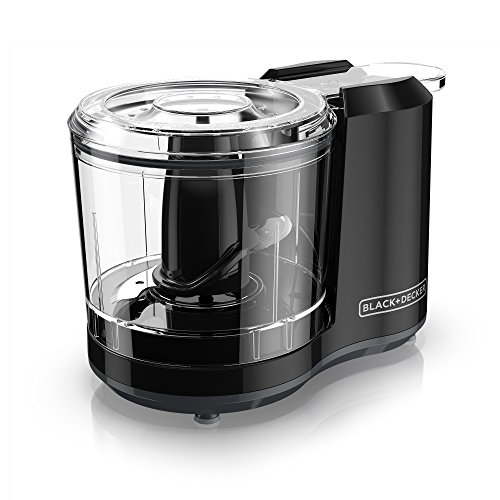
- 1.5-cup capacity is the smallest footprint in this guide
- One-touch pulse could not be simpler to operate or store
- Dishwasher-safe parts and a stay-sharp blade keep upkeep minimal
Trade-offs
- 1.5 cups is a hard ceiling: single servings and small jobs only
- 150W motor is sized for its small loads, not for ambition
- No modes beyond its single pulse operation
Key specs (from the listing)
- Capacity: 1.5-cup
- Motor: 150W
- Controls named in the listing: one-touch pulse
- Blade: stay-sharp blade
- Parts: dishwasher safe
The BLACK+DECKER 1.5-Cup Electric Food Chopper lists a 150W motor, one-touch pulse, a stay-sharp blade and dishwasher-safe parts. It is the smallest machine in this guide and the answer for the smallest kitchens: studio counters, dorm-adjacent cooking, tiny apartments where the appliance shelf is a single shelf. Its bowl holds a serving of salsa, a portion of pesto, a baby-food meal, a chopped onion and its companions, and the machine itself stores in spaces, a deep drawer, a high shelf, a corner, that no other pick here can use.
Judge it by the jobs that make small-kitchen cooking pleasant rather than by the jobs it cannot do: garlic and herbs without a board full of mince, a single sauce that makes a plain dinner feel cooked, a small dip for one evening. Its one-touch operation matches tired weeknight energy exactly. The household that asks it for a family’s hummus will be disappointed in two loads’ time; the household that asks it for the daily small work will wonder how the kitchen functioned without it. In the smallest kitchens, that daily small work is most of the cooking there is.
There is a budget-of-space argument that mirrors a budget-of-money one: the smallest machine that covers your real jobs leaves room, literal room, for everything else a small kitchen must hold. A 1.5-cup chopper plus excellent knives is a coherent small-kitchen system, and for many solo cooks it is a better system than a mid-size machine that crowds out the cutting board it was meant to assist.
Best for: studio and tiny kitchens, solo cooks, the smallest daily jobs / Not suited for: any household batch cooking

KitchenAid 3.5 Cup Food Chopper (Contour Silver)
Badge: Best Compact in a Neutral Finish
Strengths
- Same 3.5-cup compact format and controls as its red sibling
- Contour Silver suits small kitchens avoiding bright appliances
- Cord wrap and dishwasher-safe bowl keep storage and cleanup easy
Trade-offs
- Functionally a color variant; choose on kitchen fit alone
- 3.5-cup ceiling as with its sibling
- No discs, as with every compact here
Key specs (from the listing)
- Capacity: 3.5 cup
- Blade: stainless steel multi-purpose blade
- Controls named in the listing: 2 speeds plus pulse
- Work bowl: dishwasher-safe
- Storage detail named in the listing: easy cord wrap
- Model: KFC3516CU
- Color: Contour Silver
The KitchenAid 3.5 Cup Food Chopper KFC3516CU in Contour Silver is the same compact chopper as the Empire Red model above, with the same listing: a stainless steel multi-purpose blade, 2 speeds plus pulse, a dishwasher-safe work bowl and an easy cord wrap. It is a separate pick because it is a separate listing, and its small-kitchen character is identical in every functional respect: compact capacity, the set’s best controls, tidy storage. The silver finish is its whole argument, and in a small kitchen that argument is legitimate, because the machine will be seen every day.
Choose between the two KitchenAid choppers purely on the room: a small kitchen with a calm, neutral palette will keep the silver one out happily, and a kitchen that wants a single warm accent will keep the red one out happily, and being kept out is the functional outcome that matters. Everything else, the pulse discipline for onions and herbs, the low speed for folding, the 3.5-cup batch judgment, is shared with its sibling word for word in substance. Small kitchens run on such micro-decisions of fit, and this guide treats them with the seriousness they deserve at this scale.
Pairs of small kitchens exist too: partners with two small apartments, a student and a parent’s guest space, a main home and a tiny cabin. The two color variants of this chopper are a natural one-for-each solution, identical in operation so a cook is fluent in both kitchens, different in finish so each belongs to its room. Consistency of operation across small spaces is an underrated comfort, and this pair offers it trivially.
Best for: the same compact duties as the red variant, in a quiet finish / Not suited for: batch cooking and disc work, as with all compacts here
BLACK+DECKER 8-Cup Food Processor
Badge: Prose-Only: The Counterexample
Strengths
- 450W power stated and five functions named, a capable full-size machine
- 8-cup bowl handles family batches the minis cannot
- Shred and slice attachments widen its repertoire beyond the compacts
Trade-offs
- No compact or mini attribute in its listing; it is a full-size footprint
- 8-cup bowl and base will dominate a small counter or cupboard
- Its capacity is surplus for the one and two-person cooking small kitchens do
Key specs (from the listing)
- Capacity: 8-cup
- Power named in the listing: 450W
- Blade: stainless steel
- Attachments named in the listing: shred, slice, mince, grind and puree
The BLACK+DECKER 8-Cup Food Processor lists 450W of power, a stainless steel blade, and attachments to shred, slice, mince, grind and puree. As a food processor it is entirely respectable, and in a larger kitchen it would be a sensible recommendation. It appears in this guide prose-only, with no link, for one reason: its listing makes no compact claim of any kind, no mini format, no small capacity, no storage feature, and this keyword is a promise about size. An 8-cup machine in a small kitchen is not a slightly bigger mini; it is a different category of object, with a base, a bowl and attachments that must all live somewhere.
Picture it honestly in the kitchens this guide serves: the base takes the counter corner where the kettle lived, the bowl and discs take the cupboard the plates used, and within a month the machine is either a permanent counter monument that resents every meal, or a stored appliance whose shredding disc might as well not exist. That is the fate this guide’s five linked minis exist to prevent. The exception proves the rule usefully: a small kitchen feeding a family of five, cooking in genuine batches, may rationally choose this machine and accept the storage cost with open eyes, and the buying guide below addresses that household directly rather than pretending it does not exist.
Let the counterexample also clarify what compact quality means: it is not weakness. The five linked machines above chop, grind, puree and fold the daily work of small households completely. What they decline is surplus, capacity, footprint and storage burden beyond the household’s real pattern. A small kitchen equipped to its actual life is not a compromised kitchen; it is the only kind of small kitchen that works, and this full-size machine, however capable, is equipment for a different life.
Best for: a small kitchen feeding a large household in real batches, accepting the storage cost / Not suited for: the typical one or two-person small kitchen this guide serves
Comparison Table
Read this table as a storage plan as much as a product comparison: the capacities descend as the footprints shrink, and the prose-only row at the bottom is the size this guide recommends against for its stated audience.
| Product | Capacity | Standout for this job | Amazon |
|---|---|---|---|
| Cuisinart Core Custom 4-Cup Mini Chopper | 4-cup mini bowl | Most useful compact capacity in the set | Check on Amazon |
| Cuisinart Elemental 4-Cup Chopper/Grinder | 4-cup | Storage-friendly locked blade design | Check on Amazon |
| KitchenAid 3.5 Cup Food Chopper (Empire Red) | 3.5 cup | Best controls in the compact class | Check on Amazon |
| BLACK+DECKER 1.5-Cup Electric Food Chopper | 1.5-cup | Smallest footprint in the guide | Check on Amazon |
| KitchenAid 3.5 Cup Food Chopper (Contour Silver) | 3.5 cup | Color variant with identical compact fit | Check on Amazon |
| BLACK+DECKER 8-Cup Food Processor | 8-cup | Prose-only: full-size counterexample | Prose-only pick |
How to Choose a Food Processor for a Small Kitchen
Measure first: the three numbers that decide
Before any product page, take three measurements. Cupboard height where the machine would live, because a processor that must be disassembled to store will eventually not be stored, or not be used. Counter depth and the clear run of counter you can honestly surrender, because a machine that takes the only prep surface has taxed the kitchen more than it pays. And the distance from that spot to an outlet, because a machine that needs an extension cord for every use has friction built into every job. Compact is the machine that passes all three measurements in your kitchen, not the one with the word in its name.
Capacity is the proxy when dimensions are not stated, as in most listings: 4 cups and under is the compact class in this category, 8 cups and over is full-size, and the space between is the contested middle. The listings in this guide were judged by exactly that proxy, which is why the 8-cup machine stands prose-only at the end of the reviews.
Capacity honesty for one and two cooks
Small kitchens usually feed one or two people, and their processor jobs are sized accordingly: a sauce, a dip, a slaw for two, a small soup base, a crumb or paste. Four cups covers that list with headroom; 3.5 cups covers it nearly as well; 1.5 cups covers its smallest half beautifully. The batch jobs that genuinely exceed these bowls, a party’s worth of hummus, a freezer session, are rare in small kitchens, and planning a purchase around rare jobs is how small kitchens end up storing monuments.
The exception is the small kitchen feeding many: a family compressed into a small apartment cooks at family scale in a small space, and for that household the prose-only 8-cup review and the mid-size machines in this cluster’s other guides deserve a fair hearing. Even there, the discipline holds: buy the smallest machine that covers the real, weekly pattern, not the largest the cupboard can be forced to accept.
Storage features are real features
At compact scale, the unglamorous details decide ownership happiness: a cord wrap that keeps storage tidy, a blade that locks inside its bowl, parts that nest, a bowl that goes in the dishwasher so the small sink is not monopolized. Several listings in this guide name those details outright, the KitchenAid’s easy cord wrap, the Elemental’s BladeLock, dishwasher-safe parts across the set, and this guide credits them as primary features, because in a small kitchen they are used as often as the blade itself.
Counter presence is the other storage decision. A compact machine left out is a machine used daily, so its finish and footprint on the counter are functional choices. The two KitchenAid color variants in this guide exist to make that point concretely: pick the one your kitchen will happily host in plain sight, because plain sight is where small-kitchen appliances earn their keep. The small-batch work these minis do daily is detailed in Best Food Processors For Smoothies, where their small bowls are a texture advantage, not a compromise.
Building the small-kitchen system around a mini
A compact processor works best as the center of a small system: excellent knives for the slicing a mini cannot do, a hand grater for the occasional cheese, and the mini for everything powered. That system covers a remarkable share of home cooking without a single full-size appliance. As the household’s cooking grows, the system’s next addition is usually a second compact with a different strength, a 4-cup beside a 1.5-cup, rather than a leap to full size, because the storage math that chose the first mini still governs the kitchen.
The guides in this cluster map those additions by job: the pasta filling minis for the cook who discovers fresh pasta, the ricing minis for the grain-light kitchen. Each addition is small, storable and justified by a real weekly job, which is how a small kitchen grows in capability without growing in clutter.
How to Set Up a Food Processor Station in a Small Kitchen
A small kitchen rewards a deliberate station: one home for the machine, one motion to start work, one motion to put it away. The setup below assumes a compact machine from this guide and a kitchen where every surface is contested.
- Choose the machine’s home first: a counter corner near an outlet, a deep drawer, or the most reachable cupboard shelf, and let that choice veto any machine that does not fit it.
- Store the machine assembled with its blade locked or nested inside the bowl, so starting work is one motion rather than a search for parts.
- Keep the cord wrapped or managed so the machine slides out and back without a tangle tax on every use.
- Place a small board and a bowl beside the station’s spot; compact processing is a relay between board, bowl and machine, and the relay should be short.
- Work in the order dry to wet and mild to strong, so one rinse keeps the machine in service through a whole meal’s prep.
- Wash or rinse the bowl immediately after each job; in a small sink, a soaking processor bowl blocks the entire washing system.
- Dry the blade and bowl before storing, especially in drawers and closed cupboards where trapped moisture lingers.
- Review the station monthly: if the machine has migrated or been buried, the station has failed, and a smaller or differently placed setup is the fix.
The station’s real test is a tired weeknight: if the machine can be out, used, rinsed and home again inside the time a pan heats, the setup is right and the appliance will be used for years. If any step involves moving other appliances, fetching parts from another room, or washing by hand what a dishwasher could take, friction will win within a month, and the honest response is to change the setup or the machine’s size, not to blame the cook.
Small kitchens also benefit from a one-in-one-out discipline for appliances generally: a new compact earns its place by replacing a stored one, not by joining it. The guides in this cluster can make many machines sound essential; the small kitchen’s defense is the weekly pattern, consulted honestly, which rarely justifies more than two compact processors in total.
Troubleshooting
Problem: The processor lives in its box and is never used → The storage spot failed the reach test. Move the machine to the counter or the most reachable drawer, store it assembled, and accept the small space it takes as the price of it existing in your cooking at all.
Problem: The bowl monopolizes the small sink after every job → The cleanup rhythm is wrong for the space. Rinse the bowl immediately, use the dishwasher where the listing allows, and process in an order that needs only one rinse between jobs instead of a full wash.
Problem: Batches keep overflowing the compact bowl → The household’s real pattern is bigger than the machine, which is information, not failure. Step up one class, to the 4-cup pair from a 1.5 or 3.5-cup start, or accept a two-load rhythm for the one weekly job that exceeds the bowl.
Small Kitchens Around the World Cook This Way
Most of the world’s kitchens are small, and their cooking traditions assume compact equipment and daily small batches: a mortar’s worth of paste, a sauce for the meal, vegetables cut to order. The compact processor fits those traditions naturally, which is why the minis in this guide keep appearing in sauce, paste and filling work across cuisines. A small Western kitchen adopting a mini as its main processor is not downsizing its ambitions; it is joining the majority tradition of cooking fresh, small and often.
That perspective also corrects the gadget instinct. A small kitchen does not need compact versions of everything; it needs a few tools matched to its real dishes. For many households the complete powered list is one compact processor and perhaps a stick blender or a kettle, and the rest is knives, boards and pans that stack. The processor earns its place in that short list by doing the daily chopping, grinding and pureeing that no other single tool covers.
Renters, Students and Second Kitchens: The Portable Processor
Compact processors are the portable class: they move house without a packing strategy, fit rental kitchens with no storage to spare, and serve second kitchens, cabins, in-law suites, office kitchenettes, where full-size equipment is absurd. A graduate’s first apartment, equipped with a 4-cup mini from this guide, a knife and a pan, is a real kitchen, capable of sauces, soups, dips, slaws and fillings from the first week. That is not a compromise narrative; it is how most cooks actually begin.
Portability also argues for the boring virtues: dishwasher-safe parts for unpredictable dishwashers, a cord wrap for transport, a finish that survives being seen in every kind of room. The picks in this guide were chosen with those virtues in view, and either KitchenAid variant or the Cuisinart minis will follow a household through several small kitchens before any of them is outgrown, which is the best definition of value this category offers. The soup work that makes a small kitchen feel fully capable is covered in Best Food Processors For Soup.
The Small Kitchen Pantry: What a Compact Processor Unlocks
A compact processor quietly changes what a small kitchen can stock. Whole spices become grindable in teaspoon quantities, so a small spice collection stays fresh instead of aging pre-ground. Nuts become butters and crumbs in serving sizes. Dried beans are still a stove job, but their transformation into dips, spreads and purees becomes a two-minute decision. Even the freezer reorganizes: small batches of sauces, pastes and bases, made in the mini and frozen flat in small bags, give a tiny freezer the leverage of a much larger one.
That pantry effect is the deepest answer to the small kitchen’s supposed limitations. The constraint was never really cooking ability; it was the friction of preparation at small scale, and friction is exactly what a present, right-sized processor removes. Households discover this in the second month, when the meals coming out of a tiny kitchen stop resembling compromises and start resembling a cuisine of their own: fresh, small, frequent and entirely deliberate.
Common Buying Mistakes
Buying full-size for a small kitchen’s storage. The defining error for this keyword, illustrated by the prose-only pick. Capacity you cannot store is capacity you do not own. Measure the home first and let it veto without appeal.
Assuming compact means incapable. The minis here chop, grind, puree and fold the daily work of small households completely. What they decline is surplus, and surplus is precisely what a small kitchen cannot afford.
Ignoring the cord and the blade in storage. A tangled cord and a loose blade make a compact machine unpleasant to fetch and put away, and unpleasant machines migrate to boxes. Cord wraps and locking blades are small-kitchen features, full stop.
Letting the bowl soak in a small sink. One soaking bowl blocks the whole washing system of a small kitchen. Rinse immediately, use the dishwasher where allowed, and keep the sink as free as the counter.
Equipping for imagined dinner parties. The weekly pattern should choose the machine. Parties can borrow, batch in relays, or be cooked around; the other three hundred nights cannot borrow a smaller footprint.
Final Recommendation
For most small kitchens, the Cuisinart Core Custom 4-Cup Mini is the first recommendation: named a mini in its own listing, the compact class’s most useful capacity, and dishwasher-safe cleanup for a small sink. It is the machine most likely to live within reach and be used daily, which in a small kitchen is the whole definition of best.
Start with the Cuisinart Core Custom 4-Cup Mini Chopper if it matches your kitchen, or the Cuisinart Elemental 4-Cup Chopper/Grinder as the closest alternative — check the latest price on Amazon for either before you decide.
Choose the Elemental if drawer storage and locked-blade pouring suit your space, either KitchenAid for the best compact controls and cord management, in the finish your kitchen will happily host, and the little BLACK+DECKER if your kitchen is the smallest of all and your jobs match its scale. Let the prose-only 8-cup stand as the reminder that in this category, the bravest and best decision is usually the smaller one, honestly matched to the life the kitchen actually lives.
Frequently Asked Questions
What size food processor is best for a small kitchen?
For most one and two-person households, a 4-cup mini is the sweet spot, with 3.5 cups a close alternative and 1.5 cups right for the smallest kitchens and jobs. The governing test is storage: the best size is the largest machine that still lives within easy reach in your kitchen, which for most small kitchens is the compact class, not the full-size one.
Can a mini food processor replace a full-size one?
For the daily cooking of a small household, largely yes: chopping, grinding, small purees, sauces, dips and fillings are all mini work. What a mini cannot do is discs, slicing and shredding, and genuine family batches. Households that rarely need those will not miss the full-size machine; households that need them weekly should solve the storage problem deliberately rather than by default.
Where should a food processor live in a small kitchen?
Within one motion of where prep happens: a counter corner near an outlet, a deep drawer, or the most reachable cupboard shelf, stored assembled with its blade nested or locked. Any home that requires fetching parts or moving other appliances will quietly retire the machine within a month.
Why is one pick in this guide not linked?
Because its listing describes a full-size 8-cup machine with no compact, mini or small-capacity attribute, and this keyword is a promise about size. It is reviewed in full as a prose-only counterexample, and for the unusual small kitchen feeding a large household it may still be the right purchase, made with open eyes about storage.
Do compact processors handle pureeing and sauces well?
Yes; at small quantities their bowls are often better than full-size bowls, because a small load circulates completely instead of smearing across a large base. The discussion in Best Food Processors For Soup covers that small-batch advantage in the context of family cooking, where the minis play the finishing role for servings and garnishes.
What should I measure before buying?
Cupboard or drawer height and depth where the machine will live, the clear counter run you can surrender, and the distance to an outlet. Take the measurements to the product page, not the other way round, and let them veto any machine, however capable, that your kitchen cannot house within reach.
Is a compact processor a good first appliance for a new home?
It is one of the best: inexpensive in space, broad in function, and matched to the quantities new households actually cook. Paired with a knife, a board and a pan, a 4-cup mini from this guide constitutes a working kitchen, and its skills transfer unchanged when the household and its kitchen eventually grow.