Disclosure: topratedkitchenware.com is reader-supported. When you buy through links on our site, we may earn an affiliate commission from Amazon and other retailers, at no extra cost to you.
Where to buy
The fastest way to compare the six countertop ovens in this guide is to check each listing directly, confirm the footprint against your counter measurements, and look at what accessories are included in the box. Start with the full list below, then read the detailed reviews before you decide.
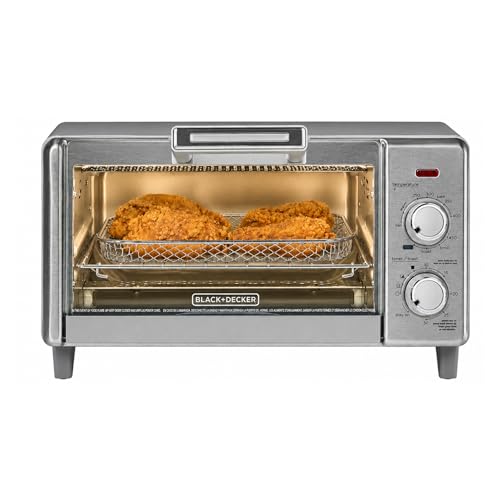
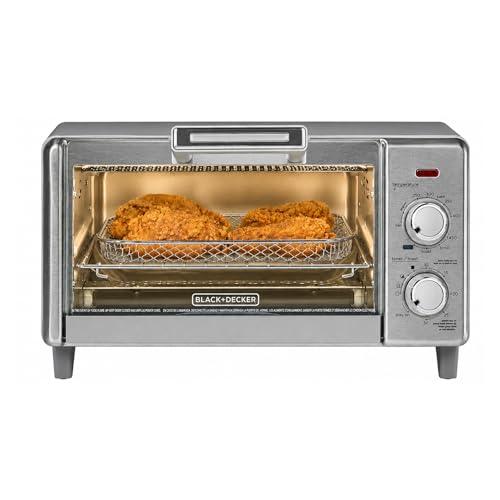
- BLACK+DECKER 4-Slice Air Fry Toaster Oven
- Ninja Digital Air Fry Countertop Oven SP101
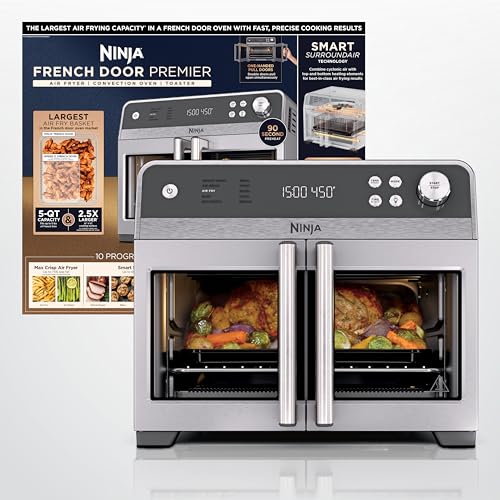
- Ninja French Door Premier Air Fry Oven FO101
- Gourmia Toaster Oven with French Door Design
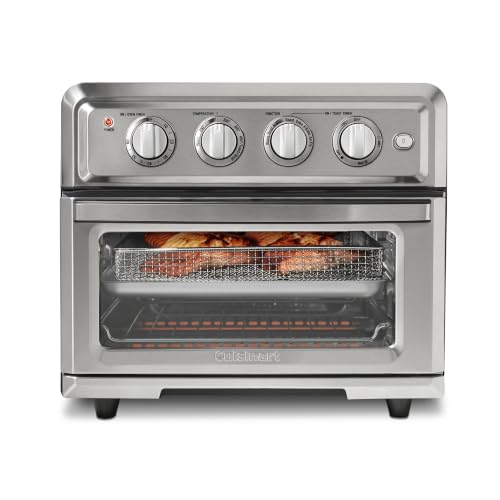
- Cuisinart Air Fryer Toaster Oven TOA-FD70
- Emeril Lagasse Everyday 360 Air Fryer Oven
Read the full guide ↓ for sizing math, clearance rules, and which oven fits which kind of cooking.
Introduction: Finding the best toaster ovens for countertop use
Shopping for the best toaster ovens for countertop use sounds simple until you measure your kitchen. The oven has to fit between your cabinets and the counter edge, it has to leave breathing room so heat can escape, and it still has to be big enough inside for the food you actually cook. A compact 4-slice model that handles toast and a 9-inch pizza is perfect for one person, while a family that reheats sheet-pan dinners needs a very different cavity. This guide compares six verified countertop ovens across that whole range, from a flip-up Ninja that stores against the backsplash to French-door models that open without a hot door swinging down onto your hands.
Every pick here is a true countertop appliance, not a built-in or a commercial unit. We weighted footprint and clearance as heavily as cooking functions, because the best oven on paper is useless if it crowds out your prep space or sits too close to upper cabinets. If your main job is frozen pizza on busy nights, see our companion guide to Best Toaster Ovens For Frozen Pizza as well. If toast is your daily driver, the notes in Best Toaster Ovens For Making Toast go deeper on browning control.
Below you will find quick picks, a transparent explanation of how these picks were chosen, detailed reviews with honest trade-offs, a comparison table, a buying guide with real sizing math, a practical how-to section covering setup, cleaning, and troubleshooting, and answers to the questions countertop buyers ask most often.
Key Takeaways
- Measure width, depth with the door open, and the gap under your cabinets before anything else; leave clearance on the sides and top for heat to escape.
- The BLACK+DECKER 4-Slice is the smallest, simplest option here and suits toast, snacks, and a 9-inch pizza.
- The Ninja SP101 flips up against the backsplash, reclaiming counter space when it is not cooking — a rare answer to the footprint problem.
- French-door models from Ninja, Gourmia, and Cuisinart make loading safer and easier, especially for heavier pans.
- Air fry functions add versatility, but they also add fan noise, splatter, and cleaning work; buy them only if you will use them.
- Capacity claims in slices and pizza inches are more useful than quart figures when you are matching an oven to your pans.
In this guide
Quick Picks
| Pick | Badge | Standout trait from verified listing | Link |
|---|---|---|---|
| BLACK+DECKER 4-Slice Air Fry Toaster Oven | Best for Small Counters | 5-in-1, EvenToast technology, room for a 9-inch pizza | Check on Amazon |
| Ninja Digital Air Fry Countertop Oven SP101 | Best Space-Saving Design | 8-in-1, XL, 1800W, flips up and away for storage | Check on Amazon |
| Ninja French Door Premier Air Fry Oven FO101 | Best Premium | 10-in-1, 20.3 Qt, cyclonic air up to 450F, PFAS-free surface | Check on Amazon |
| Gourmia Toaster Oven, French Door | Most Presets | 6-slice capacity, 17 cooking presets, FryForce 360° technology | Check on Amazon |
| Cuisinart Air Fryer Toaster Oven TOA-FD70 | Best for Pizza Nights | Artisan French-door design, 7 functions, fits a 12-inch pizza | Check on Amazon |
| Emeril Lagasse Everyday 360 | Most Versatile | 9-in-1, 360° convection, rotisserie included | Check on Amazon |
Households working with very tight counters should also read our notes on Best Toaster Ovens For Small Spaces, where footprint is the first filter rather than one factor among many.
How These Picks Were Chosen
This is a research-led guide. We did not run a test kitchen, and we will not pretend otherwise. Each pick was verified against Amazon’s own catalog data through the Creators API on 2026-11-20: the brand, model, function list, capacity language, and product image in this article all come from that verified listing data, and only picks with a confirmed match carry a purchase link. That process matters because toaster oven listings are full of near-identical model names, and a single wrong digit can point you at a different size or feature set.
From the verified pool for this category, we selected six ovens that spread across the countertop spectrum: one compact 4-slice unit, one flip-up storage design, two mid-to-large French-door models, one preset-heavy value design, and one rotisserie-equipped all-rounder. We compared function counts carefully — a 5-in-1 that toasts well can serve a small household better than a 10-in-1 whose extra modes duplicate a range you already own. We also weighed door style, because on a real counter the door is a safety and space decision: drop-down doors need front clearance and put a hot surface at hand height, while French doors open sideways and keep the opening compact.
Finally, we applied two standing editorial rules. There are no static prices anywhere in this guide, because countertop appliance pricing shifts constantly; use the links to check the current figure. And there are no fixed star ratings or review counts, for the same reason — those numbers change daily and would mislead you within weeks. What does not change is footprint, capacity, and function set, so those are what this guide is built on.
The 6 Best Toaster Ovens for Countertop Use
BLACK+DECKER 4-Slice Air Fry Toaster Oven
Badge: Best for Small Counters
Strengths
- Compact 4-slice format leaves prep room on smaller counters
- 5-in-1 coverage — air fry, bake, broil, toast, and keep warm — handles daily basics
- EvenToast technology is aimed squarely at consistent toast browning
Trade-offs
- Interior fits a 9-inch pizza, so standard 12-inch frozen pizzas will not fit
- No rotisserie, dehydrate, or proof-style specialty modes
- Smaller cavity means batch cooking for a crowd takes multiple rounds
Mini spec box: Functions: air fry, bake, broil, toast, keep warm (5-in-1) · Capacity: 4-slice · Pizza fit: 9-inch · Technology: EvenToast
For a single person, a couple, or a dorm-style kitchenette, this is the honest starting point. It covers the jobs a countertop oven is actually bought for — morning toast, reheated leftovers, a small personal pizza, a tray of snacks — without demanding the counter depth of the larger French-door models. The air fry mode gives you a way to crisp small batches without heating a full-size range, which is where a compact oven earns its keep on weeknights. Its limitation is equally clear: the cavity is sized for small-format food. If your household’s default dinner is a full-size frozen pizza, skip ahead to the Cuisinart or Ninja French Door instead of trying to make this oven be something it is not.
Best for: small households and tight counters / Not suited for: 12-inch pizzas or family-size trays

Ninja Digital Air Fry Countertop Oven, SP101
Badge: Best Space-Saving Design
Strengths
- Flips up and away against the backsplash, returning counter depth when stored
- 8-in-1 function set including air roast, bagel, and dehydrate
- 1800W power in an XL-format cavity that still stores compactly
Trade-offs
- Low interior height limits tall items such as whole chickens or high casseroles
- You must remember to flip it down and let it cool before storing it upright
- Digital controls are more than buyers who want a single dial may prefer
Mini spec box: Functions: air fry, air roast, broil, bake, toast, bagel, dehydrate, keep warm (8-in-1) · Power: 1800W · Format: XL, flip up and away · Finish: Silver
The SP101 answers the most common countertop complaint — “I have no room for one of these” — with mechanics rather than compromise. In use it is a wide, powerful oven that handles toast, bagels, air-roasted vegetables, and reheating with digital precision. After the meal, it rotates up to sit against the backsplash, freeing the front of the counter for prep. That wide, low shape does shape what you cook: sheet-pan style food, flatbreads, fillets, and trays of vegetables are ideal, while tall roasts are not. Readers comparing dedicated pizza performance should cross-check Best Toaster Ovens For Pizza, but as an everyday countertop citizen, this Ninja is the easiest large oven to live with in a small kitchen.
Best for: small kitchens that still cook widely / Not suited for: tall roasts or buyers wanting analog simplicity

Ninja French Door Premier Air Fry Oven, FO101
Badge: Best Premium
Strengths
- 10-in-1 versatility, the broadest function set in this guide
- Cyclonic air up to 450F with a sear crisp mode for serious browning
- PFAS-free surface and French doors that open with a single pull
Trade-offs
- 20.3 Qt capacity needs a generous, well-ventilated counter spot
- Premium-tier positioning in this class
- More modes mean a learning curve before settings feel automatic
Mini spec box: Functions: 10-in-1 including air fry, sear crisp, bake, broil, toast, dehydrate · Capacity: 20.3 Qt · Max temperature: 450F · Finish: Stainless
If your countertop oven is effectively your second oven — or, in a studio or accessory dwelling unit, your only oven — the FO101 is built for that role. The French doors open together, so you can slide a pan in with one hand while holding it steady with the other, and the cyclonic air system is designed to brown and crisp at temperatures up to 450F. The sear crisp function targets the finish on proteins and vegetables that ordinary bake modes leave pale. Be honest about space before choosing it: this is a substantial appliance that wants a permanent home with clearance, not a cabinet-to-counter daily lift. For buyers who cook daily and broadly, that trade is usually worth it.
Best for: committed home cooks replacing a second oven / Not suited for: minimal counters or occasional use

Gourmia Toaster Oven, French Door Air Fryer Combo
Badge: Most Presets
Strengths
- 17 cooking presets reduce guesswork for common foods
- 6-slice capacity suits family breakfasts and snack batches
- Dishwasher-safe trays simplify the least pleasant part of ownership
Trade-offs
- Black finish and French-door width need measuring against your space
- Preset-heavy digital panel is less direct than dials for simple toast
- FryForce 360° air frying still requires shaking or turning for even results
Mini spec box: Capacity: 6-slice · Presets: 17 · Controls: digital display, adjustable time and temperature · Technology: FryForce 360° · Trays: dishwasher-safe
Gourmia’s pitch is convenience through presets: instead of memorising times and temperatures for fries, wings, toast, and reheating, you pick a programme and let the oven set the starting point, then adjust time and temperature to taste. The French-door layout keeps the opening wide for a 6-slice load, and dishwasher-safe trays matter more than they sound — air fry splatter is the main reason countertop ovens fall out of daily use. This is a strong family choice, particularly where several people use the oven and presets keep results consistent between them. Buyers focused purely on toast craft may prefer a simpler machine; see Best Toaster Ovens For Toast for that narrower comparison.
Best for: families wanting preset convenience / Not suited for: minimalists who dislike digital panels

Cuisinart Air Fryer Toaster Oven, TOA-FD70
Badge: Best for Pizza Nights
Strengths
- Explicitly fits a 12-inch pizza — the standard frozen pizza size
- Dedicated pizza function alongside air fry, toast, bake, broil, roast, and warm
- Artisan French-door design in stainless steel suits visible counters
Trade-offs
- French-door footprint is wider than compact drop-down models
- Seven functions, so no dehydrate or rotisserie modes
- Stainless exterior shows fingerprints and needs wiping to stay smart
Mini spec box: Functions: air fry, toast, bake, broil, roast, pizza, warm (7) · Pizza fit: 12-inch · Design: Artisan French-door · Finish: Stainless steel
Cuisinart built this model around the way many households actually use a countertop oven: pizza, toast, roasted vegetables, and reheated leftovers, with air frying on top. The dedicated pizza function and confirmed 12-inch fit remove the guesswork that ruins frozen pizza night in smaller ovens, and the French doors make loading a hot, flexible pizza far less awkward than a drop-down door. It does fewer tricks than the 10-in-1 Ninja, but the seven functions it has map closely to everyday cooking. If pizza is a weekly event in your home, this is the most purpose-fit pick in the guide; the deeper pizza-only comparison lives at Best Toaster Ovens For Pizza.
Best for: pizza-regular households wanting French doors / Not suited for: buyers needing dehydrate or rotisserie
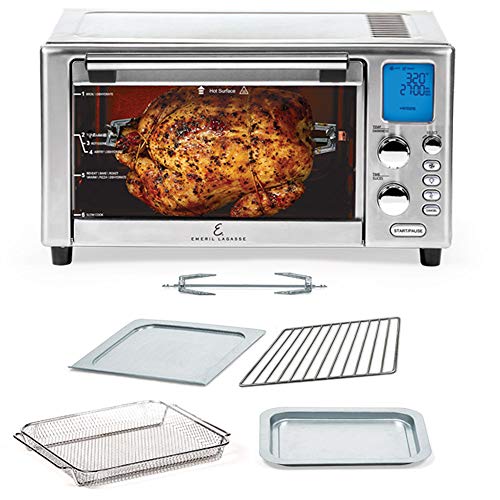
Emeril Lagasse Everyday 360 Air Fryer Oven
Badge: Most Versatile
Strengths
- 9-in-1 coverage including rotisserie, which few countertop ovens offer
- 360° convection aims for even cooking without constant turning
- Broad everyday function set suits varied family cooking
Trade-offs
- Rotisserie capacity is limited to smaller birds and roasts
- Larger everyday footprint than the compact picks
- More accessories to store than simpler models
Mini spec box: Functions: 9-in-1 · Technology: 360° convection · Specialty: rotisserie · Format: Countertop oven
The Everyday 360 is the pick for cooks who want one countertop appliance to cover the widest ground: air frying, baking, roasting, toasting, and a rotisserie for small chickens and roasts. The 360° convection positioning is about evenness — hot air moving around food rather than blasting from one side. Rotisserie cooking is the differentiator here; if you have never wanted to rotisserie anything, its value drops and a simpler oven serves you better. With that caveat, it is a capable all-rounder for households that cook varied meals and want the countertop oven, not the range, to be the default.
Best for: varied family cooking and rotisserie fans / Not suited for: tiny counters or single-function buyers
Comparison Table
| Model | Functions | Capacity cue | Door / format | Link |
|---|---|---|---|---|
| BLACK+DECKER 4-Slice | 5-in-1 | 9-inch pizza | Compact drop-down | Check on Amazon |
| Ninja SP101 | 8-in-1, 1800W | XL, low profile | Flip up and away | Check on Amazon |
| Ninja FO101 | 10-in-1 | 20.3 Qt | French door | Check on Amazon |
| Gourmia French Door | 17 presets | 6-slice | French door | Check on Amazon |
| Cuisinart TOA-FD70 | 7 functions | 12-inch pizza | French door | Check on Amazon |
| Emeril Everyday 360 | 9-in-1 | Rotisserie class | Drop-down | Check on Amazon |
How to Choose the Right Countertop Toaster Oven
Start with the tape measure, not the feature list. Record three numbers: the width of counter you can give up permanently, the depth from backsplash to counter edge, and the vertical gap between counter and upper cabinets. Then add clearance: countertop ovens vent hot air, and manufacturers expect space at the sides and top. An oven that technically fits but sits flush against a wall or cabinet will run hotter, cook less evenly, and age faster. If your depth is limited, the flip-up Ninja SP101 or the compact BLACK+DECKER deserve first consideration; if you have a wide, open run of counter, French-door models become practical.
Match capacity to your pans and your food, using concrete cues. Slice count tells you about breakfast loads: 4 slices suits one or two people, 6 slices suits a family. Pizza inches tell you about dinner: a 9-inch fit handles personal pizzas, while a 12-inch fit is required for standard frozen pizzas. Quart and cubic-foot figures help compare cavity volume, but always check them against the pan you use most — bring its measurements to the listing, not the other way around. Height matters too: low-profile ovens excel at flat food and struggle with tall casseroles or whole birds.
Choose functions by auditing your week. List what you cooked in the last seven days and mark which items a countertop oven could have handled faster than your range. Toast, reheating, roasting vegetables, baking small batches, and air frying cover most households. Rotisserie, dehydrate, and proof modes are valuable only if they match real habits. Every extra function usually adds cost, control complexity, and cleaning surface, so the right function count is the smallest one that covers your actual cooking.
Consider controls and cleaning before you fall for a finish. Dials are fast and glove-friendly but coarse; digital panels give precise temperatures and timers at the cost of more button presses. For cleaning, look for removable crumb trays, dishwasher-safe accessories where offered, and interior surfaces you can wipe without disassembling the oven. Air fry modes splatter fat upward onto elements and walls, so an oven you dread cleaning will quietly stop being used. Finally, think about door mechanics: French doors keep the hot door off your wrists and need less front clearance, while drop-down doors double as a resting shelf but demand space in front.
How to Set Up, Use, and Maintain a Countertop Toaster Oven
Setup takes ten minutes and pays off for years. Unpack on the counter where the oven will live, remove all packing materials from inside the cavity, wash racks and trays in warm soapy water, and run the empty oven on a bake setting for a short burn-off cycle with the kitchen ventilated — new elements commonly produce a faint odour the first time. Position the oven with the clearance the manual specifies, plug it directly into a wall outlet rather than an extension lead, and confirm the door opens fully without striking handles or taps.
For daily use, preheat for toast-adjacent jobs only when browning matters, place food in the centre of the rack, and use the middle rack position unless a recipe says otherwise. Air fry in a single layer with space between pieces; crowding is the main reason home air frying disappoints. Use the crumb tray as designed and empty it weekly. Wipe the interior while it is warm but not hot, with a damp cloth and mild detergent, and never flood the elements with water. Descale is not a toaster oven task, but degreasing is: a paste of baking soda and water, left briefly on baked-on spots, lifts most splatter without harsh chemicals.
Troubleshooting follows a pattern. Problem: toast browns unevenly → check that slices are centred, the crumb tray is seated, and you are not using the air fry mode for toast. Problem: the oven smokes during air frying → fat has pooled on the tray or elements; pause, let it cool, clean thoroughly, and trim excess fat or use a tray under fatty food where the manual allows. Problem: food cooks slower than expected → the cavity was crowded, the door was opened repeatedly, or the oven was placed so vents are blocked; restore clearance and cook in a single layer.
Countertop Placement: Heat, Cabinets, and Workflow
Where the oven sits changes how you cook. The ideal spot is on your main prep run, near the fridge and the board, so loading and unloading happen in one step rather than a walk across the kitchen carrying a hot pan. Keep the landing zone beside the oven clear — you need somewhere to set the hot tray down the second it comes out. Avoid placing any countertop oven directly under low cabinets if the gap is tight, and never drape towels or store oils on top of a working oven. If your only available spot is a corner, French doors and flip-up designs cope best, because they ask the least of the space in front of and above the appliance. Think of the oven as a permanent workstation: the kitchens that use these appliances daily are the ones that stopped treating them as occasional gadgets to be fetched from a cupboard.
Countertop Oven vs. Full-Size Range: When Each Wins
A countertop oven heats a small cavity, so it preheats faster and uses its energy on the food rather than on a large empty box. For one or two portions — toast, a fillet, a tray of vegetables, a personal pizza, reheated leftovers — it is the more sensible tool almost every time. The range wins when volume or height dominates: a full turkey, multiple sheet pans, tall Dutch ovens, or a baking day with several trays rotating. Many households settle into a hybrid rhythm, range for weekends and gatherings, countertop oven for the weekday majority. Choosing a countertop model with that rhythm in mind — everyday functions done well, rather than maximum functions — is the decision this guide’s picks are built around. Crafters who bake non-food projects should note a separate rule covered in Best Toaster Ovens For Polymer Clay: an oven used for polymer clay should stay dedicated to craft use and never return to food.
Common Buying Mistakes
The classic mistake is buying by quart size alone and discovering your favourite pan does not fit; always verify pizza inches, slice count, and interior height against your own cookware. Second is ignoring clearance, then wondering why the oven runs hot and the cabinet above discolours over time. Third is paying for a long function list you will never open — dehydrate and rotisserie modes are wonderful for the households that use them and dead weight for everyone else. Fourth is assuming air fry in an oven behaves identically to a basket air fryer; oven-style air frying cooks larger, flatter loads and needs turning, which is a feature for sheet-pan food and a surprise if you expected basket results. Finally, do not skip the burn-off cycle or the first cleaning routine; early neglect is how splatter becomes permanent.
Final Recommendation
For most kitchens, start with the Ninja SP101: its flip-up storage solves the countertop problem that stops other ovens being used, and its 8-in-1 set covers the everyday workload. If your counter is genuinely small and your cooking simple, the BLACK+DECKER 4-Slice is the honest, compact answer. If the oven will work as a second range and pizza night is sacred, choose the Cuisinart TOA-FD70 for its confirmed 12-inch pizza fit and French doors. Measure first, match the cavity to your pans, and any of the six will serve you well.
A Week of Real Countertop Cooking: Matching the Oven to the Meal
Abstract specs become clearer when you walk through an ordinary week. Monday breakfast is toast and coffee for two: every oven here does it, but the compact BLACK+DECKER and the Ninja SP101 heat fastest because their cavities match the job. Tuesday is a reheating night — leftover roast vegetables and chicken that a microwave would steam into softness. A bake or air fry mode at moderate heat restores edges, and the Gourmia’s presets take the guesswork out of it for whoever gets home first. Wednesday is frozen pizza night, and this is where the guide splits honestly: the Cuisinart with its confirmed 12-inch fit and the larger French-door and XL models handle a standard pizza whole, while the 9-inch BLACK+DECKER requires a personal-size pizza instead. Pretending otherwise would be the fastest way to disappoint a buyer.
Thursday might be sheet-pan cooking: salmon fillets and asparagus, or sausages with peppers, spread in a single layer. The wide, low SP101 and the 20.3 Qt Ninja FO101 shine here because surface area, not height, is what sheet-pan food needs. Friday is snack cooking — wings, fries, mozzarella sticks — where air fry modes earn their cleaning cost. The Emeril’s rotisserie comes into its own on the weekend, when a small chicken or roast justifies the setup, and Sunday baking, a small batch of muffins or a crumble, suits any of the six. The lesson of the week is that no single oven wins every day. The right choice is the one whose strengths line up with your most frequent days, not your most ambitious one.
It also helps to think about who else uses the oven. In a household where teenagers reheat their own snacks, presets and clear digital displays reduce both questions and mistakes. In a household of one confident cook, dials and a simple function set may be faster. Where counters are shared with a stand mixer, a coffee station, and a knife block, the physical negotiation matters as much as the cooking: the flip-up SP101 exists precisely for kitchens where the oven must earn its footprint twice — once while cooking, once while stored.
Energy, Preheat, and Everyday Running Habits
One practical advantage of countertop ovens rarely appears on the box: they preheat a small cavity, so the time and energy spent bringing the oven to temperature is a fraction of a full-size range cycle. For short jobs — toast, reheating a portion, roasting a single tray — that difference is the whole point of owning one. Habits multiply the benefit. Batch your small jobs together while the oven is already hot: toast first, then the tray of vegetables, then keep dinner warm while you finish a sauce. Avoid opening the door to check progress every minute; each opening dumps the hot air you just paid to create, and the window and interior light on many models exist so you do not have to.
Placement affects running costs too. An oven with blocked vents works harder and cooks less evenly, which quietly lengthens every cycle. Keep the sides and top clear as the manual directs, and pull the oven slightly forward when cooking if your counter layout allows, returning it afterwards. Finally, match mode to goal: air fry circulates hot air aggressively and is ideal for crisping, but gentle baking and reheating often do better on a plain bake setting, which is also quieter and produces less splatter to clean. Choosing the calmest mode that does the job is a small skill that makes countertop cooking feel effortless rather than frantic.
Accessories and Pans That Actually Fit
Most countertop oven disappointment is really a pan problem. Before ordering accessories, measure the interior width, depth, and the height between the lowest rack position and the top element, then buy pans with at least a small margin on every side so air can circulate. Quarter sheet pans are the workhorse size for the larger models here; smaller jelly-roll pans and 9-inch pizza pans suit the compact BLACK+DECKER. A dedicated air fry basket or mesh tray improves crisping because it lifts food into the airflow instead of letting it sit in its own juices on a solid tray.
Glass and ceramic dishes work if they are rated for oven use and fit with clearance, but remember they heat more slowly than metal and can crack if moved from a cold counter into a fully preheated small oven whose elements sit close to the dish. Silicone liners are convenient on trays, yet they should never cover the crumb tray or block vents. The most useful accessory of all costs nothing: the habit of keeping the rack, tray, and basket stored inside the oven, so the full kit is always where you need it and never colonising a drawer across the kitchen.
Safety and Long-Term Ownership on the Counter
A countertop oven is a high-heat appliance that lives at arm’s height, so a few habits protect both people and cabinets. Keep the cord short, untangled, and away from the door’s swing and the oven’s hot sides; never let it dangle where a child or a passing hip can catch it. Teach everyone in the house that the top and sides get hot during and after cooking, and that the oven is not a shelf — no towels, no oil bottles, no mail. When you unload food, use both hands and dry oven mitts; wet mitts conduct heat quickly, and French doors, while safer than a drop-down door, still present hot edges at close range. If you cook fatty food often, stay nearby: air frying renders fat fast, and a small cavity concentrates both heat and smoke sooner than a large range does.
Ownership over years is mostly about protecting the interior and the door. Wipe splatter while it is still warm and soft rather than letting it carbonise over dozens of cycles; carbonised grease is what eventually smokes on every preheat. Keep the crumb tray empty, because a full tray is both a fire risk in the extreme and a source of stale odours in the ordinary week. Check the door seal and hinges occasionally — a door that no longer closes squarely leaks heat and stretches cooking times, and it is usually a hinge or debris issue you can spot early. Treat the glass with the same respect: avoid thermal shock by not setting a frozen dish against hot glass or splashing cold water on a hot door.
Finally, think about end-of-habit fit. The ovens in this guide will serve longest in homes that use them at least a few times a week, because regular use keeps them clean, familiar, and worth their counter space. If your honest forecast is monthly use, a compact model you can store, or the flip-up Ninja SP101, respects your kitchen better than a large French-door oven that becomes an obstacle. Counter space is the most contested real estate in any kitchen; the best toaster oven for your counter is ultimately the one whose size, door, and functions fit the way your household already moves through that space, every single day.
Reading a Countertop Oven Listing Like an Editor
Listings reward careful reading. Function counts combine modes in different ways — one brand’s 10-in-1 may split air fry and sear crisp, while another’s 7 functions may cover the same cooking with fewer labels — so compare the actual function names, not just the number. Capacity is stated in slices, pizza inches, quarts, and cubic feet across brands, and none of those units convert perfectly into each other; anchor on the one that matches your food, usually pizza inches for dinner and slice count for breakfast. Phrases like “fits a 12-inch pizza” are verifiable claims, and in this guide they are quoted only where the verified listing states them, as with the Cuisinart TOA-FD70 and the 9-inch fit of the compact BLACK+DECKER.
Also note what a listing does not claim. If a model you are considering for rotisserie cooking does not list a rotisserie function, do not assume a spit is in the box. If dishwasher-safe trays matter to you, look for that exact phrase — the Gourmia states it, others may not. And treat included accessories as part of the real comparison: racks, baskets, trays, and rotisserie kits that arrive in the box are worth more than a slightly longer preset list, because they determine what you can cook on day one. Reading listings this way — claims first, adjectives last — is exactly how the six picks above were separated from the wider pool.
Which Pick Fits Which Counter? A Placement Walk-Through
Picture three common kitchens. The first is a galley kitchen in an apartment: one short run of counter, cabinets close above, and a microwave already competing for space. Here the BLACK+DECKER 4-Slice earns its place because it asks for the least width and still covers toast, snacks, and personal pizzas; if the household cooks more broadly, the Ninja SP101 is the upgrade that stores vertically instead of spreading. The second kitchen is a family workspace with an island or a long counter run. Width is available, several people cook, and breakfast is a production. The Gourmia’s 6-slice capacity and 17 presets, or the Cuisinart’s French doors and 12-inch pizza fit, turn that width into throughput — more slices per batch, fewer arguments about settings, and doors that open without sweeping the workspace in front of the oven.
The third kitchen is the keen cook’s: fewer people, more ambition, and a range that already handles roasts. The countertop oven here is a specialist second oven — the Ninja FO101 for high-heat finishing and sear crisp work up to 450F, or the Emeril Everyday 360 when rotisserie cooking is the hobby. In each kitchen the winning question was the same: not “which oven is best?” but “which oven fits this counter, this household, and these meals?” Answer that honestly, verify the footprint twice, and the six detailed reviews above will point you to the right box.
Toast, Reheating, and the Small Jobs That Decide Satisfaction
Most countertop ovens are judged, in the end, on small jobs repeated hundreds of times. Toast should brown evenly without a pale stripe where the elements gap, and the shade control should be repeatable — the slice you make on a sleepy Tuesday should match Monday’s. Reheated pizza should revive the crust rather than steaming it, which is why a short bake or air fry cycle beats the microwave for anything with a crust or a crisp coating. Leftover fries, fried chicken, and roasted vegetables all follow the same rule: a few minutes of circulating hot air restores texture that microwaves destroy. Keep warm modes, present on the BLACK+DECKER and the Cuisinart here, quietly solve the staggered-dinner problem, holding one person’s plate at serving temperature without continuing to cook it. None of these jobs is glamorous, and together they are ninety percent of countertop oven life — which is why this guide weighted them ahead of novelty modes when ranking otherwise similar machines.
One last habit separates satisfied owners from frustrated ones: cook the same few dishes several times in the first two weeks. Every countertop oven runs a little hotter or cooler than its dial suggests, and its hot spots are its own. By repeating toast, a tray of vegetables, and a frozen pizza, you learn your oven’s personality — which rack position browns best, how its timer maps to your preferred shade, and when to rotate a tray. That short apprenticeship turns a new appliance into a trusted tool, and it costs nothing but a little attention.
Keep a small notebook or a note on your phone for the first month: the shade setting that suits your usual bread, the minutes your favourite frozen pizza needs in your oven, and the rack position that roasts vegetables without scorching the edges. Those three personal numbers are worth more than any preset chart, because they are calibrated to your ingredients, your altitude, and your oven. After a month you will stop consulting the note — the knowledge will simply be how you cook.
Frequently Asked Questions
How much clearance does a countertop toaster oven need?
Follow the manual for your model, and as a working rule leave open space at the sides and top so hot air can escape. Never run the oven pushed flush into a corner or with items stored on top of it.
Can a countertop toaster oven replace my full-size oven?
For one or two people cooking everyday portions, often yes. For large gatherings, tall roasts, or multi-tray baking, a full-size range remains the better tool. Many households use the countertop oven for the weekday majority and the range for big events.
What size fits a standard frozen pizza?
You need an oven that explicitly fits a 12-inch pizza, such as the Cuisinart TOA-FD70 in this guide. A 9-inch fit, like the compact BLACK+DECKER, handles personal pizzas only.
Are French doors worth it on a countertop oven?
They help if your counter is deep enough across the front: both doors open sideways, loading feels safer, and you do not lean over a hot drop-down door. On very narrow counters, a compact drop-down or flip-up design may fit your space better.
How often should I clean a countertop toaster oven?
Empty the crumb tray weekly, wipe the interior after greasy cooking once the oven has cooled to warm, and deep-clean monthly if you air fry often. Regular small cleans prevent the baked-on buildup that causes smoke.
Can I use metal pans and foil in a countertop toaster oven?
Metal pans are standard for these ovens. Use foil only as the manual allows, keep it away from the heating elements, and never let it block airflow or touch the walls where it can reflect heat unevenly.