Disclosure: topratedkitchenware.com is reader-supported. When you buy through links on our site, we may earn an affiliate commission from Amazon and other retailers, at no extra cost to you.
Where to buy
All six picks are linked in this guide, because every listing in the verified pool states the slot geometry this keyword is about — wide, extra-wide or extra-long slots. They differ in how completely they solve the big-bread problem, and the reviews sort them by exactly that.
- Hommater 2-Slice Smart Toaster with LCD Digital Countdown Timer — wide slots with nine shade settings and a countdown display
- Amazon Basics 2-Slice Toaster — extra-wide slots, six browning settings and a stated 900W rating
- Elite Gourmet ECT1027B Cool-Touch Toaster — slots measured at 1.25 inches, extra-wide, in a cool-touch body
- Hamilton Beach 22634 Extra-Wide Slot Toaster — extra-wide slot with toast boost for retrieving tall pieces
- bella Fits-Anywhere Slim 4-Slice Toaster — the pool’s only extra-long slot, four slices at once
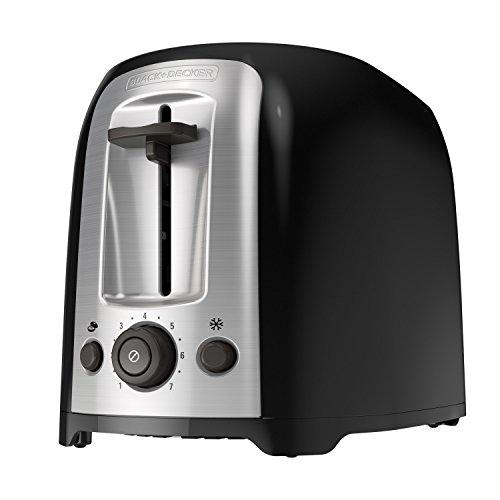
- BLACK+DECKER 2-Slice Toaster with Extra-Wide Slots — extra-wide slots with an extra lift lever and bagel mode
Read the full guide ↓
The best toasters for big bread exist because bread changed and slots, for a long time, did not. The standard toaster slot was designed around the uniform sandwich loaf, and the modern bakery shelf — wide sourdoughs, tall farmhouse loaves, thick-cut Texas-style slices, rustic rounds sliced at home — defeats it in three distinct ways: slices too wide for the slot’s length, too thick for its width, or too tall to retrieve without a dig. This guide treats those as three separate problems, because they are. Every pick in the verified pool, cross-checked against the Creators API on 2026-11-20, states a wide, extra-wide or extra-long slot in its listing, but they solve different parts of the geometry: one measures its width at 1.25 inches, one stretches its slot long enough for a whole artisan slice to lie down, two add lift mechanisms that matter most when the piece is large, and one gives thick slices the finest shade control in the group for the dense crumb that big bread usually carries. Read the reviews with your own loaf in mind — ideally, as the buying-guide section suggests, with its actual measurements in hand — because in this category the right answer is quite literally a matter of fit.
Big bread also changes the toasting itself, not just the loading. A thick slice insulates its own centre; a wide slice presents more face to the elements; a dense sourdough crumb browns on a different schedule from a soft sandwich loaf. The machines below are therefore judged on control as well as capacity, and the how-to section gives the technique — centring, shade discipline, heat-soak awareness — that lets a big slice emerge crisp at the faces and warm at the heart. Readers whose problem is specifically four slices at once should pair this guide with Best Toasters For Four Large Pieces Of Bread, where throughput takes the lead.
Key Takeaways
- Big bread fails in standard slots three ways — too long, too thick, too tall to retrieve — and each pick here solves a different failure.
- The bella’s extra-long, extra-wide slot is the only design in the pool that takes a whole large slice lying down, four at a time.
- The Elite Gourmet states the pool’s only measured slot width, 1.25 inches, which buyers can verify against a thick slice.
- Toast boost and the extra lift lever, on the Hamilton Beach and BLACK+DECKER, matter most with tall, heavy pieces.
- The Hommater’s nine shade settings suit dense, thick crumb that browns on a narrow window.
- Measure your loaf before ordering: length decides the slot format, thickness decides the width, and no adjective substitutes for either number.
In this guide
Quick Picks
| Pick | Badge | Slot claim in listing | Capacity | Link |
|---|---|---|---|---|
| Hommater 2-Slice Smart Toaster | Best Control for Thick Slices | Wide slot | 2-slice | Check on Amazon |
| Amazon Basics 2-Slice Toaster | Best Simple Wide Slot | Extra wide, for bagels | 2-slice | Check on Amazon |
| Elite Gourmet ECT1027B Cool-Touch Toaster | Best Measured Slot | 1.25-inch extra-wide | 2-slice | Check on Amazon |
| Hamilton Beach 22634 Extra-Wide Slot Toaster | Best All-Round Wide Slot | Extra-wide slot | 2-slice | Check on Amazon |
| bella Fits-Anywhere Slim 4-Slice Toaster | Best Overall for Big Bread | Extra long and wide slot | 4-slice | Check on Amazon |
| BLACK+DECKER 2-Slice Toaster with Extra-Wide Slots | Best Lift for Big Pieces | Extra-wide slots | 2-slice | Check on Amazon |
How These Picks Were Chosen
The six picks are the programme’s verified toasters pool, cross-checked against the Creators API on 2026-11-20. For this keyword the eligibility test was slot geometry stated in the listing: a wide, extra-wide or extra-long slot claim. All six listings make such a claim — the Hommater’s wide slot, the Amazon Basics, Hamilton Beach and BLACK+DECKER extra-wide slots, the Elite Gourmet’s measured 1.25-inch extra-wide slots, and the bella’s extra-long and wide slot — so all six are linked, and the reviews differentiate them by the completeness of the solution rather than by eligibility. Within that, we weighted the supporting evidence that big bread specifically rewards: lift assistance for tall pieces, shade granularity for dense crumb, defrost for the thick slices many households freeze, and honest specification, including which claims are measured and which are directional.
The guide is research-led and says so: we did not feed a bakery’s worth of loaves through these machines, and no fit guarantee appears here for any specific loaf, because loaves vary more than listings do. What we provide is the verified geometry each maker claims, the technique that makes the most of it, and a measurement routine in the buying-guide section that lets you settle fit for your own bread before money changes hands. The consistency questions that big slices raise are pursued further in Best Toasters For Even Toasting, where browning across a large face gets its own examination.
The Best Toasters for Big Bread: Full Reviews
Each review is judged against the three big-bread failures — length, thickness and retrieval — plus the control that dense, large slices demand.
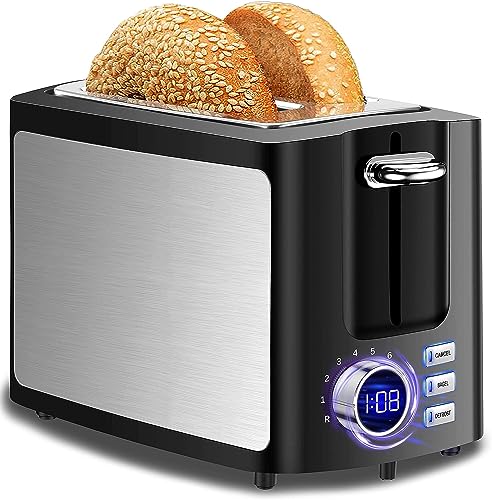
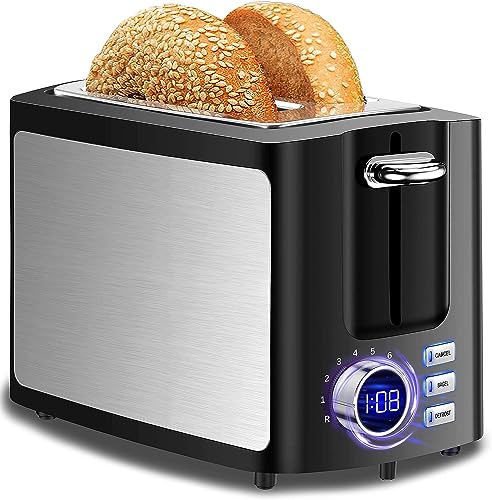
Hommater 2-Slice Smart Toaster with LCD Digital Countdown Timer
Badge: Best Control for Thick Slices
Strengths
- Nine shade settings — the control dense, thick slices reward most
- LCD countdown disciplines the longer cycles big bread needs
- Defrost and reheat functions suit thick slices stored frozen and eaten in shifts
Trade-offs
- Slot described as wide, not extra-wide or long; very large slices remain a standard-slot fit question
- Two-slice capacity
- No lift assistance is claimed for tall pieces
Mini spec box
- Format: 2-slice pop-up toaster, wide slot
- Display: LCD digital countdown timer
- Shade settings: 9
- Named functions: bagel, defrost, cancel, reheat
Big bread’s quiet problem is not only fit but timing. A thick, dense slice needs a longer, more carefully judged cycle than a thin one: too short and the centre is cool dough, too long and the faces pass from bronzed to bitter while the centre is still catching up. The Hommater is this guide’s control specialist for exactly that problem. Nine shade settings divide the browning range more finely than any rival here, which lets a household find — and, crucially, remember — the precise step where their sourdough’s faces crisp while its heart warms through. The countdown display supports the same discipline from the other side, making a long cycle legible: you can see that the thick slice still has time to run and resist the premature lift-and-check that cools one face and ruins the other’s finish.
Defrost and reheat extend the case to how big bread is actually stored and eaten. Thick loaves are often sliced and frozen, and defrost gives those slices a thawing phase before browning; reheat rescues the slice that waited while a large breakfast assembled itself. The honest limitation is geometry. The listing claims a wide slot without the extra-wide or long language of its rivals and without a measurement, so the very largest artisan slices — the ones that motivate this keyword at its extreme — are better served by the bella’s long slot below. Buy the Hommater when your big bread is thick and dense rather than enormous, and when control matters more than the last centimetre of slot. Check the latest price on Amazon.
Best for: thick, dense slices that need precise, repeatable cycles / Not suited for: the largest whole artisan slices

Amazon Basics 2-Slice Toaster
Badge: Best Simple Wide Slot
Strengths
- Extra-wide slots, stated plainly, take thick-cut slices without a squeeze
- Defrost button covers thick slices stored in the freezer
- The pool’s only stated wattage, 900W, and a cord wrap for storage-led kitchens
Trade-offs
- Six browning settings is the joint-narrowest range for dense crumb
- Standard slot length — long slices still need turning or trimming
- No lift assistance for tall pieces
Mini spec box
- Format: 2-slice pop-up toaster
- Slots: extra wide, for bagels
- Browning settings: 6
- Power: 900W
- Named functions: defrost, cancel and bagel buttons
- Convenience: removable crumb tray; cord wrap
- Finish: black and silver
The Amazon Basics approaches big bread from the thickness direction. Its slots are extra wide — the listing attaches them to bagels, but width is width, and the thick-cut sandwich slices and chunky farmhouse cuts that jam standard slots are the direct beneficiaries. For the large population whose big-bread problem is a thick slice rather than a long one, this is a complete and refreshingly uncomplicated answer, supported by a defrost button for the freezer-stored loaf and the pool’s only stated power figure, which at least lets a buyer know the elements’ rating in plain numbers. The cord wrap adds a practical note for the many big-bread households — farmhouse kitchens, shared houses — where the toaster is stored between uses rather than enthroned on the counter.
The limitations are length and granularity. The slot is a standard length, so the long artisan slice still faces the old choices of trimming, turning halfway, or accepting a pale band; and six browning settings give dense crumb the least precise landing strip in the pool, which thick-slice households will feel when a single step jumps from underdone to dark. Neither flaw matters if your loaf is thick and standard-shaped. If it is long, read on to the bella; if it is dense and demanding, read back to the Hommater. Check the latest price on Amazon.
Best for: thick-cut standard loaves and straightforward households / Not suited for: long artisan slices

Elite Gourmet ECT1027B 2-Slice Cool-Touch Toaster
Badge: Best Measured Slot
Strengths
- Slot width stated as a measurement — 1.25 inches — not an adjective
- Listing names thick bread alongside bagels as the slot’s purpose
- Cool-touch cabinet suits the hands-on handling big slices need
Trade-offs
- Standard slot length; long slices are not its brief
- Six shade settings, the joint-narrowest range here
- No defrost function is named in its listing
Mini spec box
- Format: 2-slice pop-up toaster
- Exterior: cool-touch, black finish
- Slots: 1.25-inch extra-wide
- Shade settings: 6
- Named functions: cancel; bagels and thick bread handling
- Model: ECT1027B
In a category addicted to the word wide, the Elite Gourmet does something quietly radical: it measures. Its slots are stated at 1.25 inches, and its listing names thick bread in the same breath as bagels, which together make it the most verifiable big-bread claim in the pool. A buyer can take a caliper or a ruler to their thickest usual slice, compare it with 1.25 inches, and know — before ordering — whether the fit question is settled. That is how specifications are supposed to work, and it stands in instructive contrast to the directional claims elsewhere. The cool-touch cabinet supports the use case more than it might appear: big slices are handled more than small ones — turned, checked, steadied — and a forgiving exterior suits a toaster that hands keep approaching.
Its boundaries are length and frozen stock. The slot is a standard length, so this is a thickness solution, not a long-loaf solution, and no defrost function is named for households whose thick slices live in the freezer. Six shades, again, is adequate rather than fine. Within its brief — thick, fresh, standard-length bread, bought by people who like a number they can check — it is the most satisfying pick in the guide, and its family applications are extended in Best Toasters For Kids, where measured slots and cool sides serve smaller hands. Check the latest price on Amazon.
Best for: thick-slice buyers who shop by measurement / Not suited for: long loaves or freezer-stored slices
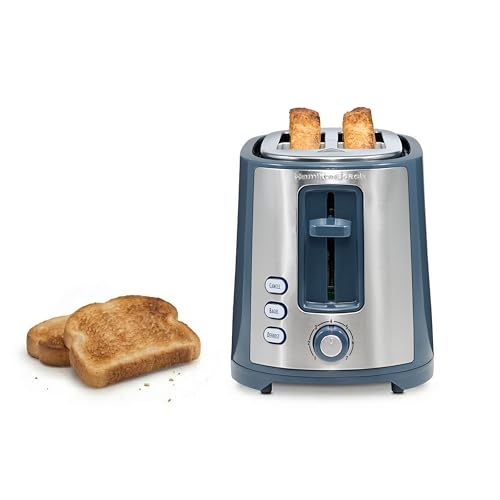
Hamilton Beach 22634 Extra-Wide Slot 2-Slice Toaster
Badge: Best All-Round Wide Slot
Strengths
- Extra-wide slot with toast boost — fit plus retrieval for tall pieces
- Defrost button for thick frozen slices
- Seven browning shades and auto shutoff complete the routine
Trade-offs
- Standard slot length, so the longest slices still will not lie flat
- Two-slice capacity
- Width is claimed, not measured
Mini spec box
- Format: 2-slice pop-up toaster, extra-wide slot design
- Shade settings: 7 browning shades
- Named functions: bagel and defrost buttons; auto shutoff; toast boost
- Crumb tray: slide-out
- Finish: Kitchen Makeover Blue
- Model: 22634
The Hamilton Beach is the all-rounder of this guide because big bread, in practice, is a routine rather than a single fit test, and this machine supports every stage of it. The extra-wide slot takes the thick slice. The defrost button handles the same slice when it comes from the freezer, as thick farmhouse cuts so often do. Seven browning shades give the dense crumb a finer target than the six-setting models. And toast boost addresses the stage everyone forgets until they are doing it: retrieval. A tall, heavy slice rides low and weighs more; the boost raises the carriage beyond standard travel so the piece presents itself to your hand instead of asking your fingers to descend toward the elements. Auto shutoff and a slide-out crumb tray — the tray matters, because big rustic slices shed big rustic crumbs — complete the most finished big-bread routine among the two-slice picks.
The limitation is the familiar one: length. The slot is extra-wide but standard in length, so the whole artisan slice that lies down in the bella must here be trimmed or turned, and its width, while claimed plainly, is not given the Elite Gourmet’s measured precision. Buyers must therefore choose their geometry honestly: thickness and routine, this machine; length, the next one. For the mixed household whose big bread is thick, frozen, tall and various — which is to say, most big-bread households — this is the safest single recommendation in the guide, and its everyday context is the family kitchen surveyed in Best Toasters For Home Use. Check the latest price on Amazon.
Best for: mixed big-bread routines — thick, frozen and tall / Not suited for: whole long artisan slices

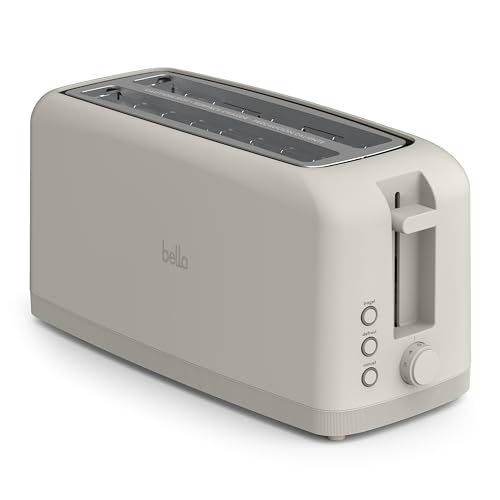
bella Fits-Anywhere Slim Toaster, 4 Slice
Badge: Best Overall for Big Bread
Strengths
- Extra-long and wide slot — the only design that takes a whole large slice lying down
- Four slices per cycle, doubling every other pick’s throughput
- Slim body fits the counter strips other four-slice machines cannot
Trade-offs
- Shade count, defrost and other functions are not stated in its listing
- No lift assistance is claimed for very tall pieces
- A long footprint needs a long counter run
Mini spec box
- Format: 4-slice pop-up toaster, slim profile
- Slot: extra long and wide
- Finish: Oatmilk
- Shade settings: not stated in listing
- Named functions: not stated in listing
Every other pick in this guide negotiates with big bread. The bella simply accommodates it. Its extra-long, extra-wide slot is the only design in the pool that addresses the length failure — the wide sourdough slice, the long farmhouse cut — by letting the slice lie down whole, untoasted ends and mid-cycle turning abolished at a stroke. Four slices per cycle then converts that accommodation into abundance: the big-bread household, which tends to be a bread-serious and often a numerous household, gets a full round of toast in one cycle instead of a relay. The slim Fits-Anywhere body is the final piece of the argument, because a long machine that was also deep would exile itself from real counters; this one was proportioned for the spaces kitchens actually offer. For the reader whose big bread is genuinely big — measured in length as much as thickness — this is the guide’s headline answer, and the natural partner to the capacity discussion in Best Toasters For Large Pieces Of Bread.
The caveats are about documentation, not geometry. Its listing states no shade count and no defrost or other named functions, so the dense-crumb control that the Hommater documents and the frozen routine that the Hamilton Beach documents are, here, unconfirmed; a buyer is trusting the format to carry the result. No lift assistance is claimed either, though a slice lying in a long slot presents differently from one standing in a deep one. None of this dims the format’s victory for its intended buyer — but it does mean the purchase should be made for the slot, with eyes open about the silence around it. Check the latest price on Amazon, and measure your counter run as carefully as your loaf.
Best for: long, wide artisan loaves and households that eat together / Not suited for: buyers who need documented shade and defrost specifications
BLACK+DECKER 2-Slice Toaster with Extra-Wide Slots
Badge: Best Lift for Big Pieces
Strengths
- Extra lift lever — the retrieval feature big, heavy pieces reward most
- Extra-wide slots and seven shade settings
- Bagel mode covers the round end of the big-bread family
Trade-offs
- Standard slot length; long slices still need trimming or turning
- No defrost function is named in its listing
- No auto shutoff or cool-touch claim
Mini spec box
- Format: 2-slice pop-up toaster
- Slots: extra-wide
- Shade settings: 7
- Named functions: bagel mode
- Convenience: extra lift lever; removable crumb tray
The BLACK+DECKER’s big-bread case rests on the moment the cycle ends. Large pieces are heavy, tall and awkward; they sit deep, they lean, and they invite exactly the fingertip excavation that toaster design should prevent. The extra lift lever is the pool’s most explicit answer — additional carriage travel, provided by name, so the piece rises to the hand. Around that headline, the specification is the proven one: extra-wide slots for thick cuts, seven shade settings for a finer landing on dense crumb, a bagel mode for the round branch of the family, and a removable crumb tray sized for the debris that rustic bread reliably produces. It is a traditional machine that happens to have thought carefully about the largest thing it will be asked to lift.
Its limits are length and frozen handling. The slot is standard in length, so the long-loaf buyer belongs with the bella, and no defrost function is named, so the freezer household belongs with the Hamilton Beach or the Hommater. Within the thick-and-tall brief, though, it offers the most retrieval-conscious package in the pool, and retrieval is the part of big-bread toasting that hands remember. Check the latest price on Amazon.
Best for: thick, tall pieces and buyers who prioritise safe retrieval / Not suited for: long loaves or frozen-slice routines
Comparison Table
| Pick | Slot claim | Capacity | Shade settings | Big-bread edge | Link |
|---|---|---|---|---|---|
| Hommater 2-Slice Smart | Wide | 2-slice | 9 | Finest control for dense crumb | Check on Amazon |
| Amazon Basics 2-Slice | Extra wide | 2-slice | 6 | Simple thick-slice fit, defrost | Check on Amazon |
| Elite Gourmet ECT1027B | 1.25-inch extra-wide | 2-slice | 6 | Measured width; thick bread named | Check on Amazon |
| Hamilton Beach 22634 | Extra-wide | 2-slice | 7 | Toast boost retrieval; defrost | Check on Amazon |
| bella Fits-Anywhere Slim | Extra long and wide | 4-slice | Not stated | Whole large slices, four at once | Check on Amazon |
| BLACK+DECKER 2-Slice | Extra-wide | 2-slice | 7 | Extra lift lever for tall pieces | Check on Amazon |
How to Choose a Toaster for Big Bread
Measure before you shop; in this category, two numbers decide almost everything. Take the largest slice from your usual loaf and measure its length across the base and its thickness at the crust. Length arbitrates the format question: a slice that exceeds a standard slot’s length belongs in the bella’s long slot, and no other feature compensates for a slice that cannot lie or stand whole. Thickness arbitrates the width question: compare it with the Elite Gourmet’s stated 1.25 inches if you want a verified answer, and treat unmeasured extra-wide claims as suitable for thick-cut commercial bread rather than guaranteed for the thickest home-cut slabs. Height, the third number, arbitrates retrieval: the taller and heavier your pieces, the more a boost or extra lift lever is worth. Only after geometry should you rank the supporting cast — defrost if your big loaf is sliced and frozen, shade granularity if your crumb is dense and your household divided, capacity if you eat together.
Tier logic follows the same order. Wide-slot competence is available at the pool’s straightforward end, so do not pay upward for width alone. Pay upward, in qualitative terms, for the specific additions your loaf demands: length of slot, lift assistance, control granularity, or a cabinet that forgives the extra handling big bread involves. The expensive mistake in this category is not buying too little toaster; it is buying the wrong geometry very confidently.
Finally, calibrate once and write it down. Every loaf-and-machine pairing has a number, and the household that spends one relaxed weekend cycle finding it — then notes it on the fridge — gets months of unconsidered, correct toast in exchange. Big bread rewards that small investment more than any other kind, because its window between underdone and overdone is the narrowest in the bread box.
How to Toast Big Bread Well
Technique begins before the lever. Slice evenly — a wedge-shaped slice browns like two different breads — and slice thick with intent, because a big slice toasted timidly-thin is just toast. Centre the slice in the slot; on a large face, an off-centre load shows immediately as a pale margin on one side. Choose shade for the crumb, not the crust: dense sourdough and whole-grain loaves want a step more than their colour suggests, while enriched farmhouse bread, with its sugars, wants a step less than its paleness invites. Let the cycle finish rather than lifting to inspect, because a big slice loses more heat per inspection than a small one and repays impatience with a cool centre. For slices stored frozen, use defrost where fitted rather than a darker shade, so the heart thaws before the faces finish. And respect heat soak across a big breakfast: by the third round, the cavity is hotter and the same setting browns faster, so step down one notch for later batches.
Care is crumb management, because big rustic bread sheds more than any other kind. Empty the tray weekly — slide-out and removable trays in this pool make it a minute’s work — and brush loose flour and crust fragments from the slot rims before they bake into place. Troubleshooting follows three patterns. Problem: a pale band across one end of a long slice → the slice exceeded the slot’s honest length; turn it halfway through future cycles, or move to a long-slot machine. Problem: faces dark but centre cool → the slice is thick and the cycle was shade-driven rather than defrost-aware; use defrost for frozen stock and a longer, gentler setting for fresh. Problem: the slice leans and browns on one face only → it was loaded off-centre or is too thin for the slot’s width; centre it, and toast thin slices in pairs where the format allows.
The Three Failures, Revisited: Length, Thickness, Height
It is worth ending the analysis where it began, because the three-failure framework is the most useful thing this guide can leave with a buyer who shops elsewhere. Length failure looks like a pale, untoasted end or a slice bent to fit; its only honest cure is slot length, which in this pool means the bella. Thickness failure looks like a squeezed, torn or element-scraped slice; its cure is slot width, ideally a measured width like the Elite Gourmet’s, and its warning sign is any listing that says wide without a context you can test. Height failure looks like fingertips near hot metal at the end of every cycle; its cure is lift, and the pool offers it under two names — boost and extra lift — on the Hamilton Beach and BLACK+DECKER. A buyer who can name which failure they are shopping against will choose correctly from almost any shortlist; a buyer shopping against the vague idea of big will keep being surprised by a specific loaf. Name your failure, then buy its cure.
Loaf by Loaf: Which Pick Serves Which Bread
Run the bakery shelf through the shortlist and the division of labour sharpens. The wide sourdough boule, sliced thick from the middle, is the bella’s home fixture — length and width together, with the Hommater as the alternative for households that slice it narrower and prize control over coverage. The tall farmhouse tin loaf, cut into high, heavy slices, belongs to the lift machines: the Hamilton Beach’s toast boost for the everyday routine, the BLACK+DECKER’s extra lift lever for buyers who want the mechanism named and mechanical. Thick-cut commercial sandwich bread — the least exotic big bread and the most commonly owned — is served perfectly well by the Amazon Basics’ extra-wide slots, and overspending beyond it buys features the loaf cannot use. Bagel-adjacent big bread, the thick halves and rounds, routes back to the Elite Gourmet’s measured slot and named thick-bread handling. Frozen sliced loaves, whatever their shape, add one requirement that overrides brand preference: a confirmed defrost function, which narrows the field to the Hommater, the Hamilton Beach and the Amazon Basics before any other virtue is counted.
The pattern underneath the pairings is that big bread is not one food but a family of shapes sharing an adjective, and the pool’s six designs map onto that family with surprisingly little overlap. That is good news disguised as complexity: it means a household that knows its loaf can choose with unusual confidence, because the right machine is determined by geometry rather than by taste in brands. It also means the wrong machine is determined the same way, and no amount of satisfaction with its finish or its display will reconcile a long loaf to a short slot.
Slicing at Home: The Variable Nobody Specifies
Home-sliced bread introduces a variable no listing can govern: the slice itself. A loaf cut by hand varies in thickness from slice to slice and often within a slice, and that variance, more than any machine property, explains the household that reports its toaster as inconsistent when the toaster is blameless. Three habits tame it. Use a serrated bread knife with a sawing motion and let the blade do the work; pressure is what wedges a slice. Aim for a consistent target thickness and check it against your slot — remembering that the Elite Gourmet’s 1.25 inches is a ceiling to slice under, not a challenge. And toast the thickest slices of a batch first, while you are freshest and the machine is coolest, stepping the shade down as heat soak builds and the thinner slices arrive. Households that bake their own bread should also let a loaf cool completely before slicing; a warm crumb compresses under the knife into a density that no shade setting can rescue. None of this is machinery, and all of it decides whether the machinery gets a fair trial.
The Counter Question: Living With a Bigger Answer
Big-bread solutions occupy counter, and the occupation should be planned rather than discovered. The bella’s long body is slim but extended; it wants a run of counter, ideally the stretch beside a wall where its length parallels the room rather than crossing the workspace. The two-slice wide-slot machines ask for the standard toaster footprint but reward the same clearance discipline as any model — open air above the slots, nothing slumping against the sides. Households storing the toaster between uses should weigh the Amazon Basics’ cord wrap and the general portability of the two-slice designs against the bella’s greater presence in a cupboard. None of these considerations is a reason to choose a machine that does not fit your bread; a toaster that fits the counter but not the loaf is furniture, not equipment. Measure the loaf first, then the counter, and let the two measurements negotiate — in most kitchens they reach an agreement, and in the ones that cannot, the slim long-slot format exists precisely to settle the argument.
What Big Bread Does to a Toaster Over Time
Big bread is harder on a toaster than small bread, and owners should know the three ways it shows. First, crumbs: rustic crusts and seeded loaves shed heavily, and the debris load is the strongest argument in this guide for the tray designs that slide or lift out cleanly — a tray emptied in a minute gets emptied, and a machine whose interior stays clean browns consistently for longer. Second, residue: flour dust and the occasional smear of butter or jam from an over-filled slice bake onto slot rims and cavity edges, and a weekly wipe of the cool, unplugged machine keeps that seasoning from becoming next month’s smoke. Third, handling wear: large slices are loaded, turned and retrieved with more force and more contact than small ones, which is why lift mechanisms and forgiving cabinets age better in big-bread households — they absorb the handling instead of transmitting it to the carriage and the cook. None of this shortens a well-kept machine’s life in any way a buyer should fear; it simply means the maintenance minute matters more in this category than in any other toaster niche, and the picks above were chosen partly for how gracefully they accept that minute.
Toasting Big Bread for a Table: Sequencing a Shared Breakfast
When big bread is served to a table rather than a person, sequence becomes the cook’s real skill, and the machine’s virtues reorder themselves around it. Toast in descending order of hardiness: the densest, thickest slices first, because they hold their heat and texture while later rounds run, and the lightest, sweetest slices last, because they stale and toughen fastest off the heat. Use the heat-soak curve instead of fighting it — the first round at your calibrated setting, later rounds a step lighter — and where a reheat function is fitted, as on the Hommater, treat it as the table’s equaliser, refreshing the earliest slices for ten seconds of warmth rather than re-toasting them into croutons. Keep finished slices standing in a rack or tented loosely rather than stacked flat, because big slices stacked flat steam each other’s faces soft in the minutes before serving, undoing the crispness the whole exercise was for. And slice to order where the loaf allows it: a loaf holds its quality far better than its slices do, so the household that cuts each round as the previous one toasts gets better toast and a calmer cook. These are small disciplines, but they are the difference between a big-bread breakfast that feels abundant and one that feels like a queue with crumbs.
Common Buying Mistakes
- Shopping by adjective. Wide is a direction; your loaf has dimensions. Measure both and compare numbers where numbers exist.
- Confusing thickness with length. Extra-wide slots do nothing for a long slice; long slots are a separate geometry.
- Forgetting retrieval. A tall, heavy slice that fits can still defeat you at the end of the cycle without lift assistance.
- Improvising frozen thick slices with extra shade. Defrost thaws the centre; shade only darkens the faces.
- Lifting to inspect. Big slices lose heat fast; trust the cycle and adjust the next one.
- Neglecting the crumb tray. Rustic bread sheds heavily, and a full tray is tomorrow’s burnt smell.
Final Recommendation
Start from your loaf. If it is long and wide, the answer is the bella Fits-Anywhere Slim Toaster, the pool’s only extra-long slot, with four-slice capacity as a bonus. If it is thick and you want a verified fit, take the Elite Gourmet ECT1027B and its measured 1.25-inch slots. If it is thick, dense and demanding, take the Hommater for nine-step control; if it is a bit of everything, the Hamilton Beach’s wide slot, defrost and toast boost make it the safest all-round choice, with the BLACK+DECKER for lift-first buyers and the Amazon Basics for simple thick-cut service. Check the latest price on Amazon for your pick, and confirm the slot claim on the current listing before ordering.
Frequently Asked Questions
What slot size do I need for sourdough and artisan loaves?
Measure your largest slice’s length and thickness rather than trusting category words. Length is the usual artisan problem, and it points to a long-slot design like the bella’s extra-long slot; thickness points to width, where the Elite Gourmet’s stated 1.25 inches is the pool’s only verifiable figure.
Can I toast a long slice in a standard two-slice toaster?
You can toast it in two passes, turning it halfway so each end takes its turn in the heated zone, and many households do exactly that. The result is serviceable but rarely even, which is why long-slot machines exist; if the loaf is a weekly staple, the format upgrade is the honest fix.
Why does my thick slice brown outside but stay cool inside?
Thickness insulates. The faces sit close to the elements while the centre is protected by the crumb itself, so the cycle ends on the faces’ schedule. A longer, gentler setting, defrost for frozen slices, and resisting the urge to lift and inspect all push heat toward the centre.
Is four-slice capacity worth it for big bread?
For households that eat together, yes — big-bread breakfasts are usually shared breakfasts, and the bella’s four-slice long slot ends the queue. For staggered households, a two-slice machine with the right geometry serves just as well and takes less counter.
Do I need a lift feature if my slices are tall?
It is the feature you will appreciate most often. Tall, heavy pieces ride low and lean, and a boost or extra lift lever raises them to your hand; without one, retrieval becomes the least pleasant part of an otherwise good breakfast. Never substitute a utensil, and never use a metal one.
Should I toast big bread on a lower setting for longer?
Often, yes. A gentler, longer cycle gives heat time to reach a thick slice’s centre before the faces finish, which is the core big-bread trade-off. The picks with defrost functions formalise that idea for frozen slices; for fresh thick slices, stepping one shade lighter and letting the full cycle run usually beats a short, fierce blast followed by a second pass.
What if only one of my regular loaves is oversized?
Buy for the regular rotation, not the exception. A single oversized loaf in an otherwise standard week can be handled by turning slices halfway in a good two-slice machine; reshaping your whole purchase around it means living with a larger machine every day for a problem that visits occasionally. If the oversized loaf is the weekly staple and the others are the exception, reverse the logic and take the long slot.
Can I toast garlic bread, cheese-topped bread or other dressed slices?
With caution and supervision. Toppings drip, and drips inside a slot toaster become smoke, residue and, in the worst case, a fire risk; dressed breads belong under a grill or in a toaster oven rather than in a pop-up slot. Plain big bread is this category’s brief, and keeping it plain keeps the machine clean and the kitchen calm.
How do I stop one face of a big slice browning more than the other?
Centre the slice carefully, keep its thickness even when you cut it, and avoid loading a slice so thin for the slot’s width that it leans against one side. If the pattern persists across loaves, it is a geometry mismatch, and the comparison table above is the place to re-choose.