Disclosure: topratedkitchenware.com is reader-supported. When you buy through links on our site, we may earn an affiliate commission from Amazon and other retailers, at no extra cost to you.
Where to buy
All six verified picks are linked in this guide. Home use is the broadest brief a toaster can be given — daily bread, family breakfasts, frozen slices, bagels, guests — and every model in the pool answers some honest version of it, from the storable two-slice to the four-slice family machine.
- Hommater 2-Slice Smart Toaster with LCD Digital Countdown Timer — nine shade settings, a countdown display, and bagel, defrost, cancel and reheat functions
- Amazon Basics 2-Slice Toaster — extra-wide slots, defrost and bagel buttons, a stated 900W rating and a cord wrap
- Elite Gourmet ECT1027B Cool-Touch Toaster — a cool-touch body and 1.25-inch extra-wide slots
- Hamilton Beach 22634 Extra-Wide Slot Toaster — seven browning shades, auto shutoff, toast boost and a slide-out crumb tray
- bella Fits-Anywhere Slim 4-Slice Toaster — four slices in an extra-long, extra-wide slot, in a slim body
- BLACK+DECKER 2-Slice Toaster with Extra-Wide Slots — bagel mode, seven shade settings and an extra lift lever
Read the full guide ↓
The best toasters for home use are not the most powerful, the most feature-laden or the most beautiful; they are the ones that disappear into a household’s routine and stay disappeared for years. Home use is a specific discipline, different from cafe use or gadget enthusiasm: the machine is operated half-asleep by several different people, fed whatever bread the week brought home, stored or stationed according to the kitchen’s real estate, and cleaned exactly as often as its design makes easy. Judged that way, the six toasters in the verified pool — cross-checked against the Creators API on 2026-11-20 — divide the domestic territory cleanly. One times and counts down for choreographed mornings. One wraps its cord and lives in a cupboard. One keeps its sides cool in a crowded family kitchen. One has quietly solved retrieval, shutoff and crumb management. One feeds four people at once from a slim footprint. One does the traditional jobs in the traditional way. This guide’s job is not to crown one of them for every home, because there is no every home; it is to match each design to the household shape it serves, so that the toaster you buy becomes the toaster your kitchen forgets about, in the best sense.
Two home truths run through the reviews. First, the features that matter domestically are the unglamorous ones: a crumb tray you will actually empty, a lift that keeps fingers out of slots, a defrost that matches how your bread is actually stored, a capacity that matches how your household actually eats. Second, every home is a compromise among the people in it — browning preferences, heights, schedules — and the right toaster is the one whose compromises your household will not notice. The specialised corners of domestic life get their own treatment elsewhere, from Best Toasters For Kids to the compact-living notes in Best Toasters For Small Spaces, and this guide ties them together.
Key Takeaways
- Home use rewards the unglamorous virtues: easy cleaning, safe retrieval, defrost for freezer bread and capacity matched to the household.
- The Hommater is the control centre pick — countdown, nine shades and reheat for staggered family mornings.
- The Hamilton Beach is the most finished all-rounder: auto shutoff, toast boost and a slide-out tray.
- The Elite Gourmet’s cool-touch body suits crowded family kitchens; the bella’s four-slice long slot suits households that eat together.
- The Amazon Basics is the storable, simple answer for small households and second kitchens.
- The BLACK+DECKER covers the traditional brief — bagel mode, extra lift, seven shades — without fuss.
In this guide
Quick Picks
| Pick | Badge | Capacity and slots | Home-use highlight | Link |
|---|---|---|---|---|
| Hommater 2-Slice Smart Toaster | Best Overall for Home Use | 2-slice, wide | Countdown, nine shades, reheat | Check on Amazon |
| Amazon Basics 2-Slice Toaster | Best for Small Households | 2-slice, extra wide | Cord wrap; simple buttons | Check on Amazon |
| Elite Gourmet ECT1027B Cool-Touch Toaster | Best for Busy Family Kitchens | 2-slice, 1.25-inch extra-wide | Cool-touch cabinet | Check on Amazon |
| Hamilton Beach 22634 Extra-Wide Slot Toaster | Best All-Rounder | 2-slice, extra-wide | Auto shutoff; toast boost | Check on Amazon |
| bella Fits-Anywhere Slim 4-Slice Toaster | Best for Family Breakfasts | 4-slice, extra long and wide | Four at once, slim body | Check on Amazon |
| BLACK+DECKER 2-Slice Toaster with Extra-Wide Slots | Best for Traditional Homes | 2-slice, extra-wide | Bagel mode; extra lift lever | Check on Amazon |
How These Picks Were Chosen
The six picks are the programme’s verified toasters pool, cross-checked against the Creators API on 2026-11-20, with specifications and images taken from the API response. Home use names no excluding attribute — every pick is a domestic countertop toaster — so all six are linked, and the work of this guide is weighting rather than filtering. We weighted the qualities domestic service actually tests: function coverage for the real home rotation (toast, bagels, frozen bread, reheating, cancelling), slot geometry against the bread households buy now, retrieval design for the range of hands in a home, safety behaviours that work without being remembered, cleaning paths short enough to happen weekly, and storage and footprint honesty for kitchens where the toaster competes for space. Each pick leads the pool at one of those weightings, which is why the badges describe household shapes rather than a single ladder.
The guide is research-led and transparent about it: no hands-on claims, no invented lifespan figures, and silences in listings — the bella’s unstated shade count is the standing example — recorded rather than papered over. Where a household’s needs sharpen into a specialism, we say so and point onward; the loaf-shape end of home toasting, for instance, is covered in Best Toasters For Large Slices, and this guide’s role is to keep the generalist picture honest and complete.
The Best Toasters for Home Use: Full Reviews
Each review is written from the household outward: who lives with this machine, what their mornings look like, and where the design’s limits will be felt.
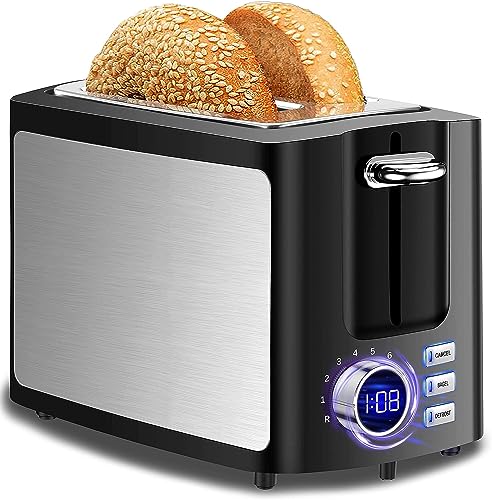
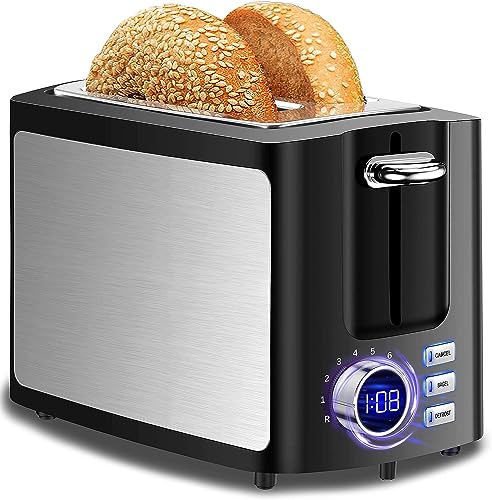
Hommater 2-Slice Smart Toaster with LCD Digital Countdown Timer
Badge: Best Overall for Home Use
Strengths
- Countdown display coordinates a multi-dish family breakfast
- Nine shade settings give every household member a number to call their own
- Bagel, defrost, cancel and reheat cover the full home rotation
Trade-offs
- Two-slice capacity queues a large family
- A display needs a weekly wipe in a flour-dusted kitchen
- Wide rather than extra-wide or long slots
Mini spec box
- Format: 2-slice pop-up toaster, wide slot
- Display: LCD digital countdown timer
- Shade settings: 9
- Named functions: bagel, defrost, cancel, reheat
The modern home morning is a scheduling problem wearing a dressing gown: lunches to pack, eggs to time, a departure to hit. The Hommater earns the overall badge for home use because it is the pool’s best scheduling citizen. The countdown display lets whoever is cooking run the rest of breakfast against a visible number instead of a guess, and the nine shade settings convert the household’s oldest argument — how dark toast should be — into a set of personal numbers that end the argument permanently. Its function list is the complete domestic rotation in one row: bagel for the weekend, defrost for the weekday loaf that lives in the freezer, cancel for the doorbell moment, and reheat, the function staggered households did not know they needed until the first slice popped for an eater who was still in the shower. Reheated-not-retoasted is a small mercy that happens daily in real homes.
The limitations are capacity and upkeep. Two slices at a time will queue a household of five that eats together, and those households should read the bella’s review first. A display in a home kitchen also collects the evidence of home cooking — flour, steam, fingerprints — and wants the weekly wipe this guide prescribes for every machine. Neither point dents its standing for the typical two-to-four-person home whose mornings are busy rather than numerous: it is the most capable domestic all-rounder in the pool, and the natural first recommendation of this guide. Check the latest price on Amazon.
Best for: busy small-to-medium households that run breakfast to a schedule / Not suited for: large families eating simultaneously

Amazon Basics 2-Slice Toaster
Badge: Best for Small Households
Strengths
- Cord wrap and a compact two-slice format suit stored, not stationed, living
- Defrost, cancel and bagel buttons — the home essentials, labelled plainly
- Fully stated specification including 900W; nothing to decode
Trade-offs
- Six browning settings is the joint-narrowest range here
- No lift assistance, shutoff or reheat
- Two-slice capacity
Mini spec box
- Format: 2-slice pop-up toaster
- Slots: extra wide, for bagels
- Browning settings: 6
- Power: 900W
- Named functions: defrost, cancel and bagel buttons
- Convenience: removable crumb tray; cord wrap
- Finish: black and silver
For the one- and two-person household, the flat with a galley kitchen, the second home and the rental, the Amazon Basics is the pool’s most proportionate answer. Home use at that scale is defined by storage and simplicity: the toaster is fetched, used and put away, and a cord wrap turns that cycle from a tangle into a habit. Its buttons state the domestic essentials without a learning curve — a guest, a teenager or a grandparent produces correct toast on the first attempt, which is the true home-usability test — and its extra-wide slots take the bagels and thick slices that small households buy in the same variety as large ones. The fully stated specification, wattage included, suits buyers who furnish practically and dislike decoding marketing at any scale of home.
Its limits appear when a home grows or gathers. Six settings give divided households the least room to personalise, no reheat means staggered slices are re-toasted rather than refreshed, and two slices queue a visiting family. None of that matters to the household it is designed for, and its price-free virtue — qualitative, straightforward value — is that it spends nothing on capabilities its owners will never call. Homes expecting to expand should buy a step up the pool now rather than twice; homes settled at small scale may never need to. Check the latest price on Amazon.
Best for: singles, couples, rentals and second kitchens / Not suited for: growing families or feature-first buyers

Elite Gourmet ECT1027B 2-Slice Cool-Touch Toaster
Badge: Best for Busy Family Kitchens
Strengths
- Cool-touch cabinet — the family kitchen’s most forgiving surface
- 1.25-inch extra-wide slots for the thick bread family loaves come in
- Simple six-shade, cancel-equipped routine any household member can run
Trade-offs
- No defrost function is named in its listing
- Six shades is the joint-narrowest range in the pool
- Two slices per cycle
Mini spec box
- Format: 2-slice pop-up toaster
- Exterior: cool-touch, black finish
- Slots: 1.25-inch extra-wide
- Shade settings: 6
- Named functions: cancel; bagels and thick bread handling
- Model: ECT1027B
Family kitchens are contact-rich environments: the toaster is steadied by one hand while the other loads, brushed by sleeves, leaned past by children, and generally treated as furniture by people thinking about something else. The Elite Gourmet’s cool-touch cabinet — the only confirmed claim of its kind in the pool — is designed for exactly that treatment, and it is why this machine takes the family badge despite a modest specification elsewhere. Its slots support the family’s bread reality, measured at 1.25 inches and named for bagels and thick bread, so the chunky loaf a family buys fits without the squeeze-and-tear routine. The control story is deliberately simple — six shades and a cancel — which in a multi-operator home is a virtue: there is little to mis-set and nothing to configure.
The gaps are defrost and granularity. A family whose loaf lives sliced in the freezer will miss a named defrost cycle, and a family split into browning factions gets only six positions to negotiate with. Both are survivable; neither is hidden in this guide’s account. What the household gets in exchange is the safest-feeling daily surface in the pool and a machine whose simplicity scales across every operator in the house. It is also, not coincidentally, the natural bridge to the sourdough-leaning guidance in Best Toasters For Sourdough Bread, since thick family loaves and measured slots travel together. Check the latest price on Amazon.
Best for: families with children and crowded counters / Not suited for: freezer-loaf households needing a named defrost
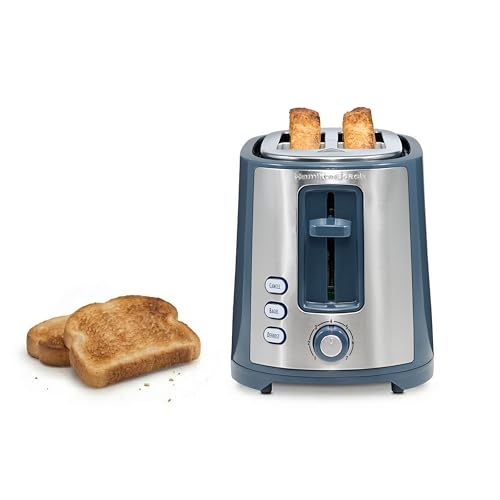
Hamilton Beach 22634 Extra-Wide Slot 2-Slice Toaster
Badge: Best All-Rounder
Strengths
- Auto shutoff protects the distracted domestic morning
- Toast boost retrieves small pieces for every size of hand
- Seven shades, bagel and defrost buttons, slide-out crumb tray
Trade-offs
- Two-slice capacity
- No reheat function is claimed
- The blue finish is a presence in traditional kitchens
Mini spec box
- Format: 2-slice pop-up toaster, extra-wide slot design
- Shade settings: 7 browning shades
- Named functions: bagel and defrost buttons; auto shutoff; toast boost
- Crumb tray: slide-out
- Finish: Kitchen Makeover Blue
- Model: 22634
If home use has a centre of gravity, the Hamilton Beach sits on it. Its specification reads like a response to a decade of domestic feedback: a browning control with seven shades for the household’s spread of preferences; bagel and defrost buttons for the two states home bread actually arrives in; toast boost so that the smallest eater’s muffin half and the tallest eater’s thick slice are both retrievable without drama; auto shutoff standing behind the morning’s inevitable distractions; and a slide-out crumb tray that makes the weekly clean a glide instead of a wrestling match. No single feature is spectacular. The completeness is the spectacle, and completeness is what all-rounders are for: the household that cannot predict its own breakfasts — guests, phases, new bread habits — is best served by the machine with the fewest gaps.
The honest asterisks are capacity, reheat and colour. Two slices queues the big sit-down breakfast; the absence of a claimed reheat function leaves staggered slices to the oven’s mercy or a careful second pass; and the Kitchen Makeover Blue finish will be a delight in one kitchen and a negotiation in another. Set against the pool, it remains the recommendation this guide would give a household that asked for one toaster, no special circumstances, no regrets — the domestic default, against which the specialisms of its five rivals should be measured. Check the latest price on Amazon.
Best for: households that want one toaster with no gaps / Not suited for: simultaneous family service or reheat-dependent routines

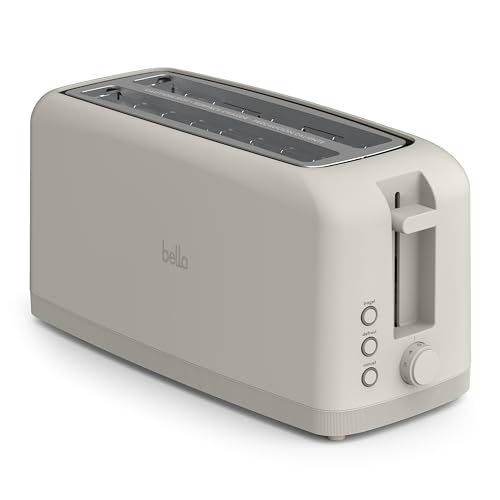
bella Fits-Anywhere Slim Toaster, 4 Slice
Badge: Best for Family Breakfasts
Strengths
- Four slices per cycle ends the family breakfast queue
- Extra-long, extra-wide slot takes the loaves families actually buy
- Slim body fits family kitchens where counter is contested
Trade-offs
- Shade count and named functions are not stated in its listing
- One shared cycle setting per round for mixed preferences
- Long footprint needs a long counter run
Mini spec box
- Format: 4-slice pop-up toaster, slim profile
- Slot: extra long and wide
- Finish: Oatmilk
- Shade settings: not stated in listing
- Named functions: not stated in listing
For the household whose defining meal is breakfast together, the bella reorders every priority in this guide. Four slices in one cycle means the family sits down together, and the slot that receives them is extra long and wide, sized for the bakery loaves and thick cuts that family shopping produces. The slim body is the domestic masterstroke: family kitchens are the most contested counters in the world, and a four-slice machine that takes depth like a two-slice machine earns its place instead of annexing it. In homes where the toaster’s busiest hour involves four or more people and one departure time, this format is not an upgrade; it is the difference between a system that works and a queue that everyone has silently agreed to resent.
The recorded caveats stand: its listing states no shade count and no named functions, so defrost and bagel specifics are unconfirmed, and a shared cycle means one browning setting per round for a table that may contain factions. Families should buy it as what it verifiably is — a capacity and geometry answer — and calibrate its controls in the first week. Households whose breakfasts are staggered rather than simultaneous will get more from the Hommater’s reheat or the Hamilton Beach’s completeness. But for the eat-together home, including the hosting end of domestic life that shades toward Best Toasters For Restaurants in spirit if not in scale, this is the pool’s standout. Check the latest price on Amazon.
Best for: families that eat breakfast together / Not suited for: staggered households or specification-first buyers
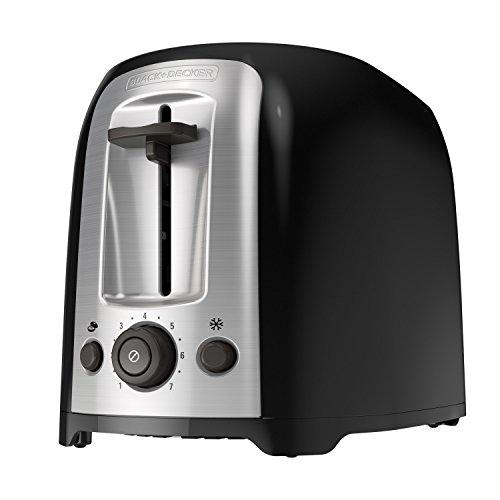
BLACK+DECKER 2-Slice Toaster with Extra-Wide Slots
Badge: Best for Traditional Homes
Strengths
- Dedicated bagel mode for the weekend side of home life
- Extra lift lever keeps every household hand clear of the slots
- Seven shade settings and a removable crumb tray
Trade-offs
- No defrost or auto shutoff claim in its listing
- Two-slice capacity
- Conventional controls only
Mini spec box
- Format: 2-slice pop-up toaster
- Slots: extra-wide
- Shade settings: 7
- Named functions: bagel mode
- Convenience: extra lift lever; removable crumb tray
Some homes run on tradition: toast on weekdays, bagels on weekends, and an appliance expected to behave like the one it replaced. The BLACK+DECKER is that household’s machine. Its bagel mode handles the weekend properly, its extra-wide slots and seven shade settings cover the weekday range, and its extra lift lever is the domestic detail that every generation of a family appreciates, from the grandparent retrieving a small end piece to the teenager fishing out a muffin half. The removable crumb tray keeps the machine’s interior honest across years of mornings, and the whole specification is operable by anyone who has ever used a toaster, which in a multi-generational home is not a trivial virtue.
Its absences are the modern comforts: no named defrost for the freezer loaf, no auto shutoff behind a distracted cook, no countdown or reheat. A traditional household that has begun freezing its bread or staggering its mornings should look at the Hamilton Beach or Hommater instead. A household whose routine is stable and whose members value the familiar will find this the least surprising machine in the pool, and at home, unsurprising is often the highest praise an appliance earns. Check the latest price on Amazon.
Best for: traditional, multi-generational households / Not suited for: freezer-first or staggered-morning homes
Comparison Table
| Pick | Capacity and slots | Shade settings | Home-use signature | Link |
|---|---|---|---|---|
| Hommater 2-Slice Smart | 2-slice, wide | 9 | Countdown, reheat, full function set | Check on Amazon |
| Amazon Basics 2-Slice | 2-slice, extra wide | 6 | Storable simplicity, cord wrap | Check on Amazon |
| Elite Gourmet ECT1027B | 2-slice, 1.25-inch extra-wide | 6 | Cool-touch family cabinet | Check on Amazon |
| Hamilton Beach 22634 | 2-slice, extra-wide | 7 | Shutoff, boost, slide-out tray | Check on Amazon |
| bella Fits-Anywhere Slim | 4-slice, extra long and wide | Not stated | Simultaneous family service | Check on Amazon |
| BLACK+DECKER 2-Slice | 2-slice, extra-wide | 7 | Bagel mode, extra lift | Check on Amazon |
How to Choose a Toaster for Your Home
Begin with the household, not the appliance. Count the people who eat breakfast at the same time on the busiest ordinary morning — not the holiday maximum — and let that number set capacity: one or two simultaneous eaters are served by every pick here; three or four who sit down together point at the bella. Next, inventory your bread as it is actually stored and bought: a freezer household must shortlist the confirmed defrost picks — Hommater, Hamilton Beach, Amazon Basics — before any other virtue is weighed, while a fresh-bread household can spend its attention on slots and shades. Then walk the counter. A resident toaster needs a footprint the kitchen can surrender permanently, with clearance and open air above; a stored toaster needs a wrap, a manageable size and a shape that survives cupboard life. Finally, match the control style to the operators: buttons and dials for households that value instant legibility, numbered steps and a countdown for households that run on coordination and personal settings.
Tier thinking, qualitatively: the pool’s straightforward designs cover the domestic essentials completely, and no household should feel under-toastered by them. The step up buys specialisation — a cabinet for a crowded family kitchen, a countdown for a scheduled one, a long slot for a loaf-led one, a finished mechanism set for a household that hates small annoyances. Buy the specialisation your home will use weekly; admire the others in the reviews and let them go.
Keep a small, fixed home for the bread knife, the butter and the toaster’s own routine, and breakfast will organise itself around them. Households underestimate how much of a toaster’s perceived quality is actually kitchen geography: the machine beside the bread, at the height of the person who cooks, with a clear patch for the finished slices, will be praised; the identical machine exiled to a corner will be blamed. Set the geography once, and let the appliance take the credit.
How to Use and Care for a Home Toaster
Set the machine up as a household appliance, not a personal gadget: a stable, heat-safe position with clearance, the cord routed clear, and — in a multi-operator home — a house shade convention agreed early, whether that is numbers on a display, marks by a dial, or simply the understanding that whoever resets the control announces it. Run one empty medium cycle before first use. Day to day, centre slices, use bagel and defrost modes for the foods they exist for rather than improvising with shade, let cycles finish, and retrieve with the lift provided instead of fingers or utensils. Teach children the household rules with the machine cold — slots are never for fingers or metal, the lever is the only handle toast needs — and supervise their early solo breakfasts with any model, cool-touch included.
Care is a shared weekly minute: unplug, cool, empty the crumb tray, wipe the exterior, and leave displays readable and dials clean. Troubleshooting follows three domestic patterns. Problem: toast quality varies between household members → the control is being reset silently; agree a convention and, on the Hommater, assign personal numbers. Problem: later breakfast rounds brown darker → heat soak; step down a shade as the morning builds. Problem: a burning smell in a family kitchen → the tray is overdue and crumbs are scorching; empty it, and if the smell persists with a clean tray and no bread, unplug the machine and replace it rather than tolerating it.
One Toaster, Many Operators: The Multi-User Test
The deepest difference between home use and every other kind is that the operator changes. A cafe worker learns a machine; a household merely lives with one, across grandparents, guests, babysitters and children home from university, each arriving with different assumptions. The multi-user test therefore asks three questions of every pick. Can a first-time operator succeed without instruction? The button-led Amazon Basics and the dial-led classics pass instantly; the countdown machine passes after one glance at its display. Does the machine forgive the previous operator? Cancel functions, auto shutoff and cool-touch cabinets are forgiveness in three forms — for the interrupted cycle, the forgotten cycle and the careless touch. And does it keep the household’s settings findable? Numbered steps forgive the knocked dial; a written house convention forgives everything else. A toaster that passes all three questions will be described by its household, years later, with the highest domestic praise available: nobody ever thinks about it.
The Home Bread Rotation, Mapped to Functions
A week’s home bread, in most households, rotates through more states than a feature list suggests, and mapping the rotation to the pool’s confirmed functions is the fastest way to see which machine a given home will thank. Monday’s sliced loaf, frozen since the weekend shop, is a defrost morning — Hommater, Hamilton Beach or Amazon Basics territory. Tuesday’s fresh sandwich bread is every machine’s home ground. Wednesday’s thick farmhouse cut tests slot width and belongs to the extra-wide claims, with the Elite Gourmet’s measured slot as the certainty pick. Thursday’s leftover half-loaf, sliced thick by hand, tests centring and shade judgement more than machinery. Friday’s crumpets, muffins and small pieces test retrieval — boost and extra lift territory. The weekend brings bagels, where a named mode or button separates the specialists from the improvisers, and, in the eat-together household, the four-slice round that only the bella can run. A household that recognises its own week in that rotation can simply count which states dominate and buy the machine whose confirmed functions cover the dominant three; a household whose week is mostly Tuesday can buy almost anything in this pool and be content, which is its own useful discovery.
The rotation also explains why function lists should be read as coverage rather than as scores. A machine that covers your three dominant states with named functions will outperform, in your kitchen, a machine with more functions aimed at states you rarely meet. Home use is personal in a way no category average captures, and the rotation exercise — ten honest minutes with your own bread habits — is worth more than any ranking, including this guide’s badges.
Renters, Sharers and Second Homes: The Other Domestic Briefs
Three common home situations deserve their own paragraph because their priorities invert the standard advice. Renters, who may move with the toaster and cannot modify the kitchen around it, should weight portability, a cord wrap and a footprint that fits unknown future counters — the Amazon Basics profile — over any resident-machine specialisation. Sharers, in houses where the toaster serves near-strangers, should weight forgiveness and legibility: buttons a newcomer cannot misread, auto shutoff behind an unfamiliar user’s distraction, and a cabinet that tolerates being treated casually — the Hamilton Beach and Elite Gourmet profiles. Second homes invert the calendar: the machine sits idle for weeks and performs for concentrated weekends, which rewards mechanical simplicity, easy cleaning after a stand, and capacity for the gathering — the BLACK+DECKER’s traditional layout for the idle weeks and the bella’s format for the full-house weekends are the two poles, and the choice between them is a choice about which part of the second-home rhythm matters more. None of these briefs appears on a box, and all of them decide more real purchases than shade counts do.
When to Replace the Home Toaster
Home toasters rarely die dramatically; they fade, and households adapt to the fading until the adaptation becomes the complaint. Replace on behaviour, not on age or fashion. A carriage that will not latch, or that must be held, is a replacement signal on safety grounds alone. Browning that has become unpredictable at a familiar setting, after the tray has been emptied and the slices centred, signals a machine whose consistency — its core domestic duty — is spent. A persistent burning smell with a clean tray, a damaged cord, a cabinet cracked or warped by heat: each ends the conversation. Short of those signals, a working home toaster that fits the household’s bread and routine should be kept, cleaned and used, whatever this year’s lists say; the most domestic sentence in this entire guide is that the best toaster for home use is very often the one already at home, maintained for the minute a week it asks.
Running Sense: Power, Habits and the Household Bill
Buyers occasionally ask whether one home toaster is cheaper to run than another, and the honest answer begins with the pool’s evidence: only one listing states a power figure at all — the Amazon Basics at 900W — so no running-cost league table can be built from this pool, and any guide that builds one is inventing it. What can be said usefully is behavioural. A toaster’s energy use is dominated by how long it runs and how often, not by small differences in rating, so the household levers are habits: toast in full loads rather than single slices where the format allows, avoid re-running cycles to inspect progress, and use reheat rather than a full second cycle for a cooled slice. The countdown and step-based controls help indirectly, because a cycle set correctly the first time is a cycle run once. Beyond that, the domestic economics of a toaster are decided at purchase and in longevity, not at the meter — a machine that fits the household and is kept for its full service life is the economical machine, whatever its rating plate says.
The Sound, Smell and Feel of a Home Toaster
Home appliances are lived with through the senses, and a toaster’s sensory signature shapes a household’s feelings about it more than any specification. The pop is the category’s founding sound — the announcement that lets a cook stop attending — and the countdown display is best understood as that sound made visible in advance. The smell of a healthy home toaster is the smell of toast; the moment it becomes the smell of old crumbs, the tray is overdue, and the household that learns to read that signal keeps its machine sweet without a schedule. The feel of the controls matters at six in the morning: a lever with a positive action, buttons that confirm a press, a dial that can be read by touch and by a glance. None of these qualities appears in a listing, which is precisely why this guide weights the proxies that do — named mechanisms, tray designs, control types — and why its final advice is to choose the machine whose daily sensory footprint your household will enjoy: quiet competence, a clean smell, a pop you can set a morning by.
Guests and Gatherings: The Home Toaster at Full Stretch
Every home toaster eventually faces its examination: the morning of the full house, when the guest list exceeds the household and the bread basket empties twice. The machines divide predictably. The bella treats the examination as its home fixture — four at a time, round after round, with the step-down discipline for heat soak as the only concession. The two-slice picks require the host to become a sequencer, and the ones with reheat, countdowns, boost levers and shutoff — the Hommater and Hamilton Beach above all — repay the host’s organisation with polish and safety. Two hosting habits matter more than machinery: slice and stage everything before the first cycle, so the toaster is never waiting on a knife; and put a household member on toast duty rather than letting guests improvise with an unfamiliar machine, because gatherings are when levers get held down, settings get changed silently and small pieces get retrieved adventurously. The host who runs that system will conclude, correctly, that their home toaster was big enough; the host who does not will conclude, incorrectly, that it was not.
Common Buying Mistakes
- Buying for the holiday maximum. Capacity should fit the busiest ordinary morning, not the annual brunch.
- Forgetting where your bread lives. A freezer household without a defrost function improvises every single morning.
- Choosing controls for one operator. The guest, grandparent and teenager test decides real home usability.
- Stationing without clearance. Home counters accumulate neighbours; give the toaster air on every side.
- Skipping the tray routine until it smells. Weekly is a minute; monthly is a problem.
- Over-buying specialisation. A countdown for a household that never schedules is decoration, not equipment.
A final domestic principle, offered because it resolves most of the indecision this category produces: buy for the household you have this year, in the kitchen you have this year, eating the bread you bought this week. Home use changes — children grow, loaves change, households merge and split — and the toaster that serves the present honestly will usually serve the near future too, while the one bought for an imagined household serves neither. Every pick in this guide is a complete answer to some real version of the present tense. Identify yours, choose its machine, set the house convention, empty the tray on Sundays, and let breakfast become the least negotiated part of the day.
Final Recommendation
For the typical busy household, start with the Hommater 2-Slice Smart Toaster — the countdown, nine personal shade steps and reheat make it the best domestic coordinator in the pool. If you want the safest all-round default with no special circumstances, take the Hamilton Beach 22634; if your family eats together, the bella; if your kitchen is crowded with small hands, the Elite Gourmet; if your home is small or your toaster is stored, the Amazon Basics; and if your household runs on tradition, the BLACK+DECKER. Check the latest price on Amazon for your choice, and confirm its headline features on the current listing before ordering.
And if the household cannot agree after all of this, let the person who makes breakfast most often cast the deciding vote. Home appliances are democratic in use but should be monarchical in selection, and the morning cook’s judgement about countdowns, cabinets and capacity is the most experienced evidence any household owns.
Frequently Asked Questions
What is the best all-round toaster for a family home?
It depends on how the family eats. Simultaneous eaters belong with the bella’s four-slice format; staggered, schedule-driven families with the Hommater’s countdown and reheat; and families wanting one gap-free default with the Hamilton Beach’s shutoff, boost and tray. The reviews above map each case in full.
Do I need a defrost function at home?
If your bread is stored in the freezer — as most sliced household bread now is — yes, it earns its place weekly. Defrost thaws before browning, which a darker shade setting cannot imitate. Fresh-bread households can safely rank it below slots and capacity.
Is a four-slice toaster too much for a small home?
Not necessarily in this pool: the bella’s slim profile was designed for tight counters, so its cost is counter length rather than depth. The real question is whether your household eats together; if it does not, a two-slice machine will serve the same breakfasts with less presence.
How do I stop household members from fighting over the shade setting?
Give the setting a system. On a nine-step digital model, assign each person a number. On a dial model, agree a house default and a rule that whoever changes it changes it back. Most shade wars are really memory wars, and systems end them.
Where should a home toaster live?
On a stable, heat-safe surface with clear space on all sides and open air above the slots, away from curtains, paper and anything that slumps. If it must be stored, choose a design with a cord wrap and let it cool fully before it goes into the cupboard.
Should a home toaster live on the counter or in a cupboard?
Whichever your kitchen honestly supports. Counter-resident machines get used more and cleaned more; stored machines free the workspace but must be cool before they are put away and benefit from a cord wrap. The mistake is the halfway state — a machine dragged out daily and left in the traffic line — which combines both costs.
Can one toaster serve both a couple and their weekend guests?
Yes, if the couple’s daily brief is met first and the guest brief is handled by routine rather than capacity. A capable two-slice machine with defrost, a lift feature and — ideally — reheat will run a guest breakfast in sequenced rounds without drama. Only households whose guests are weekly and numerous should let the guest brief choose the machine, and for them the four-slice bella exists.
What is the one feature most homes underrate?
The crumb tray’s design. It decides whether the weekly clean happens, and the weekly clean decides how the machine smells, browns and ages. Slide-out and removable trays — both represented in this pool — are the difference between a routine and a resolution.
How long should a home toaster last, and how do I help it?
This guide promises no figure, because none can be certified from a listing. What helps is knowable: an emptied crumb tray, cycles allowed to finish, retrieval by lever rather than utensil, and prompt retirement if the machine ever refuses to latch or behaves erratically.