Disclosure: topratedkitchenware.com is reader-supported. When you buy through links on our site, we may earn an affiliate commission from Amazon and other retailers, at no extra cost to you.
Where to buy
All six picks below are our shortlist of the best teapots for all budgets: glass models with infusers, sold through Amazon, spanning the realistic spending tiers for this category — from simple entry-level brewers to feature-rich gift sets. Because prices on marketplace listings move with sales, seasons, and sellers, this guide positions each pot by tier and by what the extra money actually buys, and leaves the live figure to the listing itself, where you can check the current price on Amazon before deciding.
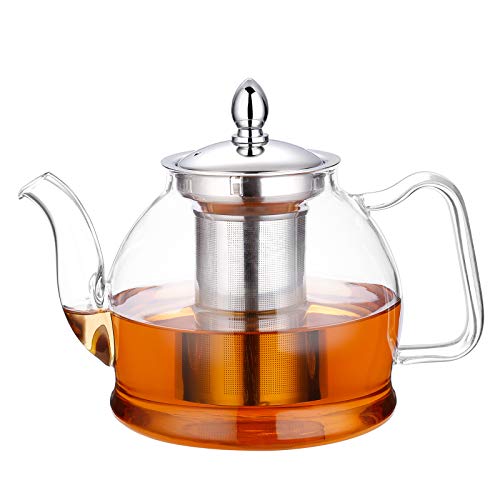
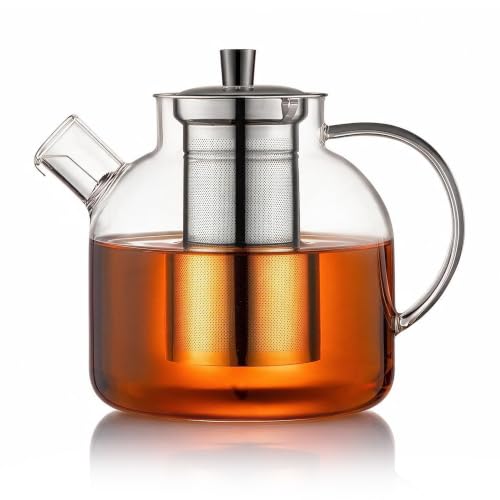
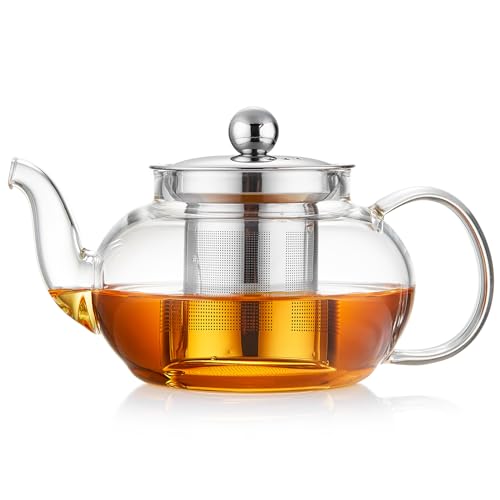
- DOPUDO Small Glass Teapot with Infuser, 18 oz (530ml) — Check on Amazon
- STNTUS Glass Teapot, 40 oz / 1200ml, 4–6 Cups
- Enchanti One Touch Glass Teapot with Infuser, 27 oz / 800ml
- Teabloom Celebration Glass Teapot & Kettle, 27 oz
- CNGLASS Glass Teapot Stovetop Safe with Removable Infuser, 20.3 oz
- DRNKNSTX Enchanted Tea Pot with Tea Infuser, 20 oz
Read the full guide ↓
Shopping for the best teapots for all budgets means refusing two lazy ideas: that the cheapest pot is always the smart buy, and that the most expensive pot brews the best tea. Neither survives contact with how teapots actually work. A teapot is a vessel, an infuser, and a pour — the tea, the water, and your timing do the rest. What money buys in this category is not magic flavour; it is capacity, materials that last, heating flexibility, and small conveniences that decide whether the pot gets used every day or twice a year. This guide maps six glass teapots across the spending tiers so you can put your money on the attributes you will feel, and save on the ones you will not.
Every pick here is glass with an infuser, because glass is the great leveller of the teapot world: at the entry tier it already gives you the two things that matter most — a clear view of the brew and a flavour-neutral vessel — and the tiers above it refine rather than reinvent. Moving up buys you a stovetop rating so the pot can heat its own water, a larger capacity for households and guests, dual straining systems, glass infusers and gift presentation, and mechanisms that simplify the steep. Moving down, honestly assessed, loses none of the core experience for a solo drinker: a small, well-made entry-level pot brews a superb cup for one.
A word on method: we deliberately print no prices in this guide. Marketplace prices for the same pot can differ between sellers and change during sales events, so a printed figure would mislead within weeks. Instead, each review positions its pot in qualitative terms — entry-level, mid-tier, premium-feature — and explains what drives that position. When you are ready, check the latest price on Amazon for the two or three finalists that fit your household, and judge them by cost per brew over the years you will own them. The tier logic here pairs naturally with our broader survey of the Best Teapots For All Tea, which ranks formats by the teas they serve rather than by spend.
Key Takeaways
- Money in glass teapots buys capacity, heating ratings, infuser refinement, and convenience — not fundamentally better flavour.
- The DOPUDO is the entry-level benchmark: a compact borosilicate pot with a steel infuser for individual brewing.
- The STNTUS is the mid-tier workhorse: 1200ml, stovetop safe, with an infuser plus a stainless strainer.
- The Teabloom Celebration tops the feature list among the small pots: stovetop and microwave safe, glass infuser, blooming teas included.
- The CNGLASS is the value stovetop pick at 20.3 oz — a heating rating usually found on larger, dearer pots.
- Judge value by cost per brew over years of use, and check the live listing price only once you have a shortlist.
In this guide
Quick Picks
| Pick | Badge | Capacity | Infuser | Link |
|---|---|---|---|---|
| DOPUDO Small Glass Teapot | Best Entry-Level Value | 18 oz / 530ml | Removable 18/8 steel infuser | Check on Amazon |
| STNTUS Glass Teapot | Best Mid-Tier Workhorse | 40 oz / 1200ml, 4–6 cups | Infuser with stainless steel strainer | Check on Amazon |
| Enchanti Tea Pot | Best Mid-Tier Convenience | 27 oz / 800ml | Infuser, one-touch design | Check on Amazon |
| Teabloom Celebration Teapot | Best Premium-Feature Small Pot | 27 oz | Removable glass infuser | Check on Amazon |
| CNGLASS Glass Teapot | Best Compact Stovetop Value | 20.3 oz | Removable infuser | Check on Amazon |
| DRNKNSTX Enchanted Tea Pot | Best Novelty Gift Steeper | 20 oz | Tea infuser / steeper design | Check on Amazon |
How These Picks Were Chosen
We assembled this list by verifying each pot against its manufacturer’s listing data — capacity, infuser construction, stated heating ratings, and included extras, all checked on 2026-11-20 — and then sorting the verified pots into the tiers their specifications support. A pot’s tier here reflects its feature set, not a guess at its price tag: entry-level pots do one job simply, mid-tier pots add capacity or a heating rating or a second straining system, and the premium-feature pots combine several refinements with presentation touches like included blooming teas and gift packaging.
This is a research-led guide. We did not purchase or bench-test these six pots, and we do not present invented scores. What careful specification reading does reveal is where money genuinely goes in this category. Across dozens of listings, the same pattern repeats: the first step up from basic buys you a stovetop-safe rating and a stainless infuser; the next buys capacity and dual straining; the top of the glass category buys glass infusers, included teas, and mechanisms. Decorative flourishes that do not change the brew exist at every tier, and our reviews name them when they see them.
We also weighted durability of the daily routine over novelty. A pot that rinses in a minute, whose infuser can be replaced or re-seated easily, and whose size matches the household will deliver more good cups per unit of money than a spectacular pot used monthly. That is the standard behind every badge below, and it is the same standard we apply in our technique-first guide to the Best Teapots For Brewing Tea: the best budget is the one spent on the pot you will actually use.
The 6 Best Teapots for All Budgets, Tier by Tier

DOPUDO Small Glass Teapot with Infuser, 18 oz (530ml)
Badge: Best Entry-Level Value
Strengths
- Borosilicate glass body at an entry-tier position, with a removable 18/8 steel infuser that outperforms the plastic strainers found on many basic pots.
- Compact 530ml size purpose-built for individual loose-leaf brewing, so nothing about it is wasted on a solo drinker.
- Simple two-part construction rinses fast and stores anywhere.
Trade-offs
- No stovetop rating in its listing — it is a pour-over brewer, so a kettle does the heating.
- 18 oz serves one properly; it is not a household pot.
- No included extras: no blooming teas, no gift presentation.
Spec box
- Capacity: 18 oz / 530ml
- Material: Borosilicate glass
- Infuser: Removable 18/8 steel infuser
- Format: Compact teapot for individual loose-leaf brewing
- Stovetop: Not stated in the maker listing — treat as pour-over only
The DOPUDO is what a sensible entry-level teapot looks like when the maker spends the budget on the right things. The money here is in the borosilicate body and the stainless infuser — the two components that touch your tea — and not in packaging, mechanisms, or decorative extras. For a solo drinker, that allocation is exactly right: the brew quality from this pot, with good leaves and correct water temperature, is limited by your technique rather than by the vessel. Students, first-time loose-leaf buyers, and anyone furnishing a small kitchen get a pot that teaches the craft honestly, because the clear glass shows every steep and the steel infuser handles fine leaves that would escape a coarser basket.
Where the entry tier shows is in flexibility. There is no stovetop rating, so the pot depends on a kettle; there is no second straining system; and the capacity ceiling is one person’s session. If your household grows or your brewing becomes social, you will outgrow it — but as a first pot, outgrowing it means it did its job.
Best for: Solo drinkers and first loose-leaf pots / Not suited for: Households brewing for several people

STNTUS Glass Teapot, 40 oz / 1200ml, 4–6 Cups
Badge: Best Mid-Tier Workhorse
Strengths
- 1200ml capacity sized by the maker for four to six cups — family scale without entertainer bulk.
- Two straining systems, an infuser basket and a stainless steel strainer, cover contained and free-leaf brewing.
- Stovetop safe, removing the separate-kettle step for households that heat on the stove.
Trade-offs
- Two metal components to wash, dry, and keep together.
- Oversized for one or two drinkers; small households will under-fill it.
- Presentation is functional rather than gift-oriented.
Spec box
- Capacity: 40 oz / 1200ml
- Cup guide: Four to six cups per maker
- Infuser: Infuser basket plus stainless steel strainer
- Stovetop: Described as stovetop safe by the maker
- Tea types named by maker: Loose tea
The mid-tier earns its name when a pot stops being a personal accessory and becomes household infrastructure, and the STNTUS is the clearest example here. The step up from entry level buys three concrete things: family capacity, a stovetop rating, and a second way to strain. Each of those removes a daily friction. Capacity removes the second brew at breakfast. The stovetop rating removes the kettle shuffle in a stove-first kitchen. Dual straining removes the argument between the household member who brews in the basket and the one who brews leaves loose for a stronger cup. Priced as a mid-tier pot in qualitative terms, it is the one most households should shortlist first, because it is the cheapest point in this lineup where nothing essential is missing.
Its costs are the costs of capability: more parts, more washing, more cupboard. A couple who drinks one mug each in the morning will feel the size as bulk rather than benefit, and should look at the Enchanti or Celebration instead.
Best for: Families and households of three to six / Not suited for: Solo drinkers and minimalists

Enchanti One Touch Glass Teapot with Infuser, 27 oz / 800ml
Badge: Best Mid-Tier Convenience
Strengths
- One-touch design mechanises the separation of leaves and liquor, simplifying loose leaf for newer brewers.
- 800ml is the most versatile capacity in this lineup: a large solo pot or a genuine two-person brew.
- Sold as a tea gift set, so presentation is handled if the pot is a present.
Trade-offs
- No stovetop rating in the listing — kettle water only.
- The one-touch mechanism has more surfaces to rinse than a plain basket.
- Convenience features are worth paying for only if you will use them; purists may prefer a basket.
Spec box
- Capacity: 27 oz / 800ml
- Infuser: Infuser included, one-touch design
- Format: Glass teapot and tea maker for loose leaf tea
- Packaging: Tea gift set per maker
- Stovetop: Not stated in the maker listing — treat as pour-over only
The Enchanti represents the other way to spend a mid-tier budget: not on capacity, but on convenience. Its one-touch design handles the fiddliest part of loose-leaf brewing — separating the leaves from the liquor at the right moment — which is precisely the step beginners get wrong and the step that decides whether a cup is clean or stewed. For a buyer moving from tea bags to loose leaf, that assistance is worth more than an extra few hundred millilitres. The 800ml size quietly helps too: it is the only capacity in this group that serves a generous solo session and a two-person tea without compromise in either direction.
Judge the trade honestly. A mechanism is a commitment to rinsing moving parts, and in hard-water homes, to descaling them. If you already brew confidently with a basket infuser, the Enchanti’s premium buys you little; if you are buying for someone who has never brewed loose leaf, it buys them a much shorter learning curve — and that is a legitimate thing to spend money on.
Best for: Beginners, gift buyers, one-to-two person households / Not suited for: Stovetop workflows or large families
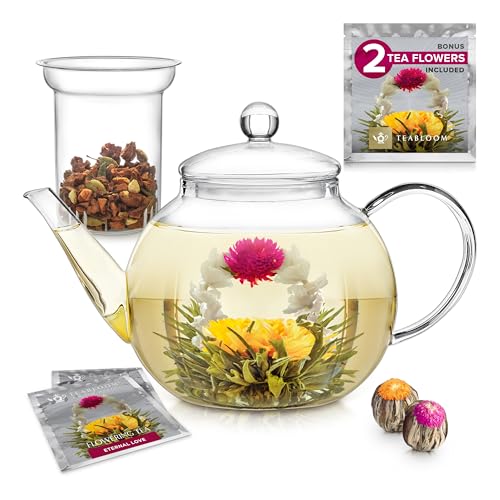
Teabloom Celebration Glass Teapot & Kettle, 27 oz
Badge: Best Premium-Feature Small Pot
Strengths
- The fullest feature set among the compact pots: stovetop and microwave safe, heat-resistant glass, removable glass infuser.
- Handles loose leaf, bagged, and blooming tea, with two blooming teas included to start.
- A kettle-and-teapot in one, which returns its cost in saved bench space for small kitchens.
Trade-offs
- Premium-feature positioning means it asks more of the budget than simpler pots of the same size.
- The glass infuser is delicate and prefers careful owners.
- 27 oz remains a one-to-two person capacity, whatever the feature list.
Spec box
- Capacity: 27 oz
- Infuser: Removable glass infuser
- Stovetop: Stovetop and microwave safe per maker
- Material: Heat-resistant glass
- Included: 2 blooming teas
- Tea types named by maker: Loose leaf, bagged, and blooming
The Celebration shows what the top of the small-pot category looks like when a maker refuses to cut corners. Every line of its specification answers a limitation found elsewhere in this guide: the DOPUDO cannot heat water, and this can — two ways. Basic pots exclude blooming tea presentation, and this includes the teas themselves. Steel infusers interrupt the all-glass view, and this uses glass. Whether that completeness is worth its premium position depends entirely on whether you will use the features. A renter whose next home may have a microwave but no stove, a gift buyer who wants one box to contain the whole experience, or a small-kitchen owner deleting a separate kettle from the bench — all of them get real value here. A confident brewer with a kettle they love gets less, and should let the CNGLASS or DOPUDO carry the budget further.
One caution belongs to the glass infuser: it is the component that separates careful households from careless ones. If the pot will live in a busy shared sink, its premium features will not protect its most fragile part.
Best for: Feature seekers, small kitchens, complete-package gifts / Not suited for: Rough shared use or group brewing

CNGLASS Glass Teapot Stovetop Safe with Removable Infuser, 20.3 oz
Badge: Best Compact Stovetop Value
Strengths
- Stovetop-safe rating at a compact 20.3 oz size — heating flexibility that usually arrives on larger, higher-tier pots.
- Removable infuser covers loose leaf and blooming tea, the two formats glass does best.
- Simple, unfussy construction keeps the tier position honest: you pay for the rating and the glass, not for decoration.
Trade-offs
- 20.3 oz is a one-to-two person pot; groups need a second brew.
- No included extras or gift presentation.
- Single straining system — no backup strainer for free-leaf brewing.
Spec box
- Capacity: 20.3 oz
- Infuser: Removable infuser
- Stovetop: Described as stovetop safe by the maker
- Tea types named by maker: Loose leaf and blooming tea
The CNGLASS is the value hunter’s pot in this lineup, and its value is specific: it delivers a stovetop rating — the single most useful upgrade in the glass category — at a compact size and a modest tier position. For a solo drinker or a couple in a small flat, that combination means one vessel heats the water on the stove and brews the tea, the kettle stays in the cupboard, and the budget is not stretched to family capacity that will never be used. Value, properly understood, is paying for exactly the features your household touches daily, and for stove-first small households the CNGLASS is the most precisely aimed pot here. Readers whose kitchens run on electric elements rather than gas will find the compatibility discussion in our guide to the Best Teapots For Boiling Water a useful companion, since it covers heating glass safely in depth.
The limits are scale and spareness. There is no second strainer, no included tea, no gift box — the budget went to the glass and its rating. Buyers who entertain should step up to the STNTUS; buyers who want the full ceremony should look at the Celebration.
Best for: Stove-first solo drinkers and couples watching spend / Not suited for: Entertaining or gift presentation

DRNKNSTX Enchanted Tea Pot with Tea Infuser, 20 oz
Badge: Best Novelty Gift Steeper
Strengths
- A steeper-style design presented as an enchanted, giftable piece — the most characterful object in this lineup.
- 20 oz capacity suits personal loose-leaf sessions and dessert teas for two.
- Glass body keeps the brew visible, preserving the main pleasure of the category.
Trade-offs
- No stovetop rating in its listing — it steeps with water heated elsewhere.
- Novelty presentation is the point of the spend; purely practical buyers get more from the CNGLASS at a similar size.
- Steeper formats reward prompt serving; they are not keep-warm pots.
Spec box
- Capacity: 20 oz
- Infuser: Tea infuser / steeper design for loose leaf
- Format: Glass tea maker and steeper, gift-oriented presentation
- Stovetop: Not stated in the maker listing — treat as pour-over only
Every budget guide needs one pick that exists for joy rather than efficiency, and the DRNKNSTX is ours. Marketed as an enchanted tea pot and an ideal gift for tea lovers, it is a 20 oz glass steeper that turns a personal brew into a small performance. Judged as a gift — for the friend who collects whimsical kitchen pieces, the young tea drinker being encouraged into loose leaf, the hostess present that will actually be used — its novelty is not a surcharge but the product itself. Judged as a daily workhorse, it asks you to accept pour-over-only heating and a presentation-first design at a size where the CNGLASS offers a stovetop rating instead.
That is the honest budget question this pot poses: are you buying an appliance or an experience? Both are legitimate purchases. Confusing one for the other is the only real mistake, and it is the mistake this guide exists to prevent.
Best for: Gifts, whimsical kitchens, personal steeper sessions / Not suited for: Buyers wanting stovetop heating or maximum practicality per spend
Comparison Table
| Teapot | Tier position | Capacity | Heating | What the money buys | Link |
|---|---|---|---|---|---|
| DOPUDO | Entry-level | 530ml | Pour-over | Borosilicate body, steel infuser, nothing wasted | Check on Amazon |
| STNTUS | Mid-tier | 1200ml | Stovetop safe | Family capacity plus dual straining | Check on Amazon |
| Enchanti | Mid-tier | 800ml | Pour-over | One-touch convenience, gift set | Check on Amazon |
| Teabloom Celebration | Premium-feature | 27 oz | Stovetop + microwave | Full feature set, glass infuser, teas included | Check on Amazon |
| CNGLASS | Value | 20.3 oz | Stovetop safe | The heating rating without the bulk | Check on Amazon |
| DRNKNSTX | Novelty / gift | 20 oz | Pour-over | Character and gift appeal | Check on Amazon |
How to Choose a Teapot on Any Budget: Where Money Matters and Where It Does Not
Pay for the heating rating if your kitchen workflow needs it. A stovetop-safe pot replaces a kettle step every single day, and features used daily repay their tier quickly. If you already own and love a kettle, the rating is worth little to you — bank the saving and buy a pour-over pot. This single decision sorts most buyers: stove-first households should shortlist the STNTUS, CNGLASS, and Celebration; kettle households can consider all six.
Pay for capacity only to your real headcount. Capacity is the most over-bought attribute in the category, because buyers shop for the dinner party and live with the Tuesday. Count your daily drinkers, multiply by your mug size, and buy the pot that matches, with one size of headroom at most. The money saved by not oversizing is better spent on the infuser quality or the heating rating you will feel every morning. Households that genuinely serve groups — the Best Teapots For Cafe Use end of the spectrum — should invert the rule and buy for the group, because a second brew mid-service costs more goodwill than the larger pot costs money.
Pay for infuser quality; it touches every cup. A fine stainless mesh keeps small leaves out of the liquor and rinses clean for years; it is the quiet reason the entry-level DOPUDO punches above its tier. Glass infusers buy beauty and flavour purity at the price of fragility. One-touch mechanisms buy forgiveness for beginners. There is no wrong answer, only mismatches: fine-leaf drinkers need mesh, blooming-tea drinkers want glass, new brewers benefit from mechanisms.
Do not pay for printed promises. Skip pots whose listings lean on decorative claims while omitting the basics — capacity in clear units, the infuser material, an explicit heating rating. Every pot in this guide states those basics in its listing, which is itself a quality signal worth weighting. And whatever tier you choose, judge it by cost per brew: a pot used daily for three years delivers thousands of brews, so the difference between tiers shrinks to almost nothing per cup, while the difference between a pot you use and a pot you avoid is infinite.
Time your purchase, but do not obsess. Marketplace prices for kitchenware dip around major sales events and rise in gift seasons. If your need is not urgent, watching a shortlist through one sales cycle is reasonable; if your old pot cracked this morning, the best budget decision is the right pot today. Either way, compare the finalists’ live prices at the moment of purchase rather than trusting any figure printed anywhere — including, deliberately, this guide.
How to Brew Well at Every Price Point
The technique that costs nothing. Warm the pot with a swirl of hot water before brewing; cold glass steals the first degrees of heat and can stress the vessel. Use fresh water, and bring it to the right temperature for the leaf: just off the boil for black tea, rested a couple of minutes for green and white teas, which turn bitter in boiling water. Dose roughly a teaspoon of loose leaf per 250ml, steep with the lid on, and remove the infuser the moment the timer ends. Those four habits — warm pot, right temperature, measured leaf, timed steep — improve a cup from an entry-level pot more than any upgrade on this page.
Steeping by tier. In basket-infuser pots (DOPUDO, STNTUS, CNGLASS), lift the basket onto a small dish between pours so the leaves stop extracting. In one-touch and steeper designs (Enchanti, DRNKNSTX), serve promptly once the mechanism has separated the liquor, since these formats are built for immediate drinking. In glass-infuser pots (Celebration), pour gently and completely; the wider slots mean a slow, steady pour keeps stray leaves in the pot where they belong.
Care that protects the investment. Rinse infusers immediately, wash glass with a soft sponge, and descale with a citric-acid soak when a white film appears — hard-water households will see it within weeks, and it is cosmetic, not damage. Never move a hot pot onto a cold stone bench or under a cold tap; thermal shock, not age, is what ends glass pots. Store with the infuser inside and the lid seated, on a shelf at hand height or lower.
Troubleshooting.
- Problem: The tea tastes weak no matter the pot → what to do: check the leaf dose and water temperature before blaming the vessel; under-dosed leaf and under-heated water cause most weak cups, and both are free to fix.
- Problem: Bitterness in the second cup → what to do: the leaves kept steeping. Remove the infuser at the timer, or decant the finished brew into a second warmed vessel for serving.
- Problem: The pot looks cloudy despite washing → what to do: that is limescale film. Soak with citric acid solution for an hour, rinse well, and repeat on a schedule matched to your water hardness.
- Problem: A burning smell when a stovetop pot is used → what to do: something is on the element or the pot boiled dry. Switch off, let everything cool, clean the base and the burner, and never leave a heating pot unattended.
What Each Tier Feels Like After a Year of Use
Specifications describe the first week; ownership is the next few years. Entry-level pots like the DOPUDO tend to become invisible in the best way — a daily tool with no ceremony, rinsed and refilled without thought, and their owners typically report that the pot stopped feeling basic once their technique improved. Mid-tier pots like the STNTUS and Enchanti become household fixtures with a social role: the breakfast pot, the guest pot, the pot a partner asks for by name. Premium-feature pots like the Celebration earn their keep in moments rather than routines — the blooming tea for a visitor, the microwave reheating in a bedsit, the stove brew in a holiday rental — and owners value them precisely because those moments keep arriving. Novelty pots like the DRNKNSTX live or die by affection: used weekly by someone who smiles at it, it is a bargain at any tier; bought for someone else’s taste, it is cupboard art. The budget question is never really about the pot. It is about which of those years you are buying.
Tier-by-Tier Buying Scenarios: Matching Real Households to Real Pots
Abstract tiers become decisions when you attach them to households. Consider a graduate in a first studio flat, brewing alone on weekday mornings: the DOPUDO is not a compromise but the correct pot, because every feature it omits — capacity, stovetop rating, second strainer — is a feature that household would never touch, and the money not spent goes to rent, books, and better tea. Consider a family of four in a stove-first kitchen: the STNTUS replaces both a kettle step and a second morning brew, so its mid-tier position is repaid in minutes every single day, and within a school term it has saved more time than the family’s last appliance purchase. Consider a couple who host a monthly tea afternoon: the Celebration’s included blooming teas and glass infuser turn that afternoon into an occasion, and a feature used twelve times a year with delight is better value than a feature used daily with indifference. Consider finally the office manager buying for a shared kitchen: the right question is not which pot is finest but which pot survives — and the answer is the one with the steel infuser, the simple construction, and the size that means it is never carried brim-full across a crowded room, which in this lineup points back to the STNTUS or the CNGLASS depending on headcount.
A fifth scenario deserves mention because it is the most common of all: the replacement buyer, whose old pot has cracked and who needs tea tomorrow morning. Replacement buyers are the most vulnerable to panic tiers — either grabbing the cheapest pot in frustration or overspending to make the problem feel solved. The discipline that helps is to replace by role: buy the pot that fills the old pot’s job, at the tier the old pot’s life justified. If the cracked pot served daily for years, its replacement has earned a mid-tier successor; if it died young and barely used, the honest conclusion is that the household needs a smaller, simpler pot, and the budget should follow that conclusion rather than sentiment.
The pattern across all four scenarios is the same: the best budget decision is a matching decision. Money spent aligning a pot to a household’s size, stove, and habits returns itself; money spent on specifications beyond the household’s life is decoration. That is why this guide refuses to crown a single winner across tiers and instead assigns each pot the household where its price — whatever the listing says today — is most honestly earned.
The Hidden Costs and Savings of Owning a Glass Teapot
The purchase price is the smallest number in teapot ownership. The real ledger includes the consumables and habits around the pot. On the cost side: loose-leaf tea itself, which rewards buying in moderate quantities from a supplier you trust rather than in bulk that stales; descaling supplies, which amount to a pantry staple like citric acid a few times a year; and the replacement risk that comes with glass, which careful handling reduces to near zero but never quite reaches it. On the saving side: a home-brewed pot replaces café-bought tea at a fraction of the running cost, a durable pot ends the cycle of replacing flimsy brewers, and a pot that makes tea you genuinely enjoy displaces other, dearer habits — the afternoon café run, the bottled iced tea, the second coffee that was really a break in disguise.
There is also a saving hidden in the infuser. Households that brew loose leaf in a proper infuser pot stop buying disposable filter papers and single-use pods, and the leaves themselves can often be steeped twice — green teas and oolongs especially — which halves the effective cost of the most expensive ingredient in the cup. None of these numbers appears on a product listing, and all of them matter more to a yearly budget than the difference between adjacent tiers. Buy the pot that fits, brew leaves worth re-steeping, and the economics of tea at home take care of themselves.
When to Buy Once and When to Buy in Stages
Some households should buy their final pot immediately; others are better served by staging. Buy once when your household is stable — settled headcount, settled kitchen, settled habits — because the mid-tier pot you choose will serve for years and the staging saving is an illusion. The STNTUS household and the Celebration household are both buy-once households: their needs are known, and the right pot today beats a placeholder pot plus the right pot later. Buy in stages when your life is in motion: the student who will move from dorm to share house to first flat should start with the DOPUDO, which will remain useful as a desk pot forever, and add a household pot only when a household exists. The staged buyer spends more across the decade but never owns a wrong pot, while the buy-once buyer spends less and risks one confident mistake. Neither strategy is superior in the abstract; the honest question is whether your next three years look like your last three. If they do, buy the final pot. If they do not, buy the pot for the life you have and let the future buy its own.
Common Buying Mistakes
- Chasing a printed price instead of a tier. Prices move; roles do not. Choose the pot by what it does, then check its live price once.
- Oversizing for imaginary guests. The daily pot should fit daily drinkers; brew twice for the rare crowd.
- Paying for features your kitchen cannot use. A stovetop rating is worthless in a kettle-only dorm; a microwave rating is gold in one. Match features to your actual appliances, as our guide to the Best Teapots For Gas Stove explores for flame-cooking households.
- Assuming price equals flavour. Leaf quality, water, and timing decide the cup; the pot’s job is to not get in their way.
- Ignoring the infuser. It is the component you will handle and clean most; a poor one taxes every brew for years.
Final Recommendation
If your budget has one pot in it, make it the STNTUS 1200ml if you brew for a household, or the DOPUDO 530ml if you brew for yourself: those two cover the most daily life per tier step in this guide. Stove-first small households should take the CNGLASS and its compact stovetop rating; beginners and gift buyers, the Enchanti; feature completists and small kitchens, the Teabloom Celebration; and anyone buying a smile, the DRNKNSTX. Whichever tier you land on, confirm the live price on the listing, remember that cost per brew over years is the only honest metric, and spend the difference on better leaves — that is where flavour actually lives. A well-matched pot and a tin of good leaf will outperform a mismatched premium pot and tired leaf every single morning of the year, and that, in the end, is the whole philosophy of buying teapots on a budget: fund the cup, not the cupboard.
Frequently Asked Questions
Why does this guide not list prices?
Because marketplace prices for the same teapot change with sellers, sales events, and seasons, and a printed figure would be wrong more often than right. We position each pot by tier and explain what drives that position; you check the live price on the listing at the moment you buy, which is the only price that matters.
Is a more expensive glass teapot actually better?
It is more capable, not magically better-tasting. Higher tiers buy capacity, stovetop or microwave ratings, dual straining, glass infusers, mechanisms, and included extras. If you use those features daily, they are worth it; if not, an entry-level pot with good leaves and good technique brews an equally enjoyable cup.
What is the single best upgrade to spend on?
For most buyers, the stovetop-safe rating, because it changes the daily workflow by removing a vessel from the process. For beginners, a forgiving infuser design — fine mesh or a one-touch mechanism — repays its cost in successful early brews. For group households, capacity is the upgrade that matters.
How long should a glass teapot last?
Years, if it is handled like glass: no thermal shocks, no boiling dry, no abrasive scouring, and storage out of traffic. The infuser is the wear item; steel ones last longest, glass ones need the gentlest handling. A pot retired by a crack has usually met a temperature extreme, not old age.
Should I buy one versatile pot or two specialised ones?
One versatile pot suits most households: a mid-size with a good infuser covers solo and social brewing adequately. Two pots make sense when your life genuinely splits — a personal desk pot plus a family pot, for example — because each then gets used at its proper fill level, which brews better tea than one compromise size.
Are gift-set teapots worth it?
When the recipient will use the extras, yes. Included blooming teas and presentable packaging — as with the Teabloom Celebration and the Enchanti gift set — remove the need for a second purchase and make the first brew an occasion. For your own kitchen, the same money usually goes further on a plain pot and better leaves.
How can I tell which tier a teapot belongs to without seeing its price?
Read its specification for the tier markers: a basic pot states a capacity and an infuser and little else; a mid-tier pot adds a heating rating, a second straining system, or a family capacity; a premium-feature pot combines several of those with presentation extras like a glass infuser or included teas. If a listing cannot tell you its infuser material and heating rating, treat it as below entry level whatever it costs.
Does buying during a sale change which pot I should choose?
It can move a pot between your personal tiers, which is exactly why this guide sorts by features rather than figures. Decide your shortlist by role first — size, heating, infuser — then let the live prices on the day reorder them. A feature-rich pot on promotion may be the rational buy; a basic pot at full price may not be. Never let a discount talk you into the wrong capacity.
What is the cheapest acceptable teapot in this guide?
The DOPUDO, in tier terms: it is the entry-level pick, and it is acceptable in the ways that matter — borosilicate body, stainless infuser, honest capacity. Cheaper constructions with plastic strainers or unstated materials ask you to compromise the parts that touch the tea, which is the wrong place to save. The floor of the category is not a number; it is the point below which the materials stop being trustworthy, and this pot sits just above that floor, which is exactly where a budget pick should sit.