Disclosure: topratedkitchenware.com is reader-supported. When you buy through links on our site, we may earn an affiliate commission from Amazon and other retailers, at no extra cost to you.
Where to buy
The six glass teapots below are the models we would shortlist as the best teapots for cafe use across cafés, tea houses, bed-and-breakfasts, and small hospitality service. All are sold through Amazon, which makes equipping or replacing a service set straightforward. Café buyers should order with breakage in mind — glass in commercial service lives a harder life than glass at home — and confirm each pot’s capacity and infuser type on the listing before building a set around it.
- Ehugos 1500ml (50 oz) Glass Teapot with Removable Infuser — Check on Amazon
- Teabloom Stovetop & Microwave Safe Glass Teapot (40 oz)
- DOPUDO Small Glass Teapot with Infuser, 18 oz (530ml)
- STNTUS Glass Teapot, 40 oz / 1200ml, 4–6 Cups
- Enchanti One Touch Glass Teapot with Infuser, 27 oz / 800ml
- Teabloom Celebration Glass Teapot & Kettle, 27 oz
Read the full guide ↓
The best teapots for cafe use are judged by a harsher standard than home pots, because café service is a system, not a ritual. A café pot must brew consistently when the person making it changes every shift, survive being washed dozens of times a week, present beautifully enough to justify a menu price, and be replaceable the week it breaks — because in commercial service, the question is never whether glass breaks, but how the operation absorbs it. The six pots in this guide are the glass models whose specifications suit that system: capacities that map to table sizes, removable infusers that let staff stop a steep precisely during a rush, and formats available through a supply channel any small operator can reorder from without a wholesaler account.
Let us be honest about the material at the outset. Glass is not the durability champion of commercial service; stainless steel and heavy ceramic outlast it, and a high-volume diner should choose those. Glass wins where the tea itself is the product — boutique cafés, tea houses, afternoon-tea services, B&Bs, and cafés whose loose-leaf menu is a point of difference. In those rooms, a clear pot on the table does marketing work no menu description can: the guest watches the leaves open, sees the colour, and understands what they paid for. Every pick below is glass with an infuser for exactly that reason, verified against manufacturer listings on 2026-11-20, and the reviews are written from the operator’s side of the counter — throughput, consistency, washing, and replacement — rather than the home brewer’s.
The set divides by service role. The Ehugos at 1500ml and the STNTUS at 1200ml are the table-service pots, sized for shared rounds. The Teabloom models are the presentation pots, built around blooming tea and visual ceremony. The Enchanti’s one-touch design is the consistency pot, forgiving of rotating staff. And the DOPUDO, at 530ml, is the single-guest premium pot — the one that lets a café sell a personal pot of a fine tea at a fine-tea price. Operators building a broader drinks programme will find the heating discussion in our Best Teapots For Electric Stove guide relevant, since most café back-bars heat water electrically even when the pots themselves are stovetop rated.
Key Takeaways
- Café teapots are a system purchase: consistency across staff, washability, presentation, and replaceability matter as much as the brew.
- The STNTUS 1200ml is the café workhorse: four-to-six-cup capacity, dual straining, stovetop safe.
- The Ehugos 1500ml serves a full table from one extraction, keeping every cup consistent.
- The Teabloom pots own the presentation tier — blooming teas that sell the menu’s premium line at the table.
- The DOPUDO enables single-guest premium service: one guest, one personal pot, one higher margin.
- Glass suits boutique and tea-focused service; plan a breakage budget and keep spare infusers and a backup pot.
In this guide
Quick Picks
| Pick | Badge | Capacity | Infuser | Link |
|---|---|---|---|---|
| Ehugos Glass Teapot | Best for Table Service Volume | 1500ml / 50 oz | Removable stainless infuser | Check on Amazon |
| Teabloom Glass Teapot | Best for Blooming Tea Presentation | 40 oz | Removable glass infuser | Check on Amazon |
| DOPUDO Small Glass Teapot | Best for Single-Guest Premium Service | 18 oz / 530ml | Removable 18/8 steel infuser | Check on Amazon |
| STNTUS Glass Teapot | Best Café Workhorse | 40 oz / 1200ml, 4–6 cups | Infuser with stainless steel strainer | Check on Amazon |
| Enchanti Tea Pot | Best for Staff-Proof Consistency | 27 oz / 800ml | Infuser, one-touch design | Check on Amazon |
| Teabloom Celebration Teapot | Best for Small-Café Flexibility | 27 oz | Removable glass infuser | Check on Amazon |
How These Picks Were Chosen
We selected these pots by reading their verified manufacturer specifications — capacity, infuser construction, heating ratings, and included components, all checked on 2026-11-20 — through an operator’s lens. A pot qualified for café consideration if its capacity mapped to a real service unit (a guest, a couple, a table), its infuser could be removed and rinsed quickly during service, and its format could be reordered identically when — not if — a replacement was needed. Presentation value counted, because in tea-led venues the pot is part of the product; so did the number of separate components, because every loose part in a commercial wash area is a part that will eventually be lost.
This is a research-led guide, not a trial in a working café, and we make no claim to have run these pots through a service season. What specification analysis can do reliably is match mechanics to service patterns: dual straining for venues that brew both basket and free-leaf styles, steel infusers where the wash cycle is relentless, glass infusers where the visual product justifies gentler handling. We have also been frank about the category’s limit — none of these pots is the right answer for a venue whose tea service is an afterthought at diner volumes — because a guide that recommends glass everywhere recommends it nowhere credibly.
Operators should read the badges as staffing decisions. The workhorse badge means “any trained team member can run this pot on a busy Saturday.” The presentation badges mean “this pot earns its fragility back at the table.” The single-guest badge means “this pot is a menu item, not a vessel.” Chosen with those meanings in mind, a set of these pots covers the realistic range of tea-led service, from the solo premium drinker to the six-top afternoon tea.
The 6 Best Teapots for Cafe Use

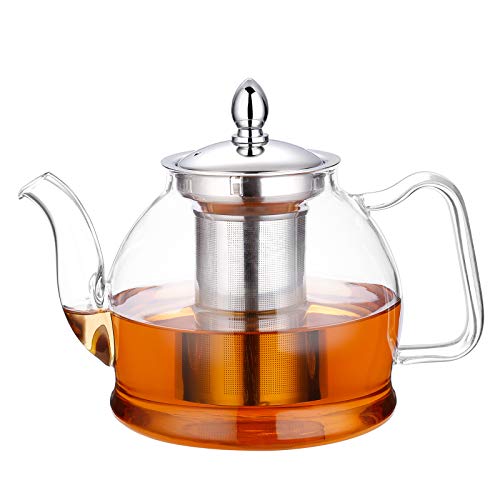
Ehugos 1500ml (50 oz) Glass Teapot with Removable Infuser
Badge: Best for Table Service Volume
Strengths
- 1500ml brews one extraction for a full table, so a shared pot is consistent from first cup to last.
- Stovetop safe with a removable stainless infuser — back-bar can heat and brew in the same vessel.
- Wide hand-crafted body is a genuine table centrepiece for blooming and large-leaf teas.
Trade-offs
- The heaviest pour in the set when full; staff need a two-handed service technique.
- One dropped pot is a bigger loss than a small one; keep a backup in the cupboard.
- Oversized for the many café orders that are a single cup.
Spec box
- Capacity: 1500ml / 50 oz
- Material: Glass, hand crafted
- Infuser: Removable stainless infuser
- Stovetop: Described as stovetop safe by the maker
- Tea types named by maker: Blooming and loose leaf
Afternoon tea and group service live or die on the shared pot, and the Ehugos is the shared pot of this set. A table that orders “a pot for the table” expects one tea, brewed once, tasting the same in every cup — and a 1500ml single extraction delivers exactly that, where two successive smaller brews would deliver two near-misses. The stovetop rating streamlines the back-bar: water heats in the service vessel, the infuser goes in, the timer runs, and the pot walks to the table with nothing decanted and nothing lost. Its wide body doubles as the blooming-tea stage for premium tables, which lets one SKU cover both the standard group round and the celebration order.
The operational cautions are weight and consequence. Train the pour — two hands, lid supported, tray for the carry — and hold a spare, because a venue that sells table pots cannot 86 the menu line while a replacement ships. Managed that way, the Ehugos is the revenue pot of the group: it is the one that turns tea into an occasion a table pays for together.
Best for: Afternoon tea and group table service / Not suited for: High-turnover single-cup counters

Teabloom Stovetop & Microwave Safe Glass Teapot (40 oz)
Badge: Best for Blooming Tea Presentation
Strengths
- Purpose-built for blooming teas, with two included — the highest-presentation format in café tea service.
- Stovetop and microwave safe, and functions as a 2-in-1 kettle and tea maker at the back bar.
- Removable glass infuser preserves the all-glass theatre guests are paying for.
Trade-offs
- The glass infuser is the most fragile component in this entire guide; commercial washing must be gentle and separate.
- 40 oz serves a couple or a small table, not a full one.
- Blooming tea stock is a specialty line the venue must keep sourcing.
Spec box
- Capacity: 40 oz
- Infuser: Removable loose tea glass infuser
- Stovetop: Stovetop and microwave safe per maker
- Included: 2 blooming teas
- Format: 2-in-1 tea kettle and tea maker
Every tea-led menu needs a signature, and the Teabloom is the signature pot. A blooming tea served in clear glass is the one item on a drinks menu that photographs itself, gets described to friends, and justifies a premium line without a word of copy. The pot’s theatre is its consistency: the flower opens at the table, in front of the guest, identically on a Tuesday or a Saturday, whoever is on shift. The dual heating rating helps the back bar more than guests will ever know — water can be brought up on the stove or in the microwave during a rush, in the service vessel itself. For venues whose identity is the tea, this pot is not an accessory; it is the brand, in glass.
The fragility ledger must be kept honestly. Glass infusers and commercial dish pits are natural enemies, so this pot gets hand-washed, stored on its own shelf, and backed up by a spare. Venues unwilling to grant that care should sell their blooming teas in the Ehugos instead and accept a steel infuser in the frame.
Best for: Tea houses and signature blooming-tea service / Not suited for: Rough, high-volume wash cycles


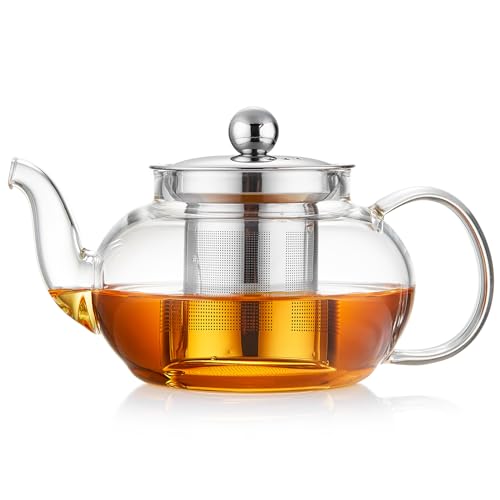
DOPUDO Small Glass Teapot with Infuser, 18 oz (530ml)
Badge: Best for Single-Guest Premium Service
Strengths
- 530ml personal format turns a single fine tea into a pot service — the format premium pricing is built on.
- Borosilicate body with a durable 18/8 steel infuser that tolerates constant washing better than glass infusers.
- Small footprint: a row of them fits a back bar shelf where family-size pots cannot.
Trade-offs
- No stovetop claim — back bar heats water separately, which most cafés do anyway.
- Strictly one guest per pot; it cannot flex up to a couple.
- Small pots cool faster; service should be prompt once brewed.
Spec box
- Capacity: 18 oz / 530ml
- Material: Borosilicate glass
- Infuser: Removable 18/8 steel infuser
- Format: Compact teapot for individual loose-leaf brewing
- Stovetop: Not stated in the maker listing — treat as pour-over only
The DOPUDO is the margin pot. A café’s finest teas — the ones with real per-cup economics — are usually drunk by one guest at a time, and serving that guest a personal glass pot instead of a mug transforms the transaction: the guest controls the pour, watches the colour, re-steeps if the format allows, and perceives the premium as an experience rather than a surcharge. Operationally the pot is kindly: steel infuser for the wash cycle, a size that brews in minutes and rinses in seconds, and a footprint that lets a small venue hold a working set of six on one shelf. Its pour-over nature is no handicap in a café, where a boiler or kettle station already anchors the back bar — and venues weighing their water-heating setup will find our Best Teapots For Gas Stove and electric companions useful on the back-bar side of the decision.
Its discipline is inventory: a personal-pot programme needs enough units for the lunch rush plus the wash cycle, and a venue that buys two will spend service apologising. Buy the set, not the sample.
Best for: Premium single-guest tea service / Not suited for: Couples or tables

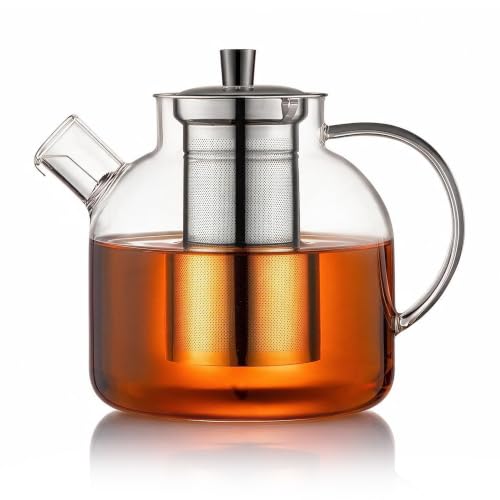
STNTUS Glass Teapot, 40 oz / 1200ml, 4–6 Cups
Badge: Best Café Workhorse
Strengths
- 1200ml capacity sized by the maker for four to six cups — the standard café table round.
- Infuser basket plus a stainless steel strainer covers house blends brewed either contained or free-leaf.
- Stovetop safe, keeping the heat-and-brew workflow on one vessel at the back bar.
Trade-offs
- Two metal components per pot multiply across a set; assign storage or lose strainers.
- Less theatrical than the Teabloom models; it is infrastructure, not a signature.
- Glass still demands a breakage allowance in the budget.
Spec box
- Capacity: 40 oz / 1200ml
- Cup guide: Four to six cups per maker
- Infuser: Infuser basket plus stainless steel strainer
- Stovetop: Described as stovetop safe by the maker
- Tea types named by maker: Loose tea
If a café could only run one pot from this list at volume, it would run the STNTUS. The capacity is the industry-shaped one — a table round without a second brew — and the dual straining is the quiet operational win: house blends can be brewed in the basket during the rush for speed and cleanliness, and free-leaf for the afternoon-tea service where the fuller extraction is the point, all from the same fleet of pots. Consistency is what a workhorse is for, and a pot that brews identically in any trained hands, washes without ceremony, and reorders identically when one breaks is the definition of café infrastructure. It will never be the pot in the Instagram post; it will be the pot in the background of ten thousand satisfactory services, which is the better job.
Manage the parts. A strainer per pot, stored inside its pot, checked at close — the venue that builds that habit keeps the dual system; the venue that does not ends up with a basket-only fleet and a drawer of orphans.
Best for: Core café table service / Not suited for: Signature presentation lines

Enchanti One Touch Glass Teapot with Infuser, 27 oz / 800ml
Badge: Best for Staff-Proof Consistency
Strengths
- One-touch design separates leaves from liquor mechanically, removing the steep-timing error that varies most between staff.
- 800ml suits the café’s most common order: tea for one serious drinker or two light ones.
- Gift-set presentation doubles as retail stock for the café’s shelf.
Trade-offs
- No stovetop claim in the listing — kettle or boiler water only.
- The mechanism needs a thorough rinse protocol or residue builds where guests cannot see but can taste.
- Not a table-round size; groups still need the STNTUS or Ehugos.
Spec box
- Capacity: 27 oz / 800ml
- Infuser: Infuser included, one-touch design
- Format: Glass teapot and tea maker for loose leaf tea
- Packaging: Tea gift set per maker
- Stovetop: Not stated in the maker listing — treat as pour-over only
Ask café owners what varies most between their best and worst cups and the answer is rarely the leaf; it is the steep, drifting with whoever is busiest. The Enchanti attacks exactly that variance. Its one-touch separation turns “stop the extraction” from a judgement call into a mechanism, so a new hire’s pot lands much closer to the trainer’s pot than freehand infuser work allows. At 800ml it also matches the modal café order — the solo worker with a laptop, the couple sharing — which means the consistency lands where the volume is. And because it arrives as a gift set, the same unit can sit on the retail shelf, letting guests buy the pot their tea came in: a small, real revenue line that costs the venue nothing but shelf space.
The protocol cost is cleaning. Mechanisms in commercial service need a written rinse-and-soak routine, owned by the closing shift, or the convenience curdles into a hygiene risk. Venues with that discipline get the most consistent small-pot service in this guide; venues without it should choose the DOPUDO’s simplicity.
Best for: Cafés with rotating staff and a retail shelf / Not suited for: Venues without a cleaning protocol
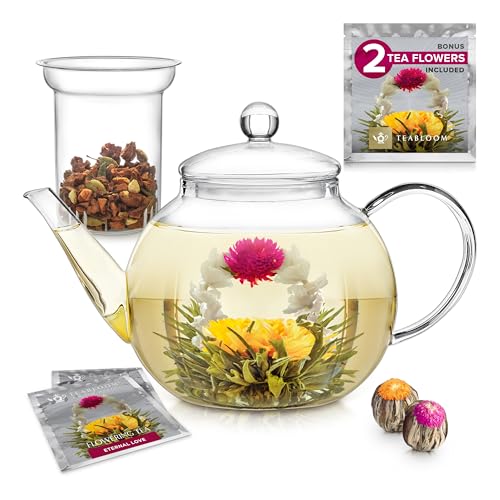
Teabloom Celebration Glass Teapot & Kettle, 27 oz
Badge: Best for Small-Café Flexibility
Strengths
- Stovetop and microwave safe — the only small pot here that can heat water by either route in a compact back bar.
- Handles loose leaf, bagged, and blooming tea per its maker, so one unit covers a small venue’s whole menu.
- Includes two blooming teas, letting a new venue test its premium line immediately.
Trade-offs
- Glass infuser needs gentle, separate washing in a commercial setting.
- 27 oz is a one-to-two guest format; it cannot carry a table round.
- Flexibility costs more per unit than a single-purpose pot of the same size.
Spec box
- Capacity: 27 oz
- Infuser: Removable glass infuser
- Stovetop: Stovetop and microwave safe per maker
- Material: Heat-resistant glass
- Included: 2 blooming teas
- Tea types named by maker: Loose leaf, bagged, and blooming
Small cafés live on flexibility, and the Celebration is the flexible unit of this set. A venue with six tables and one back-bar corner cannot stock a specialist for every line on the menu; it needs a pot that heats water on the stove during prep, reheats in the microwave during service, brews the house loose leaf at noon, a bagged tea for the guest who asks, and a blooming tea for the couple celebrating something. The Celebration’s specification is the only one here that names all of that in a single 27 oz unit. For B&Bs and guesthouses — where breakfast tea service is intimate, varied, and run by one person — it may be the single most practical pot in this guide.
Its ceiling is scale, plainly. Two guests per brew means a full small café still needs the STNTUS class for rounds, and the glass infuser asks the same gentle handling as its larger Teabloom sibling. As the flexible second pot in a small venue’s fleet, it has no rival here.
Best for: Small cafés, B&Bs, guesthouses / Not suited for: Table rounds or rough washing
Comparison Table
| Teapot | Capacity | Infuser | Heating | Café role | Link |
|---|---|---|---|---|---|
| Ehugos | 1500ml | Stainless infuser | Stovetop safe | Table rounds, afternoon tea | Check on Amazon |
| Teabloom | 40 oz | Glass infuser | Stovetop + microwave | Signature blooming service | Check on Amazon |
| DOPUDO | 530ml | 18/8 steel infuser | Pour-over | Single-guest premium | Check on Amazon |
| STNTUS | 1200ml | Infuser + strainer | Stovetop safe | Core workhorse | Check on Amazon |
| Enchanti | 800ml | One-touch infuser | Pour-over | Consistency, retail | Check on Amazon |
| Teabloom Celebration | 27 oz | Glass infuser | Stovetop + microwave | Small-venue flexibility | Check on Amazon |
How to Choose Teapots for a Café: The Operator’s Checklist
Buy by service unit, not by the dozen. Map your menu to pots before you order: single-guest premium service wants personal pots (DOPUDO, Celebration); couples want 800ml (Enchanti); tables want 1200–1500ml (STNTUS, Ehugos). A fleet bought in those proportions serves a whole day’s tickets; a fleet bought as twelve identical mid-size pots serves none of them well. Count your covers, estimate the tea share of orders honestly, and hold at least one spare per size in the cupboard — the spare is not stock, it is continuity.
Standardise the steep, in writing. The pot cannot fix a drifting method, so write the house method on a card at the back bar: dose per pot size, water temperature per tea family, steep minutes, infuser out. Glass helps here more than any other material, because the trainer can point at the colour and say “there” — the liquor becomes the shared standard that new staff calibrate against. Venues serving delicate lines should cross-check their card against our Best Teapots For Green Tea guidance, since green tea is where café steep drift shows first and costs most.
Plan the wash before the first service. Glass infusers get hand-washed or a protected rack; steel infusers can take the machine cycle; mechanisms get a soak protocol. Decide which pots live under which rule, label the shelf, and train it on day one. A café’s teapot programme usually fails in the dish pit, not at the table — pots chipped by hurried stacking, infusers lost to the wrong bin, strainers separated from their pots. The checklist is boring and decisive.
Budget breakage as a line, not a surprise. Commercial glass breaks. The operators who thrive with glass treat replacement as a known operating cost — a pot or two per size per season, reordered from the same listing so the fleet stays identical — and price the tea menu with that cost inside it. The operators who fail treat each break as an accident, substitute mismatched pots, and watch the service standard dissolve one replacement at a time. Identical reordering is a genuine advantage of buying these models through a mainstream marketplace: the SKU you bought in spring is the SKU you replace with in autumn.
Match the pot to the menu’s centre of gravity. A café whose tea menu is three house blends needs workhorses. A tea house whose menu is a tour of regions needs presentation and personal pots. A B&B needs flexibility in small numbers. Buy for the menu you have, and let a proven line — the blooming tea that sells out, the personal pot guests ask about — justify its specialist pot after the fact, not before.
How to Run Tea Service: Brewing, Holding, and Hygiene
The service brew, standardised. Warm the pot at the pass. Dose by the house card — a teaspoon per 250ml is the starting point most cafés calibrate from. Fill with water at the family’s temperature: boiling for black and herbal lines, rested for greens. Lid on, timer on, and the infuser comes out when the timer ends, whoever is free — assign the timer to the ticket, not to a person’s memory. Serve on a tray with the pot’s lid seated and a small dish for the guest’s second-pour needs. That sequence, run identically by every shift, is what guests experience as “this place makes good tea.”
Holding and second pours. Brewed tea waits badly, and café honesty means brewing to the ticket rather than holding pots for hypothetical orders. For tables that linger, the kindest service is a fresh small pot rather than a large one stewing — the DOPUDO and Celebration sizes exist for exactly that second act. If a pot must wait minutes, keep the infuser out and the lid on; never return a brewed pot to the heat to keep it warm, which punishes both the tea and the glass.
Hygiene and descaling in service. Infusers are the hygiene-critical component: they hold organic residue in mesh and mechanism, and they touch every cup. Rinse immediately after service, wash fully at close, and soak mechanisms on the written schedule. Descale pots with a citric-acid soak whenever a film is visible — in a café, appearance is hygiene’s public face, and a cloudy pot on a table reads as a dirty pot whether or not it is one. Hard-water venues will descale weekly; build it into the closing list. Our infusion-focused companion on the Best Teapots For Infusion Tea Like Rooibos covers the fine-residue teas that test café infusers hardest.
Troubleshooting.
- Problem: Guests say the tea tastes different between visits → what to do: the steep is drifting. Re-issue the house card, calibrate dose with a scale for a week, and use the glass colour standard in training until the team’s eyes agree.
- Problem: Breakages cluster on weekends → what to do: the wash and carry system, not the staff, is failing. Add a tray rule for full pots, a protected rack for glass infusers, and a spare-pot shelf so nobody rushes a hot wash to get a pot back into service.
- Problem: Pots look cloudy in service → what to do: institute the descale schedule and a final polish with a dry cloth before a pot leaves the pass; in hard-water areas, a rinse with filtered water as the last step keeps the glass presentable longer.
- Problem: A signature line keeps running out → what to do: the pot count, not the tea stock, is the bottleneck. Count simultaneous services the line demands at peak and hold that many pots plus one.
Glass in a Commercial Setting: The Honest Risk Assessment
Glass in a café is a calculated risk, and this guide would fail operators by hiding the calculation. The risks are breakage in washing and carrying, thermal misuse by a hurried hand, and the simple mathematics of hundreds of services per pot per year. The returns are presentation that no opaque material matches, flavour neutrality across a whole menu, guest-visible hygiene — a clean glass pot proves itself at a glance — and the modest unit economics of pots that can be reordered identically without a trade account. The calculation favours glass when tea is a headline product, service is seated, and the team is small enough to train well. It turns against glass when tea is an afterthought, turnover is frantic, and the wash area is chaos. Most boutique cafés, tea rooms, and B&Bs sit firmly on the favourable side, which is why glass fleets like this one are their standard equipment. A venue on the other side should take the hint this guide embeds in its own shortlist: the steel-infuser, simplest-construction pots — the STNTUS and DOPUDO — are where glass comes closest to commercial toughness, and they are the bridge for an operator who wants the look with the least risk the material allows.
Building the Tea Menu Around the Fleet
A fleet and a menu should be designed together, because each pot on the shelf is a promise the menu can keep. The workhorse STNTUS supports the house blends — the lines that must never fail, at any hour, in any hands — and those blends should be chosen for forgiveness: robust blacks and forgiving herbals that hold their character across small variations in steep. The personal pots support the connoisseur lines, where a guest paying a premium expects the theatre of a pot to themselves and leaves that reward attentive brewing; delicate greens and rare oolongs belong here, brewed to order in small volumes that never sit. The presentation pots support the celebration lines — blooming teas, afternoon-tea sets, seasonal specials — where the pot is photographed, gifted, and talked about. Operators who sort their menu this way find purchasing becomes obvious: the fleet size of each class follows the sales share of its lines, the training sorts itself by class, and a new menu item announces which pot it needs before it launches. The reverse order — buying attractive pots and then inventing a menu to justify them — produces the familiar café shelf of beautiful, unused glass. Let the menu lead, and every pot in this guide has a job waiting for it.
Training Staff on Glass: A Short Programme That Works
Glass service is a trained skill, and the training is shorter than most owners fear. Session one is handling: two hands or a tray for anything full, lids supported on the pour, no pot carried by its handle alone across a room, and the immediate reporting of any chip or crack — a damaged pot leaves service the moment it is noticed, no exceptions, because a cracked pot that fails in a guest’s hands is the worst outcome in this entire category. Session two is the steep: the house card, the colour standard shown in an actual pot, the timer discipline, and the tasting of a correct cup beside an over-steeped one, which teaches more in five minutes than a manual does in a week. Session three is the wash: which components are hand-washed, where each pot lives, how the descale schedule works, and who owns it at close. Venues that run those three sessions once, and refresh them when a new hire starts, report the same discovery: breakage and inconsistency were never really equipment problems. They were training problems wearing equipment costumes, and they are among the cheapest problems in hospitality to fix.
Retail and Gifting: The Second Life of a Café Teapot
Tea-led venues hold an advantage coffee-led ones envy: their equipment is sellable. A guest who has just enjoyed a blooming tea from a Teabloom, or a personal pot service from a DOPUDO, is a guest primed to buy the experience for their own kitchen — and several pots in this guide arrive in gift-ready presentation that makes the transition from service fleet to retail shelf effortless. The Enchanti is sold as a gift set outright; the Teabloom models include the blooming teas that complete the present. A modest retail corner — the fleet’s own models, a few tins of the house blends, a card with the house steep method — converts service satisfaction into retail margin and sends the café’s standard home with the guest, where it advertises quietly for years. Operators should keep the retail stock identical to the service fleet, never a cheaper substitute: the guest is buying the thing they used, and discovering a lesser version at home undoes the trust the service built. Handled honestly, retail is not a sideline to the tea programme; it is the programme, extended into the guest’s own kitchen. It also solves a quieter operational problem: a venue that stocks its fleet models for retail always has its own spares on hand, because the retail shelf and the backup shelf are the same shelf — the replacement for a broken service pot is already in the building, wrapped and ready, and the next delivery simply refills the shelf instead of rescuing the service.
Common Buying Mistakes
- Buying one size for every ticket. Fleets fail by uniformity: match pot sizes to service units — guest, couple, table.
- No spares on the shelf. A broken pot with no backup deletes a menu line during the replacement window.
- Skipping the written steep standard. Rotating staff plus unwritten method equals a different tea every shift.
- Washing glass infusers with the heavy load. The presentation pots pay for the menu’s premium; their infusers need protected handling.
- Treating breakage as failure instead of budget. Unbudgeted breakage leads to mismatched substitutions and a dissolving standard.
Final Recommendation
Build the fleet around the STNTUS 1200ml as the workhorse — it covers the standard table round with the fewest operational demands — and add the Ehugos 1500ml for full-table and afternoon-tea service. Layer the DOPUDO for single-guest premium lines, the Enchanti where staff consistency is the challenge, and one of the Teabloom pots wherever the menu needs a signature — the larger for blooming-tea theatre, the Celebration for small-venue flexibility. Write the steep card, budget the breakage, keep the spares, and the fleet will do what café equipment is supposed to do: disappear into a service guests remember as simply excellent tea. Start with the workhorse and one specialist, run a month of real tickets, and let the sales pattern — not a catalogue — tell you which pot to multiply next; a fleet grown from evidence will always out-serve a fleet bought on a guess, and the guests will taste the difference in every consistent cup.
Frequently Asked Questions
Are glass teapots practical for a working café?
For tea-led, seated service, yes — with systems. Glass gives presentation, flavour neutrality across a menu, and visible cleanliness, at the cost of a breakage budget, protected washing for glass infusers, and a written steep standard. High-volume venues where tea is incidental should choose steel or ceramic instead; the guide’s steel-infuser models are the toughest glass options for borderline cases.
How many teapots does a small café need?
Enough of each size for peak simultaneous services plus the wash cycle, plus one spare per size. In practice, a small café often starts with a workhorse set of mid-size pots for tables, a handful of personal pots for single-guest premium service, and one or two presentation pots — then lets a month of tickets correct the proportions. Keep the count per size written on the cupboard door, spares included, so the closing shift can see at a glance when the fleet has quietly shrunk below service strength.
Which of these pots is easiest for new staff to use consistently?
The Enchanti, because its one-touch design mechanises the steep-stopping step that varies most between people. The STNTUS is the next easiest at table scale, provided the house steep card is written and trained. Glass itself helps training: new staff can be shown the target colour rather than told an abstract time alone.
How do cafés keep glass teapots looking clean?
Immediate rinsing of infusers, a scheduled citric-acid descale matched to local water hardness, protected washing for glass components, and a dry-cloth polish before service. In hard-water areas the descale is weekly housekeeping, and a final rinse with filtered water keeps the film from returning between services.
Can these pots handle a café’s whole tea menu?
Between them, yes: the fleet covers loose leaf in basket or free-leaf styles, bagged tea with infusers removed, blooming teas in the Teabloom and Ehugos, and fine infusions in the steel-mesh DOPUDO. A venue should still match each menu line to its best pot rather than running everything through one model.
What is the biggest operational mistake cafés make with teapots?
Buying the pots and skipping the system: no steep standard, no spares, no wash protocol, no breakage budget. The equipment in this guide is capable; café tea programmes fail on the unwritten parts. The venues that succeed treat the pot as one component in a small, deliberate system — and guests can taste the difference.
How should a café price tea served in these pots?
Price the service, not the leaf alone: the pot, the theatre, the trained steep, and the table time are the product. Personal-pot premium lines and blooming teas carry the highest margins because the experience is visible; house blends in the workhorse pots carry the volume. Build the known costs — leaf, labour minutes, and the breakage allowance — into the menu price from the start, and the programme funds its own replacements.
What should a café do when a teapot is chipped or cracked?
Remove it from service immediately and permanently for hot liquids. A chipped spout is a hygiene and presentation failure; a cracked body is a safety hazard that can fail under heat in front of a guest. Log it against the breakage budget, replace it from the spare shelf, and reorder an identical unit so the fleet standard survives the loss intact. A simple log — date, pot, cause — also tells the owner over a season whether breakage is random wear or a pattern with an address, such as one shelf, one shift, or one washing habit, and patterns can be fixed.
Should a café offer blooming teas?
If the venue’s identity is tea-led and the service is seated, blooming tea is one of the highest-return lines a menu can carry: theatrical, premium-priced, and self-advertising at the table. It needs the right pot — the Teabloom models or the Ehugos — a reliable supply of blooms, and staff who present it as the small ceremony it is. Train the presentation as carefully as the steep: the pot arrives on a tray, the guest is invited to watch for a moment, and the first pour waits until the flower has opened — thirty seconds of theatre that guests remember long after they have forgotten the cake.