Disclosure: topratedkitchenware.com is reader-supported. When you buy through links on our site, we may earn an affiliate commission from Amazon and other retailers, at no extra cost to you.
Where to buy
The six glass teapots below were chosen as the best teapots for green tea on three things: clear walls that show the liquor’s pale colour honestly, removable infusers that stop a short steep exactly on time, and sizes that suit the small, repeated infusions green tea rewards. All are sold through Amazon. Check each listing for capacity and infuser type before ordering, and match the pot to the greens you drink — fine Japanese leaves and whole-leaf Chinese greens ask slightly different things of an infuser.
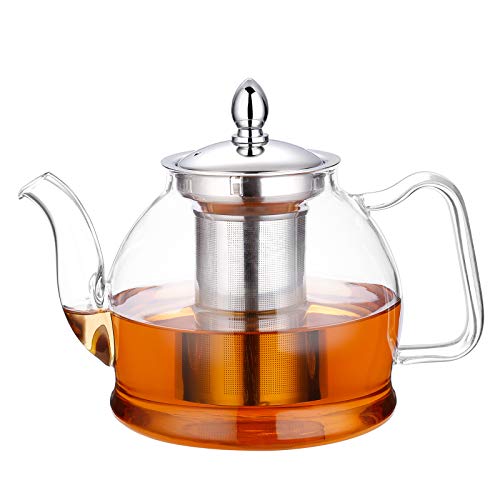
- CNGLASS Glass Teapot Stovetop Safe with Removable Infuser, 20.3 oz — Check on Amazon
- DRNKNSTX Enchanted Tea Pot with Tea Infuser, 20 oz
- HIWARE 1000ml Glass Teapot with Removable Infuser
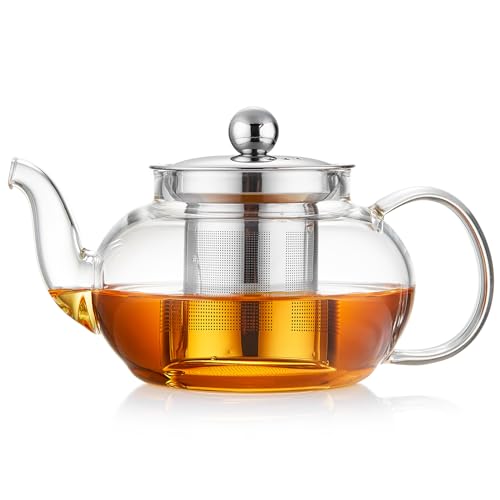
- PARACITY Glass Teapot Stovetop 18.6 oz (550ml)
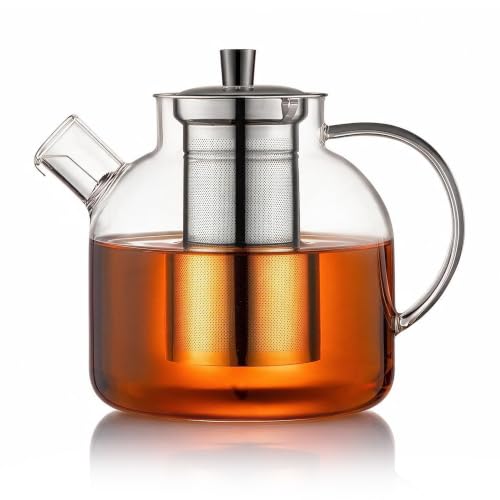
- Ehugos 1500ml (50 oz) Glass Teapot with Removable Infuser
- Teabloom Stovetop & Microwave Safe Glass Teapot (40 oz)
Read the full guide ↓
The best teapots for green tea are chosen by a leaf that forgives nothing. Green tea is unoxidised, delicate, and brewed cooler and shorter than any other major tea family — water around 75–85°C rather than a boil, steeps of one to three minutes rather than five — and it turns bitter, stewed, or flat when any of those courtesies is skipped. A teapot earns its place in a green tea kitchen by making the courtesies easy: an infuser that lifts out in one motion the second the steep ends, a size that suits small volumes drunk fresh and re-steeped, and walls that show the liquor’s colour, because with green tea the difference between ready and ruined can be thirty seconds and a shade of gold. The six glass pots in this guide were picked on exactly those terms.
Glass deserves its dominance here for a reason beyond beauty. Green tea’s flavour is the most easily contaminated in the tea world — a pot that remembers yesterday’s spiced chai or smoky black will lend those ghosts to today’s sencha — and glass remembers nothing. Rinsed in seconds, it returns to a blank slate, so the same pot can serve a Chinese pan-fired green in the morning and a steamed Japanese green in the afternoon without either tasting of the other. Add the visual gauge — the liquor of a green tea deepens from palest straw to gold as extraction proceeds, and a practised eye reads doneness from that gradient more reliably than from any timer — and glass stops being a style choice for green tea. It is the reference instrument.
The set spans green tea’s real range. The PARACITY, with its fine 18/8 steel infuser and 550ml borosilicate body, is the precision instrument for fine Japanese-style leaves. The CNGLASS brings a stovetop rating to a compact 20.3 oz for brewers who heat and steep in one vessel. The HIWARE and Ehugos scale the ritual to households and groups without changing its rules, the Teabloom suits the scented and flowering end of the family, and the DRNKNSTX steeper covers the relaxed formats — cold brews and casual evening infusions — where green tea goes off duty. Technique threads through everything that follows, because with this leaf, the pot is only ever half the answer; our companion on the Best Teapots For Japanese Tea takes the most demanding branch of the family deeper still.
Key Takeaways
- Green tea wants cooler water (roughly 75–85°C), short steeps, and an infuser that comes out the moment the steep ends.
- Glass is the reference material: flavour-neutral between brews, and it shows the liquor colour that gauges doneness.
- The PARACITY’s fine steel infuser and 550ml size make it the precision pick for fine Japanese-style greens.
- The HIWARE 1000ml serves households; the Ehugos 1500ml serves groups and iced green tea batches.
- Small volumes drunk fresh, then re-steeped, beat one large pot nursed for an hour.
- Boiling water is green tea’s most common injury — rest the kettle, every time.
In this guide
Quick Picks
| Pick | Badge | Capacity | Infuser | Link |
|---|---|---|---|---|
| CNGLASS Glass Teapot | Best Compact Pot for Green Tea | 20.3 oz | Removable infuser | Check on Amazon |
| DRNKNSTX Enchanted Tea Pot | Best for Cold-Brew & Casual Steeps | 20 oz | Tea infuser / steeper design | Check on Amazon |
| HIWARE Glass Teapot | Best for Households | 1000ml | Removable infuser | Check on Amazon |
| PARACITY Glass Teapot | Best for Fine Japanese-Style Greens | 18.6 oz / 550ml | Removable 18/8 stainless steel infuser | Check on Amazon |
| Ehugos Glass Teapot | Best for Groups & Iced Green Tea | 1500ml / 50 oz | Removable stainless infuser | Check on Amazon |
| Teabloom Glass Teapot | Best for Scented & Flowering Greens | 40 oz | Removable glass infuser | Check on Amazon |
How These Picks Were Chosen
We assessed these pots against green tea’s specific mechanics, using each manufacturer’s verified listing data — capacity, infuser construction, heating ratings, and named tea formats, checked on 2026-11-20. Three questions decided inclusion. Does the infuser remove cleanly and completely, so a two-minute steep can actually end at two minutes? Does the infuser’s fineness suit green leaves, from whole-leaf Chinese greens down to the smaller, finer Japanese styles? And does the pot’s size match the way green tea is drunk — in modest volumes, fresh, and often re-steeped — rather than in litre-long sessions? Pots that answered well at their scale made the list, from the PARACITY’s fine-mesh precision to the Ehugos’s group capacity, where the same discipline simply scales.
This is a research-led guide, not a tasting panel, and we claim no laboratory scores. The brewing parameters we rely on — temperature bands, steep ranges, re-steeping practice — are the established working consensus for green tea, and they are stated as ranges precisely because leaf, water, and taste move them. What specification reading establishes reliably is the fit between a pot’s mechanics and those parameters: mesh against leaf size, capacity against session style, a stovetop rating against the catch-the-moment heating that delicate teas reward. Where a pot’s fit is partial — a wide glass infuser meeting a fine needle leaf — the review says so in plain terms.
One selection principle deserves emphasis because green tea punishes its violation: we did not reward size. In most of our teapot guides, capacity is a headline virtue; here it is a conditional one, valuable for households and iced batches and a liability for the solo drinker who fills a third of a litre pot and wonders why the tea is thin and cold. The badges below therefore honour the small pots first, and readers whose green tea life is social should read the large pots’ reviews with the fill-level warning in mind — a principle our Best Teapots For Loose Leaf Tea companion applies across the whole loose-leaf shelf.
The 6 Best Teapots for Green Tea

CNGLASS Glass Teapot Stovetop Safe with Removable Infuser, 20.3 oz
Badge: Best Compact Pot for Green Tea
Strengths
- Stovetop-safe rating lets the brewer heat water in the pot and take it off at the first bubble stage — the catch-the-moment control green tea rewards.
- Compact 20.3 oz volume suits the small, fresh sessions green tea is best drunk in.
- Removable infuser with loose leaf named by the maker; a clean, quick steep-stop.
Trade-offs
- One-to-two drinkers per brew; it is not a household pot.
- Heating in the pot demands attention — water for greens must be caught early, not boiled by default.
- A single infuser system; the finest needle leaves are better contained by the PARACITY’s mesh.
Spec box
- Capacity: 20.3 oz
- Infuser: Removable infuser
- Stovetop: Described as stovetop safe by the maker
- Tea types named by maker: Loose leaf and blooming tea
The CNGLASS offers green tea drinkers a workflow no kettle quite replicates: water heating in the brewing vessel itself, watched through glass, and lifted off the heat at the first lazy bubble streams — well below a boil, exactly where a delicate leaf wants it. That catch-the-moment control, repeated daily, is worth more to a green tea routine than any thermometer habit, because it builds the eye. At 20.3 oz the pot is also honestly sized for the family it serves: a session is two cups, drunk fresh, with the leaves kept for a second steeping an hour later rather than drowned in a litre that cools and stews. For solo and couple drinkers who heat on a stove, it is the most integrated green tea station in this guide.
Its demand is attention. A stovetop pot will sail past 85°C while its owner answers the door, and green tea keeps the receipt. Brewers who know their mornings are chaotic should heat water in a kettle, rest it, and pour — the same pot serves that workflow just as well.
Best for: Attentive solo and couple brewers who heat on the stove / Not suited for: Distracted mornings or family volumes

DRNKNSTX Enchanted Tea Pot with Tea Infuser, 20 oz
Badge: Best for Cold-Brew & Casual Steeps
Strengths
- Steeper format suits cold-brewing beautifully — the green tea method with no temperature risk at all.
- 20 oz personal size matches a relaxed glass-or-two session.
- Gift-oriented presentation encourages new green tea drinkers into the loose-leaf habit.
Trade-offs
- A steeper is a blunt instrument for precision hot brewing; competition-style greens belong in the PARACITY.
- No stovetop claim in its listing — hot water comes from a kettle, rested to temperature.
- Built for prompt serving rather than heat-holding.
Spec box
- Capacity: 20 oz
- Infuser: Tea infuser / steeper design for loose leaf
- Format: Glass tea maker and steeper, gift-oriented presentation
- Stovetop: Not stated in the maker listing — treat as pour-over only
Every tea family has an off-duty mode, and green tea’s is the cold brew: leaves and cold water, hours in the fridge, and a liquor that comes out naturally sweet because the bitter compounds extract reluctantly in the cold. The DRNKNSTX, a steeper by design, is the natural vessel for it in this set — load the leaves, fill, refrigerate, and serve over the afternoon, with the glass showing the pale green deepening as the hours pass. It also covers the casual hot steep for drinkers who like their green tea forgiving rather than exact: a flavoured green blend, a jasmine, an evening cup where the ritual matters more than the reading. Within a green tea household, it is the second pot — the relaxed one — and as a gift that starts a sceptic on loose leaf, its enchanted presentation does real persuasive work.
Do not ask it for precision. Fine hot greens brewed to a standard belong in the mesh-and-timer world of the PARACITY or CNGLASS. The DRNKNSTX’s green tea is the kind you drink with your feet up, and there is more of that kind in a life than the other.
Best for: Cold-brew green tea and relaxed flavoured greens / Not suited for: Precision hot brewing
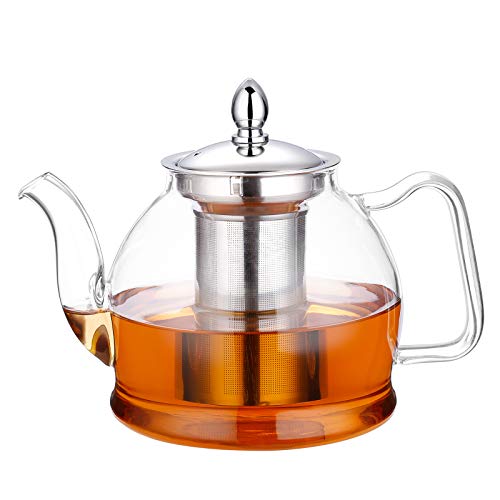
HIWARE 1000ml Glass Teapot with Removable Infuser
Badge: Best for Households
Strengths
- A full litre serves a household’s green tea round in one extraction, keeping every cup at the same strength.
- Stovetop safe, so water can be heated in the pot and caught below the boil for the leaf.
- Removable infuser gives the whole table a clean steep-stop at once.
Trade-offs
- A litre is a commitment: green tea brewed at this scale must be drunk promptly, not nursed.
- Half-filled for one drinker, it brews thin and cools fast.
- Its generalist infuser is outclassed for the finest Japanese leaves by the PARACITY’s mesh.
Spec box
- Capacity: 1000ml
- Material: Glass (per manufacturer listing)
- Infuser: Removable infuser included
- Stovetop: Described as stovetop safe by the maker
- Tea types named by maker: Blooming and loose leaf
Households that drink green tea together face a scaling problem the solo brewer never meets: green tea’s short, cool steep must happen for four cups as precisely as for one, and the second small pot, brewed in a hurry while the first is poured, never quite matches. The HIWARE solves it with a single litre extraction — water caught below the boil on the stove, one dose, one steep, the infuser lifted once for the whole table. The result is a round of green tea that tastes like one tea, which is rarer at family scale than it should be. Its glass walls let the brewer read the colour for the table’s preference and adjust the next round by seconds, the way a household’s house style is actually built.
The discipline is promptness. A litre of green tea is a litre at its peak for perhaps twenty minutes; after that it should have been drunk, decanted, or iced. Families who sip slowly across a long morning will be happier brewing two half-litres in the CNGLASS class of pot — or accepting the HIWARE’s rhythm, which is the rhythm green tea itself prefers.
Best for: Green-tea households and shared rounds / Not suited for: Slow solo sipping
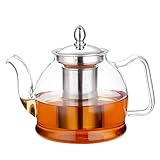

PARACITY Glass Teapot Stovetop 18.6 oz (550ml)
Badge: Best for Fine Japanese-Style Greens
Strengths
- Fine 18/8 stainless steel infuser — the tightest straining here, suited to the small, needle-like leaves of Japanese-style greens.
- 550ml borosilicate body matches the small, repeated infusions those teas are brewed in.
- Stovetop listed, so water can be heated in the pot and caught at the first bubble stage.
Trade-offs
- Strictly a one-to-two person pot.
- Small volumes cool quickly — an advantage for control, a limit for lingering.
- Tightly rolled Chinese greens have less room to unfurl than in a wide basket.
Spec box
- Capacity: 18.6 oz / 550ml
- Material: Borosilicate glass
- Infuser: Removable 18/8 stainless steel infuser
- Stovetop: Listed as a stovetop teapot by the maker
- Use cases named by maker: Camping, travel, home brewing
Japanese-style greens — sencha and its relatives — are the sternest examination a teapot can sit: fine, needle-like leaves that slip through coarse infusers, water that must sit in a narrow temperature band, steeps measured in tens of seconds, and a drinker who expects two or three infusions from the same leaf. The PARACITY is the pot in this guide built to pass. Its steel mesh is the finest strainer here, keeping the cup clean of the leaf dust that clouds lesser pots’ liquor. Its 550ml is the native volume of the style — small enough that each infusion is drunk at its moment, large enough for two to share the round. And its borosilicate, stovetop-listed body lets the brewer heat the water in the vessel and arrest it early, which is how the temperature band is hit without instruments. For the green tea drinker whose shelf leans Japanese, this is not the budget option or the travel option; it is simply the right tool.
Its boundaries are the style’s boundaries. It will not serve a table, and a big rolled oolong-style green will feel the basket’s modest room. Within the fine-green discipline, though, nothing else in this set is as fluent.
Best for: Japanese-style and fine-leaf green tea drinkers / Not suited for: Groups or maximum-expansion leaves

Ehugos 1500ml (50 oz) Glass Teapot with Removable Infuser
Badge: Best for Groups & Iced Green Tea
Strengths
- 1500ml brews a group round — or a full batch of double-strength tea for icing — in one extraction.
- Stovetop safe with a removable stainless infuser for a clean, timed stop at scale.
- Wide hand-crafted body suits the scented and large-leaf greens that need room.
Trade-offs
- At this scale, a forgotten steep ruins six cups at once; the timer is non-negotiable.
- Hot green tea at 1500ml must be served promptly or iced — it will not wait politely.
- Heavy when full; a two-handed pour is part of the service.
Spec box
- Capacity: 1500ml / 50 oz
- Material: Glass, hand crafted
- Infuser: Removable stainless infuser
- Stovetop: Described as stovetop safe by the maker
- Tea types named by maker: Blooming and loose leaf
The Ehugos earns its green tea place at the two ends of service the small pots cannot reach. The first is the group round: a table that drinks green tea together, brewed once at the correct temperature and strength, rather than a relay of small pots drifting apart in character. The second is iced green tea, where the method is a double-strength hot brew poured over ice — a job that wants volume, a clean infuser stop so the concentrate does not stew while it waits, and glass that shows the strength honestly before it is diluted. A 1500ml stovetop-safe pot does both jobs in the vessel that heated the water. Summer households that live on iced green tea will use this pot more in July than in January, and it is sized for exactly that loyalty.
The warning is the family’s standing one, amplified: green tea at scale forgives nothing, and a 1500ml steep left three minutes too long is a large quantity of bitterness. Appoint the brewer, set the timer aloud, and this pot will serve a crowd better than any other here.
Best for: Groups, gatherings, and iced green tea batches / Not suited for: Solo daily brewing

Teabloom Stovetop & Microwave Safe Glass Teapot (40 oz)
Badge: Best for Scented & Flowering Greens
Strengths
- Glass infuser and clear body present scented and flowering greens — jasmine pearls, blooming teas — at their visual best.
- Stovetop and microwave safe, and a 2-in-1 kettle and tea maker for flexible heating.
- Two blooming teas included, so the flowering format can be tried immediately.
Trade-offs
- The glass infuser’s wider slots let fine needle leaves slip; it is a large-leaf and pearl instrument.
- Glass infuser fragility asks for gentle washing.
- 40 oz is a middle size — generous for one, a stretch for a full table.
Spec box
- Capacity: 40 oz
- Infuser: Removable loose tea glass infuser
- Stovetop: Stovetop and microwave safe per maker
- Included: 2 blooming teas
- Format: 2-in-1 tea kettle and tea maker
A whole branch of the green family is grown and scented to be looked at: jasmine pearls that unfurl as they steep, flowering teas that open into blossoms, large-leaf greens whose liquor runs pale gold. The Teabloom is that branch’s pot. Its glass infuser keeps the frame invisible, its 40 oz body gives a pearl or a bloom the room its performance needs, and its dual heating rating means the water can be brought up gently on a stove or in a microwave and — critically for scented teas, whose aromatics are the point — kept below the boil that would drive the fragrance off. A jasmine green brewed in this pot, at rested temperature, with the pearls opening in full view, is the strongest argument in this guide that presentation and quality are sometimes the same thing.
Match it to its leaves. Fine needle greens belong in the PARACITY’s mesh; the Teabloom’s wider glass slots will let their dust through and cloud the cup. Scented, pearled, flowering, and large-leaf greens are its repertoire, and within it, it has no rival here.
Best for: Jasmine, scented, and flowering green teas / Not suited for: Fine needle-leaf greens

Comparison Table
| Teapot | Capacity | Infuser | Heating | Green tea strength | Link |
|---|---|---|---|---|---|
| CNGLASS | 20.3 oz | Removable infuser | Stovetop safe | Compact catch-the-moment brewing | Check on Amazon |
| DRNKNSTX | 20 oz | Steeper / infuser | Pour-over | Cold brew and casual steeps | Check on Amazon |
| HIWARE | 1000ml | Removable infuser | Stovetop safe | Household rounds | Check on Amazon |
| PARACITY | 550ml | 18/8 steel infuser | Stovetop listed | Fine Japanese-style greens | Check on Amazon |
| Ehugos | 1500ml | Stainless infuser | Stovetop safe | Groups and iced batches | Check on Amazon |
| Teabloom | 40 oz | Glass infuser | Stovetop + microwave | Scented and flowering greens | Check on Amazon |
How to Choose a Teapot for Green Tea
Match the infuser to your leaf’s size. Green tea is not one leaf. Japanese styles run fine and needle-like and demand the finest mesh you can get — in this set, the PARACITY’s 18/8 steel. Chinese styles run larger — whole, twisted, or pearled leaves that need room more than fineness, and that the wider baskets and glass infusers serve beautifully. A household that drinks both should default to fine mesh, because a fine infuser handles large leaves adequately while a wide one genuinely fails fine leaves. That asymmetry settles most green tea purchases.
Size for the infusion, not the day. Green tea is drunk in infusions: a modest volume, finished, then re-steeped. A pot sized to one infusion — 20 oz or under for solo drinkers — will always outperform a litre pot filled a third of the way, because temperature and circulation behave at proper fill. Buy up in size only when the drinking is genuinely social, and then treat the big pot’s output as an event to be finished, not a supply to be kept. Our Best Teapots For Loose Tea companion works through the same sizing logic for the wider loose-leaf shelf.
Decide how your water will reach 80 degrees. The pot cannot cool boiling water for you, but the workflow can be designed: a stovetop-rated pot (CNGLASS, PARACITY, HIWARE, Ehugos, Teabloom) lets you catch the water before the boil; a kettle workflow rests boiled water for two to three minutes, or blends it with a portion of cool water. Temperature-control kettles remove the guesswork entirely. All three routes end at the same place — water in the high seventies to mid eighties — and the best route is the one your mornings will actually follow.
Value the rinse. Green tea drinkers brew more often and more variously than any other tea household, so the pot’s life is a life of rinsing between teas. Glass rinses to neutral in seconds, which is why it fills this guide. A pot that is slow to clean will quietly narrow its owner’s repertoire to one tea, and a narrowed repertoire is the opposite of what a green tea shelf is for.
How to Brew Green Tea: The Working Method
Warm the pot, gently. A swirl of warm — not boiling — water takes the chill off the glass so the brew temperature stays where you set it. Pour it away before the leaves go in.
Dose for the style. Start near a teaspoon per 250ml for Chinese greens, and a more generous measure for fine Japanese greens, which are traditionally brewed strong in small volumes. Keep the spoon and the pot constant while you learn a new tea, and change one variable at a time.
Water at green-tea temperature. Bring fresh water toward the boil and stop early, or boil and rest it two to three minutes. Aim for roughly 75–85°C — cooler for the most delicate Japanese greens, warmer for robust pan-fired Chinese styles. If you take one habit from this guide, take this one: the rested kettle is the difference between green tea as it should taste and green tea as most people first meet it and wrongly judge.
Steep short, lid on, eyes on the colour. One to three minutes covers the family: the short end for fine Japanese styles, the longer end for large-leaf Chinese greens. Watch the liquor through the glass — pale straw deepening toward gold — and lift the infuser the moment the shade matches the strength you want. The timer is the backup; the colour is the instrument.
Stop, pour, and re-steep. Infuser out, completely, onto its dish. Pour promptly and fully. Then re-steep the same leaves once or twice more, adding roughly half a minute per round; quality greens often peak on the second infusion, and a household that re-steeps drinks better tea for the same leaf budget. Between rounds, keep the leaves in the infuser, drained and covered.
Cold brew, the zero-risk method. Leaves and cold, fresh water in the pot — the DRNKNSTX is shaped for it — then several hours refrigerated. The result is naturally sweet and almost impossible to ruin, and it is the method to hand a sceptic who believes green tea is bitter. It is also the practical summer answer for households without an iced-tea routine: brew overnight, drink all day.
Troubleshooting.
- Problem: The tea is bitter and harsh → what to do: the water was too hot or the steep too long, in that order of likelihood. Rest the kettle longer, cut the steep by a third, and taste again before changing the leaf or the pot.
- Problem: The tea tastes like hot water → what to do: the water was too cool, the dose too light, or the pot too big for the volume. Warm the water slightly, add a little leaf, and brew at the pot’s proper fill.
- Problem: The cup is cloudy with leaf dust → what to do: your infuser is too coarse for that leaf. Pour gently, let the last centimetre stay in the pot, and brew that tea in the finest mesh you own.
- Problem: The second steep is weak → what to do: add time, not temperature — half a minute to a minute more — and make sure the leaves stayed moist and covered between rounds rather than drying out.
Chinese and Japanese Greens: One Family, Two Temperaments
It is worth understanding why this guide keeps splitting its advice, because the green family contains two brewing cultures. Chinese greens are typically pan-fired, which sets their flavour and makes them comparatively robust: larger leaves, warmer water tolerated, steeps of two to three minutes, and a forgiving nature in a generalist pot — the HIWARE and Teabloom serve them handsomely. Japanese greens are typically steamed, which keeps them vivid, vegetal, and delicate: finer leaves, cooler water, steeps that can run under a minute for the finest grades, and a premium on mesh fineness and small volumes — the PARACITY’s home ground. Neither culture is superior; they are different answers to the same leaf. The buying consequence is simple honesty about your shelf. A household that drinks mostly Dragon Well and jasmine can choose almost any pot here and thrive. A household that drinks sencha daily should buy for the sencha, because it is the leaf that will grade the pot’s performance every single morning — and let the forgiving teas, which forgive, take the same pot as it comes. Readers exploring the neighbouring families will find the same leaf-size logic at work in our guide to the Best Teapots For Oolong, where rolled leaves rewrite the infuser question once more.
Storing Green Tea So the Pot Has Something Worth Brewing
A green teapot can only express the leaf it is given, and green leaf is the most perishable stock in the tea cupboard: it dulls with light, air, heat, and time faster than any oxidised tea. Store it sealed, opaque, cool, and away from the spice rack, whose aromas it will absorb through any imperfect seal. Buy in quantities the household finishes while the leaf is lively, and reseal the tin the moment the spoon comes out. The glass pot plays its own small part in storage discipline — because it shows everything, a brewer who rinses it promptly and stores it dry with the lid ajar never gives yesterday’s residue a chance to season today’s delicate cup. It is unglamorous advice, and it is the difference between a household that thinks green tea is grassy and flat and a household that understands what the fuss is about: the leaf was fresh, the water was rested, the steep was short, and the pot kept out of the way. Three of those four are free.
Iced Green Tea: The Summer Method in Full
Iced green tea fails in most kitchens for one reason: it is brewed like hot tea and then chilled, which locks in whatever bitterness the hot steep produced and dilutes it into mediocrity. The two methods that work are opposites. The flash-chill method brews a deliberate double-strength hot tea — twice the leaf, the correct temperature, the usual short steep — removes the infuser, and pours the hot concentrate directly over a full measure of ice, which dilutes it to drinking strength while locking in the aromatics; the Ehugos exists for this at batch scale. The cold-brew method skips heat entirely: leaves, cold water, hours of patience, and a sweetness no hot method matches, at the cost of planning ahead. Both methods share one rule with all green tea work in glass: never subject the pot to thermal shock in the process — the concentrate goes over ice in the serving glass or a room-temperature pitcher, not into a freezer-chilled pot, and a hot pot is never plunged into cold water to hurry it. Summer is green tea’s second season, and a household with either method in its repertoire will drink more of it, better, than the household still chilling yesterday’s leftover pot and wondering why nobody finishes it.
Building a Green Tea Routine That Survives Busy Mornings
Green tea has a reputation for fussiness that its drinkers know is really a reputation for sequence: the whole craft is four small acts in the right order, and a routine that arranges them in advance makes the craft invisible. The night-before version is cold brew, already covered — the morning version is a station. Kettle filled the night before so the morning is one switch; the pot living beside it with its infuser inside; the day’s leaf tin at the front of the shelf, not behind the black teas; a small timer or the stove clock within sight. Rested water becomes a habit when the kettle is switched on before the shower and poured after it, because the rest is built into the morning rather than added to it. The steep becomes a habit when the infuser’s dish lives in one place and the pour is always into the same warmed cup. None of this is technique in the grand sense, and all of it is why some households drink beautiful green tea on workdays while others, owning finer pots, drink it only on Sundays. Choose the pot that fits the station — for most solo drinkers the PARACITY or CNGLASS, small enough to live beside the kettle permanently — and let the arrangement, renewed daily, do the remembering for you.
Common Buying Mistakes
- Brewing green tea with boiling water and blaming the pot. Temperature is the brewer’s first duty; no vessel corrects a scalded leaf.
- Buying a litre pot for a solo green tea habit. Under-filled pots brew thin, cool tea; green tea wants small volumes at full fill.
- Choosing a wide glass infuser for fine Japanese leaves. The dust in the cup was decided at purchase, not at the stove.
- Leaving the infuser in “for the second cup.” Green tea’s window is short; the second cup should come from a re-steep, not a stew.
- Judging a green by its first, hottest attempt. Give a new tea three brews at descending temperatures before deciding the shelf does not suit it.
Final Recommendation
For most green tea drinkers, the PARACITY 550ml is the pot to start with: the finest infuser in this set, a native green-tea volume, and borosilicate that can catch its own water below the boil. Stove-first solo brewers who want the integrated workflow should take the CNGLASS; households, the HIWARE; groups and iced-tea summers, the Ehugos; jasmine and flowering devotees, the Teabloom; and cold-brew converts, the DRNKNSTX as the relaxed second pot. Then honour the leaf’s one great rule — rest the water — and any of these six will show you why green tea drinkers become evangelists. Start with the leaf you already own, brew it three ways in the first week, and let the pot and the temperatures introduce themselves properly; green tea rewards that small patience more generously than any other drink in the kitchen, and the first cup that comes out sweet, pale gold, and entirely free of bitterness tends to convert the brewer for good.
Frequently Asked Questions
What temperature should green tea be brewed at?
Roughly 75–85°C for most green teas: the cooler end for delicate Japanese styles, the warmer end for robust pan-fired Chinese greens. Boiling water scalds green leaves and extracts bitterness faster than flavour, which is why the rested kettle — two to three minutes off the boil — is the green tea brewer’s foundational habit.
How long should green tea steep?
One to three minutes for the first infusion, depending on the style: under a minute to ninety seconds for the finest Japanese greens, two to three minutes for large-leaf Chinese greens. Watch the liquor’s colour through the glass and stop the steep by removing the infuser completely; then re-steep, adding a little time per round.
Why does my green tea taste bitter?
Almost always heat or time: water too hot, a steep too long, or leaves left sitting in the liquor after the steep. Correct in that order — rest the water longer, shorten the steep, lift the infuser promptly — before blaming the tea or the pot. True green tea, brewed in its band, is sweet and vegetal, not bitter.
Can green tea be re-steeped?
Yes, and it should be: quality greens give two or three infusions, often peaking on the second. Keep the leaves in the infuser, drained and covered between rounds, use water at the same temperature, and add roughly half a minute per steep. When a round comes out thin despite the extra time, the leaf is finished.
Which of these pots is best for Japanese green tea?
The PARACITY: its 18/8 stainless steel infuser is the finest strainer in the set, which fine Japanese leaves require, and its 550ml volume matches the small, repeated infusions of the style. Its borosilicate body is also stovetop listed, so water can be heated in the pot and caught early — exactly the temperature discipline these teas reward.
Is glass really better than ceramic for green tea?
For most drinkers, yes: glass is flavour-neutral between the many teas a green drinker rotates, and it shows the liquor colour that gauges a short steep better than any timer. Ceramic holds heat better and suits a single-tea household. The more delicate and varied your shelf, the stronger the case for glass.
Does green tea need a special teapot, or will any glass pot do?
Any glass pot with a removable infuser can brew green tea, and all six here qualify. What “special” adds is fit: a fine enough infuser for your leaf size, a capacity matched to small fresh infusions, and — if you heat on a stove — a rating that lets you catch the water early. Drinkers of fine Japanese greens feel the fit most; drinkers of robust Chinese greens can choose almost entirely by size and habit.
What is the best way to learn a new green tea?
Brew it three times across a week at three temperatures — straight off a short rest, after a longer rest, and cooler still — keeping dose and time constant, and note which cup you finished with pleasure. That small ladder teaches a new leaf’s temperament faster than any description, and it calibrates your rested-kettle habit to your own kitchen’s cooling rate, which no generic chart can do.
Can I cold-brew green tea in these pots?
Yes — cold brewing suits green tea beautifully and removes the temperature risk entirely. Add leaves and cold fresh water, refrigerate for several hours, and strain or remove the infuser before serving. The DRNKNSTX steeper is shaped for the format, but any pot here works; the result is naturally sweet and keeps well for a day in the fridge. Serve it over ice with nothing added first — cold-brewed green tea is the easiest glass to hand a sceptic, and the one most likely to change their mind about the whole family.