Disclosure: topratedkitchenware.com is reader-supported. When you buy through links on our site, we may earn an affiliate commission from Amazon and other retailers, at no extra cost to you.
Where to buy
Only three of the six teapots below earn a place among the best teapots for electric stove use, because only those three carry a stovetop claim from their makers — and only those three are linked and recommended for use on an electric stove. The other three — the DOPUDO, the Enchanti, and the DRNKNSTX — make no stovetop claim in their listings, so we review them honestly as kettle companions and give them no purchase link: they must never sit on an element. Linked pots are sold through Amazon; check the stovetop wording on the listing itself, and read the induction warning in this guide before assuming any glass pot works on your hob.
- DOPUDO Small Glass Teapot with Infuser, 18 oz (530ml) — no stovetop claim; reviewed prose-only below
- STNTUS Glass Teapot, 40 oz / 1200ml, 4–6 Cups — Check on Amazon
- Enchanti One Touch Glass Teapot with Infuser, 27 oz / 800ml — no stovetop claim; reviewed prose-only below
- Teabloom Celebration Glass Teapot & Kettle, 27 oz
- CNGLASS Glass Teapot Stovetop Safe with Removable Infuser, 20.3 oz
- DRNKNSTX Enchanted Tea Pot with Tea Infuser, 20 oz — no stovetop claim; reviewed prose-only below
Read the full guide ↓
The best teapots for electric stove kitchens have to pass two tests that a gas-stove pot never faces. The first is the rating test: the maker’s own listing must state stovetop safety, because glass on a heating element is a claim about materials, not a matter of optimism. The second is the element test: electric heat is not one thing. A coil element concentrates heat in raised rings, a radiant glass-top spreads it under a smooth surface, and an induction hob — the trap in this category — does not heat plain glass at all, no matter what any teapot claims. A guide that ignored those differences would sell induction owners a pot that sits cold on their hob, so this one leads with them.
Three of the six pots reviewed here carry a stovetop claim verified against manufacturer listings on 2026-11-20: the STNTUS, described as stovetop safe; the Teabloom Celebration, described as stovetop and microwave safe; and the CNGLASS, described as stovetop safe. Those three are the electric-stove recommendations, and they divide the work by size — family, flexible, and compact. The remaining three pots are reviewed in full and in prose only, because they are good brewers that electric-stove owners will meet in every search result, and someone should say plainly what their listings do not: no stovetop claim means the kettle heats the water, always. Used that way, they serve an electric kitchen perfectly well; the electric kettle and the glass pot are natural partners, and for induction households they are the only partnership on offer.
Why heat on the stove at all in an electric kitchen? Because a rated glass pot on a radiant or coil element deletes the kettle from the tea routine, catches water at the temperature moment your leaf wants, and frees the counter space the kettle would have owned. The cautions are real and this guide states them without softening: electric elements cycle and surge, residual heat lingers after switch-off, and glass must never be dragged across a glass-top hob or set down hot on a cold surface. Follow the method section and the three rated pots below will serve an electric kitchen safely for years. Readers cooking over flame should cross-check with our companion guide to the Best Teapots For Gas Stove, where the same three rated pots are assessed against burner heat instead.
Key Takeaways
- Only maker-rated stovetop pots belong on an electric element: here, the STNTUS, the Teabloom Celebration, and the CNGLASS.
- Induction hobs do not heat plain glass at all — induction owners need a kettle workflow or the Celebration’s microwave route.
- The DOPUDO, Enchanti, and DRNKNSTX carry no stovetop claim; they are reviewed prose-only as kettle companions and must stay off elements.
- Radiant glass-top hobs suit rated glass pots best; coil elements demand flat, full base contact.
- Electric elements hold residual heat — move the pot off the element when the water is ready, and never boil dry.
- The STNTUS 1200ml is the family pick; the CNGLASS is the compact pick; the Celebration is the flexible pick.
In this guide
Quick Picks
| Pick | Badge | Capacity | On an electric stove? | Link |
|---|---|---|---|---|
| DOPUDO Small Glass Teapot | Kettle Companion (Prose-Only) | 18 oz / 530ml | No — no stovetop claim | Reviewed below, no link |
| STNTUS Glass Teapot | Best for Family Electric-Stove Use | 40 oz / 1200ml, 4–6 cups | Yes — stovetop safe per maker | Check on Amazon |
| Enchanti Tea Pot | Kettle Companion (Prose-Only) | 27 oz / 800ml | No — no stovetop claim | Reviewed below, no link |
| Teabloom Celebration Teapot | Best for Small Electric Kitchens | 27 oz | Yes — stovetop and microwave safe | Check on Amazon |
| CNGLASS Glass Teapot | Best Compact Electric-Stove Boiler | 20.3 oz | Yes — stovetop safe per maker | Check on Amazon |
| DRNKNSTX Enchanted Tea Pot | Kettle Companion (Prose-Only) | 20 oz | No — no stovetop claim | Reviewed below, no link |
How These Picks Were Chosen
The gate for this guide was a single sentence in each maker’s own listing. We verified all six listings on 2026-11-20 and sorted the pots by what the listings actually state. Three state stovetop safety — the STNTUS (“stovetop safe”), the CNGLASS (“stovetop safe”), and the Teabloom Celebration (“stovetop & microwave safe”) — and those three carry this guide’s links, images, and recommendations. Three state nothing about stovetop use — the DOPUDO, the Enchanti, and the DRNKNSTX — and those three are reviewed in prose only, with no link and no image, and with explicit instruction that they belong on a counter, filled from a kettle, never on an element.
This is a research-led guide, not a bench test on a live hob; we did not cycle these pots on coil and radiant elements to compare them, and we report no invented heating times. The element guidance that follows is established practice for rated glass cookware: flat contact, moderate settings, residual-heat awareness, and no thermal shocks. Where a question is genuinely hob-specific — above all, induction — we answer it from the physics rather than from any listing: a plain glass vessel has no magnetic base, an induction hob cannot heat it, and no wording in a teapot listing changes that. If your hob is induction, read the three prose-only reviews as your shortlist and the rated pots as brewers to fill from your kettle.
We included the unrated pots deliberately rather than silently dropping them, because electric-stove shoppers will encounter all six in the same search results, often side by side, with nothing on the results page to distinguish a rated pot from an unrated one. A guide’s job in that situation is labelling, and the labels here are unambiguous: rated, linked, and recommended for the element — or unrated, unlinked, and recommended for the kettle.
The 6 Best Teapots for Electric Stove Kitchens (3 Rated + 3 Kettle Companions)
DOPUDO Small Glass Teapot with Infuser, 18 oz (530ml) (Prose-Only: Kettle Companion)
Badge: Kettle Companion (Prose-Only)
Strengths
- Compact 530ml borosilicate pot purpose-built for individual loose-leaf brewing from kettle water.
- Removable 18/8 steel infuser — fine straining, fast rinsing, durable.
- The natural partner for an electric kettle station: the kettle heats, the pot brews, nothing is wasted.
Trade-offs
- No stovetop claim in its listing — it must never be placed on an electric element, however sturdy it feels.
- Depends entirely on a kettle for hot water.
- 18 oz serves one; it is not a household pot.
Spec box
- Capacity: 18 oz / 530ml
- Material: Borosilicate glass
- Infuser: Removable 18/8 steel infuser
- Format: Compact teapot for individual loose-leaf brewing
- Stovetop: NOT stated by the maker — keep off all elements
In an electric kitchen, the most common tea setup is not a pot on the hob at all — it is the electric kettle and a brewer beside it, and the DOPUDO is the brewer that setup deserves. Its listing claims nothing about stovetop use, so on the counter is where it lives: kettle boils, pot warms, leaves go in, and a solo drinker gets a properly sized 530ml session instead of a mug and a bag. The steel infuser handles fine leaves the way pricier pots do, and the whole arrangement asks nothing of the hob — which makes it the safest recommendation in this guide for induction owners, coil owners who dislike glass-on-element contact, and anyone whose kitchen rules are kettle-first. It carries no link here because this guide’s promise is to link only what it can recommend for the keyword’s purpose; as a brewer in an electric kitchen, though, it is entirely recommendable, and owners who buy it elsewhere for that role will not be disappointed.
Best for: Kettle-station solo brewing, induction households / Not suited for: Any direct contact with a heating element

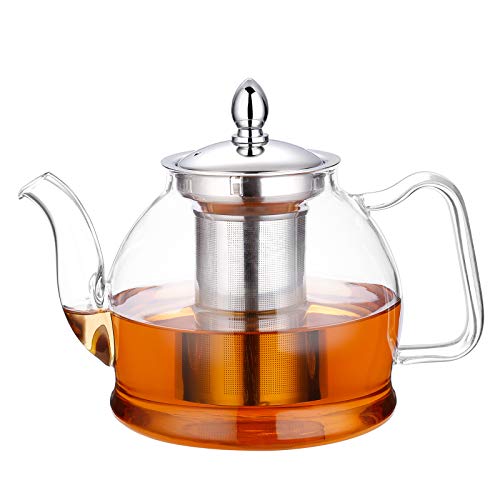
STNTUS Glass Teapot, 40 oz / 1200ml, 4–6 Cups
Badge: Best for Family Electric-Stove Use
Strengths
- Stovetop safe per its maker, at a family capacity of 1200ml sized for four to six cups.
- Infuser basket plus a stainless steel strainer — brew contained or free-leaf from the same pot.
- A broad, stable presence on a radiant or coil element suits its size.
Trade-offs
- Two components to wash and keep together.
- The largest of the rated pots here, so it takes the longest to bring to temperature on an element.
- On coil elements, confirm the base sits flat and fully supported before heating.
Spec box
- Capacity: 40 oz / 1200ml
- Cup guide: Four to six cups per maker
- Infuser: Infuser basket plus stainless steel strainer
- Stovetop: Described as stovetop safe by the maker
- Tea types named by maker: Loose tea
The STNTUS is the family answer on electric heat. Its 1200ml capacity replaces the kettle relay at breakfast — one fill, one element, one extraction for the table — and its dual straining means the household’s basket brewers and free-leaf traditionalists share the same pot across the day. On a radiant glass-top, its broad base makes the flat contact electric heating rewards; on a coil, seat it squarely on a ring that supports the full base and use a moderate setting, letting the element’s cycling do steady work rather than fighting it at maximum. The stovetop claim in its listing is the foundation of all of this — without it, a pot this size would be a kettle-only vessel, and with it, the STNTUS is the centrepiece of an electric kitchen’s tea routine.
Respect the residual heat. Electric elements stay hot after switch-off, so when the water reaches temperature, move the pot to a cool zone or a trivet rather than letting it sit and stew on a dying element. That single habit protects both the tea and the glass.
Best for: Families heating and brewing on electric hobs / Not suited for: Induction hobs, or minimalists who dislike two-part infusers
Enchanti One Touch Glass Teapot with Infuser, 27 oz / 800ml (Prose-Only: Kettle Companion)
Badge: Kettle Companion (Prose-Only)
Strengths
- One-touch design separates leaves from liquor mechanically — the most forgiving steep for beginners using kettle water.
- 800ml bridges solo and two-person brewing better than any other size here.
- Gift-set presentation makes it the present-ready option among the companions.
Trade-offs
- No stovetop claim in its listing — electric elements are off limits, without exception.
- The one-touch mechanism needs a prompt rinse to stay clean.
- Kettle-dependent by design.
Spec box
- Capacity: 27 oz / 800ml
- Infuser: Infuser included, one-touch design
- Format: Glass teapot and tea maker for loose leaf tea
- Packaging: Tea gift set per maker
- Stovetop: NOT stated by the maker — keep off all elements
The Enchanti’s absence from the element is not a flaw in the pot; it is a fact about its listing, and this guide treats it as final. What the Enchanti offers an electric kitchen instead is the easiest loose-leaf routine available beside a kettle: fill from the kettle, let the one-touch mechanism handle the separation that beginners fumble, and pour a clean cup at 800ml — the size that serves a serious solo session or a couple’s shared pot. In practice, many electric-stove households will use a pot exactly like this more than any rated boiler, because the kettle is already on the counter and already hot. We review it without a link for the same reason as the DOPUDO: this guide links the pots it can recommend for heating on an electric stove, and the Enchanti, by its maker’s own silence, is not one of them. As a brewer next to the kettle, it is one of the most likeable pots in the set.
Best for: Beginners with a kettle station, gift buyers / Not suited for: Heating on any element
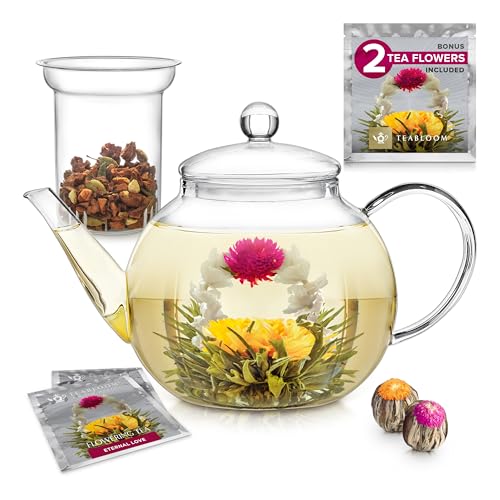
Teabloom Celebration Glass Teapot & Kettle, 27 oz
Badge: Best for Small Electric Kitchens
Strengths
- Stovetop and microwave safe per its maker — two electric heating routes in one compact pot.
- Removable glass infuser and heat-resistant glass handle loose leaf, bagged, and blooming teas.
- Two blooming teas included, and a kettle-and-teapot format that deletes a separate kettle from small counters.
Trade-offs
- Even with its stovetop claim, plain glass does not heat on induction — the microwave route is its induction answer.
- The glass infuser is delicate and wants careful washing.
- 27 oz serves one to two; families need the STNTUS.
Spec box
- Capacity: 27 oz
- Infuser: Removable glass infuser
- Stovetop: Stovetop and microwave safe per maker
- Material: Heat-resistant glass
- Included: 2 blooming teas
- Tea types named by maker: Loose leaf, bagged, and blooming
The Celebration is the electric kitchen’s opportunist. On a radiant or coil element it is a rated stovetop pot, heating its own water at a one-to-two person scale. In a microwave-only kitchenette — the student flat, the office, the bedsit where the hob is two rings and both are taken — it heats its water the other way, a trick none of its rivals here can perform. And on an induction hob, where its glass body cannot heat directly, the microwave rating rescues it from kettle-dependence: it remains a self-sufficient heating vessel by the second route. Add a specification that names loose leaf, bagged, and blooming tea, and this is the most adaptable 27 oz in electric kitchens, full stop.
The cautions are the glass infuser’s fragility and the induction caveat, which bears repeating because it is the most misunderstood point in this category: stovetop safe describes the glass’s tolerance for heat, not a promise that every hob can deliver heat to it. Know your hob type, and the Celebration will meet it on one of its two routes.
Best for: Small electric kitchens, microwave-only spaces, adaptable households / Not suited for: Family volumes or direct induction heating

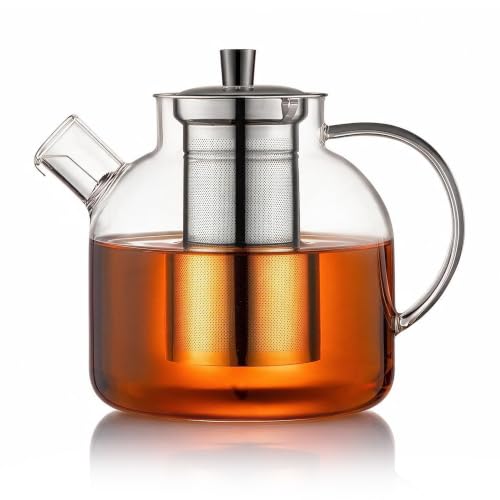
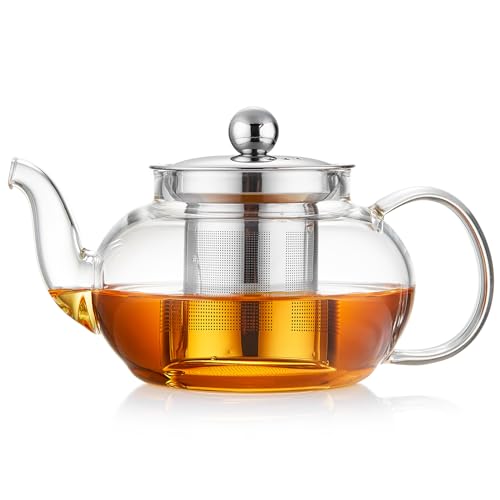
CNGLASS Glass Teapot Stovetop Safe with Removable Infuser, 20.3 oz
Badge: Best Compact Electric-Stove Boiler
Strengths
- Stovetop-safe rating at a compact 20.3 oz — a personal volume that comes to temperature quickly on a small element.
- Removable infuser for the loose leaf and blooming teas its maker names.
- Simple, single-system construction: easy to seat, easy to inspect, easy to clean.
Trade-offs
- 20.3 oz is a one-to-two person ceiling.
- On a large radiant zone, centre it carefully so the heat stays under the base.
- No microwave rating is stated — the element is its only heating route.
Spec box
- Capacity: 20.3 oz
- Infuser: Removable infuser
- Stovetop: Described as stovetop safe by the maker
- Tea types named by maker: Loose leaf and blooming tea
The CNGLASS is the rated boiler for the smallest electric kitchens and the simplest routines. A 20.3 oz volume on a small radiant zone or a well-matched coil reaches temperature quickly, which on electric heat matters twice: the element spends less time cycling at full draw, and the brewer spends less time supervising. It is the pot for the studio flat with a two-ring hob, the desk-adjacent kitchenette, the caravan that has moved from gas to a plug-in plate. Where the STNTUS is the family’s electric boiler, the CNGLASS is the individual’s — same rating, same single-vessel workflow, at the scale one person actually drinks. Readers comparing it against flame will find its sibling assessment in our guide to the Best Teapots For Loose Leaf Tea, which treats these same glass pots purely as brewers, heat source aside.
Match the element to the base. A small pot adrift on a large radiant zone wastes energy and invites a wandering hand to meet hot glass-top; centre it, use the smallest suitable zone, and let the rating do its work.
Best for: Solo electric-stove users and small hobs / Not suited for: Groups or induction hobs
DRNKNSTX Enchanted Tea Pot with Tea Infuser, 20 oz (Prose-Only: Kettle Companion)
Badge: Kettle Companion (Prose-Only)
Strengths
- A giftable glass steeper for loose leaf, well matched to herbal and dessert teas brewed from kettle water.
- 20 oz personal size suits an unhurried evening session at the counter, not the hob.
- Characterful presentation encourages new loose-leaf drinkers.
Trade-offs
- No stovetop claim anywhere in its listing — it must never touch an electric element.
- Entirely kettle-dependent for hot water.
- A steeper format built for prompt serving, not for holding heat.
Spec box
- Capacity: 20 oz
- Infuser: Tea infuser / steeper design for loose leaf
- Format: Glass tea maker and steeper, gift-oriented presentation
- Stovetop: NOT stated by the maker — keep off all elements
The DRNKNSTX closes the set as the third honest companion. Its listing describes an enchanted, gift-oriented glass steeper for loose leaf tea and claims nothing about stovetop use — so in an electric kitchen it belongs exactly where the DOPUDO and Enchanti belong: on the counter, filled from the kettle, brewing the forgiving teas that ask only for hot water and time. Herbal infusions and dessert blends are its home territory, and an electric kettle delivers their boiling water without the pot ever meeting an element. It is reviewed without a link or image under this guide’s labelling rule — links are reserved for pots recommendable for the keyword’s core purpose, heating on an electric stove — and readers who want it as a steeper should understand that this is a statement about its listing, not a defect in the object. As a kettle companion with personality, it earns its shelf space; as an electric-stove teapot, it is not a candidate, and no honest guide should present it as one.
Best for: Kettle owners wanting a characterful herbal steeper / Not suited for: Any contact with a heating element
Comparison Table
| Teapot | Capacity | Maker’s heating claim | Electric-stove verdict | Link |
|---|---|---|---|---|
| DOPUDO | 530ml | None stated | Kettle companion only | No link — prose-only |
| STNTUS | 1200ml | Stovetop safe | Rated for coil and radiant elements | Check on Amazon |
| Enchanti | 800ml | None stated | Kettle companion only | No link — prose-only |
| Teabloom Celebration | 27 oz | Stovetop + microwave safe | Rated for elements; microwave route for induction homes | Check on Amazon |
| CNGLASS | 20.3 oz | Stovetop safe | Rated for coil and radiant elements | Check on Amazon |
| DRNKNSTX | 20 oz | None stated | Kettle companion only | No link — prose-only |
How to Choose a Teapot for an Electric Stove: Know Your Hob First
Identify your element type before you shop. Coil elements are raised metal rings: they demand a pot whose base sits flat and fully supported across the coil, and they reward moderate settings because their heat arrives in pulses. Radiant elements hide under a smooth glass-ceramic top: they are the friendliest electric surface for rated glass pots, spreading heat evenly, provided the pot is lifted rather than slid and the top is kept clean, since burnt-on spills under a glass base create hot spots that stress both surfaces. Induction hobs look like radiant hobs and behave like nothing else in the kitchen: they heat only magnetic cookware, plain glass stays cold, and the correct teapot strategy is a kettle workflow or a microwave-rated pot like the Celebration. Solid-plate elements, found on older ranges, behave like slow coils — flat contact and patience.
Then demand the rating. With the hob identified, the pot’s listing must state stovetop safety — the maker’s words, for that model. Three pots here carry it; three do not, and the three that do not are not lesser products, they are different products, built for the kettle station. The expensive mistake in this category is assuming; the cheap habit is reading. If a listing’s wording is vague — “heat resistant” without “stovetop” — treat it as unrated and either ask the seller directly or choose a pot whose claim is plain.
Size the pot to the element and the drinker together. A pot much wider than its zone wastes energy and overheats the glass-top around it; a pot much smaller invites an off-centre seat. The CNGLASS belongs on small zones, the Celebration on small-to-medium, the STNTUS on the largest stable zone your hob offers. Match capacity to drinkers the same way — the family that buys the STNTUS will use its rating daily; the solo drinker who buys it will mostly heat air. Households whose menu leans delicate should also read our Best Teapots For Green Tea companion, because electric elements’ habit of overshooting makes the rested-water technique doubly important for greens.
Consider the microwave route honestly. In the smallest electric kitchens, the microwave is a legitimate water-heating appliance, and a pot rated for it — the Celebration alone here — collapses the whole tea station into one vessel and one socket. It is slower for full pots and less even than an element, but for one or two cups in a bedsit or office it is the difference between a tea ritual that exists and one that was never set up.
How to Heat and Brew on an Electric Stove: The Safe Method
Set up for contact. Clean, dry element; clean, dry pot base. Seat the pot centred on a zone matched to its base, filled with the water you need — never heat a rated glass pot empty or nearly empty. On coil elements, confirm the pot sits level and does not rock; a rocking pot concentrates heat and stress at the contact points.
Heat progressively. Start at a low-to-medium setting and step up if needed. Electric elements cycle on and off to hold a setting, and a moderate setting gives the glass a series of gentle pulses rather than a sustained maximum blast. Keep the lid on to shorten the process. Stay in the room: a pot on an element is an attended appliance, and electric heat’s silence makes it easier to forget than a hissing gas ring.
Mind the residual heat. When the water reaches the stage your tea wants — first bubbles for delicate greens if you are catching it early, a full boil for black tea — switch off and move the pot to a cold zone, a trivet, or a wooden board. An element that is “off” is still hot enough to keep cooking the water and stress the glass, and a brewed pot left sitting on it will stew its leaves while it waits. Steep off the heat, always.
Handle the hob kindly. Lift the pot; never drag it across a glass-ceramic top, which scratches and can chip the pot’s base in the same motion. Set a hot pot down only on heat-safe, dry, room-temperature surfaces — never a wet counter, a cold stone slab, or the sink. Let the pot cool before washing, and never run cold water into hot glass.
Care in an electric kitchen. Descale on schedule with a citric-acid soak; scale on the base insulates the glass from the element and makes heating slower and less even, which tempts owners into higher settings and longer exposure. Inspect the base regularly for chips — a chipped base on an element is a stress concentrator — and retire any pot whose base or walls crack, without a second tour of duty.
Troubleshooting.
- Problem: The pot does not heat at all on a smooth black hob → what to do: you almost certainly have induction. Plain glass cannot heat there; switch to a kettle workflow or the microwave route, and do not leave the pot sitting on the hob hoping.
- Problem: Heating is slow and uneven on a coil element → what to do: check the seat — the base must be flat, centred, and fully supported — and descale the base; choose a coil whose diameter matches the pot.
- Problem: The water overshoots the temperature delicate teas want → what to do: electric elements surge; heat with the lid off near the end, watch for the first bubble streams, and pull the pot early — the residual heat in the water will carry it the last few degrees.
- Problem: A burnt smell during heating → what to do: something is on the element or the glass-top. Switch off, let everything cool fully, and clean both surfaces before the next use; never investigate a hot element with a wet cloth.
Electric vs Gas for Glass Teapots: What Actually Differs
Owners moving between fuel types often ask whether a pot rated for one stove suits the other, and the honest answer is that the rating travels but the technique changes. Gas delivers heat around the base and up the sides if the flame is wide, responds instantly, and stops the moment it is off. Electric delivers heat through the base alone, responds slowly, cycles to hold temperature, and keeps giving heat after switch-off. For glass, the electric profile is in some ways gentler — no flame licking the handle zone, no sudden flare — and in one way more treacherous: the invisible residual heat that punishes a pot left sitting and a hand that forgets. A rated pot like the three linked here can live on either fuel happily, provided the cook adjusts the habits: flame discipline on gas, residual-heat discipline on electric. What never travels is the induction exception — the one hob type where the question is not technique but physics, and where the kettle companions reviewed above stop being a compromise and become the correct answer.
Setting Up a Tea Station Around an Electric Hob
The rated pots in this guide work best inside a small, deliberate station. Keep the brewing zone to one side of the hob, with a heat-safe trivet or wooden board permanently stationed beside it — the pot’s landing pad the moment it leaves the element, so no one ever improvises with a wet tea towel or a cold worktop. Keep the leaf tins, the infuser dish, and the mugs within one step, because a brewer who has to cross the kitchen mid-steep is a brewer who leaves a pot unattended on a live element. Kettle households should build the mirror image of the same station: kettle, brewer pot, and leaf in one triangle on the counter, with the hob uninvolved. In both arrangements, the principle is identical — everything within reach, nothing within the splash zone of other cooking, and a landing pad that is always in the same place. Fine, fast-extracting teas benefit most from that discipline; drinkers of rooibos and other robust infusions, covered in our guide to the Best Teapots For Infusion Tea Like Rooibos, will find the station forgiving, but the greens drinkers in the house will find it essential.
What About Portable and Plug-In Hot Plates?
A large share of electric-stove tea is actually made on portable single or double hot plates — in bedsits, offices, caravans, and student kitchens — and the rules of this guide apply to them unchanged, with one addition. Portable plates vary enormously in how honestly their dials map to heat, and their surfaces are often smaller than a family pot’s base. Treat the first boil on any new plate as a calibration: water only, moderate setting, full attention, and a note of which dial position behaves like a simmer and which like a surge. Compact rated pots — the CNGLASS above all — suit portable plates best, because their bases match the plate’s surface and their volumes forgive a fierce element. A final caution belongs to shared and temporary housing: if the plate is old, damaged, or borrowed, the kettle route with a companion pot is the wiser system, because the rating on the pot cannot compensate for an appliance whose own condition is unknown.
Energy and Running Costs: A Brief, Honest Word
Electric-stove households sometimes ask whether heating water in a pot on the hob costs more than a kettle, and the honest answer is that it depends on matching, not on the appliance category. An electric kettle heats water with an immersed or concealed element in an insulated body and is hard to beat for pure water-heating efficiency. A glass pot on a radiant zone loses some heat to the hob surface and the room, and an oversized zone under a small pot wastes visibly more. But the comparison that matters is the routine’s total: a pot that heats exactly the water it brews, once, can outperform a kettle habit that boils a full kettle for one mug three times a day and re-boils it twice more. The practical rules follow from that: heat only the water you need, match the zone to the base, keep the lid on, and never re-heat a pot that has gone cold for the sake of one cup — brew fresh at the right size instead. Households that follow those rules will find the difference between hob and kettle too small to measure on a bill, and can choose their workflow on the grounds that actually matter: space, habit, and the quality of the tea ritual itself.
Common Buying Mistakes
- Buying a glass pot for an induction hob. The most expensive misunderstanding in this category: plain glass and induction do not interact at all.
- Assuming “heat resistant” means “stovetop safe.” Only the maker’s explicit stovetop claim counts; three pots in this very guide lack it.
- Dragging the pot across a glass-top hob. One habit, two casualties: a scratched hob and a chipped pot base.
- Leaving the pot on a switched-off element. Residual heat keeps cooking the tea and stressing the glass long after the dial says zero.
- Maximum settings to save time. Moderate settings and a lid reach the boil with far less thermal drama.
Final Recommendation
On a coil or radiant electric hob, buy by household size from the three rated pots: the STNTUS 1200ml for families, the Teabloom Celebration for small and flexible kitchens — the only pot here that also heats in a microwave — and the CNGLASS for solo users on small zones. On an induction hob, skip the element entirely: run a kettle station and choose a brewer you love, knowing the DOPUDO, Enchanti, and DRNKNSTX reviewed above are exactly that, honestly labelled. Whatever your hob, read the listing’s own words before you buy, heat progressively, move the pot off the residual heat, and a rated glass teapot will make an electric kitchen feel like it was designed for tea. And if your kitchen turns out to be a kettle kitchen after all, take that verdict in good part: the companion pots in this guide brew beautifully beside a kettle, and the best electric-stove teapot is ultimately the one whose workflow you will still be enjoying, safely and without fuss, a year from now.
Frequently Asked Questions
Can I use a glass teapot on an induction hob?
No — not to heat it. Induction works only with magnetic cookware, and plain glass has no magnetic base, so the pot stays cold. None of the pots here claims an induction-compatible base. Induction owners should heat water in a compatible kettle and brew in any glass pot, or use a microwave-safe pot like the Teabloom Celebration to heat water by that route. Be wary of listings that imply induction compatibility for ordinary glass through vague wording about modern hobs; genuine induction-ready glass cookware is a distinct, explicitly engineered product, and none of the teapots in this guide claims to be one.
Which electric stove type is best for glass teapots?
Radiant glass-ceramic hobs, because they spread heat evenly across the pot’s base and present a flat, stable surface. Coil elements work well with a flat-seated, properly matched pot. Solid plates are slower but serviceable. Induction is the exception that does not work at all with plain glass.
How do I know if my teapot is safe for an electric stove?
Read the maker’s listing for your exact model and look for an explicit stovetop-safe statement. “Heat resistant,” attractive photographs on stoves, and claims made for other models do not count. If the words are absent — as they are for the DOPUDO, Enchanti, and DRNKNSTX — the pot is a kettle companion, and it should be used and enjoyed as one.
Why does my electric element make the water overshoot the right temperature?
Electric elements store heat and release it in cycles, so the water’s temperature keeps climbing briefly after the setting drops or the pot is at temperature. For delicate teas, heat with the lid off as you approach the target, watch for the first steady bubble streams, and pull the pot early; the water will coast to where you want it.
Can I leave a stovetop-safe teapot on the element to keep warm?
No. A switched-off electric element retains enough heat to keep the tea cooking and the glass stressed, and a pot left on a low setting will stew its leaves and risk boiling dry. Move the pot to a trivet or a cold zone, and if the tea must wait, decant it into a warmed serving vessel.
Is the microwave a sensible way to heat teapot water?
For small volumes in kitchens where the hob is busy, absent, or induction, yes — provided the pot is rated for it, as the Teabloom Celebration is. Microwave heating is slower and less even for full pots, so rest the water briefly before brewing delicate teas. Never put a pot in the microwave unless its maker rates it for microwave use.
Can I use a heat diffuser under a glass teapot on an electric element?
A diffuser plate can soften the pulses of a fierce coil element, and some glass owners swear by them, but it also slows heating and adds a layer of unpredictability between the dial and the pot. If you use one, it must be clean, flat, and rated for your hob type — never on a glass-ceramic top unless the hob’s maker allows it. The simpler discipline works for most households: a matched zone, a moderate setting, and a pot that is never left to boil dry.
Do stovetop-safe teapots work on portable hot plates?
Yes, with calibration. Portable plates vary widely in how their dials map to real heat, so run the first boil with water only, at a moderate setting, and learn the plate’s temper before trusting it with a daily routine. Compact pots with bases matched to the plate — the CNGLASS is the natural fit here — behave best; a family-size pot overhanging a small plate heats unevenly and should be avoided.
What should I do if a rated pot cracks on my electric stove?
Switch the element off, let everything cool completely without moving the pot if it is holding water precariously, and retire the pot once it is safe to handle. Do not heat cracked glass again. Then review the likely cause honestly — dry heating, maximum settings, cold shock, or a chip that predated the incident — because the replacement deserves the corrected habit.