Disclosure: topratedkitchenware.com is reader-supported. When you buy through links on our site, we may earn an affiliate commission from Amazon and other retailers, at no extra cost to you.
Where to buy
All six sets in this guide to the best measuring spoons for nootropics are current, verified listings, and each carries a direct link so you can check the latest price on Amazon before ordering. The six are the TILUCK Stainless Steel Measuring Cups and Spoons Set for a complete nesting system, the TILUCK Measuring Cups and Spoons Set of 6 with Coffee Scoop for a compact daily set, the THLHKD 6-Piece Measuring Spoons Set for small sizes running from 1/8 teaspoon upward, the Spring Chef Nesting Measuring Spoons Set of 7 for narrow rectangular bowls that enter jars and tubs, the Spring Chef Measuring Cups and Spoons Set of 14 with Leveler for the widest range with a leveling tool, and the Hudson Essentials Stainless Steel Measuring Spoons Set of 7 for jar-friendly classic spoons. If you want the set aimed most directly at small powder measures, start with the THLHKD set — Check on Amazon, then read the full guide below, including the important section on what spoons can and cannot measure.
Read the full guide ↓
Introduction: Small Powders, Small Spoons, and One Honest Caveat
People searching for the best measuring spoons for nootropics have a more specific job in mind than most spoon buyers. Nootropic powders — and the protein powders, creatine, and supplement blends that live beside them in many kitchens — are measured in small quantities, often from narrow tubs and jars, often daily, and often by people who care about consistency from one day to the next. That job rewards a particular kind of spoon set: one that reaches genuinely small sizes, fits inside supplement containers, has markings you can read at a glance, levels cleanly so each scoop matches the last, and is made of a material that will not hold the taste or smell of yesterday’s powder. The six stainless steel sets in this roundup were chosen against exactly that checklist.
The honest caveat belongs at the front, not buried at the back: a measuring spoon measures volume, not weight. Powders differ in density, and the same powder packs differently depending on humidity and how it was scooped, so a level teaspoon of one powder is not the same amount of substance as a level teaspoon of another — or even of the same powder on a different day. Where a product’s label gives its serving in spoon measures, a good spoon set is the right tool. Where a serving is given by weight, the right tool is a small kitchen scale, and no spoon in this guide pretends otherwise. What spoons do superbly is repeatability within your own routine: the same spoon, filled and leveled the same way, from the same tub, gives you a consistency that scooping freehand never will. This guide is about choosing the spoons that deliver that consistency best — and about the technique that makes the consistency real.
Key Takeaways
- Spoons measure volume, not weight; use them where labels speak in spoon measures, and use a small scale where labels speak in grams.
- The THLHKD set is the most directly aimed at this use: sizes from 1/8 teaspoon to 1 tablespoon, clear markings, and protein powder named in its listing.
- Container access matters daily — narrow and rectangular bowls, like the Spring Chef set of 7 and the Hudson Essentials set, enter tubs and jars that round bowls cannot.
- A leveler turns a variable heap into a repeatable measure; the Spring Chef set of 14 includes one and covers cups as well.
- Stainless steel is the right material for powders: it does not hold odors or flavors between different products.
- Consistency is a technique before it is a product — same spoon, same fill, same level, every day.
In this guide
Quick Picks
| Pick | Badge | Set | Standout trait from its listing | Link |
|---|---|---|---|---|
| TILUCK Measuring Cups and Spoons Set | Best Complete System | Cups and spoons, 10 pieces | Nesting stainless steel cups and spoons for cooking and baking measures in one system | Check on Amazon |
| TILUCK Cups and Spoons Set of 6 | Best Compact Daily Set | Set of 6 with coffee scoop spoon | Stainless steel set with a coffee scoop for daily drink and powder routines | Check on Amazon |
| THLHKD Measuring Spoons Set | Best for Small Powder Measures | 6 pieces, 1/8 tsp to 1 tbsp | Clear size markings; listing names coffee, spices, and protein powder | Check on Amazon |
| Spring Chef Nesting Measuring Spoons | Best for Narrow Containers | Set of 7 with leveler | Rectangular bowls fit in spice jars, long handles, nesting storage | Check on Amazon |
| Spring Chef Cups and Spoons Set of 14 | Best Full Range with Leveler | Set of 14 with leveler | Nesting metal cups plus rectangular spoons for dry and liquid ingredients | Check on Amazon |
| Hudson Essentials Measuring Spoons | Best Jar-Friendly Classic | Set of 7 | Stainless steel spoons for dry or liquid, shaped to fit in spice jars | Check on Amazon |
How These Picks Were Chosen
This is a research-led roundup built from verified product listings, and the shortlist was filtered for the powder routine specifically. We required stainless steel, because powders are exactly the ingredients that expose plastic’s weaknesses — fine particles cling, flavors linger, and a spoon that smells of the last product is a poor tool for measuring the next one. We required spoon ranges that reach the small end, because supplement and nootropic quantities live in the fractional teaspoons. We weighted container access heavily, since most powders are stored in the tubs and jars they were sold in, and a spoon that cannot enter the container forces the shake-and-guess method this purchase is meant to end. And we noted which sets include a leveler, because leveling is what turns a spoon from a scoop into a measure.
Three of the six are cups-and-spoons systems rather than spoons alone; they are included deliberately and labeled as such, because powder routines rarely live alone — the same household is usually measuring coffee, baking ingredients, and drink mixes with the same drawer of tools, a pattern the broader comparison at Best Measuring Spoons Set covers in full. Specifications in the mini spec boxes come only from each set’s own listing, and where a listing is silent, we leave the detail out. One more rule governed this guide in particular: it makes no claims about any supplement itself. This is a guide to measuring tools and measuring technique, and it treats every powder the same way — as a material to be portioned consistently, according to its own label’s directions.
The 6 Best Measuring Spoons for Nootropics

TILUCK Stainless Steel Measuring Cups and Spoons Set (10)
Badge: Best Complete System
Strengths
- Cups and spoons in one matched, nesting stainless steel system of 10 pieces.
- One system covers the powder routine and the rest of the kitchen’s measuring.
- Nesting storage keeps the whole set together in one drawer corner.
Trade-offs
- The listing does not detail the smallest spoon size, which matters for this use.
- If you only ever measure powders, the cups are extra pieces to store.
- No leveler is mentioned in its listing.
Mini spec box
- Material: Stainless steel
- Pieces: 10, cups and spoons
- Storage: Nesting
- Use: Cooking and baking
The TILUCK 10-piece system is the choice for the household whose powder routine is one part of a larger measuring life. Its virtue is completeness in a single material: stainless steel cups for the drink mixes and baking, stainless steel spoons for the small quantities, all nesting into one storage footprint and all sharing the same easy-cleaning, odor-neutral character that powders demand. A supplement spoon that lives in the same system as everything else you measure is a spoon that stays findable, and findability is an underrated feature in a daily routine — the best routine is the one with no friction in it.
Its limits for this specific keyword are about information rather than quality. The listing presents the system as a whole and does not call out the smallest spoon in the set, and for nootropic-style measuring the small end is where the action is; shoppers for whom fractional teaspoons are the entire point should compare this set’s range carefully against the THLHKD below, whose listing leads with exactly that detail. Likewise, no leveler is mentioned, so leveling falls to the knife-back method. None of that prevents this from being the best single purchase for a kitchen being equipped from scratch — it simply means the specialist buyer should read its spoon range on the product page before deciding.
Best for: Households equipping a complete measuring system for powders and general cooking alike / Not suited for: Specialists who need a confirmed 1/8-teaspoon size above all else

TILUCK Stainless Steel Measuring Cups and Spoons Set of 6
Badge: Best Compact Daily Set
Strengths
- Includes a coffee scoop spoon — the anchor of most morning powder routines.
- Compact six-piece system in stainless steel for daily use.
- Cups and spoons together cover drinks, powders, and ordinary cooking.
Trade-offs
- A tighter range than the 10-piece system from the same brand.
- The listing focuses on the set as a whole rather than spoon-by-spoon detail.
- No leveler is mentioned in its listing.
Mini spec box
- Material: Stainless steel
- Pieces: Set of 6, cups and spoons
- Extra: Coffee scoop spoon
- Use: Cooking and baking
The smaller TILUCK set understands the shape of an actual morning. For most people building a powder routine, the anchor drink is coffee or a coffee-adjacent drink, and this set includes a dedicated coffee scoop spoon alongside its cups and spoons — a small inclusion that turns the whole routine into one drawer, one set, one habit. Six stainless steel pieces will not cover every baking project ever attempted, but they cover the daily cycle of drinks and powders with room to spare, and they do it in a material that rinses clean between products without carrying flavors across.
Between the two TILUCK sets, the choice is about range versus footprint. This six-piece set is the one for a compact kitchen or a single-person routine; the 10-piece is the one for a household that bakes. For the nootropics use specifically, both share the same caveat — their listings describe the system rather than spotlighting the smallest spoon — so the buyer whose routine depends on a particular fractional size should confirm that size on the product page. As a daily-routine set at the qualitative lower-cost end of this roundup’s systems, it is easy to recommend; routines succeed on convenience far more often than on completeness.
Best for: Daily coffee-and-powder routines in compact kitchens / Not suited for: Buyers who need the widest confirmed spoon range in one purchase

THLHKD Measuring Spoons Set, 6 Pieces
Badge: Best for Small Powder Measures
Strengths
- Size range runs from 1/8 teaspoon to 1 tablespoon — the small end this use depends on.
- Clear size markings for fast, correct identification mid-routine.
- Its listing names protein powder directly, alongside coffee and spices.
Trade-offs
- Spoons only — no cups in this set.
- No leveler is mentioned in its listing, so leveling is by knife or straight edge.
- Six pieces is a focused range, not an expansive one.
Mini spec box
- Material: Stainless steel
- Pieces: 6
- Size range: 1/8 tsp to 1 tbsp, per its listing
- Markings: Clear size markings
- Use: Dry and liquid ingredients, coffee, spices, protein powder
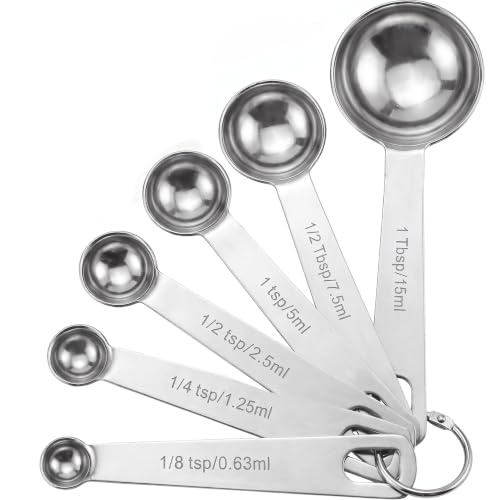
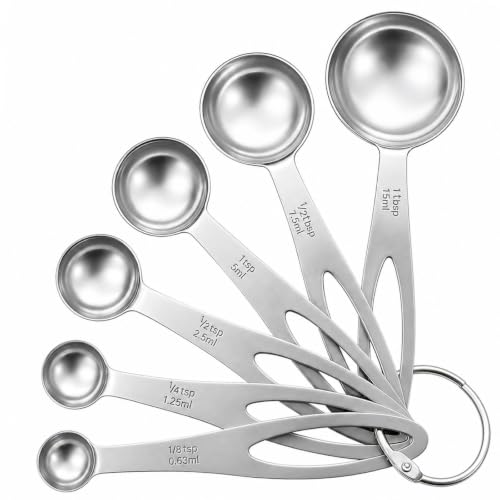
The THLHKD is the set in this roundup that was plainly designed with this reader in mind. Start with the range: 1/8 teaspoon to 1 tablespoon covers the territory where supplement and nootropic quantities actually live, including the fractional measures that many general-purpose sets skip entirely. Continue with the markings: clear size markings are the difference between a routine that flows and one that involves holding spoons up to the light. And finish with the listing’s own words, which name protein powder alongside coffee and spices as intended uses — the maker is telling you, in so many words, that fine powders are this set’s home ground.
Used well, this is the set that makes a spoon-based routine as consistent as a spoon-based routine can be: same spoon, dipped the same way, leveled the same way, every morning. Its boundaries are scope boundaries. It will not help you with cup measures, it bundles no leveler, and — like every spoon ever made — it measures volume, so where a label doses by weight it is a companion to a scale, not a replacement for one. Within its intended job, though, it is the most precisely aimed set on this page, and the community experiences gathered in Best Measuring Spoons Reddit suggest that small-size range and legible markings are exactly what powder users end up valuing most.
Best for: Powder routines built on fractional teaspoons and clear, fast identification / Not suited for: Households wanting cups included in the same purchase
Spring Chef Nesting Measuring Spoons, Set of 7
Badge: Best for Narrow Containers
Strengths
- Rectangular bowls fit inside jars and tubs that round bowls cannot enter.
- Long handles reach deep containers without fingers brushing the rim.
- Includes a leveler — the consistency tool — and nests for storage.
Trade-offs
- Rectangular bowls feel less natural for liquids than round bowls.
- The listing does not spotlight a 1/8-teaspoon size for the smallest measures.
- Seven pieces is a mid-size range among the sets here.
Mini spec box
- Material: Stainless steel
- Pieces: Set of 7
- Bowl shape: Rectangular, fits in spice jars
- Handles: Long handle design
- Extras: Leveler included
- Storage: Nesting
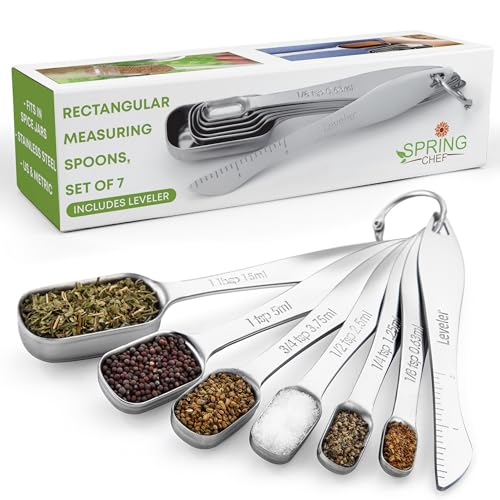
Powders live in containers, and containers have mouths, and the mismatch between round spoons and narrow mouths is the daily friction of supplement measuring. The Spring Chef set of 7 attacks that friction directly: rectangular bowls shaped to fit inside spice jars, long handles that reach to the bottom of a deep tub, and a leveler that lets you flatten the spoonful against the container’s own rim so the excess falls back in rather than onto the counter. For a routine performed over an open tub every morning, that combination — access, reach, and in-place leveling — is worth more than an extra spoon size or two.
The set’s specialization cuts the other way for liquids, where rectangular bowls pour less intuitively, and its listing does not make the small-size promise the THLHKD makes, so the two sets divide this keyword between them: THLHKD for the smallest measures, Spring Chef for the narrowest containers. Many serious powder users will recognize their own routine in one description or the other immediately. The nesting storage completes a design that respects the routine’s rhythm — out of the drawer as one stack, back into the drawer as one stack — and the testing-focused discussion at Best Measuring Spoons Serious Eats makes a parallel case for narrow bowls wherever jars are involved.
Best for: Powders stored in narrow tubs and jars, and anyone who levels at the container rim / Not suited for: Routines dominated by the very smallest fractional measures

Spring Chef Stainless Steel Measuring Cups and Spoons Set of 14 with Leveler
Badge: Best Full Range with Leveler
Strengths
- The largest system here — 14 pieces of nesting metal cups and spoons.
- Includes a leveler, the single most useful accessory for repeatable powder measures.
- Rectangular spoon bowls carry the jar-access advantage into the full system.
Trade-offs
- Fourteen pieces is a real drawer commitment for a powder-only user.
- The system’s breadth means its spoons share the stage with cups you may not need.
- More pieces means more discipline required to keep the set together.
Mini spec box
- Material: Stainless steel
- Pieces: Set of 14, cups and spoons, with leveler
- Spoon shape: Rectangular teaspoon and tablespoon bowls
- Storage: Nesting
- Use: Dry and liquid ingredients
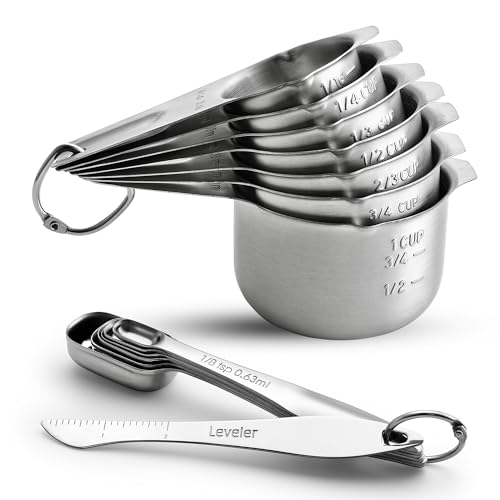
If the powder routine shares a kitchen with serious baking, the Spring Chef set of 14 is the one-purchase answer to both. It combines nesting stainless steel measuring cups with rectangular measuring spoons — the jar-friendly bowl shape from its smaller sibling — and includes the leveler that turns scooping into measuring. For the nootropics use specifically, that leveler is the headline: the difference between a heaped teaspoon and a leveled one is the largest uncontrolled variable in any spoon-based routine, and this set builds the control into the box rather than leaving it to a knife drawer.
The cost of completeness is footprint and housekeeping. Fourteen pieces nest, but they nest into a substantial object, and a set this size stays a set only if its owner returns every piece to the stack — a small discipline that daily routines either build or abandon within the first month. Powder-only users should honestly ask whether they will ever touch the cups; if not, the THLHKD or the smaller Spring Chef set serves the same routine with less to store. But for the household that measures everything from fractional teaspoons of powder to cups of flour, this is the most capable single system in the roundup, and the editorial comparisons at Best Measuring Spoons Sweethome similarly reward sets that pair range with a leveler.
Best for: Households combining a powder routine with regular baking and full-range measuring / Not suited for: Powder-only users in small kitchens

Hudson Essentials Stainless Steel Measuring Spoons, Set of 7
Badge: Best Jar-Friendly Classic
Strengths
- Shaped to fit in spice jars — container access in a classic round-set format.
- Stainless steel construction for dry or liquid ingredients.
- A straightforward seven-piece range without system bulk.
Trade-offs
- No leveler is mentioned in its listing.
- The listing gives less detail on the smallest sizes than the THLHKD’s does.
- Spoons only — no cups, by design.
Mini spec box
- Material: Stainless steel
- Pieces: Set of 7
- Design: Fits in spice jars
- Use: Dry or liquid ingredients
The Hudson Essentials set is the classicist’s answer to the container problem. Rather than rectangular bowls, it keeps a traditional spoon profile and shapes the set to fit in spice jars — the listing says so directly — which makes it the natural choice for the cook whose powders live in jars rather than wide tubs and who prefers familiar round-bowl handling for everything else. Seven stainless steel pieces cover the working range for dry and liquid ingredients, with no cups, no system, and nothing to learn.
Its trade-offs are the familiar ones for a focused set: no leveler in the listing, and less published detail about its smallest sizes than the specialist THLHKD offers, so buyers whose routine hinges on one fractional size should confirm it on the product page. Within those bounds it is a quietly excellent fit for this keyword’s real-world version — a jar of powder on a shelf, a spoon that can actually get into it, and a measure that comes out the same every day. Kitchens that also measure sticky ingredients will find the shape discussion continues usefully in Best Measuring Spoons For Peanut Butter, where release and cleaning get their own examination.
Best for: Jar-stored powders and cooks who want jar access in a classic spoon format / Not suited for: Buyers wanting a bundled leveler or a cups-and-spoons system
Comparison Table
| Set | Material | Pieces | Small-size / access trait | Leveler | Link |
|---|---|---|---|---|---|
| TILUCK 10-Piece | Stainless steel | 10, cups and spoons | Complete nesting system | Not listed | Check on Amazon |
| TILUCK Set of 6 | Stainless steel | 6, cups and spoons | Coffee scoop spoon included | Not listed | Check on Amazon |
| THLHKD | Stainless steel | 6 | 1/8 tsp to 1 tbsp, clear markings | Not listed | Check on Amazon |
| Spring Chef Nesting | Stainless steel | 7 | Rectangular bowls fit jars, long handles | Included | Check on Amazon |
| Spring Chef Set of 14 | Stainless steel | 14, cups and spoons | Rectangular spoons in a full system | Included | Check on Amazon |
| Hudson Essentials | Stainless steel | 7 | Fits in spice jars | Not listed | Check on Amazon |
How to Choose Measuring Spoons for a Powder Routine
Choose in the order your routine actually encounters problems. First, the small end: list the quantities your labels and habits actually use, and make sure the set covers them — for most powder routines that means a genuine 1/8 or 1/4 teaspoon, which is why the THLHKD’s stated range matters. Second, the container: look at the tubs and jars on your shelf and measure their mouths against bowl shapes honestly. Narrow mouths want rectangular or jar-shaped bowls; wide tubs forgive anything. Third, the leveler question: if your routine’s credibility depends on repeatability, a set with a leveler — or the discipline to use a knife back every single time — is not optional equipment. Fourth, markings: you will read these spoons daily, often early and in poor light, so clear, durable size markings are a daily-quality-of-life feature, not a detail.
Fifth, material discipline: stainless steel across every set here is deliberate, because powders punish absorbent materials. A steel spoon rinsed and dried between products carries nothing forward; that neutrality is what lets one set serve a whole shelf of different powders. Finally, decide your system’s scope. A powder-only routine is best served by a focused spoon set; a routine embedded in a baking household is best served by one of the systems. What you should not do is buy range you will never use to compensate for a gap at the small end you will use daily — in this category, the smallest spoon is the product, and everything else is supporting cast. The hands-on perspective collected at Best Measuring Spoons Kitchn reinforces the same ordering: coverage of your actual sizes first, features second.
How to Measure Powders Consistently: Technique, Cleaning, and Troubleshooting
Consistency is a procedure, and it has four steps. One: always take the powder from the same state — give the tub the same gentle shake or none, because settled and fluffy powder fill a spoon differently. Two: dip the spoon the same way every time, straight down and out, rather than scooping along the surface on some days and digging on others. Three: level every spoon, every time, with the leveler or a knife back drawn across the bowl in one motion — this single step removes more variation than any other choice you will make. Four: if a label gives a serving by weight, weigh it, at least until you have learned what that weight looks like in your spoon with that powder; after that calibration, the spoon can carry the daily routine and the scale can audit it occasionally.
Cleaning between powders matters more in this use than in baking. Rinse and fully dry the spoon before moving to a different product, both for flavor neutrality and to keep moisture out of dry tubs — a damp spoon dipped into powder cakes the surface it touches and changes how the next spoonful fills. Store the set together and dry, and keep the routine’s spoons in the same place as the tubs if you can; a routine whose tools live together is a routine that survives busy mornings.
Troubleshooting follows a short pattern. Problem: the same spoon seems to give different amounts day to day → the powder’s packing is changing; standardize the pre-shake and the dip, and re-check against a scale if the label doses by weight. Problem: powder clings to the spoon and will not release → the spoon or the powder is carrying moisture or static; dry the spoon thoroughly and tap rather than shake it over the glass. Problem: the spoon will not fit the tub → that is a bowl-shape limit, not a technique failure; a rectangular or jar-shaped set is the real fix, and decanting into a wider jar is the workaround until then.
Volume Is Not Weight: The Honest Limit of Every Spoon
This section exists because a responsible guide to this keyword has to say the quiet part in full sentences. A teaspoon is a unit of volume. Powders are substances with densities, and those densities vary between products — and vary within one product depending on how finely it is milled, how it settled in shipping, and how humid the kitchen is. Two level teaspoons of two different powders can contain meaningfully different amounts of the substances themselves, and even the same powder can drift as a tub settles over weeks. None of this makes spoons useless; it defines their proper job. Where a manufacturer expresses a serving in spoons, the spoon is the manufacturer’s own chosen instrument and a good set serves you exactly as intended. Where a serving is expressed by weight, the manufacturer is telling you the spoon is not precise enough for their product, and the correct response is a small scale, not a more expensive spoon.
The practical synthesis most careful users arrive at is a partnership: scale for calibration and for weight-based labels, spoons for the daily rhythm. Learn what your serving looks like in your chosen spoon, filled your chosen way, and the spoon becomes a reliable proxy you can audit whenever a new tub arrives. That is the most any honest guide can promise from a set of spoons — and, used that way, it is genuinely enough for a consistent routine.
Building a Repeatable Morning Routine Around Your Spoons
Routines fail from friction, not from ignorance, so design yours to be frictionless. Keep the tubs, the spoon set, and the glass or shaker in one zone of the kitchen, in the order you use them. Use the same spoon for the same product every day — many users quietly dedicate the 1/2 teaspoon to one powder and the 1/8 to another, which removes the reading step entirely once the habit forms. Level over the tub, not over the glass, so the excess returns to the supply instead of the counter. Rinse and dry the spoons as the last step of the routine rather than leaving them for later, because a routine that ends clean starts clean, and a spoon left powdery in a drawer will eventually be a spoon you do not trust.
Finally, audit yourself occasionally. Once in a while — when a new tub opens, or when a routine starts feeling different — re-check your spoon measure against the label’s directions or a scale. Powders change between batches and brands, and the audit is what keeps a comfortable habit from drifting into a different routine than the one you intended. The spoons in this guide were chosen to make that whole cycle — reach, dip, level, rinse, store — as smooth as the tools allow. The rest is simply doing it the same way tomorrow.
Organizing a Multi-Powder Shelf Without Cross-Contamination
Many readers of this keyword measure more than one powder, and the moment a second tub joins the shelf, organization becomes part of accuracy. The core rule is simple: a spoon that goes into one product should be clean and dry before it goes into another. That is partly about flavor — nobody wants yesterday’s berry blend haunting today’s unflavored powder — and partly about purity, because powders are precisely the ingredients where a damp or residue-carrying spoon changes what it touches. Stainless steel makes the discipline easy, since a rinse and a thorough dry return the spoon to neutral in seconds, but the discipline still has to exist. Households with several daily powders often solve it structurally instead: one small set, or even one dedicated spoon size, per staple product, stored with that product. The sets in this roundup are inexpensive enough as a class that dedicating a THLHKD to the powder shelf and keeping a general set in the baking drawer is a rational layout, not an extravagance.
Labeling is the other half of shelf organization, and it is a measuring issue, not a tidiness issue. When three tubs of pale powder sit side by side, the risk is not measuring badly — it is measuring the wrong product beautifully. Keep tubs in a fixed order, keep their labels facing out, and finish one product’s measure completely — spoon rinsed or set down — before opening the next container. It sounds ceremonial, but a routine is a ceremony you have optimized, and the two minutes of orderliness are what stand between a consistent practice and a confident mistake. The spoons support all of this best when they live with the tubs rather than across the kitchen: a set stored at the point of use gets used properly, while a set stored elsewhere invites the nearest teaspoon from the cutlery drawer, which is not a measuring spoon at all.
When You Change Brands, Products, or Forms
The most dangerous moment in a spoon-based routine is not the first day — it is the day something changes. A new brand of the same kind of powder may be milled finer or coarser than the old one, and a level spoon of it can hold a noticeably different amount. A product may switch its label from spoon measures to weight, or change its serving size entirely, while the tub on your shelf looks reassuringly similar to the last one. Even the same product can behave differently in a fresh, fluffy tub than it did settled at the bottom of the old one. The defense is a habit this guide has mentioned before and will repeat once more because it matters: every change re-opens the calibration question. Read the new label in full, follow its stated method, and if it speaks in weight, weigh your first servings and learn what they look like in your spoon before trusting the spoon alone again.
Form changes deserve the same respect. Powders that arrive as capsules, gummies, or ready-to-drink versions of something you used to scoop are not interchangeable with the powder by spoon logic, and a routine built around one form should never be casually transferred to another. This guide’s scope is deliberately narrow — spoons, powders, and the space between a label’s directions and your hand — and staying inside that scope is what keeps a simple kitchen routine simple. When a product’s own directions and your habits disagree, the directions win, every time; the spoons are there to execute them consistently, not to improvise around them.
Common Buying Mistakes
The first mistake is buying a beautiful general set that never reaches the small sizes your routine uses, then guessing the fractional measures the purchase was meant to eliminate. The second is ignoring the container: a round spoon and a narrow tub will annoy you every single morning, predictably and forever. Third, shoppers skip the leveler question and then wonder why their “consistent” routine varies — the heap was the variation. Fourth, buyers treat spoons as weight instruments for weight-labeled products, a category error no set can fix. And fifth, people buy a sprawling system for a powder-only routine and then lose the one small spoon they needed inside a fourteen-piece stack they never fully use. Buy for the routine you actually have: small sizes covered, container access solved, leveling built in, steel throughout.
Final Recommendation
For the powder routine itself, start with the THLHKD set: its 1/8-teaspoon-to-tablespoon range, clear markings, and powder-focused listing aim it directly at this job. If your powders live in narrow tubs, choose the Spring Chef Set of 7 for its rectangular bowls and leveler, or the Hudson Essentials for jar access in a classic shape. Households that measure everything should step up to the Spring Chef Set of 14, and compact daily routines are best served by the smaller TILUCK set, with the 10-piece TILUCK as the full-system option. Whichever you choose, pair it with the technique in this guide — same spoon, same dip, level every time, and a scale for anything labeled by weight — and your routine will be as consistent as measuring by spoon can honestly be.
One last thought for the reader building this routine from zero: start smaller than you think. One tub, one spoon size, one label read carefully, and one week of doing it identically will teach you more about your own measuring than any roundup can — including this one. Add products and complexity only when the simple version has become boring, because boring is what a good routine feels like from the inside. The sets above were chosen to disappear into that boredom gracefully: found instantly, read at a glance, leveled without thought, and rinsed without complaint, morning after morning, in the ordinary kitchen light of an ordinary day, by hands that are still half asleep and a mind that is already thinking about everything except measuring — which is, in the end, exactly the working condition every tool in this guide was selected to survive.
Frequently Asked Questions
Can measuring spoons replace a scale for nootropic powders?
Not where a label doses by weight. Spoons measure volume, and powder density varies between products and even between tubs of the same product. Use spoons confidently where labels give spoon measures, and use a small scale where they give grams — or use the scale to calibrate what a weight-based serving looks like in your spoon, then audit that proxy whenever a new tub arrives.
What is the most important spoon size for powder routines?
The small end does the work: fractional teaspoons, down to 1/8 teaspoon in the THLHKD set’s case, cover the quantities supplement and nootropic labels most often use. A set that skips the fractions forces pinches and guesses at exactly the quantities where consistency matters most, which is why range at the small end outranks total piece count for this use.
Why do rectangular spoons matter for supplements?
Because powders are stored in their tubs and jars, and many of those containers have mouths too narrow for round bowls. Rectangular bowls enter, fill, and level at the rim without decanting or shaking powder out into your hand first. If your containers are wide-mouthed, the advantage fades; if they are narrow, it is the difference between measuring and improvising.
How do I keep powder measures consistent from day to day?
Standardize the whole motion: same spoon, same treatment of the tub before dipping, same dip, and a leveled top every time. Most inconsistency comes from the heap, not the spoon. Rinse and dry the spoon between different products, and re-check your spoon against the label or a scale when a new tub or brand enters the routine.
Is stainless steel really better than plastic for powders?
For this use, yes. Fine powders cling to and flavor-retain in plastic over time, and plastic bowls can flex when digging into a packed tub. Stainless steel rinses neutral, keeps its shape, and its markings stay readable — which is why every set in this roundup is steel. One set can then serve a whole shelf of different powders without carrying any of them into the next.
Should I dedicate one spoon set to powders and keep another for baking?
It is a sensible layout if your routine is daily. A powder-dedicated set that lives with the tubs is always where the routine happens, never lost in a baking drawer, and never carrying butter or spice residue into a supplement. Several sets in this roundup are modest enough as purchases that dedicating one is practical. Households with occasional powder use can share one set happily — the rinse-and-dry discipline between products is what matters, not the number of sets you own.
What should I do if my spoon will not fit my supplement tub?
Treat it as a shape problem with two solutions: switch to a narrow or rectangular set — two in this guide are designed for jar access — or decant the powder into a wider, airtight jar you can measure from comfortably. Do not settle for shaking powder into your palm and estimating; that workaround quietly destroys the consistency the spoons were bought to create.