Disclosure: topratedkitchenware.com is reader-supported. When you buy through links on our site, we may earn an affiliate commission from Amazon and other retailers, at no extra cost to you.
Where to buy
Looking for the best professional measuring spoons, the kind that survive daily volume and keep a whole kitchen consistent? The six sets below are this guide’s recommendations, in review order. Each name links to its Amazon listing, where you can check the latest price on Amazon and confirm the stated construction and sizes.
- Rena Chris 6-Piece Heavy Duty Stainless Steel Measuring Spoons Set — Check on Amazon
- Spring Chef Stainless Steel Magnetic Measuring Spoons Set of 8, Black
- TILUCK Stainless Steel Measuring Cups and Spoons Set of 10
- TILUCK Stainless Steel Measuring Cups and Spoons Set of 6 with Coffee Scoop
- THLHKD 6-Piece Stainless Steel Measuring Spoons Set
- Spring Chef Nesting Stainless Steel Measuring Spoons Set of 7 with Leveler
Read the full guide ↓ for what professional use actually demands of a spoon set, which stated features answer those demands, and where the honest limits of home-market sets sit, including the standardization, backup, and training systems that turn a good purchase into a reliable station standard.
Professional measuring is not really about prestige; it is about repetition under pressure. A spoon set in a working kitchen, a bakery program, a cooking school, or a serious home test kitchen is used dozens of times a day, washed constantly, grabbed by different hands, and expected to deliver the same teaspoon at 7 in the morning and at the end of service. The best professional measuring spoons are therefore chosen on unglamorous criteria: construction that resists bending, markings that stay legible through constant washing, a size ladder complete enough that no cook in the room has to estimate, accessories like a leveler that standardize technique across people, and storage that keeps the set complete on a crowded station. This guide evaluates six stainless steel sets against exactly those demands, crediting only what each listing states, including the one set that puts heavy duty in its name and the sets that state dishwasher-safe care. It is equally honest about the boundary: these are high-quality sets from the home market assessed for professional-style work, and high-volume operations should read the sections on backups and standardization before equipping a whole kitchen around any single purchase. Along the way it covers the operational details that decide whether a good set stays good in service: training new cooks on a written standard, the true economics of durability against repeated replacement, hygiene and washing at volume, and the fit between each set and the station, spice, pastry, beverage, or general, where it will actually earn its living.
Key Takeaways
- Professional use punishes weak construction first: rigid, heavy duty stainless steel is the entry requirement, and one set here states it outright.
- Consistency across cooks is the real professional standard, and a leveler plus readable markings are the tools that create it.
- Dishwasher-safe construction, stated on one set here, matters when a set is washed many times a day.
- A complete stated size ladder prevents estimation, which multiplies dangerously when several people cook from one recipe.
- Professional kitchens standardize on one set and keep an identical backup; the set you can re-order is part of the specification.
- Jar-fit and long-handle designs earn their keep at a spice station, where most small measuring in service actually happens.
- Buy by station rather than by slogan: spice, pastry, beverage, and general stations reward different features, and one set rarely wins all four rooms.
- Washing is a specification at volume: simple forms and stated dishwasher-safe care decide whether a set gets washed properly or merely washed eventually.
In this guide
Quick Picks
| Pick | Badge | Set size | Professional-relevant feature from the listing | Link |
|---|---|---|---|---|
| Rena Chris Set of 6 | Best Heavy-Duty Build | 6 spoons | Heavy duty stainless steel, metric and US measurements | Check on Amazon |
| Spring Chef Magnetic Set of 8 | Best for High-Volume Routines | 8 spoons plus leveler | Dishwasher safe, dual sided, leveler included | Check on Amazon |
| TILUCK Set of 10 | Best Complete Station Kit | 10 pieces, cups and spoons | Nesting steel system for cooking and baking stations | Check on Amazon |
| TILUCK Set of 6 | Best Compact Station Kit | 6 pieces | Cups, spoons, and a coffee scoop for beverage work | Check on Amazon |
| THLHKD Set of 6 | Best Readability | 6 spoons | Clear size markings, 1/8 tsp to 1 tbsp range | Check on Amazon |
| Spring Chef Set of 7 | Best for the Spice Station | 7 spoons plus leveler | Rectangular jar-fit heads, long handle, leveler | Check on Amazon |
How These Picks Were Chosen
This is a research-led guide. Sets were evaluated on the demands of repeated, multi-cook use: stated construction strength, with heavy duty language credited where a manufacturer uses it; marking clarity, because a set read by many hands in poor light must be legible at a glance; size coverage, because estimation is a worse fault in a shared kitchen than in a solo one; included levelers, because they standardize the most variable step across cooks; stated dishwasher-safe care, because washing frequency is the tax professional use collects; and storage systems that keep sets complete and ordered on a station. Only listing-stated facts appear in the spec boxes, and no commercial certifications are claimed for any set, because none are stated. Prices are not printed since they change; check the latest price on Amazon through the links. For the quality-first home comparison, see Best Quality Measuring Cups And Spoons, and for the full-set framing, Best Set Of Measuring Spoons.
The 6 Best Professional Measuring Spoons

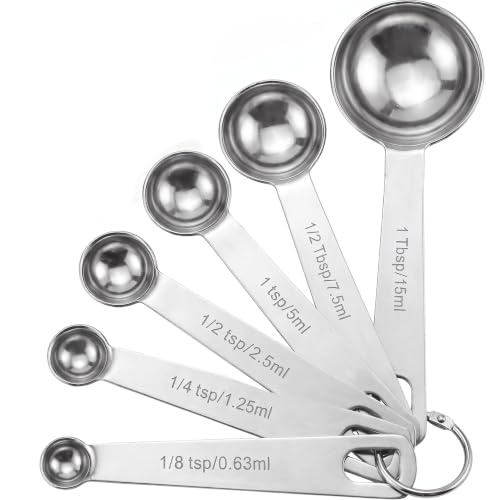
Rena Chris 6-Piece Heavy Duty Stainless Steel Measuring Spoons Set
Badge: Best Heavy-Duty Build
Strengths
- Heavy duty stainless steel is stated in the listing, the construction language professional buyers look for first.
- Metric and US measurements serve kitchens working from international recipes and formulas.
- A focused six-piece set minimizes wrong grabs during fast work.
Trade-offs
- Six pieces leave some intermediate amounts to combining.
- No leveler is included for standardizing across cooks.
- The small-tablespoon profile is compact rather than deep-bowled for liquids.
Mini spec box
- Material: stainless steel, heavy duty
- Pieces: 6
- Design note: small tablespoon
- Measurements: metric and US
- Use: dry and liquid ingredients
Professional evaluation starts with survival, and this is the set whose listing speaks that language directly. Heavy duty construction is the difference between a spoon that keeps its volume through a year of daily service and one that slowly bends at the handle neck, changing its measure without announcing the change. In a multi-cook kitchen that silent drift is a quality-control failure, because every cook trusts the tool and the tool has quietly stopped deserving it. The dual metric and US markings serve the second professional reality, recipes and formulas arriving from everywhere, converted at the counter under time pressure, where a handle that speaks both systems removes an error-prone step. Six focused pieces suit station work, where the standard sizes are used constantly and exotic increments live in a second, specialist set. The gaps are real: no leveler for cross-cook standardization, and a ladder that asks for combining at intermediate amounts. As the durability anchor of a professional-style setup, though, this is the set the guide would hand to the busiest station.
Best for: high-frequency stations and durability-first buyers / Not suited for: kitchens needing many fine increments in one set

Spring Chef Stainless Steel Magnetic Measuring Spoons Set of 8, Black
Badge: Best for High-Volume Routines
Strengths
- Dishwasher safe construction is stated, essential when sets cycle through washing all day.
- An included leveler standardizes dry measuring across different cooks.
- Dual-sided spoons keep production moving: dry on one end, liquid on the other, no wash in between.
Trade-offs
- The size ladder is not enumerated in the listing summary; confirm it before standardizing a kitchen on this set.
- The black finish shows wear differently than plain steel over heavy use.
- Magnetic nesting is slightly slower to separate mid-service than a loose ring.
Mini spec box
- Material: stainless steel
- Pieces: 8, dual sided, plus leveler
- Finish: black
- Storage: magnetic nesting
- Care: dishwasher safe
- Use: dry and liquid ingredients
If the Rena Chris set is the durability anchor, this set is the workflow anchor. Professional measuring fails operationally in predictable places: the spoon that needs washing between the spice and the extract, the level that varies by cook, the set that scatters across a station until a size is missing. Dual-sided spoons address the first, the included leveler the second, and magnetic nesting the third, while stated dishwasher-safe care keeps the whole system cycling through a commercial-style wash routine without special handling. That is a coherent professional package, and in a teaching kitchen or bakery program it may matter more than raw construction language. The cautions are equally operational: confirm the size ladder on the listing before adopting it as a house standard, and expect the black finish to show its service history more visibly than plain steel. For a busy, multi-cook environment that values throughput and consistency, this is the most thoughtfully equipped set in the guide.
Best for: teaching kitchens, bakery programs, and multi-cook consistency / Not suited for: buyers who need the ladder verified at a glance

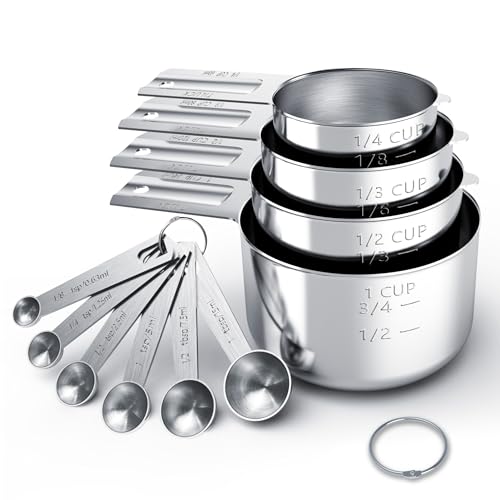
TILUCK Stainless Steel Measuring Cups and Spoons Set of 10
Badge: Best Complete Station Kit
Strengths
- Cups and spoons in one nesting stainless steel system, so a station’s whole volume kit matches.
- Nesting storage keeps the set complete and ordered in size sequence.
- Ten pieces balance coverage against station clutter.
Trade-offs
- No heavy duty or dishwasher-safe language is stated in the listing summary.
- The exact spoon sizes are not enumerated in the summary.
- No leveler is mentioned.
Mini spec box
- Material: stainless steel
- Pieces: 10, cups and spoons
- Storage: nesting
- Use: cooking and baking
A professional station needs cups as much as spoons, and a matched system has a real operational virtue: one material, one marking style, one storage stack, learned once by every cook who rotates through. TILUCK’s nesting ten-piece makes that system case. The nesting order doubles as inventory control, since a missing piece is visible in the stack before service rather than discovered during it. For a small bakery, a cafe prep corner, or a serious home test kitchen, that completeness-in-one-purchase is attractive. The professional caveats are informational: the listing summary does not use heavy duty language, does not state dishwasher-safe care, and does not enumerate the spoon sizes, so a buyer equipping a demanding operation should confirm those details on the full listing and weigh the Rena Chris and Spring Chef magnetic sets, whose professional features are stated outright, before standardizing. As a tidy, complete station kit for moderate-volume work, it remains a sound choice.
Best for: small operations wanting one matched cups-and-spoons system / Not suited for: the heaviest daily volume without verifying care details

TILUCK Stainless Steel Measuring Cups and Spoons Set of 6 with Coffee Scoop
Badge: Best Compact Station Kit
Strengths
- A dedicated coffee scoop spoon serves beverage stations, where one repeated measure defines the product.
- Six stainless steel pieces keep a compact station complete and easy to inventory.
- Cups and spoons together cover a small operation’s daily range.
Trade-offs
- The least size coverage here for baking-heavy work.
- No leveler, heavy duty, or dishwasher-safe language is stated in the summary.
- Growing operations will outgrow six pieces quickly.
Mini spec box
- Material: stainless steel
- Pieces: 6, cups and spoons, coffee scoop spoon included
- Use: cooking and baking
Not every professional station is a bakery. The coffee bar, the smoothie counter, and the small cafe prep corner run on a short list of repeated measures, and for them this compact kit’s inclusion of a dedicated coffee scoop is the professional feature: the same scoop, filled the same way, is how a beverage program holds its flavor standard across staff and shifts. Six pieces are easy to inventory at close, easy to replace as a unit, and sufficient where the menu’s measuring is routine rather than elaborate. The limits are plain: baking programs need ladders this set does not claim, and the listing summary states no heavy duty or dishwasher-safe language, so high-volume buyers should verify care on the full listing. For the compact beverage-led station, and for mobile setups like the ones discussed in Best Rv Measuring Spoons, it is a right-sized professional tool.
Best for: cafes, beverage stations, and compact professional setups / Not suited for: baking programs needing fine increments

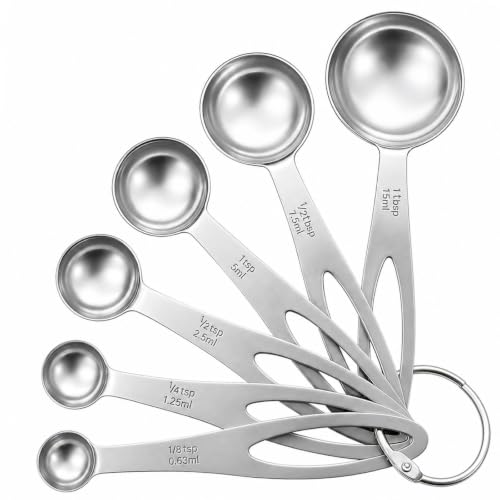
THLHKD 6-Piece Stainless Steel Measuring Spoons Set
Badge: Best Readability
Strengths
- Clear size markings are the headline feature, and legibility is a professional virtue: fast, correct reads by any cook.
- A stated range from 1/8 teaspoon to 1 tablespoon covers service’s everyday small measures.
- Listed for coffee, spices, and protein powder as well as general use, a genuinely station-friendly brief.
Trade-offs
- No leveler is included.
- Six spoons only; no cups for the station.
- No heavy duty language is used in the listing.
Mini spec box
- Material: stainless steel
- Pieces: 6
- Size range stated: 1/8 tsp to 1 tbsp
- Markings: clear size markings
- Use: dry and liquid ingredients, coffee, spices, protein powder
Ask experienced cooks what fails first in a shared set and many will say the markings: a spoon nobody can read becomes a spoon everybody guesses with, and guessing is contagious in a busy kitchen. THLHKD leads with clear size markings, and in a professional frame that is not a cosmetic detail but a consistency system. The stated range suits station work, reaching the 1/8 teaspoon that seasoning adjustments live on, and the listing’s explicit inclusion of coffee, spices, and protein powder reads like a description of an actual service station’s day. What the set does not claim is equally clear: no leveler, no cups, no heavy duty language. As a readable, dependable spoons set for a spice-and-seasoning station, or as the second set in a two-set professional system, it earns its place; as a one-set solution for a full bakery, it needs the companions this guide’s final section describes.
Best for: seasoning stations and readability-first buyers / Not suited for: one-set bakery solutions
Spring Chef Nesting Stainless Steel Measuring Spoons Set of 7 with Leveler
Badge: Best for the Spice Station
Strengths
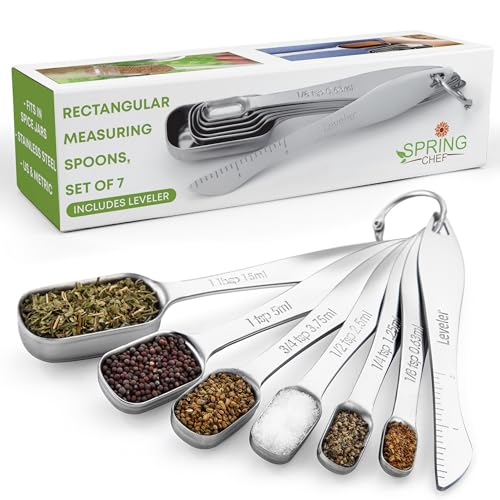
- Rectangular heads fit in spice jars, the defining motion of a working spice station.
- A long handle reaches deep bulk containers, and an included leveler standardizes seasoning across cooks.
- Nesting storage keeps the station set together between services.
Trade-offs
- Rectangular bowls are less forgiving for high-volume liquid measuring.
- Seven spoons only, with no cups.
- No dishwasher-safe statement appears in the listing title.
Mini spec box
- Material: stainless steel
- Pieces: 7 spoons plus leveler
- Head shape: rectangular
- Storage: nesting
- Handle: long handle
- Use: dry and liquid ingredients; fits in spice jars
Every professional kitchen has a spice station, and it is where small measuring concentrates: blends built to a house ratio, seasoning adjusted by the eighth teaspoon, rubs scaled for service. This set is designed for that geography. Rectangular heads enter the jars and bulk tubs the station actually uses, the long handle reaches their depths, and the leveler turns each cook’s seasoning into the house’s seasoning, which is the entire point of a recipe in a multi-cook room. Nesting keeps the seven spoons together through the chaos of a station reset. Its limits are the shape’s: liquids prefer rounder bowls, and cups must come from elsewhere. Paired with a general set for liquids and volume, this is the specialist that makes a professional setup feel professional where it counts most, at the seasoning. Legacy-brand comparisons in Best Results By Ekco Measuring Spoons cover the older names some professional buyers still search for.
Best for: spice stations, blend programs, and seasoning consistency / Not suited for: liquid-heavy stations as a sole set
Comparison Table
| Set | Pieces | Construction note stated | Leveler | Dishwasher safe stated | Link |
|---|---|---|---|---|---|
| Rena Chris 6 | 6 | Heavy duty stainless steel | No | Not in title | Check on Amazon |
| Spring Chef Magnetic 8 | 8 plus leveler | Stainless steel, dual sided | Yes | Yes | Check on Amazon |
| TILUCK 10 | 10 | Stainless steel, nesting | No | Not in title | Check on Amazon |
| TILUCK 6 | 6 | Stainless steel | No | Not in title | Check on Amazon |
| THLHKD 6 | 6 | Stainless steel, clear markings | No | Not in title | Check on Amazon |
| Spring Chef 7 | 7 plus leveler | Stainless steel, rectangular | Yes | Not in title | Check on Amazon |
How to Choose Professional Measuring Spoons
Choose by station, not by superlative. Map the measuring your operation actually does: the spice station needs jar fit, reach, and a leveler; the bakery station needs a complete ladder and cups; the beverage station needs one perfect repeated scoop; the general station needs durability and legibility above all. Then match each station to the set whose listing states the relevant features, because in a professional context an unstated feature is an unverified one, and unverified tools create variance you will taste. Standardize: whatever you choose, choose it once, for every station doing the same work, so that a teaspoon means the same thing in every hand in the building. Buy the backup at the same time from the same listing, because the day a set is lost or damaged mid-service is the wrong day to discover it was discontinued. Prefer stated care instructions that match your washing reality; a set that must be hand-washed will, in a busy operation, simply be washed badly, so stated dishwasher-safe construction is a genuine professional feature rather than a convenience. Finally, weigh total system cost over years: rigid steel sets that survive are cheaper than delicate sets replaced quarterly, and the professional buyer’s spreadsheet should count replacements, not just the first order.
How to Run a Measuring Station Like a Professional
Set the station before service: spoons nested or on their ring at the point of use, leveler with them, containers arranged so the daily ingredients are closest. Measure dry before liquid within any recipe sequence, and keep a dry towel at the station for the complete drying that keeps dry measures honest between ingredients. Level everything dry, every time, with the leveler or a straight edge, because the house standard is a level spoon and any cook’s personal heap is a recipe deviation. Read the handle on every grab during the first weeks with a new set, until the sizes are spatial knowledge. Wash sets in rotation so a clean, dry set is always available, and inspect rims and handles weekly: a spoon that has bent comes out of service immediately, because a bent spoon in a professional kitchen is not a worn tool but a wrong ingredient in every recipe it touches. Log the house ratios where the staff can see them, especially blends and seasonings, so the standard lives on paper and not in one cook’s memory. Close the station by inventorying the sets; a missing spoon found at close is a nuisance, while the same spoon discovered mid-service tomorrow is a problem.
Troubleshooting
Problem: two cooks’ versions of the same dish taste different → their leveling differs; adopt the leveler as the house standard and retire knife-leveling for shared recipes.
Problem: a set’s tablespoon no longer matches the others → it has bent in service; remove it, compare suspect spoons against a known set with water, and replace from the same listing to preserve the standard.
Problem: spoons keep vanishing from the station → the set is being stored loose or borrowed across stations; switch to nesting or magnetic storage, assign sets to stations, and keep the sealed backup for genuine losses.
Problem: new staff keep grabbing the wrong size under pressure → the set’s markings are not legible enough for the room’s light and pace; move to the clearest-marked set as the station standard and retrain the grab on size order in the nesting stack.
Problem: the wash stream is damaging the set → its care needs do not match the operation’s routine; reassign it to a hand-wash station and standardize the high-volume stations on a set whose listing states dishwasher-safe construction.
Standardization: The Professional Habit That Matters Most
Home cooks buy a set; professional kitchens adopt a standard. The distinction explains most of the advice in this guide. A standard means one set model, everywhere the same work is done, with a written routine for leveling and measuring order, and a replacement path that preserves the model. Under a standard, recipes become portable between cooks and shifts, training becomes simple, and when something tastes wrong, the measuring system can be eliminated as a suspect in seconds because it is known and uniform. None of this requires expensive equipment; it requires choosing once, deliberately, on stated features, and then defending the choice against the slow entropy of borrowed, bent, and mismatched tools that accumulates in every busy kitchen. The sets in this guide are all plausible standards for operations of their scale. The Rena Chris for durability-led kitchens, the magnetic Spring Chef for consistency-led ones, the Spring Chef rectangular set for spice-led ones, and the TILUCK kits where cups and spoons should standardize together. Pick the standard that matches your dominant work, buy it in duplicate, and your measuring will quietly become the most reliable system in the building.
The Honest Boundary: Home-Market Sets in Professional Roles
This guide would be incomplete without stating its own limit plainly. The six sets here are consumer-market products, and their listings make consumer claims: none states a commercial certification, a health-code designation, or a warranty for restaurant use, and this guide claims none on their behalf. For a home test kitchen, a cooking class, a small cafe, a bakery program of modest volume, or a serious enthusiast’s bench, their stated features, steel construction, levelers, dual markings, dishwasher-safe care where stated, are rationally matched to the work. For a high-volume commercial operation, the same features should be verified against the operation’s actual requirements and local rules, and truly commercial supply channels may be the right source. That boundary does not weaken the recommendations; it defines them. Professional, in this guide’s honest usage, describes a standard of selection and routine, durability, legibility, completeness, standardization, that any kitchen can adopt, and these sets are the ones whose stated facts best support that standard at this scale.
Training New Cooks on the House Standard
Every professional kitchen teaches measuring, whether it plans to or not; the only question is whether the lesson is deliberate. A deliberate program takes twenty minutes and pays for itself for years. The new cook learns the house routine in order: read the handle, spoon and level with the leveler, dry before liquid, dry the spoon completely between, and return the set nested to its station. They learn the two failure stories by heart, the bent spoon that silently changed a recipe and the heaped teaspoon that doubled a seasoning, because stories stick where rules slide off. They learn where the written ratios live and that deviating from them is a decision to escalate, not a liberty to take. And they learn the closing inventory, the least glamorous and most protective habit in the building. Equipment supports every step of that training: legible markings make reading teachable, a leveler makes leveling demonstrable rather than a matter of touch, nesting storage makes the closing inventory a glance, and standardized sets make the whole lesson portable to any station. A kitchen that buys with training in mind chooses differently from one that buys for a single expert hand, and since staff turns over in every real operation, the training-minded purchase is almost always the right one. The sets ranked highest in this guide are, not coincidentally, the ones a trainer would choose: readable, leveler-equipped where it counts, and simple enough to teach in one session.
The Economics of Durability: What Cheap Sets Actually Cost
Professional buyers run numbers, so here is the honest arithmetic in words rather than figures, since prices vary. A delicate set in a busy kitchen is not bought once; it is bought repeatedly, as handles bend, markings fade, and pieces vanish, and each repurchase carries hidden costs beyond the ticket: the service disrupted while a station improvises, the inconsistency introduced when the replacement is a different model because the original was discontinued, and the management time spent re-solving a solved problem. A durable set bought once, in duplicate, with a model that stays listed, converts all of that into a single decision. This is why the guide weighs stated construction so heavily and treats continuity of availability as a feature: the professional question is never what a set costs this month, but what the measuring function costs per year of reliable service. By that measure, rigid stainless steel sets with stated heavy duty construction or stated dishwasher-safe care are not the expensive option; they are the cheap one, amortized across thousands of accurate measures. The same logic explains the backup doctrine. A sealed duplicate looks like redundancy on a shelf and behaves like insurance in service, and insurance is priced against the bad day, not the average one. Kitchens that understand this buy measuring tools the way they buy knives: once, well, and with a plan for the day one disappears.
Recipe Development and Scaling: Where Ladders Earn Their Price
The most demanding measuring in any kitchen happens away from service, in development: a sauce being built for the first time, a blend being tuned across a dozen test batches, a home recipe being scaled to a banquet. Development measuring is where size ladders prove themselves, because scaling multiplies fractions. A recipe written in teaspoons that must triple, or a blend recorded in quarter teaspoons that must become a batch, generates amounts that standard sets do not own, and every estimated fraction in the development record becomes a permanent error in the scaled product. The professional habit is to develop with the finest ladder available, record the results in the units the ladder actually measured, and only then convert the finished formula into the production format, weights for bulk, house spoons for service. Dual-marked sets support the international side of development, where source recipes arrive in metric and must be tested before conversion. None of the sets in this guide claims a development pedigree, and this guide claims none for them; but the features that serve development, complete stated ladders, dual units, levelers for repeatable tests, are exactly the features credited in the reviews above, and a kitchen that develops recipes should weight them accordingly when it standardizes.
Stations, Plural: Fitting the Set to the Room
Walk a working kitchen and the measuring needs change every few steps. At the garde-manger and salad station, spoons measure dressings and seasonings in small, frequent amounts, where readability and jar access dominate. At the pastry station, the ladder and the cups rule, and leveling discipline is the difference between a consistent crumb and a weekly mystery. At the sauté station, spoons appear for finishing: a measured splash, a final seasoning, executed one-handed and fast, which favors a simple, familiar set over an elaborate one. At the bar and beverage station, one scoop repeated perfectly outranks every other virtue. A thoughtful operation does not force one set to win all four rooms; it standardizes within each kind of work, which is why this guide’s recommendations are organized by station logic rather than by a single champion. The home enthusiast with professional habits can borrow the same map at smaller scale: the baking drawer gets the ladder, the spice rack gets the rectangular set, the coffee corner gets the scoop kit, and the general drawer gets the durable, legible everyday set. Professionalism, in the end, is this kind of fit between tool and task, repeated calmly across a kitchen, and it is available to any cook who buys by station instead of by slogan.
Hygiene and Washing at Volume: The Unspoken Specification
Professional measuring tools live in water. They are washed between ingredients, between cooks, between services, and the washing itself becomes a selection criterion that home guides rarely mention. Three properties matter. First, simplicity of form: spoons without crevices, hinges, or layered constructions wash clean quickly and completely, which is a point in favor of the plain steel designs throughout this guide. Second, stated care compatibility: a set whose listing states dishwasher-safe construction can enter the operation’s normal wash stream without a special-handling exception that busy staff will eventually ignore, and ignored exceptions are how tools get damaged and standards erode. Third, drying discipline: a set that nests wet will sit in its own moisture, so stations should store sets only once dry, a routine point that protects both hygiene and the markings’ legibility. None of the listings here makes sanitation claims, and this guide makes none for them; the point is narrower and more practical. In a high-frequency kitchen, the set that fits the washing system gets washed properly, and the set that fights it gets washed badly, so care statements belong in the professional specification right beside construction and sizes. Buyers should read them there, in the listing, before the first service rather than after the first warped or faded spoon teaches the lesson at full price.
A Note for Serious Home Cooks: Borrowing the Professional System
Most readers of this guide cook at home, and the professional frame is useful to them precisely because home cooking has professional moments: the holiday bake produced in quantity, the recipe being developed for a blog or a family event, the dinner party where four dishes must land together. Borrowing the system costs little. Standardize on one good set and keep a second for the wet-dry problem during big cooks. Put the leveler with the spoons and use it until leveling is reflex. Write your house ratios, the rub, the dressing, the brine, on a card in the drawer, because memory is the least professional tool in any kitchen. Inspect the set when you deep-clean the drawers, and retire the spoon that has bent without debating it. And when you buy, buy like an operation: stated features over labels, duplicates over singles, continuity over novelty. The result is not a home kitchen pretending to be a restaurant. It is a home kitchen whose measuring can be trusted on its biggest days, which is the only part of professionalism worth importing, and the sets reviewed above are the ones whose stated facts best support that trust at home scale.
Common Buying Mistakes
- Buying on a professional label rather than stated features: heavy duty language, care statements, and enumerated sizes are the evidence.
- Mixing set models across stations, so a teaspoon quietly means different things in different hands.
- Skipping the backup set, then replacing a lost set mid-season with whatever is available.
- Ignoring the leveler, the cheapest consistency system a multi-cook kitchen can buy.
- Letting a bent spoon stay in service because it still looks fine.
- Choosing a set whose care instructions fight the operation’s washing reality.
- Skipping the twenty-minute training session, then blaming the tools for inconsistencies that were really untaught technique.
- Judging a new standard after one service instead of a month of rotations, washes, and cooks.
Final Recommendation
For durability-led work, standardize on the Rena Chris Set of 6, whose heavy duty construction is stated outright. For consistency-led, multi-cook work, choose the Spring Chef Magnetic Set of 8 for its leveler, dual-sided workflow, and stated dishwasher-safe care. Add the rectangular Spring Chef set at the spice station, a TILUCK kit where cups and spoons should match, and the THLHKD set wherever readability is the bottleneck. Whatever you adopt, adopt it in duplicate, write the routine down, and pull bent spoons without sentiment. That system, more than any single product, is what professional measuring actually is. Give the standard a month of service before judging it: standards prove themselves across rotations of staff, menus, and washing cycles, not in a single afternoon, and a set that still measures identically, reads clearly, and sits complete at its station after that month has earned a permanence that no first impression can confer or deny.
Frequently Asked Questions
What makes a measuring spoon set professional?
In practice: construction that survives daily volume without bending, markings that stay legible through constant washing, a complete enough size ladder that nobody estimates, and features like a leveler that standardize technique across cooks. The label matters less than those stated features, which is how this guide evaluated every set it recommends, crediting only what each manufacturer’s own listing actually states.
Do professional kitchens use measuring spoons or only scales?
Both, divided by quantity and by the nature of the ingredient being measured at that moment. Scales handle large dry ingredients by weight; spoons handle the small, potent end, spices, leavening, salt, extracts, where they are faster and entirely repeatable when leveled. A professional setup standardizes both tools rather than choosing between them.
Why does a leveler matter more in a professional kitchen?
Because several people measure the same recipes, often under time pressure and in less than perfect light. One cook’s level is another’s heap, and the difference shows up as inconsistency customers can taste. A leveler replaces individual judgment with a shared mechanical standard, which is why two sets in this guide include one.
How many sets should a small operation buy?
At minimum, one per station doing distinct work, plus one sealed identical backup per model in use across the whole operation. Teaspoons are lost and bent in real service, inevitably, and a backup bought from the same listing preserves the house standard instead of forcing an improvised replacement.
Is dishwasher-safe construction important?
In high-frequency use, yes, absolutely: a set washed many times daily needs care instructions that match that reality, and a stated dishwasher-safe construction, like the Spring Chef magnetic set’s, removes a daily friction. Sets without the statement should be top-racked or hand-washed, which busy operations should weigh honestly when choosing.
How do professionals keep track of small tools like spoons?
By treating them as a system rather than as mere utensils: sets are assigned to stations, stored nested or on rings so completeness is visible, inventoried at close, and replaced from a sealed backup of the identical model. Some kitchens add a simple sign-out habit for shared specialty sets. The principle is that a teaspoon is small enough to lose and important enough to matter, so it gets the same asset discipline as any other tool the service depends on.
Are expensive designer sets worth it for a working kitchen?
Rarely, on professional criteria alone. Working kitchens pay for stated construction, legibility, ladder completeness, care compatibility, and re-order continuity. Finish and presentation, the things upper-tier pricing usually buys, do not change a single measure. A serious home cook may enjoy them as objects, and that is a legitimate pleasure, but it should be bought knowingly as pleasure rather than mistaken for performance.
Should a professional kitchen keep spoons and cups from the same set?
Where possible, yes, because a properly matched system shares one material, one marking style, and one storage format, which shortens training and makes inventory a single glance. The TILUCK kits in this guide are built on that logic. Kitchens with strong existing cups can still standardize the spoons separately, but the mixed drawer should be a deliberate choice with its own inventory habit, not an accident of successive unrelated purchases.
When should a spoon be taken out of service?
When it bends, when its rim no longer levels cleanly, or when its marking becomes hard to read at a glance in the station’s actual working light. In a professional setting each of those is a measurement fault, not a cosmetic one, and it should be treated with the same seriousness as any other faulty instrument in the building. Compare suspect spoons against a known-good reference set and replace from the same listing to keep the standard intact.