Disclosure: topratedkitchenware.com is reader-supported. When you buy through links on our site, we may earn an affiliate commission from Amazon and other retailers, at no extra cost to you.
Where to buy
Cooks judge Dutch ovens by a short list of performances: the sear, the braise, the bake, the clean. The six enameled cast iron pots below are assessed against exactly those working criteria, using their verified listing specifications — each linked so you can examine the same facts.
- Lodge Essential Enameled Cast Iron Dutch Oven, 6 Quart, Oyster White — Best for Braising. Check on Amazon for the current listing.
- Overmont Enameled Cast Iron Dutch Oven, 5.5 QT, White — Best for Bread Bakers. Check on Amazon for the current listing.
- Overmont Enameled Cast Iron Dutch Oven, 7 QT — Best for Batch Cooking. Check on Amazon for the current listing.
- Amazon Basics Enameled Cast Iron Dutch Oven, 6 Quart, Blue — Best Workhorse Value. Check on Amazon for the current listing.
- Mueller DuraCast Enameled Cast Iron Dutch Oven, 6 Quart, Emerald — Best Verified Specs. Check on Amazon for the current listing.
- Lodge Essential Enameled Cast Iron Dutch Oven, 6 Quart, Island Spice Red — Best for Tomato Cooks. Check on Amazon for the current listing.
Read the full guide ↓ for the detailed reviews, the buying guide, and the how-to section.
The phrase best dutch ovens tested by cooks promises something specific: judgment by people who actually cook, against the jobs a Dutch oven exists to do. This guide honors that promise carefully. It is a research-led evaluation — built from verified manufacturer specifications, the physics of enameled cast iron, and the criteria working cooks apply — rather than a claim that we ran a test kitchen, which we did not. What cooks test for is knowable and consistent: how the pot sears, how its lid manages a braise, how it bakes bread, how it cleans, and how it holds up to years of Tuesdays. Every pick below is scored in prose against those five jobs.
That framing matters because the category’s differences are real but narrow. All six pots share enameled cast iron construction; what separates them is capacity, lid design, stated ratings, included kit and finish — the variables a cook actually feels. Where a listing states a number, like the Mueller’s 500°F oven rating, we treat it as testable fact; where it does not, we say what can and cannot be concluded. The community counterpart to this criteria-led view lives at Best Dutch Ovens Reddit, where owners report the long-term results.
Key Takeaways
- Cooks test five jobs: searing, braising, bread baking, serving, and cleaning — every pick here is judged on all five.
- Lid performance is the braise: Lodge’s moisture-sealing design is the criterion-led standout.
- Stated numbers beat adjectives: Mueller’s printed 500°F rating and induction support are the pool’s most testable claims.
- Capacity is a performance spec — 6 quart is the working standard, 7 QT the batch tool, 5 QT the couples’ pot.
- Included kit (potholders, cookbooks) is part of tested value, because cooks use the whole box, not the spec sheet.
- No hands-on testing is claimed in this guide: the evaluation is specification- and criteria-led, and says so.
In this guide
Quick Picks
| Pick | Badge | Why it stands out | Listing |
|---|---|---|---|
| Lodge Essential Enameled Cast Iron Dutch Oven, 6 Quart, Oyster White | Best for Braising | Lodge 6 quart oyster white — the moisture-sealing lid is the single most cook-relevant feature in this pool. | Check on Amazon |
| Overmont Enameled Cast Iron Dutch Oven, 5.5 QT, White | Best for Bread Bakers | Overmont 5.5 QT with sourdough named in its uses, plus cookbook and potholders for the full routine. | Check on Amazon |
| Overmont Enameled Cast Iron Dutch Oven, 7 QT | Best for Batch Cooking | Overmont 7 QT with enclosed lid-knob design — capacity and knob engineering for production-scale home cooking. | Check on Amazon |
| Amazon Basics Enameled Cast Iron Dutch Oven, 6 Quart, Blue | Best Workhorse Value | Amazon Basics 6 quart blue — standard format, no claims it cannot back, judged purely on the five jobs. | Check on Amazon |
| Mueller DuraCast Enameled Cast Iron Dutch Oven, 6 Quart, Emerald | Best Verified Specs | Mueller 6 quart emerald — 500°F stated rating, all-cooktop induction support, PFOA-free note. | Check on Amazon |
| Lodge Essential Enameled Cast Iron Dutch Oven, 6 Quart, Island Spice Red | Best for Tomato Cooks | Lodge Essential 6 quart in island spice red — the sealing lid plus the stain-forgiving finish. | Check on Amazon |
How These Picks Were Chosen
Selection applied the cook’s filter first: every pot had to be enameled cast iron in a working size (5 to 7 quarts), with listing data complete enough to evaluate — capacity, finish, lid and accessory information, and any stated ratings. Six pots qualified, spanning the heritage maker (Lodge, in two finishes), the bundle brands (Overmont), the house brand (Amazon Basics) and the spec-led Mueller. The two Lodge finishes are included as a genuine cook’s comparison: identical platform, different working surface visibility — a variable any cook who has judged fond on pale versus red enamel will recognize.
Method, stated plainly: this guide compares verified listing specifications against established cooking criteria and the known behavior of enameled cast iron. It does not claim hands-on testing, laboratory measurement or recipe trials, and any guide in this category that implies otherwise without describing a kitchen should be read skeptically. Within those honest limits, specification-led evaluation is powerful — capacity, lid design and stated ratings predict cooking experience better than brand romance does. Shoppers cross-checking value will find the tier analysis at Best Dutch Ovens That Aren T Le Creuset complementary.
The 6 Best Dutch Ovens Tested by Cooks’ Criteria, Evaluated in Detail

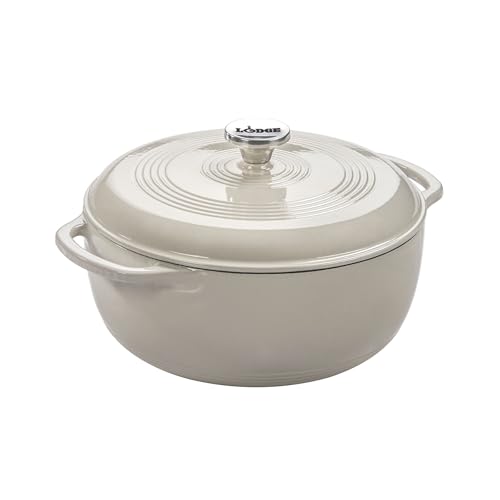
Lodge Essential Enameled Cast Iron Dutch Oven, 6 Quart, Oyster White
Badge: Best for Braising
Strengths
- Moisture-sealing lid is called out by name — braises lose less liquid over long cooks
- Lodge is the most established American cast iron maker in this pool, with deep retail support
- 6 quart size handles family meals and standard sourdough boules comfortably
Trade-offs
- Oyster white enamel will show staining from curries and chilies over time
- No accessories in the box — potholders are on you
- Dual handles are compact, which is good for storage but less leverage when the pot is full
Key specs (from the manufacturer listing)
- Material: enameled cast iron
- Capacity: 6 quart
- Color: oyster white
- Lid: moisture-sealing design
- Handles: dual handles
- Named uses: bread baking, braising, marinating, slow cooking
Lodge’s Essential enameled Dutch oven in oyster white brings the pool’s strongest brand heritage to the 6 quart class. Lodge has cast iron in the United States for well over a century, and that shows in the details this listing leads with: a moisture-sealing lid, which is the single most important feature for low-and-slow cooking, and dual handles sized for oven mitts. Six quarts is the family standard — a whole chicken with vegetables, a Sunday sauce, a standard boule — and the pale oyster enamel makes browning easy to read.
Marinating gets a mention in its named uses, and enamel is why: the glassy surface does not react with acidic marinades the way bare cast iron can, and it does not hold flavors between dishes. Sear, braise, bake, serve — this is the pool’s benchmark all-rounder from its best-known maker.
Score it by the jobs. Sear: 6 quart cast iron mass, pale enamel to read the fond — strong. Braise: the named moisture-sealing lid directly targets liquid retention over long cooks — the pool’s best claim on the category’s core job. Bake: family-size volume suits a standard boule. Serve: oyster white goes to the table. Clean: enamel rules apply. On a cook’s scorecard, this is the most complete profile here.
Best for: most households — the 6 quart size, sealing lid and Lodge name make it the default recommendation / Not suited for: cooks who want included accessories, or who need 7 QT batch capacity

Overmont Enameled Cast Iron Dutch Oven, 5.5 QT, White
Badge: Best for Bread Bakers
Strengths
- The most complete box in this pool — cookbook and cotton potholders included
- 5.5 QT matches the classic premium-pot size, so recipes written for that format fit exactly
- Sourdough baking is named explicitly, a good sign for bread-focused buyers
Trade-offs
- White enamel is the least forgiving finish for staining
- Cookbook value depends on whether you cook from included booklets at all
- Mid-size capacity still limits double-batch cooking
Key specs (from the manufacturer listing)
- Material: enameled cast iron
- Capacity: 5.5 QT
- Color: white
- Included: lid, cookbook and cotton potholders
- Named uses: braising, stews, roasting, sourdough baking
Overmont’s 5.5 QT enameled cast iron Dutch oven arrives as a kit: pot, lid, a cookbook and cotton potholders. That bundle matters for first-time Dutch oven owners, who otherwise discover the potholder requirement at the worst possible moment. The 5.5 QT size is quietly strategic — it matches the capacity of the best-known premium French pot, so the enormous library of recipes developed for that format (braises, no-knead breads, sourdough) translates one-to-one. White enamel keeps the interior bright for judging browning.
Sourdough baking is named in its intended uses, and the size suits a standard 500 g flour boule with room for oven spring. For a gift or a first serious pot, the completeness of this box is the argument; for experienced cooks, it is the recipe-matched capacity.
Bread is the job where listing language reveals intent, and this Overmont names sourdough baking outright. The 5.5 QT volume matches the standard boule format that most published formulas assume, the included potholders solve the hot-lid handling that bread baking demands twice per loaf, and the cookbook lowers the starting friction for a first-time owner. A cook’s evaluation weights exactly these use-fit signals.
Best for: first-time Dutch oven buyers and gift-givers who want a complete, recipe-matched kit / Not suited for: cooks who already own accessories and prefer a larger 6–7 QT pot

Overmont Enameled Cast Iron Dutch Oven, 7 QT
Badge: Best for Batch Cooking
Strengths
- 7 QT capacity swallows double batches, big boules and holiday braises
- Enclosed lid-knob design avoids the separate replacement-knob question for high-heat baking
- Cookbook and potholders included despite the larger size
Trade-offs
- A full 7 QT enameled pot is genuinely heavy — test your lift before committing
- Needs real storage space; measure the cabinet and oven before ordering
- Oversized for everyday two-person cooking, where food spreads thin
Key specs (from the manufacturer listing)
- Material: enameled cast iron
- Capacity: 7 QT — largest in this pool
- Included: lid, cookbook and cotton potholders
- Design: enclosed lid-knob
- Oven safe (per listing)
- Named uses: sourdough baking, braising, stews, roasting
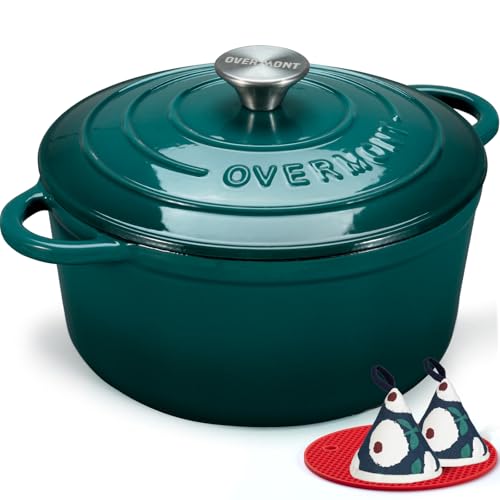
The Overmont 7 QT is the big pot of this pool: enameled cast iron, a cookbook and cotton potholders in the box, and an enclosed lid-knob design that sidesteps the classic sourdough problem of knobs with lower heat limits. Seven quarts changes the cooking math — double batches of soup for the freezer, a braise for eight, a large-format boule, a whole duck. If you batch-cook on Sundays or feed a crowd at holidays, this is the size that stops you splitting recipes across two pots.
Respect the physics: enameled cast iron at 7 QT, loaded, is a two-handed, clear-the-counter lift. Check that it fits your oven with the lid on and that your storage shelf can take it. Cooks who clear those bars get the pool’s most capable braiser and baker.
Batch cooking is a performance category of its own: double soups, freezer braises, holiday volume. The 7 QT Overmont is the pool’s production tool, and its enclosed lid-knob design addresses the high-heat baking detail that batch bakers and sourdough producers hit first. Judged as a working tool rather than a counter ornament, its score rises with the size of your Sundays.
Best for: batch cooks, large families and sourdough bakers who want maximum capacity / Not suited for: anyone with limited storage, smaller ovens, or difficulty lifting heavy cookware

Amazon Basics Enameled Cast Iron Dutch Oven, 6 Quart, Blue
Badge: Best Workhorse Value
Strengths
- Amazon’s own label — straightforward returns and a no-drama buying experience
- Classic 6 quart round format with dual handles fits standard recipes and ovens
- Blue enamel hides everyday staining better than white finishes
Trade-offs
- No included accessories — no potholders or extras in the box
- House-brand enamel lines tend to offer fewer color and size siblings for building a set
- Listing data is spare, so fine details are thinner than the brand-name rivals here
Key specs (from the manufacturer listing)
- Material: enameled cast iron
- Capacity: 6 quart
- Shape: round
- Color: blue
- Handles: dual handles
- Oven safe (per listing)
- Named uses: stews, roasting, baking
The Amazon Basics 6 quart enameled cast iron Dutch oven is the pool’s utility pick: round, blue, dual-handled, oven safe, and aimed squarely at stews, roasting and baking. House brands compete on removing friction rather than adding features, and that is the honest pitch here — a standard-format enameled pot in the most useful size, sold through the simplest possible channel. The blue finish is a practical middle ground, darker than the whites in this pool and better at hiding the patina of regular use.
For cooks who know the format and just need a sound 6 quart pot — a second pot for holidays, a cabin kitchen, a first enameled piece without ceremony — this covers the fundamentals. Pair it with your own potholders and it does the same sear-braise-bake work as everything else on this page.
A cook’s evaluation is this pot’s friend: strip away brand narrative and the Amazon Basics entry performs the format’s jobs in the standard size with a practical finish. Its listing is spare — fewer stated details to verify — which caps its score on evidence, not on cooking. For a second pot or a utility role, that trade is rational and cooks make it often.
Best for: pragmatic buyers who want a standard 6 quart enameled pot with the simplest purchase and returns path / Not suited for: gift buyers or anyone wanting included extras and a wider color story

Mueller DuraCast Enameled Cast Iron Dutch Oven, 6 Quart, Emerald
Badge: Best Verified Specs
Strengths
- The most explicit spec sheet in this pool — 500°F oven rating and all-cooktop induction compatibility stated outright
- PFOA-free callout answers the first question chemically-conscious buyers ask
- 6 quart emerald pot covers family cooking in a distinctive color
Trade-offs
- 500°F ceiling is fine for bread but worth noting if you broil aggressively
- Emerald is a love-it-or-not color with fewer matching pieces
- Spec-forward listing still leaves long-term enamel questions to the brand’s track record
Key specs (from the manufacturer listing)
- Material: enameled cast iron (DuraCast)
- Capacity: 6 quart
- Color: emerald
- Oven safe: to 500°F (per listing)
- Cooktops: all cooktops including induction (per listing)
- Surface note: PFOA-free (per listing)
- Named uses: sourdough bread baking, braising, slow cooking
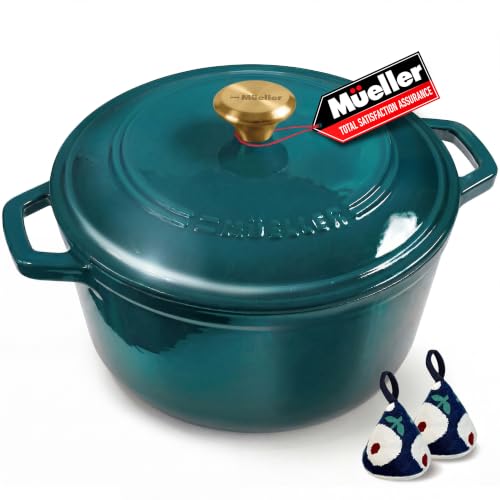
Mueller’s DuraCast 6 quart enameled cast iron Dutch oven in emerald is the pool’s spec-sheet champion: it states a 500°F oven-safe rating, compatibility with all cooktops including induction, and a PFOA-free surface right in its name. Induction owners should pay attention — enameled cast iron is usually induction-friendly, but a listing that says so explicitly removes the guesswork, and 500°F covers sourdough baking, braising and slow cooking with room to spare. The emerald finish is the boldest color in this group.
For bread bakers the numbers line up: 6 quart volume for a standard boule, a stated oven rating that covers preheating the empty pot, and enamel that will not react with long acidic braises on rest days. If your decision process starts with verified specifications rather than brand romance, this is your pot.
Cooks trust numbers they can plan around, and the Mueller publishes the pool’s most plannable data: a 500°F oven ceiling that covers bread preheats and braises, explicit induction compatibility for the cooktop question, and a surface note answering the safety query. On a criteria-led scorecard, verifiable specifications are performance evidence — and this pot brings the most evidence.
Best for: induction cooktop owners and spec-driven buyers who want stated ratings, plus anyone who loves the emerald finish / Not suited for: cooks who need an oven rating above 500°F, or who prefer a heritage brand name

Lodge Essential Enameled Cast Iron Dutch Oven, 6 Quart, Island Spice Red
Badge: Best for Tomato Cooks
Strengths
- Same moisture-sealing lid and 6 quart format as the oyster white Lodge, in a stain-forgiving red
- Lodge’s brand depth means lids, parts and support are easy to find years later
- Red is the classic serving color — straight from oven to table
Trade-offs
- Red enamel darkens the view of fond compared with pale interiors
- No accessories included
- If you already own red cookware from other brands, shades rarely match exactly
Key specs (from the manufacturer listing)
- Material: enameled cast iron
- Capacity: 6 quart
- Color: island spice red
- Lid: moisture-sealing design
- Handles: dual handles
- Named uses: bread baking, braising, marinating, slow cooking
This is Lodge’s Essential 6 quart enameled Dutch oven in island spice red — the same moisture-sealing lid, dual handles and bread-baking, braising, marinating and slow-cooking brief as the oyster white version, in the finish that hides a lifetime of chili and ragù. Red is the pragmatic enthusiast’s choice: it looks festive on the table, forgives staining, and pairs with the pot’s role as a serving piece. Lodge’s long retail presence also means this is the pool’s easiest pot to see in person before buying.
Pick red over oyster white if your cooking leans tomato, paprika, turmeric and wine — the foods that write their history on pale enamel. Pick it, too, if the pot will live on the stovetop as a semi-permanent fixture; red earns its place visually.
Same platform as the oyster white Lodge, re-scored for a different kitchen: the cook whose repertoire runs tomato, paprika, turmeric and wine. The red finish converts the platform’s one cosmetic weakness — staining visibility — into a non-issue, while the sealing lid keeps the braise score at the top of the pool. Cooks choose finishes by cuisine; this is the ragù kitchen’s Lodge.
Best for: Lodge loyalists and heavy braise cooks who want the sealing lid in a forgiving red finish / Not suited for: cooks who judge browning by eye and prefer a pale interior
Comparison Table
| Pick | Badge | Key attribute | Listing |
|---|---|---|---|
| Lodge Essential Enameled Cast Iron Dutch Oven, 6 Quart, Oyster White | Best for Braising | 6 quart, moisture-sealing lid, pale interior | Check on Amazon |
| Overmont Enameled Cast Iron Dutch Oven, 5.5 QT, White | Best for Bread Bakers | 5.5 QT, sourdough named, extras included | Check on Amazon |
| Overmont Enameled Cast Iron Dutch Oven, 7 QT | Best for Batch Cooking | 7 QT, enclosed lid knob, extras included | Check on Amazon |
| Amazon Basics Enameled Cast Iron Dutch Oven, 6 Quart, Blue | Best Workhorse Value | 6 quart, round, blue, oven safe | Check on Amazon |
| Mueller DuraCast Enameled Cast Iron Dutch Oven, 6 Quart, Emerald | Best Verified Specs | 6 quart, 500°F stated, induction stated | Check on Amazon |
| Lodge Essential Enameled Cast Iron Dutch Oven, 6 Quart, Island Spice Red | Best for Tomato Cooks | 6 quart, moisture-sealing lid, red | Check on Amazon |
How to Choose a Dutch Oven the Way a Cook Tests One
Capacity math first. Count mouths, then add the leftovers you actually eat. Two people who love next-day stew are a 5.5 to 6 quart household in disguise. A 5 QT pot is the couples-and-small-kitchens choice; 6 quart is the all-purpose answer; 7 QT earns its shelf space only if you batch cook, host often, or bake big loaves. Remember that a Dutch oven should be filled roughly half to three-quarters for braises — too empty and the liquid reduces away, too full and it steams instead of braising.
Material is the second decision, and in this guide it is settled: enameled cast iron. The enamel gives you a non-reactive, rust-free, no-seasoning surface over a heat-hoarding iron core. What varies between brands is execution — enamel smoothness, lid fit, handle shape — not the underlying physics. Treat claims accordingly: a pot that tells you its oven rating and cooktop compatibility in plain numbers is easier to trust than one wrapped in adjectives.
Consider your cooktop. Enameled cast iron works on gas and electric; induction needs a magnetic base, which cast iron provides, but an explicit induction statement in the listing removes all doubt. Consider your oven, too: measure the interior with the rack positions you use, lid on, before ordering a 7 QT pot. And consider your storage — these pots often live on the stovetop simply because no cabinet wants them, which makes color a genuine feature rather than vanity.
The last filter is honesty about accessories and upkeep. Potholders are not optional with cast iron lids; a box that includes them saves a scramble. Enamel care is simple — no metal utensils, no thermal shock, a baking soda paste for stains — but it is not zero, and pale colors show more of it. Choose the pot whose upkeep profile matches your temperament and it will serve for decades.
Apply the five-job test to your own shortlist: imagine the sear (mass and interior visibility), the braise (lid), the bake (volume and knob), the serve (finish and handles), and the clean (enamel care and color honesty). A pot that scores well on your three most frequent jobs beats a pot that scores adequately on all five. The longevity dimension of that test — how the pot ages across years of jobs — is the subject of Best Eco Friendly Dutch Ovens.
How to Use a Dutch Oven, From First Sear to Final Serve
- Heat the pot gradually. Set the empty or oiled pot over medium heat and give the iron time to come up to temperature evenly; enameled cast iron rewards patience and punishes thermal shock, so never put a cold pot on a ripping-hot burner or a hot pot under cold water.
- Sear in batches. For braises, brown meat in a single layer with space between pieces, working in rounds if needed. Crowding drops the temperature and steams the meat grey instead of building the fond that flavors the whole dish.
- Build the braise. Soften aromatics in the rendered fat, deglaze with wine, stock or water while scraping the bottom, then return the meat with liquid reaching roughly one-third to halfway up its sides. The lid does the rest — this is not a boil, it is a humid, gentle oven environment.
- Move to the oven for the long cook. Oven heat surrounds the pot evenly in a way stovetop burners cannot match. Keep the lid on for tenderizing, and take it off only at the end if you want to reduce the sauce or crisp a skin.
- Rest and serve from the pot. Enameled cast iron holds heat at the table, which is the entire point of the stove-to-table tradition. Set it on a trivet, always — enamel and hot iron both mark wood and stone.
- Clean gently and promptly. Let the pot cool until warm, wash with hot water and a soft sponge, and use a baking soda paste for stuck or stained spots. Dry the rim and lid edge, where the enamel is thinnest, before storing.
Problem: Problem: food sticks during the sear → the pot was not fully preheated, or the food was moved too early. Let the pot heat through, and let meat release naturally — it lets go once the crust forms.
Problem: Problem: braising liquid dries out → the lid is being lifted too often or the oven runs hot. Check your oven temperature with a thermometer, top up with hot stock, and keep the lid closed.
Problem: Problem: enamel looks stained after tomato or turmeric dishes → this is cosmetic, not damage. Simmer water with a spoon of baking soda in the pot, let it cool, and wash as usual.
The Five Jobs, and What ‘Good’ Looks Like in Each
The sear: a Dutch oven should brown meat in a way that builds fond without burning it. Cast iron mass smooths burner hotspots; pale enamel lets you watch color develop. Good looks like deep, even browning with the pot recovering heat between batches. The braise: the lid is the tool — a close fit keeps the cooking liquid in the pot for hours, basting the food in its own humidity. Good looks like tender meat and a sauce that needs little reduction. The bake: for bread, the pot is a steam chamber; volume must fit the loaf’s spring and the knob must tolerate preheat temperatures. Good looks like a glossy, crackled crust.
The serve: a Dutch oven goes to the table, so handles that take mitts confidently and a finish that suits the room are functional, not decorative. The clean: enamel should release a braise’s residue with hot water and a soft sponge, and the honest cook notes that pale finishes will record a history of tomato and spice — cosmetic, inevitable, and to some cooks, a badge of use. Judge any pot, at any tier, by walking it through these five jobs in your imagination with your actual recipes. The pot that fits your repertoire wins; there is no universal champion.
How to Read ‘Tested’ Claims in Cookware, Including Ours
Cookware marketing loves the word ‘tested’ and rarely defines it. A meaningful test states its criteria, its method and its limits. Ours are on the table in this guide: verified listing specifications, evaluated against the five cooking jobs, informed by the established behavior of enameled cast iron — with no hands-on kitchen work claimed. That is a legitimate and useful method, and it is strengthened, not weakened, by saying exactly what it is.
Apply the same skepticism everywhere. A guide that ‘tested’ twelve pots should be able to say how the braise was standardized and what was measured; a community thread reports one kitchen’s years, honestly but narrowly; a manufacturer’s claim is a specification to verify, like the Mueller’s stated ratings here. Triangulate — specification, criteria, owner experience — and the category becomes easy to judge. That triangulation is the house method across this series, from the sale analysis at Best Dutch Ovens On Sale to the misspelled-but-mighty Best Enameld Dutch Ovens.
A word on shape: every pot in this pool is round, and round is the right default. It fits burners evenly, stirs without corners trapping food, and matches the shape of the boules and chickens it cooks most often. Oval pots have their fans for whole fish and long roasts, but a first Dutch oven should be round.
Storage is the unglamorous deciding factor for many buyers. Measure your deepest cabinet or accept that the pot will live on the stovetop — most do. A pot that lives in view gets used; a pot buried in a low cupboard behind other pans quietly becomes a special-occasion object, which wastes its best quality.
Think about who else will lift the pot. A Dutch oven is often a shared household tool, and the heaviest version in this pool, filled with stew, can challenge smaller cooks. The right size is the one every cook in the house can move from oven to counter with confidence, potholders on, every time.
Enamel color is partly practical. Pale interiors let you watch fond and caramelization change color, which teaches timing better than any timer. Dark and saturated exteriors forgive the stains of tomato, wine and spice cooking. Many experienced cooks own one of each and reach for them by dish, not by mood.
Secondhand shoppers should know that enameled cast iron is one of the most durable things in a kitchen: chips on the rim are cosmetic, a smooth interior without crazing is what matters, and a well-kept pot from any brand in this guide can serve a second owner for decades. Check the lid fit and the cooking surface, and ignore the rest.
If you cook on a schedule, note how these pots change weeknight math. A Dutch oven braise is mostly unattended time; the pot asks for twenty active minutes and returns dinner plus leftovers. That ratio — little attention, large yield — is why the format survives every kitchen trend cycle.
Do not overlook the lid as a tool in itself. A heavy, well-fitting lid is what turns the pot into a small oven; it is also, flipped in some kitchens, an emergency trivet or a rest for a spoon. Judge a Dutch oven by its lid and you will rarely judge wrong.
Consider the stovetop-to-oven handoff, the movement that defines this cookware. A Dutch oven sears on the burner, then finishes in the oven without a transfer — which means one less pan to wash, one less temperature loss, and flavors that stay in the same vessel from fond to finish. When you evaluate any pot in this guide, imagine that handoff with a full load: handles you can grip with mitts, a lid you can lift without drama, a weight you can move with confidence. The pots that make that movement easy are the pots that get used on weeknights, not just Sundays.
A note on lids and evaporation for cooks who like precision: a tight lid keeps a braise’s liquid nearly constant over hours, which makes recipes repeatable. A loose lid reduces as it cooks, concentrating flavor but demanding attention. Neither is wrong — sauces have been built both ways for centuries — but consistency favors the tight lid, and it is why lid language in a listing deserves the weight this guide gives it. If you braise the same dish monthly, a sealing lid turns it into a reliable ritual rather than a fresh experiment each time.
Think, too, about what a Dutch oven does to a household’s cooking confidence. Beginners succeed with it because the format is forgiving: heavy iron smooths out burner unevenness, the lid forgives timing, and enamel forgives acidic ingredients that would punish bare metal. Many cooks trace their first great braise, their first real loaf, to the season a pot like these entered the kitchen. Buying the right size is therefore not just a capacity decision — it is an invitation to cook more ambitiously, extended daily.
Oven fit deserves one more practical word. Measure diagonally as well as straight across: a round pot’s handles make its true footprint wider than its body diameter, and oven interiors taper. Check the height with the lid on and the rack in its lowest useful position. The 7 QT pots in this guide are magnificent batch tools, but only in ovens that welcome them; a pot that must be wrestled past the rack rails will quietly discourage the very cooking it was bought for.
There is also the question of a second pot, which many households reach within a few years: a smaller one for sides and bread while the main pot braises, or a larger one for holidays while the everyday pot handles Tuesdays. The pairs in this guide — the two Lodge finishes, the Umite twins, the Overmont sizes — hint at how naturally these pots form a working set across sizes and finishes. Buy the first one for your most common meal; the second, when it comes, will choose itself.
Finally, a word about patience as a cooking technique, because Dutch ovens reward it disproportionately. Preheat patiently and the sear improves. Braise patiently and connective tissue surrenders. Let the pot cool patiently before washing and the enamel lasts decades. Almost every disappointment attributed to this cookware traces to hurry — a ripping burner under a cold pot, a lid lifted every ten minutes, a sauce rushed at a boil. The pot’s whole design argues for slowness; cooks who accept the argument eat better.
If you are furnishing a kitchen from zero, sequence the purchase early. A Dutch oven covers the work of a stockpot, a braiser, a bread cloche and a serving dish, which makes it the highest-leverage first serious pot a kitchen can own. Several households in every cook’s acquaintance run their entire winter menu — soups, stews, roasts, breads — out of one enameled pot and a sheet pan. The guides in this series differ in angle, but on that point they are unanimous.
And when the pot finally shows its years — a stained interior, a rim chip from an honest accident — remember that none of it reduces what the pot does. Enameled cast iron ages the way good tools age: visibly, and without apology. The cooks who love these objects most tend to love the used-looking ones best, because every mark is a meal. Choose well, and in twenty years your pot will have the same biography.
One more sizing nuance belongs in every buyer’s notebook: stated capacity is brim capacity, and nobody cooks at the brim. A braise wants headroom for bubbling, a soup wants headroom for stirring, and bread wants headroom for spring. Treat roughly three-quarters of the stated figure as the working capacity and every size in this guide becomes clearer — the 5 QT pots are honest four-serving tools, the 6 quart pots are six-serving tools, and the 7 QT pots are the double-batch and holiday tools.
Do not forget the human factors on the day the pot arrives: fill it with water, lift it, carry it the distance from your oven to your counter, and set it down. That thirty-second rehearsal tells you more about whether you bought the right pot than any review can, and it is far better done inside the returns window than discovered at Thanksgiving. Every maker in this guide sells through channels that make that rehearsal risk-free — use it.
Common Buying Mistakes
- Believing any ‘tested’ claim that does not state its method — including preferring this guide’s honesty to another’s adjectives.
- Judging a pot on one job (usually bread) when your repertoire is braises and soups.
- Ignoring the lid in evaluation, though it decides the category’s central job.
- Treating capacity as a vanity metric instead of the performance spec it is.
- Discounting included kit in value judgments — cooks use potholders daily and spec sheets never.
- Confusing cosmetic staining with performance decline; enamel records its history without cooking worse for it.
Final Recommendation
On a cook’s scorecard: the Lodge in oyster white takes braising and all-round honors, the Mueller takes verifiable specifications, the Overmont 5.5 QT takes bread, the Overmont 7 QT takes batch production, the red Lodge takes the tomato kitchen, and the Amazon Basics takes utility value. Choose by your three most frequent jobs and the verdict will match your cooking, which is the only test result that matters. For the seasonal moment to act on that verdict, the event guide at Best Dutch Ovens Sale Black Friday covers timing without undoing any of the criteria above.
Start with one of these three:
- Lodge Essential Enameled Cast Iron Dutch Oven, 6 Quart, Oyster White — Check on Amazon.
- Mueller DuraCast Enameled Cast Iron Dutch Oven, 6 Quart, Emerald — Check on Amazon.
- Overmont Enameled Cast Iron Dutch Oven, 5.5 QT, White — Check on Amazon.
Frequently Asked Questions
Were these Dutch ovens actually tested?
This guide is transparent: it is a research-led evaluation, not a hands-on test. We compared verified manufacturer specifications against the criteria cooks use — searing, braising, baking, serving, cleaning — and the known behavior of enameled cast iron. We consider that honesty part of the evaluation’s value, and we recommend skepticism toward any ‘tested’ claim that will not describe its method.
What is the most important thing cooks test in a Dutch oven?
The braise, and within it the lid. A close-fitting lid keeps cooking liquid in the pot across hours, which is the difference between self-basting tenderness and a dry-edged stew. That is why Lodge’s moisture-sealing lid language matters and why lid fit is the first check on any pot’s arrival.
Which pot here is best for sourdough?
The Overmont 5.5 QT names sourdough in its intended uses and matches the standard boule format, with potholders included for hot-lid handling; the Overmont 7 QT adds an enclosed lid-knob design suited to high-heat preheats for larger loaves. The Mueller’s stated 500°F rating also covers bread preheating with room to spare.
Does enamel color affect cooking performance?
The cooking is identical; the information is not. Pale interiors show fond and browning development, which helps timing; dark and red finishes hide staining, which helps cosmetics. Cooks choose by which of those they value — the two Lodge finishes in this guide exist to make that exact comparison.
How much do stated oven ratings matter?
They define your ceiling. Bread baking and high-heat roasting push pots toward their limits, so a stated rating — like the Mueller’s 500°F — lets you plan with certainty. Where a listing says only ‘oven safe’, the prudent cook treats the ceiling as unknown and cooks accordingly.
What separates these pots if the material is the same?
Capacity, lid design, stated specifications, included kit and finish — the five variables this guide scores. Enameled cast iron sets the floor for all of them; those variables decide which pot fits a given kitchen, which is the only ranking a cook should trust.