Disclosure: topratedkitchenware.com is reader-supported. When you buy through links on our site, we may earn an affiliate commission from Amazon and other retailers, at no extra cost to you.
Where to buy
The best oven proof dutch ovens are the ones whose oven credentials you can point to, and this guide grades the evidence as carefully as the pots: one listing here states a numeric oven-safe figure, others state oven-safe positioning in words, and the rest are enameled cast iron designs whose oven use is the format’s whole purpose — with the documentation gap flagged in each review rather than filled with invention. Each name below links to its Amazon listing, and each review carries its own link so you can check the latest price on Amazon and re-read the listing’s oven wording in the same visit.
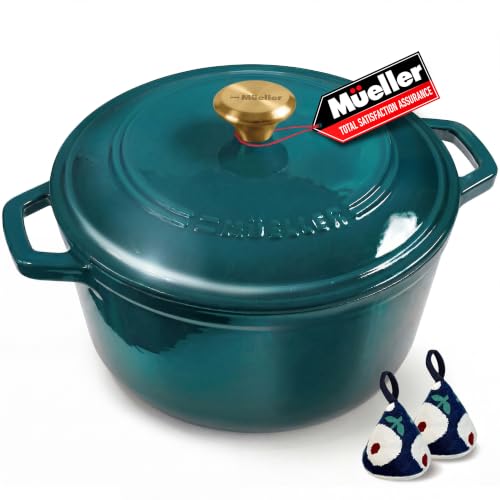
- Mueller DuraCast 6 Quart Enameled Cast Iron Dutch Oven, Emerald — Best Proven on Paper. Best for buyers who want the oven-safe figure printed in the listing.
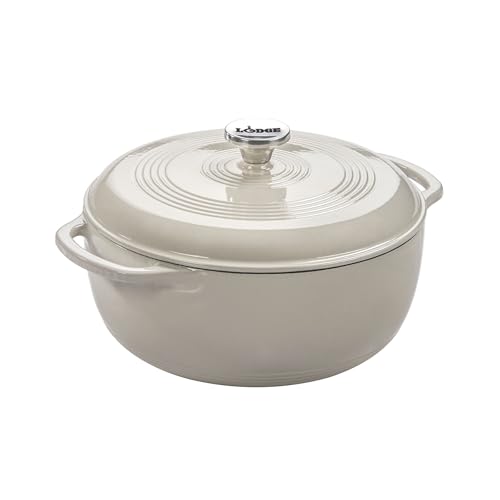
- Lodge Essential Enamel Cast Iron Dutch Oven, 6 Quart, Island Spice Red — Best for Oven Braising. Best for families whose cooking lives in the oven for hours.
- Le Creuset Enameled Cast Iron Round Dutch Oven, 5.5 qt., Cerise — Best Premium Oven Performer. Best for cooks who prize even oven heat and the benchmark name.
- Umite Chef 7QT Enameled Cast Iron Dutch Oven, Emerald — Best Oven Capacity. Best for big roasts and batch bakes that fill the oven.
- Umite Chef 5QT Enameled Cast Iron Dutch Oven, Cream White — Best for Oven Bread. Best for bakers whose pot lives in the oven daily.
- Umite Chef 5QT Enameled Cast Iron Dutch Oven, Red — Best Oven Workhorse in Red. Best for cooks who want the baker’s size in a forgiving finish.
Read the full guide ↓ for the evidence grades, per-pot oven verdicts, and the technique that makes an oven pot perform like one.
A Dutch oven is named for the oven, and shoppers who search for the best oven proof dutch ovens are asking the format’s founding question in modern form: which of these pots can I trust in the oven — for the preheated bread bake, the three-hour braise, the roast that starts on the hob and finishes behind the oven door — and how do I know? The knowing is this guide’s subject as much as the pots are. Among the six verified enameled cast iron pots below, the Mueller’s listing states a numeric oven-safe figure outright. The category’s design intent covers the rest: a lidded cast iron pot exists to cook in ovens, and every pick here is built for stovetop-to-oven work. But intent is not documentation, and where a title is silent about limits, this guide says so and sends you to the full listing for the model’s stated figure — especially for the lid knob, which is so often the component that sets the practical ceiling.
Ranked with that honesty, the shortlist still gives oven-led cooks everything they need: a documented six-quart all-rounder, a sealing-lid braiser, the premium benchmark, a seven-quart oven-filler, and a pair of five-quart bread pots in two finishes. Readers comparing the wider heat question across the category will find the companion treatment at Best Dutch Ovens Reddit, where community experience with these pots’ oven lives is part of the evidence — a useful counterweight to the listing-first method used here.
Key Takeaways
- The Mueller listing states the only numeric oven-safe figure in this pool — 500°F, printed in its title — alongside all-cooktops-including-induction confirmation.
- Every pick is enameled cast iron, the stovetop-to-oven format by design; where a title states no figure, confirm the model’s limit on its full listing before cooking to a number.
- The lid knob is usually the practical oven ceiling, not the iron — one reason the guide keeps directing you to per-model documentation.
- For oven braising, the Lodge’s moisture-sealing lid is the feature that matters most; for oven bread, the five-quart Umite Chef pair is sized to the loaf.
- Capacity fills the oven differently: the 7QT Umite Chef is the batch and big-roast answer, the 5.5 qt. Le Creuset the versatile middle.
- Oven-proof is a claim to verify, not a vibe: stated figures beat heavy-duty adjectives, every time.
In this guide
Quick Picks
Six pots graded for oven duty, badges repeated in the detailed reviews.
| Pick | Badge | Who it suits |
|---|---|---|
| Mueller DuraCast 6 Quart Enameled Cast Iron Dutch Oven, Emerald | Best Proven on Paper | Buyers who want the oven figure in writing |
| Lodge Essential Enamel Cast Iron Dutch Oven, 6 Quart, Island Spice Red | Best for Oven Braising | Families braising for hours with a sealing lid |
| Le Creuset Enameled Cast Iron Round Dutch Oven, 5.5 qt., Cerise | Best Premium Oven Performer | Cooks who prize even oven heat and the benchmark name |
| Umite Chef 7QT Enameled Cast Iron Dutch Oven, Emerald | Best Oven Capacity | Big roasts and batch bakes |
| Umite Chef 5QT Enameled Cast Iron Dutch Oven, Cream White | Best for Oven Bread | Daily bakers and smaller households |
| Umite Chef 5QT Enameled Cast Iron Dutch Oven, Red | Best Oven Workhorse in Red | The baker’s size in a stain-forgiving finish |
How These Picks Were Chosen
Selection started from the verified enameled cast iron pool and then graded each listing’s oven evidence in three tiers: a stated numeric figure, stated oven-safe positioning in words, or the format’s design intent without a title-level claim. The reviews and spec boxes preserve those grades exactly, because for this keyword the grade is the information. No pot was given a figure its title does not print, and no pot was excluded for a silent title — the Dutch oven is an oven instrument by definition, and a documentation gap is a reason to check a listing, not to disqualify a pot. Named features that affect oven work — a moisture-sealing lid for braises, included potholders for handling at temperature, capacities that fit ovens and fill them — were weighted in the ranking.
All specifications come from the verified listing titles, and the standing advice of this series applies with extra force here: confirm the current listing, including any knob-specific guidance, before cooking to a limit. The value-side view of several of these pots is at Best Dutch Ovens On Sale, for readers balancing oven credentials against tier.
The 6 Best Oven Proof Dutch Ovens in Detail

Mueller DuraCast 6 Quart Enameled Cast Iron Dutch Oven, Emerald
Badge: Best Proven on Paper
Strengths
- The only title in this pool that prints its oven-safe figure: 500°F oven safe, stated in the listing.
- All cooktops including induction are confirmed in the same title, completing the stovetop-to-oven paperwork.
- Six quarts in Emerald, with PFOA-free positioning also stated.
Trade-offs
- No potholders or cookbook included, and no named lid feature in the title.
- A stated figure is a ceiling to cook within, not a challenge to test.
- Confirm the current listing, since stated specifications can be revised.
Mini spec box
- Material: enameled cast iron
- Capacity: 6 Quart
- Oven evidence in title: 500°F oven safe — numeric figure stated
- Also stated in listing: PFOA-free; all cooktops incl. induction
- Colour: Emerald
- Listed uses: sourdough bread baking, braising, slow cooking
The Mueller leads an oven-proof guide for the simplest of reasons: it proves it. Its listing title states a 500°F oven-safe figure — a number that covers the realistic oven repertoire of bread preheats, roasting and braising — and pairs it with written confirmation of all cooktops including induction, so the entire stovetop-to-oven journey is documented in one title. Six quarts suits the family scale of that journey, the stated uses run from sourdough bread baking through braising to slow cooking, and the Emerald finish hides the patina that regular oven work writes on a pot. For a buyer whose keyword is proof, this is the only pick whose proof is printed where anyone can check it before purchase.
It suits documentation-first buyers, induction owners and bread bakers who preheat without anxiety. Its limitations are the bare bundle — bring your own mitts — and the discipline its own figure imposes: cook within the stated ceiling and the pot’s promise holds. Within those terms, it is the most completely evidenced oven pot in the guide.
Best for: buyers who want the oven figure in writing / Not suited for: buyers who want bundled accessories or a named lid feature
Check on Amazon to see the current listing for the Mueller DuraCast 6 Quart in Emerald.

Lodge Essential Enamel Cast Iron Dutch Oven, 6 Quart, Island Spice Red
Badge: Best for Oven Braising
Strengths
- A moisture-sealing lid and dual handles, named in the listing — the oven braise’s two working features.
- Six quarts matches family braises that spend hours behind the oven door.
- Island Spice Red presents oven-to-table without a serving transfer.
Trade-offs
- The title states no oven figure; confirm the model’s limit on the full listing before cooking to a number.
- No potholders listed as included.
- Documentation-first buyers should start with the Mueller.
Mini spec box
- Material: enamel cast iron (per listing title)
- Capacity: 6 Quart
- Oven evidence in title: none stated — confirm limit on listing
- Features named in listing: moisture-sealing lid, dual handles
- Colour: Island Spice Red
- Listed uses: bread baking, braising, marinating, slow cooking
Oven braising is where a Dutch oven spends its longest hours, and the Lodge is specified for those hours in the ways its listing verifies. The moisture-sealing lid keeps braising liquid circulating inside the pot across an afternoon in the oven, so the meat bastes rather than dries; the dual handles move the full, hot pot between hob, oven and table under full control; and six quarts holds the family braise with headroom. Its stated repertoire — bread baking, braising, marinating, slow cooking — is an oven-led list. What the title does not state is a numeric limit, and this guide’s evidence discipline applies: the format’s oven purpose is beyond dispute, but a buyer cooking to a specific figure should read it on the full listing, knob guidance included, before the first long braise.
It suits braising families who value the lid over the paperwork. If paperwork wins, the Mueller is above it in this ranking for exactly that reason; if dinner wins, the Lodge’s named features are the ones that will matter at hour three of the braise.
Best for: long oven braises at family scale / Not suited for: buyers who need a title-printed oven figure
Check on Amazon to see the current listing for the Lodge Essential 6 Quart in Island Spice Red.

Le Creuset Enameled Cast Iron Round Dutch Oven, 5.5 qt., Cerise
Badge: Best Premium Oven Performer
Strengths
- The benchmark name in enameled cast iron, in the versatile 5.5-quart round format ovens and burners both suit.
- Even, stored heat is the premium oven experience: calm braises, uniform loaves, steady roasts.
- Cerise finish makes the oven-to-table journey a presentation.
Trade-offs
- The title states no oven figure; confirm the model’s stated limit, including knob guidance, on the current listing.
- Premium tier, with no bundled potholders listed.
- Not the batch-capacity answer at 5.5 quarts.
Mini spec box
- Material: enameled cast iron
- Capacity: 5.5 qt.
- Shape: round
- Oven evidence in title: none stated — confirm limit on listing
- Colour: Cerise
The Le Creuset’s oven case rests on the quality of its heat rather than the printing of its limits. Verified from its listing, it is an enameled cast iron round Dutch oven of 5.5 quarts in Cerise — the benchmark object of the category, whose reputation was built substantially in ovens: braises that hold a calm equilibrium for hours, loaves that colour uniformly in the stored heat, roasts that move from sear to oven without a vessel change. This guide does not print a figure its title does not state, and buyers for whom a number is the decision should take the Mueller’s documentation as the standard and read the Le Creuset’s full listing for its own stated limit before buying. Buyers for whom the cooking is the decision already know what this pot is.
It suits frequent oven cooks who will amortise the premium across years of weekly use. Its limitations for this keyword are documentation and scale, both stated plainly. The brand-side deep dive lives at Best Dutch Ovens Not Le Crueset for readers comparing the premium against the field it inspired.
Best for: premium oven performance in the versatile size / Not suited for: batch cooking or buyers who need the figure in the title
Check on Amazon to see the current listing for the Le Creuset 5.5 qt. in Cerise.

Umite Chef 7QT Enameled Cast Iron Dutch Oven, Emerald
Badge: Best Oven Capacity
Strengths
- Seven quarts fills an oven with purpose: whole birds, big roasts and double batches in one vessel.
- Cotton potholders included — essential for a pot of this size at oven temperature.
- Heavy-duty positioning for bread baking, braising, stews and marinating, per its listing.
Trade-offs
- The title states no oven figure; confirm the model’s limit on the full listing.
- The heaviest hot carry in the guide — plan the route from oven to trivet.
- Check oven shelf clearance with the lid on before buying.
Mini spec box
- Material: enameled cast iron
- Capacity: 7QT
- Oven evidence in title: none stated — confirm limit on listing
- Includes: lid and cotton potholders (per listing title)
- Colour: Emerald
- Listed uses: bread baking, braising, stews, marinating
Oven capacity is a distinct virtue: a seven-quart pot turns the oven into a batch kitchen, roasting the whole bird with its vegetables in one uncrowded layer and baking the loaf sized for a gathering. The Umite Chef’s listing describes heavy-duty enameled cast iron for bread baking, braising, stews and marinating, and includes the cotton potholders that a pot of this scale at oven temperature makes mandatory equipment. Its thermal mass steadies a long oven cook beautifully — door openings for basting barely register — and the Emerald finish absorbs the visual record of that work. The evidence note stands as it does for its peers: no figure is printed in the title, so the full listing is the place to confirm the limit for your hottest intended routine.
It suits hosts, batch cooks and large families whose oven is the kitchen’s engine. Measure the oven before you measure anything else: shelf clearance with the lid on is this pot’s first specification in practice, whatever the paperwork says.
Best for: big oven roasts and batch bakes / Not suited for: small ovens or buyers who need a title-printed figure
Check on Amazon to see the current listing for the Umite Chef 7QT in Emerald.

Umite Chef 5QT Enameled Cast Iron Dutch Oven, Cream White
Badge: Best for Oven Bread
Strengths
- Five quarts is the loaf-sized pot: a preheated, lidded bake with steam trapped where the crust forms.
- Cotton potholders included — the baker’s handling kit for a pot retrieved at full temperature.
- The pale interior shows fond and crumb-side browning cues clearly.
Trade-offs
- The title states no oven figure; bakers should confirm the model’s limit covers their baking routine on the full listing.
- Cream White enamel shows the scorch-kissed record of regular bread baking.
- Mid-size ceiling for family braises.
Mini spec box
- Material: enameled cast iron
- Capacity: 5QT
- Oven evidence in title: none stated — confirm limit on listing
- Includes: lid and cotton potholders (per listing title)
- Colour: Cream White
- Listed uses: bread baking, braising, stews, roasting
Bread is the oven routine that tests a pot most theatrically — preheated empty, loaded with dough, baked covered then uncovered — and the five-quart Umite Chef is sized for its standard form. The listing aims it at bread baking first among its uses, and includes the potholders that the routine’s hottest moment, retrieving the preheated pot, demands. Between bakes it covers the smaller household’s braises, stews and roasts, and its pale interior doubles as a baker’s gauge for fond and sauce colour. The documentation note is the baker’s version of this guide’s refrain: the title prints no figure, so confirm on the full listing that the model’s stated limit sits comfortably above your baking temperature before the first preheat.
It suits daily bakers and households of one to four. Its limitations are the mid-size ceiling and the pale finish’s honest record of a baking life — which many bakers wear as a badge rather than a flaw.
Best for: sourdough routines and smaller households / Not suited for: batch cooking or buyers who skip the limit check
Check on Amazon to see the current listing for the Umite Chef 5QT in Cream White.

Umite Chef 5QT Enameled Cast Iron Dutch Oven, Red
Badge: Best Oven Workhorse in Red
Strengths
- The same loaf-sized, potholder-bundled build as the Cream White version, in the finish that hides oven patina best.
- Red is the classic oven-pot colour — it looks at home on the hob and at the table between bakes.
- Covers the same stated repertoire: bread baking, braising, stews, roasting.
Trade-offs
- A finish variant of the previous pick, not a different oven performer.
- The title states no oven figure; the same listing check applies.
- Shares the five-quart ceiling.
Mini spec box
- Material: enameled cast iron
- Capacity: 5QT
- Oven evidence in title: none stated — confirm limit on listing
- Includes: lid and cotton potholders (per listing title)
- Colour: Red
- Listed uses: bread baking, braising, stews, roasting
The red Umite Chef closes the shortlist as the workhorse variant of the baker’s pot: identical enameled cast iron, identical five-quart format, identical potholder bundle and stated repertoire, wearing the finish that forgives an oven life. Regular preheating, the occasional scorched drip, the smoke-kiss of a roast — red absorbs the evidence that Cream White displays, so the pot keeps its looks with ordinary washing across years of oven service. This guide lists it separately, as it has the colour pairs throughout the series, so that the finish decision is made openly rather than discovered. The oven-evidence note is shared with its sibling: no figure in the title, so the full listing carries the limit, and the careful baker reads it once and cooks freely thereafter.
Choose red if your oven routine is frequent and your sauces are rich; choose cream if the pale interior’s readability matters more. The oven will not know the difference, and neither will the bread.
Best for: frequent oven cooks who want the forgiving finish / Not suited for: buyers expecting any performance difference from the Cream White pick
Check on Amazon to see the current listing for the Umite Chef 5QT in Red.
Comparison Table
| Pick | Capacity | Oven evidence in title | Named feature or extras | Link |
|---|---|---|---|---|
| Mueller DuraCast Dutch Oven | 6 Quart | 500°F oven safe stated | All cooktops incl. induction stated | Check on Amazon |
| Lodge Essential Dutch Oven | 6 Quart | Not stated — check listing | Moisture-sealing lid, dual handles | Check on Amazon |
| Le Creuset Round Dutch Oven | 5.5 qt. | Not stated — check listing | Premium benchmark name | Check on Amazon |
| Umite Chef Dutch Oven | 7QT | Not stated — check listing | Cotton potholders included | Check on Amazon |
| Umite Chef Dutch Oven | 5QT | Not stated — check listing | Cotton potholders included | Check on Amazon |
| Umite Chef Dutch Oven | 5QT | Not stated — check listing | Cotton potholders included | Check on Amazon |
How to Choose an Oven Proof Dutch Oven
Choose by evidence tier first, because that is this keyword’s question. If your oven work runs hot and specific — daily bread preheats, high roasting temperatures — prefer the pot whose listing states its figure, and cook inside it: in this pool, that is the Mueller alone, and its written induction confirmation settles the hob side of the journey too. If your oven work is the long, moderate braise, the evidence that matters shifts from numbers to lids, and the Lodge’s moisture-sealing design becomes the deciding feature, with its full listing read once for the model’s limit. If your oven work is scale — birds, batches, gatherings — capacity leads, and the seven-quart Umite Chef is the answer, again with the listing check as the one-minute price of certainty. Premium evenness leads to the Le Creuset; daily bread leads to the five-quart pair. In every branch, the same two habits protect the purchase: read the model’s stated limit, knob included, on the current listing, and respect it as a ceiling rather than a target.
Fit the oven as you fit the pot. Measure shelf clearance with the lid on, especially at seven quarts; confirm the base suits your largest burner for the stovetop start most oven dishes need; and plan the landing — a trivet where the hot pot will live between oven and table. An oven-proof pot that does not fit the oven is a paperwork victory and a kitchen defeat.
How to Cook in the Oven With a Dutch Oven: The Core Routines
Three routines cover most oven work. The braise: sear on the hob, deglaze, add liquid to a modest depth, cover, and give the pot hours at a gentle oven heat, where surrounding warmth replaces the hob’s one-directional push and the lid — sealing, where your pot has one — keeps the moisture circulating. The roast: start or finish uncovered so surfaces brown, use the pot’s mass to smooth the oven’s cycles, and rest the meat in the vessel so its juices stay in the meal. The bake: preheat pot and lid with the oven, load the dough on parchment, bake covered for the steam phase and uncovered for colour, and handle the retrieved pot as the uniformly hot object it is — the moment the included or purchased potholders justify themselves.
Care after oven work is the category standard with one emphasis: let the pot cool on a trivet before it meets water, because the thermal gap between a hot pot and a cold sink is enamel’s oldest enemy. Soak, soften, wash with a soft sponge, use a baking-soda simmer for baked-on residue, and dry fully before storage.
Troubleshooting, in brief. Problem: a braise dries at the edges despite the lid → the oven ran hot or the liquid started low; add hot stock, drop the temperature, and let the sealing lid do its work at a gentler equilibrium. Problem: bread crust pales → the pot was not fully preheated; preheat with the oven from cold and extend the uncovered finish. Problem: a roast steams instead of browning → too much liquid or the lid stayed on; roast uncovered for the browning phase and cover only to finish or rest.
The Knob: The Small Part That Sets the Ceiling
Every oven-proof conversation eventually arrives at the knob, and it deserves its own section rather than a footnote. The pot’s body is cast iron, a material at home in serious heat; the enamel is a fused coating built for the same environment; but the lid knob is a separate component, gripped at the oven’s full temperature, and makers specify its limits separately — which is why model listings, not category generalities, carry the number that matters for your hottest routine. This guide’s repeated instruction to confirm the limit on the full listing is, in practice, an instruction to read the knob’s specification along with the pot’s. Treat every knob as hot regardless of material, grip it with the potholders the thoughtful listings here include, and let the stated ceiling — where one exists — govern your preheats. A buyer who understands the knob understands oven-proof as a property of an assembled object, and will never be surprised by the one component that was always the frontier. The porcelain-enamel side of that assembly is explored further at Best Porcilan Cast Iron Dutch Ovens, misspelling preserved from the keyword that prompted it.
Oven Work Across a Week: What Proof Looks Like in Practice
Proof, in the end, is not a figure but a routine the pot survives gracefully, week after week. Monday’s braise spends three hours behind the oven door and emerges with its sauce intact because the lid held. Wednesday’s loaf goes into a pot preheated to baking temperature and comes out blistered, the pot none the worse for the most theatrical routine in home cooking. Friday’s roast starts with a hob sear, finishes in the oven, rests in the iron and serves from it, one vessel across the whole arc. The weekend’s batch cook fills the seven-quart with tomorrow’s lunches. None of these routines is exotic, and that is the point: oven-proof, properly understood, is the property of being unremarkable at temperature, repeatedly, for years. The listings’ figures and phrases are the paperwork for that property; the technique in this guide is its daily practice; and the pots above are the shortlist that paperwork and practice jointly produce.
Stovetop Starts, Oven Finishes: The Transfer Craft
Most oven dishes begin on the hob, and the transfer between the two is a small craft worth making explicit. Sear and build the dish on the burner, where you can see and adjust; bring liquids to the edge of a simmer before the pot goes in, so the oven’s job is holding and transforming rather than heating from cold, which shortens the cook and evens it. Set the oven before you need it — a pot should never wait, full and cooling, for an oven to catch up. Move the pot with both protected hands on a rehearsed path, set it centrally on the shelf, and close the door gently; a slammed door sloshes braises and startles loaves. On the return journey, the trivet should already be waiting, because a hot pot in search of a landing is how counters get scorched and cooks get hurried. None of this is difficult, and all of it is the difference between a pot that is oven proof on paper and a kitchen that is oven fluent in practice — which is the actual goal the keyword is reaching for.
Common Buying Mistakes
- Treating oven proof as a category-wide constant. Limits are model-specific and often knob-specific. The Mueller’s stated figure belongs to the Mueller alone.
- Skipping the listing check because the format is obviously oven-safe. Design intent is real, but your hottest routine deserves the model’s own number. The check takes a minute.
- Preheating carelessly. Bring pot and oven up together for bread; never set a cold enameled pot into a fully hot oven or a hot pot into cold water.
- Forgetting shelf clearance. A seven-quart pot with its lid on is taller than your shelf spacing may be. Measure first.
- Handling at temperature without the system. Potholders or mitts, both hands, a planned landing — at oven heat this is procedure, not caution theatre.
- Cooking to the ceiling as a habit. A stated limit is a boundary for occasional peaks, not a daily target. Routine cooking well inside it preserves the enamel.
A Brief History of the Oven in the Name
The name itself is the oldest oven-proof claim in the category. The original Dutch oven earned its title from cooking in and around hearth ovens and coals — a lidded iron pot that functioned as a portable oven wherever it was set down. The modern enameled version moved that oven-within-an-oven indoors, trading coals for the controlled heat of a domestic range while keeping the essential trick: a heavy, lidded vessel that surrounds food with stored, even heat. When today’s shoppers add the word proof to the search, they are asking the descendant to document what the ancestor demonstrated nightly. This guide’s answer — one printed figure, honest grades for the rest, and a standing instruction to read each model’s own limit — is simply that old demonstration translated into modern paperwork. The material has not changed its nature; only the evidence has changed its format.
When the Paperwork Should Not Decide
A closing calibration, in fairness to the pots this guide graded on silence. For the great mainstream of oven cooking — braises, roasts, stews and loaves at ordinary oven temperatures — every verified enameled cast iron pot in this pool is operating in its design’s home territory, and a buyer whose routine lives there can choose on lid, capacity, bundle and finish with a clear conscience after the one-minute listing check. The documentation tiers in this guide matter most at the edges: the baker preheating daily toward a limit, the induction owner needing written compatibility, the cook whose oven runs fierce. Know your edge, or know that you do not have one, and let that knowledge set how much of the decision the paperwork carries. Proof is a means to confident cooking, not a substitute for it — and confident cooking, in a pot that fits your oven and your meals, is the purchase this keyword was always trying to make.
Final Recommendation
If proof is the purchase, buy the Mueller DuraCast: the only listing here that prints its oven-safe figure, with induction confirmation beside it, at the family size. If braising is the purchase, buy the Lodge and read its listing once for the limit — its sealing lid will matter more across a year of oven hours than any number. Premium buyers should take the Le Creuset for the quality of its oven heat, hosts the Umite Chef 7QT for capacity, and bakers either five-quart Umite Chef, Cream White for readability or Red for forgiveness. Every route in this guide ends the same way: a verified enameled cast iron pot, a limit read and respected, and an oven that finally has the vessel it was named for.
If you want a fast answer, start with one of these three and read its detailed review above: Mueller DuraCast 6 Quart Enameled Cast Iron Dutch Oven, Emerald, Lodge Essential Enamel Cast Iron Dutch Oven, 6 Quart, Island Spice Red, Umite Chef 7QT Enameled Cast Iron Dutch Oven, Emerald. They cover the documented, braising and capacity cases for oven-led cooking.
And once the pot is home, do the thing that turns paperwork into proof: cook in it this week. A braise, a roast or a loaf will teach you its heat, its lid and its handles faster than any listing can — and the oven, at last, will be working with the vessel it was named for.
Frequently Asked Questions
What does oven proof actually mean for a Dutch oven?
That the maker intends and specifies the pot for oven use, up to a stated limit that applies to the whole assembled object — body, enamel, lid and knob. In this pool only the Mueller prints its figure in the title; for the others, the full listing carries the model’s limit, and this guide directs you there rather than inventing one.
Can I put any enameled Dutch oven straight from the hob into the oven?
That transfer is the format’s founding move, and every pick here is built for it. Observe two courtesies: avoid extreme, sudden temperature jumps where you can, and cook within the model’s stated limit once you have read it on the listing. The pot that sears your stew meat is designed to finish that stew behind the oven door.
Why is the lid knob such a big deal?
Because it is a separate component sitting in the oven’s hottest air, and its material often sets the practical ceiling below what the iron body could bear. Makers state knob guidance per model, which is why oven-proof homework is listing homework. Grip every knob with protection regardless — at temperature, they are all hot.
Is a bigger pot more oven proof?
No — capacity and oven limits are independent properties set by each model’s own specification. A seven-quart pot holds more food and steadies long cooks with its mass, but its ceiling is whatever its listing states, exactly as a five-quart pot’s is. Buy size for your meals and proof from the paperwork.
Can I use a Dutch oven for baking bread at high temperatures?
That is one of its signature uses, and several listings here name sourdough or bread baking directly. Preheat the pot with the oven, respect the model’s stated limit as your ceiling, and handle the preheated pot with both protected hands. Confirm the limit covers your baking temperature on the full listing before the first bake.
Is a stated oven figure a guarantee against all damage?
No — it is a specification for temperature, not a promise against impact, thermal shock or misuse. A pot cooked within its stated limit can still be chipped by a dropped lid or stressed by cold water at the wrong moment. Proof and care work together: the figure tells you where the oven may go, and the technique in this guide keeps the pot worthy of going there.
Can I leave food to rest in the pot after the oven?
Yes, and you should — resting in the iron is part of the method. A braise or roast left covered in the pot holds its temperature gently while the meat relaxes and the sauce settles, and the same vessel then serves at the table. Just remember the pot remains hot long after the oven is off, and keep the trivet and the warning to the table in place.
Does the enamel need different care after oven use?
No different system, just the same courtesies applied consistently: cool on a trivet before washing, soak rather than scour baked-on residue, and use the baking-soda simmer for stubborn oven films. Oven work will write patina on the exterior over time, especially on pale finishes; that record is cosmetic, and saturated finishes simply show less of it.
What is the first oven dish I should cook in a new pot?
A forgiving braise or a simple loaf — a dish that teaches you the pot’s heat, lid behaviour and handling at low stakes. Save the gathering-sized roast and the ambitious bake for the second or third outing, when the transfer from hob to oven and the landing on the trivet are already habits rather than first performances.
Should an oven proof pot also be broiler proof?
Not automatically, and the distinction matters. Broiler heat is radiant, direct and harsher than oven air, and it falls hardest on the lid and knob. No title in this pool claims broiler use, so treat broiling as a separate verification on the full listing of your chosen model — and if it is not stated, keep the pot in the oven proper, where its proof lives.
How do I know my oven is big enough for a 7-quart pot?
Measure the shelf-to-shelf height and the width between the oven walls, then compare with the listing’s external dimensions, lid and handles included, leaving margin for gloved hands. The seven-quart pick in this guide is the one to measure twice for; the five and five-and-a-half-quart pots fit most domestic ovens without drama.
Does oven proof cover the lid as well as the pot?
It must — a Dutch oven cooks in the oven as an assembled object, lid on, which is why this guide treats the knob’s specification as part of the pot’s proof and directs you to the model’s own stated limit rather than a category assumption. When you read a listing’s oven figure, read it as covering the configuration the maker describes, and follow any knob-specific guidance the listing adds.
Can I use an oven proof Dutch oven for baking and roasting on the same day?
Yes — sequential cooking is a natural strength of cast iron’s heat retention, and many owners bake the loaf, then braise in the same pot while the bread cools. Let the pot adjust between duties without shocking it: no cold water between a hot bake and the next cook, just a wipe or a gentle wash once it has cooled enough to handle safely.
What should I do if my pot’s listing states no limit?
Read the listing’s full specification section and the maker’s guidance for the model — the figure usually lives there even when the title omits it. Until you have it, cook at the moderate temperatures of ordinary braising and roasting, which is the format’s home ground, rather than testing the extremes of your oven.