Disclosure: topratedkitchenware.com is reader-supported. When you buy through links on our site, we may earn an affiliate commission from Amazon and other retailers, at no extra cost to you.
Where to buy
The six best vacuum sealers for Europe sous vide cooks below are sold through Amazon — and for European buyers, the listing check matters more than the machine choice: confirm the voltage and plug version offered to your country before anything else. Our top recommendation for sous vide performance is the UPRUBE Vacuum Sealer, 95kPa, 9-in-1 with Pulse Mode and Digital Timer — Check on Amazon — with the full shortlist here:
- ROUUO Vacuum Sealer, 95kpa with Pulse Mode and Drip Tray
- Bonsenkitchen Vacuum Sealer Machine, Silver
- Chef Preserve Compact Vacuum Sealer with 30 Reusable Bags
- VACLER Vacuum Sealer Machine, 6-in-1 Smart Modes
- FoodSaver Mini Handheld Vacuum Sealer, Cordless
Read the full guide ↓ — especially the voltage section. A perfect sealer in the wrong voltage is not a bargain; it is a return shipment.
Shoppers searching for the best vacuum sealers for europe sous vide are solving two problems at once, and most guides only solve one. The sous vide problem is familiar: a water bath demands bags with the air fully removed and seals that survive an hour or more submerged in hot water, plus enough control to handle the marinades and butters that make sous vide worth doing. The Europe problem is electrical and logistical: European kitchens run on a higher household voltage than North America, with different plugs, metric expectations, and regional model variants that share names with American machines while differing in the ways that matter most. The best vacuum sealers for europe sous vide, then, are machines whose sous vide credentials are verifiable and whose regional version a European buyer can actually confirm and purchase — and this guide treats the second condition as seriously as the first.
Let us be direct about the listings in this guide: they are drawn from the US marketplace, and we make no claim that any specific unit ships in a European-voltage variant. What we can do — and what a careful buyer anywhere should do — is rank the machines on their stated sous vide-relevant features (pulse control for liquids, moist modes, seal-session design, stated vacuum strength), and give you the exact verification checklist that confirms the individual unit you order is built for your wall sockets. A machine that tops this list in its correct regional version is a superb purchase; the same nameplate in the wrong voltage is a hazard and a disappointment. Buy the version, not just the model. Readers whose sous vide work centers on delicate proteins will also want Best Vacuum Sealers For Fish, where the gentle-sealing craft is covered portion by portion.
Key Takeaways
- Voltage first: European homes use a higher voltage standard and different plugs than North America — verify the exact unit’s rating on its listing and nameplate before ordering, and never rely on a plug adapter to fix a voltage mismatch.
- The UPRUBE is our top sous vide pick: pulse mode for marinades and liquids, moist mode for juicy proteins, a digital timer for repeatable cycles, and a stated 95kPa vacuum for tight, sink-ready bags.
- Seal integrity is the sous vide specification: inspect every seal, double-seal long cooks, and keep liquid out of the seal zone with headspace and pulse control.
- The ROUUO is the session alternative — the strongest stated power here, pulse control, and a removable drip tray for a counter full of marinade bags.
- Handheld valve bags work for short sous vide cooks with compatible bags; the FoodSaver Mini lists sous vide among its uses, while welded countertop seals remain the reference for long baths.
- Buy bags and rolls in metric-friendly quantities with the machine; a sealer without film in a new country is a paperweight with potential.
- Write the bath plan on the bag — protein, temperature, time — because the cook who labels is the cook whose second attempt at a dish is better than the first, and sous vide rewards that memory more than any other method in the kitchen.
In this guide
Quick Picks
| Pick | Badge | Standout detail from the listing | Link |
|---|---|---|---|
| ROUUO Vacuum Sealer 95kpa | Best for Bath Sessions | 95kpa, 230W, pulse mode, removable drip tray, bag storage and cutter, 3 rolls and 10 bags | Check on Amazon |
| Bonsenkitchen Vacuum Sealer | Best Value | Multiple modes, external vacuum system, compact silver body, sous-vide named in its uses, 5 bags | Check on Amazon |
| UPRUBE Vacuum Sealer 95kPa | Best Overall for Sous Vide | 9-in-1, dry/moist/pulse modes, 12L/min, digital timer, cutter and bag storage, 10 ft roll | Check on Amazon |
| Chef Preserve Compact | Best for Travel and Portions | Handheld portable sealer with 30 reusable vacuum bags included | Check on Amazon |
| VACLER Vacuum Sealer | Most Versatile | 6-in-1 smart modes including Wet and Dry; bag cutter; 20 bags and vacuum hose included | Check on Amazon |
| FoodSaver Mini Handheld | Best Handheld for Sous Vide | Cordless handheld, marinate setting, charging dock; sous vide named among its uses | Check on Amazon |
How These Picks Were Chosen
This is a research-led guide built on verified listing data: every machine’s name, stated figures, named modes, and box contents were checked against its current listing, and nothing is claimed that the listing does not support. Two filters were then applied for this specific keyword. The sous vide filter ranked pulse control first — liquids and marinades in the bag are sous vide’s signature challenge, and pulse is the tool that stops a draw before the liquid reaches the seal — followed by moist modes, seal-session hygiene, and stated vacuum strength, because a bag with residual air floats, and floating bags cook unevenly. The Europe filter did not rank machines at all; it produced the verification protocol in the buying guide, because regional suitability is a property of the individual unit and its listing, not of the model line.
Note the discipline on sous vide claims: where a listing names sous vide — the Bonsenkitchen and the FoodSaver Mini do — we say so; where it does not, we evaluate the machine’s sealing features for the bath without putting words in the maker’s mouth. That restraint is not pedantry. A buyer in Lisbon or Lyon deserves a guide whose claims survive contact with the listing they are about to purchase from, in the version that will actually arrive at their door — and every sentence of this article was written to pass that test. Any competent external sealer with a strong weld can serve a water bath, and the technique section below matters more than any badge. Home cooks weighing the same machines for general duty should cross-read Best Vacuum Sealers For Home Use; the overlap is large, and the Europe-and-bath specialization is this page’s contribution.
The 6 Best Vacuum Sealers for Europe Sous Vide Cooks

ROUUO Vacuum Sealer 95kpa with Pulse Mode
Badge: Best for Bath Sessions
Strengths
- Pulse mode for marinade-heavy bags: stop the draw before liquid reaches the seal zone.
- Removable drip tray — a sous vide session is a wet session, and the tray keeps the machine’s seal area clean across it.
- Stated 95kpa vacuum and 230W power pull bags tight and flat, so portions sink and cook evenly.
Trade-offs
- Manual pulse control asks for attention across a session of many bags.
- Regional version must be verified like every pick here — power figures make the correct-voltage unit essential, not optional.
- More machine than a once-a-month sous vide cook needs.
Mini spec box
- Type: external countertop vacuum sealer
- Vacuum: 95kpa (as stated in listing)
- Power: 230W (as stated in listing)
- Modes: dry/moist, pulse mode
- Features: built-in bag storage and cutter, removable drip tray
- Included: 3 bag rolls and 10 bags
Sous vide prep is a production line of wet bags, and the ROUUO is built like it knows. Pulse control handles the defining moment — the marinade climbing the bag as the air leaves — by putting the stop under the cook’s thumb, bag after bag. The drip tray handles the defining mess: something always weeps, and a tray that lifts out for rinsing keeps the twelfth bag’s seal as clean as the first’s, which matters because a contaminated seal in a hot bath is a ruined dinner discovered an hour late. The strong stated vacuum completes the picture by pulling bags truly flat, so portions submerge fully instead of ballooning at the surface where the water is coolest.
Its demands are engagement and verification. Pulse is a skill, and the correct regional version is a precondition — a point this guide repeats for every machine and means most where power is highest. For the European cook running weekly baths of marinated proteins, in the verified-correct version, the ROUUO is the session tool of choice. The same wet-session discipline serves the marinade-first cooks of Best Vacuum Sealers For Marinades, where the liquid is the point rather than the hazard.
Best for: frequent sous vide with marinades, batch bath prep, engaged cooks / Not suited for: set-and-forget users or anyone skipping the voltage check
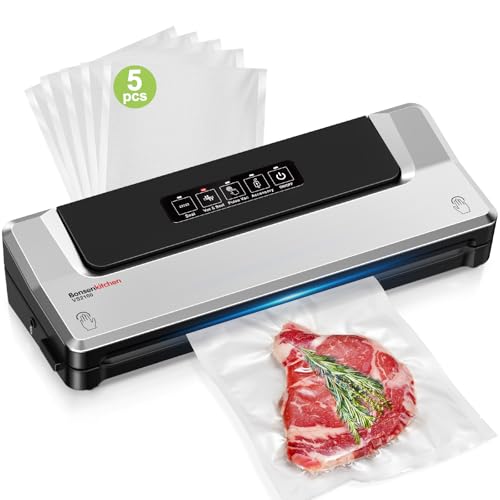
Bonsenkitchen Vacuum Sealer Machine
Badge: Best Value
Strengths
- Sous-vide is named in its stated uses — the maker built and describes it with the bath in mind.
- Multiple modes in a compact, silver, apartment-friendly body.
- The value tier leaves budget for the circulator, container, and film that complete a sous vide setup.
Trade-offs
- No pulse mode named: liquid-heavy bags need the freeze-the-marinade trick or a careful partial fill.
- Only 5 bags included — order rolls with it, sized for your portions.
- Compact session pace for large dinner-party batches.
Mini spec box
- Type: external vacuum system, compact countertop
- Modes: multiple modes for meal prep
- Finish: silver
- Included: 5 vacuum bags
- Uses: kitchen food storage and sous-vide
A sous vide setup is a system — circulator, vessel, sealer, film — and the Bonsenkitchen is the sealer for the buyer who would rather fund the whole system well than the sealer alone brilliantly. It is a compact external vacuum system whose stated uses include sous-vide, with multiple modes for the prep around the bath. For the classic home bath work — seasoned portions, butter and herbs in the bag, an hour or two submerged — its welded seals do the job, and its size suits the smaller kitchens common across much of Europe, where the sealer may share a counter with everything else the cook owns.
The technique tax is the absence of a named pulse mode: marinades must be managed by freezing them into the portion first, filling bags with restraint, and leaving generous headspace — all learnable, all standard practice for generations of sous vide cooks before pulse buttons were common. Add rolls to the order, since five bags will not see out the first month of baths. Judged as the value component in a complete European sous vide station, verified in the correct regional version, it earns its place without pretending to be the flagship.
Best for: value-minded sous vide beginners, small European kitchens, complete-system budgeting / Not suited for: marinade-heavy work without the freeze-first workaround

UPRUBE Vacuum Sealer, 95kPa, 9-in-1
Badge: Best Overall for Sous Vide
Strengths
- The complete sous vide mode set: pulse for liquids, moist for juicy proteins, dry for everything else.
- Digital timer makes a proven cycle repeatable across a whole evening’s worth of bath bags.
- Stated 95kPa vacuum and 12L/min draw — tight, flat, sink-ready bags, produced quickly.
Trade-offs
- Nine functions mean a learning session before the first bath day runs smoothly.
- Like every pick, the regional version must be verified before purchase.
- Feature depth exceeds a casual cook’s needs.
Mini spec box
- Type: external countertop vacuum sealer
- Vacuum: 95kPa (as stated in listing)
- Speed: 12L/min (as stated in listing)
- Power: 135W (as stated in listing)
- Modes: dry / moist / pulse, 9-in-1 functions
- Features: digital timer, easy-tear cutter, bag storage
- Included: 10 ft bag roll
The UPRUBE leads this guide because sous vide rewards exactly the virtues it states. The bath punishes two failures — air left in the bag, and liquid in the seal — and the UPRUBE answers both by design: a strong, fast draw that empties the bag before marinade can migrate, and a pulse mode for the bags where the cook, watching the liquid climb, decides the stopping point personally. The moist mode covers the middle ground of juicy proteins automatically, and the digital timer turns the cycle that worked for tonight’s duck into the cycle that works for next month’s, identically. Repeatability is the soul of sous vide — the method is literally temperature and time, repeated — and this is the most repeatable sealer in the list.
The workstation details suit European kitchens building a permanent bath corner: cutter and bag storage at the machine, a full roll included, and a footprint that coexists with a circulator and container. Its cautions are the learning curve and this guide’s standing one — verify the regional version on the listing, because a specification sheet this good deserves the correct wall power behind it. For the cook who will run baths weekly for years, the UPRUBE in its proper version is the considered choice, and its gentle modes double beautifully for the proteins in Best Vacuum Sealers For Meat.
Best for: regular sous vide cooks, marinade work, repeatability devotees / Not suited for: one-button cooks or unverified cross-region purchases

Chef Preserve Compact Vacuum Sealer
Badge: Best for Travel and Portions
Strengths
- Handheld and portable — the sealer that fits a small flat, a holiday kitchen, or a camper van.
- Thirty reusable bags included: portioning without a film supply chain, in any country.
- Gentle, stop-anytime draws suit small portions and delicate items.
Trade-offs
- Its listing does not claim sous vide use, and this guide does not claim it for the bath — treat it as the storage and portioning specialist.
- No welded seal: long freezer storage and long cooks belong to countertop machines.
- Closed reusable-bag format.
Mini spec box
- Type: handheld vacuum sealer
- Included: 30 reusable vacuum bags
- Format: compact, portable
The Chef Preserve earns its place in a Europe guide on logistics rather than bath performance, and we will be precise: its verified listing presents it as a compact food sealer with reusable bags, and that is the role we recommend it for — the portioning, fridge, and freezer-short-term work around a sous vide life, in kitchens where space and travel dominate. Small European flats, students, and van-life cooks will recognize the appeal instantly: no counter footprint, no roll inventory to source in a new city, thirty reusable bags in the box, and a gentle draw that handles tonight’s portions without ceremony.
For the bath itself, choose a welded-seal machine from this list; the Chef Preserve’s honest kingdom is everything before and after — marinating portions held in the fridge, leftovers after the bath, the cheese and produce of a small household. Regional verification still applies to its charging arrangements, as with any powered device bought across borders. As the second tool in a European sous vide kitchen, or the first tool in a tiny one that has not yet committed to a circulator, it is a rational, likeable purchase.
Best for: small flats, travel, portioning and storage around a sous vide routine / Not suited for: the bath itself or long freezer storage

VACLER Vacuum Sealer Machine, 6-in-1 Smart Modes
Badge: Most Versatile
Strengths
- Six smart modes, including a Wet mode whose whole purpose is the juicy, marinade-adjacent sealing sous vide prep involves.
- Vacuum hose included for containers — marinating and storage beyond bags.
- Twenty bags and a cutter included: a deep starter kit for a new kitchen.
Trade-offs
- Programs rather than pulse: the most liquid-heavy bags still need headspace discipline and a watchful eye.
- Compact body, standard session pace.
- Mode names need translating to your own menu at first.
Mini spec box
- Type: external countertop vacuum sealer
- Modes: 6-in-1 smart modes (Rice, Wet, Dry named in listing)
- Included: bag cutter, 20 bags, vacuum hose
- Operation: automatic
The VACLER’s sous vide case rests on its Wet mode and its breadth. A bath cook’s sealing week is varied — dry-seasoned portions one day, butter-and-herb bags the next, a genuinely wet marinade on the weekend — and a machine with named programs for those conditions automates the judgment that beginners have not yet built. The Wet mode in particular addresses the bath’s core risk, the compromised seal, by adjusting the cycle for moisture at the seal zone. Add the included hose, and the same machine runs the container work around the bath: marinating under vacuum before the cook, storing the sauce after it.
Its ceiling is the program’s ceiling: without a pulse control, the most ambitious liquid bags ask for the freeze-the-marinade technique and generous headspace, which experienced bath cooks treat as routine anyway. For a European household equipping a first serious sous vide corner — verified regional version, as always — the VACLER’s combination of modes, hose, and a twenty-bag start is the most forgiving on-ramp in this guide, and its pantry modes keep it employed on the days the circulator rests. Professional-adjacent readers running very high volumes should also weigh the session logic in Best Vacuum Sealers For Small Butcher Shop, where the same seal-integrity questions scale up.
Best for: versatile households, first sous vide corners, container users / Not suited for: cooks wanting manual pulse command of every bag
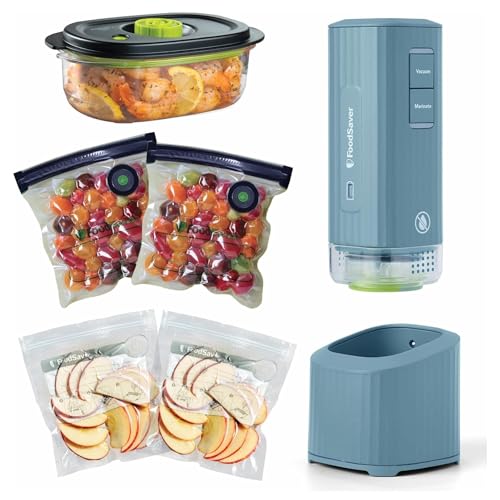
FoodSaver Mini Handheld Vacuum Sealer
Badge: Best Handheld for Sous Vide
Strengths
- Sous vide is named among its stated uses, with compatible reusable bags — single portions without cutting film.
- Marinate setting accelerates the pre-bath flavor step in the same little tool.
- Cordless with a charging dock: works in the small kitchens and rental flats where countertop machines cannot live.
Trade-offs
- Valve-bag seals suit shorter cooks; long baths and long storage favor welded seals.
- Closed reusable-bag format, with per-bag cost recovered only through reuse.
- Charging and regional plug details need the same verification as any device bought across borders.
Mini spec box
- Type: handheld vacuum sealer
- Power: cordless, rechargeable, with charging dock
- Special feature: marinate setting
- Color: blue
The Mini is the sous vide sealer for the cook with one portion and no counter. Its listing names sous vide among its uses, and the format genuinely suits the solo bath: a reusable valve bag, a portion, a quick cordless draw at the fridge door, and into the water — no roll cut, no film spent, and the bag returns to service tomorrow. The marinate setting closes the loop elegantly, since the same vacuum that seals the bath bag can accelerate the marinade before it. For students, small flats, and the many European kitchens where a circulator lives in a cupboard and the counter is a negotiation, this is not the compromise option; it is the enabling one.
Its limits are the format’s: a valve closure is not a weld, so the longest baths and the deepest storage belong to the countertop machines, and a household cooking for four nightly will outgrow single-portion pacing. Verify the dock’s plug and charging specification for your country as you would any powered purchase. Within its honest brief — small portions, short-to-medium cooks, daily storage — the Mini is the most European-shaped tool in this guide: compact, reusable, and unbothered by small spaces.
Best for: solo and small-household sous vide, tiny kitchens, marinating / Not suited for: long baths, big families, or deep storage
Comparison Table
| Pick | Type | Sous vide-relevant features | Included extras | Link |
|---|---|---|---|---|
| ROUUO | External countertop | Pulse, drip tray, 95kpa, 230W | 3 rolls & 10 bags | Check on Amazon |
| Bonsenkitchen | External countertop, compact | Multiple modes; sous-vide named in uses | 5 bags | Check on Amazon |
| UPRUBE | External countertop | Pulse + timer, moist mode, 95kPa, 12L/min | 10 ft roll | Check on Amazon |
| Chef Preserve | Handheld | Storage/portioning role (no sous vide claim in listing) | 30 reusable bags | Check on Amazon |
| VACLER | External countertop | 6-in-1 modes incl. Wet; hose for containers | 20 bags, vacuum hose | Check on Amazon |
| FoodSaver Mini | Handheld, cordless | Sous vide named in uses; marinate setting | Charging dock | Check on Amazon |
How to Choose: The European Verification Checklist
Verify voltage before features. European household power runs at a higher voltage than North American. On the listing and, on arrival, on the unit’s nameplate, confirm the machine is rated for your country’s supply. A plug adapter changes the shape of the connection, not the voltage; only a machine built for your voltage — or a proper converter rated for the appliance, a clumsy last resort — belongs in your kitchen. When a model is sold in regional versions, buy the version made for your market through its own listing.
Verify the plug and the paperwork. Confirm the plug type for your country, and that the manual and any app or support channel serve your language and region. Warranty handling differs by market; a machine bought from your regional storefront is a machine whose support path is short.
Then choose on sous vide merits. With the electrical gate passed, the ranking in this guide applies directly: pulse control for liquids, moist or wet modes for juicy proteins, drip management for sessions, stated vacuum strength for flat, sinking bags, and a timer if your cooking is repeat-driven. Size the machine to your kitchen — compact and handheld formats exist because European counters, like all counters, are finite.
Think about the second life of the purchase. A sealer in a European kitchen rarely does only sous vide: it splits market hauls, protects cheese, files away the garden’s August glut, and travels to the holiday house in July. The versatile picks in this guide — the VACLER’s mode library, the Mini’s daily resealing — earn their footprint across that whole calendar, while the specialists earn theirs at the bath. Buy for the calendar you actually live, and let the bath be the headline rather than the whole story.
Stock film in the same order. Bags and rolls are the consumable; arriving machine-rich and film-poor in a new market is the classic own goal. Order the roll or bag set with the machine, in the sizes your portions actually use.
How to Seal for the Bath, Step by Step
- Season and portion first. Salt, herbs, butter, and marinade go in before the bag closes; the bath cooks what the bag contains, nothing more.
- Mind the liquid. For marinades, use pulse control and stop the draw early — or freeze the liquid into the portion beforehand and seal the solid. Keep the seal zone dry and give every bag generous headspace.
- Choose the mode for the contents. Moist or wet programs for juicy proteins, pulse for liquid-bearing bags, dry for plain portions. The mode is the machine’s half of seal integrity.
- Inspect, then double-seal long cooks. Read the seal band for channels; for baths running long, add a second seal line a few millimetres inside the first. It costs seconds and insures dinner.
- Confirm the bag sinks. A properly evacuated bag submerges; a floater has air inside — reseal it rather than weighting it down and hoping.
- Label with contents and cook plan. Protein, cut, temperature, and time, in marker, on the bag. The bath rewards cooks who write things down.
Troubleshooting. Problem: the bag floats → air remains; reseal with a fuller draw, or expel the pocket by hand before the final seal on a fresh bag. Problem: liquid in the seal and a weak weld → pulse earlier, freeze the marinade first, dry the seal zone, and reseal in a clean section. Problem: the bag leaks in the bath → a channel crossed the seal or the film was nicked; double-seal the next batch and retire any bag that has held raw protein from further cooks.
Sous Vide in a European Kitchen: Space, Vessels, and Rhythm
The European sous vide corner has its own geography. Counters are shared with espresso, kettles, and the day’s bread; the circulator often lives in a cupboard and the vessel doubles as the stockpot. A compact sealer or a dock-kept handheld fits that geography honestly, and even the full countertop picks here were chosen with worktop coexistence in mind. The rhythm differs too: market shopping in smaller, fresher quantities means portions are sealed the day they are bought and cooked within days, which favors quick, gentle, repeatable sealing over marathon sessions — the UPRUBE’s timer and the Mini’s grab-and-go draw both serve that rhythm from opposite ends of the size scale. Build the corner around your actual market week, keep the film with the machine, and the bath becomes what it is in the best European kitchens: not an event, but a Tuesday technique. The hunting households of Best Vacuum Sealers For Hunters run the opposite rhythm — seasonal, voluminous — on the same seal-integrity principles.
Food Safety in the Bath: The Rules That Travel With the Technique
Sous vide’s precision is a safety system only when its rules are respected, and they are the same in every country. Cook at temperatures and times appropriate to the protein from a reliable source, and do not improvise in the low-temperature ranges where patience and pathogens compete. Chill leftovers quickly — an ice bath before the fridge — and remember that a sealed bag is an anaerobic environment: food meant to be kept must be kept cold, and food cooked for later should be cooled fast, stored cold, and reheated with the same care it was cooked with. Never hold cooked food in the lukewarm zone while you decide what to do with it. Label every bag with contents and date, because a vacuum bag in a fridge is anonymous by design. And treat the sealer’s role honestly: it enables the technique; it does not sterilize anything, and no seal, however beautiful, extends a food past the limits that time and temperature set. Cooks who internalize those rules get the method’s real gift — repeatability — without its risks, and they get it in any kitchen, on any continent.
Metric Portions, European Cuts, and Bag Sizing
European market shopping shapes the sealing week differently from the warehouse-club pattern many American guides assume. Portions are bought in grams, cuts differ — the thick steak, the whole duck breast, the market fish portioned by the monger — and bags should be sized to those realities rather than to a standard the food does not follow. This is the practical argument for roll-fed machines in this guide: a roll cuts to a 180-gram portion or a whole side of salmon with equal indifference, wasting nothing on either. It is also the argument for keeping two bag widths in the house where the machine allows, a narrow roll for portions and a wide one for the occasional celebratory piece. Write weights on labels in the units your household thinks in, note the bath temperature and time beside them, and your freezer and fridge become a small, legible library of future dinners — the true end state of a well-run sous vide kitchen, and a satisfaction no single gadget purchase delivers on its own.
Assembling the Complete Station on a Sensible Budget
A European sous vide station assembles in an order that respects both money and learning. Start with the circulator and a vessel you already own — a deep stockpot serves — plus the sealer that fits your counter and your region’s sockets, verified as this guide insists. Add film in your portion sizes, a rack or weights for the occasional buoyant bag, and a notebook or a label habit. Cook that station for a season before upgrading anything: the upgrades that matter will announce themselves (a dedicated container with a lid for long baths, an insulated vessel for overnight cooks, a second bag width), and the ones that do not matter will stay on the shelf where they belong. The sealer is the station’s foundation because every cook passes through it, which is why this guide spends its length on seal integrity, liquid control, and the unglamorous regional verification that decides whether the foundation is even plugged into the right wall. Build in that order, and the station grows the way good kitchens do — by evidence, not by catalog.
Common Buying Mistakes
- Ordering across regions without checking voltage. The costliest mistake available in this category. Verify the unit’s rating, every time.
- Trusting a plug adapter to solve voltage. Adapters change shape, not power. Only the correct regional version, or a properly rated converter, is safe.
- Sealing marinades on a full automatic cycle. Liquid reaches the seal and the bath finds the weak weld. Pulse, or freeze the liquid first.
- Skipping the double seal on long cooks. The longer the bath, the longer the seal is audited. Insure it.
- Arriving without film. Order rolls or bags with the machine, in your portion sizes, from the same regional storefront.
- Assuming a shared model name means a shared specification. Regional variants differ. The listing in front of you is the only specification that ships.
Rentals, Relocations, and Second Homes
A significant share of European sous vide cooks practice in kitchens they do not permanently own — rental flats, relocated postings, second homes in the countryside. The buying logic shifts accordingly. Portability and footprint rise in value: a handheld or compact that moves with you beats a flagship abandoned at each relocation. Regional verification becomes a recurring habit rather than a one-time check, because a machine bought for one country’s sockets may vacation badly in another’s — within Europe the voltage is harmonized in practice, but plugs still differ by country, and a pocketful of the right adapters, bought deliberately, is part of the mobile kit. And film logistics simplify: reusable bags and a single versatile roll width travel better than a library of sizes. The cooks who thrive in changing kitchens are the ones whose systems are small, verified, and complete — which is, not coincidentally, a fair description of the shortlist in this guide at its compact end.
One closing thought for the cook still weighing whether the whole apparatus is worth it: sous vide is the rare technique whose quality is set almost entirely before the cooking starts — in the shopping, the seasoning, and the sealing. That is why a guide to its sealers can be this long and still be, in the end, a short argument: control the air, control the liquid, respect the seal, and plug the result into the correct wall. Do those four things in a European kitchen and the bath will do the rest, quietly, precisely, and on schedule, for years.
Final Recommendation
In its correct regional version, buy the UPRUBE 95kPa Vacuum Sealer — Check on Amazon. Its pulse control, moist mode, timer-driven repeatability, and stated vacuum strength are the most complete sous vide toolkit in this guide, and its workstation design suits a permanent bath corner. Choose the ROUUO for heavier, wetter sessions, the VACLER for guided modes and container work, and the FoodSaver Mini for solo portions in a small kitchen. But let the verdict’s first word stand: version. Confirm the voltage, the plug, and the film supply for your country, and the machine you choose will reward you every bath for years.
Frequently Asked Questions
Can I use a US vacuum sealer in Europe with an adapter?
A simple travel adapter only changes the plug shape; it does not convert voltage. European household voltage is higher than North American, and a machine rated only for the lower voltage can be damaged or unsafe on the higher supply. Buy the version of the machine rated for your country’s voltage — check the listing and the nameplate — and treat a properly rated voltage converter as a last resort, not a plan.
What makes a vacuum sealer good for sous vide?
Three things: a strong, complete vacuum so bags sink and cook evenly; control over liquids, via pulse mode or moist programs, so marinades do not compromise the seal; and seal integrity that survives hours submerged — which the cook supports by inspecting every seal and double-sealing long cooks.
Can I sous vide in reusable handheld bags?
With bags made and rated for the purpose, yes — the FoodSaver Mini in this guide names sous vide among its uses with its compatible bags, and the format is handy for single portions and shorter cooks. For long baths, a welded countertop seal remains the reference standard for integrity.
How do I stop marinade from ruining the seal?
Use pulse control and stop the draw before liquid climbs to the seal zone; or freeze the marinade with the portion until firm and seal the solid; and always leave generous headspace with a dry seal area. If a seal does get wet, cut it off and reseal in a clean section rather than trusting it to the bath.
Where should a European buyer purchase from?
From the storefront and listing that serves your country, for the regional version of the machine — that route gives you the correct voltage and plug, local warranty handling, and film you can reorder without cross-border friction. Verify those three things on the listing itself, whatever the storefront.
What temperature and time should I cook at?
That depends entirely on the protein, its thickness, and the result you want — and it should come from a reliable recipe source for your exact cut, not from a sealer guide. What this guide can insist on is the sealing side of safety: a complete vacuum, an inspected (and for long cooks, doubled) seal, prompt chilling of leftovers in an ice bath, and cold storage afterward. The circulator’s precision deserves the same precision in everything around it.
Can I prepare sous vide bags in advance and freeze them?
Yes — it is one of the method’s great conveniences. Season, seal, and freeze portions flat; many cooks then move the frozen bag directly into the bath, adding time for the frozen start according to their recipe source. Label with contents, date, and the cook plan so the frozen bag is self-explanatory weeks later.
Is a handheld sealer enough to start sous vide?
For a solo cook making single portions and shorter cooks, a handheld whose listing names sous vide — the FoodSaver Mini here — is a legitimate starting point, with the bonus of daily storage duty. The moment baths lengthen, portions multiply, or marinades get ambitious, a countertop machine’s welded seal and pulse control stop being luxuries. Start where your cooking is; upgrade when the bath tells you to.
Why does my sous vide bag puff up during the cook?
Air expands as it heats, so a bag sealed with residual air will inflate in the bath and cook its contents unevenly where it lifts from the water. The fix is upstream: a fuller draw at sealing time, a hand-press to expel pockets before the final seal, and — for gassy vegetables especially — the patience to reseal a bag that was not properly emptied. A bag that starts flat stays flat.
Should I sear before or after the bath?
Most cooks sear after, for crust and color on a fully cooked, rested portion — and the sealer’s relevance is that a well-dried surface sears best, so pat the portion dry when it leaves the bag. A pre-sear under the seasoning is some cooks’ preference for depth of flavor. Either way, the bag’s job ends at the bath; what happens in the pan afterward is the cook’s signature, not the machine’s.
Do I need special bags for sous vide in Europe?
You need food-safe bags rated for cooking temperatures, in the sizes your portions use — the same requirement as anywhere. Rolls you cut yourself adapt to European portion habits and market cuts most flexibly. Avoid reusing bags that held raw protein for a subsequent cook, and double-seal for the longest baths.