Disclosure: topratedkitchenware.com is reader-supported. When you buy through links on our site, we may earn an affiliate commission from Amazon and other retailers, at no extra cost to you.
Where to buy
The six models below are the verified picks for this guide to the best recommended food dehydrators. Each name links to its Amazon listing, where you can check the latest price on Amazon and confirm the current configuration before you decide. A recommendation is only worth reading if it says who it is for, so every pick in this guide carries a named household it is recommended to — and, just as plainly, the household it is not.
- Magic Mill Pro Food Dehydrator Machine, 7 Trays, Rear Fan — The Recommendation for Most Households
- PSIIDAN Food Dehydrator, 8 Full-Size Stainless Steel Trays — Recommended for Families
- Magic Mill Food Dehydrator Machine, 5 Stainless Steel Trays — Recommended Starter Machine
- FOHERE Food Dehydrator, 5 BPA-Free Trays — Recommended for Small Kitchens
- Elite Gourmet 5-Tray Food Dehydrator EFD319 — Recommended for Simplicity Seekers
- HOPERAN 16 Tray Food Dehydrator Machine — Recommended for Bulk Preservers
Read the full guide ↓ for the reasoning behind each recommendation, the honest limitations that accompany every one, and the questions that match you to the right machine faster than any ranking.
Asking for the best recommended food dehydrators is asking for judgement, not just information — and judgement should show its working. Anyone can list six machines; a recommendation has to answer the follow-up question: recommended to whom, for what, and instead of what? This guide is built around that discipline. Each of the six verified machines below was assessed against its current listing data — tray count and material, stated temperature range, timer length, wattage, fan layout, and named extras — and then matched to the household whose routine it genuinely serves. The result is not a ladder from best to worst. It is a set of six defensible recommendations, from the seven-tray rear-fan machine we would hand to the widest range of households, through family-size and starter picks, to a sixteen-tray bulk machine we recommend enthusiastically to perhaps one reader in ten and actively warn the other nine away from.
That honesty about fit is what separates a recommendation from an advertisement, and it runs through every section that follows: the detailed reviews name who should skip each machine, the buying guide is organised by household rather than by feature, and the final recommendation is a matching exercise, not a coronation. If you already know your constraints, you may find your answer in the Quick Picks table alone. If you are choosing between neighbouring questions, note that jerky specialists will get more from Best Food Dehydrators For Jerky, sale hunters from Best Food Dehydrators For Jerkey For Sale, and nut-soaking households from Best Food Dehydrators For Soaked Nuts — this guide is the generalist’s map, and it says so.
A word about what this guide will not do: it will not crown a machine on specifications it cannot verify, borrow authority from unnamed experts, or pretend that a research-led recommendation is the same thing as a laboratory verdict. What it offers instead is traceable reasoning — every claim below can be followed back to a listing figure, and every ranking can be re-run with your own priorities. Readers who value a different evidence style, such as the independent-testing approach, will find the same discipline applied from another angle in the thermometer guides on this site; the habit of showing the working is the house style, and it is deliberate.
Key Takeaways
- The headline recommendation — the rear-fan Magic Mill Pro with seven full-size trays — earns its place on even drying, a fully stated 95°–176° range, and finishing features, not on size.
- Every other pick is a recommendation to a specific household: families, beginners, small kitchens, simplicity seekers, and bulk preservers each get a named machine.
- Stainless trays appear on five of six picks; the compact exception states its range fully and suits gentle work.
- A 48-hour timer is recommended as near-standard for real households, because life does not schedule itself around drying fruit.
- The sixteen-tray pick is a strong recommendation for bulk preservers and a deliberate non-recommendation for everyone else.
- Check the latest price on Amazon for each pick, and confirm any specification its listing title leaves unstated before ordering.
In this guide
Quick Picks
| Pick | Badge | Recommended to | Listing |
|---|---|---|---|
| Magic Mill Pro, 7 Trays, Rear Fan | The Recommendation for Most Households | Anyone wanting even batches, a stated 95°–176° range, keep warm and auto shutoff, ETL listed. | Check on Amazon |
| PSIIDAN, 8 Full-Size Trays | Recommended for Families | Bigger households: eight full-size stainless trays, stated 95°–167°, 650W, 48-hour timer. | Check on Amazon |
| Magic Mill, 5 Stainless Trays | Recommended Starter Machine | New dryers: stainless trays, 48-hour timer, control up to 167° in a storeable size. | Check on Amazon |
| FOHERE, 5 BPA-Free Trays | Recommended for Small Kitchens | Compact, gentle drying: stated 95–158°F range, 400W, stackable 11.42-inch trays. | Check on Amazon |
| Elite Gourmet EFD319 | Recommended for Simplicity Seekers | Buyers who want adjustable temperature and five trays with nothing to programme. | Check on Amazon |
| HOPERAN, 16 Trays | Recommended for Bulk Preservers | Harvest-scale drying: sixteen stainless trays, two fans, mesh screens and fruit roll tray included. | Check on Amazon |
One scope note: this guide recommends dehydrators for home kitchens, across the normal home repertoire of jerky, fruit, vegetables, herbs, treats, and preserving. It does not attempt commercial recommendations, and it treats specialist crafts — raw-food drying with its verified low-temperature floor, freeze drying, and the like — as separate questions with their own guides on this site. Within its scope, though, it aims to be complete: if your household dries food at home, one of the six verdicts below was written for you, and the others were written to be honestly ruled out.
How These Picks Were Chosen
This is a research-led guide, not a hands-on laboratory test, and its recommendations rest on verifiable listing evidence rather than borrowed enthusiasm. Every pick was confirmed against its current Amazon listing data — brand, tray count and material, stated temperature range, timer, wattage where given, fan information where given, certifications and included accessories where named — and only machines whose identity and core specification could be confirmed were allowed a link. The recommendation layer then asked a different question of each verified machine: if a specific reader described a specific kitchen and routine, would this be the machine a knowledgeable friend would steer them to, and what would that friend warn them about in the same breath?
Ranking follows breadth of fit. The seven-tray rear-fan model leads because the widest range of households would be well served by it — even drying, the widest fully stated range in the group, keep warm, auto shutoff, and an ETL listing amount to the fewest caveats attached to any recommendation here. The family and bulk picks rank next by the size of the audience they serve perfectly. The starter, compact, and simplicity picks rank where they do not because they are lesser machines but because their audiences are narrower — and their reviews say exactly who those audiences are. Where a listing leaves a figure unstated, the review flags it; a recommendation that hides its evidence is not one this guide is willing to make.
The 6 Best Recommended Food Dehydrators

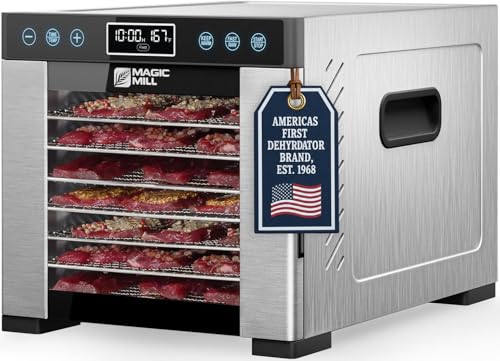
Magic Mill Pro Food Dehydrator Machine, 7 Full-Size Stainless Steel Trays
Badge: The Recommendation for Most Households
Strengths
- A named 600W rear fan even-drying system — the strongest evenness story in this line-up.
- The widest fully stated range here, 95°–176°, plus a 48-hour timer, keep warm, and auto shutoff.
- ETL listed, with seven full-size stainless steel trays.
Trade-offs
- Seven trays will not swallow a full orchard harvest in one load.
- No drying-area figure or accessory bundle is named in the title data.
- Mid-size cabinet footprint needs a settled home on the counter or a shelf.
Mini spec box (from listing data)
- Trays: 7, full-size, stainless steel
- Fan: 600W rear fan even-drying system
- Temperature: 95°–176°; timer up to 48 hours
- Extras: keep warm, auto shutoff; ETL listed
When a friend asks which dehydrator to buy and gives no further detail, this is the machine this guide names — because it is the pick with the fewest conditions attached. Its rear fan addresses the complaint that ends more dehydrating hobbies than any other, uneven batches, and it does so by design rather than by asking you to rotate trays on a schedule. Its range is stated at both ends, gentle enough for herbs and low-temperature work, high enough for jerky, and its finishing features — keep warm for the batch that completes while you are out, auto shutoff for the batch you forget — are the features real routines actually use. Seven full-size stainless trays cover the family batch without becoming furniture.
Who it suits: the broad middle of the market — households that dry weekly or seasonally, make jerky and fruit and herbs, and want one machine that simply behaves. The honest limitation is harvest scale: a preserving household with crates to process will run this machine in relays and should take the HOPERAN below instead. Everyone else can stop reading rankings after this review and start reading recipes — which is what a headline recommendation is supposed to allow.
Best for: most households wanting one even, fully specified machine / Not suited for: single-load harvest preserving

PSIIDAN Food Dehydrator, 8 Full-Size Stainless Steel Trays
Badge: Recommended for Families
Strengths
- Eight full-size stainless trays sized for family batches of snacks, jerky, and treats.
- A fully stated 95°–167° range and a 48-hour digital timer.
- 650W gives a full eight-tray load real drying pace.
Trade-offs
- The title names no fan layout or certification — confirm on the listing if those are decisive for you.
- No accessory bundle is named in the title data.
- A less familiar brand than the Magic Mill names around it.
Mini spec box (from listing data)
- Trays: 8, full-size, stainless steel
- Temperature: 95°–167°
- Timer: 48-hour digital
- Power: 650W
Families dry differently: more mouths, bigger snack demand, school-lunch fruit leather by the sheet, and jerky that disappears the day it is made. The PSIIDAN is the recommendation shaped by that reality. Eight full-size trays take a family batch in one load — the difference between drying as a background routine and drying as a weekend project — and the specification behind them is complete where it counts: a stated range from a gentle 95° to a jerky-capable 167°, a two-day timer for the wettest loads, and 650W so a full cabinet does not crawl. Stainless trays matter in a family kitchen most of all, because they will be washed by everyone, often, and not always gently.
Who it suits: households of four or more, snack-producing parents, and anyone whose batches keep outgrowing five or six trays. The honest limitation is evidential thinness at the edges — no fan layout or certification appears in the title data — so detail-first buyers should confirm those on the listing, and small households should honestly ask whether eight trays will ever be filled; the five-tray picks below exist for them.
Best for: family-scale weekly drying / Not suited for: small households or buyers needing certification details confirmed in advance
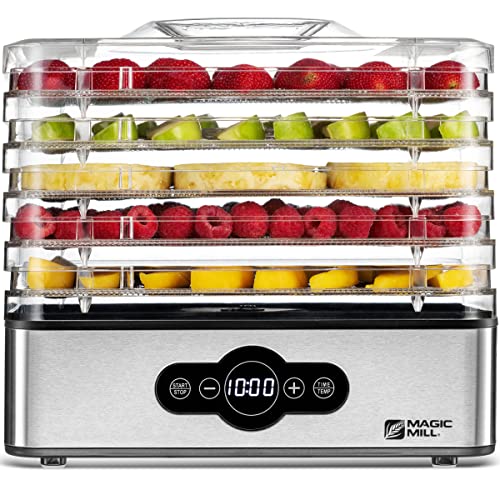
Magic Mill Food Dehydrator Machine, 5 Stainless Steel Trays
Badge: Recommended Starter Machine
Strengths
- Stainless steel trays from the very first machine — no plastic-tray upgrade path needed later.
- A 48-hour digital timer and adjustable temperature control up to 167°.
- Stackable five-tray format stores easily between batches.
Trade-offs
- The listing does not state the low end of the range or the wattage.
- Five trays are a starter capacity that keen beginners may outgrow within a season.
- Stackable designs ask for tray rotation on uneven loads.
Mini spec box (from listing data)
- Trays: 5, stackable, stainless steel
- Temperature: adjustable, up to 167° (low end not stated in title)
- Timer: digital, up to 48 hours
- Listing highlights: jerky, fruit, dog treats and general preserving
The starter recommendation has one job: be the machine a beginner succeeds with immediately and does not regret within the year. This Magic Mill earns it by skipping the usual starter compromise. Its trays are stainless from day one, so the beginner’s cleaning habits form on a surface that forgives them; its timer runs a full 48 hours, so a first batch of thick fruit can run long without supervision anxiety; and its control reaches 167°, so first jerky — the batch most beginners are actually dreaming about — is fully on the menu. Five stackable trays hold a real batch, not a demonstration, yet the whole machine still tucks into a cupboard when the lesson ends.
Who it suits: first-time buyers, gift givers who want the recipient to succeed, and small households drying weekly in modest amounts. The honest limitation is the ceiling on ambition: if your first season turns into a preserving habit, you will meet the five-tray limit, and the listing’s silence on the range’s low end means low-temperature specialists should verify before buying — the dedicated treatment in Best Food Dehydrators For Sale listings will show this same machine recommended, correctly, as a generalist rather than a specialist.
Best for: beginners and small households wanting a stainless, full-timer start / Not suited for: bulk batches or buyers who need a stated low-temperature floor

FOHERE Food Dehydrator, 5 BPA-Free Trays
Badge: Recommended for Small Kitchens
Strengths
- A fully stated 95–158°F range — gentle at the bottom, where herbs and fruit live.
- Compact stackable 11.42-inch trays and a modest 400W draw.
- A 48-hour timer that small machines often omit.
Trade-offs
- The 158°F ceiling is the lowest here; some jerky methods want more top end.
- BPA-free plastic trays rather than stainless.
- Five compact trays are a small-batch capacity by design.
Mini spec box (from listing data)
- Trays: 5, BPA-free, 11.42-inch, stackable
- Temperature: 95–158°F
- Timer: up to 48 hours
- Power: 400W
Small kitchens do not need a smaller version of a big machine’s compromises; they need a machine designed for the work small households actually do, and the FOHERE is the recommendation that fits that brief. Its stated range begins at a genuinely gentle 95°F — herb and fruit territory — and its timer runs the full 48 hours, so nothing about its small size forces supervision or shortcuts. Stackable trays store in a cupboard rather than colonising a counter, and the 400W draw suits the long, slow, low-temperature runs that dominate herb, fruit, and treat drying.
Who it suits: apartment and small-household dryers, herb gardeners, and gentle-drying specialists. The honest limitation is the ceiling: at 158°F, jerky methods that specify a hotter initial phase belong to the Magic Mill picks, and high-volume households will find five compact trays a hard ceiling of a different kind. Recommended within its brief without reservation; outside that brief, recommended not at all — which is exactly how recommendations should work.
Best for: small kitchens, herbs, fruit, and gentle drying / Not suited for: high-heat jerky methods or family-volume batches
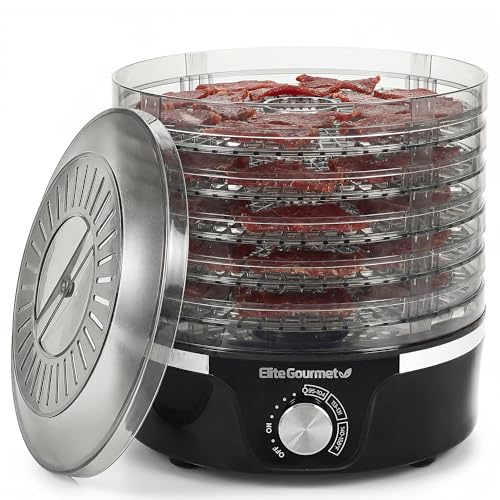
Elite Gourmet 5-Tray Food Dehydrator EFD319
Badge: Recommended for Simplicity Seekers
Strengths
- Adjustable temperature with a deliberately simple, learn-in-minutes approach.
- Five BPA-free 11.4-inch trays for the classic starter repertoire.
- A straightforward countertop design (model EFD319) from a familiar appliance brand.
Trade-offs
- The listing does not state a digital timer, a wattage, or an exact temperature range in its title data.
- Plastic trays and a basic feature set mark it as a learn-the-craft machine.
- Not the pick for unattended multi-day projects.
Mini spec box (from listing data)
- Trays: 5, BPA-free, 11.4-inch
- Temperature: adjustable (range not stated in listing title)
- Model: EFD319, black
- Listing highlights: jerky, fruit, herbs and vegetables
Some recommendations are about removing friction rather than adding features. The Elite Gourmet is recommended to the buyer who has looked at digital panels and felt their enthusiasm drain: the person who wants to slice, load, set a temperature, and be done. Adjustable temperature is present — the one control that genuinely changes results — and the five-tray stack handles jerky, fruit, herbs, and vegetables in honest starter quantities. There is a respectable argument that the simplest machine in a kitchen is the one used most, and for occasional, supervised, daytime drying, this is that machine.
Who it suits: beginners who prize simplicity, occasional users, and anyone buying for a less technical household member. The honest limitation is supervision: without a stated long digital timer in the listing data, this is not the machine for overnight harvest projects, and its unstated range means recipe-specific buyers should confirm figures on the listing. Recommend it for learning the craft and for light duty, and recommend the Magic Mill starter above the moment drying becomes a weekly habit.
Best for: simplicity-first beginners and light, supervised use / Not suited for: long unattended runs or specification-driven buyers

HOPERAN 16 Tray Food Dehydrator Machine
Badge: Recommended for Bulk Preservers
Strengths
- Sixteen stainless steel trays — single-load capacity nothing else here approaches.
- Two fans and 800W behind that capacity, with digital temperature and timer control.
- Listed as quiet under 48dB, and bundled with 2 mesh screens and 1 fruit roll tray.
Trade-offs
- The listing title does not state an exact temperature range — bulk jerky buyers should confirm it.
- A machine this size needs dedicated counter and storage space.
- For small households it is a non-recommendation: capacity you never fill is pure overhead.
Mini spec box (from listing data)
- Trays: 16, stainless steel
- Fans / power: 2 fans, 800W
- Controls: digital temperature and timer
- Noise: listed as quiet, under 48dB; included: 2 mesh screens, 1 fruit roll tray
Every guide needs one pick it recommends with both hands to a minority and waves everyone else away from, and this is that pick. For the bulk preserver — the gardener facing a plum tree, the hunter processing a season of jerky, the dog owner producing treats by the trayful — sixteen stainless trays with two fans is not excess; it is the difference between one load and three, between a preserving weekend and a preserving week. The included mesh screens and fruit roll tray complete the bulk brief, covering the small items and purees that bulk harvests always include, and the stated quiet operation matters when a machine this size runs for a day and a half in a lived-in home.
Who it suits: bulk preservers, and only bulk preservers — a sentence this guide means literally. The honest limitation is everything that makes it great: footprint, washing load, and capacity that mocks a two-apple batch. Confirm the exact temperature range on the listing before ordering, since the title data does not state it. If your harvests are real, no other pick here is recommended to you; if they are not, this one is not — the cleanest illustration in the guide of why Best Food Dehydrators For Making Vegan Bread and other specialist lists exist alongside a general recommendation.
Best for: harvest-scale, single-load preserving / Not suited for: small or occasional batches, or compact kitchens
Comparison Table
| Pick | Badge | Trays | Stated temperature | Listing |
|---|---|---|---|---|
| Magic Mill Pro 7 | For Most Households | 7 full-size stainless | 95°–176°; rear fan; keep warm; ETL | Check on Amazon |
| PSIIDAN 8 | For Families | 8 full-size stainless | 95°–167°; 650W; 48H timer | Check on Amazon |
| Magic Mill 5 | Starter Machine | 5 stainless, stackable | Up to 167°; 48H timer | Check on Amazon |
| FOHERE 5 | For Small Kitchens | 5 BPA-free, 11.42-inch | 95–158°F; 400W; 48H timer | Check on Amazon |
| Elite Gourmet EFD319 | For Simplicity Seekers | 5 BPA-free, 11.4-inch | Adjustable; range not stated in title | Check on Amazon |
| HOPERAN 16 | For Bulk Preservers | 16 stainless | Digital control; range not stated in title | Check on Amazon |
How to Choose the Dehydrator That Fits Your Household
Choose by household first and features second, in this order. Start with batch reality: picture the largest load you will honestly dry in a typical month — not the harvest fantasy, the Tuesday reality — and count the trays it needs. Five trays serve most beginners and small households; seven or eight serve families; sixteen serves preservers. Next, match the temperature story to your foods: gentle-range households (herbs, fruit, low-temperature work) should insist on a stated low floor, jerky households on a stated ceiling in the 160s or above, and everyone should treat an unstated end of the range as a question to resolve on the listing. Then the timer: if your life cannot attend a machine, a 48-hour timer is not a luxury but the feature that makes the hobby possible. Then materials: stainless if the machine will be washed weekly for years, BPA-free plastic acceptable on the compact, gentle-work picks. Finally, airflow: if uneven batches would discourage you — and for most people they would — favour the named fan designs, led here by the rear-fan headline pick.
Run those five checks and most readers will find the recommendations above simply confirm their own answer, which is the sign of a good matching process. If two picks still tie, choose by limitation rather than by strength: you will meet the limitation every week, so pick the machine whose weakness lives where your routine is strongest. The jerky maker with patience can forgive a smaller tray count; the harvest preserver with a big sink can forgive everything except capacity.
How to Use Your Dehydrator: Setup, Drying, Cleaning, and Troubleshooting
Whichever pick you take home, the routine is the same. Place the machine on a level, heat-safe surface with vent clearance, wash the trays, and let it warm while you slice. Slice uniformly — thickness consistency decides evenness more than any setting — and load in a single layer with air gaps, grouping similar thicknesses together. Set temperature by food: gentle for herbs, mid-range for fruit and vegetables, the high end for jerky following your recipe’s full safety process. Check for doneness before the earliest expected time: fruit pliable without moisture beads, jerky cracking on the bend, herbs crumbling. Cool fully before sealing, condition fruit in jars for several days with a daily shake, and clean trays while residue is fresh.
Troubleshooting follows the pattern. Problem: one section of a tray finishes hours before the rest → the load was uneven in thickness or the tray was crowded; slice uniformly and leave gaps. Problem: dried fruit moulds within weeks → it was sealed warm or under-dried; condition before storing and dry longer when in doubt. Problem: batches keep running past your bedtime → plan around the timer you have: start thick, wet loads in the morning, and let keep-warm and auto-shutoff features, where your pick has them, carry the finish. Good drying is mostly these habits; the recommended machines simply make the habits easier to keep.
Recommendations by Persona: Five Readers, Five Answers
The new parent making baby-food fruit leather and teething snacks needs gentle range, easy washing, and modest size: the FOHERE for compact gentleness, or the Magic Mill starter if jerky for the adults is also on the list. The hunter or angler processing seasonal protein needs ceiling and capacity: the headline seven-tray Pro for weekly jerky, the HOPERAN when the season lands all at once. The gardener with a herb and tomato glut needs low-end control and tray area: the PSIIDAN’s eight full-size trays, or the headline pick for maximum evenness on herb work. The apartment dweller needs stackable storage and quiet, long, low runs: the FOHERE again, unapologetically. The gift buyer needs the recipient to succeed on the first batch: the Magic Mill starter, stainless and full-timered, or the Elite Gourmet when the recipient’s love language is a single simple control. Notice that no persona was told to buy the biggest or the most featured machine — each was matched, which is the entire philosophy of a recommendation worth the name.
How to Read Any Recommendation — Including This One
A recommendation is a compressed argument, and a careful reader should be able to decompress it. Three questions do the work. First: recommended by whom, on what evidence? Here, the answer is a research-led editorial process working from verified listing data, with no hands-on claims and no borrowed scores — which is why every specification in this guide is phrased as what the listing states. Second: recommended for what pattern of use? A machine perfect for a weekly jerky routine can be wrong for a once-a-year harvest, and any recommendation that does not name its use case is hiding its limits. Third: what would change the recommendation? In this guide the answers are concrete — a confirmed range figure on the listings that leave one unstated, a household that grows into bulk preserving, a beginner who becomes a weekly dryer. If a recommendation cannot answer those three questions, treat it as advertising and keep shopping. If it can, you do not have to agree with it — but you can use it, because you can see exactly where your own priorities would reorder it.
Accessories Worth Recommending Alongside the Machine
The right machine plus the wrong accessories still frustrates, so this guide’s recommendations extend one step beyond the box. Mesh screens are the first addition for most households: herbs, peas, berries, soaked seeds, and granola pieces shrink as they dry and fall through standard tray spacing, and a screen converts a lost-through-the-slats annoyance into a non-event. A fruit roll tray or suitable non-stick sheet is the second, unlocking purees, leathers, and sauces — for many families the single most-used capability after jerky. A mandoline or a disciplined slicing routine is the unglamorous third: uniform thickness is the cheapest evenness upgrade available to any machine at any tier. Beyond those, buy accessories only when a recipe demands them; the HOPERAN’s included bundle is praised in this guide precisely because its screens and roll tray match what bulk preservers demonstrably use, not because a longer bundle list is inherently better. Storage jars with tight lids, labels, and a simple drying log complete the kit — none of it glamorous, all of it the difference between a recommended machine and a recommended routine.
Your First Month With a Recommended Machine
Whichever pick you choose, spend the first month learning it deliberately and the recommendation will prove itself. Week one: a forgiving fruit batch — apple rings or banana chips — to learn your trays’ pace and your own slicing consistency. Week two: herbs or a vegetable batch at gentle settings, noting times in a simple log. Week three: fruit leather or a puree project if your accessories allow, which teaches conditioning and storage. Week four: jerky, following a complete recipe with its full safety process, now that the machine’s behaviour is familiar. By the end of the month you will know your machine’s fast and slow zones, your household’s real batch size, and whether the recommendation matched your life — knowledge no review can give you in advance, and the reason every review in this guide pairs its praise with the household it assumes. If the match is right, the machine disappears into the weekly routine. If it is wrong, it will be wrong in a specific, nameable way — too small, too supervised, too much machine — and the matching logic in this guide will point you at the correct second choice with unusual precision.
When the Recommendation Changes: Seasons, Households, and Second Machines
Recommendations are snapshots of a household at a moment, and honest guides admit they expire. The beginner who takes the starter Magic Mill in spring may be a preserver by autumn, at which point this guide’s answer changes to the PSIIDAN or the HOPERAN — not because the first recommendation was wrong, but because the household it described no longer exists. A family that adds a garden, a hunter who takes up sausage making, a raw-food convert who discovers low-temperature crackers: each new routine re-runs the matching exercise with new inputs. Some households solve this with a second, complementary machine — a compact gentle dryer beside a bulk cabinet — which is why the FOHERE and the HOPERAN, opposite poles of this list, so often end up recommended to the same kitchen a year apart. The practical advice is to buy for the household you have, keep the drying log that shows you how it is changing, and re-read recommendation pages as your routine evolves rather than treating any single purchase as a lifetime verdict. The machines will not change. You will, and a good guide expects that.
Storing the Harvest: The Recommendation After the Recommendation
A recommended machine earns a final endorsement only if its output keeps, so build storage into the routine from the first batch. Cool dried food completely before sealing; condition fruit in loosely filled jars for about a week, shaking daily and checking for condensation, and return anything doubtful for more drying time. Store jars somewhere cool, dark, and dry, labelled with contents and date, oldest first in use. Jerky should be stored exactly as your recipe directs, with refrigeration or freezing for anything beyond its stated short-term window, because home methods vary and safety margins outrank shelf-life ambitions. Herbs live best near the stove, in the dark of a cupboard, where they will actually be reached for. None of this is machine-specific, and that is the point: the recommendation that matters most is a routine — buy the matched size, dry evenly, store carefully — and any of the six machines above will serve it well.
Common Buying Mistakes
- Reading a ranking as a verdict. The sixth pick here is the first choice for bulk preservers; order reflects breadth of fit, not worth.
- Buying capacity for the fantasy batch. Size for the typical month and run the rare giant load in two cycles.
- Ignoring an unstated range end. Two picks here leave a figure to confirm on the listing; confirm it before the box arrives, not after.
- Skipping the timer question. Households that cannot supervise a machine need the 48-hour timer more than they need extra trays.
- Choosing on bundle length. Accessories matter when they match your foods — mesh screens for small items, a roll tray for purees — not as a count.
- Forgetting where the machine will live. A dehydrator stored somewhere annoying is a dehydrator used twice a year, whatever its badge says.
Final Recommendation
If you read nothing else: the recommendation for most households is the Magic Mill Pro Food Dehydrator Machine, 7 Trays, Rear Fan, for its even-drying design, fully stated range, and finishing discipline. Families should take the PSIIDAN Food Dehydrator, 8 Full-Size Stainless Steel Trays, and beginners the Magic Mill Food Dehydrator Machine, 5 Stainless Steel Trays. Small kitchens get the FOHERE, simplicity seekers get the Elite Gourmet, and bulk preservers — only bulk preservers — get the sixteen-tray HOPERAN. Six machines, six households, no orphans: that is what a recommendation page owes its readers. If your household is not described anywhere above, default to the headline pick and adjust by the one variable you know best — batch size — because even drying, a stated range, and a forgiving finish forgive almost every other mismatch. And whichever machine arrives at your door, run the first-month plan in this guide before judging it: recommendations are proven in routines, not in unboxings, and four honest batches will tell you more about fit than any page, including this one, can promise in advance.
Energy, Noise, and the Everyday Recommendation
Two practical factors quietly shape whether a recommended machine stays recommended after a month in your kitchen. The first is running cost in time and electricity: the picks here state wattages from 400W on the compact FOHERE to 800W on the bulk HOPERAN, and the honest way to compare them is per finished batch — a full large machine finishing a harvest in one cycle against a small machine running the same food in three. Load whichever you buy fully, and the difference narrows to the point of irrelevance for most households. The second is presence: a machine that runs for a day at a time becomes part of the home’s soundscape and warmth. Only one pick here states a noise figure in its title data — the HOPERAN, listed as quiet under 48dB — and buyers planning overnight runs in small homes should weight that kind of stated detail, place the machine away from bedrooms, and prefer the models whose timers and finishing features let a batch complete without an audience. A recommendation that ignores how a machine lives in a house is only half a recommendation; the verdicts above were written with the house in mind.
Frequently Asked Questions
Which dehydrator do you recommend if I can only buy one?
The seven-tray rear-fan Magic Mill Pro. It has the fewest conditions attached: even drying by design, a fully stated 95°–176° range, a 48-hour timer, keep warm, auto shutoff, an ETL listing, and seven full-size stainless trays that fit the broadest range of real households.
Is the most recommended machine also the best for jerky?
It is an excellent jerky machine — stated ceiling of 176°, even airflow for uniform strips — but a dedicated jerky household drying in bulk should weigh the sixteen-tray HOPERAN for capacity, after confirming its exact range on the listing, and read the specialist jerky guide linked earlier in this page.
What do you recommend for a complete beginner?
The five-tray stainless Magic Mill if you want a machine to grow with, or the Elite Gourmet EFD319 if simplicity matters more than features. Both hold five trays and cover the starter repertoire; the difference is digital timing and stainless longevity versus a deliberately minimal control experience.
Why recommend a machine whose listing leaves a figure unstated?
Because the recommendation rests on everything the listing does verify — capacity, materials, timer, design — and the guide flags the gap openly in the review and the comparison table, telling you exactly what to confirm. A recommendation with a disclosed caveat is more trustworthy than one that papers over it.
How many trays does the average household actually need?
Five to eight covers nearly everyone: five for beginners and small households, seven or eight for families drying weekly. Sixteen is a preserver’s tool. The most common recommendation error is buying for the single biggest batch of the year instead of the typical month.
Should I buy the recommended machine as a gift?
Yes, with the household-matching caveat that runs through this guide: gift the starter Magic Mill to a curious beginner, the Elite Gourmet to a simplicity-loving cook, and the headline Pro to a household you know dries regularly. Avoid gifting the sixteen-tray HOPERAN unless the recipient has literally asked for bulk capacity — a recommendation that requires a dedicated shelf is a decision, not a present.
How long do these recommendations stay valid?
The matching logic stays valid as long as your household does; the specific models are tied to their current listings, which is why this guide dates its checks and tells you to confirm configurations before ordering. If a listing changes materially — a range restated, a bundle altered — the affected review’s caveat is the place to re-check first, and the household-first method in the buying guide will re-run the recommendation correctly even if a model name changes.
What if my household sits between two recommendations?
Choose by the limitation you would rather live with. Between the starter and the family pick, the question is whether occasional relay batches (starter) bother you more than everyday extra washing and storage (family pick). Between the headline Pro and the PSIIDAN, it is evenness features versus one more tray. There is no wrong answer — only the answer whose trade-off fits your routine, which is the standard every verdict line in this guide applies.
Does the recommended list change for raw or low-temperature drying?
The emphasis does: insist on a stated low floor. On that test the headline Pro (95° stated), the PSIIDAN (95° stated), and the FOHERE (95°F stated) remain recommendable, while the starter Magic Mill’s unstated low end moves it from recommended to verify-first for that specific craft.