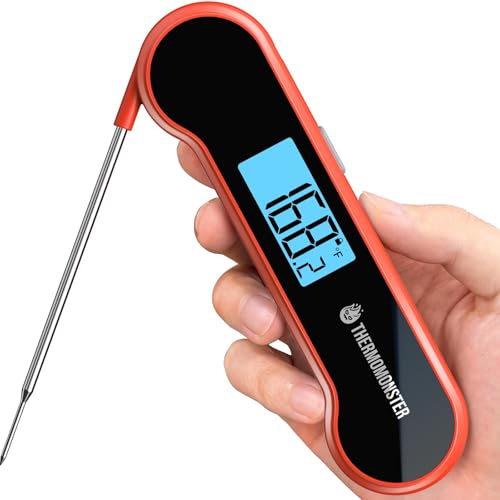
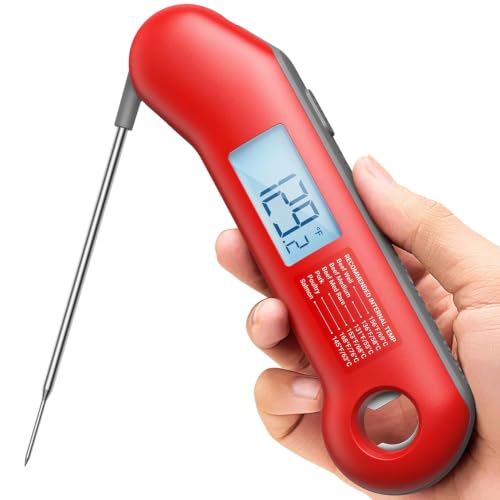
Disclosure: topratedkitchenware.com is reader-supported. When you buy through links on our site, we may earn an affiliate commission from Amazon and other retailers, at no extra cost to you.
Where to buy
The six models below are the verified picks for this guide to the best meat thermometers america’s test kitchen style — thermometers evaluated the way a rigorous test kitchen evaluates equipment: repeated trials, multiple proteins, accuracy checked at several temperatures, and usability scored by cooks who take hundreds of readings, not six. Each name links to its Amazon listing, where you can check the latest price on Amazon and confirm the current configuration. One honesty note belongs first, because this keyword demands it: this guide does not reproduce, summarise, or imply America’s Test Kitchen’s actual reviews, winners, or endorsements for any product. No pick below is described as chosen, rated, or approved by that organisation. What the guide borrows is the method — the test-kitchen discipline of repeatability, blind comparison, and evidence over reputation — applied to the verified listing data for these six models.
- ThermoMonster Instant Read Meat Thermometer, Black — Best Overall by Test-Kitchen Criteria
- TempPro TempSwift Digital Meat Thermometer — Best Certified Everyday Pick
- ThermoMaven Digital Meat Thermometer, Bright LED — Best Accuracy-Focused Pick
- TempPro TempSwift Instant Read Thermometer, Rotating Display — Best Display Flexibility
- ThermoMonster Instant Read Meat Thermometer, Red — Best Stated Response Time
- Alpha Grillers Meat Thermometer Digital — Best Pre-Calibrated Simplicity
Read the full guide ↓ for the test-kitchen method behind the ranking, the trial protocol you can repeat at home, and the honest limitations of every pick.
People who search for the best meat thermometers america’s test kitchen are looking for a particular kind of confidence: not the loudest claim, but the most repetitions. A test kitchen’s authority comes from doing the boring thing hundreds of times — probing roast after roast, timing reading after reading, checking the same thermometer against the same reference baths until the pattern of its behaviour is undeniable. This guide cannot replicate that laboratory, and it does not pretend to. What it can do — and does — is judge six verified instant-read models by the criteria that method would apply, using only evidence their listings state: response times claimed from half a second to two seconds, accuracy figures where given and the standards they reference, certifications where named, sealing where rated, and display designs tested by the postures of real cooking. Where the evidence is strong, the review says so; where a pick’s case rests on simplicity or ergonomics rather than figures, the review says that instead, in the open.
The field is usefully varied for a method-first read. Two models from one maker state identical speed and precision figures in different colours — a natural experiment in what colour is worth. Two models from a second maker split their bets between certification-plus-versatility and a rotating display. A certified professional model brings the brightest auto-rotating screen in the group, and a pre-calibrated veteran makes the readiness argument. A test kitchen would enjoy this line-up, because it contains real trade-offs rather than a coronation — and so will you, once the method section below teaches you how to weight them. For neighbouring form factors, see Best Meat Thermometers For Smoking and Best Meat Thermometers Timers after this guide.
It also helps to know what kind of reader this method serves best. If you cook by feel and resent instruments, no thermometer guide will convert you, and none should try. But if you are the cook who wants to know — who suspects that the difference between good and great chicken is a number, repeatably hit — then the test-kitchen tradition is your tradition, and its first lesson is humility about single readings. Instruments drift, placements err, and batches vary; the method exists to catch all three. Keep that humility in mind as you read the rankings: they are a starting grid for your own trials, not a substitute for them, and the picks are ordered by evidence you are explicitly invited to re-weigh.
Key Takeaways
- This guide claims no America’s Test Kitchen endorsement, score, or winner for any pick — it applies test-kitchen method to listing evidence, and says so plainly.
- Repeatability is the test-kitchen virtue: a stated accuracy figure tied to a standard, confirmed by your own ice-point checks over time, beats any single heroic claim.
- The strongest stated evidence here pairs half-second response claims with ±0.5°F precision figures referenced to NIST.
- Certification appears in two flavours in this group — NIST and NSF named together on the accuracy-focused pick, NSF on the versatile everyday pick.
- Usability is a scored category, not a garnish: rotating displays, bright LED screens, backlighting, and motion-friendly designs decide whether accurate readings actually happen.
- Check the latest price on Amazon for each pick, then run the home trial protocol in this guide before trusting any of them with a holiday roast.
In this guide
Quick Picks
| Pick | Badge | Test-kitchen reading | Listing |
|---|---|---|---|
| ThermoMonster, Black | Best Overall by Test-Kitchen Criteria | Stated 0.5-second response and NIST-referenced ±0.5°F precision; the strongest paired evidence. | Check on Amazon |
| TempPro TempSwift | Best Certified Everyday Pick | Stated 1-second response, backlit, NSF certified, and the widest stated repertoire in the group. | Check on Amazon |
| ThermoMaven, Bright LED | Best Accuracy-Focused Pick | Stated ±0.5°F accuracy with NIST and NSF certification, auto-rotate bright LED screen, IP67. | Check on Amazon |
| TempPro, Rotating Display | Best Display Flexibility | Stated 1-second response, 180° rotating display, IP67 — the usability specialist. | Check on Amazon |
| ThermoMonster, Red | Best Stated Response Time | The same stated 0.5-second, NIST-referenced profile as the leader, in red. | Check on Amazon |
| Alpha Grillers | Best Pre-Calibrated Simplicity | Stated 1–2 second response, backlit, IP67, pre-calibrated and ready to use. | Check on Amazon |
Finally, a note on what would change these rankings, because a method that cannot state its own sensitivities is not a method. If your kitchen’s trials would be dominated by low-light smoking, the usability weighting rises and the ThermoMaven LED pick takes the overall badge. If your cooking is a weekly family grill of mixed cuts, the readiness and sealing of the Alpha Grillers argue louder than any figure. The headline weighting — speed and documented accuracy first — is declared in the open precisely so that readers with different kitchens can re-run the ranking honestly and land somewhere else with this guide’s blessing.
How These Picks Were Chosen
This is a research-led guide, not a test kitchen, and the distinction is the first thing its method requires it to state. No laboratory trials were run for this page, no organisation’s results are quoted, and no pick is credited with a performance figure its listing does not state. Instead, each model was verified against its current Amazon listing data, and the verified evidence was then scored against the criteria a test kitchen applies: accuracy, meaning a stated figure and the traceability behind it; speed, meaning the stated response read as a comparable claim within the group; repeatability proxies, meaning certifications and standards references that imply controlled manufacture; usability, meaning display design, rotation, backlighting, and activation; and durability proxies, meaning stated sealing ratings and build claims. Scores were kept qualitative and argued in prose, because inventing numerical ratings would violate the very method the keyword celebrates.
Two features of the pool shaped the ranking and are disclosed rather than smoothed over. The same stated performance profile appears twice under one brand in two colours; the guide ranks the black variant as its overall pick on the strength of that profile and treats the red as the identical-evidence alternative, saying so openly. And no pick in this pool is a famous reference name — which a method-first guide should welcome, because it forces the ranking to rest entirely on stated evidence, exactly as a blind test would. Where a listing is silent, the review is silent: no pick below is credited with an unstated figure, an unstated certification, or anyone else’s endorsement.
The 6 Best Meat Thermometers, America’s Test Kitchen Style

ThermoMonster Instant Read Meat Thermometer, Black
Badge: Best Overall by Test-Kitchen Criteria
Strengths
- The strongest paired evidence in the group: a stated 0.5-second response with a stated ±0.5°F precision figure.
- The precision figure is referenced to NIST in the listing — a claim with an address, as testers put it.
- Listed for oven, grill, candy, and BBQ work, covering the trial repertoire a test kitchen would run.
Trade-offs
- No waterproof rating is stated in the title data — a durability proxy left blank.
- No rotating display is claimed, so usability at awkward angles is unassisted.
- Its red sibling states the identical profile; the choice between them is colour, and this guide says so.
Mini spec box (from listing data)
- Stated response: 0.5 seconds
- Stated precision: ±0.5°F, NIST-referenced (per listing)
- Colour: black
- Listing highlights: oven, grill, candy, BBQ use
A test kitchen ranks on paired virtues, because a thermometer that is fast but vague fails half its trials and one that is precise but slow fails the other half. On stated evidence, this model is the only pick that leads on both axes at once: the joint-fastest response claim in the group, married to a precision figure that names its reference standard. That pairing is what repeated trials reward — in a morning of probing, the instrument that settles immediately and settles true compresses the whole error budget of a cook’s technique, leaving placement as the only variable, which is exactly where a good test wants the variable to live.
Who it suits: method-minded cooks who want the strongest documented hand in the group and will verify it with the home protocol below. The honest limitation is the blank durability proxy: with no sealing rating stated, sink discipline is on you, and the usability crown belongs to rivals with rotating screens. On the two criteria test kitchens weight first — speed and documented accuracy — nothing else here states more.
Best for: cooks who rank on paired speed and accuracy evidence / Not suited for: buyers who need a stated waterproof rating
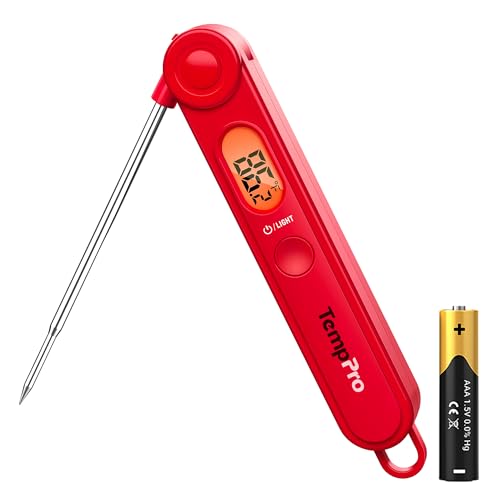
TempPro TempSwift Digital Meat Thermometer
Badge: Best Certified Everyday Pick
Strengths
- NSF certification named in the listing — a standards paper trail for an everyday instrument.
- The widest stated repertoire in the group: grill, smoker, BBQ, oil, fry, candy, turkey, and milk.
- Stated 1-second response with a backlit display.
Trade-offs
- No numerical accuracy figure is stated in the title data.
- No waterproof rating or rotating display is claimed in the title.
- Its case is versatility plus certification, not headline figures.
Mini spec box (from listing data)
- Stated response: 1 second
- Display: backlit
- Certification: NSF certified (per listing)
- Listing highlights: grill, smoker, BBQ, oil fry, candy, turkey, milk
Test kitchens keep a category for the tool that does everything well enough, every day, and this TempPro is that tool’s strongest claimant here. Its listing reads like a trial schedule — the grill and the smoker, the fryer and the oil pot, candy, the holiday turkey, even milk at the stove — and it brings a certification to that schedule, which in test-kitchen terms is a promise that the instrument was built to a standard someone else defined. The one-second stated response will not win a speed trial, and no accuracy figure is stated to win a precision trial; what it wins is the calendar, week after week, across the full range of what a home cook actually measures.
Who it suits: the generalist household that wants one certified instrument for every temperature task it owns. The honest limitation is the missing figure: a buyer comparing numerical accuracy should weigh the ThermoMaven and ThermoMonster picks, whose listings state theirs. Judged as the everyday, everything, certified pick — the role test kitchens respect more than any specialist — it earns its silver medal outright, a profile it shares with the folding designs assessed in Best Meat Thermometers With Folding Probe.
Best for: one-thermometer kitchens wanting certification and total repertoire / Not suited for: figure-by-figure accuracy comparison shoppers

ThermoMaven Digital Meat Thermometer, Bright LED Screen
Badge: Best Accuracy-Focused Pick
Strengths
- A stated ±0.5°F accuracy figure backed by two named certifications: NIST and NSF.
- An auto-rotating bright LED screen — the strongest usability specification in the group.
- IP67 waterproofing completes the durability column.
Trade-offs
- Its stated 1-second response trails the half-second pair.
- Credential density will exceed what casual cooks feel they need.
- As ever, certification describes the model; your ice-point trials describe your unit.
Mini spec box (from listing data)
- Stated response: 1 second
- Stated accuracy: ±0.5°F
- Certification: NIST and NSF certified (per listing)
- Display: auto-rotate bright LED screen; waterproof IP67; colour black
If the test-kitchen method has a favourite evidence pattern, it is a claim, a standard, and a second standard — and this ThermoMaven is the only pick that presents all three for its accuracy. The figure is stated, the traceability is named, and the certification is doubled, which is the paperwork equivalent of a result that repeats. Then, unusually, the usability column matches the accuracy column: a bright LED screen that rotates to the reader is the display a trial panel would score highest for the smoker-at-dusk and the left-handed grill cook, and IP67 sealing closes the durability question the leader leaves open.
Who it suits: accuracy-first cooks, low-light and low-angle readers, and anyone building a one-thermometer kitchen on paperwork. The honest limitation is a half-second: in rapid thin-cut batch trials, the two ThermoMonster picks state the faster settle. A test kitchen would call this the most complete instrument in the group and the speed pair the fastest — and would refuse, as this guide refuses, to pretend those are the same sentence.
Best for: certified accuracy with the best screen in the group / Not suited for: the fastest thin-cut batch work
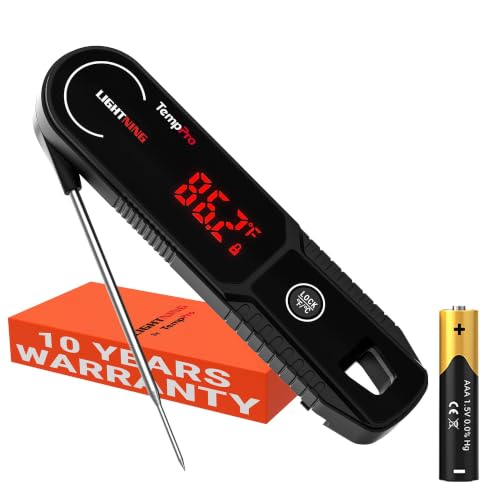
TempPro TempSwift Instant Read Thermometer, Rotating Display
Badge: Best Display Flexibility
Strengths
- A stated 180° rotating display — the usability feature trial panels consistently reward.
- Stated 1-second response with IP67 waterproofing.
- Listed for deep fry, smoker, grill, and BBQ work.
Trade-offs
- No accuracy figure or certification is stated in the title data.
- Rotation aids reading, not sensing; its trial scores would be usability-led.
- The ThermoMaven LED pick states rotation plus certification, for buyers who want both.
Mini spec box (from listing data)
- Stated response: 1 second
- Display: 180° rotating
- Waterproof: IP67 (per listing)
- Listing highlights: deep fry, smoker, grill, BBQ
Every experienced tester has a story about the reading that failed because the number was upside down, and this TempPro exists to retire those stories. A display that rotates through 180° keeps the verdict upright whether you probe down into a roast, sideways into a chop, or up from a low smoker shelf — and in a trial protocol, where the same thermometer is read by many hands at many angles, that flexibility converts directly into fewer misreads. The stated one-second response and IP67 sealing give the usability argument a working instrument to sit on, aimed squarely at fryers and smokers as much as grills.
Who it suits: left-handed cooks, low-smoker and deep-pot probers, and any kitchen where readings happen at contorted angles. The honest limitation is documentary: no stated accuracy figure or certification appears in the title data, so this pick’s trial would begin, as this guide’s advice begins, with your own ice-point verification standing in for its paperwork. As the group’s usability specialist with real sealing, it earns its place on the merits a panel would actually score.
Best for: awkward-angle, any-hand reading with sealed durability / Not suited for: certification-first buyers

ThermoMonster Instant Read Meat Thermometer, Red
Badge: Best Stated Response Time
Strengths
- The joint-fastest stated response in the group: 0.5 seconds.
- Stated ±0.5°F precision referenced to NIST in the listing.
- A high-visibility red finish — the one that finds itself in a crowded drawer.
Trade-offs
- Its stated profile is identical to the black variant ranked first; this is a colour decision, honestly labelled.
- No waterproof rating is stated in the title data.
- No rotating display is claimed.
Mini spec box (from listing data)
- Stated response: 0.5 seconds
- Stated precision: ±0.5°F, NIST-referenced (per listing)
- Colour: red
- Listing highlights: oven, grill, candy, BBQ use
A method-first guide owes its readers a moment of candour, and here it is: this pick and the overall pick state the same response figure, the same precision figure, and the same standards reference, in the same listing language, differing in colour. A test kitchen running blind trials would score them identically and say so. This guide ranks the black first for no grander reason than ordering, awards this red variant the stated-response badge it equally deserves, and leaves the real decision — which colour survives your drawer, your grill light, and your eye — entirely to you. That is not a weakness of the guide; it is the guide working as intended, refusing to manufacture a difference the evidence does not contain.
Who it suits: exactly the buyer described in the leading review, who prefers red — visibility at the grill, visibility in the drawer, a finish that announces itself. The honest limitation is the shared one: no stated sealing rating, no rotating display, and a case that rests on two strong figures rather than a complete evidence set. If those two figures are your criteria, this pick and its sibling stand together at the top of the table, and colour is a perfectly respectable tiebreaker.
Best for: speed-and-precision shoppers who want the visible colourway / Not suited for: buyers who need stated sealing or display rotation

Alpha Grillers Meat Thermometer Digital
Badge: Best Pre-Calibrated Simplicity
Strengths
- Pre-calibrated and ready to use, per the listing — the first thing a trial panel checks.
- Stated 1–2 second response with a bright backlit display.
- IP67 waterproof, the durability proxy the speed pair leaves blank.
Trade-offs
- No accuracy figure or certification is stated in the title data.
- Its stated response band is the widest here.
- No rotating display is claimed.
Mini spec box (from listing data)
- Stated response: 1–2 seconds
- Display: bright backlit
- Waterproof: IP67 (per listing)
- Calibration: pre-calibrated, ready to use (per listing)
The closing pick makes the argument a test kitchen hears from its own line cooks: the best thermometer is the one that is right when you pick it up. Pre-calibrated readiness, a bright backlit display for the dark end of the grill, and a stated IP67 seal amount to a trial profile built on dependability rather than documents — and panels respect that profile, because most real-world reading failures are failures of readiness and legibility, not of sensor physics. Its response band will not win the speed trial and its paperwork will not win the accuracy trial; it enters every trial, finishes every trial, and asks nothing of its owner first.
Who it suits: grillers, gift buyers, and any cook whose priority is an instrument that simply works, sealed and readable, from the first day. The honest limitation is the missing evidence: with no stated accuracy figure, your ice-point verification carries the full weight of trust for this pick — a fair bargain, openly stated, and the same bargain the preset-focused designs in Best Preset Meat Thermometers ask of their buyers.
Best for: readiness, sealing, and backlit simplicity / Not suited for: figure-led or certification-led comparison
Comparison Table
| Pick | Badge | Stated response | Accuracy evidence | Listing |
|---|---|---|---|---|
| ThermoMonster, Black | Best Overall by Test-Kitchen Criteria | 0.5 sec | ±0.5°F, NIST-referenced (per listing) | Check on Amazon |
| TempPro TempSwift | Best Certified Everyday Pick | 1 sec | NSF certified (per listing); no figure stated | Check on Amazon |
| ThermoMaven, Bright LED | Best Accuracy-Focused Pick | 1 sec | ±0.5°F; NIST and NSF certified; IP67 | Check on Amazon |
| TempPro, Rotating Display | Best Display Flexibility | 1 sec | No figure stated in title data; IP67 | Check on Amazon |
| ThermoMonster, Red | Best Stated Response Time | 0.5 sec | ±0.5°F, NIST-referenced (per listing) | Check on Amazon |
| Alpha Grillers | Best Pre-Calibrated Simplicity | 1–2 sec | Pre-calibrated (per listing); no figure stated | Check on Amazon |
The Test-Kitchen Method, Explained: What Rigorous Equipment Testing Looks For
A serious test kitchen evaluates a thermometer the way science evaluates anything: by controlling variables and counting repetitions. Accuracy is checked at more than one temperature, because an instrument can be honest in an ice bath and lazy near serving temperatures; the ice point and a hot bath bracket the working range, and a trustworthy tool reads true at both. Speed is timed against a defined settling standard, because “fast” without a definition is a mood. Repeatability is logged across many trials, because the tenth reading is the one that reveals drift, hesitation, and displays that flicker between two numbers. Usability is scored by the people doing the repetitions — grip in a wet hand, deployment with one hand, a screen that stays legible through steam and repetition fatigue. And the whole panel works, where possible, without deference to brand, because the history of equipment testing is a history of famous names coasting and unknown names excelling.
This guide adopts that method’s values within its means. It cannot run the trials, so it does the next honest things: it credits only stated evidence, it weights traceability — figures with standards attached — above bare claims, it treats identical stated profiles as identical however they are coloured, and it hands you the home protocol below so the final trial, the one on your unit in your kitchen, is yours to run. A guide that borrowed an organisation’s authority without its labour would be doing the opposite of what that organisation stands for; this one borrows the labour’s logic instead, and shows it.
How to Run Your Own Test-Kitchen Trial at Home
You need ice, water, a kettle, and ten minutes. First, the ice point: fill a glass with crushed ice, add cold water to fill the gaps, stir, and wait a minute. Insert the probe tip into the centre without touching the glass and record the settled reading; repeat it three times, removing and reinserting the probe between trials, and note whether the readings agree with each other — repeatability — as well as whether they sit at the freezing point — accuracy. Second, the hot check: in freshly boiled water, adjusted in your expectations for altitude, the probe should settle near the boiling point and, again, agree with itself across trials. Third, the usability circuit: take readings one-handed, left-handed, from above and below, in your kitchen’s worst light, and time the whole act — deployment to trusted number — because that total, not the sensor’s claim, is your real response time.
Then cook with it, and keep the log a test kitchen would keep: date, food, placement, reading, result. Within a month you will own something no review can give you — a behavioural profile of your individual instrument. Care between trials is part of the protocol: rinse or wipe the probe between raw and cooked checks, wash within the limits its listing states, and store it with the tip protected. Troubleshooting follows the pattern. Problem: repeat readings in the same bath disagree → the tip may be touching the vessel or sitting in an unstirred pocket; stir, centre the tip, and retest before judging. Problem: readings settle slowly on meat but fast in water → placement, not the sensor; the tip is likely in fat or near a surface, so reinsert into the thermal centre. Problem: the ice point drifts over weeks → retest carefully, and treat a persistent drift as a calibration or replacement question, answered by the maker’s documentation.
How to Choose Using Test-Kitchen Criteria
Weight the criteria by your cooking, in the open, the way a panel argues its shortlist. If your trials would be thin cuts and batch work, weight stated response first: the half-second pair leads, and the one-second picks are honest runners-up. If your trials would be precision work — thick steaks pulled at exact temperatures, candy, delicate proteins — weight stated accuracy and its certification: the ThermoMaven’s doubled paperwork leads, with the ThermoMonster pair’s referenced figure beside it. If your trials would be ergonomics — hundreds of readings at awkward angles, in bad light, by both hands — weight display design: the auto-rotating LED and the 180° rotating screen are the specialists. If your trials would be endurance — sinks, steam, weather, years — weight the stated sealing: IP67 appears on three picks here and should be believed over adjectives. Finally, weight readiness: the pre-calibrated pick asks the least of its owner, and some kitchens should pay for exactly that.
Notice what this framework refuses to do: crown a winner independent of the weighting. That refusal is the test-kitchen method’s soul, and it is why this guide’s overall pick is labelled “by test-kitchen criteria” with its weighting — speed and accuracy evidence first — stated in its review for you to overrule. A reader who weights usability first should take the ThermoMaven or the rotating TempPro and know that the method endorses their choice as fully as it endorses the headline.
Repeatability: The Virtue Nobody Advertises
Open any listing in this group and you will find speed and accuracy in the headline; you will not find repeatability, because it cannot be photographed. Yet repeatability — the same bath, the same probe, the same number, ten times running — is the property that separates instruments from toys, and the one a test kitchen’s logbook exists to measure. Its proxies are visible if you know where to look: certifications imply a manufacturing process held to a standard; a stated figure implies a maker willing to be checked against it; and a brand that states identical figures across colour variants is, intentionally or not, describing a controlled product rather than a lucky one. Your home protocol measures the real thing directly, which is why this guide returns to it so insistently: three ice-point trials on delivery day tell you more about your unit’s character than any document, including this one. Buy the strongest proxies you can, then verify the virtue itself, in your own kitchen, with your own ice. That two-step — trust the evidence, then test the instrument — is the entire philosophy the keyword points at, reduced to a habit anyone can keep.
Protein by Protein: How the Criteria Play Out in Real Trials
Run the six picks mentally through a test kitchen’s week and the weighting framework stops being abstract. Poultry trials reward certainty above all: a whole bird’s thermal centre is elusive, the safety margin is unforgiving, and the cook probes repeatedly — which is where stated accuracy and its certification stop being paperwork and start being the difference between confidence and a nervous extra ten minutes that dries the breast. Steak trials reward the pairing of speed and precision, because a thick cut’s centre moves slowly until it suddenly does not, and the pull decision is a single reading taken at exactly the right second. Burger and chop trials are usability trials in disguise: many pieces, many readings, one free hand, and the rotating and auto-rotating displays convert directly into fewer errors. Candy and caramel trials are range-and-repeatability trials, where the same bath is read again and again across a long session and any drift announces itself. Fish trials are gentleness trials — thin, delicate, quick — where deployment speed and a display you can read at a glance matter more than any figure. No pick wins all five proteins, and a guide that understands the method will not ask one to; it will show you which trial your kitchen runs most, and hand you the instrument that wins that one.
Durability Trials: The Sink, the Steam, and the Drawer
Test kitchens are destructive places, and their durability findings usually reduce to three environments. The sink: thermometers are washed constantly, often carelessly, and the stated IP67 ratings on the ThermoMaven, the rotating TempPro, and the Alpha Grillers are the only durability evidence in this group expressed as a standard rather than a hope — the two ThermoMonster picks, for all their speed and precision paperwork, leave that column blank, and a method-first buyer should register the blank. The steam: repeated exposure over stockpots and kettles fogs weak displays and tests seals thermally, which is one more reason the bright LED and backlit designs score as usability features rather than cosmetics. The drawer: tips bend, hinges loosen, and bodies scuff in the kitchen’s junk drawer, and the honest mitigation is storage discipline — a sheath, a magnetic home, a dedicated slot — which no listing can sell you and every tester recommends. Weight the three environments by your own kitchen’s violence level. A careful cook in a calm kitchen may never test a seal; a busy family kitchen tests all three weekly, and for that buyer the durability column deserves promotion from tiebreaker to headline criterion.
What This Guide Deliberately Does Not Do
Because the keyword invokes a famous testing name, it is worth listing the refusals explicitly, since they are the guide’s credentials. It does not state or imply that any organisation tested, ranked, or endorsed these products. It does not invent trial results, scores, or percentages. It does not credit any pick with a specification its listing leaves unstated — no response figure appears from reputation, no certification from assumption. It does not print prices that would stale or ratings that would freeze other people’s opinions into false precision. What it does instead is slower and less clickable: it verifies what can be verified, argues from that evidence in the open, flags every silence it finds, and teaches the reader to run the decisive trials at home. If that reads as restraint, it is — the same restraint that makes a real test kitchen’s rare enthusiasms worth trusting when they come. A buying guide cannot borrow that trust; it can only behave in a way that earns a smaller, local version of it, one honest paragraph at a time.
Common Buying Mistakes
- Assuming a test organisation endorsed whatever ranks first in search. This guide claims no America’s Test Kitchen endorsement for any pick, and you should discount any source that implies one without proof.
- Ranking on a single criterion. Speed without accuracy, or accuracy without usability, wins one trial and loses the season; weight the criteria by your cooking.
- Treating identical stated profiles as different products. Two picks here differ in colour alone, and an honest guide — like an honest panel — says so.
- Skipping your own trials. Three ice-point readings on delivery day measure repeatability and accuracy on your unit; no document substitutes for them.
- Ignoring the durability column. A stated sealing rating predicts years of sink-side survival; its absence is a fact to price into the decision.
- Confusing certification with endorsement. NIST and NSF references describe standards compliance for a model — valuable, checkable, and entirely different from a magazine’s recommendation.
Final Recommendation
Weighted the test-kitchen way — stated speed and documented accuracy first — the first choice is the ThermoMonster Instant Read Meat Thermometer, Black. Kitchens that weight versatility and certification should take the TempPro TempSwift Digital Meat Thermometer, and cooks who weight the accuracy paperwork above all should take the ThermoMaven Digital Meat Thermometer, Bright LED. The rotating TempPro is the usability pick, the red ThermoMonster the identical-evidence alternative in the visible colourway, and the Alpha Grillers the readiness pick. Whichever you choose, run the home trial protocol before its first important cook: that is what a test kitchen would do, and it is the most faithful way to honour the name in this keyword. One last piece of method to take with you: re-run your trials seasonally. Batteries age, hinges loosen, seals meet one sink too many, and the instrument that aced its delivery-day protocol deserves a fresh ice-point check before the holiday bird, not blind faith carried over from spring. Testing, in the tradition this page borrows, is not an event but a habit — and a cook who keeps the habit will never again have to wonder, at the decisive moment, whether the number on the screen deserves to be believed.
Frequently Asked Questions
Are any of these thermometers actually recommended by America’s Test Kitchen?
This guide makes no such claim for any pick, and states none of that organisation’s scores, winners, or verdicts. It applies the publicly understood methods of test-kitchen evaluation — repeated accuracy checks, defined speed criteria, usability scoring — to the listing evidence for these six models. If you need that organisation’s actual current verdicts, consult its own publications; if you need a method you can verify yourself, this guide provides one.
What does a test kitchen check first in a thermometer?
Accuracy at known temperatures, starting with an ice-water slurry at the freezing point, and repeatability — whether the same bath produces the same reading across many insertions. Speed, display legibility, deployment, and sealing follow. The home protocol section of this guide reproduces that order with household equipment.
Why does this guide refuse to give numerical scores?
Because a score implies trials behind it. This is a research-led guide working from verified listing evidence; inventing a numerical rating would misrepresent that basis. Instead, every judgement is argued in prose from stated figures, certifications, and design facts you can check — the same transparency the test-kitchen method demands of the products themselves.
How much do stated response times really differ in cooking?
Between the half-second and one-second claims here, the difference is a breath — irrelevant on a roast, genuinely useful across a grill of thin cuts finishing at staggered moments. Between those and a one-to-two-second band, the gap widens into workflow. Judge response as one criterion among several, weighted by how you cook, exactly as the buying framework above suggests.
What is the difference between NIST-referenced and NSF certified?
As the listings use the terms: a NIST reference ties a stated accuracy figure to a national measurement standard’s traceability, while NSF certification indicates the product was certified against that organisation’s standards, which for food equipment include safety and sanitation dimensions. Both are checkable, standards-based claims — the kind of evidence this guide weights — and neither is a magazine endorsement.
Does the colour of a thermometer ever matter?
Only practically — and this group contains the proof. Two picks here state identical speed and precision profiles in black and in red, so the honest differences are visibility in a drawer, visibility in low grill light, and simple preference. A test kitchen scoring blind would tie them; a home cook choosing between them should pick the one they will find fastest at the decisive moment, and feel no guilt that the criterion is cosmetic — finding the instrument quickly is a usability fact, not a vanity.
How many readings should I take before trusting a result?
On any important piece, at least two, in two spots — and on a new thermometer, three ice-point trials before its first cook. Repetition is the cheapest accuracy upgrade in existence: a single reading can be a placement accident, while two agreeing readings in the thermal centre are a measurement. Test kitchens build their conclusions on hundreds of repetitions; a home cook who builds each important decision on two is practising the same method at household scale.
Should I pay more for the certified model?
Pay for certification when your cooking punishes error — precision steak work, candy, poultry for a crowd, any cooking where a wrong number has real consequences — because what you are buying is accountable manufacture, the strongest available proxy for repeatability. If your probing is occasional and forgiving, the readiness and usability picks here serve honestly, provided you verify them at the ice point as this guide directs.
Can I trust a thermometer with no stated accuracy figure?
You can verify it, which is better than trusting it. Picks here without a stated figure — the versatile TempPro’s certification notwithstanding, the rotating TempPro, and the Alpha Grillers — ask you to substitute your own ice-point trials for their paperwork. Run the protocol in this guide; a unit that reads true repeatedly has earned your trust on evidence, whatever its listing left unsaid.