Disclosure: topratedkitchenware.com is reader-supported. When you buy through links on our site, we may earn an affiliate commission from Amazon and other retailers, at no extra cost to you.
Where to buy
If you are shopping for the best steak meat thermometers — start with the six verified instant-read picks below. Every model here is a handheld digital probe designed to give you a trustworthy steak temperature in seconds — not a leave-in probe, not a wireless monitor and not an oven dial. Each linked name takes you to its Amazon listing, where you can check the latest price on Amazon and confirm the current configuration before you order.
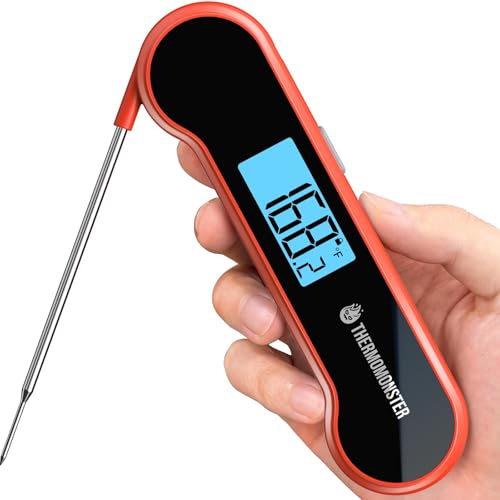
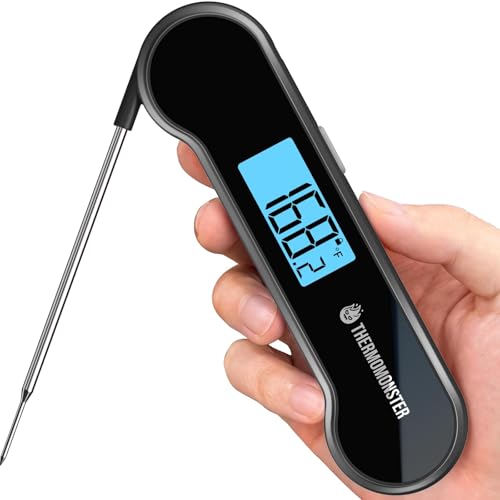
- ThermoMonster 0.5 Sec Instant Read Meat Thermometer, Red
- Alpha Grillers Meat Thermometer Digital
- ONFIKY Meat Thermometer Digital, Red
- TempPro TempSwift TP19H Instant Read Meat Thermometer
- ThermoMaven Professional Meat Thermometer Digital, Red and Gray
- ThermoWorks Thermapen ONE, Cayenne Pepper Red
Read the full guide ↓ to see how the six picks differ on the things that actually decide a steak — stated accuracy, response time, display readability over a hot grill, and how each one behaves on thin cuts, thick ribeyes and reverse-seared roasts.
A steak is the least forgiving thing most people cook. The window between a blushing medium-rare and a grey, overdone medium can be a handful of degrees, the meat keeps cooking after it leaves the heat, and the difference between the surface temperature and the centre temperature on a thick cut can be wide enough to fool any guess based on touch, timing or the colour of the juices. That is why the best steak meat thermometers are not really about gadgets. They are about removing the one variable you cannot see. A fast, accurate instant-read probe turns doneness from a hope into a measurement: you probe the centre, read the number, and pull the steak at the moment the number tells you to, accounting for the few degrees of carryover that arrive during the rest.
The six picks in this guide were chosen from a verified pool of digital instant-read thermometers whose listings state their key numbers plainly. Two of them publish a tight ±0.5°F precision figure with a named calibration reference behind it. Several state read times between half a second and two seconds. Most state waterproofing, and two name an IP67 rating, which matters more than it sounds when your hands are wet, the board is covered in resting juices and the probe needs rinsing between a rare steak and a well-done one cooked for somebody else. One pick is a long-standing premium benchmark whose listing is unusually quiet about specifications — and this guide treats that quiet honestly rather than filling it in from reputation.
One boundary is worth drawing before the rankings. An instant-read thermometer is a spot-check tool: you open the lid, insert the probe, read, and withdraw. If your problem is monitoring a brisket from the couch or watching two roasts at once, that is a different category, and readers weighing it should also look at Best Meat Dual Probe Thermometers rather than forcing a handheld probe to do a monitor’s job. This guide stays in its lane — handheld instant-reads, judged on how well they answer the steak question.
Key Takeaways
- For steak, stated accuracy matters more than raw speed: two picks publish a ±0.5°F figure, and that tightness is what lets you pull a steak a few degrees early with confidence.
- Every pick states a read time between half a second and two seconds; inside that band, probe placement and technique matter more than the remaining fractions.
- Waterproofing is stated on most picks and rated IP67 on two of them, which makes rinsing between steaks and cleaning up afterwards genuinely simple.
- Auto-rotating backlit displays appear on two picks and help when you probe left-handed, over a dark grill, or from the far side of a thick cut.
- None of these six is a leave-in or wireless thermometer; they are spot-check tools, and the guide judges them only on that job.
- An ice-water check at home verifies any of these tools in about two minutes, and building that habit matters more than the brand debate.
In this guide
Quick Picks
| Pick | Badge | Why it stands out | Link |
|---|---|---|---|
| ThermoMonster Instant Read, Red | Best Fast Read for Thin Steaks | Half-second stated response with a NIST-referenced ±0.5°F precision claim in a red housing. | Check on Amazon |
| Alpha Grillers Meat Thermometer Digital | Best Ready Out of the Box | Pre-calibrated and ready to use, with a one-to-two-second response, bright backlight and IP67 waterproofing. | Check on Amazon |
| ONFIKY Meat Thermometer Digital, Red | Best for Mixed Grill Households | One-to-two-second reads, bright backlit display and a waterproof body aimed at grilling, air fryer, smoker and candy work as well as steak. | Check on Amazon |
| TempPro TempSwift TP19H | Best Display for Awkward Angles | One-second reads with a motion-activated, auto-rotating backlit display and waterproof construction. | Check on Amazon |
| ThermoMaven Professional, Red and Gray | Best Overall | Half-second response, ±0.5°F stated accuracy, NIST and NSF certification, IP67 sealing and an auto-rotating backlit screen. | Check on Amazon |
| ThermoWorks Thermapen ONE, Cayenne Pepper Red | Best Premium Benchmark | The long-running premium instant-read name in a Cayenne Pepper Red finish, positioned at the top tier of the category. | Check on Amazon |
How These Picks Were Chosen
This roundup was built from a verified product pool checked against Amazon catalog data on 2026-11-20. Every product name, response time, accuracy figure and waterproofing claim in the reviews below comes from the verified listing title for that exact product; nothing was filled in from memory, from a different model in the same brand’s range, or from a review written about an earlier version. Where a listing title does not state a specification, this guide does not claim it — and you will see that discipline bite hardest on the premium pick, whose listing title is short and whose reputation is long. The reputation is noted as context; the specifications are not invented to match it.
The decisive filter was the steak use case itself. A steak thermometer has to be an instant-read: a probe you insert for a few seconds at the centre of the cut, at the moment of decision. All six picks state an instant-read format in their titles, and five of the six state a numeric response time. Leave-in probes and remote monitors were excluded from the rankings even though they are legitimate tools, because they answer a different question; readers who need that question answered will find the framing in Best Meat Probe Thermometers and in the oven-focused guide at Best Meat Thermometers For Oven more useful than anything here.
This is research-led guidance, not a laboratory test report, and no hands-on testing is claimed. The comparisons rest on the verified specifications, on how the stated figures interact in practice — a half-second read is worth little if the display cannot be read over a flare-up, and a tight accuracy figure is worth a great deal when you are pulling a steak early to allow for carryover — and on well-established cooking practice: probe placement at the thermal centre, the effect of bone and fat pockets on readings, and the resting rise that every thick steak goes through. Readers who like to cross-check picks against published test programmes may also enjoy the discussion in Best Meat Thermometers Americas Test Kitchen, which looks at how structured testing treats this same category.
The 6 Best Steak Meat Thermometers, Honestly Sorted
The reviews are ordered as assigned in the research rotation. Each one states plainly what its listing claims, what that means at the grill, and where the honest limitation sits, so you can match the tool to the way you actually cook steak rather than to a marketing ladder.

ThermoMonster 0.5 Sec Instant Read Meat Thermometer, Red
Badge: Best Fast Read for Thin Steaks
Strengths
- Half-second stated response — the fastest claim in this group, and genuinely useful on thin steaks that overcook while a slower probe is still settling.
- Stated ±0.5°F precision with a NIST reference behind it, which is the tightness you want when pulling a steak early for carryover.
- The listing names oven, grill, candy and barbecue work alongside steak, so it covers a mixed kitchen without pretending to be a leave-in tool.
Trade-offs
- The listing title does not state a waterproof rating, so rinsing discipline is on you in a way it is not with the IP67 picks.
- No auto-rotating display is stated, so left-handed probing at odd angles is less convenient than with the TempPro or ThermoMaven.
- It is a spot-check tool only; there is no stated leave-in, timer or remote function for long cooks.
At a glance
- Format: digital instant-read probe
- Stated response: 0.5 seconds
- Stated precision: ±0.5°F, NIST-referenced
- Colour: red
Thin steaks are where response time stops being a spec-sheet number and starts being the whole game. A skirt steak, a flank steak or a thin sirloin can move through the medium-rare window in the time a slow probe takes to settle, and by the time a lagging display shows you a number, the centre has already moved past it. The ThermoMonster’s half-second stated response is built for exactly that problem, and pairing it with a stated ±0.5°F precision figure means the fast number is also meant to be a trustworthy one. In practice you would use it the way all instant-reads should be used on thin cuts: probe from the side, into the centre of the thickest part, and trust the lowest stable reading rather than the first flash on the screen.
The honest limitation is everything the listing does not say. There is no stated waterproof rating, no stated auto-rotating screen and no stated certification beyond the NIST precision reference, so this is a pick you buy for speed and stated precision at the accessible end of the group, not for the fullest feature set. Treat it gently around the sink, dry it before it goes back in the drawer, and it does the one job steak cooks actually need: a fast, tight number at the moment of decision.
Best for: cooks who grill thin steaks often and want the fastest stated read in the group / Not suited for: anyone who wants a rated-waterproof tool they can rinse without thinking

Alpha Grillers Meat Thermometer Digital
Badge: Best Ready Out of the Box
Strengths
- Pre-calibrated and stated ready to use, so there is no setup step between opening the box and temping tonight’s steak.
- IP67 waterproof rating is stated outright, which makes rinsing the probe between steaks simple and safe.
- Bright backlit display is stated, and it matters at dusk on a patio grill more than most spec sheets admit.
Trade-offs
- Stated response is one to two seconds — quick, but not the half-second class of the fastest picks here.
- The listing does not publish a numeric accuracy figure, so its precision claim rests on the pre-calibration statement rather than a stated tolerance.
- No auto-rotating display is stated, so upside-down readings stay upside down.
At a glance
- Format: digital instant-read probe
- Stated response: 1–2 seconds
- Waterproofing: IP67 stated
- Calibration: pre-calibrated, ready to use
- Display: bright backlit
The Alpha Grillers pick is the one for the cook who does not want a project. It arrives pre-calibrated and ready to use, it reads in one to two seconds, the display is backlit brightly enough for evening grilling, and the IP67 rating means the rinse-between-steaks habit that good steak cooking requires is not a risk to the tool. That combination — no setup, fast enough, sealed properly — is why it earns the ready-out-of-the-box badge even though two rivals state faster responses and two state tighter accuracy figures.
Where it asks you to compromise is on published precision. The listing leans on its pre-calibrated status instead of a stated tolerance, so a cook who is chasing a very specific pull temperature on an expensive ribeye, and who wants the paperwork to back the decision, will find the ThermoMonster and ThermoMaven claims easier to lean on. The sensible way to use this pick is to verify it once in ice water when it arrives — a two-minute habit this guide recommends for every thermometer — and then simply cook with it. For weeknight steaks, burgers and chops, that is more than enough rigour.
Best for: weeknight grillers who want a sealed, backlit, zero-setup thermometer / Not suited for: precision-first cooks who want a published accuracy tolerance in the listing

ONFIKY Meat Thermometer Digital, Red
Badge: Best for Mixed Grill Households
Strengths
- One-to-two-second instant read with a bright backlit display — the core steak job, covered plainly.
- Waterproof body is stated, so rinsing between a rare steak and a well-done one is not a worry.
- The listing names grilling, air fryer, smoker and candy work alongside steak, suiting households whose thermometer does a bit of everything.
Trade-offs
- Waterproof is stated without an IP rating, so the exact sealing standard is less precisely defined than on the IP67 picks.
- No numeric accuracy figure is published in the listing title.
- No auto-rotating or motion-activated display features are stated.
At a glance
- Format: digital instant-read probe
- Stated response: 1–2 seconds
- Waterproofing: waterproof stated, no IP rating in title
- Display: bright backlit
- Colour: red
Not every household’s thermometer lives a steak-only life. In a lot of kitchens the same probe temps the steak on Saturday, checks chicken thighs on Tuesday, verifies an air-fryer roast on Thursday and gets borrowed for candy or jam when somebody is feeling ambitious. The ONFIKY listing is written for that reality: it names food, cooking, grilling, air fryer, smoker and candy work in one breath, backs it with a one-to-two-second read and a waterproof body, and keeps the display bright and simple. As a steak tool it does the essential thing — a fast centre reading you can act on — without asking you to pay attention to features you will never use.
Its compromises are about paperwork rather than function. The waterproofing is stated without an IP number, and no accuracy tolerance is published, so on both counts you are trusting the general claim rather than a graded figure. For the mixed household that is a reasonable trade; for the cook temping a dry-aged ribeye that cost real money, one of the picks with a stated ±0.5°F figure is the calmer choice. Used with a side-probe technique on thick cuts and an occasional ice-water sanity check, this is a sensible, unfussy middle pick.
Best for: households whose thermometer splits its time between steak, poultry, air fryer and candy work / Not suited for: cooks who want graded IP sealing and a published accuracy tolerance

TempPro TempSwift TP19H Instant Read Meat Thermometer
Badge: Best Display for Awkward Angles
Strengths
- One-second stated response, squarely in the fast class for steak work.
- Auto-rotating backlit display is stated, so the number reads upright whether you probe left-handed, right-handed or from the far side of the grill.
- Motion activation is stated — the tool wakes when you pick it up, which removes a fumble step when your other hand is holding tongs and a tray.
Trade-offs
- Waterproof is stated without an IP rating in the title, so the sealing grade is less explicit than on the IP67 picks.
- No numeric accuracy tolerance is published in the listing title.
- Display cleverness does not change probe physics: placement still decides whether the number means anything.
At a glance
- Format: digital instant-read probe
- Stated response: 1 second
- Display: auto-rotating backlit, motion-activated
- Waterproofing: waterproof stated, no IP rating in title
Anyone who has temped a steak on a crowded grill knows the display problem. The thickest part of the cut is at the back, the probe goes in at an angle, the numbers are upside down, the light is bad, and you are doing mental rotation while the steak cooks past its window. The TP19H is built around solving that specific annoyance: its backlit display auto-rotates to stay upright, and motion activation means it is awake the moment you grab it. Combined with a one-second stated response, it is the pick that minimises fumbling — and fumbling, at the grill, is a real cause of overcooked steak.
The trade is the same paperwork gap as the other mid-group picks: waterproofing without a stated IP grade, and no published accuracy tolerance. Neither stops it doing excellent weeknight and weekend work, especially for left-handed cooks and anyone who grills after dark. If your steak routine involves thick cuts probed from several angles to find the true centre — the technique this guide recommends in the how-to section below — the rotating display stops being a luxury and becomes the feature you use most.
Best for: left-handed cooks, night grillers and anyone who probes thick steaks from several angles / Not suited for: buyers who want a graded IP rating and a published accuracy figure above display features

ThermoMaven Professional Meat Thermometer Digital, Red and Gray
Badge: Best Overall
Strengths
- Half-second stated response paired with a stated ±0.5°F accuracy — the strongest combined speed-and-precision claim in the group.
- NIST and NSF certification are both named in the listing, the fullest calibration paperwork of any pick here.
- IP67 waterproofing and an auto-rotating backlit display are both stated, so it gives up nothing on sealing or readability.
Trade-offs
- It is positioned as the professional option in this group, so expect it to sit in the group’s upper tier — check the latest price on Amazon and decide whether the paperwork earns it for your cooking.
- Like every pick here, it is a spot-check tool; the professional label does not add leave-in or remote monitoring.
- The feature set is more than a casual cook strictly needs for burgers and thin chops.
At a glance
- Format: digital instant-read probe
- Stated response: 0.5 seconds
- Stated accuracy: ±0.5°F
- Certification named: NIST and NSF
- Waterproofing: IP67 stated
- Display: auto-rotating backlit
- Colour: red and gray
The ThermoMaven earns Best Overall by being the pick with no obvious hole in its stated specification. Speed: half a second, matching the fastest claim here. Precision: ±0.5°F, matching the tightest claim here, and backed by two named certifications rather than one. Sealing: IP67, matching the best rating here. Display: auto-rotating and backlit, matching the most convenient arrangement here. For steak specifically, that combination means you can probe a thick ribeye from two or three angles, read each number upright in bad light, rinse the probe, probe again, and trust the lowest reading to within the stated tolerance while you decide whether the steak comes off now or in ninety seconds.
The honest caveat is proportionality. If your steak cooking is a couple of sirloins a month, the gap between this pick and the simpler mid-group options will rarely show up on the plate, and the money difference — whatever it is on the day you check — buys a lot of steak. But if you cook thick, expensive cuts often, or you are the person friends hand the tongs to, this is the pick whose stated numbers support the confidence the job demands. It is also the natural reference point for readers comparing against structured test coverage such as Best Instant Read Meat Thermometers Consumer Reports, where stated accuracy and response time are the first things examined.
Best for: frequent steak cooks and thick-cut specialists who want the fullest stated specification / Not suited for: occasional cooks who will never feel the difference over a simpler pick

ThermoWorks Thermapen ONE, Cayenne Pepper Red
Badge: Best Premium Benchmark
Strengths
- The Thermapen name is the long-running premium reference in this category, and the ONE is its flagship instant-read format.
- The listing presents it as a recommended instant-read thermometer, and the brand’s whole reputation rests on this single product type rather than a catalogue of gadgets.
- Cayenne Pepper Red finish is stated — a small thing, but a visible one in a crowded drawer or a dark grill-side tray.
Trade-offs
- The listing title states no response time, no accuracy figure and no waterproof rating, so on verified data alone its specification is the least documented in this group — this guide will not fill those gaps in from reputation.
- It sits at the premium tier of the category; check the latest price on Amazon and weigh it against picks whose numbers are published.
- Single-purpose spot-check tool, like the rest of the group.
At a glance
- Format: digital instant-read probe
- Colour: Cayenne Pepper Red
- Specifications stated in title: format and colour only
The Thermapen ONE is the pick that tests this guide’s honesty rules, so let us be straightforward about it. The Thermapen line has been the premium benchmark for instant-read thermometers for years, professional kitchens treat it as a default, and many steak cooks buy one and stop shopping for a decade. All of that is reputation and category context. What the verified listing title itself states is much narrower: an instant-read thermometer, in Cayenne Pepper Red, presented as a recommended model. It does not state a read time, an accuracy tolerance or a waterproof grade — the three numbers this guide has used to rank everybody else.
So the fair way to present it is this: if you value the category’s most established premium name, and you are comfortable verifying the detailed specification on the listing page itself before you buy, the Thermapen ONE is the benchmark the other five are implicitly measured against. If you prefer to buy on published numbers inside the guide you are reading, the ThermoMaven states more, on the record, for the same job. Neither answer is wrong; they are different buying philosophies, and a good guide should let you choose between them with your eyes open.
Best for: buyers who want the category’s established premium benchmark and will confirm full specifications on the listing / Not suited for: buyers who want every key number published before they commit

Comparison Table
| Pick | Stated response | Stated accuracy | Waterproofing | Display | Link |
|---|---|---|---|---|---|
| ThermoMonster Instant Read, Red | 0.5 sec | ±0.5°F, NIST-referenced | Not stated in title | Standard | Check on Amazon |
| Alpha Grillers Digital | 1–2 sec | Pre-calibrated; no figure stated | IP67 | Bright backlit | Check on Amazon |
| ONFIKY Digital, Red | 1–2 sec | Not stated in title | Waterproof, no IP grade stated | Bright backlit | Check on Amazon |
| TempPro TempSwift TP19H | 1 sec | Not stated in title | Waterproof, no IP grade stated | Auto-rotating backlit, motion-activated | Check on Amazon |
| ThermoMaven Professional | 0.5 sec | ±0.5°F, NIST and NSF named | IP67 | Auto-rotating backlit | Check on Amazon |
| ThermoWorks Thermapen ONE | Not stated in title | Not stated in title | Not stated in title | Not stated in title | Check on Amazon |
How to Choose the Right Steak Thermometer for Your Cooking
Start with how you actually cook steak, because the right pick follows from the habit, not from the spec sheet. If most of your steaks are thin — skirt, flank, sandwich steaks, thin sirloins — response time is your first filter, because the centre of a thin cut moves quickly and a slow probe reports where the temperature was, not where it is. The two half-second picks exist for you. If most of your steaks are thick — ribeyes, strips and fillets an inch and a half or more — accuracy and display readability matter more, because you will probe several times, from the side and from the top, hunting for the true thermal centre, and each reading has to be legible and trustworthy while you do it.
Next, be honest about your sink habits. A thermometer that gets rinsed under the tap between every steak lives a different life from one wiped on a towel. If you rinse — and during a multi-steak cook, rinsing is the hygienic habit — a stated IP67 rating removes all doubt about whether the tool minds. Waterproofing stated without a grade is a softer promise; it is probably fine for a rinse, but the graded picks remove the guesswork. Similarly, decide whether display rotation matters to you: it sounds like a gimmick until you are left-handed, or your grill is against a wall and every probe goes in from the same awkward side, at which point it becomes the feature you notice on every single cook.
Finally, place the tiers qualitatively. This group runs from straightforward fast readers at the accessible end, through sealed and backlit all-rounders in the middle, to a fully certified professional pick and a premium benchmark name at the top. The plate cannot tell which tier your thermometer came from — it can only tell whether the number you acted on was right. Buy the tier whose stated specification matches the cost of your mistakes: the more expensive the steaks and the thicker the cuts, the more a published accuracy figure earns its keep. Readers whose cooking extends to long, low smokes should treat this guide as the spot-check half of their kit and read Best Meat Thermometers For Smoking for the monitoring half.
How to Temp a Steak Properly, Step by Step
Technique decides whether a good thermometer produces a good steak. Follow this sequence and any pick in this guide will serve you well.
- Decide your pull temperature before the steak hits the heat. A thick steak’s centre keeps rising after it leaves the grill — commonly by around five degrees during the rest, sometimes more on very thick cuts. So you pull early by roughly that amount: for a medium-rare finish, you are looking to come off the heat in the mid-120s°F rather than at the final serving temperature. Thin steaks carry over far less, so pull them essentially at target.
- Probe from the side on thick cuts. Slide the probe horizontally into the centre of the thickest part, so the tip sits in the middle of the meat rather than passing through it. From the top, it is easy to push the tip too deep and read the hotter lower half.
- Avoid bone, fat seams and the pan or grate. Bone conducts heat differently from meat and will distort the reading; a fat pocket reads its own temperature, not the steak’s. If a number looks suspiciously high or low, move the probe a few millimetres and read again.
- Take two or three readings and trust the lowest stable one. The coolest point in the steak is the point that decides doneness and, for the person eating it, texture. Scan slowly through the centre and note where the reading bottoms out.
- Rest the steak and expect the rise. Tent loosely and rest thick steaks for at least five to ten minutes. A final probe during the rest confirms the carryover arrived where you predicted.
- Rinse or wipe the probe between steaks cooked to different doneness or for different people, and wash it properly at the end of the cook.
Troubleshooting. Problem: the reading jumps around and never settles → the tip is probably straddling a fat seam or touching bone; reposition into solid meat and hold still for a full second longer than feels necessary. Problem: the steak reads done but eats underdone → you likely probed too shallow or read the hotter outer layer; next time probe from the side to the true centre, and take the lowest of several readings. Problem: the reading seems implausibly high the moment the probe goes in → the probe may have touched the grate or pan on the way through; withdraw slightly and read again in the meat only.
Instant-Read vs Leave-In: Why Steak Belongs to the Instant-Read
It is worth understanding why this guide insists on handheld instant-reads for steak when leave-in probes and wireless monitors exist. A steak cooks in minutes, its temperature curve is steep at the end, and the decision — pull now or wait — happens in a short window while you are standing at the heat. A leave-in probe answers a monitoring question over hours; inserted into a steak, its cable fights your tongs, its probe occupies the spot you need to flip around, and its reading is fixed to wherever it happened to be placed. An instant-read lets you sample several points in seconds, find the true centre, and get out. For roasts, briskets and smokers the logic reverses, which is why those categories have their own guides — but at the steak station, the handheld probe is not the budget option. It is the correct tool.
What the Numbers Mean: Doneness, Pull Temperatures and Honest Targets
A thermometer hands you a number; you still have to know which number you are looking for. Steak doneness is a spectrum, but the commonly used bands are consistent: rare centres sit in the low 120s°F at serving, medium-rare in the low 130s°F, medium in the mid-to-high 130s°F, and well-done at 160°F and beyond. Because of carryover, the number you act on at the grill is not the serving number — it is the serving number minus the rise you expect during the rest. On a thick steak rested ten minutes, that rise is commonly around five degrees; on a very thick, very hot-seared cut it can be a little more; on a thin steak it is close to nothing. This is why the same thermometer, used the same way, produces a perfect medium-rare for one cook and an overshoot for another: the difference is not the tool, it is whether the pull decision accounted for the rest.
Two further wrinkles reward a precise pick. The first is gradient: a steak seared hard has a hot outer band and a cooler centre, so a single reading taken too shallow describes the band, not the middle. Probing from the side and scanning for the lowest stable reading is how you find the number that actually describes the bite in the middle of the steak. The second is variation across the cut: the centre of a ribeye near the fat cap cooks differently from the eye, and a strip steak can be a few degrees cooler at its thick end than its thin end. Sampling two spots on a large steak is not fussiness — it is how you decide whether the whole cut comes off, or whether the thick end gets another minute while the thin end is already there.
Food-safety guidance deserves a plain sentence in any temperature discussion. Official guidance for steaks generally cites 145°F with a rest as the safety reference point, and plenty of cooks choose to eat steak below that by preference, accepting the trade-off knowingly. A thermometer does not make that decision for you; what it does is make the decision informed, so the temperature on the plate is the one you intended rather than the one that happened to you. Ground beef is a different matter entirely — it should be cooked through to the higher temperatures recommended for ground meat, and no doneness preference overrides that. Keep the two categories separate in your head and your thermometer will serve both safely.
Common Buying Mistakes
- Buying on speed alone. A half-second read with no stated accuracy figure is a fast guess. For steak, the tolerance matters as much as the timer.
- Assuming every waterproof claim is equal. A stated IP67 rating is a graded promise; the word waterproof alone is not. Match the claim to your rinsing habits.
- Filling in missing specifications from reputation. If a listing does not state a number, verify it on the listing page before buying rather than assuming the famous model must lead the table.
- Using a leave-in probe for steak. Cables, fixed placement and slow sampling fight the way steak is actually cooked.
- Probing from the top only. Top-down probing overshoots the centre on thick cuts and reads the hot lower layer — a technique mistake no thermometer can fix.
- Skipping the ice-water check. A glass of ice water should read at freezing point; two minutes of verification protects every steak that follows.
Final Recommendation
For most steak cooks, the ThermoMonster Instant Read is the sharpest starting point if thin and medium cuts dominate your grill, because its half-second stated response and NIST-referenced ±0.5°F precision attack the exact failure mode of thin-steak cooking. If you want zero setup and graded sealing, the Alpha Grillers Digital is the pick that simply works from the day it arrives. And if your thermometer splits its life across the whole kitchen, the ONFIKY Digital covers that mixed duty without fuss. Step up to the ThermoMaven if you cook thick, expensive cuts often and want the fullest stated specification in the group, choose the TempPro TP19H if display fumbling is your personal grill-side enemy, and choose the Thermapen ONE if the premium benchmark name is what you trust and you are happy to confirm its full specification on the listing. Whichever you pick, probe from the side, trust the lowest reading, and pull early for the rest — the thermometer supplies the number, but that technique is what turns it into a better steak.
Frequently Asked Questions
What temperature should I pull a steak off the grill?
Pull thick steaks roughly five degrees below your target serving temperature, because the centre keeps rising during the rest. For medium-rare, that means coming off the heat in the mid-120s°F and resting up to the low 130s°F. Thin steaks carry over very little, so pull them essentially at your target. The exact target is a matter of taste; the pull-early principle is not.
Where exactly should the probe go in a steak?
Into the thermal centre: the middle of the thickest part, ideally inserted from the side so the tip sits in the centre of the meat. Avoid bone, thick fat seams and gristle, all of which read their own temperature rather than the steak’s. On a thick cut, take readings in two or three spots and act on the lowest stable one.
Is a half-second thermometer really better than a two-second one?
On thin steaks, yes, measurably: the centre moves fast enough that a settling probe can lag behind it. On thick steaks the difference mostly disappears, because you hold the probe in place through several readings anyway and accuracy becomes the deciding figure. Match the priority to the cuts you cook most.
How do I check my thermometer is reading accurately?
Fill a glass with ice and top it with water, stir, and insert the probe without touching the glass. It should settle at freezing point, 32°F. If it reads a degree or two off, note the offset and apply it mentally, or follow the maker’s calibration instructions if your model offers them. Repeat the check every few months and after any hard drop.
Can I leave one of these probes in the steak while it cooks?
No — all six picks are instant-read spot-check tools, not leave-in probes. Leaving a handheld instant-read in meat over heat can damage the probe and the housing, and the reading would be fixed to one spot anyway. If you need continuous monitoring, that is the leave-in and wireless category, a different tool for a different job.
Why does my steak keep overshooting its target temperature?
Usually one of three causes: you probed the hotter outer layer instead of the centre, you pulled at the serving temperature instead of below it and carryover did the rest, or the steak was thinner than your timing assumed. Side probing, the lowest-of-several-readings rule, and pulling early for the rest fix nearly every case.
Does the colour of the thermometer matter?
Only practically, but practically counts: a red thermometer — and several picks here are red, including the Cayenne Pepper Red Thermapen — is easier to spot in a full drawer, on a dark tray, or in grass after a garden cookout. It will not change your steak, but it may change whether the thermometer is in your hand or still in the kitchen when the steak is ready to temp.
Should I temp a steak again after slicing it?
There is little point: once a steak is sliced, its centre temperature falls quickly and the reading no longer describes what anyone is eating. The readings that matter are the pull reading at the grill and, if you want to confirm your carryover prediction, one check midway through the rest. After that, put the probe away, slice against the grain, and let the thermometer’s work speak for itself on the plate.