Disclosure: topratedkitchenware.com is reader-supported. When you buy through links on our site, we may earn an affiliate commission from Amazon and other retailers, at no extra cost to you.
Where to buy
Two of the six models below are the true around-1.0 cu ft countertop picks and carry full Amazon links; the other four are the step-up and step-down sizes shoppers cross-shop against this class, reviewed in full but presented without links because their capacities sit clearly outside the 1.0 class. Start with the linked pair if you want the size this guide is actually about.
- BLACK+DECKER Countertop Microwave Oven, 0.9 Cu.Ft, 900W, Stainless Steel
- TOSHIBA Microwave Oven, 0.9 Cu.Ft, 900W, Black Stainless Steel
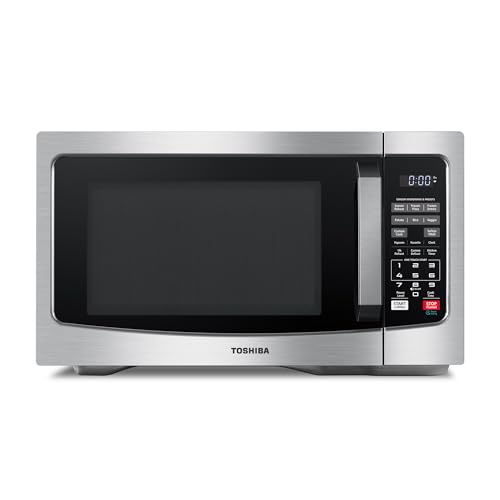
- TOSHIBA Countertop Microwave Oven, 1.2 Cu.Ft, 1000W, Stainless Steel — step-up size, reviewed prose-only below
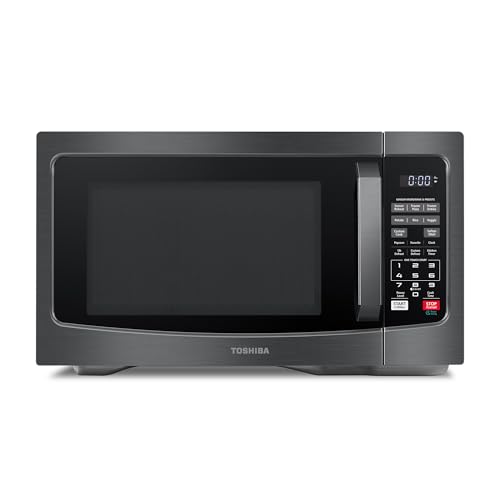
- TOSHIBA Countertop Microwave Oven, 1.2 Cu.Ft, 1000W, Black — step-up size, reviewed prose-only below
- Chefman Countertop Microwave Oven 0.7 Cu. Ft., 700 Watts — Black — step-down size, reviewed prose-only below
- COMFEE’ Countertop Microwave Oven, 0.7 Cu.Ft, 700W, Black — step-down size, reviewed prose-only below
Read the full guide ↓
Counter space is the one kitchen resource nobody can manufacture more of, which is why the search for the best small 1.0 countertop microwaves matters so much to apartment dwellers, dorm residents, and anyone whose kitchen was designed before microwaves existed. The roughly one-cubic-foot class is the sweet spot of the whole category: big enough for a full dinner plate and a quart of soup, small enough to leave room on the counter for a cutting board. This guide works through six countertop models around that class — and it begins with an honesty note most roundups skip.
Here is that note, stated plainly. In the verified pool for this guide, no model is labeled exactly 1.0 cu ft. The two models that genuinely belong to this class are the 0.9 cu ft ovens from BLACK+DECKER and Toshiba: a tenth of a cubic foot is within the rounding of this size class, and both are sold, shelved, and shopped as the small countertop standard. The two 1.2 cu ft Toshibas are a clear step up and the two 0.7 cu ft models from Chefman and COMFEE’ are a clear step down, so all four are reviewed honestly as context — what you gain and give up by leaving the class — but without purchase links, because presenting a 1.2 or a 0.7 as a 1.0 pick would not be truthful. If your counter demands the exact class, the linked pair is your shortlist; if you are still deciding which class you belong to, the prose-only reviews will help you more than any ranking could.
Power in this class clusters at 900 watts for the two core picks, which is close enough to the timings printed on most packaged foods that the adjustment is a few seconds rather than a calculation. The step-up models run 1000 watts, the step-down pair 700 watts, and the buying guide below explains exactly how those numbers translate at the table. Shoppers whose kitchens can take a built-in over-range unit instead should look at Best Microhood Microwaves, which solve the counter problem by moving the oven above the cooktop entirely.
Key Takeaways
- The honest core of the 1.0 class in this pool is 0.9 cu ft: the BLACK+DECKER and the Toshiba, both 900W, both sized for full dinner plates.
- No verified model here is labeled exactly 1.0 cu ft; the 1.2 cu ft and 0.7 cu ft models are reviewed prose-only as step-up and step-down context, never as 1.0 picks.
- 900W is the practical sweet spot for this size — close to packaged-food timings, gentle enough for small portions.
- Choose the BLACK+DECKER for the push-button door and stainless finish; choose the Toshiba for the mute function, LED lighting, and apartment brief.
- Step up to 1.2 cu ft only if a specific casserole or serving dish demands it; step down to 0.7 only if your cooking is genuinely mugs and bowls.
- Measure the counter footprint, not just the cavity: the oven body and its vent clearance are always bigger than the interior number suggests.
In this guide
Quick Picks
| Pick | Badge | Capacity | Power | Standing in this guide | Link |
|---|---|---|---|---|---|
| BLACK+DECKER Countertop Microwave Oven, 0.9 Cu.Ft | Best Overall | 0.9 cu ft | 900W | Core class pick — linked | Check on Amazon |
| TOSHIBA Microwave Oven, 0.9 Cu.Ft | Best for Apartments | 0.9 cu ft | 900W | Core class pick — linked | Check on Amazon |
| TOSHIBA Countertop Microwave Oven, 1.2 Cu.Ft, Stainless Steel | Best Step-Up | 1.2 cu ft | 1000W | Above the class — prose-only | Reviewed below |
| TOSHIBA Countertop Microwave Oven, 1.2 Cu.Ft, Black | Step-Up Alternative | 1.2 cu ft | 1000W | Above the class — prose-only | Reviewed below |
| Chefman Countertop Microwave Oven 0.7 Cu. Ft. | Best Step-Down | 0.7 cu ft | 700 watts | Below the class — prose-only | Reviewed below |
| COMFEE’ Countertop Microwave Oven, 0.7 Cu.Ft | Step-Down for Dorms | 0.7 cu ft | 700W | Below the class — prose-only | Reviewed below |
How These Picks Were Chosen
This is a research-led guide built from verified listing data, not a hands-on laboratory test, and the method here had one rule that overrode everything else: capacity is a core attribute of this keyword, and it was judged strictly by the capacity stated in each model’s verified title. Models at 0.9 cu ft were treated as the in-class core, because the difference from 1.0 is a rounding step within the same shelf class. Models at 1.2 cu ft and above, and models at 0.7 cu ft, were treated as clearly different sizes — close enough to be the most useful comparisons a shopper in this class will make, different enough that linking them as 1.0 picks would mislead. That is why this guide carries two linked picks and four prose-only reviews instead of pretending all six are the same size.
Within the class, the two core picks were compared on the things small-kitchen owners actually feel: wattage against packaged-food timings, door style, the preset list, quiet features, and how the finish behaves in a small, bright kitchen. The step-up and step-down models were assessed on a different question — what changes, concretely, if you leave the class in either direction — because that is the decision most readers are really making. No specification appears anywhere in this article unless the verified listing states it, and no price or rating figure is quoted, because both change too often to print honestly; use the links on the two core picks to check the latest price on Amazon.
Readers comparing the wider countertop category before narrowing down will find the full field surveyed under Best Microwave Ovens Countertop Microwaves; this guide assumes you have already decided that small is the point.
The Best Small 1.0 Countertop Microwaves — Detailed Reviews
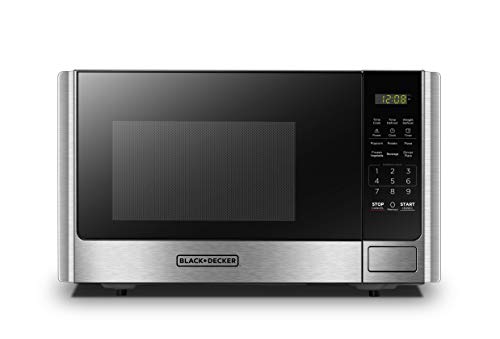
BLACK+DECKER Countertop Microwave Oven, 0.9 Cu.Ft, 900W, Stainless Steel
Badge: Best Overall
Strengths
- 0.9 cu ft cavity takes a full dinner plate — the dish that defines this class
- Push-button door opens without a free hand, a daily convenience in small kitchens
- 900W sits close to packaged-food timings, so box directions nearly work as printed
Trade-offs
- No sensor cooking; reheating times are your judgment
- No mute function is named in the listing for thin-walled apartments
- The largest casseroles still belong to the 1.2 class above
Mini spec box: Capacity 0.9 cu ft · Power 900W · 10 power levels · 6 auto cook presets · Push-button door · Child safety lock · Finish: Stainless Steel
This is the model the phrase “small countertop microwave” describes when most people use it. The 0.9 cu ft cavity is the smallest size that still swallows the reference dish of American weeknight life — a full dinner plate — without tilting it through the door, and the turntable class that comes with it rotates that plate properly so reheating stays even. In a small kitchen, that single fact decides more meals than any feature list: the moment a microwave forces you to transfer food into a smaller container before reheating, it has stopped saving you work.
The push-button door is the second everyday win. Small kitchens mean full hands — a hot dish in one, a toddler or a phone in the other — and a door that pops open from a button press, with no handle to grip or pull against the oven’s light body, is the right design for the setting. Six auto cook presets and ten power levels cover the standard rotation without menu-diving, and the child safety lock matters in the studios and small apartments where the microwave sits within a child’s reach by necessity. The honest limits are the absence of sensor reheating and of a named mute function: you judge times yourself, and the end-of-cycle beeps are what they are. For most small households, neither is close to a deal-breaker at this size, and the stainless finish wipes clean and brightens a compact counter rather than darkening it.
Best for: small households who reheat full plates and want the class standard / Not suited for: buyers who need sensor automation or a mute function

TOSHIBA Microwave Oven, 0.9 Cu.Ft, 900W, Black Stainless Steel
Badge: Best for Apartments
Strengths
- Mute function solves the late-night reheat problem in shared and thin-walled homes
- LED lighting lets you check melting and bubbling without opening the door
- 10.6 inch removable turntable lifts out for sink washing — sized for apartment sinks
Trade-offs
- No sensor, so off-preset reheating is manual timing
- 900W still trails the 1000W step-up class on frozen-meal pace
- Black stainless finish coordinates differently than bright stainless in some kitchens
Mini spec box: Capacity 0.9 cu ft · Power 900W · 6 auto menus · Mute function · Child lock · LED lighting · 10.6 inch removable turntable · Finish: Black Stainless Steel · Positioned by Toshiba for apartments
Toshiba built this twin of the class standard specifically for apartment life, and the differences from the BLACK+DECKER are a study in knowing your setting. Where the BLACK+DECKER spends its design budget on the door, this Toshiba spends it on sound and light: a mute function for the reheat at midnight that should not wake a roommate or a baby, and LED interior lighting bright enough to judge whether cheese has melted or soup is simmering without breaking the cycle. In a studio or a small flat, those are not luxuries; they are the difference between an appliance that fits your life and one that keeps apologizing for itself.
The cooking core is the same class recipe — 0.9 cu ft, 900W, six auto menus — so dinner plates fit, packaged timings nearly hold, and the daily rotation of leftovers, frozen meals, and hot drinks runs without thought. The 10.6 inch turntable is the one dimension the listing states, and it tells the size story precisely: plates up to roughly that span rotate freely, which covers standard dinnerware and excludes only genuinely large serving pieces. Choose between the two core picks on your tiebreakers — door and bright stainless on one side, mute and black stainless on the other — because on capacity and power they are the same honest answer to the same question. Long-term support is worth a thought on a daily-use apartment appliance, and the Best Mfg Warranty On Microwaves guide explains what coverage in this category actually looks like.
Best for: apartment and studio dwellers, shift workers, and light sleepers’ households / Not suited for: buyers who want a push-button door or sensor reheating
TOSHIBA Countertop Microwave Oven, 1.2 Cu.Ft, 1000W, Stainless Steel — Step-Up, Prose-Only
Badge: Best Step-Up
Strengths
- Smart humidity sensor removes reheating guesswork entirely
- 1000W matches the reference power most packaged foods assume
- Easy clean interior and ECO mode keep upkeep and standby draw down
Trade-offs
- 1.2 cu ft is visibly and measurably above this guide’s class — more counter, more presence
- Twelve auto menus is a longer panel to learn than the core picks’ six
- Presented prose-only here: no link, because it is not a 1.0-class oven
Mini spec box: Capacity 1.2 cu ft · Power 1000W · Smart humidity sensor · 12 auto menus · Mute function · ECO mode · Easy clean interior · Finish: Stainless Steel · Status in this guide: prose-only step-up
Every small-microwave shopper meets this model, because it is the one the store shelf nudges you toward: just a little bigger, just a little more powerful, with a humidity sensor that ends reheating guesswork. It is a genuinely good microwave — and it is not a 1.0-class microwave, which is why it appears here without a link. The step from 0.9 to 1.2 cu ft sounds trivial in a number and is not trivial on a counter: the body grows in every direction, and in the kitchens this guide serves, those inches come out of prep space.
The honest case for stepping up is a dish, not a feature. If there is a specific casserole, serving bowl, or tall container in your regular rotation that the 0.9 class cannot take, this Toshiba is the natural destination, and its sensor and 1000W pace will please you daily. If no such dish exists, the step-up buys capacity you will use twice a year with counter you will miss twice a day. Decide by the dish, and let the sensor be a bonus rather than the reason.
Best for: shoppers whose largest regular dish outgrows the 0.9 class / Not suited for: anyone whose counter is the binding constraint — that is the class this guide is about
TOSHIBA Countertop Microwave Oven, 1.2 Cu.Ft, 1000W, Black — Step-Up Alternative, Prose-Only
Badge: Step-Up Alternative
Strengths
- Same sensor-and-menus package as its stainless sibling, in a black finish
- 12.4 inch removable turntable is the one stated dimension — a genuinely family-plate span
- Mute function and ECO mode carry over for quiet, low-standby use
Trade-offs
- Same 1.2 cu ft step above the class as its sibling — the counter cost is identical
- Black finish shows dust and flour more readily in bright kitchens
- Prose-only in this guide for the same capacity reason
Mini spec box: Capacity 1.2 cu ft · Power 1000W · 12.4 inch removable turntable · Smart humidity sensor · 12 auto menus · Mute function · ECO mode · Easy clean interior · Finish: Black · Status in this guide: prose-only step-up
This black-finished Toshiba is the mechanical twin of the stainless step-up above: same 1.2 cu ft cavity, same 1000W, same humidity sensor and twelve auto menus. Its listing adds one useful stated figure — a 12.4 inch removable turntable — which quantifies the step-up better than the capacity label does. Against the core class’s 10.6 inch plate, that is the difference between rotating a standard dinner plate and rotating the larger serving plates and wider dishes that family cooking produces. If your dish audit points upward, this pair of Toshibas is where you land, and the choice between them is purely a finish decision: black hides the oven’s bulk in darker kitchens and shows dust more; stainless brightens small spaces and shows fingerprints more.
Everything said about the class boundary applies unchanged. A 1.2 cu ft oven in a kitchen that needed a 1.0 is not a bargain or an upgrade; it is a daily space tax. The reason both step-ups earn full reviews here is that the boundary decision is the most consequential one in this guide, and you deserve the real specifications of what sits on the other side of it — stated from their listings, without a sales link attached.
Best for: step-up shoppers who prefer a black finish and cook for a family / Not suited for: the small-counter brief at the heart of this guide
Chefman Countertop Microwave Oven 0.7 Cu. Ft., 700 Watts — Black — Step-Down, Prose-Only
Badge: Best Step-Down
Strengths
- One-touch express cook and six presets — the simplest control story in this whole guide
- 0.7 cu ft footprint fits corners the core class cannot
- Mute button included, rare at this size
Trade-offs
- 0.7 cu ft is below the class: full dinner plates do not fit — the defining compromise
- 700 watts needs meaningfully longer times than packaged directions print
- Prose-only here: a fine small microwave, but not a 1.0-class one
Mini spec box: Capacity 0.7 cu ft · Power 700 watts · 10 power levels · 6 cooking presets with one-touch express cook · Child safety lock · Mute button · Finish: Black · Status in this guide: prose-only step-down
Step down instead of up, and this Chefman is the model waiting. Its control package is arguably the most likeable in the entire guide — one-touch express starting, six presets, a mute button — wrapped in the smallest footprint here. For a single person whose microwave life is a mug of soup, a bowl of oatmeal, and a plate-free rotation of containers, it is not a compromise at all; it is the correct tool, and the counter it returns is real.
The line it cannot cross is the dinner plate. A 0.7 cu ft cavity reheats portions, not place settings, and 700 watts stretches every packaged timing by a noticeable margin. Households eat from plates, which is why the class this guide is named for starts at 0.9. Read this review as the honest lower boundary: if your cooking is genuinely container-based, step down with confidence; if plates are involved even twice a week, stay in the class.
Best for: single users with mug-and-bowl routines and the tightest counters / Not suited for: plate-based reheating — the core job of the 1.0 class
COMFEE’ Countertop Microwave Oven, 0.7 Cu.Ft, 700W, Black — Step-Down for Dorms, Prose-Only
Badge: Step-Down for Dorms
Strengths
- Positioned by its maker for dorms, apartments, and offices — the step-down use cases exactly
- One-touch buttons and sound on/off keep operation and noise under control
- ECO mode suits shared spaces watching standby draw
Trade-offs
- Same 0.7 cu ft plate limit as the Chefman — physics, not branding
- 700W pace for every job, every day
- Prose-only in this guide: below the named class
Mini spec box: Capacity 0.7 cu ft · Power 700W · ECO mode · Sound on/off · One-touch buttons · Child safety lock · Finish: Black · Maker positioning: dorm, apartment, office · Status in this guide: prose-only step-down
COMFEE’ aims this 0.7 cu ft model squarely at the dorm, the first apartment, and the office corner, and its feature choices match the brief: one-touch buttons nobody needs training on, a sound on/off control for shared walls, an ECO mode for standby-conscious buildings, and a child safety lock that matters in the family apartments where small ovens also end up. As a piece of product positioning it is coherent and honest.
Its role in this guide is to complete the map. Between the Chefman and the COMFEE’, the step-down shelf offers two flavors of the same physics — 0.7 cu ft and 700 watts — and choosing between them is a matter of finish, panel feel, and which quiet feature you value. What neither offers is the dinner-plate capacity that defines the 1.0 class, and no amount of feature charm changes that geometry. Know which side of the line your household eats on, and the choice makes itself.
Best for: dorms, offices, and first apartments with container-based cooking / Not suited for: households reheating plated meals
Comparison Table
| Pick | Capacity | Power | Class standing | Defining feature | Link |
|---|---|---|---|---|---|
| BLACK+DECKER 0.9 Cu.Ft | 0.9 cu ft | 900W | In class | Push-button door, 6 presets | Check on Amazon |
| TOSHIBA 0.9 Cu.Ft | 0.9 cu ft | 900W | In class | Mute function, LED lighting, 10.6 inch turntable | Check on Amazon |
| TOSHIBA 1.2 Cu.Ft Stainless | 1.2 cu ft | 1000W | Step up — prose-only | Humidity sensor, 12 auto menus | — |
| TOSHIBA 1.2 Cu.Ft Black | 1.2 cu ft | 1000W | Step up — prose-only | 12.4 inch turntable, humidity sensor | — |
| Chefman 0.7 Cu. Ft. | 0.7 cu ft | 700 watts | Step down — prose-only | One-touch express cook, mute | — |
| COMFEE’ 0.7 Cu.Ft | 0.7 cu ft | 700W | Step down — prose-only | Sound on/off, ECO mode, dorm positioning | — |
How to Choose in the Small 1.0 Countertop Class
Begin with the plate test, because it settles the class question in one measurement. Take the dinner plate your household uses most, measure across it including any rim you actually load with food, and compare that span with the turntable figures stated in this guide: 10.6 inches on the in-class Toshiba, 12.4 inches on the step-up Toshiba. A plate needs a little clearance beyond its own diameter to rotate without kissing the cavity walls. If your plate clears the 10.6 inch class, you belong in this guide’s core class and the step-ups are a distraction. If it does not, no review prose should talk you out of stepping up — buy the size your dishes demand and reclaim counter elsewhere.
Next, audit your containers. List what you actually microwave in a normal week: mugs, cereal bowls, storage containers, plates, a casserole. If plates appear, the 0.9 core is your floor. If the list is containers only, the 0.7 step-downs become legitimate and their smaller footprints are a genuine prize. If a casserole appears weekly, the 1.2 class earns its counter. This five-minute audit predicts satisfaction better than any feature comparison, because capacity is the one specification you cannot work around later.
Power follows from the audit. The in-class 900W models track packaged-food directions closely enough that the adjustment becomes instinct within a week. The 1000W step-ups follow them literally, and shoppers focused on that higher-power band can compare the field under Best Microwaves 1100 Watts, where several of these same listings are judged on speed. The 700W step-downs ask for a real conversion — add roughly a fifth to a third more time and check early — which is painless for soup and annoying for a hungry household’s frozen meals. Match the wattage to your patience and your menu, not to a bigger-is-better reflex.
Finally, measure the counter the way the oven will experience it: width for the body, depth for the body plus the door swing and plug, and clearance around the vents as the manual directs. Tape the footprint on the counter and live with the outline for a day before ordering. Small kitchens punish optimistic measuring more than any other room in the house.
One last class note belongs in the buying guide, because it decides returns more often than any specification: buy for the kitchen you have this year, not the one you hope to renovate into. A 0.9 cu ft oven that fits today’s counter and cooks today’s plates will serve happily for years, and if a future kitchen offers more room, it retires gracefully to a dorm, an office, or a family member’s first apartment. The wrong size, bought for a hypothetical future, annoys you every single day until it is replaced — and in a small kitchen, daily annoyance is the one feature no household can afford.
How to Set Up, Use, and Care for a Compact Countertop Microwave
Setup in a small kitchen deserves more care than in a big one, because every placement choice is a trade. Put the oven where its vents breathe — compact models vent from the sides or rear, and a unit pushed flush into a corner will run hot and age early. Keep it off power strips and on a direct wall outlet. Run a cup of water for a minute on arrival to verify operation, set the clock, and decide the sound policy on day one: the Toshiba core pick and both step-downs let you silence the beeps, which in a studio is a decision your future midnight self will thank you for.
Daily use in this class rewards two habits. First, respect the turntable: center dishes on it, keep loads balanced, and remember that a dish rotating without touching the walls is the whole point of the size class. Second, cover food. Small cavities splatter faster than big ones simply because the walls are closer, and a cover also holds the steam that even reheating depends on. Stir or rearrange halfway through manual cycles, let food stand a minute after the beep, and treat the presets as starting points you adjust by ten-second increments until your regular dishes have known settings.
Care is mostly a weekly wipe and a monthly check. Steam-clean dried splatter with a bowl of water and lemon, wash the removable turntable in the sink — both core-class turntables lift out — and inspect the door seal area for trapped food, since a clean seal is what keeps the door closing true. Never run any microwave empty, and never use the small cavity as storage for bread or cookbooks, a studio habit that ends with someone microwaving a paperback.
Troubleshooting for the compact class. Problem: a plate fits through the door but scrapes as it rotates → the plate is at the class limit; switch that dish to a slightly smaller plate or accept the step-up size at replacement time. Problem: food at the edges scorches while the center stays cold → the portion is too deep for the wattage; spread it thinner, lower the power, and add a stir halfway. Problem: the oven seems weak on frozen meals → confirm you are adjusting for 900W against directions written for a more powerful oven; a short addition of time is normal, not a defect. Problem: condensation fogs the door after every use → normal in small cavities with covered dishes; leave the door ajar for a few minutes after cooking and wipe the seal dry.
The Honest Truth About “1.0 Cu Ft”: Why the Label Rarely Exists
Shoppers are often surprised to learn that exactly-1.0 cu ft models are rare on real shelves. Manufacturers build to plate sizes and price bands, not to round numbers, so the market clusters at 0.7, 0.9, 1.1, and 1.2 cu ft — and the 0.9 cluster is what the world actually means by a small one-cubic-foot-class oven. The search phrase survives because it describes an intention — small, but a real microwave — rather than a measurement. This guide has treated that intention seriously while refusing to fake the measurement: the two 0.9 models are linked as the class core with their real capacities printed everywhere, and nothing in these pages calls a 1.2 a 1.0 or a 0.7 a 1.0 to fill out a table.
The practical lesson travels beyond microwaves. Capacity labels across small appliances are marketing-rounded, cavity shapes differ between brands at the same stated volume, and the turntable diameter — when a listing states it, as two here do — is a more honest guide to what fits than the cubic figure. Buy by the dish and the stated turntable, and the label can say whatever it likes. Readers weighing a warranty on a daily-use compact will find the category norms laid out under Best Mfg Warranty On Microwaves, which is worth the detour before any of these ovens becomes a household’s only cooker.
Small Kitchens, Real Layouts: Placing a 1.0-Class Oven
Three placements dominate small kitchens, and each favors a different pick. The straight counter run — oven beside the sink or stove — suits either core model, with the BLACK+DECKER’s push-button door shining when the oven sits where elbows and dish towels pass constantly. The corner placement saves the most usable counter but traps heat worst, so respect vent clearance strictly and prefer the model whose vents your corner can honor. The shelf or cart placement, common in dorms and studios, demands the lightest, smallest body you can honestly use — the one scenario where the 0.7 step-downs can beat the class core on merit rather than compromise.
Two placement rules apply everywhere. Keep the oven’s cord run short and direct; compact kitchens tempt extension cords, and a microwave is exactly the wrong appliance for one. And keep a landing zone — even a trivet’s worth of clear space beside the door — because a small microwave with nowhere to set a hot bowl simply relocates its inconvenience. Plan the landing zone first and the oven second, and a 0.9 cu ft footprint will feel twice as workable.
900 Watts in Real Life: Timing the Class Menu
Because both core picks run at 900W, it is worth translating that number into the meals this class actually cooks, since wattage only matters at the table. A mug of water for tea reaches a rolling heat in roughly two minutes. A bowl of soup from the refrigerator takes about three minutes with a stir in the middle. A plated weeknight leftover — rice, protein, vegetables — reheats in three to four minutes depending on density, and benefits from a minute of standing time more than from any extra burst of power. A frozen meal written for a more powerful oven needs a modest addition, typically under a minute, and the honest technique is to add less than you think and check, because an overcooked edge never un-cooks.
Defrosting is where the class earns or loses trust. At 900W with ten power levels available on the BLACK+DECKER and the preset menus on the Toshiba, a pound of ground meat thaws in stages — a few minutes, a pause to separate and turn, a few minutes more — and the cook who builds those pauses in gets meat that is thawed rather than half-cooked at the edges. Vegetables are the class’s quiet strength: frozen peas, corn, and green beans steam in their own moisture in minutes, with a texture the stovetop matches only with more washing up. Baked potatoes take longer than in a big oven but arrive properly fluffy if pierced, turned once, and rested.
The step-down pair at 700 watts cooks this same menu on a slower clock — add roughly a quarter more time across the board — and the step-up pair at 1000 watts shaves a little off it. Neither changes what is possible; both change how the evening feels. That is the correct way to think about power in this class: not as capability, which all six models share, but as tempo. A household cooking one portion at a time will never feel the 700W tax the way a household queuing three plates will, and matching tempo to household rhythm is a better buying rule than chasing the largest wattage a small counter can host.
Common Buying Mistakes
The defining mistake in this class is buying the label instead of the dish. Shoppers chase an exact 1.0 figure that barely exists, or accept a 1.2 or a 0.7 wearing a small-microwave description, and discover the truth at the first dinner plate. Measure the plate, read the stated turntable where one is given, and let those numbers choose. The second mistake is the optimistic counter measurement: cavity size is not body size, vents need clearance, and doors need swing room, so the oven that fits on paper crowds in person.
Third, buyers underrate wattage differences because 700, 900, and 1000 sound close. They are not, across a year of frozen meals: the 700W step-downs tax every packaged timing, and households that eat from boxes feel it nightly. Fourth, people ignore sound in small spaces. In a studio, the microwave is in the bedroom, effectively, and a mute function stops being a luxury — both core-class shoppers should weigh the Toshiba’s mute seriously for exactly this reason. Fifth, shoppers forget the landing zone and end up juggling hot bowls. And sixth, some buyers treat a compact oven as a temporary appliance and skip checking coverage and build entirely; a 0.9 cu ft oven in a small household often works harder than a family oven twice its size, and it deserves to be bought like the workhorse it is.
Final Recommendation
The class answer is the pair, and the tiebreak is your setting. Choose the BLACK+DECKER 0.9 Cu.Ft if your kitchen life is full-handed and plate-based — its push-button door, six presets, and stainless finish make it the class standard for a reason. Choose the TOSHIBA 0.9 Cu.Ft if your home is an apartment or studio where sound carries — the mute function and LED lighting are worth more there than any door mechanism. Step up to the 1.2 Toshibas only on the evidence of a specific dish, and step down to the 0.7 Chefman or COMFEE’ only if your cooking is honestly container-based. Check the latest price on Amazon from the links above, tape the footprint on your counter before you commit, and buy the size your plates voted for.
Frequently Asked Questions
Is 0.9 cu ft really the same class as 1.0 cu ft?
For shopping purposes, yes — and this guide says so openly rather than quietly relabeling anything. Manufacturers cluster compact ovens at 0.9 cu ft, the stated capacities of both core picks, and the practical difference from a nominal 1.0 is smaller than the difference between two brands’ cavity shapes at the same rating. What matters is the plate test: a standard dinner plate fits and rotates in the 0.9 class, which is the entire point of the size.
Why are the 1.2 cu ft models in this guide not linked?
Because 1.2 cu ft is a clearly different size from the 1.0 class this keyword names, and linking them as if they were 1.0 picks would mislead exactly the shoppers — small-counter owners — least able to absorb the mistake. They are reviewed in full, with their real specifications, because they are the most useful comparison a class shopper can make: the step-up decision deserves honest information, just not a sales link wearing the wrong size label. The same logic applies to the 0.7 cu ft pair in the other direction.
What size plate fits in the core picks?
The one stated turntable figure among the core picks is 10.6 inches, on the Toshiba, and plates up to roughly that span rotate freely; the BLACK+DECKER is built to the same class standard and takes standard dinner plates. Serving platters and the widest restaurant-style plates exceed the class and belong to the 1.2 step-up, whose black Toshiba states a 12.4 inch turntable. When a plate is borderline, a slightly smaller everyday plate is a cheaper fix than a bigger oven.
Is 900W enough, or will I regret not stepping up to 1000W?
For reheating and everyday cooking, 900W is enough, and its gap to packaged-food timings — usually written for a somewhat more powerful oven — is a small addition you will learn in a week. The 1000W step-ups earn their size only when frozen meals are a nightly staple and minutes matter, or when the larger cavity is independently justified by a dish. Power alone is rarely a good reason to surrender counter space in a small kitchen.
Which core pick is better for a studio apartment?
The Toshiba, on sound alone. A studio has no walls between the kitchen and the bed, and its mute function turns midnight reheating into a silent event; the LED lighting also helps you check food without opening the door and filling the room with steam and smell. The BLACK+DECKER wins in a small but separate kitchen, where its push-button door gets more daily use than a mute ever would.
Can a microwave this size handle a small family’s cooking?
Yes, with realistic expectations. A household of two or three that reheats plates, cooks vegetables and rice, and defrosts portions will find the 0.9 class entirely sufficient — it is the traditional family size in much of the world. What it will not do is batch cooking for gatherings or oversized dishes; families who host weekly should step up on that evidence, not on a vague feeling that bigger must be better.
How much clearance does a compact countertop microwave need?
Follow the manual for your specific model, since vent positions differ, but plan on visible breathing room on the vented sides and above rather than a flush fit, plus depth for the plug and door swing. The tape-the-footprint method in the buying guide is the reliable test: outline the body, add a margin on the vent sides, and live with the tape for a day. If the outline annoys you, the oven would have annoyed you more.