Disclosure: topratedkitchenware.com is reader-supported. When you buy through links on our site, we may earn an affiliate commission from Amazon and other retailers, at no extra cost to you.
Where to buy
The six models below are the verified picks for this guide. Each name links to its Amazon listing, where you can check the latest price on Amazon, confirm the current configuration, and read the newest owner feedback before you decide.
- EAST OAK 30-Inch Electric Smoker, Mist Silver
- EAST OAK 30-Inch Electric Smoker, Matte Black
- EAST OAK 30-Inch Electric Smoker with Mobility Stand, Polar Night
- Masterbuilt 30-Inch Analog Electric Smoker MB20070210
- RYHOFOUD 30-Inch Vertical Electric Smoker
- Royal Gourmet SE2805 28-Inch Electric Smoker
Read the full guide ↓ for the reasoning behind the ranking, the honest limitations of every pick, and the buying checks that matter more than any headline claim.
Ask a group of backyard cooks what the best selling smokers have in common and you will hear the same short list: they are easy to live with, they forgive beginner mistakes, and they produce good food without demanding a whole Saturday of fire management. That is not a coincidence. The smokers that sell in volume, season after season, are rarely the most exotic machines on the market. They are the ones a neighbor recommends after a successful brisket, the ones whose replacement parts and accessories are easy to find, and the ones a first-time buyer can unbox on Friday and cook on by Sunday. This guide reads the “best selling” label the honest way: not as invented sales figures, which we do not have and will not fabricate, but as a study of the design traits that make a smoker the kind of purchase people repeat, recommend, and gift.
Every pick in this guide is a vertical electric smoker, and that itself tells you something about what sells. Electric cabinets dominate the popular end of the market because they remove the two biggest barriers to smoking at home: fuel management and temperature anxiety. You plug the cabinet in, set a temperature, load wood chips, and the element does the holding work while the chips do the flavor work. The six models here span 454 to 725 square inches of cooking area, analog dials through digital timers and built-in meat probes, and footprints from a compact 28-inch cabinet to stand-mounted and wheeled designs built for bigger batches. Between them they cover nearly every reason a smoker becomes a household staple.
A quick honesty note before the ranking. “Best selling” is a lens, not a measurement we can verify from a listing page, so this guide will not quote sales volumes, chart positions, or owner counts for any model. What it will do is show you, pick by pick, which features drive the popularity pattern — side chip loaders that stretch smoke time, viewing windows that stop heat loss, probes that remove guesswork — and which compromises the popular models ask you to accept. If you are cross-shopping fuel types, our companion guide to Best Selling Wood Smokers For Sale covers the wood-fired end of the same conversation, including where electric cabinets honestly fall short.
Key Takeaways
- Popularity in this category follows usability: the best selling smokers are the ones with the fewest friction points between unboxing and a successful first cook.
- All six picks are vertical electric cabinets from 454 to 725 square inches, the format that dominates home smoking because it pairs real wood-chip smoke with set-a-dial temperature control.
- Side chip loaders are the single most popularity-driving feature in this pool: three EAST OAK picks load chips from outside the door and stretch a single load up to six times longer, so the door stays shut and the heat stays in.
- Built-in meat probes and viewing windows sell because they solve the beginner’s core dilemma — checking the food without dumping the heat and smoke you spent an hour building.
- Analog models like the Masterbuilt MB20070210 and Royal Gourmet SE2805 stay popular for the opposite reason: almost nothing electronic to fail, and a price tier that makes them easy first purchases and gifts.
- Buy for your typical batch, not your biggest imagined party: most households cook on two or three racks, and the compact 454–535 square inch cabinets cover that with room to spare.
In this guide
Quick Picks
| Pick | Badge | Format | Cooking area | Standout trait | Link |
|---|---|---|---|---|---|
| EAST OAK 30-Inch Electric Smoker, Mist Silver | Best Overall | Electric vertical | 725 sq in | Built-in probe, viewing window, side chip loader | Check on Amazon |
| EAST OAK 30-Inch Electric Smoker, Matte Black | Best for Long Cooks | Electric vertical | 725 sq in | Digital 12-hour timer, side chip loader, wheels | Check on Amazon |
| EAST OAK 30-Inch Electric Smoker, Polar Night | Best for Comfort | Electric vertical on stand | 725 sq in | Mobility stand raises the working height | Check on Amazon |
| Masterbuilt 30-Inch Analog Electric Smoker MB20070210 | Best Simple Pick | Electric vertical | 535 sq in | Analog dial, chrome racks, proven layout | Check on Amazon |
| RYHOFOUD 30-Inch Vertical Electric Smoker | Best for Jerky and Sausage | Electric vertical | Not stated in listing title | S-hooks, water pan, drip trays included | Check on Amazon |
| Royal Gourmet SE2805 28-Inch Electric Smoker | Best Compact Pick | Electric vertical | 454 sq in | 1350W element, three grates, smallest footprint | Check on Amazon |
How These Picks Were Chosen
This is a research-led guide, not a lab test, and it is written that way on purpose. Each pick was verified against the manufacturer’s listing data available to us: the full product title, the stated cooking area, the control type, and the included hardware. Where a specification is not stated in that verified data — the RYHOFOUD’s total cooking area, for example — this guide says so rather than filling the gap with a plausible number. Every Amazon link in this article points to a listing we confirmed exists for the exact model named, and the sources file published with this guide records each model, its identifier, and the date it was checked.
The popularity lens was applied as a set of questions rather than a set of figures. Does this model remove a known friction point — chip reloading, temperature guesswork, low working height, cramped racks? Is its format one a first-time buyer can succeed with on the first cook? Are its parts and accessories the kind that stay easy to source? Models scored well when the answer kept being yes. That is why three of the six picks come from one brand’s 30-inch platform: when a design removes the right frictions, variations of it tend to accumulate buyers, and the three EAST OAK finishes genuinely differ in the details that matter — probe and window, timer and wheels, or a stand under the cabinet.
What this guide does not do is rank by star ratings, review counts, or sales rank screenshots, all of which shift constantly and none of which tell you whether a smoker fits your patio, your outlet, and your typical Sunday. It also does not claim hands-on testing we did not perform. The performance notes below are framed around what each design’s verified features can and cannot do, and around the well-understood behavior of electric cabinet smokers as a class: steady low temperatures, mild-to-moderate smoke intensity from chips, and a hard ceiling on bark and smoke-ring drama compared with a live-fire cooker. Readers who want the hands-off end of this category pushed further should also see our guide to Best Set And Forget Smokers, which weights automation above everything else.
The 6 Best Selling Smokers, Reviewed One by One
The ranking below leads with the model that best explains the whole category’s popularity, then works through the variations buyers actually choose between: longer unattended smoke, a raised working height, analog simplicity, accessory completeness, and compact size. Badges match the Quick Picks table so you can trace each model through the guide.

EAST OAK 30-Inch Electric Smoker, Mist Silver
Badge: Best Overall
Strengths
- Built-in meat probe removes the open-the-door-to-check habit that ruins temperature stability.
- Clear viewing window lets you judge color and progress with the door shut.
- Side chip loader stretches a single chip load up to six times longer, so smoke runs uninterrupted.
Trade-offs
- The window needs regular cleaning; smoke film clouds it if you skip a wipe-down between cooks.
- 725 square inches is generous for families but more cabinet than a two-person household will often fill.
- Like every electric cabinet here, it will not produce stick-burner bark or a deep smoke ring.
Mini spec box
- Format: 30-inch electric vertical smoker
- Cooking area: 725 sq in
- Monitoring: built-in meat probe; clear viewing window
- Smoke system: side chip loader, up to 6x longer uninterrupted smoking per load
- Finish: Mist Silver
If one model explains why electric cabinets sell the way they do, it is this one, because it attacks the three moments where beginners lose a cook. The first is the check: new smokers open the door constantly to see whether the meat “looks done,” and every opening dumps heat and smoke. The built-in probe answers the doneness question from outside the cabinet, and the window answers the appearance question the same way. The second moment is the chip reload, traditionally a door-open, heat-out, smoke-out interruption; the side loader turns it into a ten-second task done from outside. The third is capacity anxiety — the fear that the smoker will be too small the one time family visits — and 725 square inches across the rack system settles that for most households without moving into catering territory.
In everyday use this is the pick for the cook who wants the popular choice to also be the low-drama choice: ribs on the middle racks, a water pan below if you use one, chips loaded from the side when the smoke thins. Its honest limitation is the class limitation — chip smoke is cleaner and milder than log smoke, and competition-style bark is not what this format is for. Within its class, though, the feature stack is exactly the one the market keeps rewarding.
Best for: first-time buyers and families who want the fullest feature set in the popular format / Not suited for: cooks chasing live-fire flavor or smoking for very large crowds

EAST OAK 30-Inch Electric Smoker, Matte Black
Badge: Best for Long Cooks
Strengths
- Digital 12-hour timer suits overnight and all-day cooks with a defined end point.
- Side chip loader stretches one load up to six times longer between refills.
- Easy-rolling wheels make a 725 square inch cabinet genuinely movable by one person.
Trade-offs
- No built-in meat probe in the verified listing data, so a separate thermometer is a sensible companion purchase.
- No viewing window; progress checks mean trusting the timer and your plan, or opening the door.
- The digital control is one more electronic component than the analog picks carry.
Mini spec box
- Format: 30-inch outdoor electric smoker
- Cooking area: 725 sq in
- Control: digital, with 12-hour timer
- Smoke system: side chip loader, up to 6x longer on a single load
- Mobility: easy-rolling wheels
- Finish: Matte Black
The Matte Black version of the same 30-inch platform earns its following from a different buyer: the one who has already decided to cook brisket and pork shoulder, the cuts that turn smoking from an afternoon into a schedule. For those cooks the headline feature is not the window they give up but the timer they gain. A digital 12-hour timer lets a long cook be planned rather than supervised, and the side loader’s extended burn means the smoke supply roughly matches the patience of the cook. Wheels matter more than they sound like they should at this size — a cabinet this large that cannot be rolled out of the weather or back against a wall becomes a patio obstacle, and obstacles get used less.
The honest gaps are the probe and the window. Without a built-in probe you are relying on time, experience, and whatever thermometer you add yourself; many experienced cooks prefer their own probe setup anyway, which is part of why this variant sells to the second-smoker crowd. Treat it as the platform’s long-cook configuration: same 725 square inches, same loader, aimed at duration instead of visibility.
Best for: brisket and shoulder cooks who plan long, timed sessions and move their smoker often / Not suited for: buyers who want doneness monitoring built in from day one
EAST OAK 30-Inch Electric Smoker with Mobility Stand, Polar Night
Badge: Best for Comfort
Strengths
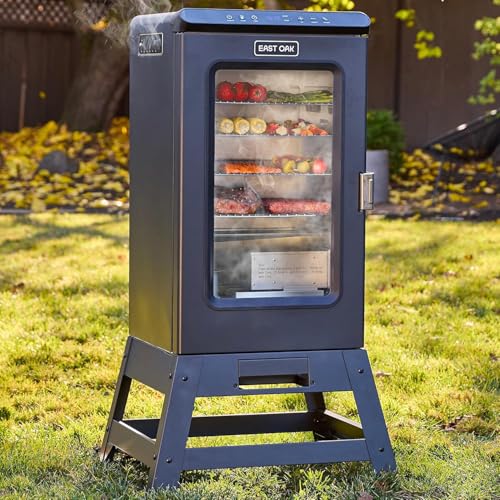
- Mobility stand raises the cabinet so loading racks happens at working height, not ground level.
- Built-in meat probe covers doneness without opening the door.
- Side chip loader keeps smoke running up to six times longer per load.
Trade-offs
- The stand adds footprint and one more assembly stage out of the box.
- No viewing window in the verified data, so visual checks still cost a door opening.
- A raised cabinet catches more wind on exposed patios; placement matters.
Mini spec box
- Format: 30-inch outdoor electric smoker on mobility stand
- Cooking area: 725 sq in
- Monitoring: built-in meat probe
- Smoke system: side chip loader, up to 6x longer uninterrupted smoke
- Finish: Polar Night
Ergonomics is the unglamorous feature that decides whether a smoker gets used weekly or twice a year, and this variant is built around that truth. A floor-level cabinet means every rack load, every water-pan check, and every cleanup happens in a crouch. The mobility stand lifts the same 725 square inch cabinet to a height where loading a heavy shoulder is a lift of inches rather than a lift from the ground, and for older cooks or anyone with a bad back, that difference is the whole purchase. It keeps the probe and the long-running side loader from the platform, trading away only the window.
It is also the variant that most rewards a permanent home. The stand wants a level, sheltered spot — ideally under cover near an outdoor outlet — and in return the smoker becomes patio furniture you cook from rather than equipment you haul out. If your smoking happens on a deck or paved patio and you plan to cook often, this is the configuration whose popularity is easiest to understand.
Best for: frequent cooks, older users, and anyone setting up a semi-permanent patio smoking station / Not suited for: buyers who store their smoker in a tight shed between uses
Masterbuilt 30-Inch Analog Electric Smoker MB20070210
Badge: Best Simple Pick
Strengths
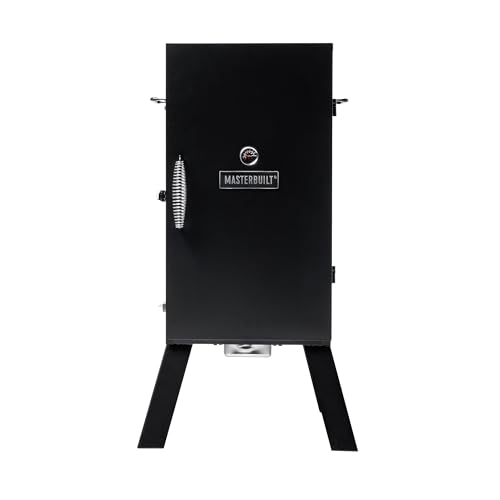
- Analog temperature control: one dial, nothing to program, almost nothing to fail.
- Chrome smoking racks in a 535 square inch cabinet — the classic starter footprint.
- Masterbuilt’s long-running 30-inch format means a deep pool of owner knowledge and accessories.
Trade-offs
- Analog dials hold a range rather than a precise set point; expect gentle swings.
- No probe, timer, or window in the verified data — monitoring is the cook’s job.
- 535 square inches is the second-smallest cabinet here; big batches need planning.
Mini spec box
- Format: 30-inch electric vertical smoker
- Cooking area: 535 sq in
- Control: analog temperature control
- Racks: chrome smoking racks
- Model: MB20070210, black
Every category has a model that sells on the strength of being the known quantity, and in electric smokers that role belongs to Masterbuilt’s analog 30-inch cabinet. The design philosophy is the opposite of the EAST OAK feature stack: instead of adding electronics, it subtracts them. One dial sets the heat. The element cycles. Chips smolder in the tray. For a large group of buyers — gift-givers, cabin owners, first-timers who distrust apps and displays — that simplicity is not a compromise but the entire appeal, and it keeps this format near the top of the category year after year.
The trade is precision. An analog dial is a suggestion the cabinet interprets, and on cold or windy days the internal temperature will wander more than a digital model would. Experienced owners learn their dial’s personality and cook excellent food regardless; beginners should budget for a basic leave-in thermometer and a little patience. What you get in return is a smoker with very few failure modes, at the approachable end of the category’s pricing tiers, in the size most households actually use.
Best for: beginners, gift buyers, and anyone who values repairable simplicity over precision / Not suited for: cooks who want set-it-exactly digital control or overnight automation

RYHOFOUD 30-Inch Vertical Electric Smoker
Badge: Best for Jerky and Sausage
Strengths
- S-hooks in the box make hanging sausage and jerky strips a day-one capability, not an accessory hunt.
- Water pan, wood chip tray, drip trays, and steel racks all included — a complete kit.
- Clear window and wheels cover visibility and mobility in one package.
Trade-offs
- Total cooking area is not stated in the verified listing title, so capacity comparisons are approximate.
- A newer name in the category, with a thinner long-term owner community than Masterbuilt.
- Drip trays and a water pan add washing-up after greasy cooks.
Mini spec box
- Format: 30-inch vertical electric smoker with wheels
- Included: water pan, wood chip tray, clear window, steel racks, S-hooks, drip trays
- Suited foods per listing: meat, fish, sausage, jerky
- Cooking area: not stated in verified title data
The RYHOFOUD’s popularity logic is completeness. Many smokers are bought for one specific ambition — a deer season’s worth of jerky, homemade sausage, smoked fish for the holidays — and this cabinet is packaged directly at those cooks. The S-hooks are the tell: hanging is how sausage and jerky strips smoke evenly, and including the hooks, the water pan, and drip management in the box means the first specialty cook happens the first weekend, not after a second order arrives. The window and wheels round out a package that asks very little of the buyer beyond an outlet and a bag of chips.
The caveats are real but narrow. We will not invent a cooking-area figure the listing title does not state, so treat its capacity as “30-inch class” and check the listing’s dimension details before ordering if a specific pan or brisket size must fit. And as a newer entrant it lacks the decade of forum threads the Masterbuilt enjoys — though for a machine this mechanically simple, that matters less than it would for a connected pellet grill.
Best for: jerky, sausage, and fish smokers who want the full accessory kit in one box / Not suited for: buyers who need a verified exact cooking area before purchasing

Royal Gourmet SE2805 28-Inch Electric Smoker
Badge: Best Compact Pick
Strengths
- 454 square inches across three cooking grates in the smallest footprint in this guide.
- 1350W element is strong for the cabinet size, recovering heat briskly after door openings.
- Analog control and adjustable heat keep the design simple and the tier accessible.
Trade-offs
- The smallest capacity here; whole large briskets may need trimming or separating.
- Analog control means the usual gentle temperature wander of a dial-based system.
- No wheels, probe, or window in the verified data.
Mini spec box
- Format: 28-inch electric vertical smoker
- Cooking area: 454 sq in
- Power: 1350W
- Control: analog temperature control, adjustable heat
- Racks: 3 cooking grates
- Model: SE2805, black
Compact smokers sell because most smoking is small: two racks of ribs, a chicken, a salmon side, a modest shoulder for the week. The SE2805 is sized honestly for that reality. Its 454 square inches over three grates handles the everyday list comfortably, the 1350W element is generously powered for the volume it heats — small cabinets with strong elements recover temperature quickly, which is exactly what a cook opening the door to spritz or wrap wants — and the analog dial keeps the whole machine at the simple, giftable, first-smoker end of the market.
Its limit is geometry. A full packer brisket is a wide piece of meat, and a 28-inch cabinet will ask you to trim aggressively or split point from flat. If that cut is your main event, step up to a 725 square inch pick. If your menu is ribs, poultry, fish, and sausage, this is the pick whose size you will appreciate every single time you carry it, clean it, and store it. Readers comparing the small end of the category specifically may also want our notes on Best Side Smokers and the side-loading designs discussed there.
Best for: small households, balcony and small-patio cooks, and first-time buyers / Not suited for: cooks whose signature dish is a whole untrimmed packer brisket
Comparison Table
| Pick | Cooking area | Control | Probe | Chip loading | Mobility | Link |
|---|---|---|---|---|---|---|
| EAST OAK Mist Silver | 725 sq in | Digital-class feature set | Built-in | Side loader, up to 6x longer | Not stated | Check on Amazon |
| EAST OAK Matte Black | 725 sq in | Digital, 12-hour timer | Not stated | Side loader, up to 6x longer | Wheels | Check on Amazon |
| EAST OAK Polar Night | 725 sq in | Not stated | Built-in | Side loader, up to 6x longer | Mobility stand | Check on Amazon |
| Masterbuilt MB20070210 | 535 sq in | Analog dial | None stated | Internal tray | Not stated | Check on Amazon |
| RYHOFOUD 30-Inch | Not stated in title | Not stated | None stated | Wood chip tray | Wheels | Check on Amazon |
| Royal Gourmet SE2805 | 454 sq in | Analog, adjustable | None stated | Internal tray | Not stated | Check on Amazon |
How to Choose a Smoker That You Will Still Be Using Next Year
The deepest pattern behind best selling smokers is not a feature — it is a fit between the machine and the cook’s actual life. Start with batch math. A rack of ribs occupies roughly a third of a 30-inch-class rack; a whole chicken takes most of one rack’s width; a pork shoulder is compact but tall. Most households, most weekends, cook one or two items. That is why the 454–535 square inch cabinets sell steadily: they cover the real menu. The 725 square inch models earn their place when you regularly cook for gatherings, batch-cook jerky, or want a brisket and ribs in the same session. Buy the size you will fill two weekends out of three, because a half-empty large cabinet still heats fine, but a too-small cabinet fails completely on the one day it matters.
Next, decide how you feel about information. Digital control with a probe and a window turns smoking into a monitored process: you know the cabinet temperature, the meat temperature, and the color, all with the door shut. Analog control turns it into a practiced craft: you learn the dial, you check with your own thermometer, you accept small swings as normal. Neither is wrong, and the sales pattern proves both — but be honest about which cook you are, because the mismatch (a data-minded buyer with an analog dial, a simplicity-minded buyer with a connected display) is the most common source of “this smoker isn’t for me” returns in the category.
Then weigh the reload path. In an electric cabinet, smoke comes from chips, and chips burn down. A side loader lets you replenish smoke without opening the cooking chamber — preserving the temperature you spent an hour stabilizing — and the extended-load designs in this guide stretch that interval several-fold. If you plan long cooks, rank this feature high; it is the difference between tending a smoker and merely owning one. If your cooks are two-to-three-hour sessions of ribs and chicken, an internal tray is a minor inconvenience and should not outweigh size or control preferences.
Finally, plan the physical life of the machine. Measure the spot it will live, confirm an outdoor-rated outlet within cord reach, and decide whether it will be moved (favor wheels), stationed (favor a stand), or stored (favor the compact cabinets). Popular smokers are, almost by definition, smokers that fit their owners’ spaces without a fight. Shoppers whose space problem is specifically about where the firebox or loader sits should look at Best Side Box Smokers, which approaches placement from the firebox side of the design.
How to Run Your First Cook in an Electric Cabinet Smoker
Season first. Before food ever enters a new cabinet, run it empty at a moderate smoking temperature with a load of chips for a couple of hours. This burns off manufacturing residues and lays down the first layer of seasoning on the interior walls. Wipe the racks, let it cool, and you are ready.
For the first real cook, choose something forgiving: a pork shoulder or a whole chicken. Fill the water pan if your model has one and you want the moisture buffer it provides. Preheat the cabinet to your target temperature — the classic low-and-slow band sits around 225–250°F — and let it stabilize for twenty minutes before loading. Add chips once the cabinet is at temperature, not during preheat, so the smoke lands on the cooking phase rather than the warm-up. Load the meat, insert the probe if your model has one, and then practice the discipline that makes electric smoking work: keep the door shut. Every opening costs heat and smoke that the cabinet must rebuild.
Manage smoke by watching its character, not just its presence. Thin, pale, almost blue smoke is the goal; thick white billows mean the chips are smoldering too aggressively and can push food toward bitterness. If smoke disappears entirely mid-cook, reload — through the side loader if you have one. Plan the finish by temperature and tenderness, not by the clock: a shoulder is done when the probe slides in with little resistance, and resting it wrapped for at least half an hour is part of the recipe, not a delay.
Troubleshooting, in the pattern worth memorizing. Problem: temperature swings wider than expected on a windy day → move the cabinet out of direct wind and give the control twenty minutes to settle before adjusting again. Problem: smoke turns harsh and the food tastes acrid → the chip load was too large or the chips were flaming; use a smaller load and let the cabinet settle into a steady smolder. Problem: the cook runs long and the meat stalls for hours → this is the well-known stall, not a malfunction; wrap the cut in foil or butcher paper and hold your temperature, and it will push through.
Why Electric Cabinets Became the Popular Format
It is worth understanding the format’s rise, because it explains the shape of this entire list. Smoking used to mean an offset pit, a woodpile, and a skill set closer to firefighting than cooking. Charcoal and pellet designs each removed part of that burden, but the electric cabinet removed the most: fuel became a cord, temperature became a dial, and smoke became a tray of chips. The flavor ceiling is lower than a live-fire pit’s — no honest guide should pretend otherwise — but the floor is dramatically higher, and for most households the floor is what determines dinner. A format where a first-timer’s first brisket is merely good instead of ruined is a format that accumulates satisfied owners, gift purchases, and repeat recommendations, which is the entire engine of “best selling” in a category like this.
The vertical layout compounds the advantage. Heat and smoke rise through stacked racks, the footprint stays close to a kitchen trash can’s, and the cabinet fits the balconies and small patios where most American grilling actually happens. Add the accessory ecosystem — covers, racks, hooks, chip varieties in every grocery store — and the popular format keeps reinforcing itself. If you are deciding between this format and a pellet grill-smoker, the honest summary is: pellets sear and grill as well as smoke, cabinets smoke with less fuss and no moving auger, and the right answer is the one matching the food you cook most.
Accessories That Popular Smokers Actually Need
Resist the bundle temptation; a short, specific list serves better. A leave-in probe thermometer matters for the analog picks that lack built-in monitoring. A fitted cover matters for any cabinet that lives outdoors. Heat protection matters every time a rack comes out — our guide to Best Silicone Gloves For Smokers covers the glove options built for exactly that job. Beyond that, spend on ingredients instead: two or three chip species (a mild fruitwood, hickory, and mesquite for short hot cooks) teach you more about smoke flavor than any gadget. Drip management — pans, liners where the design allows — pays for itself in cleanup time, and a stiff brush and a spray bottle round out a kit that fits in one drawer.
What Popularity Does Not Tell You
A best selling label is a starting point for questions, not an answer, and the most useful thing this guide can do is name what popularity leaves out. It does not tell you about longevity in your climate: a cabinet that thrives under a covered Arizona patio faces a different life in a rainy Pacific Northwest winter, and storage and cover habits will matter more to its lifespan than its sales history. It does not tell you about smoke intensity preferences, which are personal to the point of being family-specific — some households want a whisper of hickory on their chicken, others want brisket that announces itself from the driveway. And it does not tell you about your own learning curve. The most popular smoker in the country will still produce mediocre food for an owner who never learns its hot spots, never seasons it properly, and opens the door every twenty minutes to admire the meat.
Popularity also lags innovation by a season or two. The models that dominate today earned their position with designs that are now several years old, which cuts both ways: the designs are proven and their quirks are documented in owner communities, but newer features — better controllers, improved sealing, app monitoring — appear first on models that have not yet accumulated a following. The six picks here were chosen to balance that tension: the Masterbuilt analog is as proven as the category gets, while the EAST OAK variants carry the newer convenience features (side loaders, stands, probes) that are currently converting into tomorrow’s popularity. Buying slightly behind the frontier, in a format this mature, is usually the value play.
One more thing popularity hides: return reasons are rarely about the smoker. They are about the match — the buyer who wanted a grill and bought a cabinet, the cook who expected offset flavor, the household that measured nothing and found the smoker and the balcony in conflict. Every section of this guide is aimed at that match, because the best selling smokers only stay best sellers when buyers choose them for the right reasons.
Cleaning and Care: The Routine Behind Repeat Cooks
Electric cabinets ask for little maintenance, but the little they ask for is specific. After each cook, once the cabinet is cool, pull the racks and wash them with hot soapy water or run them through a dishwasher cycle if they fit; fat left on racks turns rancid and will season your next cook with last month’s. Empty and wash the drip tray and water pan the same day — this is the single most skipped step and the source of most off flavors and most pest attention. Wipe the interior walls only lightly: the darkened seasoning layer is a feature that protects the metal and contributes to flavor, and it should be knocked down only when it flakes. Clean the window, if your model has one, with a damp cloth while it is still slightly warm; smoke film wipes off easily then and resists later.
Monthly, check the door seal and the element area for grease buildup, vacuum out ash and chip residue from the bottom of the cabinet, and inspect the cord for weather damage if the smoker lives outdoors. Store chips dry — damp chips smolder poorly and taste musty — and keep the cabinet covered when it is not in use. None of this is burdensome, but it is the difference between a smoker that cooks well for years and one that quietly degrades into the corner of the patio. The popular models in this guide are popular partly because their layouts make this routine easy: removable trays, accessible racks, and cabinets that come apart in the right places.
Common Buying Mistakes
- Buying capacity for the party, not the pattern. The biggest cabinet is not the best selling choice for a household that cooks for four; it is just the biggest.
- Expecting offset-pit flavor from an electric cabinet. Chips give real wood smoke, but milder and cleaner. Buy the format for what it is and you will love it; buy it as a substitute fantasy and you will not.
- Ignoring the reload path. If you plan long cooks, a smoker that needs its door opened to add chips will tax every session. Check how chips load before you buy.
- Skipping the outlet plan. Electric smokers need outdoor power within reach. Extension-cord improvisation is a safety and performance problem; measure first.
- Trusting any “best selling” claim with numbers attached. Rankings and counts change constantly and are easy to fabricate. Buy on features, fit, and verified specifications instead.
- Forgetting the second cook. Seasoning runs, chip supply, a cover, and a cleaning routine are part of the purchase. Budget the small things and the machine stays a pleasure.
Final Recommendation
For most buyers, the EAST OAK 30-Inch Electric Smoker in Mist Silver is the recommendation: it combines the probe, the window, and the long-running side loader in the 725 square inch format, which is the fullest expression of why this category sells. If your cooks run long and timed, choose the Matte Black EAST OAK for its 12-hour digital timer and wheels; if working height matters, the Polar Night on its mobility stand is the comfort pick. The Masterbuilt analog is the simplicity vote, the RYHOFOUD is the jerky-and-sausage kit, and the Royal Gourmet is the honest compact. None of the six requires you to learn fire management, and that — more than any single specification — is what makes a best seller.
Frequently Asked Questions
What makes a smoker a “best seller” in this category?
In practice, a combination of an accessible price tier, a forgiving format, features that remove beginner friction — probes, windows, side chip loaders — and a brand or design that owners recommend to each other. This guide deliberately avoids quoting sales figures, because those numbers cannot be verified from listing data and change constantly; the traits above are the durable part of the pattern.
Are electric smokers good for beginners?
They are the most forgiving starting point in smoking. Temperature is set with a dial or digital control rather than managed through a fire, and wood chips provide real smoke without fuel tending. A beginner’s main jobs are seasoning the cabinet, loading chips, and keeping the door shut — all learnable in one cook.
How much cooking space do I actually need?
For one or two items at a time — ribs, a chicken, a modest shoulder — 454 to 535 square inches is enough. Step up to the 725 square inch class if you batch-cook, host regularly, or want a brisket plus a second item in one session. Measure your signature cut against rack dimensions on the listing before ordering.
Do electric smokers produce real smoke flavor?
Yes, from real wood chips smoldering on or near the element. The flavor is genuine but milder and cleaner than a log-burning offset, and electric cabinets do not produce the pronounced smoke ring some cooks prize. Most households find the trade — milder smoke for far easier control — well worth it.
Analog or digital control: which should I choose?
Choose digital if you want a set temperature held closely, timer features, and probe integration. Choose analog if you value simplicity, fewer components, and a lower tier — accepting gentler temperature swings that experienced owners manage by learning their dial. Both appear among the best selling smokers because both preferences are common and legitimate.
Can I use an electric smoker on a balcony or small patio?
Generally yes, subject to your building’s rules: the compact 28-inch Royal Gourmet SE2805 was designed for exactly that footprint. You need a suitable outdoor outlet, clearance from walls and railings per the manufacturer’s guidance, and a plan for where the smoke drifts — be a good neighbor about that last one.
What should I cook first?
A pork shoulder. It is inexpensive, tolerant of temperature swings, and teaches you the full cycle — seasoning, smoke management, the stall, wrapping, resting — in one cook. Chicken and ribs follow naturally; save brisket for your third or fourth session, when the cabinet’s habits are familiar.


