Disclosure: topratedkitchenware.com is reader-supported. When you buy through links on our site, we may earn an affiliate commission from Amazon and other retailers, at no extra cost to you.
Where to buy
This guide to the best immersion blenders for soap making brings together six verified stick blenders you can order online today. Each name below links to its Amazon listing, and every detailed review further down carries its own Check on Amazon link so you can check the latest price on Amazon for the exact model you are reading about. Soap makers buy these tools to dedicate to the craft, so the bundle and control details in each listing matter as much as the motor.
- Cuisinart CSB-179 Smart Stick Variable Speed Hand Blender — Best Overall for Soap Making. soap makers who want variable speed and a longer shaft for soap pots
- Cuisinart Smart Stick CSB-175 2-Speed Hand Blender — Best Simple Dedicated Stick. soap makers who want a calm, quiet, two-speed tool reserved for soap
- Braun MultiQuick 5 Hand Blender with Beaker and Whisk — Best Grip for Gloved Hands. soap makers who prioritise a secure grip while wearing gloves
- KOIOS 1000W Immersion Blender, 12 Speed, 3-in-1 — Best for Large, Slow Batches — Used Gently. experienced makers making big batches who will use low speeds and short bursts
- OVENTE HS560B Electric Hand Blender, 300W, Black — Best Low-Cost Dedication Pick. makers who want an inexpensive-feeling, simple stick reserved solely for soap
- OVENTE HS560R Electric Hand Blender, 300W, Red — Best Colour-Coded Dedication Pick. makers who want a red stick that can never be mistaken for the kitchen one
Read the full guide ↓ for badges, honest trade-offs, a comparison table and the buying advice that helps you choose between them.
Choosing the best immersion blenders for soap making starts with a rule that has nothing to do with motors: the blender you use for soap becomes a soap blender, permanently. Once a stick has worked through lye solution and raw batter, it should never go back into food, however well it washes up, because caustic residue hides in seals and around blade guards and because scent and colour migrate into plastics. Experienced makers keep a dedicated, clearly marked soap stick, store it with the soap kit rather than the kitchen drawer, and treat that separation as non-negotiable safety practice. Every pick in this guide is therefore judged as a dedicated craft tool you will own for years of batches.
What soap making actually asks of a stick blender is specific. The job is emulsification: bringing oils and lye solution to trace without whipping in excess air, in short bursts, with rests between them, while the batter is still fluid enough to pour. Control at low speed matters more than peak power, because a violent start splashes caustic batter and accelerates trace before you are ready. Splash behaviour matters for the same safety reason. Shaft length matters because soap pots are deeper than smoothie cups. And the motor only ever works in bursts, which is why modest, steady blenders have served soap makers well for decades.
This guide reads the verified listing titles through that lens: stated wattage and speed range, how the control works (slide, dial, trigger or simple two-speed), shaft reach where stated, handle security, and what else is in the box. Attachments such as whisks and choppers are treated honestly — they belong to the food side of a blender’s life, and for a dedicated soap stick they add little; what counts is the stick itself. If you are also equipping a kitchen, the general-purpose comparison in Best Immersion Hand Blenders covers these same families from a food-first angle.
One more expectation to set: a stick blender does not make soap safe, technique does. Gloves, eye protection, careful lye handling, a heat-safe vessel and good ventilation come first, and the blender is simply the tool that turns ten minutes of hand stirring into a controlled minute of bursting and stirring. Buy it for control and calm, mark it for soap, and it will repay you in consistent trace and unhurried pours.
Key Takeaways
- Dedicate the blender to soap forever: once it has touched lye batter it never returns to food use, and it should be marked and stored with the soap kit.
- Low-speed control and gentle starts matter more than peak wattage; soap work is short bursts with rests, not continuous blending.
- Splash control is a safety feature here, because the liquid being moved is caustic until the soap has cured.
- The Cuisinart CSB-179 adds variable speed and an 8-inch shaft; the CSB-175 offers a quiet 300 W motor and one-touch slide control for calm bursting.
- Whisks, choppers and frothers add little for soap; judge the stick itself — shaft, control, grip and how the guard behaves in a soap pot.
- Moderate power used patiently beats high power used eagerly: fast trace and air bubbles are the usual costs of an aggressive stick.
In this guide
Quick Picks
Six sticks judged as dedicated soap tools. The badge order reflects control and calm first, headline power second — deliberately the reverse of a smoothie guide.
- Best Overall for Soap Making: Cuisinart CSB-179 Smart Stick Variable Speed Hand Blender — variable speed control, 8-inch shaft, quiet 300 W motor — the control set a soap pot rewards most.
- Best Simple Dedicated Stick: Cuisinart Smart Stick CSB-175 2-Speed Hand Blender — 300 W quiet DC motor, 8-inch reach and one-touch slide control — few decisions, steady bursts.
- Best Grip for Gloved Hands: Braun MultiQuick 5 Hand Blender with Beaker and Whisk — 350W dual speed with a slip-proof ergonomic handle as listed, plus beaker and whisk in the box.
- Best for Large, Slow Batches — Used Gently: KOIOS 1000W Immersion Blender, 12 Speed, 3-in-1 — 1000W as listed with 12 speeds — the widest low-end choice here, provided Turbo stays untouched for soap.
- Best Low-Cost Dedication Pick: OVENTE HS560B Electric Hand Blender, 300W, Black — 300W, two speeds, stainless blades, black HS560B — a simple stick to mark, dedicate and store with the soap kit.
- Best Colour-Coded Dedication Pick: OVENTE HS560R Electric Hand Blender, 300W, Red — the red HS560R twin of the black model — same 300W two-speed formula, unmistakable in any drawer.
How These Picks Were Chosen
These picks come from a verified pool for this product group; every ASIN, title and image was checked on 2026-11-20, and only specifications stated in those verified titles appear in the spec boxes. No wattage, shaft length or attachment has been invented to make a pick sound more soap-ready than its listing supports.
The assessment method followed a soap batch in order: combining oils and lye solution without splashing, reaching emulsion with short bursts, resting and stirring between bursts, judging trace without incorporating excess air, and pouring at light trace with the stick set safely aside. Control style was weighted first, because the difference between trace in ninety seconds and trace in twenty seconds is usually the speed control, not the recipe. Stated motor size was read as headroom for thicker, additive-heavy batters rather than as a target to use fully. Handle security was credited only where a title states it, such as the Braun’s slip-proof ergonomic handle.
This is research-led guidance. No batch results are fabricated, no ratings or review counts are printed, and no prices are stated; linked picks say check the latest price on Amazon. Makers comparing the benchmark approach to judging these tools may also enjoy Best Immersion Blenders Wirecutter, which applies a test-criteria framework to a neighbouring line-up.
The 6 Best Immersion Blenders for Soap Making, Reviewed in Detail
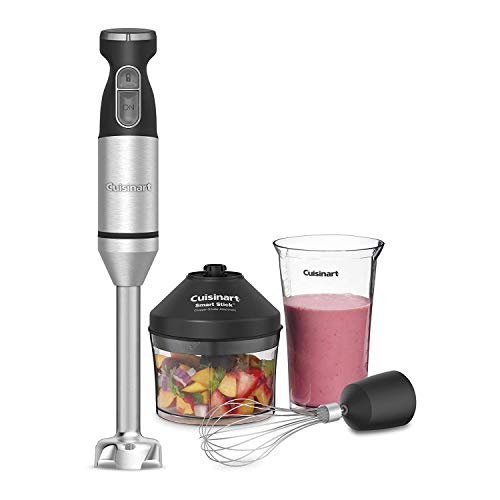
Cuisinart CSB-179 Smart Stick Variable Speed Hand Blender
Badge: Best Overall for Soap Making
Strengths
- Variable speed plus a chopper and whisk makes this a genuine small-system buy
- Quiet-motor positioning suits shared households
- 8-inch shaft reaches into stock pots without decanting
Trade-offs
- Attachment set adds washing-up after multi-part jobs
- 300 W is moderate; the chopper bowl, not the stick, should take hard prep
- More parts to store than a plain stick blender
Key specs from the verified listing title
- 300 W quiet motor
- Variable speed control
- 8-inch shaft
- Includes chopper, whisk and measuring cup
- Stainless steel finish
The Cuisinart CSB-179 takes the top badge for soap because its verified title reads like a soap maker’s checklist: variable speed control, an 8-inch shaft and a 300 W motor described as quiet. Variable speed is the headline. Emulsification rewards the slowest effective start, letting oils and lye solution combine without a caustic splash or a whipped-in froth of air, and a control you can nudge upward in small steps lets you match the stick to the batter as it thickens rather than forcing the batter to match the stick.
The 8-inch shaft matters in a soap pot, which is deeper than the beakers these tools are usually pictured with. Reach keeps the head submerged — the core anti-splash discipline — while the pot walls stay between you and the batter. The included chopper, whisk and measuring cup are, for a dedicated soap stick, mostly beside the point, and this review says so plainly: buy this pick for the stick, its control and its reach, and let the attachments be spares for another kitchen task only if this blender were not dedicated — which, once it makes soap, it is. Keep the whole kit together, marked, in the soap box.
The limitation is that variable control asks for judgement. A new maker can still hold the button too long and sprint to thick trace, especially with recipes that move quickly. Use the lowest effective speed, burst for a few seconds, rest and stir, and this pick gives you the calmest path to a pourable emulsion in the group.
Best for: soap makers who want variable speed and a longer shaft for soap pots / Not suited for: anyone who wants the simplest possible two-speed tool
Check on Amazon — check the latest price on Amazon for this exact model before you decide.

Cuisinart Smart Stick CSB-175 2-Speed Hand Blender
Badge: Best Simple Dedicated Stick
Strengths
- The 300 W DC motor is described as quiet, a real plus for early or late blending
- 8-inch reach is made for blending in the pot rather than decanting
- One-touch slide control keeps the other hand free for the vessel
Trade-offs
- Two speeds only, so texture dialling is coarse
- No attachments are named in the verified title
- In-pot blending still needs care around non-stick coatings
Key specs from the verified listing title
- 300 W quiet DC motor
- 8-inch reach for in-pot blending
- 2 speeds with one-touch slide control
- Model CSB-175SVP1
Many soap makers deliberately choose a simple stick, and the Cuisinart Smart Stick CSB-175 is the strongest simple candidate here. Its 300 W DC motor is described as quiet, its reach is 8 inches for in-pot work, and its one-touch slide control reduces operation to a single decision. In a soap session, where your attention belongs on the batter, the gloves and the mould waiting beside you, a control that cannot be mis-set has genuine value: low for combining, brief and deliberate bursts, rest, stir, look.
Two speeds are a real constraint, and this review will not dress it up. You cannot feather the start the way the variable-speed CSB-179 allows, so technique carries the difference: head fully submerged before switching on, pot deep enough for the batter to cover the guard, and bursts kept short. Practised that way, a two-speed 300 W stick has brought countless batches to trace, because soap emulsification needs persistence more than force.
As a dedicated tool it has a further quiet virtue: with no attachments named in its title, there is nothing extra to store, mark or accidentally carry back into the kitchen. It is a soap stick, a cord and nothing else. For makers who want one less variable in a process that already has several, that purity is the point.
Best for: soap makers who want a calm, quiet, two-speed tool reserved for soap / Not suited for: anyone who wants fine variable control
Check on Amazon — check the latest price on Amazon for this exact model before you decide.
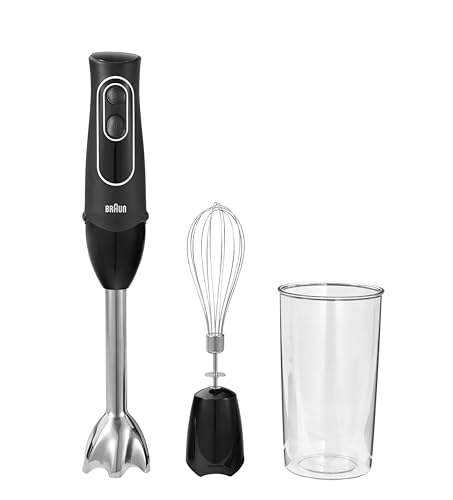
Braun MultiQuick 5 Hand Blender with Beaker and Whisk
Badge: Best Grip for Gloved Hands
Strengths
- Ergonomic, slip-proof handle is designed for a secure grip with wet hands
- Beaker and whisk are in the box for drinks and batters
- 350W sits a step above the 300W class while staying dual-speed simple
Trade-offs
- Dual speed only, so no true variable control
- The title claims a wide job list; hard, dry loads still belong in a chopper bowl
- Beaker size is not stated in the verified title
Key specs from the verified listing title
- 350W motor
- Dual speed
- Includes beaker and whisk
- Stainless steel blades
- Slip-proof ergonomic handle as listed
Soap making is done in gloves, often with a fine film of oil somewhere it should not be, and that is why the Braun MultiQuick 5 earns a soap-specific badge here: its verified title states a slip-proof ergonomic handle. Grip claims are easy to print and hard to verify from a listing, so this guide credits the wording as a design intention rather than a guarantee — but among these six titles it is the only one that names grip security at all, and for gloved work that intention is pointed exactly at the right problem.
At 350W with dual speed, the Braun offers a little more stated power than the 300W picks with the same binary simplicity. Use the low speed for combining and most of the road to trace; the higher speed is best kept for very brief finishing bursts in larger, slower batches, because extra energy in soap batter mostly buys air and acceleration. The included beaker is a food-side extra for a dedicated stick, though it can serve as a marked, soap-only vessel for small test batches or for holding the stick between bursts — labelled, always.
The limitation mirrors the other two-speed picks: no fine control, so submersion and burst discipline do the work. Makers who have struggled with a stick feeling insecure in a gloved hand will find this the most reassuring hold in the group.
Best for: soap makers who prioritise a secure grip while wearing gloves / Not suited for: anyone who wants variable speed
Check on Amazon — check the latest price on Amazon for this exact model before you decide.

KOIOS 1000W Immersion Blender, 12 Speed, 3-in-1
Badge: Best for Large, Slow Batches — Used Gently
Strengths
- Highest listed wattage in most of these line-ups, with 12 speeds to meter it
- Anti-scratch design is aimed at protecting pan and beaker surfaces
- Whisk and milk frother are included, not sold as an afterthought
Trade-offs
- High power in a small beaker can climb the walls if you start on Turbo
- Twelve speeds are more settings than simple soup work ever needs
- Frother and whisk add small parts that are easy to misplace
Key specs from the verified listing title
- 1000W motor as listed
- 12 speeds plus Turbo mode
- Anti-scratch blade guard design
- Includes whisk and milk frother
- Stainless steel blade; Non-BPA materials as listed
The KOIOS needs the most honest framing of any pick in this guide. Its verified title states 1000W, twelve speeds and a Turbo mode, and for soap making almost all of that headline is a warning rather than a promise: high power reaches trace violently fast, whips in air, and can splash caustic batter if the head breaks the surface. This pick is included for one specific maker — the experienced hand with large, slow, additive-heavy batches who wants a very low, precisely chosen speed and plenty of headroom in reserve — and even that maker should treat Turbo as a button that does not exist.
Used that way, the twelve-speed range becomes the point: the bottom of the range is where soap lives, and fine steps let you sit exactly at the gentlest speed that still moves the batter. The anti-scratch guard positioning is a small comfort in enamel and coated soap pots. The whisk and frother, for a dedicated soap stick, are irrelevant extras and are not counted in its favour here.
Beginners should choose almost any other pick in this guide. A forgiving tool teaches better habits than a powerful one, and the CSB-179 or CSB-175 will bring a first batch to trace with far less drama. The KOIOS is a specialist’s pick, labelled as such on purpose.
Best for: experienced makers making big batches who will use low speeds and short bursts / Not suited for: beginners, who may find its power works against a calm trace
Check on Amazon — check the latest price on Amazon for this exact model before you decide.

OVENTE HS560B Electric Hand Blender, 300W, Black
Badge: Best Low-Cost Dedication Pick
Strengths
- Straightforward 300W, two-speed formula with nothing to configure
- Stainless steel blades handle hot purees and cold drinks alike
- Compact stick format stores in a drawer rather than claiming counter space
Trade-offs
- Two speeds limit fine texture control
- No attachments or beaker are named in the verified title
- 300W is a moderate rating; dense mixtures need patience and movement
Key specs from the verified listing title
- 300W motor
- 2 mixing speeds
- Stainless steel blades
- Model HS560B, black
- Corded electric design
Every soap maker eventually faces the dedication dilemma: the good kitchen blender is too good to sacrifice, and the answer is a simple, separate stick bought for soap alone. The OVENTE HS560B black fits that role neatly. At 300W with two mixing speeds and stainless steel blades, it covers the mechanical needs of emulsification — which, to repeat the guide’s core point, are modest — while asking little of the budget-conscious buyer in qualitative terms: it sits at the simpler, lower-cost end of this line-up’s design spectrum.
In the soap pot it behaves as its formula suggests. Low speed combines, short bursts build the emulsion, and the absence of attachments means the whole tool wipes down and stores with the moulds and the scale. Stainless blades are a sensible material around lye solution, and the compact stick is easy to label with tape and marker, which every dedicated soap tool should be.
Its limits are reach and refinement: no shaft length is stated in the verified title, and two speeds are two speeds. For standard home batch sizes in a typical soap pot, neither limit is disqualifying. As the stick you never have to think about twice — because it lives in the soap box and only ever makes soap — it is an easy recommendation.
Best for: makers who want an inexpensive-feeling, simple stick reserved solely for soap / Not suited for: anyone making very large batches who wants a longer stated reach
Check on Amazon — check the latest price on Amazon for this exact model before you decide.
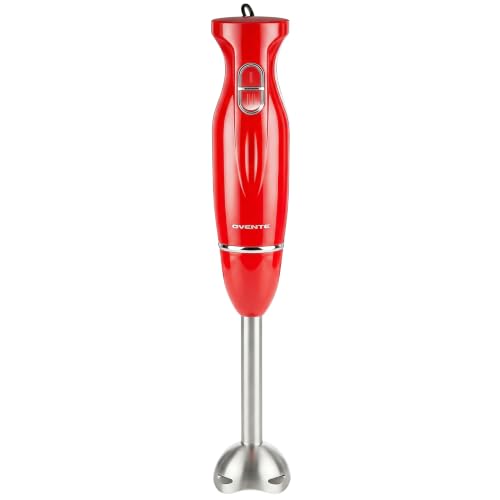
OVENTE HS560R Electric Hand Blender, 300W, Red
Badge: Best Colour-Coded Dedication Pick
Strengths
- Same simple 300W two-speed formula in a red finish that is easy to spot in a drawer
- Stainless steel blades suit smoothies, purees and baby food as listed
- No menu or dial to learn; the control decision is just low or high
Trade-offs
- Two speeds limit fine texture control
- No attachments or beaker are named in the verified title
- Colour is the main difference from the black version; buy it for the kitchen, not as an upgrade
Key specs from the verified listing title
- 300W motor
- 2 mixing speeds
- Stainless steel blades
- Model HS560R, red
- Corded electric design
The OVENTE HS560R red earns its place in a soap guide for a reason that sounds like a joke until you have run a mixed kitchen: colour is a safety system. A red stick blender is visibly not the black kitchen blender, not the steel one, not anyone else’s. In a household where another person might grab a stick to make soup, a dedicated soap tool that announces itself at a glance prevents the one mistake this whole guide exists to prevent. Marking with tape works; being manufactured red works better.
Mechanically it is the same honest formula as the black HS560B: 300W, two mixing speeds, stainless steel blades, listed for smoothies, purees and baby food on the food side of its life — a life this particular unit should never live if you buy it for soap. In the pot, the same technique applies: submerged head, low speed, short bursts, rests with stirring, and a calm eye on trace.
Do not buy it expecting an upgrade over the black model; buy it as a labelling decision. Paired with a stored-with-the-soap-kit rule, the red finish turns a good habit into a near-automatic one. Makers weighing it against the wider inexpensive field can cross-check with Best Inexpensive Immersion Blenders, read through the dedication lens this guide has applied throughout.
Best for: makers who want a red stick that can never be mistaken for the kitchen one / Not suited for: anyone expecting different performance from the black version
Check on Amazon — check the latest price on Amazon for this exact model before you decide.
Comparison Table
For soap, read the control column before the power column. The best soap stick is the one whose lowest behaviour is calmest in your hands; stated power is headroom, and in this craft headroom is mostly there to be left unused.
| Pick | Badge | Control | Stated power | Included extras named in title | Link |
|---|---|---|---|---|---|
| Cuisinart CSB-179 Smart Stick Variable Speed Hand Blender | Best Overall for Soap Making | Variable speed | 300 W | Chopper, whisk, measuring cup | Check on Amazon |
| Cuisinart Smart Stick CSB-175 2-Speed Hand Blender | Best Simple Dedicated Stick | 2 speeds, one-touch slide | 300 W | None named in verified title | Check on Amazon |
| Braun MultiQuick 5 Hand Blender with Beaker and Whisk | Best Grip for Gloved Hands | Dual speed | 350W | Beaker, whisk | Check on Amazon |
| KOIOS 1000W Immersion Blender, 12 Speed, 3-in-1 | Best for Large, Slow Batches — Used Gently | 12 speeds plus Turbo | 1000W as listed | Whisk, milk frother | Check on Amazon |
| OVENTE HS560B Electric Hand Blender, 300W, Black | Best Low-Cost Dedication Pick | 2 mixing speeds | 300W | None named in verified title | Check on Amazon |
| OVENTE HS560R Electric Hand Blender, 300W, Red | Best Colour-Coded Dedication Pick | 2 mixing speeds | 300W | None named in verified title | Check on Amazon |
How to Choose Immersion blenders for soap making
Choose control before power, every time. Emulsification is a gentle, staged process: combine, rest, burst, stir, look. Variable speed (CSB-179) gives the finest control; a wide speed range used only at its low end (KOIOS) gives precise low settings with risk attached; two-speed sticks (CSB-175, Braun, both OVENTEs) give simplicity that technique can complete. If you are new to soap making, simplicity is not a compromise — it is how you learn to read trace instead of fighting your equipment.
Choose reach for your pot. Soap pots are deeper than smoothie cups, and a stated 8-inch shaft or reach (both Cuisinarts) keeps the head submerged in a typical batch without tilting the stick at an unsafe angle. If your batches are small and your pot shallow, any pick here reaches; if you make large batches in a tall pot, reach becomes a genuine selection criterion rather than a spec-sheet decoration.
Choose the dedication system, not just the blender. Decide before it arrives: where it will be stored (with the soap kit), how it will be marked (label, tape, or the red OVENTE’s colour), and who in the household needs to know it is soap-only. That system, faithfully kept, is worth more than any single feature in this guide. A mid-priced stick inside a good system beats a premium stick that drifts back into the kitchen drawer.
Finally, match the stick to your batch style. Small test batches and colour-and-scent trials suit the simple two-speed picks. Standard cold-process batches suit the CSB-179 or CSB-175. Very large or slow batches, in experienced hands, are the KOIOS’s narrow case. And if your real interest is equipping a kitchen rather than a soap bench, pause and read Best Kitchen Hand Blenders instead — the dedication rule means a soap purchase should be a deliberate one. Shoppers who also want processing power in the kitchen can compare Best Immersion Blenders With Food Processor Attachment for that separate job.
How to Use a Stick Blender for Soap Making Without Splashes or Runaway Trace
The method below assumes standard cold-process practice and puts the blender in its proper place: a controlled accelerator inside a safe routine, never a shortcut around protective equipment or careful lye handling. Work with gloves and eye protection, in ventilation, with your mould prepared before the batter exists.
- Prepare everything first: oils melted and combined, lye solution made and cooled per your recipe, mould lined, additives and fragrance measured, spatula and thermometer to hand.
- Combine the lye solution into the oils slowly, stirring by hand first until the mixture is unified and no separate oil layer remains.
- Rest the stick on the pot bottom, fully submerged, tilted slightly to release any air trapped under the guard; let bubbles rise before switching on.
- Burst on the lowest effective speed for a few seconds only, then switch off and stir with the stick itself, moving batter from the edges to the centre.
- Repeat burst-and-stir, watching the surface: emulsion shows as a unified, slightly thickened batter with no oil streaks; light trace shows as a drizzle that sits briefly on the surface.
- Stop blending earlier than you think. Add fragrance and colour at the lightest workable trace, stir them in mostly by hand, and pour while the batter still flows.
- Set the stick in a designated, marked rest spot — never on the counter edge, never in the sink with kitchen washing — and wash it as soap equipment, with gloves still on.
Reading trace is the skill the blender serves. False trace — a sudden thickness caused by cooler temperatures or certain butters rather than true emulsification — can fool a new maker who blends eagerly; the burst-and-stir rhythm protects you, because a truly emulsified batter stays unified during the rests while a false trace relaxes. If a batch is moving too fast, stop blending entirely and work by hand; the stick can always be set down, and a pourable batter saved by hand-stirring beats a seized pot every time.
Aftercare keeps the dedication system real. Wash the stick as soap equipment, dry it, and return it to the soap box rather than the kitchen. Check the shaft and guard area for batter residue before storage, because dried raw batter is caustic dust waiting to happen. A tool that is always in its place, always marked, and always used with the same calm rhythm will make consistent soap for years.
Troubleshooting
Problem: the batter splashes when you switch on → the head was not fully submerged or air was trapped under the guard. Stop, let the batter settle, re-submerge and tilt to release air, and restart on a lower speed.
Problem: trace arrives before you can pour → you blended too long or too fast for this recipe. Next batch, shorten bursts and stir more by hand; for this batch, work quickly, skip intricate designs, and get it into the mould.
Problem: the batter is full of air bubbles → the head broke the surface during blending or the speed was too high. Keep the guard submerged, slow down, and tap the filled mould firmly to release what air you can.
Problem: oil streaks remain on the surface → emulsion is not complete. Continue with short bursts and thorough stirring until the surface is unified, checking temperature if the batch feels unusually cool.
Why Soap Makers Dedicate a Blender: the Safety Logic in Full
The dedication rule rests on three facts about raw soap batter. First, it is caustic: until saponification completes, batter and the residue it leaves carry active lye, and residue lodges exactly where washing is hardest — around blade guards, shaft seals and seams. Second, soap making uses fragrances and colourants that migrate into plastics and linger through washing, ready to flavour the next food they touch. Third, households are forgetful systems: a tool that looks like a kitchen tool will eventually be used as one, by someone, on a busy day. Dedication — one tool, one job, one storage place, one unmistakable identity — answers all three facts at once.
This is also why this guide treats colour and simplicity as real features. The red OVENTE is a labelling strategy. The plain CSB-175, with nothing else in its box, is a storage strategy. The premium variable-speed stick is a control strategy. All three are ways of making the safe behaviour the easy behaviour, which is the only kind of safety rule that survives years of hobby practice.
Burst, Rest, Stir: the Rhythm That Makes Trace Behave
New makers often imagine the stick blender as a replacement for stirring, run until the batter looks right. Experienced makers use it as punctuation: a few seconds of power inside a longer pattern of hand stirring and observation. The rests are when you learn — how the surface looks, how the drizzle falls, whether oil streaks remain — and they are when the batter’s temperature and structure settle. Most of the disasters attributed to stick blenders in soap forums are rhythm failures, not equipment failures: continuous running, high speed, head near the surface.
Build the rhythm into your recipe notes. Record how many bursts, at what setting, brought each recipe to light trace, and your future batches become calmer and more repeatable. The blender you chose from this guide will feel less like a variable and more like a known instrument — which is exactly what a dedicated tool should become.
Reading a Recipe Like a Blender Buyer
One last soap-specific discipline ties the whole guide together: read your recipes the way you read these listings, for what they actually demand of the tool. A high-water recipe with soft oils reaches emulsion gently and forgives a simple two-speed stick. A recipe heavy in hard butters, or one you plan to bring to a thicker trace for layering, asks more of the motor in each burst and rewards the variable control of the CSB-179. A recipe built for intricate swirls asks for the opposite of power — the slowest, calmest path to the lightest trace, so the design has time to happen.
Makers who keep a soap journal can close the loop between recipe and equipment in a few batches. Note the stick used, the setting, the number of bursts and the temperature, alongside how the batter behaved. Patterns emerge quickly: the recipe that always races, the one that sulks, the batch size where your pot gets awkwardly deep for your shaft. Those notes are worth more than any upgrade, because they convert the blender from a variable into a constant — and constants are what consistent soap is made of.
If the notes tell you the tool itself is the limit — bursts too violent at the lowest setting, reach too short for your pot, grip insecure in your gloves — then this guide’s reviews are organised to answer exactly that diagnosis. Change one variable, the stick, and keep the rest of your system as it is. That is how experienced makers shop: from evidence, their own this time, rather than from hope.
Common Buying Mistakes
The gravest mistake is the casual one: using the kitchen blender for a first batch “just to try it”, then washing it carefully and putting it back. That is how caustic residue and fragrance meet food. Dedicate from the very first batch, even if the dedicated tool is the simplest pick in this guide.
The second mistake is buying peak power for a job that punishes it. High wattage and Turbo modes accelerate trace, whip air and raise splash risk; for soap, they are features to avoid using, not to pay extra for, unless your batch style genuinely needs the low-end precision of a wide speed range.
Third, do not blend continuously. Burst, rest and stir is not a stylistic preference; it is how emulsion is judged and controlled. Fourth, do not skip the submersion discipline — a head that breaks the surface of caustic batter is a safety problem, not a texture problem. Finally, do not store the soap stick in the kitchen “just for now”; storage is the dedication system, and “for now” is how systems fail.
Final Recommendation
Make the Cuisinart CSB-179 your first choice for soap making: variable speed for a gentle, judged start, an 8-inch shaft for real soap pots, and a quiet 300 W motor that suits burst-and-stir work. It is the most complete soap tool in this guide on the evidence of its verified title.
Choose the CSB-175 if you prefer a simple, quiet two-speed stick with the same reach, the Braun if gloved grip security is your first concern, or either OVENTE — black for simplicity, red for unmistakable dedication — if you want a modest stick reserved entirely for soap. Keep the KOIOS for large, slow batches in experienced hands, used at the bottom of its range. Whichever you choose, mark it, store it with the soap kit, and let it make only soap, forever.
Start your shortlist here: Cuisinart CSB-179 Smart Stick Variable Speed Hand Blender, Cuisinart Smart Stick CSB-175 2-Speed Hand Blender, Braun MultiQuick 5 Hand Blender with Beaker and Whisk. Each link goes to the exact model reviewed above, so you can check the latest price on Amazon and confirm the current bundle before ordering.
Frequently Asked Questions
Can I use my kitchen immersion blender for soap making just once?
You can, but you should not plan to use it for food afterwards. A single batch is enough to leave caustic residue around guards and seals and to lodge fragrance in plastics. The safe pattern is to dedicate a blender to soap from the first batch — which is why this guide includes simple, modest picks suited to exactly that role.
What speed should I use for soap making?
The lowest speed that moves the batter. Start low, burst for a few seconds, switch off and stir by hand, and only step up if a large or slow batch needs it. High speeds and Turbo modes accelerate trace, whip in air and increase splash risk, so for most home batches they should stay unused.
How long does a stick blender take to bring soap to trace?
It varies widely with recipe, temperature and batch size, from well under a minute of total bursting for fast recipes to several minutes of burst-and-stir cycles for slow ones. The blender’s job is control, not a promised time; watch the batter, not the clock, and stop at light trace if you plan colours or swirls.
Why does my soap batter have so many air bubbles?
Usually because the blade head broke the surface during blending, air was trapped under the guard at the start, or the speed was too high. Submerge fully, tilt to release trapped air before switching on, blend low and in bursts, and tap the filled mould to help bubbles escape.
Does a more powerful blender make better soap?
No. Soap quality comes from recipe, temperatures, emulsion and cure. Power only changes how fast trace arrives, and faster is often worse. Moderate, controllable sticks have made excellent soap for decades; the variable-speed and two-speed picks here are recommended ahead of the high-power one for most makers.
How should I store a dedicated soap blender?
Washed as soap equipment, dried, clearly marked, and stored with the soap-making kit — moulds, scale, protective gear — rather than in a kitchen drawer. A distinctive colour, like the red OVENTE in this guide, adds a second layer of protection against mix-ups by other household members.
Are the whisk and chopper attachments useful for soap making?
Not for the soap itself. Emulsification is done with the stick; whisks whip in air and choppers have no role in batter. Attachments are not counted in any pick’s favour in this guide, and a dedicated soap stick’s extras should stay in the soap box with it, unused for food.


