Disclosure: topratedkitchenware.com is reader-supported. When you buy through links on our site, we may earn an affiliate commission from Amazon and other retailers, at no extra cost to you.
Where to buy
This guide to the best immersion blenders wirecutter-style shoppers look for brings together six verified stick blenders you can order online today. Each name below links to its Amazon listing, and every detailed review further down carries its own Check on Amazon link so you can check the latest price on Amazon for the exact model you are reading about. A quick, necessary clarification: this is an independent guide that borrows a benchmark way of judging — it is not a Wirecutter publication, and no pick below is presented as a Wirecutter selection.
- Cuisinart CSB-179 Smart Stick Variable Speed Hand Blender — Best on Criteria Overall. buyers who want the strongest all-criteria case in one purchase
- Braun MultiQuick 5 Hand Blender with Beaker and Whisk — Best Ergonomics on Stated Evidence. buyers who weight grip and one-tool simplicity highly
- KitchenAid KHBV53 Variable Speed Corded Hand Blender — Best Cleaning and Storage Case. buyers who blend in a jar, store leftovers in it, and rinse fast
- Turelar Immersion Blender, 400W, 2 Speed — Best Stated Power-to-Simplicity Ratio. buyers who want 400W and an ergonomic-handle claim without a bundle
- OVENTE HS560B Electric Hand Blender, 300W, Black — Best Minimal-Criteria Pick, Black. buyers whose criteria are simplicity, storage and low fuss above all
- OVENTE HS560R Electric Hand Blender, 300W, Red — Best Minimal-Criteria Pick, Red. households that colour-code tools between cooks or tasks
Read the full guide ↓ for badges, honest trade-offs, a comparison table and the buying advice that helps you choose between them.
Searchers who type best immersion blenders wirecutter are usually not hunting for a brand endorsement; they are hunting for a method. They want to know which blender a rigorous, test-driven reviewer would respect: the one that purees soup silkiest, splashes least, feels balanced in the hand, cleans without a fight and keeps doing it year after year. This guide honours that intent honestly. It applies benchmark-style criteria — the kind of criteria a publication like Wirecutter is known for using — to six verified picks, and it states its limit up front: these are not Wirecutter’s picks, no Wirecutter test results are quoted or invented, and no laboratory testing is claimed here. What you get is the framework, applied carefully to evidence you can check.
That framework has five tests a buyer can reason about without a lab. First, core blending: does the stick turn a pot of soup or a cup of smoothie ingredients into an even texture without leaving a gravel bed at the bottom? Second, control and splashing: can you start gently, keep the head submerged, and work in a real vessel without redecorating the stove? Third, ergonomics: grip security, balance and whether the controls work one-handed while the other hand holds the pot. Fourth, cleaning and storage: how fast the arm rinses, how many parts demand attention, whether the kit lives neatly. Fifth, versatility with honesty: attachments count when they genuinely extend the tool, not when they pad a product name.
Read through that lens, the six picks below separate in interesting ways. Raw wattage, the number marketing leads with, turns out to be a weak predictor; the verified titles show a 300 W quiet-motor Cuisinart, a 350W Braun with a stated slip-proof grip, a variable-speed KitchenAid with a jar, a 400W Turelar with a stated ergonomic handle, and two simple OVENTE sticks that make no grand claims at all. A benchmark mindset asks what each design choice does for the cook, and that is the question every review in this guide answers.
If you prefer your comparisons organised by a single use instead, our guides on Best Immersion Hand Blenders and Best Kitchen Hand Blenders sort neighbouring line-ups by kitchen role rather than by test criteria.
Key Takeaways
- This is an independent, benchmark-style guide: it applies test-driven criteria to verified listings and does not claim to list any publication’s selections or results.
- The five criteria used here: blending evenness, control and splash behaviour, ergonomics, cleaning and storage, and honest versatility.
- Wattage is a weak proxy: control style, guard behaviour and grip decide more of the daily result than the motor number does.
- On stated evidence, the Braun names grip security, the Cuisinart CSB-179 names variable speed and a full attachment set, and the KitchenAid names a removable arm and blending jar.
- Simple two-speed sticks are not failed premium products; judged on cleaning and storage, they often win their category outright.
- No ratings, review counts, prices or test outcomes are printed — check the latest price on Amazon at each linked pick and judge the criteria against your own cooking.
In this guide
Quick Picks
Six picks scored in prose against the five criteria above. Badges name the criterion each pick serves best, and the same badges head the detailed reviews.
- Best on Criteria Overall: Cuisinart CSB-179 Smart Stick Variable Speed Hand Blender — variable speed, 8-inch shaft, chopper, whisk and measuring cup — the widest criteria coverage in the group.
- Best Ergonomics on Stated Evidence: Braun MultiQuick 5 Hand Blender with Beaker and Whisk — 350W dual speed, beaker and whisk included, and the only title here that states a slip-proof ergonomic handle.
- Best Cleaning and Storage Case: KitchenAid KHBV53 Variable Speed Corded Hand Blender — variable speed, removable 8-inch arm and a lidded blending jar — a tidy blend-store-rinse routine.
- Best Stated Power-to-Simplicity Ratio: Turelar Immersion Blender, 400W, 2 Speed — 400W, two speeds, ergonomic handle and stainless blades as listed — simple, with the strongest stated motor of the simple sticks.
- Best Minimal-Criteria Pick, Black: OVENTE HS560B Electric Hand Blender, 300W, Black — 300W, two speeds, stainless blades — the baseline stick against which extras must justify themselves.
- Best Minimal-Criteria Pick, Red: OVENTE HS560R Electric Hand Blender, 300W, Red — the red HS560R — identical stated formula to the black model, scored identically, chosen by colour logic.
How These Picks Were Chosen
The pool for this guide was verified on 2026-11-20: every ASIN, product title and image comes from that checked pool, and the spec boxes print only what those titles state. That evidence discipline is itself part of the benchmark method — a reviewer who cannot verify a claim does not print it, which is why the Bonsenkitchen-style gaps you may know from other guides are handled here by noting when a title stays silent.
Each pick was then walked through the five criteria in a fixed order, so the reviews can be compared like-for-like: blending, control and splashing, ergonomics, cleaning and storage, versatility. Where a title states a relevant design fact — a quiet DC motor, a slip-proof handle, an anti-scratch guard, a 5-foot cord on a sibling model in another line-up — it is credited as a stated design intention. Where a title is silent, the review says the criterion must be judged on the generic behaviour of the format, not on a promise the maker never made.
No hands-on or laboratory testing is claimed, no publication’s conclusions are borrowed, and no scores are fabricated. The output of the method is a ranking of fit: which pick’s stated design best matches the criteria a test-driven buyer cares about. Buyers whose first filter is cost will find the same discipline applied in Best Inexpensive Immersion Blenders.
The 6 Best Immersion Blenders, Judged by Test-Style Criteria
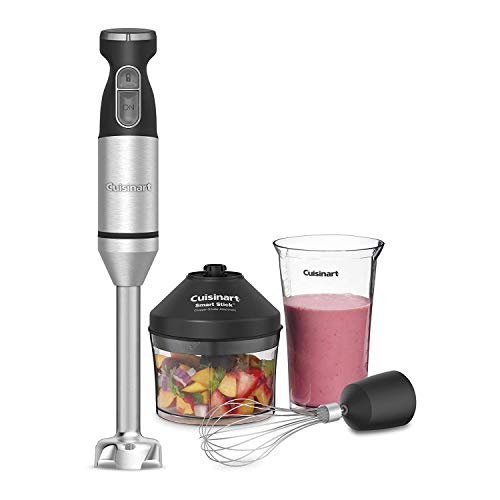
Cuisinart CSB-179 Smart Stick Variable Speed Hand Blender
Badge: Best on Criteria Overall
Strengths
- Variable speed plus a chopper and whisk makes this a genuine small-system buy
- Quiet-motor positioning suits shared households
- 8-inch shaft reaches into stock pots without decanting
Trade-offs
- Attachment set adds washing-up after multi-part jobs
- 300 W is moderate; the chopper bowl, not the stick, should take hard prep
- More parts to store than a plain stick blender
Key specs from the verified listing title
- 300 W quiet motor
- Variable speed control
- 8-inch shaft
- Includes chopper, whisk and measuring cup
- Stainless steel finish
Criterion by criterion, the Cuisinart CSB-179 builds the most complete case. Blending: a 300 W motor described as quiet, driving an 8-inch shaft that keeps the head submerged in deep pots, where even texture is made. Control: true variable speed, the single feature that most improves both gentle starts and judged finishing, because the cook — not a two-step switch — decides how energy enters the food. Versatility: a chopper, whisk and measuring cup are all named in the title, extending the tool from soups to small prep and batters without pretending the stick alone does everything.
Ergonomics and cleaning score respectably rather than spectacularly: the title makes no grip claim, so this guide credits none, and the attachment set that wins versatility points costs cleaning points, because chopper bowls and whisks must be washed and stored. That trade is visible in the criteria, which is the point of using them — a benchmark table that hides costs is marketing, not method.
Its limitation under a test lens is focus. A buyer who only blends soup twice a week is purchasing capability they will rarely exercise. But for the buyer who asked the wirecutter-style question — which one, if I buy once and use it for everything — the CSB-179 is the answer this evidence supports.
Best for: buyers who want the strongest all-criteria case in one purchase / Not suited for: anyone who wants the fewest possible parts
Check on Amazon — check the latest price on Amazon for this exact model before you decide.
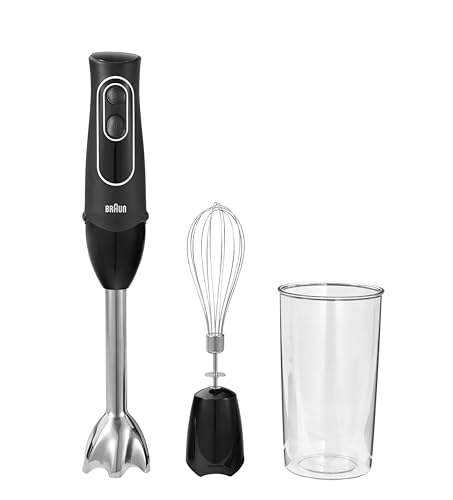
Braun MultiQuick 5 Hand Blender with Beaker and Whisk
Badge: Best Ergonomics on Stated Evidence
Strengths
- Ergonomic, slip-proof handle is designed for a secure grip with wet hands
- Beaker and whisk are in the box for drinks and batters
- 350W sits a step above the 300W class while staying dual-speed simple
Trade-offs
- Dual speed only, so no true variable control
- The title claims a wide job list; hard, dry loads still belong in a chopper bowl
- Beaker size is not stated in the verified title
Key specs from the verified listing title
- 350W motor
- Dual speed
- Includes beaker and whisk
- Stainless steel blades
- Slip-proof ergonomic handle as listed
Ergonomics is the criterion most guides gesture at and few listings evidence. The Braun MultiQuick 5’s verified title states a slip-proof, ergonomic handle outright, and under a benchmark method that stated intention earns the ergonomics badge: wet hands, a vibrating tool and a held vessel are the daily reality of stick blending, and this is the one maker in the group that names the problem. The included beaker supports the blending criterion too, by giving the head a vessel proportioned for it, and the whisk is a named, real extension rather than a vague promise.
On control, dual speed is a middling score honestly recorded: two well-chosen gears, no feathering. On power, 350W is a modest step over the 300W class. On cleaning, the part count is moderate — stick, beaker, whisk — and each piece is simple. The title’s long job list (blend, chop, whisk, mash, crush, puree) is read cautiously here; a benchmark reviewer credits the included hardware, not the verbs.
Buy this pick if your hands, your grip strength or your kitchen’s wet, busy reality make hold security your deciding criterion. It is the most ergonomically evidenced option in the line-up, and for many cooks that will matter more than a speed dial.
Best for: buyers who weight grip and one-tool simplicity highly / Not suited for: anyone who wants variable speed
Check on Amazon — check the latest price on Amazon for this exact model before you decide.

KitchenAid KHBV53 Variable Speed Corded Hand Blender
Badge: Best Cleaning and Storage Case
Strengths
- Variable speed control suits both gentle emulsions and firmer purees
- Blending jar with a lid supports blend, store and pour routines
- Removable arm makes rinsing and storage simpler
Trade-offs
- Jar-based blending suits single servings better than family batches
- No chopper or whisk is named in the verified title
- Corded only; no cordless freedom at the stove or table
Key specs from the verified listing title
- Corded hand blender, model KHBV53
- Variable speed control
- Removable 8-inch blending arm
- Blending jar with lid included
- BPA-free material as listed; Matte Black finish
The KitchenAid KHBV53 makes its criteria case on the unglamorous end of the table. Cleaning and storage: the blending arm is removable, which turns rinsing into a one-piece job and lets the kit store compactly, and the included blending jar has a lid, so a smoothie or dressing can be blended, sealed and refrigerated in the vessel it was made in — one wash, not two. Control: variable speed, the criterion this guide weights heavily, is present. Blending: the jar-and-stick pairing is purpose-matched, which supports even circulation for single servings.
Its gaps are equally clear under the method. No wattage is stated in the verified title, so no power claim is credited; no chopper or whisk is named, so versatility scores on the jar routine alone. A benchmark reader should prefer exactly this kind of honesty: the pick wins where its evidence is strong and concedes where it is silent.
For the single-serving, blend-and-store cook — smoothies on weekdays, dressings and sauces on weekends — this is arguably the most rational purchase in the group, and criteria-based shopping exists to surface precisely that kind of fit over headline specifications.
Best for: buyers who blend in a jar, store leftovers in it, and rinse fast / Not suited for: anyone who wants a chopper included
Check on Amazon — check the latest price on Amazon for this exact model before you decide.

Turelar Immersion Blender, 400W, 2 Speed
Badge: Best Stated Power-to-Simplicity Ratio
Strengths
- 400W rating steps above the 300W class while keeping controls to two speeds
- Ergonomic handle is a stated design point, not an assumption
- Listed directly for soup, smoothies, puree and baby food
Trade-offs
- Two speeds, so no gradual trigger-style ramping
- No attachments or beaker are named in the verified title
- Emulsifying still depends on slow oil addition; the tool cannot fix a rushed pour
Key specs from the verified listing title
- 400W motor
- 2 speeds
- Ergonomic handle as listed
- Stainless steel blades
- BPA-free materials as listed; corded design
The Turelar 400W is the control case in this experiment: what do the criteria say about a simple stick with a stronger stated motor? Blending: 400W is the highest wattage among the two-speed picks here, and its title names soup, smoothies, puree and baby food directly. Ergonomics: an ergonomic handle is stated, though without the Braun’s slip-proof wording, so it scores a step behind on the same criterion. Control: two speeds, no ramping, technique-dependent.
Cleaning and storage score well precisely because nothing else is in the box — or at least, nothing else is named in the title, and this guide credits only what is named. Versatility is the conceded criterion: no beaker, whisk or chopper is listed, so the buyer supplies the vessel and the tool stays in its lane.
Under a benchmark lens this is a respectable, legible product: it does the core job with a stated motor advantage and asks the buyer to bring the rest. Shoppers who value that legibility — and who already own a tall blending cup they like — will find it the easiest pick here to predict, and predictability is an underrated test result.
Best for: buyers who want 400W and an ergonomic-handle claim without a bundle / Not suited for: anyone who wants an included vessel
Check on Amazon — check the latest price on Amazon for this exact model before you decide.

OVENTE HS560B Electric Hand Blender, 300W, Black
Badge: Best Minimal-Criteria Pick, Black
Strengths
- Straightforward 300W, two-speed formula with nothing to configure
- Stainless steel blades handle hot purees and cold drinks alike
- Compact stick format stores in a drawer rather than claiming counter space
Trade-offs
- Two speeds limit fine texture control
- No attachments or beaker are named in the verified title
- 300W is a moderate rating; dense mixtures need patience and movement
Key specs from the verified listing title
- 300W motor
- 2 mixing speeds
- Stainless steel blades
- Model HS560B, black
- Corded electric design
A benchmark guide needs its baseline, and the OVENTE HS560B black is it: 300W, two mixing speeds, stainless steel blades, and a title that lists smoothies, purees and baby food without ornament. Scored strictly, it wins cleaning and storage outright — one piece, one rinse, one drawer slot — and it passes blending for the mainstream jobs its title names, provided the user supplies a suitable vessel and sound technique.
It concedes control (two speeds), versatility (nothing else named) and ergonomics (no grip claim stated). Those concessions are exactly why it belongs in a criteria guide: they define the price of the extras elsewhere. When a chopper bundle or a variable dial asks more of your money and your cupboard, this pick is the yardstick that asks what, precisely, the extra buys.
For occasional soup and smoothie work, the honest benchmark answer may well be this baseline plus good technique. Daily, ambitious blending justifies stepping up; a test-driven method says so without embarrassment in either direction.
Best for: buyers whose criteria are simplicity, storage and low fuss above all / Not suited for: buyers who weight versatility or fine control
Check on Amazon — check the latest price on Amazon for this exact model before you decide.
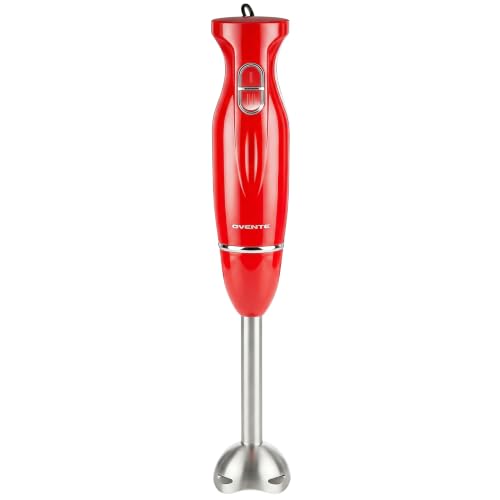
OVENTE HS560R Electric Hand Blender, 300W, Red
Badge: Best Minimal-Criteria Pick, Red
Strengths
- Same simple 300W two-speed formula in a red finish that is easy to spot in a drawer
- Stainless steel blades suit smoothies, purees and baby food as listed
- No menu or dial to learn; the control decision is just low or high
Trade-offs
- Two speeds limit fine texture control
- No attachments or beaker are named in the verified title
- Colour is the main difference from the black version; buy it for the kitchen, not as an upgrade
Key specs from the verified listing title
- 300W motor
- 2 mixing speeds
- Stainless steel blades
- Model HS560R, red
- Corded electric design
The red OVENTE HS560R is included to make a methodological point as well as a practical one. Its verified title states the same 300W, two-speed, stainless-blade formula as the black HS560B, and a criteria-based guide must therefore score it the same: same blending pass for mainstream jobs, same cleaning win, same control and versatility concessions. Any review that invented a performance gap between two colour variants would be failing the benchmark standard this guide set itself.
The real difference is organisational. Colour separates tools between household members, between a main kitchen and a second home, or — as our soap-making guide explores — between food use and a dedicated craft use where a red stick can never be grabbed by mistake. Those are legitimate buying reasons, and naming them plainly is more useful than pretending the pigment changes the motor.
Choose between the two OVENTEs on that logic alone, and choose either with confidence for simple work. Buyers whose criteria extend further — variable control, attachments, stated grip design — have three clear steps up in this same guide, each earning its place on evidence rather than adjectives.
Best for: households that colour-code tools between cooks or tasks / Not suited for: anyone expecting a performance difference from the black version
Check on Amazon — check the latest price on Amazon for this exact model before you decide.
Comparison Table
Score the table against your own weighting. A test-driven buyer who cooks gently and cleans immediately will rank these differently from a buyer who preps for a family daily — and both rankings can be right, because the criteria are explicit.
| Pick | Badge | Control | Stated power | Included extras named in title | Link |
|---|---|---|---|---|---|
| Cuisinart CSB-179 Smart Stick Variable Speed Hand Blender | Best on Criteria Overall | Variable speed | 300 W | Chopper, whisk, measuring cup | Check on Amazon |
| Braun MultiQuick 5 Hand Blender with Beaker and Whisk | Best Ergonomics on Stated Evidence | Dual speed | 350W | Beaker, whisk | Check on Amazon |
| KitchenAid KHBV53 Variable Speed Corded Hand Blender | Best Cleaning and Storage Case | Variable speed | Not stated in verified title | Blending jar with lid | Check on Amazon |
| Turelar Immersion Blender, 400W, 2 Speed | Best Stated Power-to-Simplicity Ratio | 2 speeds | 400W | None named in verified title | Check on Amazon |
| OVENTE HS560B Electric Hand Blender, 300W, Black | Best Minimal-Criteria Pick, Black | 2 mixing speeds | 300W | None named in verified title | Check on Amazon |
| OVENTE HS560R Electric Hand Blender, 300W, Red | Best Minimal-Criteria Pick, Red | 2 mixing speeds | 300W | None named in verified title | Check on Amazon |
How to Choose the Best Immersion Blenders Wirecutter Readers Are Really Asking About
Weight the criteria before you weight the products. Write down, honestly, how you will use a stick blender: soups in the pot, smoothies in a cup, baby food in small batches, sauces, prep chopping. Then assign your own importance to blending evenness, gentle control, grip, cleaning and versatility. The wirecutter-style habit worth copying is not any particular conclusion; it is this discipline of deciding what good means before looking at what is for sale.
Treat stated evidence and silence differently. A title that names a slip-proof handle, a quiet motor, a removable arm or a specific attachment is making a checkable claim about design intent. A title that says nothing about grip tells you nothing — good or bad — and a careful buyer neither credits nor punishes silence beyond noting that rivals chose to state their case. This guide’s spec boxes follow that rule strictly, which is why some are shorter than others.
Be suspicious of the single-number shortcut, including wattage. The line-up here spans stated ratings from 300 W to 400W among comparable sticks, plus variable-speed models whose titles state no wattage at all, and no serious testing tradition ranks these tools by that figure alone. Control range, guard and blade design, vessel fit and balance move the result more, and they are the things a thoughtful listing actually describes.
Finally, price the whole routine, not the product. A pick with a jar can replace a separate blending vessel purchase; a pick with attachments can retire a small chopper; a bare stick presumes you own the rest. Check the latest price on Amazon for each finalist with its true bundle in view, and let the criteria — yours, made explicit — make the final call. For a role-based second opinion, Best Lightweight Immersion Blenders sorts a neighbouring line-up by handling and effort, with the same evidence rules about what titles do and do not state.
How to Judge a Stick Blender Like a Tester, at Home
You cannot replicate a test kitchen, but you can replicate its habits with the blender you buy, in the first week, while returns are still simple. The routine below turns your own cooking into a fair trial of the criteria in this guide.
- Soup test: blend a familiar pot of vegetable soup and time how long an even texture takes, noting any unblended pieces left at the bottom or splashes on the stove.
- Cup test: make your usual smoothie or shake, starting exactly as the maker directs, and note whether powders wet cleanly and whether the head stays comfortably submerged in your vessel.
- Grip test: work once with damp hands, as real cooking gives you, and judge whether the handle and controls feel secure without gripping harder than you should.
- Cleaning test: rinse the arm immediately, then honestly note what a dried-on residue would demand; check how the parts store in the drawer or cupboard they will actually live in.
- Noise test: blend at the hour you will really blend, and decide whether the sound level fits your household — a stated quiet-motor design should feel different here.
- Verdict step: score each test against the job you bought it for, not against an imaginary perfect tool, and keep or return on that evidence.
Keep the trial honest by using your own recipes at your own batch sizes. A blender that excels at a test kitchen’s large soup batch may be clumsy in your single mug, and the reverse is equally true. The benchmark tradition, at its best, tests for a defined reader; at home, you get to be that reader precisely.
If the pick passes your trial, write down the settings and vessels that worked. That small record — which speed for soup, which cup for smoothies — is your personal test data, and it will make the tool feel better with every week of use.
Troubleshooting
Problem: soup stays chunky at the bottom → the head is not reaching or the batch is too thick to circulate. Blend in a deeper vessel or in two passes, move the head slowly through the whole volume, and add a little stock if the pot allows.
Problem: everything splashes at startup → the speed is too high for the first seconds or the head is near the surface. Start lower, start submerged, and let the mixture begin moving before raising speed.
Problem: your hand tires or the grip feels insecure → the vessel may be forcing an awkward angle, or you are gripping against vibration. Rest the pot lower, steady the vessel, use shorter bursts, and favour the stated ergonomic designs when you next buy.
Problem: cleaning takes longer than the blending did → residue dried on. Rinse the arm the moment you finish, in a jug of warm soapy water, and the problem largely disappears with any pick in this guide.
What Benchmark Reviews Get Right — and What a Listing Can and Cannot Tell You
The durable lesson of test-driven reviewing is not a ranking; it is the insistence that claims meet criteria. Applied to listings, that insistence has limits a careful buyer should respect. A listing can evidence design intentions — control type, stated motor, included hardware, handle wording — and this guide has credited exactly those. A listing cannot evidence durability over years, texture quality in your soup, or how a guard behaves in your pot. Those are the things real testing, and your own first-week trial, exist to learn.
So use this guide the way a good benchmark review asks to be used: as a filter that removes mismatches and a framework that sharpens your questions, not as an oracle. No pick here is anyone else’s official selection, and the guide has said so from its first paragraph, because that honesty is the whole method.
Why Wattage Keeps Failing as a Shortcut
Wattage survives as a buying shortcut because it is a number, and numbers feel comparable. In this line-up alone, titles state 300 W, 350W and 400W, describe one motor by its quietness rather than its rating, and sell a variable-speed KitchenAid with no wattage in the title at all. If wattage decided quality, that last pick would be unjudgeable — yet its control and jar routine make it one of the strongest criteria cases here. Motor ratings also say nothing about gearing, blade design or how the tool is meant to be loaded.
The better shortcut, if you need one, is control: how many genuinely usable speeds, how the control is operated, and whether you can start gently. Pair that with the vessel story and the cleaning story, and you have a three-question test that predicts satisfaction far better than any figure printed in a product name. Shoppers applying the same scepticism to the processing question will find it continued in Best Immersion Blenders With Food Processor Attachment.
A Worked Example: Scoring One Pick Five Ways
To make the method concrete, take the Braun MultiQuick 5 and walk it through the five criteria slowly, the way a test-driven buyer should walk any finalist. Blending: 350W and stainless blades, with an included beaker proportioned for the head — a pass for mainstream work, with no claim credited beyond the title. Control and splashing: dual speed, so the start is managed by submersion and pulsing rather than by a dial — adequate, not leading. Ergonomics: the stated slip-proof ergonomic handle — the group’s clearest evidence on this criterion, and the reason for its badge. Cleaning and storage: three simple pieces, no case, no chopper to scrub — good, not perfect. Versatility: a real whisk, a real beaker, and a long verb list this guide declines to credit beyond the hardware — moderate, honestly bounded.
Now notice what the exercise did. It produced no score and no drama, but it produced a decision-relevant portrait: a buyer who weights ergonomics first can stop here, and a buyer who weights control first knows to move to the variable-speed picks, and both buyers used the same facts. That is the entire promise of the benchmark method when it is practised honestly — shared evidence, personal weights, defensible conclusions. Any guide that skips the evidence step and hands you only the conclusion has kept the useful part for itself.
Apply the same five-step walk to your own finalist before you buy, using its own listing as the evidence base and this guide’s spec discipline as the rule. Ten minutes of that walking will do more for your satisfaction than another hour of rankings — including, this guide is content to admit, its own.
Durability: the Criterion No Listing Can Score
Every benchmark tradition eventually runs into the criterion it cannot settle from a desk: what will this tool be like in year four? Listings evidence design intentions, not lifespans, and this guide has therefore scored durability nowhere — a silence worth explaining, because buyers often read a confident review tone as a durability promise. It is not one, here or anywhere that has not actually run the years.
What a buyer can do is favour the designs whose failure modes are graceful. Fewer, simpler parts (the two-speed sticks) present fewer things to lose or break. Removable arms (the KitchenAid pattern) isolate the part that meets the food. Named makers with real product ecosystems stand behind their tools in ways a listing cannot quantify but a buyer can weigh. And the care habits in this guide’s how-to section — bursts over continuous running, immediate rinsing, dry storage — are the part of durability that was always in the owner’s hands rather than the maker’s.
How the Five Criteria Trade Against Each Other
No pick maximises all five criteria, and pretending otherwise is how marketing replaces method. Attachments raise versatility and lower the cleaning score in the same gesture, as the CSB-179 shows. Simplicity does the reverse, which is why the OVENTE sticks can win a criterion outright while conceding two others. Variable control raises the control score and, in trigger form, asks something of the hand that a slide control does not — an ergonomics debit hiding inside a control credit. Even the quiet-motor design trades against the two-speed simplicity of its own control layout.
A test-driven buyer handles these trades by weighting, not by wishing. Decide which criterion your cooking punishes most when it is absent — for most households it is cleaning, because it is paid daily — and let that weighting, applied to the honest portraits in this guide, produce your ranking. Two readers can follow this method faithfully and buy different blenders, and both can be right. That is not a failure of the framework; it is the framework working as intended, in public, where you can check it.
A Short Glossary for Benchmark-Minded Shoppers
A few terms recur in test-driven writing and are worth defining plainly, because each hides a buying decision. Guard: the bell-shaped housing around the blade, whose shape decides splashing, suction and how close the blade can work to a pan surface. Vortex: the circulating flow a good blend establishes, which feeds unblended food into the blade without the cook chasing it. Duty rhythm: the pattern of bursts and rests a motor is built around, which this guide has treated as the honest way to use every pick here. Fit: the match between a tool’s stated design and a specific kitchen’s pots, cups, outlets and hands, which is the quantity rankings approximate and only your own trial can measure.
With those four words defined, most blender marketing becomes easier to read. Claims about guards and flow are claims about your stove staying clean. Claims about power are claims about the duty rhythm you will need. And every claim, however phrased, is finally a claim about fit — which is why this guide ends where benchmark method always ends: with the criteria in your hands and the decision, properly, yours.
Common Buying Mistakes
The first mistake is treating any guide — including this one — as a substitute for your own criteria. A ranking built for a daily soup cook will mislead a weekend smoothie maker. Decide what good means for your kitchen first, then read rankings through it.
The second mistake is crediting claims a listing never made: assuming a grip is ergonomic because the tool looks shaped, assuming a beaker is included because a photo elsewhere showed one, assuming wattage that the title does not state. This guide prints only stated specs for a reason, and your shortlist should too.
Third, do not judge a stick blender by its first use in the wrong vessel. Most early disappointment is vessel mismatch, curable with a taller cup. Fourth, do not ignore the cleaning criterion because it sounds mundane; over a year, it decides whether the tool gets used. Finally, do not pay for versatility you will not exercise — attachments in a cupboard are not versatility, they are storage.
Final Recommendation
On the criteria, applied evenly, the Cuisinart CSB-179 makes the strongest overall case: variable control, an 8-inch shaft, a quiet-motor 300 W design and a named attachment set cover more of the framework than any rival here. It is this guide’s first recommendation for the buyer who asked the benchmark question in its fullest form — which one, for everything.
Choose the Braun if ergonomics is your top-weighted criterion, the KitchenAid KHBV53 if cleaning, storage and a lidded jar routine lead your list, the Turelar if you want the strongest stated motor among the simple sticks, and either OVENTE if your honest criteria are simplicity and easy ownership. Each of those verdicts follows from stated evidence, openly weighed — which is all a benchmark-style guide can promise, and all it should.
Start your shortlist here: Cuisinart CSB-179 Smart Stick Variable Speed Hand Blender, Braun MultiQuick 5 Hand Blender with Beaker and Whisk, KitchenAid KHBV53 Variable Speed Corded Hand Blender. Each link goes to the exact model reviewed above, so you can check the latest price on Amazon and confirm the current bundle before ordering.
Frequently Asked Questions
Is this guide affiliated with Wirecutter or listing its picks?
No. This is an independent guide that borrows a benchmark, criteria-led way of judging, because that is what the search itself asks for. It does not present any pick as another publication’s selection, does not quote or invent any publication’s test results, and bases every claim on the verified listing titles in its pool.
What criteria matter most for an immersion blender?
Blending evenness, gentle and controllable starts, splash behaviour, grip and balance, ease of cleaning, and whether included attachments genuinely extend the tool. This guide applies those five lenses to every pick in the same order so the reviews stay comparable.
Does higher wattage mean a better immersion blender?
Not reliably. Stated ratings here run from 300 W to 400W among similar sticks, and one strong pick states no wattage at all. Control range, blade and guard design, vessel fit and technique predict results better than the motor figure alone.
How can I test a blender fairly at home?
Run your own routine in the first week: a familiar soup, your usual smoothie, a damp-hands grip check, an immediate-rinse cleaning check and a noise check at your real blending hour. Score it against the jobs you bought it for, while a return is still easy.
Which pick is best if I only blend soup?
The Cuisinart CSB-175 in the wider family and, within this line-up, the simple two-speed sticks and the CSB-179 all serve soup well; the deciding factors are reach for your pot, a gentle start and easy rinsing. If soup is truly the only job, the simpler picks concede nothing that matters.
Are attachments worth paying for?
When they replace tools you would otherwise buy and wash — a small chopper, a whisk — yes. When they duplicate what you own or serve jobs you never do, they are storage with a price attached. The criteria method counts only exercised versatility.


