Disclosure: topratedkitchenware.com is reader-supported. When you buy through links on our site, we may earn an affiliate commission from Amazon and other retailers, at no extra cost to you.
Where to buy
This guide to the best immersion hand blenders brings together six verified stick blenders you can order online today. Each name below links to its Amazon listing, and every detailed review further down carries its own Check on Amazon link so you can check the latest price on Amazon for the exact model you are reading about. This line-up spans the format’s full range, from a premium bundle with a storage case to focused sticks that do one job well.
- Ganiza Immersion Blender 5-in-1, Max 1000W, 16 Speed — Best Overall System. cooks who want one kit covering blending, chopping, whisking and frothing
- Vitamix 5-Speed Immersion Blender 3-Piece Bundle — Best Premium Pick. buyers who value one-handed operation, tidy storage and a premium maker
- Turelar 1100W 5-in-1 Hand Blender Set with Food Processor — Best Processing Power. cooks whose hand blender must also process, with trigger control
- KitchenAid KHBV53 Variable Speed Corded Hand Blender — Best for Single Servings. one- and two-person households blending drinks and sauces in a lidded jar
- MasterChef Immersion Blender, 400W, Variable Speed and Turbo — Best Focused Stick. buyers who want variable speed and Turbo in a stick with nothing extra to store
- Turelar Immersion Blender, 400W, 2 Speed — Best Simple Step-Up Stick. buyers who want a 400W two-speed stick and nothing to configure
Read the full guide ↓ for badges, honest trade-offs, a comparison table and the buying advice that helps you choose between them.
The best immersion hand blenders are the tools cooks reach for without thinking: the soup smoothed in its own pot, the smoothie blended in its cup, the sauce finished where it cooked. “Immersion hand blender” is simply the full name for the stick blender family, and this guide treats it as the general-purpose question it is. Not a single-recipe lens, not a single feature — just: which of these six verified hand blenders deserves a place in a real kitchen, for the widest range of real work, at a sensible balance of capability, control and ownership effort?
That general question needs general criteria, applied evenly. Blending performance across the core jobs — soups, smoothies, purees, sauces, baby food. Control that suits both a gentle emulsion and a firm puree. Attachments that genuinely widen the tool, from the Ganiza’s stated 800ml beaker and 600ml chopper to the Vitamix bundle’s whisk and storage case. Ergonomics you can feel in the titles that state them. And the ownership story: parts to wash, cords to manage, kits to store. Every pick below is walked through the same set of questions so the comparison stays honest.
The range itself is instructive. At one end, the Vitamix bundle brings a premium name, five speeds, one-handed operation as listed and a case to keep it together. At the other, the Turelar 400W and MasterChef 400W sticks offer focused blending with no bundle at all. Between them sit a KitchenAid with a lidded jar, a Turelar 1100W processing set and the Ganiza 5-in-1 with the most explicitly stated capacities in the group. There is no single winner for every kitchen in that spread — there is a right answer per cook, and the reviews are written to find yours.
Readers who arrived here from a narrower question can branch out afterwards: Best Kitchen Hand Blenders looks at a neighbouring line-up through daily kitchen roles, and the specialised guides linked throughout this one take single jobs — smoothies, soap, processing — one at a time.
Key Takeaways
- This is the general-purpose line-up: six hand blenders judged across soups, smoothies, purees, sauces and prep, with no single-recipe bias.
- The Ganiza states the most complete kit on paper: max 1000W as listed, 16 speeds, an 800ml beaker and a 600ml chopper, plus whisk and frother.
- The Vitamix bundle is the premium ownership play: 5 speeds, one-handed operation as listed, a whisk and a storage case, on a 5-foot cord.
- The KitchenAid KHBV53 is the tidy single-serving system: variable speed, removable arm and a blending jar with a lid.
- Focused sticks (Turelar 400W, MasterChef 400W) trade bundles for simplicity; the MasterChef adds variable speed and Turbo at the same stated 400W.
- Control style is the daily difference: triggers, dials and two-speed switches suit different hands and different cooking rhythms.
In this guide
Quick Picks
Six hand blenders, six ownership philosophies. Badges here match the detailed reviews exactly.
- Best Overall System: Ganiza Immersion Blender 5-in-1, Max 1000W, 16 Speed — the only title here stating both beaker and chopper capacities: 800ml and 600ml, with 16 speeds and a max 1000W motor as listed.
- Best Premium Pick: Vitamix 5-Speed Immersion Blender 3-Piece Bundle — 5 speeds, one-handed operation as listed, whisk and storage case included, 5-foot cord — the considered, premium bundle.
- Best Processing Power: Turelar 1100W 5-in-1 Hand Blender Set with Food Processor — 1100W as listed, trigger variable speed and a food processor in the set — the heavy lifter of the group.
- Best for Single Servings: KitchenAid KHBV53 Variable Speed Corded Hand Blender — variable speed, removable 8-inch arm and a blending jar with a lid — blend, seal, refrigerate, rinse.
- Best Focused Stick: MasterChef Immersion Blender, 400W, Variable Speed and Turbo — 400W, variable speed and Turbo Boost in an easy-clean stick — the control-rich minimalist.
- Best Simple Step-Up Stick: Turelar Immersion Blender, 400W, 2 Speed — 400W, two speeds, ergonomic handle as listed — the simplest step up from the 300W class.
How These Picks Were Chosen
The pool for this guide was verified on 2026-11-20. Every ASIN, title and image comes from that pool, and spec boxes print only what the verified titles state — including the Ganiza’s beaker and chopper capacities, which are quoted because its title states them, and the Vitamix’s 5-foot cord, credited for the same reason. Where a title states no wattage, as with the KitchenAid, none is printed.
Assessment followed the general kitchen week: a pot of soup blended in place, a smoothie in a cup, a sauce finished at the stove, a small chopping job where a bowl was included, whisking where a whisk was included, and the washing-up after each. Control was judged on how naturally each style — trigger, speed range, two-speed switch — supports starting gently and finishing firmly. Attachments were credited only when named, and ownership costs (parts, storage, cord) were recorded alongside capabilities rather than underneath them.
This is research-led guidance: no fabricated testing, no ratings or review counts, and no prices — linked picks say check the latest price on Amazon. If your kitchen’s centre of gravity is processing, the stricter attachment audit in Best High Powered Immersion Blenders is the natural companion read.
The 6 Best Immersion Hand Blenders, Reviewed in Detail
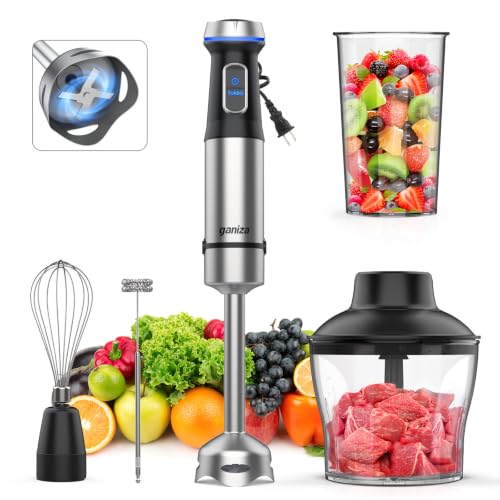
Ganiza Immersion Blender 5-in-1, Max 1000W, 16 Speed
Badge: Best Overall System
Strengths
- The only pick here that states both beaker and chopper capacities outright
- 16 speeds plus a high listed wattage give the widest control range in this group
- Full 5-in-1 kit covers blending, chopping, whisking and frothing
Trade-offs
- Five-in-one kits generate the most washing-up and storage bulk
- Sixteen speeds exceed what most recipes can meaningfully distinguish
- Max wattage wording means technique still matters more than the headline number
Key specs from the verified listing title
- Max 1000W heavy duty motor as listed
- 16 speed modes
- 800ml mixing beaker included
- 600ml chopper included
- Also includes whisk and milk frother
The Ganiza takes the overall badge in the general-purpose guide because its verified title makes the most complete, checkable case. Sixteen speed modes behind a motor listed at max 1000W give the widest control-and-headroom combination here; an 800ml mixing beaker and a 600ml chopper are both included with their capacities stated outright — a small act of listing honesty this guide wishes were universal — and a whisk and milk frother complete a 5-in-1 set that can plausibly serve as a small kitchen’s only powered prep tool.
In the general week of work, that breadth changes habits. Soup blends in the pot; the smoothie goes in the beaker that was sized for the stick; the onion for tonight’s sauce goes in the chopper instead of under a knife; eggs and batters meet the whisk. Each job uses the same motor and the same hand, and the learning curve is paid once. The chopper’s stated 600ml capacity also sets honest expectations: this is small-batch prep, done fast, not a full processor’s workload.
The costs are the system costs, recorded plainly: the most parts to wash, the most storage to organise, and a “max” wattage wording that should be read as a ceiling, not a working promise — technique and pulsing still decide results. For the cook who wants one kit and will keep it organised, those costs buy the broadest capability in this guide.
Best for: cooks who want one kit covering blending, chopping, whisking and frothing / Not suited for: anyone who hates washing multi-part kits
Check on Amazon — check the latest price on Amazon for this exact model before you decide.

Vitamix 5-Speed Immersion Blender 3-Piece Bundle
Badge: Best Premium Pick
Strengths
- One-handed operation is a genuine ergonomic differentiator at the stove
- Storage case keeps the whisk and stick together instead of loose in a drawer
- 5-foot cord gives useful reach around a kitchen island or range
Trade-offs
- Premium-tier positioning in a category with many simpler options
- Five speeds, not a stepless trigger, so control is stepped
- No chopper bowl is named in the verified title
Key specs from the verified listing title
- 5-speed control
- One-handed operation as listed
- Stainless steel blades
- Whisk and storage case included
- 5-foot cord; blends in any container as listed
The Vitamix bundle is the ownership connoisseur’s pick. Its verified title leads with experience details rather than raw numbers: 5-speed control, one-handed operation, stainless blades, a whisk and — the detail that reveals the design philosophy — a storage case, all on a 5-foot cord. One-handed operation is a real ergonomic claim for stove work, where the other hand holds the pot or the spoon, and a case turns a kit from drawer clutter into a kept system. The 5-foot cord, stated in the title, is the kind of unglamorous specification that decides whether a tool reaches your usual prep spot without a rearrangement.
Blending credentials are stated in format terms — blend in any container — rather than wattage, and this guide credits the positioning without inventing a motor figure. Five speeds are stepped rather than stepless, a small concession against the trigger and wide-range rivals, in exchange for a control that is simple to set and repeat.
No chopper bowl is named, so prep chopping is not this bundle’s story; the whisk covers the light second job. Buy it if your priorities are feel, tidiness and a maker whose name anchors the premium end of blending — and if your chopping already has a home elsewhere in the kitchen.
Best for: buyers who value one-handed operation, tidy storage and a premium maker / Not suited for: anyone who needs a chopper bowl included
Check on Amazon — check the latest price on Amazon for this exact model before you decide.

Turelar 1100W 5-in-1 Hand Blender Set with Food Processor
Badge: Best Processing Power
Strengths
- The food processor attachment is named outright, which is the point of this set
- Trigger variable speed gives graded control for both blending and processing
- Highest listed wattage in these line-ups, with anti-scratch positioning
Trade-offs
- A multi-part set needs cupboard room and more washing-up
- High power demands a firm grip and a steady bowl when processing
- Frother is a light-duty extra, not a reason to buy the set
Key specs from the verified listing title
- 1100W motor as listed
- 5-in-1 set with food processor attachment
- Trigger variable speed control
- Includes whisk and frother
- Anti-scratch design as listed
Where the Ganiza wins on stated completeness, the Turelar 1100W set wins on stated force: the highest listed wattage in this guide, a trigger variable speed control, and a food processor named in the title alongside whisk and frother. The trigger deserves its emphasis in a general guide, not only a processing one. Squeezing more power as a soup thickens or a smoothie catches, and easing off as you approach the surface, becomes a single continuous gesture, and after a week of it most cooks stop wanting to go back to switches.
The food processor bowl extends the general brief properly: small chopping and processing jobs join the blending list, and the anti-scratch positioning protects the pans and bowls the stick works in. Used with the pulse discipline a small bowl demands, the stated power is headroom for denser work rather than an invitation to run flat out.
Storage and washing are the counterweight, as with every 5-in-1 set, and the frother will be the least-used piece for most households. For the cook whose prep genuinely spans blending and processing most days, this set makes the strongest power case in the line-up.
Best for: cooks whose hand blender must also process, with trigger control / Not suited for: anyone who wants the lightest possible kit to store
Check on Amazon — check the latest price on Amazon for this exact model before you decide.

KitchenAid KHBV53 Variable Speed Corded Hand Blender
Badge: Best for Single Servings
Strengths
- Variable speed control suits both gentle emulsions and firmer purees
- Blending jar with a lid supports blend, store and pour routines
- Removable arm makes rinsing and storage simpler
Trade-offs
- Jar-based blending suits single servings better than family batches
- No chopper or whisk is named in the verified title
- Corded only; no cordless freedom at the stove or table
Key specs from the verified listing title
- Corded hand blender, model KHBV53
- Variable speed control
- Removable 8-inch blending arm
- Blending jar with lid included
- BPA-free material as listed; Matte Black finish
The KitchenAid KHBV53 is the specialist in a general guide, and its specialism — the single serving, done tidily — is common enough to earn it a clear badge. Variable speed control and a removable 8-inch blending arm pair with the detail that defines it: a blending jar with a lid. The routine writes itself. Smoothie in the jar, drink from the jar or seal it for later; dressing blended and stored in the same vessel; sauce portioned without decanting. Every transfer a normal routine skips is a washing step saved, and over a year those saved steps are the difference between a used tool and a stored one.
The removable arm supports the same philosophy at the sink: detach, rinse, done. No wattage is stated in the verified title, so none is claimed here; the pick’s case rests on control and routine rather than motor figures, and for its intended jobs that case is sound.
It concedes breadth honestly: no chopper or whisk is named, and jar-sized blending will not serve a family soup night. Within the one- and two-person kitchen it may be the most rational buy in this guide. Households weighing effort and handling across the wider category can compare it against the angle taken in Best Lightweight Immersion Blenders, where stated design, not invented weight figures, drives the ranking.
Best for: one- and two-person households blending drinks and sauces in a lidded jar / Not suited for: anyone who wants chopping included
Check on Amazon — check the latest price on Amazon for this exact model before you decide.

MasterChef Immersion Blender, 400W, Variable Speed and Turbo
Badge: Best Focused Stick
Strengths
- Variable speed plus a separate Turbo Boost covers gentle and stubborn moments
- 400W rating with a stainless stick suits hot pots and cold drinks
- Easy-clean positioning matches how these tools are actually bought: for frequent use
Trade-offs
- No attachments or beaker are named in the verified title
- Turbo is for short bursts, not a substitute for steady technique
- Brand support networks differ from the biggest legacy names; check listing details
Key specs from the verified listing title
- 400W motor
- Variable speed control with Turbo Boost
- Stainless steel blending stick
- Easy-clean positioning as listed
- Corded handheld design
The MasterChef is the minimalist’s answer to a fair question: what if I want good control but no kit? Its verified title offers a 400W motor, variable speed control and a Turbo Boost in a stainless blending stick positioned as easy to clean — and nothing else, because nothing else is included. That focus has real value. The stick rinses in seconds, stores in a drawer slot, and its whole learning curve is the speed control itself.
Variable speed at this level should not be undersold: gentle starts for emulsions and powders, firmer finishes for purees, and a Turbo reserve for the stubborn corner of the pot. For soups, smoothies and sauces — the core hand-blender repertoire — this pick covers the ground with less to wash than any system in the guide.
The boundary is equally clear: no beaker to blend in, no whisk, no chopper, so your own vessels and your other tools complete the picture. If they already do, this is the rational spend. If they do not, price the missing pieces before assuming the focused stick is the economical route.
Best for: buyers who want variable speed and Turbo in a stick with nothing extra to store / Not suited for: anyone who wants any attachment included
Check on Amazon — check the latest price on Amazon for this exact model before you decide.

Turelar Immersion Blender, 400W, 2 Speed
Badge: Best Simple Step-Up Stick
Strengths
- 400W rating steps above the 300W class while keeping controls to two speeds
- Ergonomic handle is a stated design point, not an assumption
- Listed directly for soup, smoothies, puree and baby food
Trade-offs
- Two speeds, so no gradual trigger-style ramping
- No attachments or beaker are named in the verified title
- Emulsifying still depends on slow oil addition; the tool cannot fix a rushed pour
Key specs from the verified listing title
- 400W motor
- 2 speeds
- Ergonomic handle as listed
- Stainless steel blades
- BPA-free materials as listed; corded design
The plain Turelar 400W closes the line-up as the simple step-up: a stated 400W motor where many basic sticks state 300W, two speeds, an ergonomic handle as listed, stainless blades, and a title that names soup, smoothies, puree and baby food directly. For a buyer whose needs are exactly that list, it offers the least complicated ownership in the guide alongside the MasterChef, with a stronger stated motor and a simpler control.
The comparison with its two-speed peers is instructive. What the extra stated wattage buys is headroom in thicker mixtures and a little more momentum with frozen pieces; what it does not buy is finesse, which remains technique’s job — submerged starts, movement, bursts. The ergonomic handle wording is credited as a design intention, and BPA-free materials, as listed, will matter to some households blending for children.
Choose it over the MasterChef if you prefer two decisive speeds to a variable control, and over the systems if your kitchen’s chopping and whisking already live elsewhere. It is a focused tool, honestly specified, and the guide’s final proof that a hand blender does not need a bundle to deserve its drawer space. Budget-led readers can see where it sits in the wider value field in Best Inexpensive Immersion Blenders.
Best for: buyers who want a 400W two-speed stick and nothing to configure / Not suited for: anyone who wants variable control
Check on Amazon — check the latest price on Amazon for this exact model before you decide.
Comparison Table
Compare the extras column with the control column: in this general line-up, those two decide most of the daily experience. Stated power ranges widely and matters least of the three for mainstream work.
| Pick | Badge | Control | Stated power | Included extras named in title | Link |
|---|---|---|---|---|---|
| Ganiza Immersion Blender 5-in-1, Max 1000W, 16 Speed | Best Overall System | 16 speed modes | Max 1000W as listed | 800ml beaker, 600ml chopper, whisk, milk frother | Check on Amazon |
| Vitamix 5-Speed Immersion Blender 3-Piece Bundle | Best Premium Pick | 5-speed control | Not stated in verified title | Whisk, storage case | Check on Amazon |
| Turelar 1100W 5-in-1 Hand Blender Set with Food Processor | Best Processing Power | Trigger variable speed | 1100W as listed | Food processor, whisk, frother | Check on Amazon |
| KitchenAid KHBV53 Variable Speed Corded Hand Blender | Best for Single Servings | Variable speed | Not stated in verified title | Blending jar with lid | Check on Amazon |
| MasterChef Immersion Blender, 400W, Variable Speed and Turbo | Best Focused Stick | Variable speed plus Turbo Boost | 400W | None named in verified title | Check on Amazon |
| Turelar Immersion Blender, 400W, 2 Speed | Best Simple Step-Up Stick | 2 speeds | 400W | None named in verified title | Check on Amazon |
How to Choose Immersion hand blenders
Start from the jobs, counted honestly over a month. If chopping joins blending weekly, a system with a named chopper (Ganiza, Turelar 1100W) earns its parts; if your log is soups, smoothies and sauces, a focused stick plus your own vessels covers it, and the bundle premium buys cupboard clutter. Most buyers overestimate their attachment use in the shop and underestimate it in the kitchen — the month test corrects both errors.
Choose your control style as a physical preference, not a specification. Triggers reward a responsive hand and suit cooks who blend by feel. Wide speed ranges and dials suit cooks who like a set, repeatable setting. Two speeds suit cooks who want the decision made. None is objectively best; the right one is the one your hand will enjoy on the two-hundredth use, and the reviews above describe each style in those terms deliberately.
Weigh the ownership arithmetic: every included part is capability and a washing obligation; every cord has a length, stated for the Vitamix at 5 feet and unstated for others; every kit needs a home. A storage case (Vitamix) or a compact jar routine (KitchenAid) is a design answer to that arithmetic, and for many households it predicts satisfaction better than any motor figure.
Finally, set the budget by the whole system you will actually own after checkout — stick, vessels you may still need, and any separate chopper the focused picks presume — then check the latest price on Amazon for the finalists in that full accounting. The general-purpose winner is the one whose total routine, not whose headline, fits your kitchen. The heavy-duty end of the same question continues in Best Heavy Duty Immersion Blenders for readers whose batches run large.
How to Use a Hand Blender Well: the Core Technique for Every Job
Whatever pick you choose, one technique serves them all, because the physics of a stick blender does not change with the badge. Master these habits and every review in this guide becomes more true.
- Set the vessel on a stable surface, fill it no more than comfortably, and make sure the blade head can sit fully submerged before you begin.
- Lower the stick to the bottom, tilted slightly to release air trapped under the guard, and only then switch on — lowest speed or lightest pressure first.
- Work in slow vertical movements, guiding the head through the whole volume rather than holding it in one spot, and keep the guard under the surface throughout.
- For soups, blend in the pot off the fiercest heat; for smoothies, liquid first; for purees, add liquid gradually until the texture moves freely.
- Use short bursts for thick mixtures and rest the motor between them; continuous running is for neither texture nor the tool’s health.
- Switch off before lifting the head out, let it drip over the vessel, and rinse the arm immediately — the ten-second habit that keeps the tool pleasant for years.
Two refinements separate experienced users. The first is angle: a slight tilt breaks the suction that pins a head to a pot bottom and restarts circulation without splashing. The second is sequencing: blend the liquid base first when ingredients differ wildly in hardness — greens into liquid before fruit, stock into soup before the thickest pieces — and the final texture evens out with far less total blending.
Storage technique matters too. Coil cords loosely, keep loose blades and chopper parts visible and together, and store the stick where the soup pot lives rather than where small appliances go to be forgotten. A hand blender’s value is measured in uses per month, and proximity is the strongest predictor of use.
Troubleshooting
Problem: the blend has a chunky layer at the bottom → the head never visited it. Work the stick deliberately into the corners and bottom in slow passes, or blend in a vessel shape the head can fully sweep.
Problem: the mixture climbs and splashes → the head is too near the surface or the speed too high for the stage. Submerge deeper, start lower, and fill the vessel less.
Problem: the motor sounds strained on a thick puree → the mixture is too dry to circulate. Add liquid a little at a time and use bursts; a stick blender needs a mixture that can move.
Problem: attachments never get used → they are stored apart from the stick. Keep the whole kit in one place for a month and the habit usually forms; if it does not, your next blender should be a focused stick.
Corded Confidence: Why Every Pick in This Guide Plugs In
All six picks here are corded designs, and for a general-purpose guide that deserves a sentence of defence. Corded sticks deliver their full stated performance for as long as the job takes, with no battery state to manage and no charge-planning before soup night. The costs are real — an outlet must be reachable, and a cord must be kept clear of heat and the blade’s path — and the Vitamix’s stated 5-foot cord shows a maker treating reach as a specification rather than an afterthought.
Manage the cord as part of technique: route it behind the vessel, away from the hob, and give yourself slack before you start rather than mid-blend. With that habit, corded blending is the set-and-forget option of the format, and for most kitchens it remains the sensible default this guide is happy to recommend.
Building a Small Kitchen Around One Motor
The system picks in this guide — Ganiza and Turelar with their bowls and whisks, KitchenAid and Vitamix with their jar and case — point at a small-kitchen philosophy worth naming: one good motor, several light attachments, no countertop fleet. For a compact kitchen, that philosophy can replace a food processor for small prep, a hand mixer for light batters and a jar blender for single servings, at a fraction of the storage cost.
The philosophy has a discipline: attachments must be kept together, washed promptly and used at their true scale. Observed, it is the most space-efficient route to a capable kitchen this category offers. Ignored, it is how drawers fill with orphan parts — which is why this guide scores storage and washing alongside power in every single review.
Accessories That Are Not in the Box: What to Add, What to Skip
Because this line-up spans bare sticks and full systems, many readers will end up completing a kit from their own shelves. Three additions genuinely extend a hand blender. A tall, sturdy blending cup — the single most valuable accessory in the format — rescues any bare stick from splash-prone improvisation. A heat-safe jug extends the same logic to soups and sauces in quantity. And a small lidded container habit, blending dressings and sauces in the vessel they will be stored in, quietly removes a washing step from dozens of recipes a year.
Two popular additions earn a sceptical note. Universal attachment sets that promise to fit any stick should be judged by their fit on your exact model, in your hand, before they are trusted near a pot; a wobbling accessory is worse than none. And novelty heads and gadgets that duplicate what a knife or a spoon already does tend to migrate to the back of the drawer within a season. The systems in this guide earned their extras by naming them in their titles; aftermarket extras should be held to the same standard — named, fitted, and used weekly, or not bought at all.
Matching the Blender to the Cook: Four Household Portraits
Abstract criteria land better as portraits. The single cook in a small flat, blending smoothies and soups for one, is the KitchenAid KHBV53’s natural owner: jar, lid, rinse, done, with no kit to house. The family prep cook, facing onions and sauces nightly, is the Ganiza or Turelar system owner, for whom the chopper bowl is not an accessory but the point. The experienced cook with strong opinions and stronger pans is the Vitamix or MasterChef reader — premium bundle or focused stick, both chosen on feel rather than breadth. And the new cook equipping a first kitchen is the Turelar 400W reader: a simple, honestly specified stick that teaches the technique every later upgrade will still use.
None of these portraits is a ranking. Each is a reminder that “best” in a general-purpose category is a match, not a medal — and that the reviews above were written to be matched against a household, not merely compared against each other. Find your portrait, check its pick’s live listing, and buy the match.
The First Month With a New Hand Blender: a Short Diary Structure
General-purpose tools reveal themselves across a month, not a day, and a simple diary structure helps a buyer judge fairly while returns are still possible. Week one, use the blender for its easiest wins — soups and smoothies — and note only friction: anything that made you hesitate, splash or scrub. Week two, give it the prep jobs its kit claims, chopping and whisking included, and note whether the attachments earned their washing. Week three, hand it to the household: a tool only one person can operate comfortably is a narrower tool than its title suggests. Week four, look at where it has been living and how often it truly came out; frequency is the verdict all the other notes explain.
If the diary shows a mismatch, it will also show its shape — wrong vessel, wrong scale, wrong kit — and the fix is usually a swap within this guide rather than a rejection of the format. If it shows a match, you have something better than a review: your own evidence, gathered in your own kitchen, which is what every guide in this programme is ultimately trying to teach its readers to collect.
What Breaks First, and What That Teaches a Buyer
Without inventing reliability data for any pick here, a buyer can still reason about failure the way an engineer would: by counting interfaces. Every detachable joint, every attachment coupling, every lid and seal is a place where wear, residue and misassembly can enter. The focused sticks in this line-up have the fewest interfaces and therefore the fewest failure stories available to them; the systems have the most capability and the most interfaces, and they ask for the care routines this guide describes — prompt rinsing, dry storage, parts kept together — as the price of their breadth.
That reasoning does not crown the simple tools; it prices the complex ones honestly. A system whose chopper you use nightly repays its interfaces every week. A system whose attachments sit untouched is paying interface costs for nothing. Buy the interface count your cooking justifies, maintain it with the ten-second habits in the how-to section, and either end of this line-up will serve the way its title promises.
One Sentence of Advice, Distilled
If this long general guide had to shrink to a single sentence, it would be this: buy the hand blender whose whole routine — blending, rinsing, storing, reaching for it again tomorrow — you can picture happily in your own kitchen, and let every specification argue for its place inside that picture rather than instead of it.
Common Buying Mistakes
The classic general-purpose mistake is buying the biggest bundle for the broadest imagined life, then using only the stick. Count your real jobs for a month before paying for a system; the focused picks exist precisely for the honest answer.
The second mistake is the reverse: buying a bare stick while owning no suitable vessel, then judging the tool by the splashing that follows. A tall, sturdy cup is part of the product; budget for it if your kitchen lacks one.
Third, do not run any of these tools continuously through long, thick work; bursts are the format’s native rhythm. Fourth, do not let attachments scatter across cupboards — a system stored in pieces is a stick with regrets. Finally, do not compare picks on wattage wording alone: “max” figures, unstated figures and quiet-motor positioning all appear in this one line-up, and the control and extras columns predict your experience far better.
Final Recommendation
Make the Ganiza your first choice for a general-purpose hand blender system: the widest stated control range, a beaker and chopper with capacities printed in the title, and a full 5-in-1 kit that covers the kitchen week in one purchase. It is the most complete answer to the general question this guide asked.
Choose the Vitamix bundle for premium ownership feel and one-handed ease, the Turelar 1100W set when processing power leads, the KitchenAid KHBV53 for the tidy single-serving jar routine, and either 400W focused stick — MasterChef for variable control, Turelar for two-speed simplicity — when your kitchen already owns the rest. Every verdict here traces to a stated fact in a verified title, which is the standard a general guide owes its readers.
Start your shortlist here: Ganiza Immersion Blender 5-in-1, Max 1000W, 16 Speed, Vitamix 5-Speed Immersion Blender 3-Piece Bundle, Turelar 1100W 5-in-1 Hand Blender Set with Food Processor. Each link goes to the exact model reviewed above, so you can check the latest price on Amazon and confirm the current bundle before ordering.
Frequently Asked Questions
What is the difference between an immersion blender and a hand blender?
In this category, nothing of substance: immersion blender, hand blender and stick blender name the same tool — a motor handle with a submerged blade shaft, worked by hand in the vessel. This guide uses the terms interchangeably, as the listings themselves do.
Which pick is best for a small kitchen?
The system picks, used with discipline: the Ganiza or Turelar sets let one motor cover blending, chopping and whisking without a countertop fleet, while the KitchenAid’s jar routine is the tidiest single-serving answer. Whichever you choose, store the kit together or the space saving evaporates.
Do I need attachments, or is a bare stick enough?
Count your jobs. Soups, smoothies and sauces need only the stick and a good vessel. Weekly chopping, whisking or frothing justifies a set. The focused MasterChef and Turelar sticks in this guide exist for kitchens that already own the extras — or honestly never use them.
How powerful does a hand blender need to be?
Stated ratings here run from 400W to a listed max of 1000W, with one premium pick stating no wattage at all — and all of them cover mainstream work with sound technique. Extra stated power helps most with denser mixtures and processing bowls; control and vessel fit matter more for everyday texture.
Can a hand blender replace my food processor?
For small, frequent prep, a set with a chopper bowl (Ganiza, Turelar 1100W) covers much of the ground. For dough, shredding, slicing and large batches, no — a full-size processor remains the right tool, and the honest guides in this programme say so wherever the question arises.
How do I keep a hand blender easy to clean?
Rinse the arm immediately after use, before residue sets; detach it where the design allows; wash chopper blades promptly and visibly, never lost in suds; and dry parts before storing the kit together. The habit matters more than the model.


