Disclosure: topratedkitchenware.com is reader-supported. When you buy through links on our site, we may earn an affiliate commission from Amazon and other retailers, at no extra cost to you.
Where to buy
This guide to the best prices convection doublewall ovens takes the value question seriously without printing a single figure — because the number attached to a double wall oven changes with promotions, seasons, and retailers, while the reasons one model sits in a higher tier than another stay stable for years. Each linked pick below lets you check the latest price on Amazon at the moment you shop, which is the only honest way to compare live prices. Five of the six picks are true double wall ovens and are linked. The sixth, a two-pack of compact single ovens, is covered in full as a prose-only alternative because it is not an integrated double wall oven. Read the full guide ↓
- Rangaire RWOD301GS 30″ Electric Double Wall Oven — Best Overall Value. True convection, self-cleaning, and easy-reach racks in the tier most households should start from.
- KoolMore 30-Inch Electric Double Wall Oven (KM-WO30D-SS) — Best Mid-Tier All-Rounder. Dual large-capacity ovens, rapid convection, and self-cleaning in a stainless unit.
- Forno Vomero 30 Inch Double Wall Oven — Best No-Frills Value. A straightforward electric convection double oven in stainless steel.
- Samsung NV51K7770DS 30″ Electric Double Wall Oven — Best Capacity Value. A 10.2 cu. ft. total capacity for households that cook in volume.
- Samsung NV51K6650DG/AA 30″ Smart Double Wall Oven with Steam Cook — Best Premium-Tier Value. Steam Cook and Wi-Fi for buyers stepping up a tier on purpose.
- Garvee 2 Pack 24″ Stainless Steel Built-in Wall Oven — Best Compact Twin-Cavity Alternative (prose-only in this guide). Two compact ovens instead of one integrated double oven.
Ask a room of kitchen shoppers what they want from the best prices convection doublewall ovens and most will give the same answer: two proper ovens, real convection, and a total they can defend when the credit card statement arrives. The tension is that “double wall oven” spans a wide value ladder. At one end sit straightforward electric double ovens that do the core job — two cavities, fan-assisted heat, a self-clean cycle — without connected features or steam. At the other end sit premium models layering in steam cooking, smart controls, and designer finishes. The core job, notably, is the same at both ends: two independent cavities that bake and roast evenly at the same time. Everything else is a tier decision, and tier decisions are exactly what this guide is built to help you make.
Because live numbers move, this guide compares value the durable way: what each model gives you, which tier it honestly occupies, what it asks of your kitchen, and who should pay for its extras and who should not. Five picks are true 30-inch double wall ovens spanning the value ladder from no-frills to premium. The sixth entry, the Garvee two-pack, is the budget-shaped temptation in this category — two compact ovens for a twin-cavity setup — and it is reviewed in full, but prose-only, because two separate single ovens are not the same product as an integrated double wall oven, and pretending otherwise would corrupt the price comparison this keyword asks for.
A final framing note before the picks: the oven is rarely the whole bill. Cabinetry, electrical provision, delivery, installation, and the cooktop you pair with a wall oven all belong in a true value judgement. The sections after the reviews return to that total-project view, because the cheapest oven in the wrong kitchen is the most expensive mistake in this category.
Key Takeaways
- Value in double wall ovens is a tier question, not a number: core double-oven function exists at every tier, and higher tiers buy steam, smart features, finishes, and refinement.
- The Rangaire RWOD301GS anchors the value end of the true-convection field, with true convection and self-cleaning stated in its listing.
- Capacity is the specification worth paying for if you cook in volume — the Samsung NV51K7770DS states 10.2 cu. ft. across its two cavities.
- Steam and Wi-Fi are deliberate step-ups, not defaults; the Samsung NV51K6650DG/AA is the premium-tier pick for buyers who will actually use them.
- Two compact single ovens are not a double wall oven. The Garvee two-pack is a flexible alternative, reviewed prose-only so the comparison stays honest.
- Judge the whole project — cabinetry, electrical work, installation, and a cooktop — before deciding which oven tier is genuinely affordable.
In this guide
Quick Picks
- Rangaire RWOD301GS 30″ Electric Double Wall Oven — Badge: Best Overall Value. True convection, glass touch controls, self-cleaning, easy-reach racks. Check on Amazon
- KoolMore 30-Inch Electric Double Wall Oven (KM-WO30D-SS) — Badge: Best Mid-Tier All-Rounder. Quiet, rapid convection, seven cook and baking modes, dual large-capacity ovens, self-cleaning. Check on Amazon
- Forno Vomero 30 Inch Double Wall Oven — Badge: Best No-Frills Value. Electric convection double oven in stainless steel, without feature-layer complexity. Check on Amazon
- Samsung NV51K7770DS 30″ Double Wall Oven — Badge: Best Capacity Value. 10.2 cu. ft. total capacity with a top broiler, in stainless steel. Check on Amazon
- Samsung NV51K6650DG/AA 30″ Smart Double Wall Oven — Badge: Best Premium-Tier Value. Steam Cook, Wi-Fi, fingerprint-resistant black stainless finish. Check on Amazon
- Garvee 2 Pack 24″ Built-in Wall Oven — Badge: Best Compact Twin-Cavity Alternative. Two 3000W convection wall ovens with enamel easy-clean cavities (prose-only — not an integrated double wall oven).
How These Picks Were Chosen
We worked from the verified pool for this category and applied the keyword’s own test first: a pick could be linked only if it is a true double wall oven — one integrated appliance with two cavities in a wall-oven format. Five picks passed. The Garvee listing, a two-pack of separate 24-inch single ovens, did not: it delivers two cavities, but as two appliances, with two installations and compact capacity in each. It stays in the guide as a clearly labelled prose-only alternative, because readers comparing value will meet this kind of bundle and deserve an honest account of it.
For the value lens itself, we compared what each listing states — convection type, capacity, cooking modes, cleaning method, controls, smart features, finish — and placed each model in the tier its specification honestly supports. We did not print prices, because a printed figure would be stale on arrival and would mislead the very comparison this keyword asks for; each linked pick carries a path to check the latest price on Amazon instead. We also did not use fixed ratings or review counts as evidence, for the same reason: they move, and a value guide should rest on specifications that stay true.
Two honesty notes complete the method. First, this is a research-led guide; we did not cook on these ovens, and tier placement reflects stated specifications and category knowledge, not laboratory testing. Second, tier is not a synonym for quality in a simple ladder sense. A no-frills double oven from a focused specification can be the smartest purchase in the list for a household that will never use steam or an app, and a premium model can be money well spent for a household that will use both weekly. The reviews below argue each case on its merits, and readers cross-shopping the wider built-in field can continue into Best Pro Convection Double Wall Ovens once this value picture is clear.
The 6 Best Prices Convection Doublewall Ovens — Five True Doubles and One Twin-Cavity Alternative
The picks run from the value heart of the category to its premium tier, with the twin-cavity alternative last and clearly labelled. Badges match the Quick Picks above, and each review closes with who the model suits — and who should save their money or spend it differently.

Rangaire RWOD301GS 30″ Electric Double Wall Oven
Badge: Best Overall Value
Strengths
- True convection is stated in the listing — the fan-and-element system associated with the most even multi-rack baking.
- Self-cleaning covers the chore most owners actually dread.
- Easy-reach racks address a daily ergonomic detail many premium listings never mention.
Trade-offs
- Glass touch controls will not suit cooks who prefer physical dials mid-recipe.
- No steam or connected features — buyers wanting either must step up a tier.
- The value case depends on its live price holding its tier; check it against the KoolMore below when you shop.
Spec box (as stated in the verified listing)
- Format: 30-inch electric double wall oven
- Convection: True Convection
- Cleaning: Self Cleaning
- Controls: Glass Touch Controls
- Racks: Easy Reach Racks
- Finish: Stainless Steel
- Model: RWOD301GS
The Rangaire earns the top value spot because its stated specification reads like a checklist of what actually matters in a double wall oven, with nothing padded on top. True convection is the headline: in a two-cavity appliance bought for baking and roasting in parallel, the quality of air circulation is the performance core, and true convection — a dedicated element working with the fan — is the version most associated with consistent results across racks and across cavities. Self-cleaning is the second genuinely valuable inclusion, because a double oven doubles the interior surface that needs cleaning, and a high-heat cycle is the difference between an oven that gets maintained and one that quietly accumulates baked-on history.
Easy-reach racks are the detail that reveals a design team thinking about use rather than brochures. Double ovens are loaded with heavy pans at height, and rack geometry decides whether that is comfortable or a wrestling match. Glass touch controls keep the face flat and wipeable, though they remain the pick’s main judgement call: deliberate presses on a smooth panel versus the grab-and-turn certainty of dials. There is no steam and no Wi-Fi here, and that absence is part of the value argument — you are not funding features you may never open. The honest limitation is that value is a moving target: this model’s tier position should be re-checked against live prices on the day you buy, which is exactly what the link below is for.
Best for: households wanting true convection and self-cleaning in a double wall oven without paying for steam or smart layers. / Not suited for: cooks who want connected features, steam baking, or physical control dials.
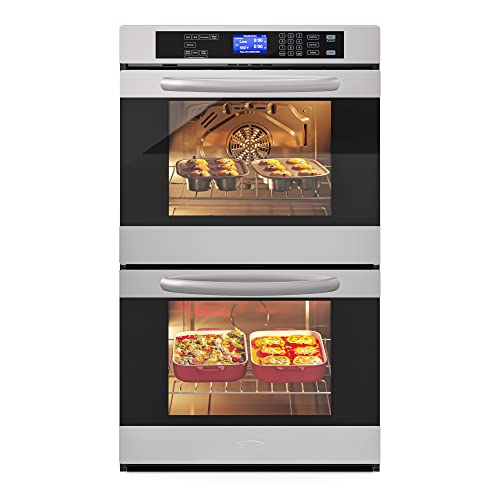
KoolMore 30-Inch Electric Double Wall Oven (KM-WO30D-SS)
Badge: Best Mid-Tier All-Rounder
Strengths
- Dual large-capacity ovens with rapid convection cooking stated in the listing.
- Seven cook and baking modes cover the everyday repertoire without menu archaeology.
- Self-cleaning and a stainless-steel build complete a well-rounded mid-tier specification.
Trade-offs
- “Quiet, rapid” convection is a positioning claim; the listing states no measured figures to compare directly.
- No steam, no Wi-Fi — the step-up features live in the premium tier.
- As a less familiar name than the legacy brands, it asks buyers to judge on specification, which this guide does and shoppers should too.
Spec box (as stated in the verified listing)
- Format: 30-inch electric double wall oven
- Convection: Quiet, rapid convection cooking (as listed)
- Modes: 7 cook and baking modes
- Capacity note: Dual large capacity ovens (as listed)
- Cleaning: Self-Cleaning
- Finish: Stainless Steel
- Model: KM-WO30D-SS
The KoolMore is the natural second stop on a value shopper’s route: a mid-tier double oven whose listing emphasises the working fundamentals — two large cavities, convection described as rapid, a sensible spread of seven cooking and baking modes, and self-cleaning. Nothing in that specification is exotic, and that is the point. Most double-oven cooking is a rotation of roasting, baking, broiling, and reheating, and a model that covers those modes cleanly in two generous cavities will satisfy the great majority of households for the whole of its service life.
Its value argument against the Rangaire above is a live-price question: the two models occupy neighbouring ground, and the smarter buy on any given week is the one whose current price sits lower for a specification you have confirmed does what you need. Against the Samsungs below, the KoolMore argues the opposite direction — it declines steam and connectivity and asks a lower tier in exchange. The honest limitation is evidential: where the listing uses qualitative language about quietness and speed without figures, we report the claim as a claim and rest our recommendation on the concrete parts of the specification — format, modes, capacity positioning, and cleaning — which are solid.
Best for: mid-tier shoppers who want two large self-cleaning convection cavities and a clean mode set. / Not suited for: buyers seeking steam, smart control, or a legacy-brand badge.
Forno Vomero 30 Inch Double Wall Oven
Badge: Best No-Frills Value
Strengths
- A straightforward electric convection double oven — the core format without feature layers to fund.
- Stainless steel finish matches the broadest range of existing kitchens.
- The simplest specification in the guide is also the easiest to compare honestly on live price.
Trade-offs
- The listing states the least detail of any pick here, so pre-purchase homework matters more, not less.
- No stated self-cleaning headline, steam, or smart features in the verified title.
- Buyers who later want premium features have no upgrade path inside the appliance.
Spec box (as stated in the verified listing)
- Format: 30-inch double wall oven
- Type: Electric, Convection Oven
- Finish: Stainless Steel
- Model line: Vomero
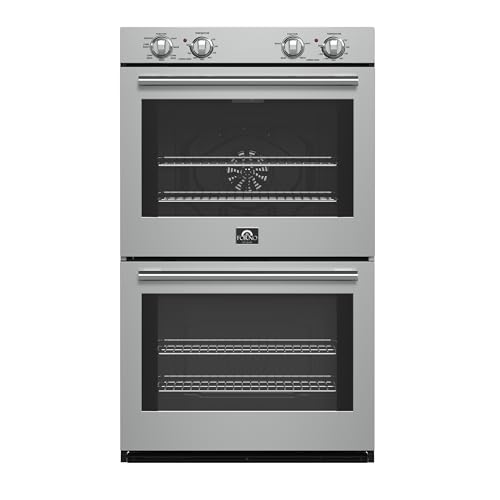
Every category has a pick whose entire argument is “the essential thing, plainly done,” and in this guide that is the Forno Vomero. The verified listing is terse — a 30-inch double wall oven, electric, convection, stainless steel — and the review must be honest about what that terseness means. It means the core promise is clear: two convection cavities in the standard width, in the standard finish, from a brand whose wider range leans into professional styling. It also means the details a careful buyer wants confirmed — cleaning method, control style, rack configuration, exact cavity volumes — are not in the title evidence, and we will not invent them here. They are questions for the product page and the manual before money moves.
Judged as a value proposition, the Vomero is the tier floor for a true double wall oven in this guide, and tier floors have a real constituency: rental-property upgrades, straightforward kitchen refreshes, and households whose cooking is hearty but uncomplicated. For those buyers, paying several tiers up for steam and connectivity they will never open is the actual waste. The limitation is symmetrical — if your baking ambitions are growing, a no-frills oven gives you no headroom. Buy the Vomero for what it plainly is, verify its unstated details on the listing, and it can be the most rational purchase in this entire comparison. Shoppers whose shortlist is brand-led, meanwhile, will find the brand-specific value framing in Best Prices Whirlpool Convection Double Wall Ovens a useful companion read.
Best for: value-first buyers who want a true double convection oven without feature layers. / Not suited for: cooks who want steam, smart features, or a fully documented premium specification.
Samsung NV51K7770DS 30″ Electric Double Wall Oven
Badge: Best Capacity Value
Strengths
- A stated 10.2 cu. ft. of total capacity — the largest oven volume in this guide.
- Two full cavities make genuine two-temperature cooking a daily option, not a holiday trick.
- A major manufacturer’s double oven in the standard 30-inch format and stainless finish.
Trade-offs
- Capacity you rarely use is still capacity you paid for; small households should count their real cooking days.
- No steam or Wi-Fi in this model’s stated specification — those live in its sibling below.
- The top broiler arrangement asks for a little menu planning when broiling and baking coincide.
Spec box (as stated in the verified listing)
- Format: 30-inch electric double wall oven
- Total capacity: 10.2 cu. ft.
- Broiler: Top broiler
- Finish: Stainless Steel
- Model: NV51K7770DS
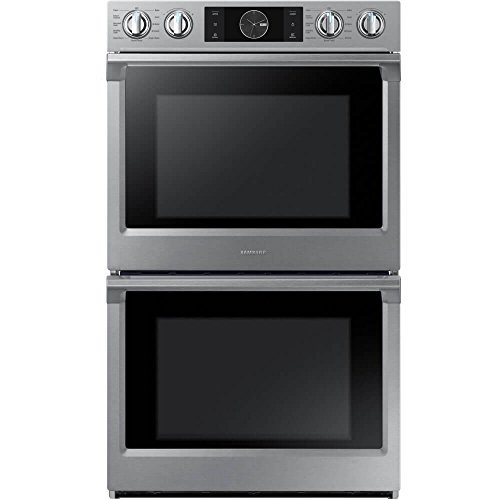
Capacity is the one specification in a double wall oven that cannot be added later, which is why this Samsung earns a value badge of its own. At a stated 10.2 cu. ft. across two cavities, it offers the most cooking volume in the guide, and volume converts directly into flexibility: the large roast and the tray of vegetables no longer negotiate for the same air, batch baking runs in parallel instead of in sequence, and the holiday menu stops being a scheduling puzzle with one box as the bottleneck. For households that cook in volume every week — big families, committed bakers, regular hosts — capacity is not a luxury tier at all; it is the working specification, and paying for it is the value move.
The counter-argument is equally honest. A two-person household that roasts a chicken on Sundays will leave most of this oven’s volume idle for most of its life, and idle capacity is the quietest form of overspending in appliance shopping. This model also keeps the feature set comparatively classic — no steam, no connectivity in its stated specification — which positions it as the volume-first alternative to its smarter sibling below. Between the two Samsungs, the choice is refreshingly legible: pay for space here, or pay for steam and smart features there. Few value decisions in this category are that clean, and readers comparing mounted formats more broadly can extend the picture with Best Residential Wall Mount Convection Ovens.
Best for: high-volume households for whom cavity space is the specification that matters. / Not suited for: small households, or buyers prioritising steam and smart features over volume.

Samsung NV51K6650DG/AA 30″ Smart Double Wall Oven with Steam Cook
Badge: Best Premium-Tier Value
Strengths
- Steam Cook adds a capability — moisture-assisted baking and roasting — that cannot be retrofitted to a plain oven.
- Wi-Fi connectivity supports remote monitoring and control for households that use it.
- Fingerprint-resistant black stainless gives a premium finish that also hides everyday marks.
Trade-offs
- It occupies the premium tier of this guide; buyers who will not use steam or the app are paying for decoration.
- The dark finish needs a kitchen designed around it, or deliberate contrast with other appliances.
- Connected features depend on your home network and your willingness to keep an appliance app in your life.
Spec box (as stated in the verified listing)
- Format: 30-inch smart double wall oven
- Features stated: Steam Cook, Wi-Fi
- Capacity note: Large oven capacity (as listed)
- Finish: Fingerprint Resistant Stainless Steel, Black
- Model: NV51K6650DG/AA
Premium tiers earn their place when the extras change what you can cook, and Steam Cook clears that bar. Introducing moisture into the bake is a real technique — bread bakers chase it for crust, and roasters value it for keeping large joints succulent while the exterior browns. A steam-capable double oven brings that technique home without improvised water pans and guesswork. Wi-Fi is the softer half of the premium case: remote preheating and monitoring are genuinely convenient for connected households and genuinely worthless for everyone else, which is why this model’s value verdict is conditional in a way the Rangaire’s is not.
The fingerprint-resistant black stainless finish completes the premium positioning, and it is more practical than it sounds — dark finishes with resistant coatings show fewer of the daily smudges that bright stainless collects in a busy kitchen. As the premium pick, this Samsung also carries the guide’s clearest warning label: premium value is use-dependent. If steam baking and app control will be weekly events in your kitchen, this is money pointed at real capability, and the tier step over its capacity-first sibling is justified. If they will be novelties that fade by the second month, the same money buys the Rangaire’s true convection or the NV51K7770DS’s volume with change left for the cooktop. Decide by your calendar, not by the brochure.
Best for: bread bakers, connected households, and dark-finish kitchens stepping up a tier on purpose. / Not suited for: value-first buyers who will not use steam or smart features regularly.
Garvee 2 Pack 24″ Stainless Steel Built-in Wall Oven
Badge: Best Compact Twin-Cavity Alternative
Strengths
- Two separate ovens can stack as a compact pair or split across two cooking stations.
- A stated 3000W high-power convection system is strong output for the compact class.
- Enamel easy-clean cavities, touch control, a safety lock, and ETL certification are stated in the listing.
Trade-offs
- It is not an integrated double wall oven — it is two single ovens, with two installations to plan and pay for.
- Compact 24-inch cavities cannot match a 30-inch double oven for large pans or big birds.
- Its headline value only survives if your design genuinely uses two compact cavities.
Spec box (as stated in the verified listing)
- Format: 2 pack of 24-inch built-in wall ovens
- Capacity (as listed): 2.5 cu. ft.
- Power: 3000W convection system
- Cavity: Enamel easy-clean
- Controls: Touch control with safety lock
- Certification: ETL certified
The Garvee bundle is the value trap and the value opportunity of this category in a single listing, which is why it is reviewed in full but kept prose-only. The opportunity is real: two convection wall ovens, each with a stated 3000W system, enamel easy-clean cavities, touch controls, and a safety lock, give a small kitchen two independent cavities — and two cavities are the entire reason double ovens exist. Stacked, they mimic a compact double oven; separated, they create a second cooking station no integrated double can offer. For a small home, a granny flat, or a two-cook household, that flexibility has genuine worth.
The trap is the comparison itself. A 24-inch compact cavity is not half of a 30-inch double oven in any useful sense: pan sizes shrink, the holiday bird does not fit, and each unit needs its own installation point and electrical provision. A shopper who prices this bundle against true double ovens as if they were equivalents will misjudge both. So the verdict is narrow and honest — as an alternative format for compact or dual-station designs, the Garvee pair is interesting and well-specified for its class; as a “double wall oven” in the sense this keyword means, it does not qualify, and no link here pretends otherwise. Readers whose kitchens genuinely suit compact convection formats may also want the microwave-convection side of the category, compared in Best Quality Microwave Convection Ovens.
Best for: compact kitchens and dual-station designs that can use two small built-in ovens. / Not suited for: shoppers who need a true 30-inch double wall oven or large-format cooking.
Comparison Table
| Pick | Format | Convection | Capacity | Value tier | Link |
|---|---|---|---|---|---|
| Rangaire RWOD301GS | 30″ electric double wall oven | True Convection | 30-inch double format | Overall value | Check on Amazon |
| KoolMore KM-WO30D-SS | 30″ electric double wall oven | Rapid convection (as listed) | Dual large capacity (as listed) | Mid-tier all-rounder | Check on Amazon |
| Forno Vomero | 30″ double wall oven | Convection | 30-inch double format | No-frills tier floor | Check on Amazon |
| Samsung NV51K7770DS | 30″ electric double wall oven | Convection double oven | 10.2 cu. ft. total | Capacity value | Check on Amazon |
| Samsung NV51K6650DG/AA | 30″ smart double wall oven | Convection with Steam Cook | Large capacity (as listed) | Premium tier | Check on Amazon |
| Garvee 2 Pack 24″ | Two single built-in wall ovens | 3000W convection system | 2.5 cu. ft. (as listed) | Alternative format | Prose-only — not an integrated double oven |
How Double Wall Oven Prices Are Built: What Actually Moves a Model Between Tiers
Understanding a price in this category means understanding what the tiers are made of. The base tier buys the format itself: two cavities, electric elements, a fan for convection, basic controls, and a stainless face. That base is not a compromise product — it cooks the full repertoire — which is why the Forno Vomero can be a rational purchase. The first step up buys refinement of the core: true convection rather than basic fan convection, a self-cleaning cycle, better racks, quieter and more even operation. That is the Rangaire and KoolMore ground, and for most households it is where the value curve bends — the improvements are things you feel weekly.
The next step buys capability rather than refinement: sheer capacity, as in the Samsung NV51K7770DS, or added cooking methods. The premium tier then buys steam, connectivity, and finish — the Samsung NV51K6650DG/AA’s territory — features that are transformative for the households that use them and inert for those that do not. Notice what is absent from every step: the ability to cook two dishes at two temperatures, which exists from the base tier upward. Shoppers who internalise that structure stop asking “which is best” and start asking the productive question — “which tier matches my cooking” — and that question is the whole secret of value in this category. The same tier logic runs through neighbouring convection categories, as the framing in Best Prices On Microwave Convection Ovens shows for microwave-convection models.
How to Choose a Convection Double Wall Oven
Begin with the cut-out, not the catalogue. A double wall oven installs into cabinetry, most commonly in a 30-inch width, and the existing cabinet opening, the electrical supply, and the surrounding design decide which models are even eligible. Measure the current cut-out precisely, confirm the circuit provision with an electrician if you are changing formats, and only then build a shortlist. An oven that does not fit your cabinet is not a bargain at any tier.
Next, size the cavities against your real cooking. Total capacity figures reward a second look: two generous cavities beat a headline number split unevenly, and rack positions decide whether both ovens can work hard at once. Take your largest roasting pan and your standard sheet pan as physical references, and check them against stated cavity dimensions on the product pages. Then choose your convection level. If you bake on multiple racks, true convection is worth its tier step. If you mostly roast in one cavity at a time, a well-executed basic convection system will not hold you back.
Cleaning and controls deserve more weight than they usually get, because you will touch them for a decade or more. Self-cleaning is close to essential in a double oven simply because there is twice the interior to maintain. Controls should be legible and operable in the middle of cooking, with wet or floury hands in mind. Finally, decide the feature question with your calendar open: steam and smart features are worth their tier only if your actual week contains bread baking, connected routines, or both. Buy the tier your calendar justifies, and let the rest of the ladder go. Cross-format shoppers can sanity-check that discipline against Best Ranking Microwave Convection Ovens, where the same use-first logic ranks a very different convection format.
The Total Project: Judging Value Beyond the Oven Itself
The most common value error in this category is comparing oven prices as if ovens were the whole purchase. A double wall oven project can include cabinet modification, electrical work, delivery, installation, haul-away of the old unit, and — for households moving from a range — a separate cooktop and its own installation. Those surrounding costs are broadly similar whichever oven you choose, which cuts both ways: they dilute the difference between tiers, making a step up less dramatic in total-project terms, and they punish a buying mistake severely, because repeating the project to fix the wrong oven costs far more than choosing correctly once.
Two practical rules follow. First, when the project costs are already committed, weight the oven’s specification more heavily than small tier differences — you will live with the appliance long after the invoice is forgotten. Second, never let a low oven price talk you into a project your kitchen does not need. If your cabinetry and cooking suit a range, the value answer may be to leave this category entirely. Honest value advice includes the option not to buy the thing at all, and double wall ovens — wonderful as they are for the right kitchen — are a considered project, not an impulse upgrade.
Installing and Cooking With a Double Wall Oven: A Practical How-To
Step 1 — Verify the installation before delivery day. Confirm the cut-out dimensions against the new oven’s stated requirements, check the electrical provision matches the manual, and plan the cabinet support for a heavy built-in appliance. Professional installation is the norm for this category; arrange it when you order, not when the oven is sitting in the hallway.
Step 2 — Burn off and set up. New ovens carry manufacturing residues. Run each empty cavity hot with the kitchen ventilated, following the manufacturer’s first-use guidance, then wipe both interiors once cool. Set rack positions for your most common cooking — a default baking position in each cavity — and learn the control logic with a simple first cook in each oven.
Step 3 — Cook in parallel deliberately. The double oven’s gift is simultaneity, so plan for it: roast in one cavity, bake in the other, and stagger start times so dishes land together. Keep a short note of combinations that worked — temperatures, racks, timings — because your own oven’s habits become predictable quickly once recorded.
Step 4 — Rotate cleaning between cavities. Wipe spills after cooking while the cavity is still slightly warm, and run the self-clean cycle on one cavity at a time on the manufacturer’s schedule. A double oven maintained in small moments rarely needs a full-day deep clean.
Troubleshooting.
Problem: One cavity browns faster than the other → what to do: treat each cavity as its own oven with its own habits; swap which cavity handles delicate baking, and check rack position and pan colour before assuming a fault — dark pans in the faster cavity explain most unevenness.
Problem: Multi-rack baking is uneven in convection mode → what to do: leave air space between pans and walls, avoid blocking the fan area with an oversized tray, and confirm you are in a convection mode rather than a thermal one; crowding defeats the airflow the mode depends on.
Problem: The kitchen overheats when both ovens run → what to do: that is physics, not failure — two cavities at roasting temperature add real heat to the room. Ventilate with the range hood or an open window, and in summer, shift one dish to a cooler method or an earlier slot.
When the Lower Tier Is the Smarter Buy — and When It Is Not
The lower tiers win more often than marketing suggests. If your cooking is a steady rotation of roasts, casseroles, traybakes, and the occasional celebration cake, a base or mid-tier double oven covers it completely, and the money held back can fund the cooktop, the cabinetry, or simply stay in your account. Lower tiers also tend to mean fewer systems to learn and fewer connected features to maintain over a long service life. For rental properties, holiday homes, and straightforward like-for-like refreshes, the no-frills and mid-tier picks in this guide are not compromises; they are the correct specification for the job.
The step up earns its money in three specific situations. The first is volume: if two-temperature cooking is a weekly event rather than an annual one, capacity and true convection stop being luxuries and become the tools the menu depends on. The second is a named technique — steam baking is the clearest example — that a lower tier physically cannot perform; a feature you will use every week is not an extravagance at any tier. The third is time horizon. A household planning to stay in the home for a decade or more spreads any tier step across thousands of cooking days, while a household expecting to move soon should weight resale-neutral, broadly appealing specifications instead. Read your own calendar and your own plans, and the tier usually chooses itself.
Common Buying Mistakes
- Comparing a bundle of single ovens with a true double oven. Two compact singles are a different product with different capacity and two installations, as the Garvee review explains. Compare like with like.
- Paying for steam and smart features you will not use. Premium tiers are use-dependent. If your week has no bread and no app routines, the premium buys you nothing but the invoice.
- Ignoring the project around the oven. Cabinetry, electrical work, and installation belong in the value judgement from the first shortlist, not as delivery-week surprises.
- Chasing a headline capacity number. Cavity shape, split, and rack positions decide usable space. Check your own pans against real dimensions.
- Skipping the cleaning question. A double oven doubles interior upkeep. Buying without self-cleaning to save a tier is a decade-long false economy for most households.
- Trusting a printed price from weeks ago. Prices in this category move with promotions and seasons. Decide your tier from specifications, then check the live price on the day you buy.
Final Recommendation
For most households shopping this keyword, the value centre of the category is the Rangaire RWOD301GS: true convection, self-cleaning, and sensible racks in a true double wall oven, without funding features you may never open. The KoolMore KM-WO30D-SS stands immediately beside it as the mid-tier all-rounder — compare their live prices on the day you shop and let the current gap arbitrate, since their specifications serve the same household. The Forno Vomero is the honest tier floor for buyers who want the double-oven format plainly and will verify its unstated details on the listing before ordering.
Step up deliberately, not by default. Choose the Samsung NV51K7770DS if capacity is your working specification — its stated 10.2 cu. ft. is the most volume in this guide. Choose the Samsung NV51K6650DG/AA if steam baking and connected control are genuinely in your weekly routine and your kitchen suits the dark finish. And keep the Garvee two-pack in its proper frame: a flexible compact alternative for small or dual-station designs, not a cut-price double wall oven. Value in this category is not the lowest number you can find; it is the tier that matches your cooking, bought at a live price you checked on the day.
Frequently Asked Questions
Why does this guide not print the prices?
Because double wall oven prices move with promotions, seasons, and retailer programmes, and a printed figure would mislead within weeks. The guide compares tiers and specifications — the durable part of the value question — and every linked pick lets you check the latest price on Amazon at the moment you actually shop.
What is the difference between true convection and regular convection?
Regular convection uses a fan to circulate air heated by the oven’s main elements. True convection adds a dedicated heating element around the fan itself, so the circulated air is heated more evenly at source. The difference shows most in multi-rack baking, where true convection tends to give the most consistent results across trays.
Is a two-pack of single wall ovens the same as a double wall oven?
No. An integrated double wall oven is one appliance with two cavities in a single 30-inch unit. A two-pack gives you two separate compact ovens — two installations, smaller cavities, but flexible placement. The Garvee review in this guide covers that format honestly as an alternative, not an equivalent.
Which tier should a first-time double oven buyer choose?
For most households, the middle of the ladder: true or well-executed convection, self-cleaning, and two generous cavities, without steam or smart layers. That is the Rangaire and KoolMore ground. Step up only for a named reason — capacity, steam, a finish your kitchen needs — rather than a general feeling that premium must be better.
What extra costs should I budget around a double wall oven?
Depending on your kitchen: cabinet modification, electrical provision, delivery, professional installation, and removal of the old appliance. If you are switching from a range, add a separate cooktop and its installation. Those project costs are similar across oven tiers, so they rarely change which oven is right — but they decide whether the project itself is affordable.
Are double wall ovens worth it compared with a range oven?
For households that cook two-temperature menus regularly, value the waist-height loading, and already have a kitchen project underway, yes. For a straightforward cooker replacement or a small household, a good range usually delivers more value per project. The right answer depends on your cooking pattern and your kitchen, not on the category’s prestige.